

The authors have produced a clear and interesting paper, providing a useful method of interpreting sample suction measurements in terms of in situ stresses that is relatively simple yet refines the more common approach of assuming isotropic behaviour. However one of the greatest difficulties in assessing in situ stresses from samples is that of sample disturbance and how to account for it.
While the authors mention that the technique assumes ‘perfect’ sampling, there is no discussion of the implications of such an assumption. Estimated values of K0 or σ′h obtained from laboratory determinations of p′k are strongly dependent on sample disturbance. While it is unlikely that any geotechnical engineer would attempt to estimate the in situ stress state of soft clays using driven tube samples, suctions obtained from U100 samples are still commonly used to estimate the in situ stress state of stiff clays. It is of interest therefore to examine the authors’ example in which a U100 sample of the stiff Belfast Upper Boulder Clay was retrieved from a depth of 28 m and used to estimate K0 and σ′h in situ.
The process of tube sampling in stiff clays tends to increase the effective stress in the sample (Vaughan et al., 1993). Chandler et al. (1992) compared effective stresses in specimens obtained from U100 samples with those obtained from block samples of London Clay. They found an increase in effective stress in the U100 samples of 15–45 kPa for soft to firm samples at shallow depths and 250–300 kPa for stiff samples at approximately 22 m depth. Similarly, Harrison (1991) found that U100 samples generally gave higher sample suctions than pushed thin-walled tube samples in the London Clay at a variety of depths. Denoting this increase in mean effective stress at λk and the mean effective stress that would be obtained from a block sample as p′kb, the mean effective stress measured in the tube sample, p′k is
The senstivity of calculated values of K0 and σ′h to the assumed value of λk is examined in Fig. 9 for the authors’ Belfast Upper Boulder Clay example, over a modest range of values of λk, using both J/3G* = −0·26, as in the paper, and J/3G* = 0. It is clear that σ′h varies much more rapidly than λk, and that relatively small values of λk can result in very significant changes in the calculated in situ stress state. In the authors’ example, where λk = 0 was implicitly assumed, values of σ′h = 382 kPa and K0 = 1·38 were obtained; however, if λk = 100 kPa, then values of σ′h = 135 kPa and K0 = 0·49 would result.
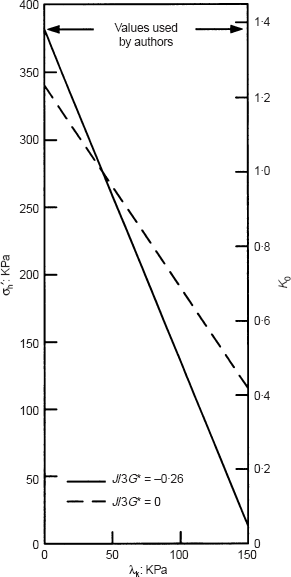
In the example above, the calculated value of σ′h changes by about 2·5 times the change in the value of p′k used to calculate it. The ratio of change in calculated σ′h to change in p′k, Δσ′h/Δp′k, is related to J/3G*, as shown in Fig. 10. This figure shows that Δσ′h is significantly greater than Δp′k throughout a range of reasonable values of J/3G* for stiff clays; this is true regardless of whether Δp′k results from sample disturbance from variability in test results.
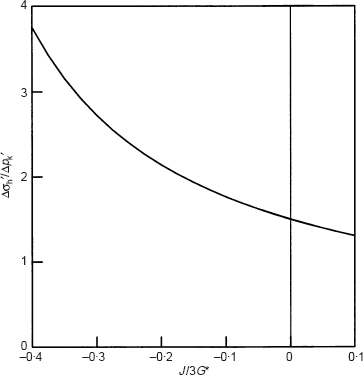
Variation of the ratio of change in horizontal effective stress to change in mean effective stress with J/3G*
Variation of the ratio of change in horizontal effective stress to change in mean effective stress with J/3G*
Therefore, it is felt that because variations in p′k are amplified in variations in σ′h calculated from it, the use of U100 samples to estimate the in situ stress of stiff clays should be treated with considerable caution. Similarly, the use of suction determination tests that give intrinsically variable results, such as the filter-paper method (Crilly & Chandler, 1993), must also be treated with considerable caution. The combination of U100 samples and filter-paper suction measurements is unlikely to give reliable information on a stiff clay's in situ stress state.
Authors' reply
The authors thank the discusser for his interest. As he says, the problem of sample disturbance is not considered in the paper, the main purpose of which was to show that estimates of in situ stresses based on the more realistic assumption of anisotropic elasticity can be made relatively simply. Clearly, the usefulness of the results depends crucially on the accuracy of the measured values of p′k on which they are based. We agree that the utilization of block samples is preferable, but so far have not had the opportunity to obtain such samples from significant depths in Belfast Upper Boulder Clay.
In the authors’ experience the filter-paper method of suction measurement is unsatisfactory, and for this reason we have used the pressure plate method. As and when more reliable values of p′k become available then more accurate estimates of in situ stresses will be obtained. In the meantime the approach described in the paper is considered to be promising.
CORRECTION
Please note that there is a typographical error in the paper. Equation (12) currently appears as
The correct format should be

