

The contribution by the author of the technical note is valuable and interesting, because he has suggested a new stabilisation technique for leaning structures.
From the title of the note it would appear that the author is discussing a technique adopted for stabilisation of the leaning tower of Pisa, over 800 years old (Fig. 3), as a case history. But this is not the case: a technique has been suggested for the stabilisation of leaning structures, which merely mentions the tower of Pisa as an example. A more appropriate title for the technical note would be ‘A new technique for stabilisation of leaning structures’.
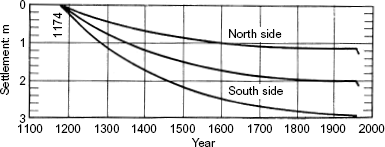
The suggested technique, based on the principle of a zero friction vertical surface, may be very useful. A vertical plane with a zero friction surface near the leaning structure may be constructed easily as well as economically, even in the difficult foundation conditions often found in the field. However, the stability of leaning structures is always extremely delicate: there is always the risk of a disastrous failure during stabilisation works, because of their uncertain stability.
Leaning structures can be stabilised by a soil-extraction method in an economic manner. This method involves a special drill just beneath the foundations opposite the leaning side, resulting in subsidence of the ground with a decrease in the inclination of the structure to the vertical direction. During drilling operation, efforts should be made not to disturb the ground. Methods based on underpinning works or surcharge loads have also been found effective in stabilising many leaning structures.
Author's reply
I should like to thank the discusser for the interest shown and references made. I agree with the discusser's observations concerning the title of the technical note. However, that title came from the fact that the idea of reducing the tilting effect, in the way suggested, was prompted by the problem aroused by the famous tower.
The note was first written in March 1998, when I came across the solution proposed by the commission charged with the restoring works for the Tower of Pisa. Unfortunately my note could not be published in time to be acknowledged by the members of that commission.
The name of the Tower of Pisa was related to the technical note, and the example was also used because of the soil conditions, with a compressible layer placed some depth below foundation level, which is the ideal situation in which to apply the proposed method.
Any stabilisation of a leaning structure must be carefully planned and executed, in order to ensure a smooth and gentle change of stability conditions, which is more likely to occur when that change is linked to consolidation phenomena, as it is case with the proposed method.

