

The authors are to be congratulated on their preliminary work, looking at strengths and density variations within young coral reef limestones of different ages and facies on the West Indies island of Barbados.
This area of study has been somewhat neglected in the geotechnical world, especially systematic study relating the detailed geology of modern and ancient reefs to their engineering characteristics.
Carbonate sediments and rocks by definition contain more than 50% carbonate minerals. These minerals are composed of CO32− and one or more cations. The most common carbonate mineral is calcite (calcium carbonate, CaCO3), which is the principal component of limestones. Minerals containing calcium cations can be said to be calcareous, for example gypsum (calcium sulphate). This term, however, is commonly used by engineers to mean calcium carbonate materials. In this discussion the term carbonate is used for preference to describe all geological materials composed principally of carbonates. In this way calcium, iron or magnesium carbonates, for instance, can be included but gypsum would and should be excluded.
The Burton et al. technical note is in part based on the observation that the original classification of Fookes & Higginbottom (1975), which placed young reef limestones in their growth position in a single class, was an over-simplification for purposes of engineering description. We wholeheartedly agree with this, but in 1975 had no information to enable us to even attempt a crude subdivision of this class (see Fig. 3 for the Fookes and Higginbottom classification). We suspected also that so many variable powerful factors (e.g. biological, climatic, geomorphological) are involved that further refinements would have only a local validity.
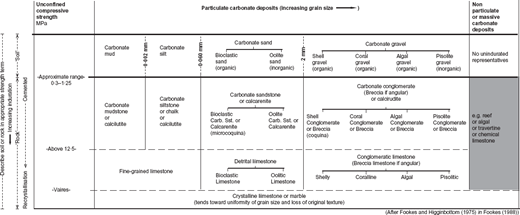
The proposed original basic classification of pure carbonate sediments for engineering purposes. The class under discussion by Butron et al. (2001) is shaded in grey (after Fookes & Higginbottom (1975) in Fookes (1988)
The proposed original basic classification of pure carbonate sediments for engineering purposes. The class under discussion by Butron et al. (2001) is shaded in grey (after Fookes & Higginbottom (1975) in Fookes (1988)
There have been, since the original publication, other classification schemes based on Fookes and Higginbottom (e.g. Clark & Walker, 1977, for particulate deposits in the Middle East; Burnett & Epps, 1979), but these, in common with the original classification, as far as we are aware, again do not have any systematic research-based study backing them up. All the classifications are based on general geotechnical site experience. There is also an important engineering classification by Anderson (1982) developed specifically for ‘coralline deposits’, which relates various states of coral reef deposition and lithification to SPTs and bearing values. Unfortunately this is not referenced by Burton et al. The Anderson paper is probably a more relevant comparison for Burton et al. than the Fookes and Higginbottom classification, which deals only with near-off-shore sediments. The technical note appears to deal only with currently onshore sediments.
There has been considerable work on carbonate soils, particularly that related to the impetus in the 1980s driven by the need to understand the behaviour of such soils in offshore and nearshore oil exploration and extraction programmes. Much of the world's knowledge on carbonate soil engineering is encapsulated in Volumes 1 and 2 of Engineering for calcareous sediments, edited by Jewell and Khorshid and published by Balkema in 1988, which comprises the Proceedings of the International Conference of Calcareous Sediments, Perth, Australia, 15–18 March 1988. A cursory examination of these volumes clearly indicates the huge bias towards investigation of soils rather than of rocks. The limited amount of work on rocks to that date is in part summarised in the state-of-the-art report on ‘The geology of carbonate soils and rocks and their engineering characterisations and descriptions’ by Fookes in Volume 2 of the Perth Proceedings (Fookes, 1988). This paper includes a simple review of the huge range of various carbonate deposition environments, including those in reef growth situations, and it must be again emphasised, as it was by Burton et al.,
that foundation engineers should regard young reef lime- stones as a highly variable material. Strengths and bearing capacities may very [sic] considerably between and within constructions sites where heavy foundation loads may necessitate individual assessment for each footing.
It is because of this variability that Fookes & Higginbottom (1975) lumped reef limestones into a single class. The new Barbados work has started on the lower rungs of the investigatory ladder to subdivide this class of the classification, but such work will have to look fairly extensively at reef limestones around the world. How the Barbados reefal information applies elsewhere is not known.
Both Dr A. C. Waltham and Professor P. G. Fookes were members of the TC16 Sub-Committee of the International Society of Soil Mechanics and Ground Engineering on Carbonate Soil and Rock Classification, but this SubCommittee was recently disbanded by the President, because after five years of deliberation it had not made sufficient written progress in the classification of carbonate soils and rocks to warrant publication. This is indicative of the general lack of worldwide research on carbonate soil and rock classification (but not soil behaviour and engineering properties) and the wide and diverse nature of such sediments and rocks. The work still needs doing.
It is of interest to note that in Fig. 3 of Burton et al. the range of strengths they give would fall neatly within the empty box of the Fookes & Higginbottom (1975) classification. Could Burton et al. give us more information on the compressive strength and density testing of the corals? The complex pore structure of coral would make density testing somewhat difficult.
Authors' reply
We thank Peter Fookes and Ian Higginbottom for their constructive discussion, and concur with their opinion that much remains to be learned with respect to the strength of coral limestones. Our note was a sideline to wider research into non-geotechnical aspects, and offered only a hint of the strength variations in corals. Our samples were all stored damp, and were tested for strength and density when drained but not heat-dried. There is scope for research into the influence of moisture state on the strengths of the various corals.

