

The writer welcomes the challenge offered by the Editor in his editorial in the December 2004 issue of Géotechnique. As the Editorial says, the introduction of technical matter into an editorial is unusual. The writer proposes that, like other technical contributions to Géotechnique, a technical editorial could be the subject of a discussion.
One of the statements made in the editorial was that, in spite of much research, an accepted principle for unsaturated soils has yet to emerge. Some time ago, the writer ‘derived’ Terzaghi's principle in what may have been a new way (Dean, 1990). The derivation assumed that effective stress is any stress that is effective in determining the macroscopic behaviour of a particulate aggregate. This definition is different from that proposed in the editorial. It focuses attention on the physics, because it means that we need to develop physical arguments to support any proposed equation, such as σ′ = σ – u, which we would then regard as a proposal or hypothesis to be tested experimentally. In this discussion, the writer would like to first summarise the ‘derivation’ for saturated soils. The derivation is then developed in a way that throws light on the complexity of the problem for unsaturated soils, and leads to a potential research methodology.
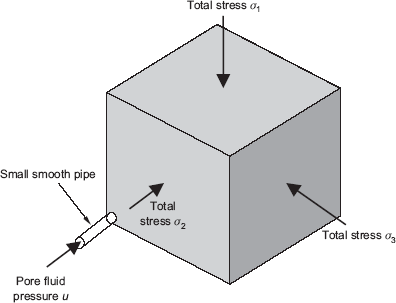
Figure 1 shows an element of soil of macroscopic volume equal to 1 unit, with faces of unit macroscopic area, under principal total stresses σi normal to the faces. If the specific volume of the soil is V, then the element contains a volume 1/V units of particles. The faces of the element are impermeable, but there is a small pipe that allows fluid under pore pressure u to enter or exit the sample without viscous or frictional losses. If there are principal strain increments dεi in the directions of the stresses, compression positive, then the incremental work dW done on the material, per unit macroscopic volume, by the stresses acting on the faces, is
where second-order effects associated with incremental changes of stress are ignored. The overall volume strain increment is dε1 + dε2 + dε3, so if the grains and fluid are incompressible, a volume of fluid equal to 1 unit times (dε1 + dε2 + dε3) flows out through the small pipe. It flows against a pressure u, so it does work dWu on the external environment, given by
If the pore fluid is incompressible, then no net work can be done on the pore fluid by change of pressure, so the work dW′ that has been done on the particles is
Using equations (1) and (2) to substitute for works on the right, and simplifying, gives
where σ′i = σi − u. Let us make the following hypothesis, referred to later as the work hypothesis.
The effective stress for a particulate aggregate can be identified as any stress that multiplies strain increment in a calculation for incremental work done on the particles.
If this is correct, equation (4) leads immediately to Terzaghi's principle.
The above derivation does not assume that the contact area ratio is small. Thus there could be grounds for supposing that Terzaghi's principle applies for deformable particles, and perhaps for cemented soils, provided the particle volume is constant. The derivation does assume that a single number, u, characterises the pore fluid state, and to achieve this the pores might all need to be connected. The calculation can readily be extended to processes in which strain increment is not coaxial with stress. Such processes are discussed by Molenkamp (1998), Gutierrez & Ishihara (2000) and others, and other effective stresses are discussed by Wood (1984), Peric et al. (1990) and others. The extension leads to the tensor form of Terzaghi's principle for saturated soils, σ′ij = σij − uδij, and we might call (σij – uδij) the Terzaghi stresses. The tensor form can be used with continuum mechanics methods (e.g. Spencer, 1980) to develop other types of effective stress, such as effective versions of the Piola– Kirchoff stress tensors.
As a prelude to applying the work hypothesis to partially saturated soils, let us consider a pore fluid that is compressible, but otherwise simple. The volume of fluid in the soil element is 1 – (1/V) units. If the pore pressure increases by an amount du during the increment, the volume of fluid reduces by du/K times this volume, where K is the bulk modulus of the fluid. Hence the work calculation in equation (2) would change into
dWfluid is work done not on the particles, but on the fluid that is inside the macroscopic unit volume. So the work done on the particles is no longer given by equation (3), but by
Using equations (1), (5) and (6) to substitute for works on the right, and simplifying, gives
with σ′i = σi − u again. On this basis, the equation for effective stress with a compressible pore fluid is the same as that for an incompressible fluid. This proposal could in principle be tested by experiments. The writer does not have the resources to do such experiments. Their results could give an indication of whether the work hypothesis is reasonable.
Finally, let us consider partially saturated soils. The fluid properties are now more complicated. For instance, the work dWfluid done on the fluid might include:
work associated with compressions or expansions of the gas(es) and liquid(s) involved, which might be partially characterised by one or more stress quantities
work associated with surface tension effects and changes of area of menisci inside voids; parameters describing this might include void size or grain size, voids ratio, type of distribution of gases and liquids, fluid/grain wetting angle.
work associated with dissolution of the gas(es) in the liquid(s)
for very small bubbles, possibly work due to sonoluminescence (Mullins, 2005)
time and viscous effects, for instance in oil-sands that may contain mixtures of hydrocarbon fluids, water and gases
other effects, such as soils that are polluted by complex mixtures of active gaseous and liquid chemical or biological pollutants, or where chemicals are introduced as liquids that subsequently set to produce stronger material.
We might also want to include consideration of compressible particles. Based on this list, the effective stress for partially saturated soils might sometimes be very complicated, and a structured methodology could assist in research. One such methodology might be for researchers to propose the underlying physical processes for a category of partially saturated soil, then measure or propose expressions for the works dWu and dWfluid (possibly with further development of equation (7) if needed), then infer the effective stress equation from the work dW′ done on the particles, and then test the expressions and equations experimentally.
The macroscopic behaviour of a soil element depends on its current state, and on its formation and its stress, strain and consolidation history. The latter three can normally be related to each other by constitutive laws, which can also apply to future behaviours. Some multiphase materials might be so complex that a different approach might be better, perhaps using the concept of work directly, instead of stress. An advantage of the proposed methodology is that the assumptions needed to calculate the works can be clearly identified. The inferred effective stresses may well be correct for soils that satisfy those assumptions. Experimental validations would test whether the assumptions apply to a particular soil. If the experiments show that a proposal is incorrect for that soil, then that result will be a positive one, possibly giving clues about the physical processes that have been missed, leading to further iterative development.
This discussion is informal, and the work hypothesis is currently speculative. The writer feels that printed informal discussions, reviewed but open to all, where people can discuss ideas that might not yet be fully validated, may help the development of our subject, particularly where research is struggling. The writer looks forwards to other contributions to this discussion, and to Professor Wheeler's 2005 Géotechnique Lecture.
Author's reply
I welcome very much Dr Dean's contribution, and am pleased that my editorial has provoked some interest. Before proceeding further it is worth recalling a succinct definition of effective stress. Bishop & Blight (1963) provide the following description, which serves very well:
… the effective stress is, by definition, that function of total stress and pore pressure which controls the mechanical effects of a change in stress, such as volume change and a change in shear strength. The principle of effective stress is the assertion that such a function exists, with determinate parameters, under a given set of conditions.
Dr Dean starts by proving that, for a saturated soil with incompressible grains and pore fluid, the conventional ‘Terzaghi’ effective stress is the quantity that is work-conjugate to the strain increment.* A proof of this result was given, at least for the triaxial case, by Schofield & Wroth (1968) (pp 103 ff), and in more general terms, including simultaneous skeleton deformation and fluid flow, by Houlsby (1979). There may well be earlier sources that prove the same result. Dr Dean shows that the same result holds for an elastically compressible pore fluid. A proof for this case was given by Houlsby (1981), although again there may be earlier sources.
I believe the most important contribution that Dr Dean makes is his ‘work hypothesis’: that the stress that is work-conjugate to the strain is the ‘effective stress’, in the sense defined above. This hypothesis is not employed in the classical work of Terzaghi (1936), Skempton (1960) or Bishop & Blight (1963). Nor does it form an essential part of the work cited in the previous paragraph. In those works it was simply proven that the effective stress is indeed conjugate to the strain for saturated soils: the work hypothesis takes this further by stating that, for more general conditions, the work-conjugate stress would play the role of effective stress. This is indeed an attractive hypothesis, but needs further critical examination.
Consider, for the time being, an elastic soil skeleton in a two-dimensional (plane strain) problem. The work input to an element of this skeleton would be dW′ = σ′1dε1 + σ′2dε2. The stored elastic strain energy would be a quadratic function of the strains, say . As the soil deforms, the input work to the skeleton is equal to the increment of strain energy, so that
If the strains in the two directions can occur independently, we can set each of dε1 and dε2 separately to zero in equation (9), and deduce that σ′1 = Aε1 and σ′2 = Aε2. Thus, in our simple elastic soil, each stress component is determined solely by the corresponding strain component.
More realistically, however, we should allow for a third ‘cross’ term in the quadratic expression for the strain energy: , so that instead of equation (9) we now derive
and this time we obtain σ′1 = Aε1 + Bε2 and σ′2 = Bε1 + Aε2. The extra term therefore introduces a cross-coupling between the stresses: the stress in any one direction depends on the strain in both directions. This is of course the well-known effect of Poisson's ratio.
The example serves as a metaphor for more complicated cases. Houlsby (1979) showed that the total work input to a saturated soil, in the presence of seepage, involves a term exactly as derived by Dean, plus a second term in which the (negative) gradient of the excess pore pressure gradient u′ appears as work conjugate to the seepage velocity wi:
As long as this work input is stored and dissipated in ways that do not involve processes that couple together the strains and the seepage velocity, then the Terzaghi stress will depend solely on the strains, and will be the ‘effective stress’ in the conventional sense. If on the other hand the right-hand side of the equivalent to equation (10), but for a real soil, includes terms that couple the strains with the seepage, then the Terzaghi stress would depend on the seepage velocity as well as on the strains! The fact that the effective stress principle works so well for saturated soils suggests very strongly that in fact no such coupled processes do occur.
Houlsby (1997) derived, under certain restrictive assumptions, possible forms of the work equation for unsaturated soils, demonstrating that the quantity that is work-conjugate to the strain depends on the choice of independent variable used to define the degree of saturation. Thus the ‘work hypothesis’ becomes insufficient for these materials, as it cannot be used to determine uniquely a definition of an effective stress.
Dr Dean concludes by considering some types of work that may have to be done in altering the states of partially saturated soils, and reveals the complexity of the possible processes involved. It is possible (indeed likely) that the correct physical description of these phenomena would involve terms that would couple together the deformation of the soil skeleton and the soil saturation. In these circumstances the stress that is work-conjugate to the strain would no longer be determined by the strain alone, and so would not be (in the sense defined by Bishop & Blight) the ‘effective stress’. It would instead depend on both the strain and the degree of saturation (and their histories).
The identification of consistently defined work-conjugate stresses and strain increments for unsaturated soils is an important step in the proper understanding of these materials, but in itself is only half the story. The other, more difficult, half lies in identifying what is, in simplified terms, the correct right-hand side for the equivalent of equation (10) for unsaturated soils. For inelastic materials, this somewhat oversimplifies the problem. What is required is a hypothesis for the way the input work is stored and dissipated. The accurate description of the relevant phenomena, listed by Dr Dean, is likely to involve coupled terms, which will mean that no single ‘effective stress’ will be uniquely determined by the strains. For example, Wheeler et al. (2003) are careful in their choice of work-conjugate variables, but then go on to use them to describe coupling phenomena.
REFERENCES
The concept of work-conjugacy of stress and strain definitions is important in mechanics. The stress that is work-conjugate to the strain satisfies, for any modes of deformation, the condition that the input mechanical work increment per unit volume is equal to the sum of the products of the stress components with their equivalent strain increments. Thus for a solid subjected to principal stresses σ1, σ2, σ3 with equivalent strain increments dε1, dε2, dε3, work conjugate definitions give dW = σ1dε1 + σ2dε2 + σ3dε3.

