

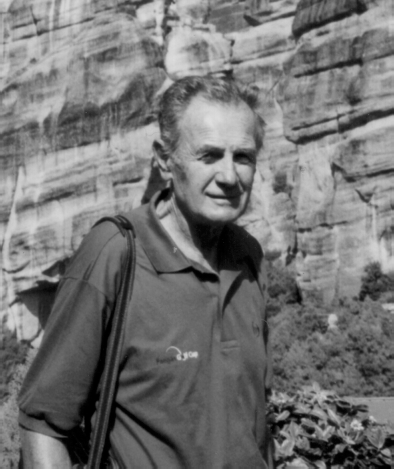
Dr Jaroslav Feda has died aged 78 as the result of an accident. On 4 August 2007 he made one of his usual one-day trips into the surroundings of Prague to visit an area with several abandoned quarries, a popular practice site for Prague mountaineers. Jaroslav, walking alone, apparently viewing the scenery of one of the quarries from the crest, slipped, fell down the rock face and died instantly. In recent months he had complained of problems with his balance and this probably contributed to the accident.
Jaroslav Feda was born on 5 March in 1929 in Czechoslovakia and received his MSc in civil engineering at the Czech Technical University, Prague, in 1953. During his MSc studies he worked part-time as an assistant at the Department of Mechanics. After a short spell as a site engineer he returned to the Technical University in Prague to do PhD studies in soil mechanics (1953-1956). After obtaining his PhD he joined the Department of Soil Mechanics in the Institute of Theoretical and Applied Mechanics of the Academy of Sciences in Prague, where he worked until his death. From 1961 to 1962 he was active as a foundation expert at Ranchi, India, and from 1966 to 1968 he was a Professor of Soil Mechanics at the University of Basra, Iraq. In 1966 he became Associate Professor at the Czech Technical University in Prague and in 1986 he was awarded the title of Doctor of Science by the Czech Academy of Sciences. In 1993 he initiated the annual Prague Geotechnical Lecture which is given by prominent geotechnical researchers and professionals.
Jaroslav Feda's professional activities ranged from foundations and piles to soil behaviour and constitutive models for soils. He was a leading figure in Czechoslovakian soil mechanics for many decades. Although he spent most of his career in research, his opinions were sought by industry and they invariably proved correct. From the 1950s he was the Secretary of the Czechoslovakian Member Society of ISSMFE, and after the political changes at the end of the century he was a clear candidate and logically became the Chairman of the Member Society.
Jaroslav Feda was a passionate researcher. He loved discussions and debates and unconventional approaches. Apart from soil mechanics he was active in philosophical clubs and enjoyed classical music and fine arts. He loved the countryside, mountaineering and skiing. For his colleagues in the department of soil mechanics he was a renaissance man, with a deep understanding of the nature of research work. His informal talks on philosophical topics at coffee breaks and his improvised seminars on philosophy will long be remembered by his colleagues.
During his studies, the post-war political situation and his interest in philosophy led him to embrace communism and to membership of the communist party. Naive as it may seem now, this was then common among young intellectuals. The Soviet invasion of Czechoslovakia in 1968 and the purges in the communist party led, however, to abrupt changes in his political philosophy and his professional career. He was permitted to continue his research within the Academy of Sciences but he was not allowed to teach and supervise PhD students and his travelling abroad was severely limited. Unfortunately, after 1989 the changes in Czech universities proved to be slow. Despite his professional reputation and publication record Jaroslav was not appointed full professor and did not receive the appropriate recognition in his country. He continued his work in the Academy of Sciences leading a small group of researchers. After his retirement he continued his research and published papers until his death.
Dr Feda authored nine books and almost 300 papers in journals and conference proceedings. Three of his books were translated into English. The English edition of Mechanics of Particulate Materials: The Principles, published by Elsevier in 1982, became an important reference book and continues to be cited.
Jaroslav Feda is survived by his daughter and two granddaughters.

