


J. Salençon, École polytechnique, Palaiseau, France
The authors should be commended for their comprehensive numerical study of the bearing capacity of surface footings on sand using finite element methods in a rigorous approach. This comment aims at adding some comparisons with formerly established results for shallow foundations.
A first reference (Salençon, 1965) is concerned with the calculation of the bearing capacity of a strip footing on a ϕ = 30° non-cohesive soil, taking into account the embedment explicitly, within the range 0·08 < D/B < 2·33. It follows Sokolovski's approach along the characteristic lines of the stress field (Sokolovski, 1960), which passes through the soil located above the level of the footing, as shown in Fig. 16, depending on the rate of embedment.
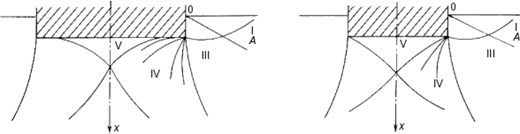
Nets of characteristic lines for the bearing capacity of a shallow strip footing
Nets of characteristic lines for the bearing capacity of a shallow strip footing
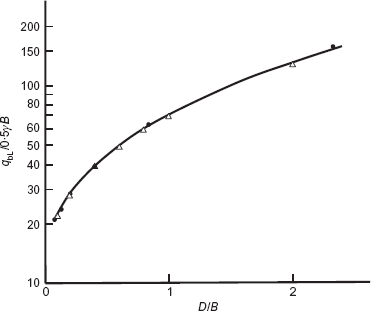
With the notation of the paper, Fig. 17 shows qbL/γB as a function of D/B, presenting both the results obtained through the use of the method of characteristics (circular symbols) and the values given in the paper (triangular symbols). The comparison yields amazingly good results, although the mesh (111 nodes) was drawn and calculated by hand at the time, but with a smart integration scheme: this emphasises the efficiency of the method of characteristics, provided it starts from a good guess of the characteristic field pattern. On the other hand it must be recalled, as observed for the first time by Bishop (1953) and many times by the discusser, that Sokolovski's approach should be analysed within the framework of the ‘limit analysis theorems’. The solution in Fig. 16 provided a limit equilibrium stress field only in a limited part of the soil medium; it was heuristically expected to be an upper bound, since no associated velocity field had been constructed. That uncertainty regarding the significance of the results is now cleared.
A second reference (Salençon et al., 1976) concerns the assessment of the validity of the classical bearing capacity equation through new calculations explicitly taking into account the coupling effect between a uniformly distributed surface load, whatever its origin, and the soil weight. A correction factor μ was introduced into the bearing capacity equation as a whole in the form of equation (25). It is a function of the dimensionless parameters defining the problem (including a vertical cohesion gradient through an equivalence theorem).
This correction factor was computed for various values of ϕ and of the other parameters of the problem. In the present case of a non-cohesive soil, with the notation of the paper, the relationship between μ and the depth factor dq takes the form of equation (26), where μ is a function of ϕ and D/B.
Figure 18 shows the correction factor μ for a non-cohesive soil as a function of B/D. It may be seen that the computations considered values of the parameters B/D and ϕ that are not relevant for practical applications, but which were necessary for ascertaining the pattern of the charts and their evolution with decreasing values of ϕ and for high and small values of B/D. As expected, μ tends to 1 when B/D → ∞ and when B/D → 0 (no longer a shallow foundation!).
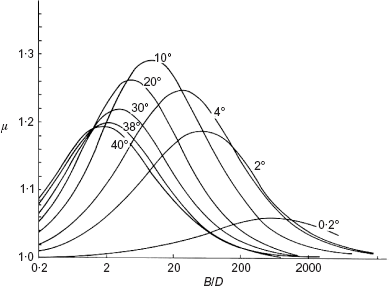
Table 9 offers a comparison between the values of the depth factor dq obtained from Table 5 in the paper and derived from Fig. 18 through equation (2) for ϕ = 30° and 40°. Although the case was not considered in the paper, results for very small values of D/B are presented from Fig. 18.
Values of the depth factor from Fig. 18 and from Table 5 in the paper
| D/B | dq from Fig. 18 | dq from Table 5 | ||
|---|---|---|---|---|
| ϕ = 30° | ϕ = 40° | ϕ = 30° | ϕ = 40° | |
| 0·005 | 2·87 | 2·60 | ||
| 0·05 | 2·13 | 2·24 | ||
| 0·1 | 1·85 | 1·92 | 1·99 | 2·01 |
| 0·2 | 1·63 | 1·69 | 1·77 | 1·82 |
| 0·4 | 1·43 | 1·58 | 1·60 | 1·65 |
| 0·6 | 1·35 | 1·44 | 1·54 | 1·58 |
| 0·8 | 1·28 | 1·35 | 1·51 | 1·54 |
| 1·0 | 1·25 | 1·30 | 1·49 | 1·52 |
| 2·0 | 1·16 | 1·17 | 1·52 | 1·52 |
Not surprisingly, the values of dq given in the paper are always greater than the corresponding values derived from Fig. 18, but they remain of the same order of magnitude. This refers to the two drawbacks of the bearing capacity equation stated in the paper. The correction factor μ addresses the coupling effect only between the weight of the soil medium and the uniformly distributed surface load, whatever the origin of the surface load, and so does dqderived from Fig. 18, thus giving an assessment of the relative importance of this effect with respect to not taking into account the rate of work in the soil layer above the level of the footing.
As D/B decreases to 0·1 it is noticeable that the coupling effect tends to account for the quasi totality of the depth factor, which is in accordance with common-sense intuition.
Furthermore, considering the values of dq derived from Fig. 18 for very small values of D/B gives an explanation of the following sentence in the paper:
The results of these calculations, given in Table 5, show clearly that the depth factor dq does not approach 1 when D/B → 0, as would be suggested by the expressions given in Table 2. On the contrary, it increases with decreasing D/B. This fact can be explained by the inadequacy of the logic of superposition and segregation of the different contributions to bearing capacity.
Indeed, as D/B → 0, μ → 1, but the behaviour of the depth factor dq is governed by equation (2), and depends on the product (μ – 1)B/D.
Other comments could be made, arising from the comparison of the results for the shape factor in consideration of Salençon & Matar (1982) and Matar & Salençon (1983), where the results of extensive calculations of the global bearing capacity of circular footings with the method of characteristics under the Haar–Karman hypothesis were presented: an interesting opportunity for assessing the validity of that well-known conjecture.
Authors' reply
We thank Mr Nigel Somers for drawing our attention to an error in equation (24) in our paper. We have corrected this, and a corrected and simpler form of equation (24) is published as a corrigendum below
We thank Professor Salençon for his interest in our paper, and for his comments. Salençon provides evidence from his past work with the method of characteristics that corroborates our results and provides insights that reinforce our observations. The bearing capacity equation is one of the cornerstones of soil mechanics, but its workings were not fully understood, nor were the many factors appearing in it well quantified, until very recently, even for perfectly plastic materials. The discusser illustrates—and this is one of our points in the paper—the contortions that are necessary to reconcile terms assumed to be independent in the original formulation of the equation when in fact they are not. In light of this, a different form of the bearing capacity equation, such as equation (20) in the paper, that fully recognises the coupling of the various terms and is at the same time simpler to use may offer significant advantages to practising engineers.
REFERENCES
Corrigendum
Equation (24) for s*γ was not correct as published. A much simpler expression does in fact fit the data in Table 8 rather well. So a corrected and simpler version of equation (24) is

