

Papers published in Géotechnique are eligible for awards from the Institution of Civil Engineers. Papers from any of the ICE journals can be nominated for several awards. In addition, each journal has awards dedicated to their specific subject area.
On Friday 23 October 2009, ICE president Jean Venables presented awards to the following papers published in Géotechnique in 2008. The editorial panel nominated their best papers and an awards committee chaired by Adrian Long allocated the awards.
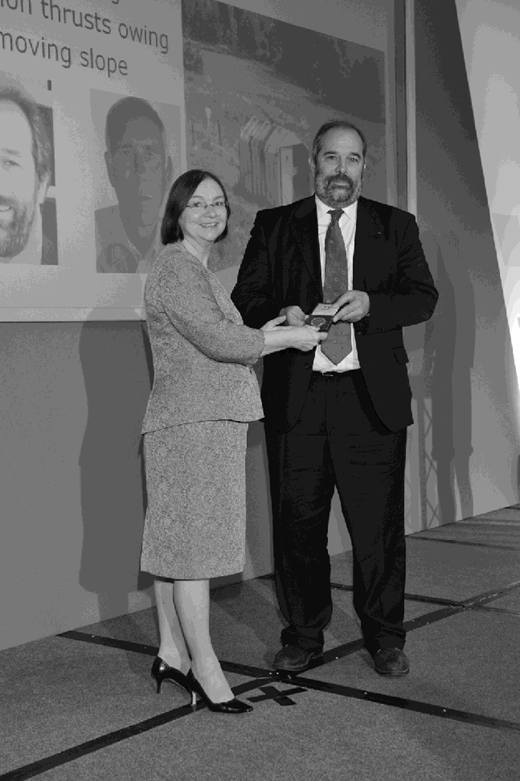
The George Stephenson Medal, presented for the second best paper overall, was awarded to: Frank, R. & Pouget, P. (2008). Experimental pile subjected to long duration thrusts owing to a moving slope. Géotechnique 58, No. 8, 645–658 [doi: 10.1680/geot.2008.58.8.645]. Fig. 1
ABSTRACT
An instrumented pipe pile has been installed in an unstable slope to measure long-duration P–Δy lateral reaction curves. After outlining the main features of the experiment, results are given over a period of 16 years. These comprise the soil movements, the pile displacements, the bending moments and the reaction pressures. A Ménard pressuremeter method and a self-boring pressuremeter method are used to predict the P–Δy reaction curves, which are then used in a numerical model to derive the overall pile behaviour. The results are compared with measured pile displacements and bending moments and show that the pile displacements and bending moments calculated by the numerical model are markedly overestimated.
The Geotechnical Research Medal, presented for the best paper on geotechnical research, was awarded to: Olivella, S. & Alonso, E. E. (2008). Gas flow through clay barriers. Géotechnique 58, No. 3, 157–176 [doi: 10.1680/geot.2008.58.3.157].Fig. 2
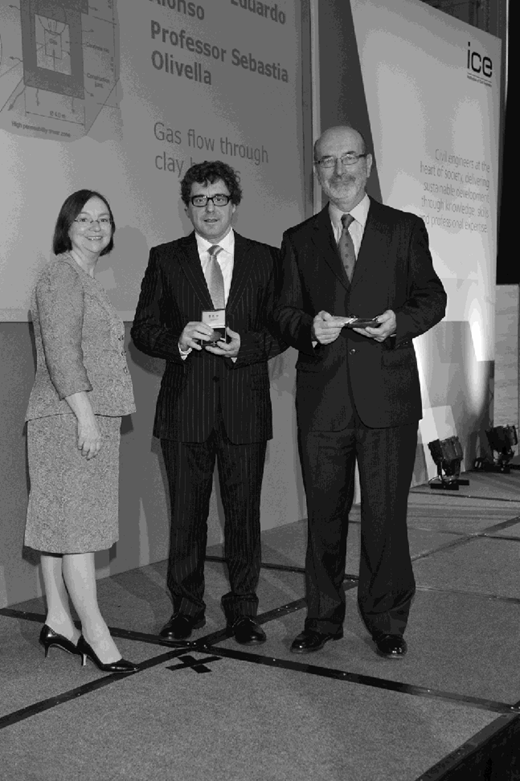
ICE President Jean Venables with Geotechnical Research Medal winners Sebastià Olivella and Eduardo Alonso
ICE President Jean Venables with Geotechnical Research Medal winners Sebastià Olivella and Eduardo Alonso
ABSTRACT
A model for the simulation of gas flow in clayey rocks and clays is described. Gas migration is associated with the development of preferential paths along existing or pressure-dependent discontinuities. The model handles the combined phenomena of two-phase (air and liquid) flow and the generation of discrete paths. Aperture of discrete paths is the main variable to account for permeability and capillary pressure variations. The model, which has been implemented in a general thermo-hydromechanical code, is used to simulate two experiments (laboratory and field). The laboratory experiment involved gas flow through shale specimens tested in a triaxial cell. In the field experiment, gas flow was forced through a sand–bentonite barrier. Experimental results and model calculations are compared in the paper.

