

The study presented in this paper provided further evidence to understand monotonic and cyclic shear behaviour of carbonate sand. However, one of the conclusions about the comparison between monotonic and cyclic tests may need further discussion.
Generally, the ultimate state line (US line in the paper) or critical stress line (CSL) is defined based on some failure criteria of friction, for example the Mohr–Coulomb criterion. The phase transformation line (PTL) was proposed by Ishihara et al. (1975) to separate the contractive and dilative behaviour of sand. As mentioned in the paper, both lines stated above are assumed to pass straight through the coordinate origin and fix in the stress space as shown in Fig. 7. However, actual CSL and PTL may move in a stress space along the mean effective principal stress axis in cyclic shear tests, which leads to non-uniqueness of the two lines.
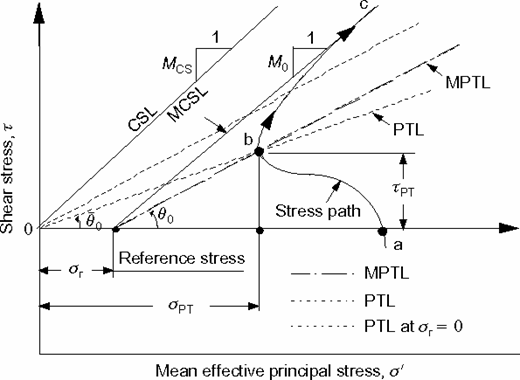
On the basis of analysis of laboratory tests, Zhang et al. (1997) proposed a new formulation for the moving critical stress line (MCSL) and moving phase transformation line (MPTL), which demonstrates that the effective stress path associated with positive dilatancy asymptotically moves in parallel with and tends towards CSL with the development of induced shear strain until initial liquefaction (Seed & Lee, 1966).
As seen in Fig. 13, MCSL is parallel to CSL with a distance called the reference stress σr along the σ′-axis. Moreover, MPTL is parallel to PTL at σr=0. A reduction in σr is observed as the number of cycles increases. θ¯0 is the angle of PTL and θ0 is the angle of MPTL as shown in Fig. 1. θ¯0 varies as the cycles increase, shown in Fig. 14, which shows the effective stress path of the cyclic undrained shear test on a Dr = 59% Toyoura sand sample, θ¯0 is 22·5° in the 11th cycle and 24° in the 12th cycle. Variety of θ¯0 with cycles is also shown in Fig. 15 of another cyclic shearing test on a Dr = 75% Toyoura sand sample. θ¯0 increases as cycles accumulate and finally reaches the same value of θ0, which remains a constant during cyclic shear.
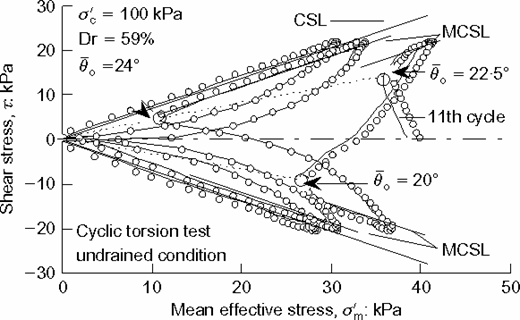
Changes in mobilised maximum stress state and phase transformation stress state during cyclic undrained shear application for Dr = 59% sample (from Zhang et al., 1997)
Changes in mobilised maximum stress state and phase transformation stress state during cyclic undrained shear application for Dr = 59% sample (from Zhang et al., 1997)
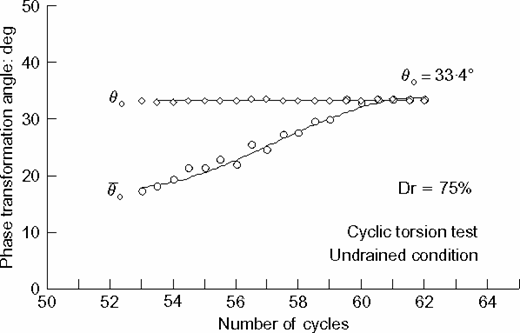
Comparison between phase transformation angles based on two different definitions for cyclic undrained shear on a Dr = 75% sample (from Zhang et al., 1997)
Comparison between phase transformation angles based on two different definitions for cyclic undrained shear on a Dr = 75% sample (from Zhang et al., 1997)
Thus, the angle of PTL is varied in different cycles and finally reaches a value similar to that in the monotonic test, while this angle was assumed to be a constant, which is during cyclic shearing in the paper. MCSL moves along the σ′-axis parallel to CSL and reaches superposition of CSL after initial liquefaction. CSL is a unique undrained ultimate failure envelope for both cyclic and monotonic tests as mentioned in the paper. Zhang et al. (1999) described the physical meaning of the MCSL and MPTL; the occurrence of the non-zero reference stress is related with an irreversible dilatancy component developed during a cyclic undrained shear application.
Authors' reply
The authors thank the discusser for his interest in this paper and the opportunity to examine thoroughly some interesting issues on the subject. The authors present in the paper under discussion the undrained behaviour of an uncemented carbonate Quiou sand (QS) through a modified NGI simple shear (SS) apparatus. Monotonic and cyclic tests were carried out on specimens reconstituted at two void ratios (loose and dense) by using the water sedimentation method. Furthermore, in order to investigate the influence of a ‘driving' static shear stress on undrained cyclic response of tested sand, both symmetrical (with the horizontal shear stress being cycled around zero) and non-symmetrical (with the horizontal shear stress being cycled around a non-zero value) tests were carried out.
The discusser mentioned the paper by Zhang et al. (1997), which presented a new formulation for modelling the undrained cyclic shear behaviour of saturated sands based on ‘moving' critical and phase transformation lines (MCSL and MPTL) in p′, q stress space. Such formulation is supported by experimental evidence on dry Toyoura silica sand from torsion and triaxial undrained cyclic tests.
The authors were already aware of the conceptual model leading to this new framework for describing the critical stress state and dilatancy features of sand when subjected to undrained cyclic loading. However, this subject was outside the purposes of their paper.
Questions are raised in the discussion regarding the variation of angle corresponding to cyclic phase transformation state with number of loading cycles. For test data on medium dense and dense Toyoura sand in cyclic undrained torsion (Zhang et al., 1997, Figs 9 and 10) a clear variation can be observed.
The cyclic phase transformation (PTcyc) line, which separates the dilative response from the contractive one in individual cycles (Ishihara et al., 1975), was reported in the authors' paper for any cyclic test as a single straight line, passing through the origin, fitting all the data points.
Above all, the authors would like to state that one of the main objectives of their study was to provide direct evidence that the cyclic PT strength envelope was located far below that determined by monotonic tests, in agreement with previous results gathered by other authors on calcareous sands such as Mao & Fahey (2003).
However, with the aim of analysing the experimental data in more detail, based on the discusser's suggestions, the authors have reported in Fig. 16 the PT points in individual cycles relative to a cyclic undrained SS test carried out on loose QS sand.
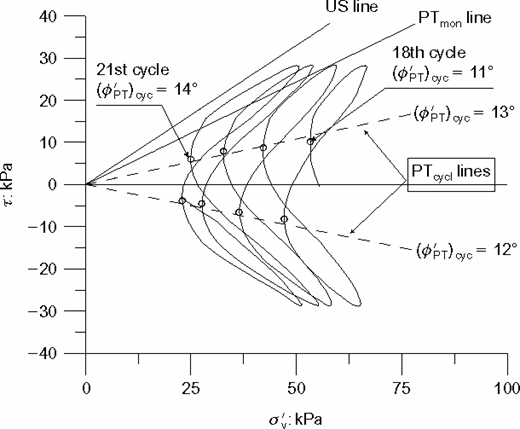
Cyclic phase transformation lines from undrained simple shear tests carried out on loose Quiou sand (= 200 kPa)
Cyclic phase transformation lines from undrained simple shear tests carried out on loose Quiou sand (= 200 kPa)
As can be seen, data points show the existence of a slight curvature of the PT strength envelope with values of ranging from 11° to 14°.
In the case of undrained cyclic SS test results performed on dense sand specimens of QS sand, the observed variability from cycle to cycle is more pronounced with the cyclic PT strength envelope showing a more marked variation of .
In any case, the authors would like to stress that there is some uncertainty as to the recognition of the ‘elbow' of PT points in the cyclic effective stress paths of SS tests for the tested sand.
Very often PT points are not clearly discernible and this results in associated uncertainties in the slope of the PTcyc line corresponding more or less to 3°. For highly ‘dilative' dense WS specimens, such individuation can be even more difficult.
The pattern of behaviour observed by the authors in undrained cyclic SS test results is consistent with that gathered in triaxial conditions on the same carbonate QS sand (Fig. 17).
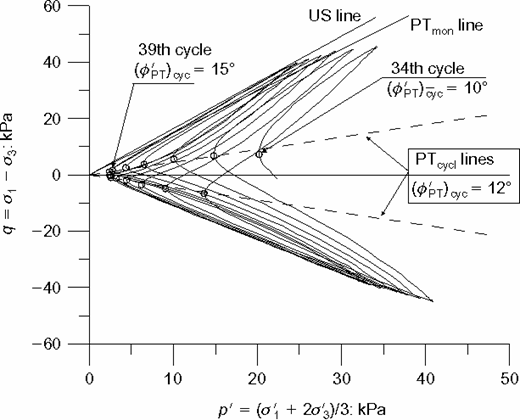
Cyclic phase transformation lines from undrained triaxial tests carried out on loose Quiou sand (= 100 kPa)
Cyclic phase transformation lines from undrained triaxial tests carried out on loose Quiou sand (= 100 kPa)
However, it is worth mentioning the theoretical basis followed for interpreting SS test results and, accordingly, for comparing test results in these two apparatus. The approach followed in the analysis of undrained SS tests is based on the assumption that the horizontal plane is the plane of maximum shear stress.
This assumption appears to be sufficiently accurate in undrained tests whatever the void ratio, in agreement with other authors (Roscoe, 1970; Sivathayalan, 1994). The reliability of the approach was assessed by comparing test results obtained by SS device with those gathered in triaxial compression tests under the same test conditions (Porcino et al., 2005a, 2005b).
In Fig. 17 the best fit through the PT points of the undrained cyclic TX tests on loose QS sand corresponds to a mobilised internal friction angle , which is clearly lower than that determined in the corresponding monotonic compression tests. Some variability in the values of with number of cycles can also be perceived, but there is no clear evidence of a trend reaching the final value of at lower effective stresses.
Finally, taking into account all of the above-mentioned points, the authors concur with the discusser's general observation that, to some extent, a variability of mobilised internal friction angle during cyclic loading appears to occur. This aspect was not ignored by the authors but only considered in the context of the main purposes of the paper.
Accordingly, we hope that our findings will encourage more investigation on the phenomenon.

