Triaxial apparatus is a commonly adopted testing device for understanding the mechanical behaviours of soils from laboratory tests. The uniform distribution of stress–strain inside the specimen till a large strain close to a steady state is a challenge. Over nearly three decades, research at the University of New South Wales, Canberra, has led to notable improvements in triaxial testing techniques. This article reviews both standard and advanced triaxial testing techniques. These include the ability of the triaxial testing device to measure and record instability behaviour, specimen preparation techniques, enlarged platens with free ends, and its effects, accuracy, and errors involved in the different measurements/calculations. A total of 166 critical state data points of Sydney sand with fines and pond ash prepared under different specimen methods and testing conditions have been included to evaluate the effectiveness and reliability of the abovementioned techniques. Representative monotonic and cyclic test results have been presented to further validate the techniques. The results demonstrate that a unique critical state line can be reliably established, enabling the accurate estimation of state parameters to predict instability behaviour using the critical state soil mechanics framework under both static and cyclic loading conditions.
Introduction
The critical state soil mechanics (CSSM) framework has been employed for modelling the behaviour of both clay and sand since its inception in the 1950s (Roscoe et al., 1958; Schofield and Worth, 1968). Central to the CSSM framework is the concept of the critical state line (CSL), which serves as the benchmark state for soil behaviour. For instance, soil states below the CSL exhibit dilative behaviour, while those above it display contractive behaviour (Been and Jefferies, 1985; Rahman and Lo, 2014). Consequently, the CSL has been integrated into the development of constitutive models for clean sand under both static and cyclic loading (Li and Dafalias, 2000; Manzari and Dafalias, 1997).
Commonly, saturated loose to medium-dense granular soil under undrained monotonic triaxial loading conditions tends to exhibit a temporary drop in deviator stress over a limited range of deviator strain after attaining the initial peak deviator stress, and then deviator stress increases with deviator strain. The attainment of such minimum deviator stress is termed as quasi-steady state (QSS) (Alarcon-Guzman et al., 1988; Ishihara, 1993; Verdugo and Ishihara, 1996) or limited flow behaviour (Bobei, 2012; Lo et al., 2010). Whether the so-called QSS is a real material response is a fundamental yet controversial question in the study of undrained shear behaviour of sand. Researchers made contradictory remarks in the literature with respect to the existence of the QSS. For example, Zhang and Garga (1997) doubt that the QSS is not a real material behaviour but a test-induced phenomenon. On the other hand, many other researchers (Chu, 1999; Vaid et al., 1999; Yang and Dai, 2011; Yoshimine, 1999) found that QSS is a real material behaviour rather than a test-induced phenomenon. This highlights the necessity of adopting proper triaxial testing techniques, as limited flow behaviour is argued (by Zhang and Garga (1997)) to be affected by end restraint or end friction, non-uniform deformation, membrane penetration, and sample dimension correction. Moreover, it is even more challenging to eliminate the effect of such factors for sand with fines and pond ash.
It is well established in the literature that different specimen preparation methods lead to different soil fabrics and different liquefaction behaviour (Miura and Toki, 1982; Mulilis et al., 1977; Wanatowski and Chu, 2008; Yamamuro and Wood, 2004). The variation in achievable ranges of density based upon the sample preparation method greatly affects the potential of soil behaviour. Moreover, specimens reconstituted from a saturated non-plastic material may be more sensitive to disturbance; thus, any unwanted disturbance induced by the reconstituting procedure may introduce a considerable amount of uncontrolled densification and non-uniformity to the specimen. Similarly, the selection of an appropriate specimen preparation method that can simulate the fabric of in situ material is also a key consideration for liquefaction studies.
Another key aspect of a triaxial testing system for liquefaction studies is the ability to commence cyclic loading from any stress state, as well as the ability to change loading frequency at any stage of testing.
Over the past two decades, the CSSM framework has been expanded to include materials such as sand with fines (Rahman et al., 2008), sand–gravel mixture (Pokhrel et al., 2024), tailings (Karim et al., 2023), pond ash (Zhang et al., 2014), and so on for both static and cyclic loading (Baki et al., 2012; Rahman et al., 2014a). Nevertheless, determining the critical state (CS) and CSL for these materials poses challenges due to their distinct particle size distribution (PSD), particle shape, and mineralogy when compared with common sands. To ensure the accurate determination of CS and CSL, it is imperative to have well-equipped laboratory facilities and adhere to rigorous experimental protocols, including specimen preparation (Bobei et al., 2009; Chu and Lo, 1993; Rahman et al., 2008). Consequently, a triaxial testing system should meet certain fundamental criteria: (i) the stress and strain distributions within the soil specimen should be uniform to ensure ‘element’ behaviour, and (ii) the measurements taken during experimentation should be sufficiently precise to fulfil the requirements of research.
Over the course of nearly three decades, researchers at the University of New South Wales (UNSW) have developed specimen preparation methods for different geo-materials (such as sand with fines and fine coal ash) that ensure uniform distribution of void ratio and fines content. These specimens maintain uniform distribution even under significant strains up to the CS. As a result, they have facilitated the development of constitutive models (Rahman et al., 2014b; Rahman and Dafalias, 2022). Moreover, these specimens have served as a standard dataset for the formulation of various constitutive models (Ghafarian et al., 2020; Lashkari, 2014; Liao et al., 2024; Zuo et al., 2023). For materials such as pond ash, a preparation method has been devised to mimic the deposition process while also achieving high uniformity in terms of void ratio and PSD. These specimens, too, exhibit uniform deformation even under large strains, ensuring element behaviour at the CS. Alongside these specimen preparation methods, substantial modifications have been made to conventional triaxial testing techniques to accurately capture characteristic features, such as the initiation of instability under both static and cyclic loading (Baki, 2011; Bobei, 2004; Chu, 1991; Lo, 1985; Lo et al., 1989; Rahman, 2009; Yan, 2015; Zhang, 2014).
Therefore, this article presents details of specimen preparation methods for unconventional materials, such as Sydney sand with fines and pond ash. It addresses their uniformity to ensure elemental behaviour, the control system used, their accuracy, the margin of error in void ratio measurements, the scatter of CS data points around the CSL, and the prediction of instability in these materials under the framework of CSSM. This study will reduce the knowledge gap in handling these materials, enabling the measurement of their CS behaviour and facilitating advanced analyses within the CSSM framework.
Triaxial testing equipment
Overview
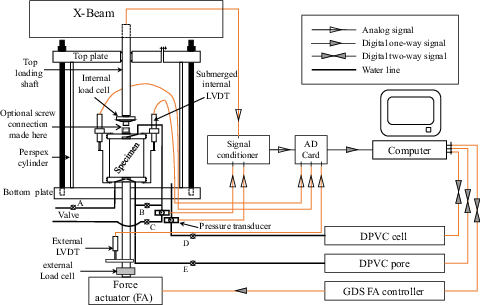
A schematic layout of one of the triaxial testing devices and the associated instrumentation at UNSW is shown in Figure 1. The cell chamber consisted of a perspex cylinder sandwiched between two plates secured by four stainless rods. To avoid exerting axial pressure on the perspex cylinder and reduce the risk of bursting under high cell pressure, four bolts were used to tighten the top platen to the rods.
Loading arrangement
A force actuator with continuous displays of force, displacement, and force control was used to impose axial load on the specimen. Force on the specimen was measured by the internal load cell located just above the top platen, and deviator stress (q) was computed by the internal load cell reading. The force actuator was driven by a geared stepper motor, which was not a fast response system and was limited by a maximum travel speed of 3–6 mm/min, depending on the applied load. This means that when the actuator attempts to apply a force exceeding the resistance of the specimen, it will not lead to catastrophic runoff deformation even if the specimen fails in a force-controlled loading mode. This attribute, plus having the force actuator located in line with the loading train that had a mass of approximately 30 kg, also damped down acceleration during failure. Thus, the internal load cell at the top of the specimen can reliably give the resistance provided by the specimen even in a load-controlled instability test.
Specimen preparation
Preparation of free ends
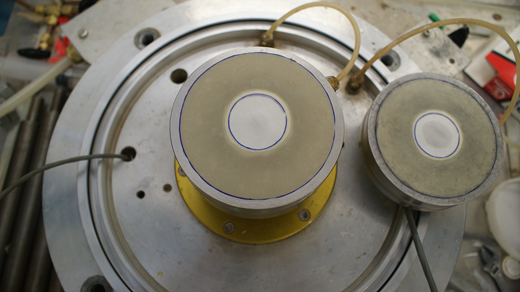
The development of the frictional forces at the contact between the platens and the soil specimen (otherwise known as the end restraint) may result in premature development of non-homogeneous deformations during shearing (Lo, 1985; Rowe and Barden, 1964). Thus, free ends with enlarged end platens were used to reduce platen restraint and to promote uniform radial specimen deformation, even at large axial strain. For this purpose, the technique developed at UNSW (Lo, 1985; Lo et al., 1989) was employed, which is described below.
A 0.30-mm-thick latex membrane, which was cut slightly larger than the soil specimen, prevented soil particles from contacting the top or bottom platen. A circular opening matching the porous disk diameter was provided to ensure free drainage. Platens were coated with high-vacuum grease before carefully placing and pre-loading the latex membrane to the expected maximum stress. Figure 2 shows prepared free ends with enlarged end platens.
Specimen mould setup
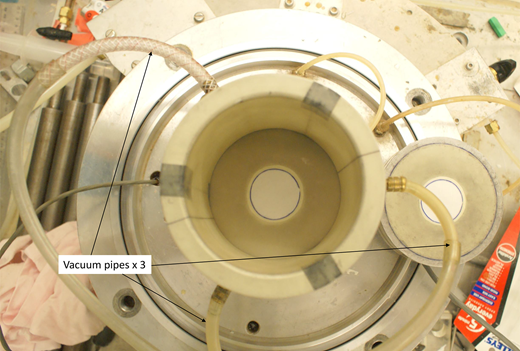
A flared metal split mould, designed to rest on the enlarged bottom platen, was used for specimen preparation. The elastic latex membrane was attached to the bottom platen using two rubber rings, and the split mould was placed on top of the bottom plate, with the membrane on the inside face of the mould. A vacuum pressure of 20 kPa was applied to secure it along with the interior periphery of the mould. The assembled split mould at this stage is shown in Figure 3.
Specimen preparation
Due to the difficulties, expense, and time in retrieving high-quality samples, triaxial tests are mostly performed on reconstituted specimens (Lagioia et al., 2006). Tested materials used for this study were Sydney sand (minimum void ratio, emin = 0.565; maximum void ratio, emax = 0.855), Sydney sand with fines, and pond ash. All the prepared specimens had a height-to-diameter ratio of 1, that is, 100 mm in diameter and 100 mm in height.
Consideration of choosing a higher height-to-diameter ratio of 2 or more may include overcoming effects of end restraint due to friction on the end plates as well as allowing shear bands to develop freely and avoiding interception by the end plates (Lade, 2016). However, with the use of techniques such as lubricated ends, a height-to-diameter ratio of unity is often preferred (Lade, 2016) and also widely used in liquefaction studies (Carraro and Prezzi, 2008; Omar and Sadrekarimi, 2015; Rabbi et al., 2021; Yamamuro and Lade, 1997), as it promotes uniform strains in the specimen, minimises the likelihood and extent of specimen tilting during shearing and results in an appropriate failure condition that best represents the soil strength (Baki et al., 2019; Bobei, 2004; Lade, 2016).
Several key specimen preparation techniques, such as moist tamping (MT), dry deposition (DD), water sedimentation (WS), slurry deposition (SD), air pluviation (AP), and water pluviation (WP), have been followed for many liquefaction studies (Carraro and Prezzi, 2008; DeGregorio, 1990; Ishihara, 1993; Khalili and Wijewickreme, 2005; Lade, 2016; Sze and Yang, 2014; Thomson and Wong, 2008; Wanatowski and Chu, 2008). The selection of the specimen preparation method depends on the purpose of the research. The moist placement method is a commonly chosen specimen reconstitution method for the liquefaction study of sands and silty sands, as it allows the preparation of specimens for a wider range of densities without particle segregation. On the other hand, specimens formed using wet deposition methods (WS and SD) better represent field conditions and, thus, are also followed by researchers for liquefaction studies. At UNSW, a modified MT (referred to as moist placement, MP) was used for liquefaction testing of silty sands, whereas both MP and a wet deposition method (referred to as paste deposition, PD) were used for pond ash testing. Falling height, depositional intensity, and uniformity of sand rain are considered to be the key factors controlling traditional specimen preparation technique by way of pluviation (Lagioia et al., 2006). In the wet deposition or wet placement method, dry soil particles are pluviated into deaired water with a controlled or near-zero falling height (Huang et al., 2015; Yamamuro and Wood, 2004). On the other hand, in the SD method, the soil is first thoroughly mixed with de-aired water and then poured or spooned into a specimen preparation mould (Kuerbis and Vaid, 1988; Rahardjo, 1989). However, the newly developed PD technique is different from wet or SD methods, and not many researchers have used a similar specimen preparation technique in the past. Details of both MT and PD methods are discussed in the next two sections.
Moist placement
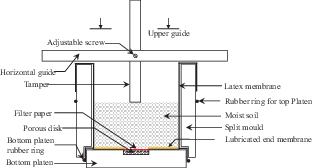
Usual problem with traditional MT is that tamping of nth layer affects n − 1, n − 2 layers, and so on. To eliminate this issue, the size of the tamping area was controlled so that the stress bulb did not penetrate into n − 1 or n − 2 layers. To achieve a loose to medium-dense density, specimens were prepared by placing the moist soil in ten layers. In each layer, a predetermined amount of soil was placed by a spoon, and then the surface was levelled. After that, the layer was worked to the target thickness by a plastic strip of a cross-section of 8.5 mm × 20 mm. This plastic strip was attached to a horizontal strip to control working depth. Figure 4 shows the arrangement for MP specimen preparation. For preparing dense soil specimens, moist soil was also placed in ten layers and tamped by dropping a mass of 0.64 kg (diameter of 40 mm) from a controlled height. Targeted densities could be achieved by adjusting drop height. It has been reported that a high level of uniformity could be achieved following a similar specimen preparation method for dense specimens (Ladd, 1978).
Paste deposition
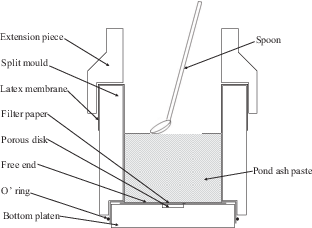
This proposed PD technique is termed to emphasise the paste-like consistency of tested pond ash slurry. This PD technique aimed to better simulate the wet disposal process of pond ash in an ash pond and, thus, possess the fabric of in situ pond ash. The procedure is summarised below, and more details can be found in Zhang (2014):
The membrane, split mould, and extension piece were first installed on the bottom platen, as shown in the schematic diagram in Figure 5. The loose-fit extension piece was placed on the split mould. A thin film of petroleum gel was used between the extension piece and the split mould to prevent leaking water from the extension piece.
Material with a predetermined dry mass was mixed with a predetermined volume of de-ionised and de-aired water to get a targeted moisture content of 60%. After mixing, the resultant material had a paste-like consistency. The paste-like material was then placed in large desiccators under a 90 kPa vacuum for 45 min and agitated every 5 min to remove air bubbles.
The paste, being kept in a well-stirred state (gentle stirring was done to avoid introducing bubbles into the paste), was then placed into the mould by a ladle-shaped spoon in small quantities (about 15 g in wet weight) to simulate the wet disposal process. To minimise disturbance, the paste was allowed to slide out of the spoon tip onto the surface of the beneath layer. The specimen was prepared in five layers, and each layer was left to sit for 45 min to allow the settlement to fully develop. Any water that bled out on the surface was carefully soaked up by tissue paper. The whole deposition was conducted with minimum disturbance, and this gave a loose PD specimen.
Vibration was applied after preparing the whole specimen while monitoring the settlement to achieve a target void ratio (within the attainable limit). For a highly dense specimen, vibration was applied continuously during placement, and the time left for each layer to settle was extended to 2 h.
Thereafter, the drainage valve connected to the bottom platen was opened and maintained a negative water head of 1 m (∼−10 kPa) to facilitate draining out the remaining water. When the surface became slightly unsaturated, the extension piece could then be removed. The extra material (normally 1–2 mm in height) was trimmed off with care, and the top platen was placed on the specimen. After that, the bottom drainage valve was closed, and ∼−5 kPa vacuum pressure was applied from the top platen to secure the specimen. The split mould was removed thereafter.
Evaluation of PD technique
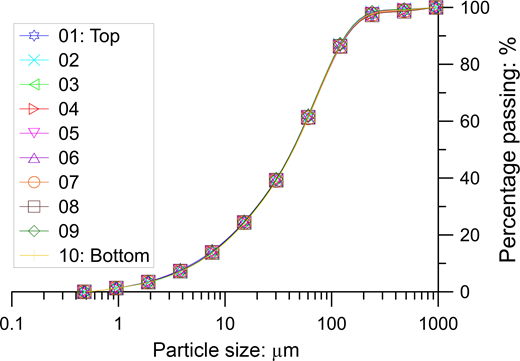
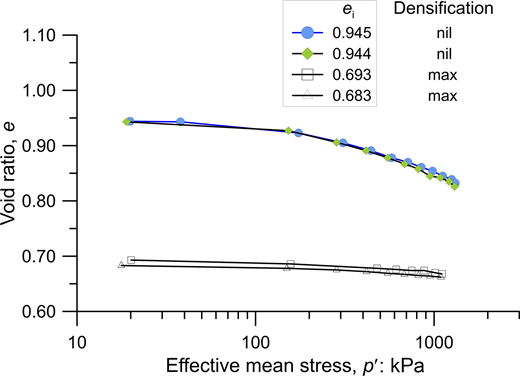
Particle segregation and attainable range of void ratio are the two key aspects that were considered to evaluate the effectiveness of the newly proposed PD specimen preparation techniques for liquefaction studies. The PSDs of ten slices along the length of the PD specimen, conducted by a laser particle size analyser, are shown in Figure 6. It can be seen that the variation of PSD curves between slices is minor. The variation of medium diameter (d50) and specific surface area between layers was also in a very close range, 43–44 µm and 0.505–0.528 m2/cm2, respectively. This illustrates that the specimens prepared by the developed PD technique were free of particle segregation. Figure 7 shows isotropic consolidation lines (ICLs) of loose and dense pond ash specimens by the PD technique. The upper pair of ICLs of the loose specimens was prepared under minimum disturbance, whereas the lower pair of ICLs ultra-dense specimens underwent maximum vibration. ei in the figure is the void ratio before consolidation. To evaluate the reproducibility of the PD technique, a pair of ICLs, each for both loose and ultra-dense states, has been presented (Figure 7). Any targeted initial state located in between these boundaries was attainable for the tested pond ash. The attainable range of void ratio was suitable for evaluating different liquefaction behaviours.
Saturation
Saturation with CO2 and de-aired water
The objective of CO2 percolation was to replace air with CO2 in the specimen, which is more soluble in water under pressure. Thus, this process facilitated the achievement of a fully saturated soil specimen. After sealing the soil specimen with rubber rings on the top and bottom platens, CO2 was percolated under a vacuum pressure of 10 kPa. The flow rate was usually kept at 1–2 bubbles/s, as it was verified by placing the outlet into the water. The percolation was continued for 30 min normally but extended up to 1 h for highly dense specimens.
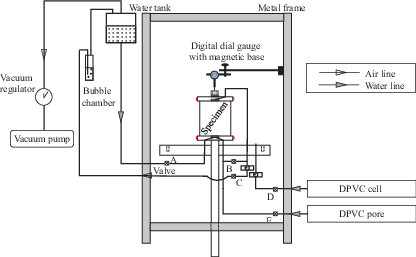
After CO2 percolation, de-aired water was introduced through the bottom drainage line under a double-vacuum flushing system with a small and constant water head of about 0.5 m without any significant washout of fines. Figure 8 shows a schematic diagram of vacuum flushing with de-aired water. The valve of the bottom platen ‘A’ was opened so that the de-aired de-ionised water, as stored in an elevated water tank, could flow from the bottom of the specimen and come out through the top platen opened drainage line (valve ‘C’ was open). A bubble chamber was used to monitor the movement of air/CO2. The washout of fine particles was checked at the end of the test by examining filter paper placed above the porous disk’s surface on the top platen. Any significant change in colour and smoothness of filter paper was used as a basis for fine movement. Vacuum flushing was considered to be completed until continuous bubble-free flow of water through the top platen’s drainage line was observed. Change in specimen void ratio at the end of vacuum flushing was calculated with direct measurement of diameter with the perimeter tape, and change in specimen height was tracked by way of a digital dial gauge placed on the top of the specimen.
Back pressure saturation
The principal aims of applying back pressure to the soil specimens are to (i) dissolve pore air/CO2 (remaining after water flushing) into the pore water and hence increase saturation and (ii) simulate pore water pressure (PWP) in the field. Once de-ionised and de-aired water had been introduced into the triaxial cell, the constant effective stress was maintained by replacing the vacuum in the specimen with a cell pressure, typically set at 20 kPa, and the ‘digital pressure volume controller (DPVC)’ pore was switched to the back pressure line using two-way valves to ensure that no air bubbles could be introduced into the specimen.
At this stage, screw connections were established for specimens requiring them for extension loading. During the screw connection process, the effective confining stress was increased to a range between 30 and 70 kPa to ensure minimal disturbance to the specimens and prevent over-consolidation. The incorporation of axial force during this step was closely monitored and confirmed to be sufficient for maintaining isotropic conditions. After the screw connections were completed, the effective confining stress was reduced to a range of 20–30 kPa. Subsequently, using DPVC, the pore pressure was systematically increased alongside an increase in cell pressure, ensuring that the specimen maintained constant effective stress, typically set at 20 kPa, until reaching saturation with a Skempton B-value ≥0.98. The minimum back pressure at the final stage of this saturation stage was kept at 300 kPa.
Consolidation
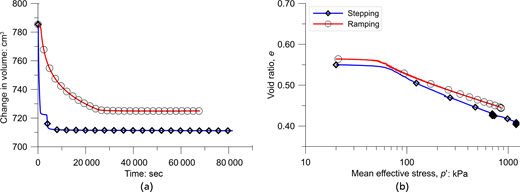
For monotonic test specimens with no extension connection, consolidation was done by ramping cell pressure at a rate of 1–2 kPa/min. On the other hand, for specimens tested with an extension connection, cell pressure was increased by stepping with a waiting time between the steps varied from 30 min to 1 h. During consolidation for specimens with an extension connection, the actuator was moved (from the bottom) to ensure zero deviator stress. For anisotropic consolidation, targeted initial static shear stress was achieved by shearing specimens in a drained condition after reaching the targeted confining stress. Consolidation of specimens was considered to be done when the specimen volume remained unchanged over a longer period of time, such as shown in Figure 9.
Measurements
Accuracy in different measurements is very important to track changes in volume throughout the test, as it plays a significant role in the characterisation of the mechanical behaviour of soil under the CSSM framework (Lade, 2016). Therefore, the accuracy and capacity of different instruments and possible sources of errors are discussed in the upcoming sections.
Deformation
The axial deformation of a specimen was monitored by one digital gauge and three linear variable differential transformers (LVDTs). A digital gauge was used to track deformation after preparing the specimen to the end of vacuum flushing. It was placed on the top of the specimen with the help of a magnetic arm before removing the split mould. The internal LVDTs had an accuracy of 0.005 mm and were used to monitor deformation at the early stage of shearing. An external LVDT was placed on the lower moving shaft outside the perspex cylinder. The accuracy of the external LVDT was 0.05 mm and was used to monitor deformation at the larger strain stage. The algorithm for calculating deformation during shearing is:
If the total displacement is small, then
δz = displacement increment = (δz1 + δz2)/2.
where δz1 and δz2 are displacement changes calculated from signal changes of internal LVDTs
else
δz = δze
where δze is calculated from external LVDT end if
Axial deformation = z = z + δz
Current height H = H − z
Strain increment = δε1 = δz/H
Axial strain = ε1 = ε1 + dε1
The incremental calculation algorithm enables a smooth switch from internal to external LVDT.
Pressure/volume change
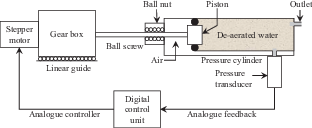
A DPVC with a maximum operational loading capacity of 2000 kPa was used to apply cell pressure. A DPVC is a microprocessor-controlled linear actuator for precise regulation and measurement of liquid pressure and volume change. It can be directly connected to a computer for computer control by way of an interface bus. The principle of DPVC in soil testing is illustrated in Figure 10, and a detailed description is given in the advanced pressure/volume controller (ADVDPC) Handbook (2000). The DPVC used for cell pressure had a maximum operational loading capacity of 2000 kPa and a volume change capacity of 1000 cc. Although the resolution of DPVC was 1 kPa for pressure and 1 mm3 for volume change, the accuracy is ≤0.1% of the maximum capacity of load and volume change. Another pressure transducer of the same maximum loading capacity as the ‘DPVC cell’ was connected to the cell to cross-check and as a backup data source.
The back pressure/PWP and the volume change of the soil specimen were monitored and controlled by a second DPVC with a maximum loading capacity of 1000 kPa. Both top and bottom drainage lines were connected to this DPVC. Volume change or PWP, which needs to be maintained constantly, depends on the drainage condition of testing. For a drained test, DPVC measured the volume change and kept PWP constant, whereas it was the opposite for an undrained test. The DVPC units were calibrated using a micro-burette of an accuracy of 0.01 ml. A pressure transducer was also connected to the top platen of the specimen to have an alternative data source and to check the PWP equilibrium inside the specimen.
Membrane penetration
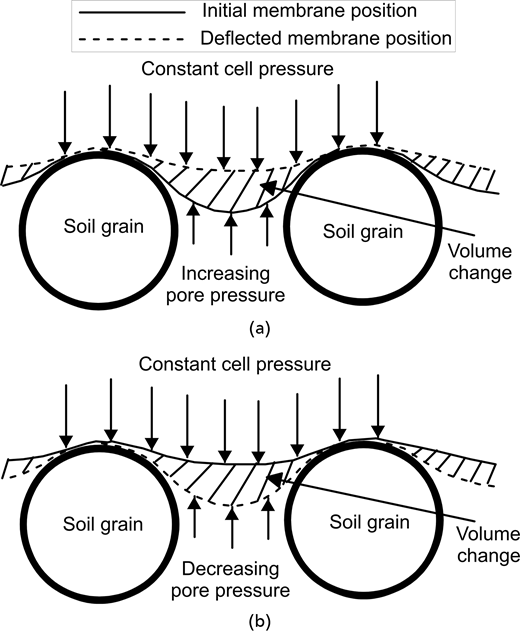
In triaxial experiments, the extent of membrane penetration plays a crucial role in determining the volume change and pore pressure assessment (Wang et al., 2023; Zhang et al., 2023). For example, in an undrained test, it is possible to maintain zero volume change either by using DPVC or by closing the valve. However, in a contractive specimen, the membrane between particles may push out, resulting in a decrease in PWP. Conversely, in a dense specimen, the membrane may pull inwards, resulting in less dilative behaviour, as depicted in Figures 11(a) and 11(b). In a conventional drained test where both the cell and pore pressure are maintained constant, no membrane penetration occurs. However, loading/unloading along proportional stress paths (i.e. q/p′ = const) will require a change in the cell pressure while the pore pressure is constant. Thus, the cell pressure pushes the membrane into/out of the peripheral voids, resulting in an error in volumetric change reading.
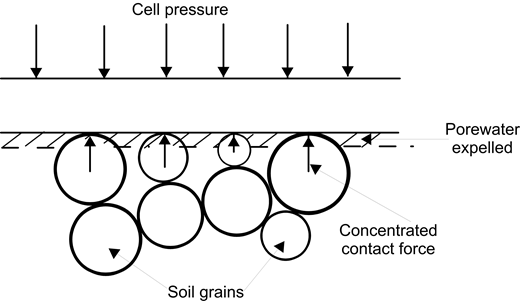
Out of many membrane correction methods available in the literature (Kramer and Sivaneswaran, 1989; Lade and Hernandez, 1977; Lo et al., 1989; Raju and Sadasivan, 1974; Roscoe et al., 1963; Tokimatsu and Nakamura, 1986; Vaid and Negussey, 1984), an error minimisation method based on the liquid rubber technique as proposed by Lo et al. (1989) was employed. The idea behind the use of the liquid rubber technique was based on flexing (Figure 11) and indentation (Figure 12) mechanisms, as pointed out by Molenkamp and Luger (1981). The application of a thin film of liquid rubber (2/3 non-shrink silicone + 1/3 hardening agent) on the inside of the elastic membrane in contact with the soil specimen was demonstrated by Lo et al. (1989) to effectively reduce these errors. Thus, the error due to the flexing mechanism is reduced because the liquid rubber fills the voids between the soil grains in contact with the rubber membrane. In addition, the indentation is reduced by the liquid rubber as it increases the area of soil grains in contact with the membrane.
Errors in void ratio measurements
The accuracy of the void ratio, e measurement is very important as it is used to represent the density state of a soil specimen and has a major influence on altering soil behaviour. During vacuum flushing to the end of saturation, the void ratio of the specimen was calculated using direct measurement of the specimen’s height and diameter. Due to the difficulties in direct measurement of specimen dimensions (height and diameter) during back pressure saturation, change in volume strain, dεV was inferred from the relation dεV ≈ λdε1 where dε1 is the change in axial strain and λ is the ratio εVe/ε1e was deduced from isotropic consolidation rebounding, where ε1e is the elastic component of axial strain and εVe is the elastic component of volumetric strain. However, most of the specimens reached a kPa and maintained the specimen shape at the end of the tests, where is the effective confining stress at CS. For these specimens, the whole specimen can be used to determine the void ratio. It was found that the backward tracking of void ratio from the end of the test was very close to the forward tracking of the void ratios using LVDTs and DPVCs. The forward tracking of the void ratio has been successfully used by the research team and has been discussed in many earlier publications (Baki et al., 2012; Bobei et al., 2009; Rahman et al., 2014; Rahman and Lo, 2014; Zhang et al., 2018).
Other potential sources of error in void ratio measurement include the following:
Error in dry mass measurement, Err(Md)
Error in perimeter measurement, Err(Psam)
Error in height measurement, Err(hsam)
Error in membrane thickness, Err(mt)
Thus, the error in void ratio calculation can be presented as:
However, Err(Md) is dependent on the bulk mass of specimen (Mb) and moisture content (w), because Md is calculated using the following relationship.
Thus, the error in dry mass calculation becomes
The maximum possible error involved in e calculation during back pressure saturation was about 0.5 d ε1, and thus, δe during back pressure saturation was inferred as 0.0015. Finally, the error after back pressure saturation was the combination of error at the end of vacuum flushing and δe during back pressure. Finally, Err(e) after back pressure saturation can be calculated as for sand with fine and for pond ash. After back pressure saturation to the end of the test, readings from DPVC connected to the PWP lines were used to calculate the void ratio change. An example calculation for the maximum possible error in the void ratio has been summarised in Table 1.
Specimen shearing
Shearing mode control
To achieve full control on stress/force application at any stage of shearing, it is essential to have control software. An in-house developed controlled software was used for this purpose, with fully automatic data logging facilities. This software facilitated the application of multiple series of cyclic stress pulses with a targeted magnitude of stress and also allowed smooth switching from strain control to stress control mode.
Loading rate
The selection of loading rate for an undrained triaxial test should be such that a uniform distribution of PWP inside the specimen is developed. Undrained monotonic loading was applied under a displacement-controlled mode with the actuator displacing at a rate varied between 0.01 and 0.030 mm/min. The chosen loading rate was proved to be sufficiently slow to achieve PWP equilibrium throughout the specimen. This was verified by readings from a pressure transducer and DPVC pore connected to the top and bottom drainage lines, which were separated by a valve. For the cyclic loading test, the sinusoidal cyclic load was applied in force-controlled mode with a period of load cycle from 600 to 3600 s, under which PWP equilibrium was also satisfied. Although this loading rate was slower compared with other similar studies (Rees, 2010; Vaid and Chern, 1983; Yang et al., 2004; Yang and Sze, 2010), many researchers (Stamatopoulos, 2010; Tatsuoka et al., 1986; Xenaki and Athanasopoulos, 2003; Zergoun and Vaid, 1994) pointed out that cyclic loading rate does not affect experimental results appreciably.
Identification of instability of soil and loading system
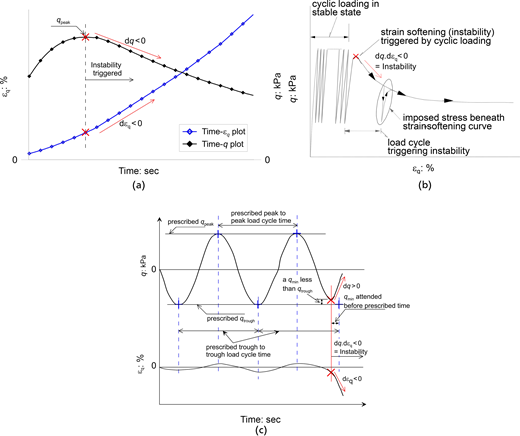
The occurrence of instability can be determined by the condition of In an undrained loading, this condition becomes Depending on whether the triggering action is monotonic or cyclic, the resultant instability can be referred to as static instability or cyclic instability. Figure 13(a) illustrates the triggering of instability under monotonic/static loading, that is, static instability. After reaching a peak deviator stress, qpeak, q was dropping along with strain-softening behaviour and thus triggered static instability, satisfying the condition of Once the soil is ‘brought’ into the deviator strain-softening regime, it is in an unstable state, thus leading to flow-like deformation; and this is considered to be the underlying mechanism of static liquefaction.
In case of cyclic instability triggered under one-way cyclic loading in compression (Figure 13(b)), the deviator strain softening curve defines the limit of deviator stress that can be mobilised, and cyclic liquefaction will result following the same line of argument based on instability under monotonic loading (Lo et al., 2010; Yamamuro and Covert, 2001; Yang and Sze, 2011). Figure 13(c) shows the identification of cyclic instability in the extension side for two-way cyclic loading. Vertical dotted lines in the figure indicate the time for prescribed peak and trough deviator stress (qpeak or qtrough, respectively). When a specimen is brought to a strain softening (instability) state by cyclic loading, the deviator resistance of the specimen as measured by the internal load cell will drop below the prescribed depending on whether it occurs in compression or extension side of stress space and at the same time εq will be increasing in the loading direction. Achieved minimum deviator stress, qmin at state ‘×’ in Figure 13(c), was less than prescribed qtrough, and occurred before prescribed peak time. After that, deviator strain softening behaviour occurred, and therefore, cyclic instability was triggered, satisfying the condition of instability, that is, Identification of triggering of cyclic instability in the compression side under two-way cyclic loading follows a similar argument. It is to be noted that, in cyclic loading, there will be unloading phases interrupting the occurrence of runoff deformation. Also, runoff deformation may not occur at peak or trough deviator stress in a loading cycle if it is limited by travel rate. The force actuator used in the triaxial devices at UNSW for liquefaction research was driven by a geared stepper motor, which is not a fast response system. This means that the actuator cannot apply a force grossly exceeding the resistance of the specimen and drive the specimen to rapid acceleration and uncontrollable deformation. This attribute, plus having a loading train that had a mass of approximately 30 kg, implies that the stationary internal load cell located at the top of the specimen can reliably give the resistance developed by the specimen. When the strain-softening state (instability) is triggered by cyclic loading, the maximum deviator stress that can be mobilised (as measured by the internal load cell) will be less than the prescribed qpeak; and a strain softening response may also be recorded.
Test results
Monotonic test results
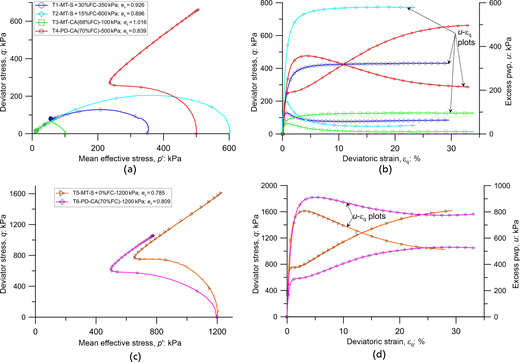
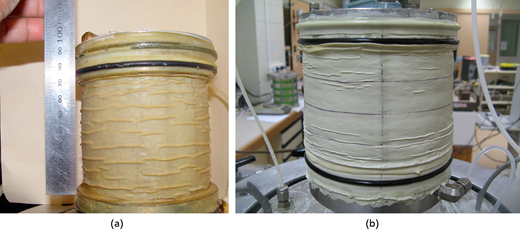
Test results of six representative undrained monotonic tests conducted on two types of soils, namely, Sydney sand with fines (0%–30%) and pond ash (predominantly fines ∼70%), have been included here to evaluate the effectiveness of abovementioned triaxial testing techniques on instability, stress–strain and SS behaviours. Specimens prepared by both MP and PD techniques are included here and tested p′0 varied from 100 to 1200 kPa. Undrained responses (q–p′, q–εq, and u–εq) of tests T1, T2, and T3 conducted at a low p′0 (100–600 kPa) are plotted in Figures 14(a) and 14(b) whereas Figures 14(c) and 14(d) shows the same responses for T4 which was conducted at p′0 of 1200 kPa. The void ratio after consolidation, ec, of the corresponding tests has been included in the legend. Out of six presented tests, three tests (T1–T3) showed flow behaviour (effective stress path, ESP, reached a peak and a post-peak deviator strain softening to a residual resistance that corresponds to steady state, SS) while the tests T4–T6 showed limited flow (Lo et al., 2010) behaviour (strain softening to the so-called QSS and then followed by strain hardening). It can be seen from Figures 14(b) and 14(d) that SS conditions for all the tests can be determined reliably by satisfying the SS condition of To evaluate the uniform deformation of specimens in such a high strain, photos of specimens after loading to a εq ∼ 35% are shown in Figure 15. These pictures demonstrate the effectiveness of the adopted lubricated free ends with latex disks (as discussed in Section 3.1) for getting uniform deformation at a high strain.
The CSSM framework has been proven to be an effective tool for analysing mechanical behaviours of different soils (i.e. sand, sand–silt mixture, and sand–gravel mixture) under monotonic and cyclic loading (Baziar and Lashkajani, 2024; Ghafarian et al., 2020; Pokhrel et al., 2024; Porcino et al., 2022; Rahman and Dafalias, 2022; Thevanayagam et al., 2002; Yan et al., 2023). However, characterisation of mechanical behaviours within the CSSM framework still remains a challenging task due to the fact that the CS or SS are influenced by a number of factors such as the testing conditions, fines content, fine types (i.e. plastic or non-plastic), particle size, and specimen preparation method among others (Amini and Yang, 2025; Baziar and Lashkajani, 2024; Chen and Yang, 2024; Reid et al., 2024; Wei and Yang, 2023). State indices such as state parameter ψ (Been and Jefferies, 1985) or equivalent state parameter ψ* (Rahman et al., 2008; Thevanayagam and Mohan, 2000), often used under the CSSM framework to examine strength and deformation behaviours, are based on a reference line, for example, CSL. CSL line is a line or curve that can be obtained by plotting CS data points from a series of elementary tests in e-logp′ space or e*-logp′ space. Therefore, a reliable testing technique and methodology are key to obtaining reliable CS data points and thus, a very accurate estimate of state parameters.
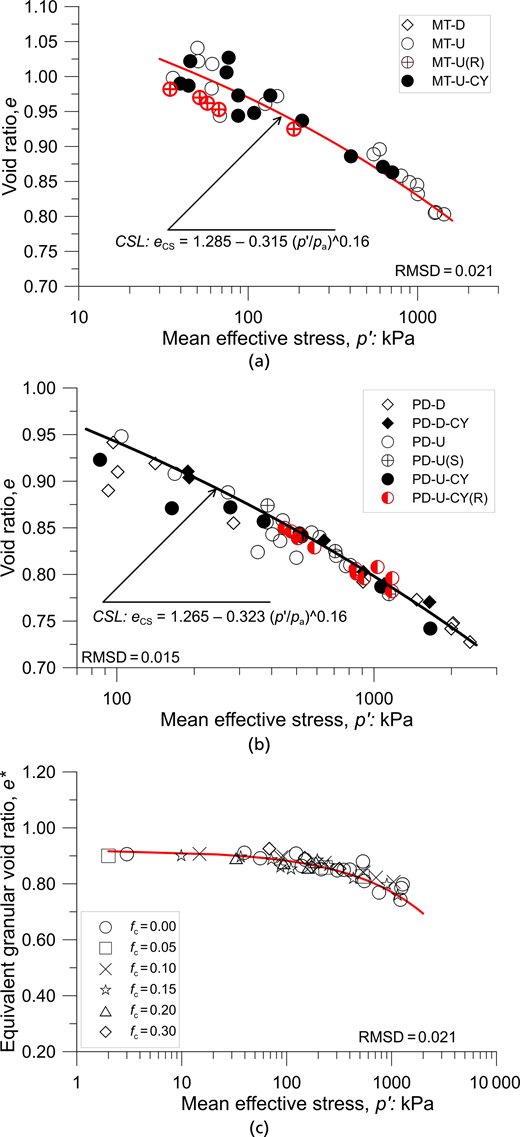
To evaluate the effectiveness of developed and improved triaxial testing techniques at UNSW, CS data points from 166 triaxial tests, as conducted by different researchers (Baki, 2011; Bobei, 2004; Rahman, 2009; Yan, 2015; Zhang, 2014), have been plotted in Figures 16(a)−16(c). Figure 16(a) shows 59 CS data points of pond ash specimens in e-logp′ space prepared under the MT method and tested under drained, undrained loading conditions, reconsolidated specimens, and specimens with cyclic loading history prior to applying displacement-controlled compression loading. In Figure 16(b), CS data points of 62 PD pond ash specimens are plotted in e-logp′ space with testing conditions covered as drained, undrained loading conditions, undrained test on the pre-Sheared PD specimen, specimen with drained or undrained cyclic loading, and reconsolidation history prior to applying displacement-controlled compression loading. For Sydney sand with fines content up to 30%, CS data points of 45 MT specimens are plotted in e*-logp′ space (Figure 16(c)). The root-mean-square deviation (RMSD), a statistical measure of scatter of the data points about the trend curve, of CS data points varied between 0.015 (MT pond ash) and 0.021 (PD pond ash and Sydney sand with fines) which is acceptably small compared to the literature as analysed in Rahman and Lo (2012). As evident from Figures 16(a)−16(c), CS data points coalesce to a single relationship for different materials and specimen preparation methods that can be represented by a power function. Furthermore, using the equivalent granular void ratio, e* concept, a unique CSL could be established for Sand with fines up to a threshold fines content, fthre. At fc = fthre, it is hypothesised that the soil fabric changes from a fines-in-sand to a sand-in-fines soil matrix. This concept has been tested and verified by many other researchers (Lu et al., 2022; Tafili et al., 2023). The highly reliable CS data points and thus unique CSL demonstrate the effectiveness of the adopted and developed testing techniques.
Cyclic loading
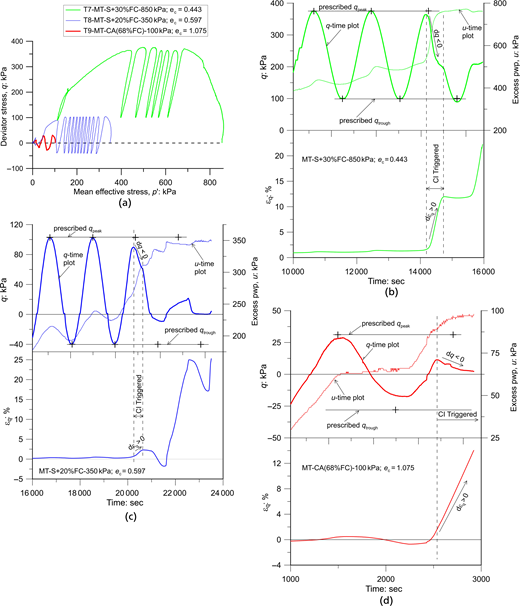
It is known that in laboratory element testing, once cyclic instability is triggered, the stress–strain curve may or may not be measured depending on the location of the load cell and the design of the loading system (Lo et al., 2010; Vaid and Sivathayalan, 2000). Thus, the results of three tests (T7, T8, and T9) conducted at different forms of cyclic loading are included here to illustrate the triaxial testing system’s capability to measure cyclic instability behaviour reliably. Figure 17(a) shows q-p′ responses of three cyclic tests, whereas individual time plots for q, εq, and u of these tests are shown in Figures 17(b)−17(d), where ‘+’ symbols indicate the prescribed time for qpeak or qthough. The one-way cyclic test specimen, T7, was sheared by two packets of cyclic loading. In the third loading cycle of the second packet of cyclic loading, the prescribed qpeak could not be attained, and cyclic ESP dipped downwards (Figure 17(a)) and attained a maximum deviator stress qmax (<qpeak) just before the prescribed time for qpeak. That means the specimen did not have enough strength to gain qpeak while the force actuator was still applying compression loading for the assigned travel time (i.e. 450 s if 1800 s/cycle was applied). Prior to this state, the maximum and minimum deviator stresses were mobilised at the prescribed times for qpeak and qthough, respectively (Figure 17(b)). Just after reaching a qmax in the last cycle, a strain-softening response and a rapid generation of excess PWP were observed with the mobilised deviator stress reducing despite being in the loading phase (Figure 17(b)). At this state, cyclic instability was triggered, satisfying the condition of as indicated in Figure 17(b). For a two-way non-symmetric cyclic loading test, T8, the soil specimen could undergo prescribed qpeak and qthough and at prescribed times up to 11th loading cycles. However, after attending a qmax < qpeak in the 12th loading cycle, a rapid excess PWP generation together with deviator strain softening was observed (Figure 17(c)). Therefore, cyclic instability was triggered. In the last loading cycle, the soil specimen essentially lost its entire strength as it could only gain a qmax and qmin of 20 and 0 kPa, respectively. Specimen T9 was at a p′0 of 100 kPa and under two-way symmetrical cyclic loading with prescribed qpeak and qthough of 31 kPa and −28 kPa, respectively. For this specimen, cyclic instability was triggered in the compression side, as evident from the time plot for q, εq, and u in Figure 17(d). For all these illustrated tests, cyclic instability was triggered in the compression side of the stress space irrespective of the applied form of loading. Also, cyclic instability triggered just (T7and T8) or well before (T9) the prescribed time for qpeak of the corresponding loading cycle. In the same way, the triggering of cyclic instability in the extension side of the stress could be reliably detected and measured by the developed triaxial device.
Summary
The summary of liquefaction testing techniques and improvements made in the triaxial testing procedure at UNSW is given:
A fully automated triaxial apparatus was established and equipped with adequate instruments that provided reliable and sufficiently accurate measurements of various quantities during the test. The control software was modified for conducting some special cyclic loading tests. The system allowed for to performance stress and strain path testing control. The testing system also allowed switching loading mode from monotonic to cyclic loading or vice versa at any stage of shearing. Different packets of cyclic loading could also be applied during a cyclic loading test. Continuous area correction of the specimen during shearing was achieved using control software.
A modified moist tamping technique, referred to as MP, was adopted for sand with fines, where the tamping depth was controlled to ensure a uniform and homogeneous distribution of the void ratio in reconstituted soil specimens. The method is free from fine migration during testing.
A specimen preparation technique, referred to as PD, was proposed and evaluated. For tested pond ash, the proposed PD technique provided no particle segregation, and a considerably wide range of attainable initial states could be achieved.
Assessment of possible sources of errors was made, and a change in void ratio throughout the testing was measured/tracked with high accuracy as demonstrated by the highly reliable CS data points (Figure 16) with very low RMSD.
The liquid rubber technique, as proposed by Lo et al. (1989), was adopted and found to be effective in minimising membrane penetration and bedding errors.
The reported triaxial testing system and testing procedure ensures uniform shearing of specimens at large strain as well as measuring SS reliably.
Attainment of highly reliable CS data points and thus establishing a unique CSL demonstrates the effectiveness of adopted and developed testing techniques. This, in turn, facilitates a very accurate estimation of the state parameter to predict instability behaviour and their triggering by way of CSSM framework for both tested materials and under both static and cyclic loading conditions.
Acknowledgements
The first and second authors would like to acknowledge the University Postgraduate Research Scholarship (UCPRS), Endeavour International Postgraduate Research Scholarship (EIPRS), and UNSW Global scholarships for providing financial support for conducting PhD research at the UNSW, Australia. The third author acknowledges experimental work conducted by his PhD students (Jian Chu, Doru Bobei, Jiajun Zhang, and Jun Yan) at UNSW.