Skip to article sections

Stone columns are an effective ground improvement technique for mitigating liquefaction hazards in seismically active regions. This review critically evaluates the mechanisms, applications, and limitations of stone columns through analysis of experimental studies, numerical simulations, and field case histories. The reinforcement effects of stone columns, including enhanced drainage, soil densification, and stress redistribution, are examined. Key design parameters influencing stone column efficacy, such as area replacement ratio and column spacing, are discussed. While stone columns have demonstrated potential in reducing liquefaction-induced deformations, their performance depends on site-specific conditions and design configurations. Challenges associated with stone column implementation, such as clogging and bulging failure under seismic loading, are assessed. Recent advancements in geosynthetic encasement technology show promise in enhancing column stability and drainage capacity. Future research priorities include the development of comprehensive design guidelines, establishment of performance databases, and validation of numerical models through collaborative efforts between researchers and practitioners. This review provides valuable insights to guide the optimisation of stone column technology for enhancing infrastructure resilience in earthquake-prone regions.

AS

stone column area

D

stone column diameter

Dr

relative density

e

void ratio

H

height of an embankment

L

length of the stone column

ru

excess pore water pressure ratio

s

stone column spacing

s/d

spacing to diameter ratio

Vs

shear wave velocity

γ

unit weight of material

ϕ

angle of friction of the stone

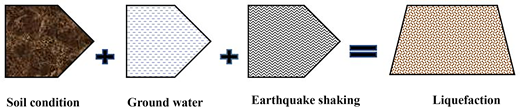
Earthquake-induced soil liquefaction poses a significant hazard to critical infrastructure and public safety in seismically active regions. The phenomenon of liquefaction occurs when saturated, loose granular soils are subjected to strong ground shaking, leading to a sudden loss of shear strength and stiffness (Seed and Idriss, 1982; Youd et al., 2001). As depicted in Figure 1, the sequence of triggering conditions for liquefaction involves the presence of susceptible soil conditions, high groundwater table, and intense seismic loading. The consequences of liquefaction can be catastrophic, manifesting as excessive settlements, lateral spreading, and bearing capacity failures.

To mitigate the risks associated with liquefaction, various ground improvement techniques have been developed and implemented in practice. Among these techniques, stone columns have emerged as a viable and cost-effective solution for enhancing the performance of liquefiable soils (Priebe, 1991; Baez and Martin, 1995). Stone columns are vertical columns composed of compacted gravel or crushed stone installed using vibro-displacement or vibro-replacement methods (Barksdale and Bachus, 1983). The primary mechanisms by which stone columns mitigate liquefaction include densification of the surrounding soil, provision of drainage pathways for excess pore pressure dissipation, and reinforcement of the soil matrix (Adalier and Elgamal, 2004).

The effectiveness of stone columns in reducing liquefaction potential has been extensively investigated through experimental studies, including centrifuge modelling (Adalier et al., 2003), full-scale field testing (Ashford et al., 2000; Boulanger et al., 1998), and shaking table experiments (Yet et al., 2017; Sasaki and Taniguchi, 1982). These experimental investigations have provided valuable insights into the behaviour of stone column–reinforced ground under various loading scenarios and have supported the development of analytical and numerical models for predicting their performance.

However, despite the growing body of research on stone columns for liquefaction mitigation, there remains a need for a comprehensive review synthesising the current state of knowledge, identifying key challenges, and outlining future research directions. This review aims to critically assess the mechanisms, application, and limitations of stone columns for liquefaction mitigation by examining evidence from experimental studies, numerical simulations, analytical models, and field case histories. The objectives of this review are to:

  • elucidate the fundamental mechanisms governing the performance of stone columns in liquefiable soils

  • evaluate the influence of key design parameters, such as area replacement ratio, column spacing, and material properties, on the effectiveness of stone columns

  • identify critical challenges and limitations associated with the implementation of stone columns for liquefaction mitigation

  • discuss recent advancements, including the use of geosynthetic-encased stone columns (geosynthetic-ESCs), and their potential for enhancing the performance and reliability of the technique

  • provide recommendations for future research directions to address knowledge gaps and optimise the design and application of stone columns in seismically vulnerable regions.

By synthesising the existing knowledge and identifying avenues for further investigation, this review contributes to the advancement of stone column technology as a reliable and sustainable solution for liquefaction mitigation. The findings of this review are expected to provide valuable insights for geotechnical engineers, researchers, and policymakers to enhance the resilience of infrastructure in seismically active areas.

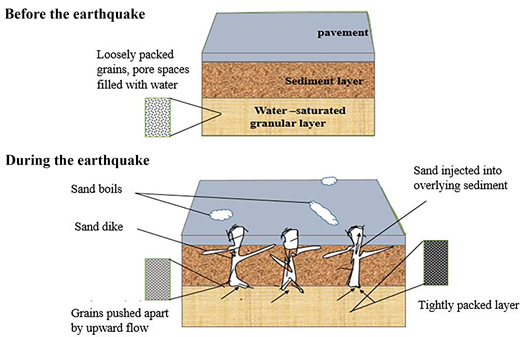
Figure 2 shows the contrast in soil conditions before and after liquefaction. It demonstrates how seismic shaking leads to pore pressure build-up and loss of effective stress, resulting in soil liquefaction.

Stone columns mitigate liquefaction through three key mechanisms:

  1. Drainage: The highly permeable stone column material facilitates rapid dissipation of excess pore water pressures generated during seismic events, preventing liquefaction triggering (Adalier and Elgamal, 2004; Seed and Booker, 1977).

  2. Densification: Vibro-replacement installation methods densify the surrounding soil, increasing its relative density and resistance to liquefaction (Baez and Martin, 1995; Massarsch and Fellenius, 2002).

    The densification effect of stone columns is highly dependent on the method of installation. Vibro-replacement methods, in particular, cause lateral displacement and vibration-induced compaction of surrounding loose soil. This increases relative density and shear resistance, reducing the potential for liquefaction (Massarsch and Fellenius, 2002; Slocombe et al., 2000).

  3. Reinforcement: The stone column stiffness and confinement provided by the surrounding soil create an improved composite system with higher shear strength and bearing capacity (Goughnour and Pestana, 1998; Ambily and Gandhi, 2007).

These mechanisms collectively enhance soil properties, reduce excess pore pressures, and improve overall stability of the treated ground, effectively mitigating liquefaction hazards.

The steps involved in installing stone columns and how they affect the characteristics of the soil:

  • installation method (vibro-replacement, vibro-displacement)

  • effects on soil properties (densification, increased drainage, enhanced shear strength)

  • soil improvements (increased resistance to liquefaction, reduced shear stress, better load distribution).

Column diameter, spacing, and arrangement pattern are among the design characteristics that affect how well stone columns mitigate liquefaction (Baez and Martin, 1995; Priebe, 1991). Columns are typically triangular or square in shape, with diameters ranging from 0.6 to 1.2 m and spacing of 1.5–3.5 m (Adalier and Elgamal, 2004; Barksdale and Bachus, 1983).

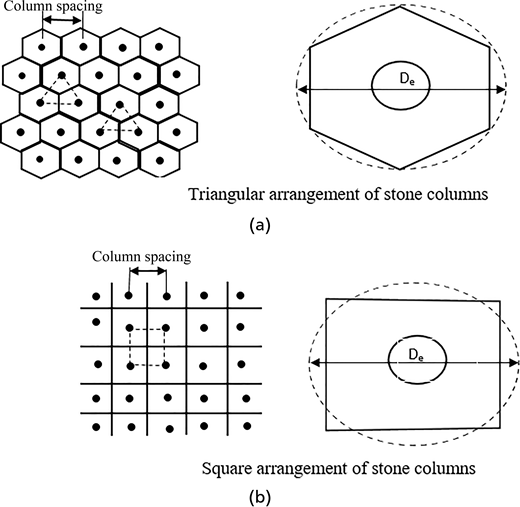
The area ratio is used to quantify ground treatment with stone columns. The area ratio is the area of tributary soil divided by the area of stone columns. Usually, an area ratio of 10%–30% is used (Part 1 of IS code 15284:2003). Figure 3 illustrates various patterns of stone columns, including triangular, square, and hexagonal arrangements, as specified in IS code 15284:2003 part 1.

According to IS code 15284:2003 Part 1, the diameter of the circular effect region is 1.128S for square patterns and 1.05S for triangular patterns, where ‘S’ corresponds to the centre-to-centre spacing between granular columns.

Table 1 compares the performance of ordinary stone columns (OSCs) and ESCs under static, cyclic, and dynamic loading conditions, summarising their effectiveness in terms of load capacity, settlement, and resilience.

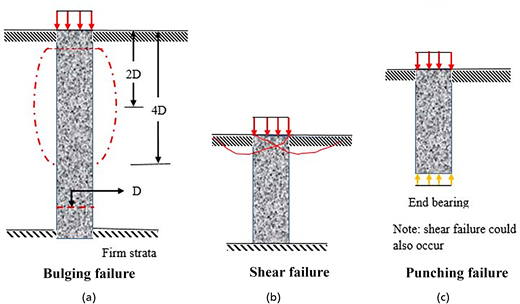
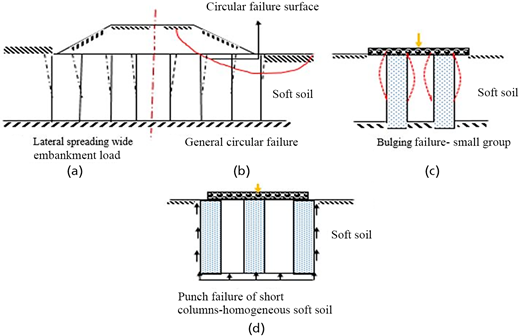
Despite their proven effectiveness, stone columns can experience different failure modes during seismic events that may compromise their liquefaction mitigation potential. Common failure mechanisms include bulging, shear failure, and excessive settlement, which is shown in Figures 4 and 5. Bulging failure happens when the surrounding soil’s lateral confining pressure is not enough to stop the stone column’s outward deformation (Hughes and Withers, 1974). Soft, cohesive soils with low undrained shear strength are more likely to experience this failure mode.

Furthermore, field case studies have demonstrated that actual earthquakes can cause stone columns to fracture (Hausler, 2002). These case studies highlight the importance of proper design, construction quality control, and post-installation monitoring to ensure the long-term performance of stone columns for liquefaction mitigation (Boulanger et al., 1998; Slocombe et al., 2000).

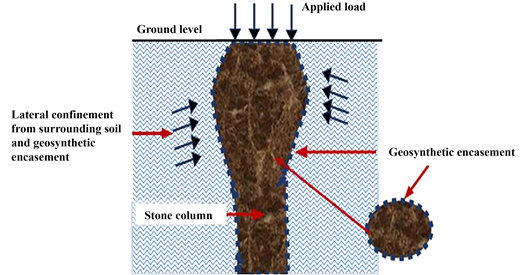
Using geosynthetic-ESCs is a novel approach to enhance performance and reduce the disadvantages of traditional stone columns (Murugesan and Rajagopal, 2007; Yoo and Lee, 2012). Geosynthetic-covered stone column is shown in Figure 6.

OSC

  • homogeneity affected due to column deformations

  • prone to clogging.

ESC

  • studied for ground supporting extensively

  • increase bearing capacity and lateral load resistance.

The geosynthetic encasements (GECs) also fulfil the role of filter and excluded the soil particles of the surrounding area from entering the stone column (Adalier and Elgamal, 2004; Indraratna et al., 2013). This filtering mechanism keeps the stone column highly permeable and drainage capacity to dissipate additional pore water pressures following earthquake stress (Murugesan and Rajagopal, 2010). As is evidenced by number of models and studies, especially in soft fine-grained soil, geosynthetic-ESCs exhibit higher effectiveness compared with conventional stone columns. Table 2 provides a comprehensive comparison between OSCs and geosynthetic-ESCs, underscoring the additional support and stability offered by GECs (Keykhosropur et al., 2012; Almeida et al., 2013).

Stone columns are a practical ground improvement technique for lowering liquefaction in seismically active areas. Table 3 summarises the foundational studies evaluating stone columns as a liquefaction mitigation strategy, highlighting the key findings and parameters critical to their design and performance.

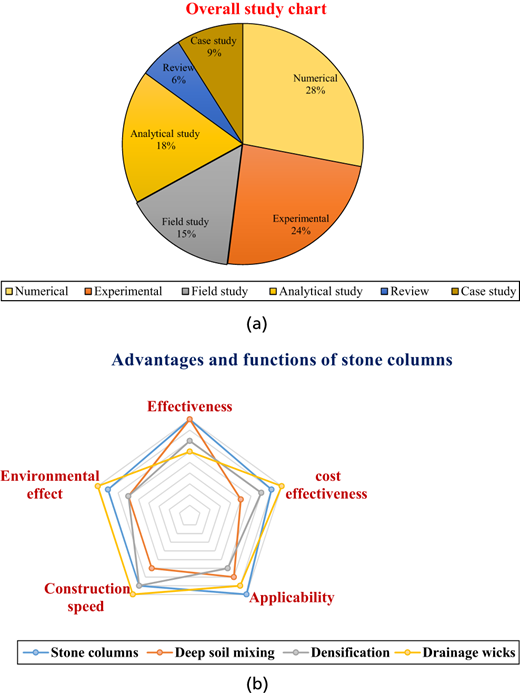
The visualisations in Figure 7 present a comprehensive overview of stone column research for liquefaction mitigation. Numerical studies dominate the field, reflecting a reliance on computational modelling to analyse complex soil–structure interactions, while laboratory and in situ testing provide critical empirical validation. When compared with other mitigation techniques (Figure 7(b)), the radar chart reveals that stone columns excel in effectiveness and environmental impact, while maintaining competitive advantages in cost-efficiency, applicability, and construction speed, making them a versatile solution. This synthesis of existing knowledge not only evaluates current advancements but also identifies directions for future research to enhance soil resilience against liquefaction.

The effectiveness of stone columns under controlled conditions that mimic field-scale behaviour has been extensively studied, especially through centrifuge testing (Adalier et al., 2003; Brennan, 2004; Zhou et al., 2021). The study also demonstrated on how key design factors influences threats of liquefaction and level of reduction by stone columns including the column layout and area replacement ratio.

Brennan (2004) showed that the columns effectively reduced seepage pressure and displacement in sandy soil during seismic load through the centrifuge tests. The research also established the finding that among the functionalities of stone columns, sustaining the level of drainage was one of the most important. Zhou et al. (2021) reported more recently centrifuge experiments concerning the effectiveness of stone column–improved ground in mitigating the effects of ground liquefaction. The three pre-selected configurations utilised for the investigations included a loose pre-improved ground, a dense post-improved ground without stone columns, and a dense post-improved ground with stone columns. The analysis of the outcomes substantiated the dominance of the densification effect in controlling post-liquefaction deformation potential (PLDP) as compared with draining influence. The reinforcing effect contributed only a minor improvement to total performance.

Apart from centrifuge test, test using the hollow cylinder apparatus (HCA) has been conducted to investigate the behaviour of the soil elements under cyclic loading condition that characterise the stone column–improved land. Following these tests, Zhang and Wang (2012) performed HCA tests to examine the correlation between the initial static shear stress and the residual volumetric and shear strain of the constituents of the soils. It was observed from the results that the total PLDP is pronounced by the maximal cyclic shear strain of the element soils under cyclic load. This strain may become residual volumetric strain and residual shear strain in case there was an initial static shear stress. Other experimental works have also looked at how different situation affect the extent to which stone column reduces liquefaction. These experimental studies are useful for refining better comparative and predictive design and evaluation methodologies of stone columns, as these studies help furnish essential data on how such systems work for liquefaction countermeasure. Further experiment is needed to understand the efficiency of the soil investigation by stone column in different types of soil, seismicity, and practical conditions. Furthermore, the results must be benchmarked against field case studies and overall long-term performance measurements.

Numerical simulations have become one of the most important methods for evaluating the effectiveness of stone columns also in combination with field investigations and model tests. A number of numerical approaches such as finite element analysis have been applied in order to explain the behaviour of ground reinforced with stone columns under seismic loads. Asgari et al. (2013) also performed a detailed numerical analysis to examine the behaviour of stone columns on reducing the effect of liquefaction of a liquefiable soil layer by employing the finite element–based software called Open Sees PL. A number of parameters, including the nature of the soil, cross-section of the column, and the loading, were evaluated in the study to judge the remediational measure. The outcomes presented showed that stone columns can potentially limit the factors of liquefaction and ground deformation depending on the design inputs and characteristics of the subsoil. In a three-dimensional rheological analysis of a sloping stratum containing stone columns and subjected to liquefaction-induced lateral deformation, Elgamal et al. (2009) looked at how this could be achieved using OpenSees PL.

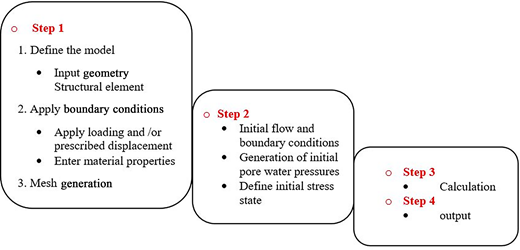
Steps involved in numerical analysis of stone column

Future numerical studies should focus on developing more detailed and complex models that consider complex soil–structure interactions, non-Darcy flow effects, and the influence of various design elements on stone column performance (Taslimian and Noorzad, 2024). Figure 8 outlines the key steps involved in the numerical analysis of stone columns, providing a framework for future research in this area. More dependable and effective numerical tools for the design and analysis of stone column–reinforced ground under seismic loading will eventually result from the encouragement of collaboration between researchers and practitioners to validate and calibrate numerical models against experimental and field data. Table 4 provides a comparison of software used in the numerical simulation of stone column applications for liquefaction mitigation.

Case studies help to assess the challenges and real usefulness of stone columns to eliminate liquefaction. Besides, these studies illustrate how effectively stone columns perform for the mitigation of potential liquefaction and the concomitant ground deformations under actual seismicity conditions containing site-specific characteristics.

Field observations of stone columns and other enhancing techniques were conducted during 1989 Loma Prieta earthquake in California as described by Mitchell and Wentz (1991). They also detected that stone columns helped to reduce lateral spreads and liquefaction-induced settlements as compared with untreated sites, proving that they were effective in minimising the liquefaction problems. Giving a case of a San Francisco region where the stone columns were put before the Loma Prieta earthquake in 1989, Hausler and Sitar (2001) described that the stone columns effectively reduced the effects of the earthquake. The feasibility of stone columns in post-earthquake situations was observed and it was found that liquefaction failed and drastic ground deformations were prevented in loose, liquefiable sand under the site. Luehring et al. (2001) provided documented information on the application of stone columns and drainage wicks at the Salmon Lake Dam in Washington. Liquefiable silt and sand dam foundation in general was improved and surplus pore water pressure was mitigated by stone column–wick drain system. In his paper, Adalier and Elgamal explained how and why Santa Barbara, California’s wastewater treatment plants and Black Sea Georgia’s oil storage facilities should decrease liquefaction with stone columns. These case studies demonstrate how effectively stone columns may be used to increase the saturated sandy soils’ resilience to liquefaction beneath vital infrastructure.

The effectiveness of stone columns in reducing liquefaction in practical situations can be ascertained through case studies and field research. These techniques also offer an opportunity to assess the long-term behaviour and constructability of stone columns, identify the challenges and limitations that emerge in practical applications, and validate the findings of numerical and experimental investigations.

In one of the earliest field studies ever documented, Engelhardt and Golding (1975) investigated the efficacy of stone columns for liquefaction mitigation at a site in California. The study demonstrated that stone column–reinforced ground may still achieve enough shear resistance even when the surrounding soil liquefied. The scientists came to the conclusion that the stone columns strengthened the liquefiable soil’s shear strength by acting as reinforcing elements. The effectiveness of improved ground after the 1989 Loma Prieta earthquake in California, including regions restored with stone columns, was thoroughly examined by Mitchell and Wentz (1991). According to the study, locations with stone columns for reinforcement performed better and suffered less damage than the nearby untreated ground.

In conclusion, field research and case studies have demonstrated the effectiveness of stone columns in lowering the danger of liquefaction in real-world situations. Important details regarding the performance, constructability, and long-term behaviour of stone columns have been made public by these studies. More field study is required to determine how effectively stone columns function in a wider range of soil types, seismic events, and field circumstances. Field performance data must be combined with experimental research and numerical simulations to create more accurate and reliable design and evaluation methods for stone column–improved ground. The outcomes of case studies and field research can aid in the optimisation of stone column design and installation in seismically active areas, ultimately leading to the creation of more resilient and sustainable infrastructure.

Comparison of findings of analytical, numerical, and field research, focusing on stone column performance under diverse conditions, is shown in Table 5.

Machine learning (ML) algorithms have shown promising results in predicting soil behaviour and the efficacy of ground augmentation techniques such as stone columns. Two often used models are neural networks (NNs) and support vector machines (SVMs).

SVMs have proven their capacity to correctly identify soil types and forecast how well soil stabilisation techniques will work. SVMs’ potential in this area was demonstrated by Wang et al. (2016), who used them to forecast soil behaviour for ground improvement.

NNs possess the ability to use deep learning algorithms to process enormous amounts of data and find complex patterns in the link between soil and structure. Zhang et al. (2020b) (vertical ESCs in soft soil) used deep learning NNs to anticipate the settlement of stone columns, demonstrating the predictive potential of these systems.

AI tools: Artificial intelligence (AI) methods such as fuzzy logic systems and genetic algorithms (GAs) have been used in geotechnical engineering to manage uncertainties and optimise the construction of stone columns.

GAs: Genetic algorithms, which mimic natural selection, can be used to optimise design characteristics such as depth, diameter, and stone column spacing. The goal of this method is to save expenses while increasing performance. Liu and Li (2018) demonstrated the efficacy of GAs by optimising the design of stone columns.

Fuzzy logic systems: More adaptable and flexible design criteria must to be incorporated in order to combat the uncertainties in soil conditions and building quality. As a result, stone column performance forecasts are more precise. Fuzzy logic’s advancements and applications in geotechnical engineering were assessed by Alavi and Gandomi (2012).

Regression analysis, including linear and multiple regression models, has been used to predict settlement and load-bearing capacity in stone column–improved ground.

Linear regression models offer a simple method for comprehending the connections between the design, soil properties, and the stone columns’ ability to support loads. Basha and Babu (2010) predicted the load-bearing capability of stone columns using linear regression.

Using these ML and AI tools, geotechnical engineers can predict, optimise, and understand the performance of stone columns for liquefaction mitigation. Table 6 highlights essential parameters and findings on the practical effectiveness of stone columns in mitigating liquefaction-induced issues.

The uses and benefits of ML, AI, and regression analysis approaches in relation to stone columns for liquefaction reduction are contrasted in the following table.

In terms of stone column design and performance assessment, regression analysis, AI, and ML offer a number of benefits. High predictive accuracy and optimisation capabilities are offered by AI tools and ML models, particularly for intricate and non-linear interactions. Even though regression analysis is easier to use and understand, it is still useful for predicting linear relationships.

Even though stone columns have proved effective in lowering the risk of liquefaction, a number of problems still need to be carefully considered and further investigated in order to optimise their performance and reliability. Table 7 outlines common challenges and corresponding mitigation strategies, including solutions for clogging and settlement issues.

Although stone columns are a useful method for reducing liquefaction, there are some implementation issues. The performance of stone columns can be negatively impacted by bulging, smear zones, clogging, and uneven settlement. Stone columns can be made more effective and stable by being aware of these problems and implementing the necessary mitigating measures, such as careful installation, GEC, suitable material selection, and careful design.

This section gives an overview of the primary reasons why stone columns fail during seismic events, while there are many design, installation, geotechnical, and unanticipated elements that might cause them to break. Stone columns are a practical ground improvement device that can increase bearing capacity, decrease the chance of liquefaction, and improve soil stability in seismically active areas.

  • Design and installation issues: Inadequate design and installation techniques are among the primary reasons why stone columns fail.

  • Excessive pore water pressure build-up: Stone columns may collapse during an earthquake if there is a significant build-up of pore water pressure. Inadequate drainage capacity, which can be caused by clogging, poor material selection, or a high fines content, may hinder the dissipation of excess pore pressure.

  • Lateral deformation and bulging: Insufficient lateral support in loose or soft soils can cause excessive lateral deformation and stone column bulging during earthquakes.

  • Liquefaction of surrounding soil: During earthquakes, the surrounding soil may liquefy due to large spaces between stone columns or improper handling of liquefiable soil. If the stone columns do not reach the entire liquefiable stratum, the untreated soil may liquefy and cause instability or failure.

To improve the performance and resilience of stone column systems in seismic zones, it is essential to address these potential failure reasons through continuous monitoring, advanced modelling, and adaptive design methodologies. For improved infrastructure safety and successful liquefaction mitigation in seismic regions, it is essential to comprehend and reduce the hazards related to stone column collapse.

Despite the abundance of studies on the use of stone columns to reduce liquefaction, some areas that require further study and knowledge gaps have been identified.

  • Limited field-scale validation: To validate the long-term performance of stone columns under various soil conditions and seismic hazard scenarios, more thorough field-scale investigations are required, as the majority of current studies rely on numerical simulations and small-scale experiments. The validation of experimental and numerical results and the improvement of design approaches are hampered by the absence of thoroughly recorded case histories.

  • Design parameter optimisation: More study is required to optimise the design of stone columns for various soil profiles, taking into account elements such as column spacing, area replacement ratio, depth of treatment, and combining stone columns with other ground improvement methods. To create solid design standards and maximise the performance of stone columns, systematic parametric studies encompassing a range of soil types, column configurations, and loading situations are required.

  • Long-term performance and durability: More research is needed to determine the long-term performance and durability of stone columns in liquefiable soils, especially with regard to the possibility of clogging drainage pathways, modifications to the properties of the soil, and the impact of installation effects on the enhanced ground response.

  • Stone column behaviour in sloping ground: Compared with level ground settings, the performance of stone columns in sloping ground that is susceptible to lateral spreading is less well characterised.

  • Evaluation of post-liquefaction deformations: It is necessary to develop and validate feasible and dependable techniques for evaluating how well stone columns mitigate liquefaction-induced deformations under a variety of field situations. Although the PLDP hypothesis has showed promise, more research is needed to determine its usefulness.

In addition to facilitating the creation of trustworthy design guidelines and performance evaluation instruments for a range of soil conditions and seismic hazard scenarios, filling these research gaps will help enhance stone column technology for liquefaction mitigation. To improve the performance of stone columns and their practical application, future research should concentrate on these areas. This will increase the infrastructure’s resistance to damage caused by liquefaction.

The current understanding of the effectiveness and challenges of stone columns for preventing liquefaction highlights many interesting avenues for future research:

  • Development of comprehensive design guidelines: Future studies should aim to establish design guidelines that encompass a wide range of factors influencing the effectiveness of stone columns, such as soil characteristics, seismic loading conditions, column configurations, and the impact of slope geometry in areas susceptible to lateral spreading.

  • Long-term performance monitoring and database development: Validating design and evaluation techniques and determining the long-term durability of stone columns need the creation of an extensive library of field case histories and long-term performance data of sites enhanced by stone columns.

  • Numerical modelling and simulation: The best use of stone columns in a variety of soil conditions and seismic scenarios can then be facilitated by using the validated numerical models to perform parametric studies and create design charts and tools.

  • Optimisation of installation methods and column materials: The relative efficacy of various installation techniques (such as vibro-replacement and vibro-compaction) and column materials (such as crushed stone and gravel) under varied soil conditions should be investigated in future research.

The performance and difficulties of stone columns for liquefaction mitigation can be better understood by concentrating on these prospective research avenues. Infrastructure in seismically active areas will eventually become more resilient and sustainable as a result of the development of more precise, dependable, and useful methods for the design and assessment of stone column–improved ground.

This review synthesises findings from diverse studies to assess the performance and challenges of stone columns in liquefaction mitigation. The literature demonstrates that properly designed stone columns can effectively reduce liquefaction potential by improving drainage, densifying soil, and providing reinforcement. Stone columns belong to a common practice used for mitigating the risks of liquefaction on the ground. Due to the high porosity of these columns, they serve as ideal conduits for drainage. This characteristic ensures that during earthquakes the soil does not have high pore water pressure. They reduce its susceptibility to liquefaction of the ground by enhancing its stability. They reduce lateral spreading and settlement by improving the response of the material of the soil with regard to cyclic loads.

However, challenges remain in optimising designs for various soil conditions, evaluating long-term performance, and characterising installation effects. Future research should focus on developing comprehensive design guidelines, establishing field performance databases, and leveraging validated numerical models to create practical design tools. Collaboration between researchers and practitioners is crucial for advancing stone column technology and addressing knowledge gaps.

By expanding our understanding of stone column behaviour and optimising designs, engineers can more confidently deploy this technology to enhance infrastructure resilience in seismically active regions. While alternative techniques may be suitable in some cases, the continued advancement of stone columns through targeted research and field applications will contribute significantly to mitigating liquefaction hazards and ensuring public safety. This review provides a foundation for future efforts to develop more effective strategies for liquefaction mitigation using stone columns.

Priyanka Ahirwar: conceptualisation, software work, and writing the original draft. Pradeep Kumar Jain: supervision and reviewing.

The facilities provided by Maulana Azad National Institute of Technology, Bhopal, is highly appreciated.
Adalier
K
and
Elgamal
A
(
2004
)
Mitigation of liquefaction and associated ground deformations by stone columns
.
Engineering Geology
72
(3–4)
:
275
–
291
, .
Adalier
K
and
Elgamal
A
(
2011
)
Stone column remediation of liquefiable silty marine foundation deposits
. In Proceedings of the 21st International Offshore and Polar Engineering Conference.
International Society of Offshore and Polar Engineers
, pp.
686
–
691
.
Adalier
K
,
Elgamal
A
,
Meneses
J
and
Baez
JI
(
2003
)
Stone columns as liquefaction countermeasure in non-plastic silty soils
.
Soil Dynamics and Earthquake Engineering
23
(7)
:
571
–
584
, .
Alavi
AH
and
Gandomi
AH
(
2012
)
Predicting the load-bearing capacity of shallow foundations using GMDH-type neural networks and EPR
.
Engineering Structures
33
(6)
:
1966
–
1976
, .
Ali
SM
,
Cubrinovski
M
,
Bray
JD
,
Sadeghinejad
A
and
Wotherspoon
L
(
2014
)
Performance of stone columns in liquefaction mitigation: field observations from Christchurch, New Zealand
.
Journal of Geotechnical and Geoenvironmental Engineering
140
(2)
:
04013004
, .
Almeida
MSS
,
Hosseinpour
I
and
Riccio
M
(
2013
)
Performance of geosyntheticencased stone columns in soft clay: numerical and analytical studies
.
Geosynthetics International
20
(4)
:
252
–
262
, .
Ambily
AP
and
Gandhi
SR
(
2007
)
Behavior of stone columns based on experimental and FEM analysis
.
Journal of Geotechnical and Geoenvironmental Engineering
133
(4)
:
405
–
415
.
Asgari
R
,
Baghlani
A
and
Ghaffarzadeh
H
(
2013
)
Seismic performance of stone columns using finite element method
.
Soil Dynamics and Earthquake Engineering
55
:
92
–
102
, .
Ashford
SA
,
Rollins
KM
and
Lane
JD
(
2000
)
Liquefaction mitigation using stone columns in silty sands
.
Journal of Geotechnical and Geoenvironmental Engineering
126
(6)
:
518
–
527
.
Baez
JI
and
Martin
GR
(
1995
) Permeability and shear wave velocity of vibro-replacement stone columns. In
Soil Improvement for Earthquake Hazard Mitigation
.
ASCE
, pp.
66
–
81
.
Barksdale
RD
and
Bachus
RC
(
1983
)
Design and Construction of Stone Columns: Vol. I
(Report No. FHWA/RD-83/026)
.
Federal Highway Administration
.
Basha
BM
and
Babu
GLS
(
2010
)
Analysis of load-carrying capacity of stone columns
.
Geotechnical and Geological Engineering
28
:
161
–
170
, .
Ben Salem
M
,
Benzouak
A
and
Chehat
F
(
2017
)
Performance of stone columns as liquefaction remediation: a case study approach
.
Bulletin of Engineering Geology and the Environment
76
(3)
:
1143
–
1153
.
Boulanger
RW
,
Curras
CJ
,
Kutter
BL
,
Wilson
DW
and
Abghari
A
(
1998
)
Seismic soil-pile-structure interaction experiments
.
Journal of Geotechnical and Geoenvironmental Engineering
124
(10)
:
1042
–
1051
.
Brennan
AJ
(
2004
)
Vertical Drains as a Countermeasure to Earthquake-Induced Soil Liquefaction
.
Doctoral dissertation
,
University of Cambridge
, .
Castro
J
and
Sagaseta
C
(
2011
)
Deformation and consolidation around encased stone columns
.
Geotextiles and Geomembranes
29
(3)
:
268
–
276
, .
El Sherbiny
R
and
Wang
Z
(
2024
)
Liquefaction mitigation around tunnels using stone columns
.
Soil Dynamics and Earthquake Engineering
180
:
107321
.
Elgamal
A
,
Lu
J
and
Forcellini
D
(
2009
)
Mitigation of liquefaction-induced lateral deformation in a sloping stratum: three-dimensional numerical simulation
.
Journal of Geotechnical and Geoenvironmental Engineering
135
(11)
:
1672
–
1682
, .
Engelhardt
H
and
Golding
B
(
1975
)
Use of stone columns for liquefaction mitigation: case study
.
ASCE Specialty Conference on Earthquake Engineering
.
Fattah
MY
and
Qasim
AA
(
2016
)
Predicting settlement of soft soil improved by stone columns using regression analysis
.
International Journal of Civil Engineering and Technology (IJCIET)
7
(1)
:
149
–
163
.
Goughnour
RR
and
Pestana
JM
(
1998
)
Mechanical behavior of stone columns under seismic loading
. In Proceeding 2nd International Conference on Ground Improvement Techniques, pp.
157
–
162
.
Guetif
Z
,
Bouassida
M
and
Debats
JM
(
2007
)
Improved soft clay characteristics by stone column reinforcement
.
Ground Improvement
11
(2)
:
91
–
102
.
Guler
E
,
Alexiew
D
,
Abbaspour
A
and
Koc
M
(
2014
)
Seismic performance of geosynthetic-encased stone columns
.
Transportation Research Record: Journal of the Transportation Research Board
2462
(1)
:
77
–
88
, .
Han
J
,
Ye
S
,
Oztoprak
S
and
Parsons
RL
(
2015
)
Numerical analysis of foundation columns to support widening of embankments
.
Computers and Geotechnics
58
:
59
–
68
, .
Hausler
EA
(
2002
)
Influence of Ground Improvement on Settlement and Liquefaction: A Study Based on Field Case History Evidence and Dynamic Geotechnical Centrifuge Tests
.
Doctoral dissertation
,
University of California
,
Berkeley
.
Hausler
EA
and
Sitar
N
(
2001
)
Performance of improved ground in the 1989 Loma Prieta earthquake
.
Journal of Geotechnical and Geoenvironmental Engineering
127
(10)
:
889
–
902
.
Hughes
JMO
and
Withers
NJ
(
1974
)
Reinforcing of soft cohesive soils with stone columns
.
Ground Engineering
7
(3)
:
42
–
49
.
Indraratna
B
,
Basack
S
and
Rujikiatkamjorn
C
(
2013
)
Numerical solution of stone column–improved soft soil considering arching, clogging, and smear effects
.
Journal of Geotechnical and Geoenvironmental Engineering
139
(3)
:
377
–
394
, .
Keykhosropur
L
,
Soroush
A
and
Imam
R
(
2012
)
Numerical study on stone columns with geosynthetic encasement
.
Geotextiles and Geomembranes
35
:
61
–
68
.
Liu
H
and
Li
L
(
2018
)
Optimization of stone column design using genetic algorithm
.
Geotechnical and Geological Engineering
36
:
3755
–
3767
, .
Luehring
D
,
Bartz
G
and
Bernard
C
(
2001
)
Stone columns and wick drains for dam foundation liquefaction mitigation
. Proceedings of the GeoFrontiers Conference 2001,
ASCE
.
Massarsch
KR
and
Fellenius
BH
(
2002
)
Vibratory compaction of coarse-grained soils
.
Canadian Geotechnical Journal
39
(3)
:
695
–
709
.
Mitchell
JK
and
Wentz
FJ
(
1991
).
Performance of Improved Ground during the Loma Prieta Earthquake
(Vol. 91, No. 12).
National Science Foundation
.
Moayedi
H
,
Huat
BBK
and
Mokhberi
M
(
2010
)
Using stone column as a suitable liquefaction remediation in Persian Gulf Coast
.
Electronic Journal of Geotechnical Engineering
15
:
1757
–
1767
.
Murugesan
S
and
Rajagopal
K
(
2007
)
Model tests on geosynthetic-encased stone columns
.
Geosynthetics International
14
(6)
:
346
–
354
, .
Murugesan
S
and
Rajagopal
K
(
2010
)
Studies on the behavior of single and group of geosynthetic encased stone columns
.
Journal of Geotechnical and Geoenvironmental Engineering
136
(1)
:
129
–
139
, .
Nguyen
TV
,
Rayamajhi
D
,
Boulanger
RW
et al.
(
2013
)
Design of DSM grids for liquefaction remediation
.
Journal of Geotechnical and Geoenvironmental Engineering
139
(11)
:
1923
–
1933
, .
Obermeier
SF
(
1999
)
Seismic liquefaction features: examples from paleoseismic investigations in the continental United States. USGS Report, 7
.
Onoue
A
,
Mori
N
and
Takano
J
(
1987
)
In situ experiment and analysis on well resistance of gravel drains
.
Soils and Foundations
27
(2)
:
42
–
60
, .
Pal
S
and
Deb
K
(
2019
)
Effect of clogging of stone column on drainage capacity during soil liquefaction
.
Soils and Foundations
59
(1)
:
196
–
207
, .
Priebe
HJ
(
1991
) Vibro-replacement-design criteria and quality control. In
Deep Foundation Improvements: Design, Construction, and Testing
.
ASTM International
.
Rayamajhi
D
,
Nguyen
TV
,
Ashford
SA
et al.
(
2014
)
Numerical study of shear stress distribution for discrete columns in liquefiable soils
.
Journal of Geotechnical and Geoenvironmental Engineering
140
(3)
:
04013034
, .
Rayamajhi
D
,
Tamura
S
,
Khosravi
M
et al.
(
2015
)
Dynamic centrifuge tests to evaluate reinforcing mechanisms of soil-cement columns in liquefiable sand
.
Journal of Geotechnical and Geoenvironmental Engineering
141
(6)
:
04015015
, .
Şahinkaya
F
,
Vekli
M
and
Çadır
CC
(
2017
)
Numerical analysis under seismic loads of soils improvement with floating stone columns
.
Natural Hazards
88
(2)
:
891
–
917
, .
Sasaki
Y
and
Taniguchi
E
(
1982
)
Shaking table tests on gravel drains to prevent liquefaction of sand deposits
.
Soils and Foundations
22
(3)
:
1
–
14
, .
Seed
HB
and
Booker
JR
(
1977
)
Stabilization of potentially liquefiable sand deposits using gravel drains
.
Journal of the Geotechnical Engineering Division
103
(7)
:
757
–
768
, .
Seed
HB
and
Idriss
IM
(
1982
)
Ground Motions and Soil Liquefaction during Earthquakes
.
Earthquake Engineering Research Institute
.
Slocombe
BC
,
Bell
AL
and
Baez
JI
(
2000
)
The densification of granular soils using vibro techniques
.
Ground Engineering
33
(4)
:
36
–
40
.
Stuedlein
AW
and
Bain
JA
(
2021
)
Probabilistic assessment of lateral spreading mitigation
.
Journal of Geotechnical and Geoenvironmental Engineering
147
(8)
:
04021062
.
Tang
L
,
Zhang
X
and
Ling
X
(
2016
)
Numerical simulation of centrifuge experiments on liquefaction mitigation of silty soils using stone columns
.
KSCE Journal of Civil Engineering
20
(2)
:
631
–
638
, .
Taslimian
R
and
Noorzad
A
(
2024
)
Liquefaction mitigation using stone columns with non-Darcy flow theory
.
Geotechnical and Geological Engineering
42
(6)
:
4375
–
4399
, .
Wang
R
,
Fu
P
,
Zhang
J-M
and
Dafalias
YF
(
2016
)
DEM study of fabric features governing undrained post-liquefaction shear deformation of sand
.
Acta Geotechnica
11
(6)
:
1321
–
1337
, .
Yasuda
S
,
Harada
K
,
Ishikawa
K
and
Kanemaru
Y
(
2012
)
Characteristics of ground motion and damage during the 2011 off the pacific Coast of Tohoku earthquake
.
Soils and Foundations
52
(5)
:
793
–
810
.
Yet
MN
,
Oztoprak
S
and
Boulanger
RW
(
2017
)
Shaking table tests on stone columns in liquefiable sand
.
Soil Dynamics and Earthquake Engineering
97
:
75
–
85
.
Yoo
C
and
Lee
IM
(
2012
)
Performance of stone columns with geosynthetic encasement in soft ground
.
Geotextiles and Geomembranes
34
:
1
–
10
.
Youd
TL
,
Idriss
IM
,
Andrus
RD
et al.
(
2001
)
Liquefaction resistance of soils: summary report from the 1996 NCEER and 1998 NCEER/NSF workshops on evaluation of liquefaction resistance of soils
.
Journal of Geotechnical and Geoenvironmental Engineering
127
(10)
:
817
–
833
, .
Zhang
J
and
Wang
Y
(
2012
)
Cyclic loading behavior of saturated sandy soil using hollow cylinder apparatus
.
Soil Dynamics and Earthquake Engineering
43
:
190
–
198
.
Zhang
Y
,
Chan
D
and
Wang
Y
(
2020
a)
Consolidation of composite foundation improved by geosynthetic-encased stone columns
.
Geotextiles and Geomembranes
48
(1)
:
62
–
69
, .
Zhang
Y
,
Chan
D
and
Wang
Y
(
2020
b)
Consolidation of soft soil improved by vertical geosynthetic-encased stone columns
.
Geotextiles and Geomembranes
48
(2)
:
170
–
180
, .
Zhou
YG
,
Liu
K
,
Sun
ZB
and
Chen
YM
(
2021
)
Liquefaction mitigation mechanisms of stone column-improved ground by dynamic centrifuge model tests
.
Soil Dynamics and Earthquake Engineering
150
:
106946
, .
Zou
W
,
Du
Y
and
Shen
S
(
2020
)
3D plasticity model for coarse-grained soils in seismic conditions
.
Engineering Geology
276
:
105751
, .
Published by Emerald Publishing Limited. This article is published under the Creative Commons Attribution (CC BY 4.0) licence. Anyone may reproduce, distribute, translate and create derivative works of this article (for both commercial and non-commercial purposes), subject to full attribution to the original publication and authors. The full terms of this licence may be seen at Link to the terms of the CC BY 4.0 licenceLink to the terms of the CC BY 4.0 licence.

Data & Figures

Figure 1.
Diagram illustrating factors contributing to liquefaction, including soil condition, ground water, and earthquake shaking.The diagram details the components leading to liquefaction. On the left, an arrow points to an illustration of soil condition. Next, another arrow connects to an illustration of ground water, followed by an illustration representing earthquake shaking. Finally, an arrow points to a shape denoting liquefaction, emphasising the combined effect of these factors. The layout is structured with illustrations aligned horizontally, creating a clear flow from individual contributing factors to the resultant phenomenon.

Liquefaction phenomenon showing the sequence of triggering conditions (adapted from Link to the website of American geoservicesLink to the website of American geoservices)

Figure 1.
Diagram illustrating factors contributing to liquefaction, including soil condition, ground water, and earthquake shaking.The diagram details the components leading to liquefaction. On the left, an arrow points to an illustration of soil condition. Next, another arrow connects to an illustration of ground water, followed by an illustration representing earthquake shaking. Finally, an arrow points to a shape denoting liquefaction, emphasising the combined effect of these factors. The layout is structured with illustrations aligned horizontally, creating a clear flow from individual contributing factors to the resultant phenomenon.

Liquefaction phenomenon showing the sequence of triggering conditions (adapted from Link to the website of American geoservicesLink to the website of American geoservices)

Close Figure 1.
Figure 2.
An illustration shows sediment layers before and during an earthquake, depicting water saturation, sand injection, and soil movement under seismic activity.The illustration compares sediment conditions before and during an earthquake. In the upper section, labelled before the earthquake, layers include pavement, overlying sediment, and a water-saturated granular layer with loosely packed grains and pore water. The lower section, labelled during the earthquake, depicts dynamic processes such as upward water flow forcing grains apart, sand boils, and sand dikes forming as sand is injected into overlying layers. Arrows and annotations highlight the movement of grains, fluid, and sand within the layers, showing soil liquefaction and sediment displacement during seismic shaking.

Ground condition before and after soil liquefaction (Obermeier, 1999)

Figure 2.
An illustration shows sediment layers before and during an earthquake, depicting water saturation, sand injection, and soil movement under seismic activity.The illustration compares sediment conditions before and during an earthquake. In the upper section, labelled before the earthquake, layers include pavement, overlying sediment, and a water-saturated granular layer with loosely packed grains and pore water. The lower section, labelled during the earthquake, depicts dynamic processes such as upward water flow forcing grains apart, sand boils, and sand dikes forming as sand is injected into overlying layers. Arrows and annotations highlight the movement of grains, fluid, and sand within the layers, showing soil liquefaction and sediment displacement during seismic shaking.

Ground condition before and after soil liquefaction (Obermeier, 1999)

Close Figure 2.
Figure 3.
Diagrams illustrating triangular and square arrangements of stone columns, depicting column spacing and corresponding shapes.The image features two diagrams labeled (a) and (b). Diagram (a) illustrates a triangular arrangement of stone columns, showing a hexagonal outline with labeled column spacing between points positioned at the vertices of the hexagons. An elliptical shape labelled De is present at the center. Diagram (b) depicts a square arrangement of stone columns within a grid layout. The diagram indicates column spacing, with dots representing the columns in a grid formation. This diagram also contains a rectangular shape labelled De, circumscribed by a dashed line. Both arrangements demonstrate spatial relationships and configurations relevant to the placement of stone columns.

Various patterns of stone columns (IS code 15284: 2003 Part 1)

Figure 3.
Diagrams illustrating triangular and square arrangements of stone columns, depicting column spacing and corresponding shapes.The image features two diagrams labeled (a) and (b). Diagram (a) illustrates a triangular arrangement of stone columns, showing a hexagonal outline with labeled column spacing between points positioned at the vertices of the hexagons. An elliptical shape labelled De is present at the center. Diagram (b) depicts a square arrangement of stone columns within a grid layout. The diagram indicates column spacing, with dots representing the columns in a grid formation. This diagram also contains a rectangular shape labelled De, circumscribed by a dashed line. Both arrangements demonstrate spatial relationships and configurations relevant to the placement of stone columns.

Various patterns of stone columns (IS code 15284: 2003 Part 1)

Close Figure 3.
Figure 4.
Illustrations depict three types of structural failures: bulging failure, shear failure, and punching failure. Each diagram includes labeled forces and dimensions for clarity.The image presents three diagrams illustrating different types of structural failures in a concrete column. The first section shows bulging failure, with curved lines indicating stress patterns and dimensions marked as D, 2 D, and 4 D above the column and specified connections to the firm strata below. The second section is labelled shear failure, displaying opposing arrows at the column's top, suggesting the direction of forces. The third section, designated as punching failure, indicates end bearing forces on a column, with a note explaining that shear failure could also occur. Each diagram includes clearly defined labels and measurements to clarify their respective concepts.

Single stone column failure mechanisms include (a) punching failure, (b) shear failure, and (c) bulging failure (Barksdale and Bachus, 1983)

Figure 4.
Illustrations depict three types of structural failures: bulging failure, shear failure, and punching failure. Each diagram includes labeled forces and dimensions for clarity.The image presents three diagrams illustrating different types of structural failures in a concrete column. The first section shows bulging failure, with curved lines indicating stress patterns and dimensions marked as D, 2 D, and 4 D above the column and specified connections to the firm strata below. The second section is labelled shear failure, displaying opposing arrows at the column's top, suggesting the direction of forces. The third section, designated as punching failure, indicates end bearing forces on a column, with a note explaining that shear failure could also occur. Each diagram includes clearly defined labels and measurements to clarify their respective concepts.

Single stone column failure mechanisms include (a) punching failure, (b) shear failure, and (c) bulging failure (Barksdale and Bachus, 1983)

Close Figure 4.
Figure 5.
Diagrams depicting several failure modes in soft soil, including circular, bulging, and punch failures, with labelled elements and surrounding soil.The image presents four diagrams illustrating various failure modes that can occur in soft soil. Diagram (a) shows a structure under lateral spreading wide embankment load, emphasizing a circular failure surface and general circular failure beneath the embankment. Diagram (b) highlights another scenario of general circular failure, with soft soil denoted below. Diagram (c) depicts bulging failure involving a small group of columns, marked with curved arrows indicating the bulging effect. Finally, diagram (d) outlines punch failure involving short columns on homogeneous soft soil, with arrows showing the force distribution. Each diagram includes elements that represent the structures, the surrounding soil, and essential load characteristics.

Stone columns can fail in four ways -- punching, general circular, bulging, and lateral spreading (Barksdale and Bachus, 1983) 

Figure 5.
Diagrams depicting several failure modes in soft soil, including circular, bulging, and punch failures, with labelled elements and surrounding soil.The image presents four diagrams illustrating various failure modes that can occur in soft soil. Diagram (a) shows a structure under lateral spreading wide embankment load, emphasizing a circular failure surface and general circular failure beneath the embankment. Diagram (b) highlights another scenario of general circular failure, with soft soil denoted below. Diagram (c) depicts bulging failure involving a small group of columns, marked with curved arrows indicating the bulging effect. Finally, diagram (d) outlines punch failure involving short columns on homogeneous soft soil, with arrows showing the force distribution. Each diagram includes elements that represent the structures, the surrounding soil, and essential load characteristics.

Stone columns can fail in four ways -- punching, general circular, bulging, and lateral spreading (Barksdale and Bachus, 1983) 

Close Figure 5.
Figure 6.
A diagram illustrates a stone column reinforced with geosynthetic encasement under applied load, highlighting lateral confinement from both soil and encasement.The diagram presents the structure and behaviour of a stone column reinforced with geosynthetic encasement under applied load. Arrows at the top indicate vertical loading on the ground surface above the column. The stone column itself is shown in close-up, emphasising its granular structure within the cylindrical geosynthetic encasement. Labels identify the role of the encasement, which provides lateral confinement to the stone column, along with additional confinement from the surrounding soil. The layout highlights the interaction between the applied load, the reinforcing encasement, and the surrounding soil in maintaining the column's stability and performance.

Geosynthetic-covered stone column (Murugesan and Rajagopal, 2010)

Figure 6.
A diagram illustrates a stone column reinforced with geosynthetic encasement under applied load, highlighting lateral confinement from both soil and encasement.The diagram presents the structure and behaviour of a stone column reinforced with geosynthetic encasement under applied load. Arrows at the top indicate vertical loading on the ground surface above the column. The stone column itself is shown in close-up, emphasising its granular structure within the cylindrical geosynthetic encasement. Labels identify the role of the encasement, which provides lateral confinement to the stone column, along with additional confinement from the surrounding soil. The layout highlights the interaction between the applied load, the reinforcing encasement, and the surrounding soil in maintaining the column's stability and performance.

Geosynthetic-covered stone column (Murugesan and Rajagopal, 2010)

Close Figure 6.
Figure 7.
A pie chart presents proportions of study types including numerical, experimental, field, analytical, review, and case studies, while a radar chart outlines advantages of stone columns such as effectiveness, cost, speed, applicability, and environmental effect.The image displays two charts summarising research on stone columns. The first is a pie chart titled Overall study chart, which categorises research types: numerical 28 percent, experimental 24 percent, field study 15 percent, analytical study 18 percent, review 6 percent, and case study 9 percent. A legend accompanies the segments. The second is a radar chart titled Advantages and functions of stone columns, which compares attributes including effectiveness, environmental effect, cost effectiveness, construction speed, and applicability. The chart uses multiple outlines to represent stone columns, deep soil mixing, densification, and drainage wicks, with each outline indicating average performance. Together, the charts convey both the distribution of research approaches and comparative functional benefits of construction methods.

(a) Distribution of study types in stone column research for liquefaction mitigation; (b) comparison of stone columns with other liquefaction mitigation techniques

Figure 7.
A pie chart presents proportions of study types including numerical, experimental, field, analytical, review, and case studies, while a radar chart outlines advantages of stone columns such as effectiveness, cost, speed, applicability, and environmental effect.The image displays two charts summarising research on stone columns. The first is a pie chart titled Overall study chart, which categorises research types: numerical 28 percent, experimental 24 percent, field study 15 percent, analytical study 18 percent, review 6 percent, and case study 9 percent. A legend accompanies the segments. The second is a radar chart titled Advantages and functions of stone columns, which compares attributes including effectiveness, environmental effect, cost effectiveness, construction speed, and applicability. The chart uses multiple outlines to represent stone columns, deep soil mixing, densification, and drainage wicks, with each outline indicating average performance. Together, the charts convey both the distribution of research approaches and comparative functional benefits of construction methods.

(a) Distribution of study types in stone column research for liquefaction mitigation; (b) comparison of stone columns with other liquefaction mitigation techniques

Close Figure 7.
Figure 8.
Flowchart depicting steps in a modeling process, including defining the model, applying boundary conditions, mesh generation, and calculation output.The image shows a flowchart detailing the steps involved in a modeling process. The first box, Step 1, includes three main points: defining the model by inputting geometry and structural elements, applying boundary conditions by specifying loading or displacement, and entering material properties, followed by mesh generation. Step 2 outlines initial flow and boundary conditions, generation of initial pore water pressures, and definition of the initial stress state. Step 3 denotes the calculation phase, while Step 4 indicates the output stage. Each step is presented in a structured manner, highlighting key processes essential for modeling. The flowchart features rounded boxes with distinct headings and bullet points for clarity.

Steps for numerical analysis of stone column

Figure 8.
Flowchart depicting steps in a modeling process, including defining the model, applying boundary conditions, mesh generation, and calculation output.The image shows a flowchart detailing the steps involved in a modeling process. The first box, Step 1, includes three main points: defining the model by inputting geometry and structural elements, applying boundary conditions by specifying loading or displacement, and entering material properties, followed by mesh generation. Step 2 outlines initial flow and boundary conditions, generation of initial pore water pressures, and definition of the initial stress state. Step 3 denotes the calculation phase, while Step 4 indicates the output stage. Each step is presented in a structured manner, highlighting key processes essential for modeling. The flowchart features rounded boxes with distinct headings and bullet points for clarity.

Steps for numerical analysis of stone column

Close Figure 8.
Table 1.

Stone column performance under various loading situations

Loading conditionPerformance metricOSCsESCsCitation
Static loadingLoad-bearing capacityHigh, influenced by soil and material qualityHigher, more consistent due to geosynthetic supportBarksdale and Bachus (1983) 
 Settlement reductionEffective, variable based on installationMore effective, significant reduction in variabilityAli et al. (2014) 
Cyclic loadingCyclic resistanceImproved, enhances soil density and drainageSuperior, prevents bulging, maintains integrityPriebe (1991) 
 Fatigue resistanceGood, depends on material and compactionExcellent, due to geosynthetic encasementHan et al. (2015) 
Dynamic loadingSeismic stabilityEnhances shear strength, reduces liquefactionSuperior, dissipates energy, reduces settlementZhang et al. (2020a) 
 Resilience and recoveryGood, maintains load-bearing capacityExcellent, due to confinement and integrityNguyen et al. (2013) 
Table 2.

Comparing the performance of regular stone columns (OSCs) and geosynthetic-encased stone columns (GECs)

AspectOSCs, or ordinary stone columnsESCs, or encased stone columns
Geosynthetic encasementNot applicableHigh tensile strength, durable geosynthetics, properly installed (Zhang et al., 2020a)
Lateral supportLimited, may require closer spacing (Priebe, 1991)Enhanced due to geosynthetic encasement (Zhang et al., 2020a)
Load-bearing capacityImproved, but variable based on soil conditions (Barksdale and Bachus, 1983)Superior, consistent performance due to encasement (Zhanget al., 2020a)
Settlement reductionEffective, but depends on quality control (Ali et al., 2014)Highly effective, significant reduction in settlements (Han et al., 2015)
Drainage improvementGood, but can be compromised by material segregation (Castro and Sagaseta, 2011)Excellent, consistent drainage paths maintained by geosynthetics (Nguyen et al., 2013)
Installation complexityRelatively simple, requires quality monitoring (Ali et al., 2014)More complex, requires precise installation of geosynthetics (Guetif et al., 2007)
CostGenerally lower cost due to simpler installationHigher initial cost due to materials and installation complexity
ApplicationsSuitable for a wide range of soils and applicationsParticularly effective in soft, liquefiable soils and high-risk seismic areas
Load-settlement behaviourExhibits typical load-settlement curve: initial elastic deformation followed by plastic deformationSuperior load-settlement behaviour due to lateral confinement. Reduced settlements and higher load-bearing capacity (Castro and Sagaseta, 2011)
ChallengesSusceptible to performance issues in soft soils without additional supportRequires precise installation and higher costs due to encasement materials (Castro and Sagaseta, 2011)
Table 3.

Key aspects of previous research studies on stone columns

Author(s), yearStudy typeStudy goalApplication and methodologyKey findingsKey parameters
Seed and Booker (1977) Analytical studyDevelop a design method for gravel drains to mitigate liquefaction potentialAnalytical solution based on excess pore pressure dissipationDeveloped a design method for gravel drains considering the spacing and permeability of drainsDrain spacing, permeability
Stuedlein and Bain (2021) AnalyticalDevelop a framework for incorporating uncertainty in liquefaction-induced lateral spreadingProposed a probabilistic approach for evaluating liquefaction-induced lateral spreadingHighlighted the importance of considering uncertainties in liquefaction assessmentsProbability of liquefaction, lateral spread displacement, ground improvement effectiveness
Ben Salem et al. (2017) Experimental and analyticalTo investigate the effectiveness of stone columns as a liquefaction remediation techniqueUsed 24 case studies with standard penetration test (SPT) and cone penetration test (CPT) performed before and after stone column reinforcement. Analysed densification and stiffening mechanismsConsidering the densification and stiffening effects considerably improve the assessment of liquefaction potential of reinforced soil by stone columnsSPT and CPT penetration resistances, area replacement ratio, shear stress reduction factor
Pal and Deb (2019) Numerical studyInvestigate the long-term performance and durability of stone columnsNumerical simulations considering clogging and repeated seismic eventsProvided insights into the potential for clogging and the influence of repeated seismic events on the effectiveness of stone columnsClogging, long-term performance
Zou et al. (2020) Numerical studyDevelop a 3D plasticity model for coarse-grained soils to simulate the seismic behaviour of stone column–reinforced liquefiable groundFinite difference analysis using the developed constitutive modelDemonstrated the capability of the proposed model in capturing the complex behaviour of stone columns and the surrounding soil under seismic loadingConstitutive modelling, non-linear strength characteristics
Tang et al. (2016) Numerical (3D finite element (FE))Explore mitigation of mildly sloped saturated sand strata using geosynthetic-encased stone columns (ESC)3D FE analyses using OpenSeesESC reduced lateral deformation more effectively than ordinary columns; improved with increased geosynthetic stiffness and thicknessGeosynthetic thickness, stiffness, permeability, area ratio
Rayamajhi et al. (2014) Numerical (3D FE)Study shear stress distribution for discrete columns in liquefiable soils3D FE simulations using OpenSees PLStone columns attracted more shear stress than surrounding soil, reducing liquefaction potential; stress concentration increased with stiffnessArea replacement ratio, column stiffness, soil properties
Moayedi et al. (2010) NumericalStudy gravel drain pile behaviour under earthquake loading for liquefaction mitigation2D FE modelling of a case study in Iran using gravel drain pilesGravel drain piles significantly reduced excess pore pressures and liquefaction potential under earthquake loadingPile diameter, pile spacing, soil permeability, input ground motion
Taslimian and Noorzad (2024) Numerical simulationInvestigate non-Darcy fluid flow in stone columns for liquefaction mitigation2D FE model with non-Darcy flow lawNon-Darcy flow increases excess pore pressures up to 100% compared with Darcy flow; permeability and stone column depth significantly influence mitigation effectivenessStone column permeability, diameter, depth; non-Darcy vs Darcy flow
El Sherbiny and Wang (2024) Numerical simulationEvaluate stone column strategies for mitigating liquefaction-induced uplift of tunnels2D and 3D models in PLAXIS with square, triangular, hexagonal column patternsStone columns arranged closer to tunnel, with larger diameters, less spacing, and more rows in square pattern provide best mitigationStone column diameter, spacing, depth, arrangement pattern
Guler et al. (2014) NumericalAnalyse effect of geotextile encasement on stone column performance under earthquake loading3D FE analysis comparing ordinary and geotextile-encased stone columnsGeotextile encasement improves column integrity and reduces system displacements under seismic loadingGeotextile stiffness, column diameter, and spacing
Şahinkaya et al. (2017) Numerical analysisInvestigate performance of floating stone columns under seismic loadsFE analysis using PLAXIS 2D, varying soil/stone column properties under earthquake loadsStone columns increase bearing capacity under static and seismic loads. Bearing capacity improves with increasing column depth, diameter, and internal friction angleFloating stone columns, seismic load, bearing capacity, FE programme
Brennan (2004) Experimental studyInvestigate the behaviour of stone columns in sandy soils using centrifuge testsCentrifuge tests on reinforced and unreinforced soilsStone columns effectively reduced excess pore water pressure and settlement during seismic loadingDrainage capacity
Rayamajhi et al. (2015) ExperimentalInvestigate the reinforcing mechanisms of soil–cement columns in liquefiable sandConducted dynamic centrifuge tests on soil–cement column–improved sandIdentified key reinforcing mechanisms of soil–cement columns in liquefiable sandArea replacement ratio, column stiffness, input motion characteristics
Zhou et al. (2021) ExperimentalInvestigate the liquefaction mitigation mechanisms of stone column–improved groundConducted dynamic centrifuge tests on stone column–improved ground modelsIdentified densification and drainage effects as primary mechanisms for mitigationArea replacement ratio, soil density, input motion characteristics
Luehring et al. (2001) Field studyEvaluate liquefaction mitigation using vibro-stone columns and drainage wicksOver 1000 dry bottom-feed stone columns installed in interbedded sandy and silty soils, pre- and post-SPT/CPTTreatment objectives met by densification between columns, drainage provided by columns and wicks during constructionColumn diameter and spacing, apparent fines content, construction sequence
Table 4.

Comparison table: numerical simulation software for liquefaction mitigation

SoftwareMethodologyKey featuresApplicationsAdvantagesLimitationsStudies
PLAXISFinite element method (FEM)Advanced soil modelsStone columns under seismic loadingHigh accuracyHigh computational powerCastro and Sagaseta (2011) 
 —Dynamic/static analysisGeosynthetic encasementDetailed modellingSteep learning curve—
 —Complex geometries————
FLACFinite difference method (FDM)Dynamic analysisStone columnsHandles large deformationsComplex interfaceHan et al. (2015) 
 —Customisable modelsESCsFlexible modellingHigh computational requirements—
 —Large deformationsColumn spacing/diameter effects———
ABAQUSFEMComprehensive material modelsSoil–column interactionsRobust and versatileExpensiveNguyen et al. (2013) 
 —Dynamic analysisLong-term performanceHigh scalabilityComplex setup—
 —Scalability————
OpenSeesOpen-source, FEM-basedCustom material modelsSeismic response of stone columnsHighly customisableSteep learning curveZhang et al. (2020b)
 —Dynamic analysisSoil improvement techniquesStrong community supportLess intuitive—
 —Earthquake engineering————
Table 5.

Comparing analytical, numerical, and field research on stone column performance for liquefaction mitigation

Study typeKey aspectsAdvantagesLimitations
Experimental studiesCentrifuge experiments (Zhou et al., 2021; Adalier et al., 2003)Controlled conditionsSimplified soil profiles
 Hollow cylinder apparatus tests (Zhang and Wang, 2012)Well-defined boundary conditions and loading scenariosLimited ability to capture field-scale behaviour
 Shaking table tests (Adalier et al., 2003)Investigation of fundamental mechanismsDifficulty in replicating in situ conditions
 —Development of design guidelinesScaling issues
Numerical simulation studiesFinite element analysis (Elgamal et al., 2009)Investigation of complex soil–structure interactionSimplified constitutive models
Finite difference analysis (Asgari et al., 2013)Parametric studiesIdealised boundary conditions
Discrete element modelling (Wang et al., 2016)Assessment of long-term performance and durabilityValidation against field performance data
 Advanced plasticity models (Zou et al., 2020)Optimisation of design parametersComputational complexity
Field studiesPre- and post-earthquake investigations (Hausler, 2002; Yasuda et al., 2012)Assessment of real-world performanceLimited instrumentation and monitoring data
 Long-term performance monitoring (Adalier and Elgamal, 2004)Validation of experimental and numerical findingsVariability in soil conditions and earthquake scenarios
 Pore pressure dissipation measurements (Onoue et al., 1987)Identification of challenges and limitationsDifficulty in isolating the effects of stone columns
 —Calibration and validation of numerical modelsLimited number of well-documented case histories
Case studiesPerformance during actual earthquakes (Mitchell and Wentz, 1991; Hausler and Sitar, 2001)Insights into real-world effectivenessLimited number of well-documented case histories
 Design, construction, and performance aspects (Luehring et al., 2001)Identification of successful implementation strategiesSite-specific conditions and challenges
 Comparison with unimproved sites (Adalier and Elgamal, 2011)Lessons learned for future applicationsDifficulty in generalising findings to other sites
 —Demonstration of practical feasibilityLack of comprehensive instrumentation and monitoring data
Table 6.

Comparative analysis and applications

AspectMachine learning (ML)AI toolsRegression analysis
Predictive accuracyHigh accuracy in predicting complex soil–structure interactions (Zhang et al., 2020a)Effective optimisation of design parameters (Liu and Li, 2018)Good for linear relationships; useful for initial predictions (Basha and Babu, 2010)
Handling non-linearityExcellent at handling non-linear relationships in large datasetsCapable of optimising non-linear and complex design problemsLimited to linear or slightly non-linear relationships
Data requirementsRequires large datasets for training and validationRequires well-defined optimisation objectives and constraintsRequires accurate input data; simpler models can be used with smaller datasets
InterpretabilityModels can be complex and less interpretableGenetic algorithms and fuzzy logic systems provide interpretable rules and solutions (Alavi and Gandomi, 2012)Highly interpretable; easy to understand the influence of individual variables
AdaptabilityAdaptive to new data and can improve over timeFlexible and adaptive to changes in design criteria and constraintsLess adaptable to changes in data or design parameters
Applications in geotechnical engineeringPredicting soil behaviour, settlement, and bearing capacity (Wang et al., 2016; Zhang et al., 2020b)Optimising design parameters, handling uncertainties in soil properties (Liu and Li, 2018; Alavi and Gandomi, 2012)Predicting load-bearing capacity, settlement estimation (Basha and Babu, 2010; Fattah and Qasim, 2016)
Implementation complexityRequires expertise in ML algorithms and computational resourcesRequires knowledge of AI optimisation techniques and computational toolsSimpler to implement; can be done using standard statistical software
Table 7.

Comparison table: problems and mitigation strategies

ProblemCauseImpactMitigation strategyCitation
CloggingSoil movement, inadequate material selectionReduced drainage, decreased load capacityProper material selection, geosynthetic encasement, regular monitoringCastro and Sagaseta (2011) 
Smear zoneInstallation techniques, tool penetrationReduced permeability, strength reductionCareful installation, geosynthetic encasement, pre-installation soil treatmentAli et al. (2014) 
Bulging and bucklingInsufficient lateral support, high loadsReduced load-bearing capacity, stabilityGeosynthetic encasement, proper design and spacingZhang et al. (2020b) 
Differential settlementHeterogeneous soil, improper design, variable loadsStructural damageUniform design, appropriate spacing, consistent installation qualityBarksdale and Bachus (1983) 

Supplements

References

Adalier
K
and
Elgamal
A
(
2004
)
Mitigation of liquefaction and associated ground deformations by stone columns
.
Engineering Geology
72
(3–4)
:
275
–
291
, .
Adalier
K
and
Elgamal
A
(
2011
)
Stone column remediation of liquefiable silty marine foundation deposits
. In Proceedings of the 21st International Offshore and Polar Engineering Conference.
International Society of Offshore and Polar Engineers
, pp.
686
–
691
.
Adalier
K
,
Elgamal
A
,
Meneses
J
and
Baez
JI
(
2003
)
Stone columns as liquefaction countermeasure in non-plastic silty soils
.
Soil Dynamics and Earthquake Engineering
23
(7)
:
571
–
584
, .
Alavi
AH
and
Gandomi
AH
(
2012
)
Predicting the load-bearing capacity of shallow foundations using GMDH-type neural networks and EPR
.
Engineering Structures
33
(6)
:
1966
–
1976
, .
Ali
SM
,
Cubrinovski
M
,
Bray
JD
,
Sadeghinejad
A
and
Wotherspoon
L
(
2014
)
Performance of stone columns in liquefaction mitigation: field observations from Christchurch, New Zealand
.
Journal of Geotechnical and Geoenvironmental Engineering
140
(2)
:
04013004
, .
Almeida
MSS
,
Hosseinpour
I
and
Riccio
M
(
2013
)
Performance of geosyntheticencased stone columns in soft clay: numerical and analytical studies
.
Geosynthetics International
20
(4)
:
252
–
262
, .
Ambily
AP
and
Gandhi
SR
(
2007
)
Behavior of stone columns based on experimental and FEM analysis
.
Journal of Geotechnical and Geoenvironmental Engineering
133
(4)
:
405
–
415
.
Asgari
R
,
Baghlani
A
and
Ghaffarzadeh
H
(
2013
)
Seismic performance of stone columns using finite element method
.
Soil Dynamics and Earthquake Engineering
55
:
92
–
102
, .
Ashford
SA
,
Rollins
KM
and
Lane
JD
(
2000
)
Liquefaction mitigation using stone columns in silty sands
.
Journal of Geotechnical and Geoenvironmental Engineering
126
(6)
:
518
–
527
.
Baez
JI
and
Martin
GR
(
1995
) Permeability and shear wave velocity of vibro-replacement stone columns. In
Soil Improvement for Earthquake Hazard Mitigation
.
ASCE
, pp.
66
–
81
.
Barksdale
RD
and
Bachus
RC
(
1983
)
Design and Construction of Stone Columns: Vol. I
(Report No. FHWA/RD-83/026)
.
Federal Highway Administration
.
Basha
BM
and
Babu
GLS
(
2010
)
Analysis of load-carrying capacity of stone columns
.
Geotechnical and Geological Engineering
28
:
161
–
170
, .
Ben Salem
M
,
Benzouak
A
and
Chehat
F
(
2017
)
Performance of stone columns as liquefaction remediation: a case study approach
.
Bulletin of Engineering Geology and the Environment
76
(3)
:
1143
–
1153
.
Boulanger
RW
,
Curras
CJ
,
Kutter
BL
,
Wilson
DW
and
Abghari
A
(
1998
)
Seismic soil-pile-structure interaction experiments
.
Journal of Geotechnical and Geoenvironmental Engineering
124
(10)
:
1042
–
1051
.
Brennan
AJ
(
2004
)
Vertical Drains as a Countermeasure to Earthquake-Induced Soil Liquefaction
.
Doctoral dissertation
,
University of Cambridge
, .
Castro
J
and
Sagaseta
C
(
2011
)
Deformation and consolidation around encased stone columns
.
Geotextiles and Geomembranes
29
(3)
:
268
–
276
, .
El Sherbiny
R
and
Wang
Z
(
2024
)
Liquefaction mitigation around tunnels using stone columns
.
Soil Dynamics and Earthquake Engineering
180
:
107321
.
Elgamal
A
,
Lu
J
and
Forcellini
D
(
2009
)
Mitigation of liquefaction-induced lateral deformation in a sloping stratum: three-dimensional numerical simulation
.
Journal of Geotechnical and Geoenvironmental Engineering
135
(11)
:
1672
–
1682
, .
Engelhardt
H
and
Golding
B
(
1975
)
Use of stone columns for liquefaction mitigation: case study
.
ASCE Specialty Conference on Earthquake Engineering
.
Fattah
MY
and
Qasim
AA
(
2016
)
Predicting settlement of soft soil improved by stone columns using regression analysis
.
International Journal of Civil Engineering and Technology (IJCIET)
7
(1)
:
149
–
163
.
Goughnour
RR
and
Pestana
JM
(
1998
)
Mechanical behavior of stone columns under seismic loading
. In Proceeding 2nd International Conference on Ground Improvement Techniques, pp.
157
–
162
.
Guetif
Z
,
Bouassida
M
and
Debats
JM
(
2007
)
Improved soft clay characteristics by stone column reinforcement
.
Ground Improvement
11
(2)
:
91
–
102
.
Guler
E
,
Alexiew
D
,
Abbaspour
A
and
Koc
M
(
2014
)
Seismic performance of geosynthetic-encased stone columns
.
Transportation Research Record: Journal of the Transportation Research Board
2462
(1)
:
77
–
88
, .
Han
J
,
Ye
S
,
Oztoprak
S
and
Parsons
RL
(
2015
)
Numerical analysis of foundation columns to support widening of embankments
.
Computers and Geotechnics
58
:
59
–
68
, .
Hausler
EA
(
2002
)
Influence of Ground Improvement on Settlement and Liquefaction: A Study Based on Field Case History Evidence and Dynamic Geotechnical Centrifuge Tests
.
Doctoral dissertation
,
University of California
,
Berkeley
.
Hausler
EA
and
Sitar
N
(
2001
)
Performance of improved ground in the 1989 Loma Prieta earthquake
.
Journal of Geotechnical and Geoenvironmental Engineering
127
(10)
:
889
–
902
.
Hughes
JMO
and
Withers
NJ
(
1974
)
Reinforcing of soft cohesive soils with stone columns
.
Ground Engineering
7
(3)
:
42
–
49
.
Indraratna
B
,
Basack
S
and
Rujikiatkamjorn
C
(
2013
)
Numerical solution of stone column–improved soft soil considering arching, clogging, and smear effects
.
Journal of Geotechnical and Geoenvironmental Engineering
139
(3)
:
377
–
394
, .
Keykhosropur
L
,
Soroush
A
and
Imam
R
(
2012
)
Numerical study on stone columns with geosynthetic encasement
.
Geotextiles and Geomembranes
35
:
61
–
68
.
Liu
H
and
Li
L
(
2018
)
Optimization of stone column design using genetic algorithm
.
Geotechnical and Geological Engineering
36
:
3755
–
3767
, .
Luehring
D
,
Bartz
G
and
Bernard
C
(
2001
)
Stone columns and wick drains for dam foundation liquefaction mitigation
. Proceedings of the GeoFrontiers Conference 2001,
ASCE
.
Massarsch
KR
and
Fellenius
BH
(
2002
)
Vibratory compaction of coarse-grained soils
.
Canadian Geotechnical Journal
39
(3)
:
695
–
709
.
Mitchell
JK
and
Wentz
FJ
(
1991
).
Performance of Improved Ground during the Loma Prieta Earthquake
(Vol. 91, No. 12).
National Science Foundation
.
Moayedi
H
,
Huat
BBK
and
Mokhberi
M
(
2010
)
Using stone column as a suitable liquefaction remediation in Persian Gulf Coast
.
Electronic Journal of Geotechnical Engineering
15
:
1757
–
1767
.
Murugesan
S
and
Rajagopal
K
(
2007
)
Model tests on geosynthetic-encased stone columns
.
Geosynthetics International
14
(6)
:
346
–
354
, .
Murugesan
S
and
Rajagopal
K
(
2010
)
Studies on the behavior of single and group of geosynthetic encased stone columns
.
Journal of Geotechnical and Geoenvironmental Engineering
136
(1)
:
129
–
139
, .
Nguyen
TV
,
Rayamajhi
D
,
Boulanger
RW
et al.
(
2013
)
Design of DSM grids for liquefaction remediation
.
Journal of Geotechnical and Geoenvironmental Engineering
139
(11)
:
1923
–
1933
, .
Obermeier
SF
(
1999
)
Seismic liquefaction features: examples from paleoseismic investigations in the continental United States. USGS Report, 7
.
Onoue
A
,
Mori
N
and
Takano
J
(
1987
)
In situ experiment and analysis on well resistance of gravel drains
.
Soils and Foundations
27
(2)
:
42
–
60
, .
Pal
S
and
Deb
K
(
2019
)
Effect of clogging of stone column on drainage capacity during soil liquefaction
.
Soils and Foundations
59
(1)
:
196
–
207
, .
Priebe
HJ
(
1991
) Vibro-replacement-design criteria and quality control. In
Deep Foundation Improvements: Design, Construction, and Testing
.
ASTM International
.
Rayamajhi
D
,
Nguyen
TV
,
Ashford
SA
et al.
(
2014
)
Numerical study of shear stress distribution for discrete columns in liquefiable soils
.
Journal of Geotechnical and Geoenvironmental Engineering
140
(3)
:
04013034
, .
Rayamajhi
D
,
Tamura
S
,
Khosravi
M
et al.
(
2015
)
Dynamic centrifuge tests to evaluate reinforcing mechanisms of soil-cement columns in liquefiable sand
.
Journal of Geotechnical and Geoenvironmental Engineering
141
(6)
:
04015015
, .
Şahinkaya
F
,
Vekli
M
and
Çadır
CC
(
2017
)
Numerical analysis under seismic loads of soils improvement with floating stone columns
.
Natural Hazards
88
(2)
:
891
–
917
, .
Sasaki
Y
and
Taniguchi
E
(
1982
)
Shaking table tests on gravel drains to prevent liquefaction of sand deposits
.
Soils and Foundations
22
(3)
:
1
–
14
, .
Seed
HB
and
Booker
JR
(
1977
)
Stabilization of potentially liquefiable sand deposits using gravel drains
.
Journal of the Geotechnical Engineering Division
103
(7)
:
757
–
768
, .
Seed
HB
and
Idriss
IM
(
1982
)
Ground Motions and Soil Liquefaction during Earthquakes
.
Earthquake Engineering Research Institute
.
Slocombe
BC
,
Bell
AL
and
Baez
JI
(
2000
)
The densification of granular soils using vibro techniques
.
Ground Engineering
33
(4)
:
36
–
40
.
Stuedlein
AW
and
Bain
JA
(
2021
)
Probabilistic assessment of lateral spreading mitigation
.
Journal of Geotechnical and Geoenvironmental Engineering
147
(8)
:
04021062
.
Tang
L
,
Zhang
X
and
Ling
X
(
2016
)
Numerical simulation of centrifuge experiments on liquefaction mitigation of silty soils using stone columns
.
KSCE Journal of Civil Engineering
20
(2)
:
631
–
638
, .
Taslimian
R
and
Noorzad
A
(
2024
)
Liquefaction mitigation using stone columns with non-Darcy flow theory
.
Geotechnical and Geological Engineering
42
(6)
:
4375
–
4399
, .
Wang
R
,
Fu
P
,
Zhang
J-M
and
Dafalias
YF
(
2016
)
DEM study of fabric features governing undrained post-liquefaction shear deformation of sand
.
Acta Geotechnica
11
(6)
:
1321
–
1337
, .
Yasuda
S
,
Harada
K
,
Ishikawa
K
and
Kanemaru
Y
(
2012
)
Characteristics of ground motion and damage during the 2011 off the pacific Coast of Tohoku earthquake
.
Soils and Foundations
52
(5)
:
793
–
810
.
Yet
MN
,
Oztoprak
S
and
Boulanger
RW
(
2017
)
Shaking table tests on stone columns in liquefiable sand
.
Soil Dynamics and Earthquake Engineering
97
:
75
–
85
.
Yoo
C
and
Lee
IM
(
2012
)
Performance of stone columns with geosynthetic encasement in soft ground
.
Geotextiles and Geomembranes
34
:
1
–
10
.
Youd
TL
,
Idriss
IM
,
Andrus
RD
et al.
(
2001
)
Liquefaction resistance of soils: summary report from the 1996 NCEER and 1998 NCEER/NSF workshops on evaluation of liquefaction resistance of soils
.
Journal of Geotechnical and Geoenvironmental Engineering
127
(10)
:
817
–
833
, .
Zhang
J
and
Wang
Y
(
2012
)
Cyclic loading behavior of saturated sandy soil using hollow cylinder apparatus
.
Soil Dynamics and Earthquake Engineering
43
:
190
–
198
.
Zhang
Y
,
Chan
D
and
Wang
Y
(
2020
a)
Consolidation of composite foundation improved by geosynthetic-encased stone columns
.
Geotextiles and Geomembranes
48
(1)
:
62
–
69
, .
Zhang
Y
,
Chan
D
and
Wang
Y
(
2020
b)
Consolidation of soft soil improved by vertical geosynthetic-encased stone columns
.
Geotextiles and Geomembranes
48
(2)
:
170
–
180
, .
Zhou
YG
,
Liu
K
,
Sun
ZB
and
Chen
YM
(
2021
)
Liquefaction mitigation mechanisms of stone column-improved ground by dynamic centrifuge model tests
.
Soil Dynamics and Earthquake Engineering
150
:
106946
, .
Zou
W
,
Du
Y
and
Shen
S
(
2020
)
3D plasticity model for coarse-grained soils in seismic conditions
.
Engineering Geology
276
:
105751
, .

Languages

or Create an Account

Close subscription notice
Close access options