Although the key aim of soil classification systems for engineering purposes is to provide a standardised system for the identification and grouping of soils of similar composition and mechanical properties, there is no common consensus among different soil classification systems. Inconsistencies between different soil classification systems can lead to incorrect foundation and earthworks design and an increase in project time and cost. This paper presents a comparison of two chosen soil classification systems, the Unified Soil Classification System (USCS; ASTM D2487-17-reapproved 2025) and the Australian Soil Classification System (ASCS; AS1726: 2017), by way of extensive laboratory test results, the cone penetration test, and the critical state soil mechanics framework. A distinct difference in fine-grained soil classification has been identified between USCS and ASCS. It has been found that the threshold fines content (i.e. 35%), as adopted in ASCS to differentiate fine-grained soil from coarse-grained soil, is more appropriate compared with the threshold fines content (i.e. 50%) adopted in USCS. Furthermore, categorising soil plasticity into three groups (i.e. low, medium, and high) is assessed to be more practical in engineering practice. This review also highlights the need for a worldwide unified approach in defining organic soils due to their detrimental effect on soil mechanical behaviour.
Introduction
Soil classification serves as a tool for geotechnical engineers to predict and characterise soil behaviours and to separate different soil types into groups of similar mechanical properties (Kovacevi′c and Juri′c-Ka′cuni′c, 2014; Park and Santamarina, 2017). Soil classification is a tool that requires categorising soils based on mineralogical, physical, or chemical properties. Proper classification and assessment of primary, secondary, and minor components, as well as plasticity of a soil, is very important in evaluating appropriate geotechnical parameters and assessing mechanical behaviours of a soil. However, a review of current international classification systems reveals inconsistencies, particularly where transitional boundaries between soil types do not align with actual performance and are thus unable to compare results or communicate with one another.
There are many soil classification systems available worldwide, such as the Unified Soil Classification System (USCS; ASTM D2487-17:R2025), the British Soil Classification System (BSI, 2020), the European Soil Classification System (ISO, 2017a,b), the German Soil Classification System (DIN, 2023), the Australian Soil Classification System (ASCS; AS 1726: 2017), the Japanese Soil Classification System (Japanese Geotechnical Society, 2009), and the Chinnese Soil Classification System (GB, 2007), Swiss soil classification (SNV, 1959), and so on. The common objective of all these classification systems is to provide the means to describe soils through a recognised grouping system so that the soils within a given category may be expected to exhibit similar engineering behaviour.
The USCS, which is an integral part of the US standard ASTM D2487-17:R25, is probably the most widely used soil classification system worldwide. The USCS categorises coarse-grained soils (more than 50% retained) from fine-grained soils (more than 50% passing), while the German classification system uses a 40% fines (particles less than 0.075 mm in diameter) fraction (DIN 18196:2023). On the contrary, other standards in the UK (BS5930:2015 + A1), France (CPCS, 1967), New Zealand (NZGS, 2005), AASHTO (2021), and Australia (AS, 2017) adopt 35% fines as the threshold fines content to differentiate fine-grained soil from coarse-grained soil.
The above comparison shows that the boundary defining the changes from coarse to fine-grained soil is different for different soil classification systems. USCS considers that the dominant (i.e. >50%) fraction governs classification, while AASHTO adopted threshold fines content (35%) from the geotechnical performance viewpoint of pavements and embankments. A behavioural approach has been adopted in AS1726 with an acknowledgement that there is no precise boundary (i.e. % fines content) defining the change in behaviour between coarse and fine-grained soils. In NZGS (2005), 35% fines content was considered appropriate as a threshold fines content on the basis that most soils with 35% fines are more likely to behave as fine soils rather than coarse soils. This brings an opportunity to use the critical state soil mechanics (CSSM) framework to evaluate threshold fines content and the effect of fines on the mechanical behaviours of coarse-grained soil.
Fine-grained soils consist of differing proportions of clay, silt, sand, and organic matter, typically containing a smaller proportion of coarser material. The initial classification of soils was primarily developed for agricultural applications, categorising soil groups based on the relative abundance of their constituent particles (Casagrande, 1948). Although attempts were made to adapt these systems for geotechnical applications, it became apparent by the mid-twentieth century that the engineering behaviour of fine-grained soils was not adequately correlated with grain size. Casagrande (1948) postulates that plasticity constitutes the most critical characteristic of fine-grained soils and thus should be given priority over grain size when developing a new soil classification system for fine-grained soil.
Understanding soil plasticity helps predict its behaviour under mechanical stress, changes in moisture, and environmental conditions (i.e. seasonal changes). For example, high-plasticity clays are more prone to shrinkage, swelling, and potential instability. This has an impact on the design and performance of earthworks and geostructures such as pavements and footings on expansive soils (Devkota et al., 2025). Hassan et al. (2023) investigated the effect of soil plasticity on the mechanical behaviour of geosynthetics. They concluded that an increase in the plasticity index (PI) of soil significantly reduces the performance of reinforcements due to the reduction in interface friction, lateral constraint, and interlocking effect. Recently, Moreno-Maroto et al. (2021) reviewed fine-grained soil classification systems based on plasticity. They pointed out that the plasticity chart proposed by Casagrande (1948) may lead to potential errors in soil classification interpretation. Kulhawy and Chen (2009) also highlighted the shortcomings of the USCS in identifying and classifying coarse-grained soils.
From a geotechnical perspective, the presence of organic matter in soils poses significant challenges for engineers due to its inherent properties, such as lower specific gravity, higher compressibility, larger creep, and low strength characteristics. Due to these properties, organic soil is often considered as ‘problem soils’. Pusch (1973) highlighted that even a minor percentage of organic content (OC), approximately 3%–4%, can substantially influence the geotechnical properties of soils. Numerous studies have investigated the impact of OC on various soil characteristics, including plasticity (Booth and Dahl, 1986; Malkawi et al., 1999; Varghese et al., 2021), consolidation parameters (Huat et al., 2005; Reddy and Latha, 2014; Santagata et al., 2008; Wong et al., 2009), and compaction and shear strength characteristics (Franklin et al., 1973; Romilus, 2004; Varghese et al., 2021; Wong et al., 2014). It has been recognised that the mechanical behaviour of organic soil is rather complex and poses significant design challenges to the practising engineers (Varghese et al., 2021). However, no clear consensus has been reached between different soil classification systems when classifying organic soils.
From the above discussion, it is clear that different soil classification systems are preliminary based on laboratory determination of particle-size characteristics, liquid limit (LL), PI, and OC. However, the basis of adopting criteria for classifying soils differs between standards. Also, it appears that consideration and analysis of threshold fines content based on the CSSM framework is absent in differentiating coarse- to fine-grained soil. Considering the above disparity of criteria makes it necessary to review different soil classification systems. From the author’s interest and to compare with the most commonly adopted against the recently updated soil classification systems, USCS and ASCS have been chosen to review their strengths and weaknesses. For this, a large number of laboratory as well as field investigation results have been used for analysis, with particular focus on how different percentages of soil fraction, soil plasticity, and OC affect compared soil classification systems.
Geotechnical database
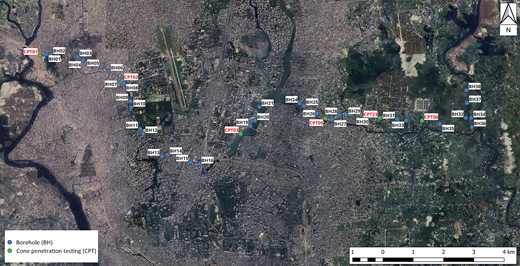
The geotechnical investigation data analysed in this paper were acquired from the Phase 1 geotechnical investigation campaign for the proposed 17.4 km long mass rapid transit Line 5-South, Dhaka, Bangladesh. As per the physiographic map of Bangladesh, published by the Geological Survey of Bangladesh, the proposed route alignment is underlain by silty clay of Pleistocene Madhupur origin, Holocene sediments to the south, alluvial silt and clay, and marshy clay and peat to the east and west (DMTCL, 2022). Figure 1 shows geotechnical investigation locations along the proposed route.
The geotechnical investigation campaign comprised the drilling and testing of a total of 34 boreholes to test termination depths between depths of 40.78 and 52.94 m and six cone penetrometer tests (CPTs) to test termination depths between 27.52 and 41.78 m. Among others, a total of 131 particle size distribution (PSD), 70 Atterberg limits (AL), and 40 OC tests had been conducted on the selected samples, all of which have been considered for analyses. All the laboratory tests were conducted following relevant ASTM standards.
Analyses of geotechnical database
In the following sections, relevant laboratory and field investigation results have been used to evaluate USCS and ASCS in classifying soils.
Fines content
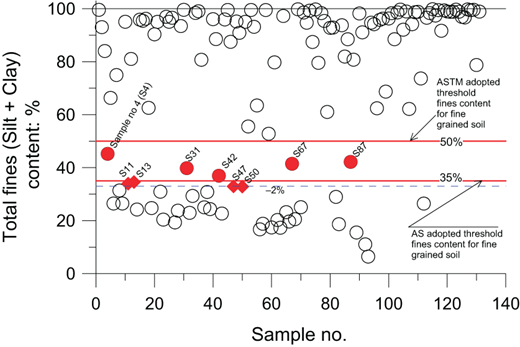
Total percentage of fines and clay fraction in the conducted samples has been plotted in Figure 2. Out of 131 samples (where sample number has been assigned as S1–S131), 68 samples had a fine content of more than 90%, that is, classified as clay or silt, whereas 10 samples contained fines less than 10%, that is, sand. In the same figure, two horizontal lines at 35% and 50% fines content were drawn to highlight the threshold fines content that differentiates coarse and fine-grained soils as per ASCS and USCS, respectively. It can be seen that five samples (S04, S31, S42, S67, and S87), shown by filled circles in Figure 2, had a fines content between 35% and 50%. Fine content of another four samples (S11, S13, S47, and S50), as shown by filled diamonds in the same figure, is within 2% of the adopted threshold fine content used in the AS soil classification system. In practice, considering factors such as soil profile above and below the tested sample, geological settings, sample collection method, sub-sampling variation, laboratory measurement inaccuracy, and so on, soils with close to borderline fines content (i.e. 35% for ASCS or 50% for USCS) are generally classified as fine-grained soils to be on the conservative side. Considering this, these nine samples (S04, S11, S13, S31, S42, S47, S50, S67, and S87) have been considered for further scrutiny following USCS and ASCS.
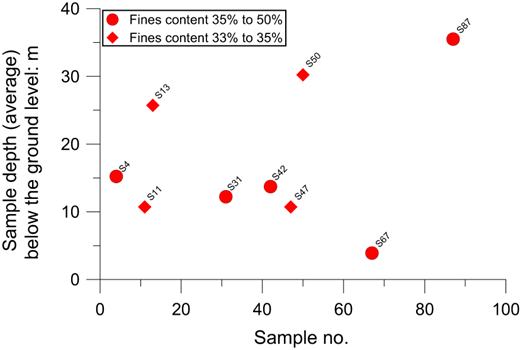
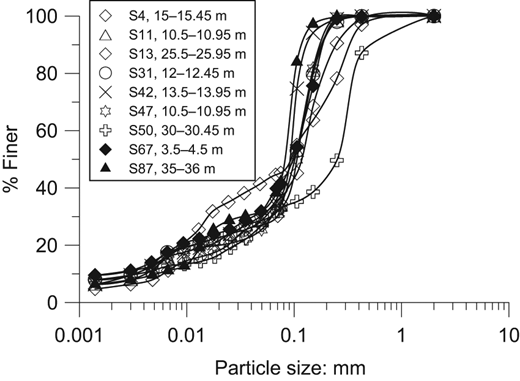
Table 1 provides a summary of the selected nine samples along with the corresponding soil classification based on USCS and ASCS. Sample collection depths and PSD curves of these samples have been plotted in Figures 3 and 4, respectively. As shown in Figure 3, sample collection depths of the scrutinised samples varied between 3.5 and 36 m. The geological origin of these samples was Alluvium (S67), Madhupur Clay (S4, S11, S13, S31, S42, and S47) and Dupi Tila (S50 and S87). Details about the subsurface geology of Dhaka city are reported elsewhere (Alam, 1988; Brammer, 2012; Monsur, 1995). As per USCS, eight of nine samples examined are classified as silty fine SAND (SM) or silty fine-medium SAND (SM), whereas the remaining one sample is classified as clayey fine to medium SAND. On the contrary, ASCS classifies all the same samples as sandy SILT (ML), with clay. It is well known that the mechanical behaviours (i.e. shear strength, compressibility, liquefaction, settlement potential, etc.) of SILT can be transitional between those of fine sands and clay (Boulanger and Idriss, 2007; Hyde et al., 2006). This is because the collapse potential of a silty sand increases with the increase of silt content (Thevanayagam et al., 2002). Further increase in silt causes further reduction in intergranular contact between the coarse grains. At a certain threshold of silt/fines content, contact friction between silt/fines becomes significant and hence controls mechanical behaviours. Therefore, a unified soil classification could reduce uncertainties in predicting such transitional behaviour. The role of fines in controlling mechanical behaviours has been discussed further in a later section below.
Cone penetration test results
The CPT is widely used in practice for in situ characterisation of saturated or dry soils (i.e. soil profiling, strength, stiffness, and compressibility) for which interpretation methods are well established (Campanella et al., 1983; Lunne et al., 1997; Mayne, 2007; Robertson, 2009; Varghese et al., 2021; Zhang et al., 2002).
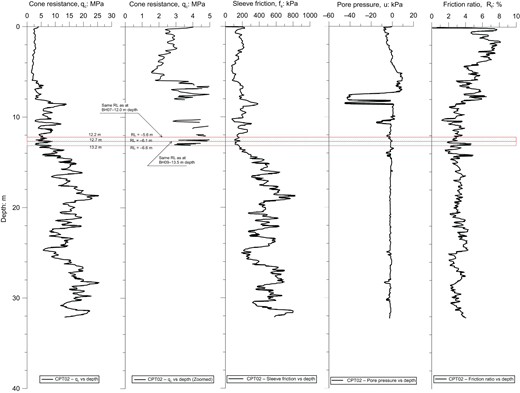
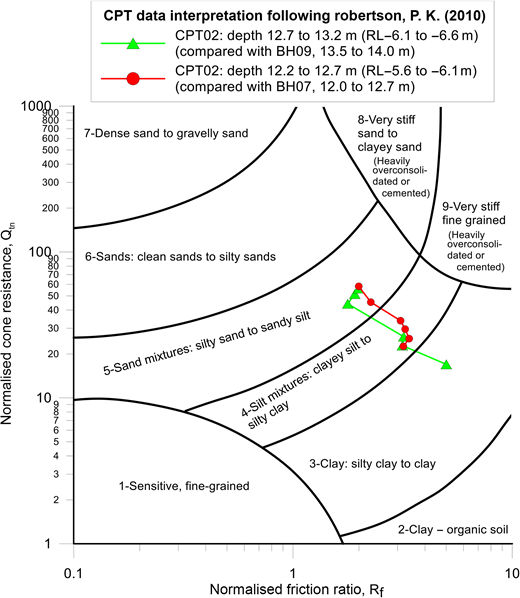
To form test pairs and compare BH and CPT test results, a reasonably close offset between test locations and the same geological formation has been considered. Out of nine scrutinised samples (i.e. S04, S11, S13, S31, S42, S47, S50, S67, and S87) and six available CPT tests, only one CPT test (CPT 2) was found to have met both criteria (offset reasonably close and had the same geological formation). Therefore, CPT 2, with a horizontal offset of about 110 m from BH07 (S31) and BH09 (S42), has been used to further scrutinise soil classification. Figure 5 shows the CPTu profile in terms of CPT parameters (cone resistance (qc), sleeve friction (fs), pore pressure (u), and friction ratio (Rf)). Figure 6 shows the same CPT data, but plotted in terms of normalised CPT parameters (normalised friction ratio (Rfn) and nomalised cone resistance (Qtn)) for the corresponding sample depths. The CPT data were normalised following the expressions proposed by Robertson (2009). An average total unit weight of 16 kN/m3 and piezometric profile (uo) were assumed. The plotted data in Robertson’s (2009) chart suggest that the soils are transitional in behaviour between either more silt mixtures (silt/clay-like) or sand mixtures, but not within or close to the sand zone. The interpreted soil type based on the CPT test result is consistent with ASCS (see Table 2) but deviates from USCS, where all the examined soil is classified as sand.
Interpretation based on critical state soil mechanics
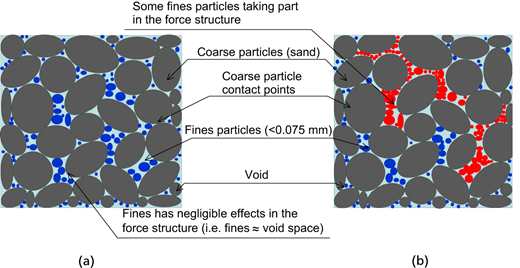
Numerous studies have confirmed that the presence of fines affects the mechanical behaviour of soil considerably (Baki et al., 2012; Chu and Leong, 2002; Rahman et al., 2008; Thevanayagam, 1998; Yamamuro and Covert, 2001; Zlatovic and Ishihara, 1995). In particular, the location of the steady-state (SS) or critical state (CS) line (or curve) in the e–log(p′) space depends on fines content, where e is the void ratio and p′ is the mean effective stress. Initially, the SS strength at the same void ratio decreases, followed by an increase in shear strength with a further increase in fines content (Pitman et al., 1994; Rahman et al., 2008; Zlatovic and Ishihara, 1995). Similarly, cyclic resistance of a sand-fines matrix reverses in direction beyond a certain fines content (Rahman et al., 2008). Researchers also found that up to a certain percentage of fines (or clay content), the fines (or clay) only occupy the pore space of the host granular material and do not significantly affect the engineering behaviour of the matrix (Kenney, 1977; Kuerbis et al., 1988; Mitchell, 1976; Rahman et al., 2008; Thevanayagam, 1998; Xenaki and Athanasopoulos, 2003). There exists a threshold fines content, fthre, beyond which the fines become the matrix. Therefore, fthre defines the transition of a sand-fine matrix from a ‘fines in a coarse matrix’ to ‘coarse material in a matrix of fines’ as illustrated in Figure 7. In Figure 7(a), fine particles are occupying the pore spaces of coarse particles (i.e. sand grains). When the fines content, fc, increases beyond fthre, fines start to contribute to the force structure as shown in red particles in Figure 7(b). In the past, many researchers inferred or estimated fthre of the sand-fines matrix, which was found to vary between 25% and 50% but generally 30% (Hang et al., 2024; Naeini and Baziar, 2004; Papadopoulou and Tika, 2008; Rahman et al., 2008; Yang et al., 2006). However, based on the ratio of fine and sand particles, Rahman and Lo (2008, 2012) proposed an empirical equation (Equation 1) to calculate fthre, which was verified with nine published datasets.
where diameter ratio, χ = D10/d50, d50 is the median size of fine and D10 is the 10% fractile of host sand. No additional input parameters are needed in Equation 1.
For the scrutinised samples, fthre has been calculated using Equation 1 to compare ASCS and USCS in relation to the expected mechanical behaviours of fine-grained soil under the CSSM framework. Calculated fthre are presented in Table 3 along with input parameters, which were obtained from PSD curves. It can be seen from Table 3 that the calculated fthre varied between 29% and 33%. Rahman and Sitharam (2020) pointed out that fthre can vary between ∼2% and ∼7% due to a narrow or ‘flat and wide’ zone on either side of fthre. Regardless, these calculated fthre values are close to the 35% threshold as adopted in ASCS but well below the USCS threshold (i.e. 50%). For the scrutinised samples, mechanical behaviours of a sand-fines matrix with fines (or clay) content greater than 33% are expected to be governed by finer particles. The above findings imply that ASCS aligns better with CSSM-based mechanical behaviour predictions.
Soil plasticity
Plasticity of a soil can affect its settlement, strength, and volume change behaviour and is widely used to assess physical or engineering behaviour of soils (Firincioglu and Bilsel, 2023). The PI, calculated as the numerical difference between the LL and plastic limit (PL), reflects the range of water content within which the soil exhibits plastic behaviour. These parameters (PI, LL, and PL) are essential for classifying fine-grained soils and estimating their engineering properties, such as internal friction angle, compression index, and low-strain shear modulus (Ramsey and Tho, 2024).
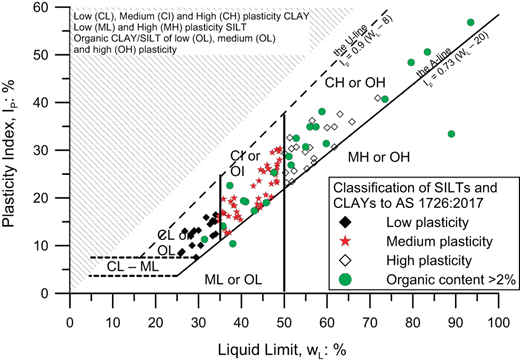
Figure 8 shows plasticity plots of all the tested samples as per ASCS. It is to be noted that the plasticity chart used in USCS differentiates low to high plasticity at an LL of 50% with no medium plasticity. Out of 104 test results examined, about 54% of the tested soil had medium plasticity (i.e. LL between 35% and 50%) when classified in accordance with ASCS (Figure 8). This has a practical engineering consequence. In practice, for shallow foundation design, generally the more reactive the soil, the more rigid the footing needed to ensure acceptable performance, unless the foundation system is isolated from surface soils with the use of piles or other deep foundations. Also, for deep foundation design, the contribution to skin friction of fine-grained soil of different plasticity can vary. Soil plasticity also plays a vital role in determining the workability of soil in construction projects. Plasticity of soil also plays an important role in earthwork design, that is, appropriate selection of machinery, such as excavators, graders, and compactors; soil blending requirements; selection of appropriate stabilisation methods; erosion control requirements; and so on.
Organic content
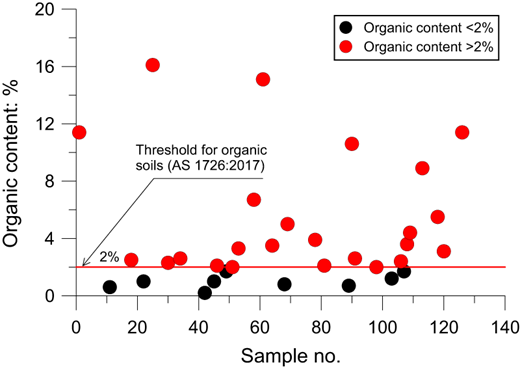
The organic matter could be formed by the decomposition of plants, tree roots/wood, and waste. The presence of organic matter at a high percentage is undesirable in soils, as it can have a significant effect on their geotechnical properties due to its detrimental properties, such as high compressibility, low shear strength, low bulk density, high moisture content, and long-term settlement. These properties can lead to excessive settlement, bearing capacity failure, or instability, especially under loading from structures, roads, or embankments. Therefore, characterising organic soil is essential to ensure safe, reliable, and cost-effective engineering design. Also. it guides decisions around foundation systems, settlement control, and risk management. The details of the scrutinised soil samples for OC are presented in Table 4.
Both ASCS and USCS consider organic soils as a subgroup of fine-grained soils. However, USCS for organic soil is based on the ratio of the oven-drying to the pre-oven-drying LL (i.e. classified as organic silt/clay if the ratio is less than 75%), whereas soils with OC more than 2% are termed as organic soil in ASCS.
Table 3 provides a summary of the tested samples for OC, whereas Figure 9 shows the variation of the OC for the tested 33 samples for this geotechnical investigation package. Among 33 samples, 22 samples were tested for LL and PI and plotted in Figure 8 (green circles). Out of 33 samples considered, 4 samples (12%) would have been classified as organic soil based on USCS, whereas 24 samples (73%) would have been classified as organic soil as per ASCS.
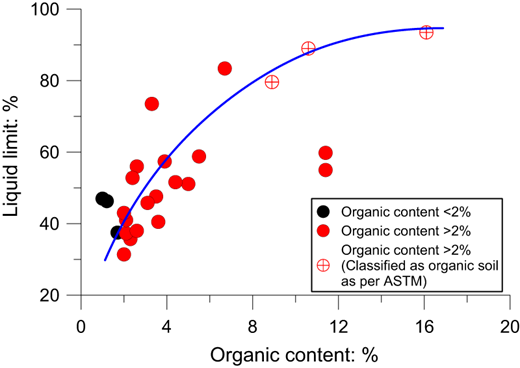
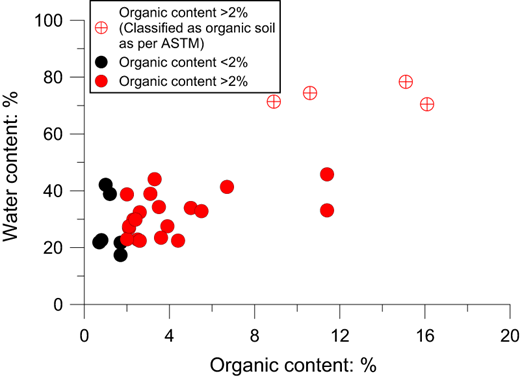
The variation of the OC with the LL and water content has been plotted in Figures 10 and 11, respectively. Both figures show an increase in the LL and water content with the increase in the OC. For the higher value of the OC (16.1%), the LL reaches 93.5% but had slightly less (8%) water content than the maximum water content (78%) attained in Figure 11. While a trend line with some error band can be established with the LL against OC data points in Figure 10, no such trendline can be established for water content data points due to scatter in data points mainly beyond about 8% OC (Figure 11). Among others, sampling techniques, storage, and transportation of samples may affect field moisture content determination.
Discussion on engineering implications
For geotechnical engineering purposes, soils categorised into the same groups or subgroups should possess similar properties and exhibit similar mechanical behaviour. Soil classification reflective of expected mechanical behaviour is vital for assessing subsurface variability and geohazards. Classification systems influence how layer boundaries are drawn, soil units are modelled, and geotechnical zones are defined. Inconsistent classification can obscure critical transitions. For example, a ‘clayey sand’ classified in USCS may be described as sandy silt in ASCS, introducing subjectivity in the assessment of compressibility, strength, and drainage behaviour. Such inconsistencies can affect the selection of design parameters for foundation bearing capacity, settlement estimation, and slope stability. This variability can result in inconsistent interpretations of the same soil across projects or jurisdictions and can compromise safety in design. Similarly, the plasticity of soil plays an important role in earthworks specification. For example, the Transport of NSW Specification Guide to QA Specification for Earthworks (TfNSW, 2020) specifies different PI limits for materials to be used for ‘select fill’ or ‘general fill’ material. Therefore, the volume of materials required to blend with the site own materials can vary significantly depending on the plasticity of site own materials and the intended use. Also, as per Australian Standards – Residential Slabs and Footings (AS, 2011), plasticity of soil is a key for classifying a site based on estimated characteristics of soil movement due to seasonal moisture change, that is, shrinkage during drying or swelling during wetting. The expected characteristic soil movement is related to soil reactivity. Reactive soils, such as high-plasticity clays, can exert significant stress on foundations, leading to cracking, tilting, or other structural problems.
Among others, the engineering behaviour of a soil is also dependent on its OC. As an engineering control measure to manage the settlement of a site with an organic soil layer, surcharging is a commonly adopted technique for infrastructure projects. For this, the surcharge load and duration of the surcharge are related to the expected primary and secondary settlement that is expected over the design life. This highlights the need for identification and classification of organic soil with an unified criteria, which is reflective of its actual mechanical behaviour.
Furthermore, miscommunication may arise between designers and contractors when interpreting classification terms in tender documents or material test reports. Without a standard conversion protocol, differences can lead to rejection of suitable materials, incorrect equipment mobilisation, or contract disputes.
Conclusion
Soil classification provides a common framework to describe and group soils with similar properties and expected mechanical behaviours. This helps practising engineers to provide safe, sustainable, and cost-effective foundation or earthwork design solutions. However, despite their common purpose, there is no universal consensus among existing fine-grain soil classification systems. Generally, differences persists in adopted threshold fines content, descriptive criteria, and behavioural assumptions.
A large laboratory test data set and relevant CPT results have been analysed to review and compare fine-grained soil classifications using USCS (ASTM, 2017) and ASCS (AS, 2017). The influence of three key parameters, that is, threshold fines content, soil plasticity, and OC, on fine-grained soil classification was studied. In addition, the CSSM framework has been used to evaluate threshold fines content, which differentiates fine-grained soil from coarse-grained soil. Based on the analyses, the following conclusions and observations were drawn:
A distinct difference in fine-grained soil classification was observed between the two soil classification systems compared. While comparing nine samples classified as silty/clayey SAND as per USCS, all those samples are classified as sandy SILT as per ASCS. This highlights that significantly different mechanical behaviours are expected for the same soil depending on the chosen soil classification system, USCS or ASCS. This could lead to an unsustainable design solution unless the assigned design parameters for the subject soil unit are validated by other means (i.e. CPT, laboratory tests, etc.).
The threshold fines content (i.e. 35%), which differentiates fine-grained soil from coarse-grained soil in ASCS, is found to be more appropriate, as supported by CPT data as well as the CSSM framework.
For the compared soil classification systems, it has been found that different boundaries, descriptive criteria, and identification methods have been adopted in classifying soil plasticity and organic soils. This could lead to potential safety and serviceability consequences in earthworks, foundation, or pavement design.
While soil classification is foundational to geotechnical engineering, the divergence between different soil classification systems may pose significant implications on interpretation, design, and project delivery, particularly when multiple international contractors or consultants are involved and limited laboratory testing is available. As such, execution of a comprehensive laboratory testing programme is beneficial to confirm engineering properties for each identified soil unit rather than relying on typical soil parameters.
In the absence of comprehensive laboratory test data, it is recommended that a sensitivity analysis be carried out to evaluate how different soil classification systems affect geotechnical design (i.e. foundation or earthwork design). For example, sensitivity checking of pile length design considering the soil layer as sandy silt (and associated design parameters) instead of silty sand.
Further validation of the presented findings herein will require more comparison between the CPT and BH test pair, additional case histories from different geological formations, and the collection of additional experimental data on fine-grained soils. Nonetheless, it is hoped that the above findings will prove useful to engineering practice and provide an opportunity to develop a universal framework in the future to remove existing inconsistencies in fine-grained soil classifications.