Contribution by D. C. Warrington
The author (Svinkin, 2019) has assembled an excellent overview of both the strengths and pitfalls of dynamic testing piles, not restricting himself to the predominant method in use (Capwap). However, a few observations are in order.
The issue of static load test (SLT) interpretation is one that is, in reality, beyond the confines of dynamic testing. There are many methods of interpreting SLTs; the method applied depends on the specific application and, in many cases, the requirements of national and international building codes applicable to a specific region. Dynamic tests that simulate SLTs to estimate a pile capacity must ultimately interpret these simulated tests in some way just as actual SLTs are interpreted after performance. Comparison of static and dynamic load testing is best done when both use the same criterion for interpretation.
The author’s comments about the time sequence of static and dynamic testing are well taken and should be a caution to both the performance and interpretation of results of both testing methods.
The topic of variable hammer energy is in reality a subset of the problem of the ‘complete’ mobilisation of the soil resistance during dynamic testing, and although the paper certainly connects the two, it would have been more useful if the energy problem had been described in terms of the mobilisation problem and not the other way around. Many dynamic methods use an elastic–purely plastic model for the soil, which is a useful simplification but not completely informative of the soil’s response. The non-linear nature of the soil means that the soil is either hardening or softening (usually the latter) with increasing strain and that simply getting ‘past the quake’ is not enough to say that the soil is completely mobilised or that there are variations in the soil response with deflections that do not exceed the quake. This was true not only in the cases described in the section on energy effects; it was certainly present (in addition to soil set-up considerations) for the Louisiana Department of Transportation and Development case study, an additional complication in the transition from the end of driving to the restrike/SLT stages of the analysis.
The author’s criticism of the persistence of the Smith model is well founded and has been repeated over the years, such as in the paper by Randolph (2003). Both one-dimensional and three-dimensional models have been in existence for many years, but these have not been utilised to correct the inadequacies of the Smith model. The results of the paper show that such a consideration is well overdue, but unfortunately, the author does not set forth alternative(s) for consideration.
Contribution by S. Buttling
The author has carried out a quite thorough review of published data on piles where comparisons between high-strain dynamic pile tests (HSDPTs) and other testing methods such as SLTs and Statnamic tests were made, as well as some between projects where different signal-matching software programs were used. In total, nearly 200 pile tests over a period of more than 20 years have been considered. As highlighted in the paper, this emphasises the variability of parameters that have to be dealt with in geotechnical engineering, and this covers not only things such as strength parameters that are spatially variable but also the purposes for which the results will be used. As mentioned throughout the paper, these different purposes include
comparison between different testing methods, such as HSDPT and SLT, regardless of the pile capacity
confirmation that a required design capacity has been achieved
investigation of the development of capacity with time.
The last point is considered particularly important because when two types of tests are being compared, it is extremely difficult to carry out both types of test at the same time. One is faced with either (a) accepting a small time difference between the two test dates while carrying out the tests on one pile or (b) accepting the small differences arising from spatial variability and differences between any two piles when carrying out the tests on adjacent piles, with an associated increase in cost. The author stresses that an HSDPT is an evaluation of the ultimate pile capacity at a particular point in time after installation, but then so is an SLT, the main difference being that HSDPT tends to be done as part of the driving effort (end of initial driving (EOID)) or a short time later (restrike), controlled by the availability of the driving rig, whereas an SLT is more often carried out significantly later, after driving has been finished and the plant cleared away.
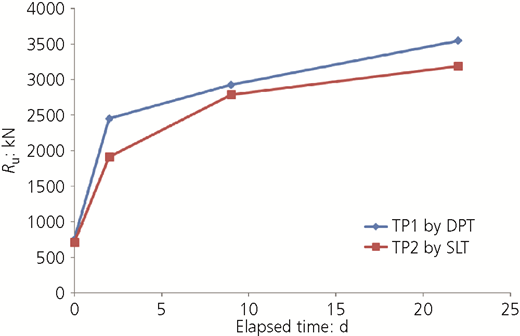
The graph shown in Figure 4 comes from some data included in the paper by Svinkin and Woods (1998) and is just one example of the increase in capacity with time after initial installation.
The author has also referred to the effect of hammer energy on mobilised capacity and illustrated this in Figures 2 and 3. This is an important aspect, and it is very similar to an SLT which does not have sufficient reaction force to reach a failure criterion. In the case of both SLT and the HSDPT, the measured resistances are lower-bound values, which cannot be compared with other estimates of the same resistance. In HSDPT, this normally means having sufficient hammer energy to mobilise fully the pile including the toe resistance. It is quite common that on restrike where there is set-up, this energy is significantly higher than the EOID energy. Typically, this will result in one of two things
failure to mobilise the pile, resulting in an increased estimate of shaft friction but a decreased estimate of end bearing
damage to the pile head.
In the former case, it seems to be accepted practice, on sites where set-up is proven, to consider that the end bearing will not decrease with time so the shaft friction on restrike can be added to the end bearing at EOID to give a higher estimate of ultimate resistance, which is still a lower bound.
Much is made in the paper of the different forms of ultimate resistance, and these are simply summarised in terms of increasing numerical value as
Qu1: the Davisson offset limit criterion
Qu2: the load at which the pile settlement equals 10% of the pile diameter (Eurocode) (or possibly the Brinch–Hansen yield criterion)
Qu3: the true ultimate value as determined by calculation assuming that all points reach their ultimate resistance simultaneously (or the value extrapolated from an SLT using the Chin–Kondner approach or similar approaches).
These three definitions of ultimate resistance are all in use, and it seems unnecessary, and probably impossible, to make everyone conform to one. It was therefore proposed by Buttling (2013) that all three be accepted, but it be made clear in any application which one is being referred to. It should also be possible to convert from one to another – for example, when comparing SLT and HSDPT, to do so using Qu1, or by extrapolating the Capwap-supplied load–settlement curve, using Qu2.
In general, the design will be done by calculation, and SLT or HSDPT will be used to confirm the design. There may be some exceptions where the design itself is done on the basis of load tests, as allowed by clause 7.6.2.4 of BS EN 1997-1:2004 (BSI, 2004) and occurred on a project in Queensland some years ago when the designer, whose design was being challenged, decided to withdraw the design and rely on the HSDPT, the values of ultimate resistance from which exceeded the design value. The problem was then that, with no design to rely on, the HSDPT data on about ten piles had to be interpreted to suggest what the other values might have been if all piles had been tested. On this basis, the HSDPT data were not adequate to confirm the design. In any event, no factor of safety was considered, but the characteristic pile resistance was compared with the factored geotechnical resistance required.
In summary, the paper gives an interesting analysis of a large number of piles in the Federal Highway Administration–GRL database, but it is feared that many of the comparisons are not of like with like. It is believed that for any given pile, it should be valid to compare performance between different tests at Qu1, Qu2 or Qu3, but never valid to compare performance between one test at Qu1 and another at Qu2, just as it is not valid to compare results from different tests at different times after EOID.
Author’s reply
The author would like to thank the contributors for their comments and interest in the paper.
The first contributor emphasised the non-linear nature of soils, which may affect the responses of the pile–soil system to impact loads during dynamic testing.
It is necessary to bring attention to the fact that structural and structure–soil systems (machine foundation–soil and pile–soil systems) respond differently to impact loads. The former systems do not change their dimensions under applied dynamic loads, but the soil part of the latter systems can be substantially increased because the bigger vertical impact on structures (massive foundations or piles) will involve the bigger soil mass in vibrations. This phenomenon can be well seen in the vibration analysis of concrete foundations under machines with dynamic loads (Svinkin, 2008). Under hammer ram impacts, piles penetrate into the ground and vibrate with an attached soil mass whose size also depends on the value of impacts. Records of pile vibrations provide information about the pile–soil system – for example, the dominant frequency and damping of the system.
As a matter of fact, different pile–soil systems are dealt with when various impacts are applied to the pile–soil system. So far, it is difficult to receive reliable solutions for a non-linear structure–soil or soil–structure system (impacts on the ground or blasting). Analysis of one such solution for the soil–structure system is presented in the paper by Svinkin (2016). Additional research is needed.
The second contributor demonstrated the problems in the determination of actual pile capacity and verification of pile ability to withstand design loads. He showed substantial problems in the mobilisation of the pile side and toe resistances at restrike and in the evaluation of the ultimate pile capacity using different approaches.
The contributor wrote, ‘In general, the design will be done by calculation, and SLT or HSDPT will be used to confirm the design’. This correct and objective statement means that in situ static or dynamic testing must confirm that the built foundations can withstand the design loads with the factor of safety required.
Nevertheless, it is possible that there is another solution as well, and a case history referenced by the second contributor showed that HSDPT data were not adequate to confirm the design and no factor of safety was considered. However, the characteristic pile resistance was compared with the factored geotechnical resistance required.