

Analysis and calculation of lateral pile load capacities using appropriate methods is a challenging task for geotechnical engineers. Primarily, piles in Dubai, UAE, are rock fully socketed with top strata of medium dense to dense silty sand or sedimentary rock resisting lateral loads. In this study, the results of two field pile lateral load tests were chosen for examining different methods used by local geotechnical engineers, where ground lithology constitutes fragile sandstone up to ∼8 m below ground level overlying extremely weak conglomerate/siltstone. Assessing the efficacy of design parameters and analysis methodology is a pivotal aspect in preliminary evaluation of the lateral load capacity of piles. In this research, two commonly adopted approaches (non-linear p–y analysis using the LPile software and finite-element analysis using the Plaxis 3D software) were assessed by comparing them with field test results to predict the lateral load capacity precisely. Design parameters were based on borehole data and laboratory tests near the test location. Even though finite-element analysis predicted better than non-linear p–y analysis, lateral load capacities were underestimated in both piles analysed, which was related to assessment of input parameters. In addition, finite-element analysis was used to back-calculate the elastic modulus of rock that yields lateral deflections of piles close to field test results.
Notation
Introduction
The majority of infrastructure development in Dubai, UAE, includes heavy structures such as elevated flyovers and high-rise towers (Latapie et al., 2019). It is inevitable for pile foundations to support these hefty structures in difficult site conditions such as non-homogeneous and uneven ground strata, low bearing capacity and high groundwater table (Mughieda et al., 2022). Most of the pile foundations in Dubai are bored cast-in-situ piles socketed into rock subjected to lateral loading. While the lateral capacity of a pile is mainly dependent on the stiffness of the ground, its deflection should adhere to allowable limits under service loads (Prakash and Muthukkumaran, 2021). The ground profile in Dubai mainly comprises sand as the top soil overlying weak sedimentary rocks underneath, with a depth of more than 60 m (Alzaylaie, 2017). Many long-span bridges (Kim et al., 2011) and waterfront structures (Matlock, 1970) in Dubai are subject to lateral loads such as wave loads, earthquake loads, wind loads and inclined loads (Fan and Long, 2005; Reese et al., 1975; Tabatabaiefar et al., 2013a, 2013b). Estimating the lateral capacity of piles is undoubtedly challenging for geotechnical engineers since it is mainly dependent on ground stiffness under serviceable conditions. Research and adequate design methods for rock-socketed piles continued to be vague until the 1960s. However, pile design methods have since improved with the consideration of applied mechanics principles and rock socket properties (Sujata et al., 2023). Various approaches proposed by different researchers (Abdel-Mohti and Khodair, 2014; Ahmadi and Ahmari, 2009; Alzaylaie, 2017; Ashour and Norris, 2003; Carter and Kulhawy, 1992; Chan and Low, 2009; Chore et al., 2012; Duncan et al., 2005; Fan and Long, 2005; Hajialilue-Bonab et al., 2011; Hazzar et al., 2017; Higgins et al., 2013; Hokmabadi et al., 2012; Lebeau, 2008; Levy et al., 2007; Li et al., 2010; Liang et al., 2009; Matlock, 1970; Nasr et al., 2022; Poulos and Davis, 1980; Sawant and Shukla, 2012; Yang and Jeremic, 2002) are available in the literature for this purpose, although heterogeneous ground conditions exhibit a high degree of variability. Hence, expensive experiments such as field lateral load tests on piles are conducted only in significant projects to confirm the calculated pile capacity. In this research work, two field lateral load tests on piles fully embedded in rock were performed, and test results were compared with outputs from approaches frequently adopted by geotechnical engineers (non-linear p–y analysis and finite-element analysis). Design parameters used in the assessment were based on borehole logs and laboratory test data available near the test location. Both methodologies effectively replicated the initial response observed in the lateral load test results. However, a significant margin of error was evident, which may be attributed to discrepancies in the design input parameters. Yielding was detected in the non-linear p–y analysis at significantly lower applied loads. Previously, Alzaylaie (2017) predicted the stiffness parameters of rock to evaluate the vertical capacities of piles. It was also recommended by earlier researchers (Manoj et al., 2021, 2022) to estimate the stiffness of Dubai sedimentary rocks based on shear wave velocity as 20% of the stiffness modulus obtained from down-hole testing (Ed). In this research, to understand the extent of difference in lateral capacities obtained between selected methods and field tests, elastic moduli of rock were back-calculated from field tests and compared with those obtained from laboratory tests used in adopted methods. It was evident that the stiffness of rock was underestimated severalfold. The forthcoming sections discuss all results obtained from the adopted methods used and field tests performed in this research.
Site details
Results obtained from two lateral pile load tests (Figure 1) carried out in Dubai were used as part of this research. The piles were referred to as pile 1 and pile 2. Both piles (bored cast in situ) were 800 mm dia., where pile 1 and pile 2 were 7.4 and 21.2 m below ground level, respectively, and were fully socketed in Dubai sedimentary rock. To calculate the lateral capacity of piles, generalised subsurface stratigraphy was developed using data from boreholes close to pile load tests. The subsurface profiles at the locations of pile 1 and pile 2 are included in Tables 1 and 2, respectively, where the pile top level was considered at 0 m. Pile 1 and pile 2 were designed to carry working lateral loads of 261.5 and 206.15 kN, respectively, and were loaded to a minimum of 200% of the working load. Dial gauges with a least count of 0.01 mm were used to record lateral displacements. At various stages, lateral displacements were recorded, and final lateral displacements at 200% of the lateral working load were recorded as 1.14 and 0.95 mm for pile 1 and pile 2, respectively. As pile load tests are expensive to execute in geotechnical engineering practice and many projects may not allocate a budget for this purpose, an effort is made in this research work to compare and understand the differences in lateral pile load capacities obtained from field tests and analytical approaches (non-linear p–y analysis using the LPile software and finite-element analysis using the Plaxis 3D software). In the forthcoming sections, details of field tests, analytical results and discussions related to results can be seen.
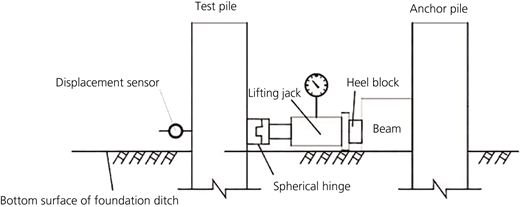
Schematic diagram of lateral pile load tests performed at the site (Xi and Ma, 2017)
General stratigraphy at the location of pile 1
| From: m | To: m | Soil/rock type | Unconfined compressive strength: MPa | Elastic modulus, E: MPa | Poisson’s ratio | c′: kPa | Φ: ° |
|---|---|---|---|---|---|---|---|
| 0.0 | 7.7 | Very weak sandstone | 1.6 | 70 | 0.25 | 60 | 28 |
| 7.7 | 15.0 | Extremely weak conglomerate/siltstone | 1.7 | 70 | 0.25 | 70 | 31 |
General stratigraphy at the location of pile 2
| From: m | To: m | Soil/rock type | Unconfined compressive strength: MPa | Elastic modulus, E: MPa | Poisson’s ratio | c′: kPa | Φ: ° |
|---|---|---|---|---|---|---|---|
| 0.0 | 8.5 | Very weak sandstone | 1.2 | 70 | 0.25 | 50 | 28 |
| 8.5 | 15.0 | Extremely weak conglomerate/siltstone | 2.5 | 150 | 0.25 | 90 | 30 |
| 15.0 | 30 | Extremely weak conglomerate/siltstone | 2.0 | 120 | 0.25 | 90 | 30 |
Note: a very low recovery (rock quality designation < 30%) was observed for all rock layers
Lateral pile analysis methodologies
Recent developments in computing capabilities have allowed geotechnical engineers to use numerical analyses frequently. Regularly adopted methods in Dubai – namely, non-linear p–y analysis and finite-element analysis – are used to perform pile lateral load capacity calculations. These methods, along with their analytical approaches and their suitability to the current situation, as well as corresponding results, are elaborated in the subsequent sections.
Non-linear p–y analysis
The LPile software was used to perform non-linear p–y analysis. The p–y curve developed by Liang et al. (2009) was utilised to model the lateral response of rock based on both full-scale load tests and three-dimensional (3D) finite-element modelling. The p–y response curve for the rock used in the analysis can be seen in Figure 2.
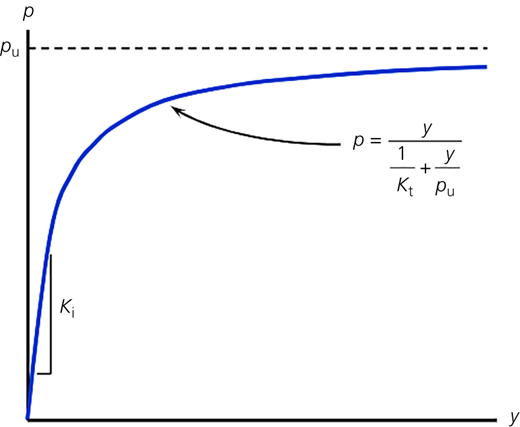
A hyperbolic equation was used as the basis for the p–y relationship, p = y/(1/K i + y/p u), where p u is the ultimate lateral resistance of the rock mass and K i is the initial slope of the p–y curve. It should be emphasised that the p–y curve for the rock was generated using the option of massive rocks in the LPile software. Upon performing calculations with non-linear p–y analysis, lateral pile deflections at the ground level for pile 1 and pile 2 were found to be 19.44 and 7.80 mm, respectively. It can be observed that these lateral deflection values were comparatively very high compared with those obtained from field tests (1.14 and 0.95 mm for pile 1 and pile 2, respectively).
Finite-element analysis using the Plaxis 3D software
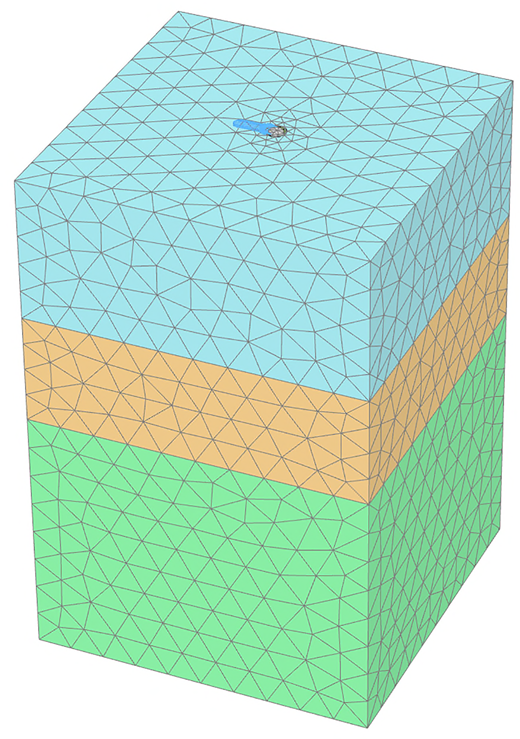
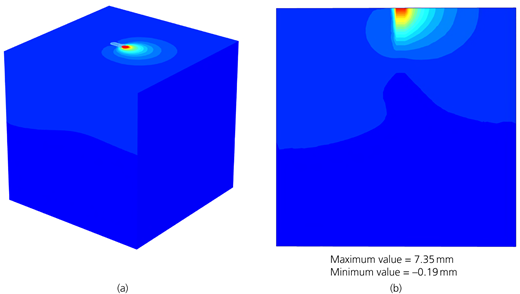
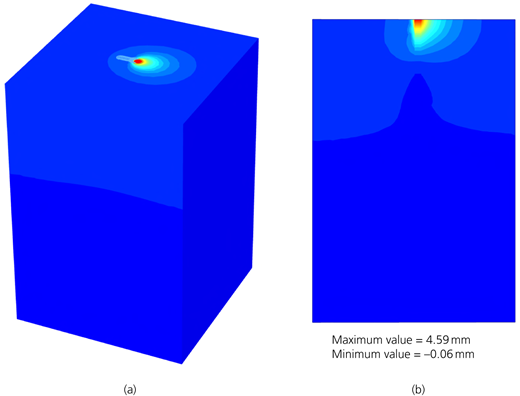
The Plaxis 3D software was used to perform 3D finite-element analysis (Figure 3) of piles using the parameters shown in Tables 1 and 2. Ten-noded tetrahedron elements were used to generate a finite-element mesh with the fine-mesh option as an auto-meshing tool. The model size and boundary conditions were defined carefully to avoid the effects of boundary conditions on the results. While the base of the model was restricted for movement in both the horizontal and vertical directions, vertical boundary conditions were selected so there would be no horizontal movement. The top of the model was unrestrained. A pressure load was applied in increments similar to the lateral pile load test conducted on the field. A Mohr–Coulomb (MC) material model was used to simulate the ground behaviour in the analysis because most geotechnical designers had limited data available at the early design stage. The MC material model considers rock behaviour as linear elastic perfectly plastic, which assumes that resistance increases linearly with displacement until the failure criterion determined by the MC model is reached. The pile was defined as a linear elastic material. Lateral deflections of piles at the ground level using the MC material model with design parameters as detailed in Tables 1 and 2 were found to be 7.35 and 4.59 mm, respectively, for pile 1 (Figure 4) and pile 2 (Figure 5).
Comparison of analyses and discussions
Tables 3 and 4 show the results obtained from numerical approaches and field tests for pile 1 and pile 2, respectively. Additionally, lateral deflections obtained from all methods/tests are graphically shown in Figures 6 and 7 for pile 1 and pile 2, respectively. It is observed that lateral deflection values from field tests are comparatively smaller than those obtained from numerical approaches, which shows that the adopted approaches and assessed design input parameters are highly conservative. Nevertheless, it is difficult to execute field tests in all projects due to budget constraints; hence, geotechnical analyses cannot be easily discarded. Therefore, it is the responsibility of the geotechnical designer to choose a suitable methodology for calculation and to opt judiciously for ground parameters derived from laboratory testing and empirical equations. Both methodologies effectively replicated the initial response observed in the lateral load test results. However, a significant margin of error was evident, which may be attributed to discrepancies in the design input parameters. Results from non-linear p–y analysis were very conservative compared with those obtained from finite-element analysis, as yielding was observed at much smaller applied loads. The lateral deflection values obtained from both numerical approaches were severalfold higher than those obtained from field tests, which undoubtedly underestimated the ground stiffness against lateral deflection. These results could be attributed to lower magnitudes of elastic modulus (E) values (Tables 1 and 2) obtained from laboratory tests and empirical equations used in the analysis. Hence, several trials were carried out to calibrate the elastic modulus using finite-element analysis (Plaxis 3D), yielding lateral deflections close to those obtained from field tests. An elastic modulus value of 600 MPa at the ground level yielded a lateral deflection of 1.48 mm in pile 1, whereas an elastic modulus value of 550 MPa resulted in 0.90 mm in pile 2. The calibrated values clearly showed that elastic modulus values (obtained from laboratory tests and empirical equations) used in the analysis were highly conservative in nature, which could be due to non-representative rock samples obtained during drilling, as seen from low rock quality designation values.
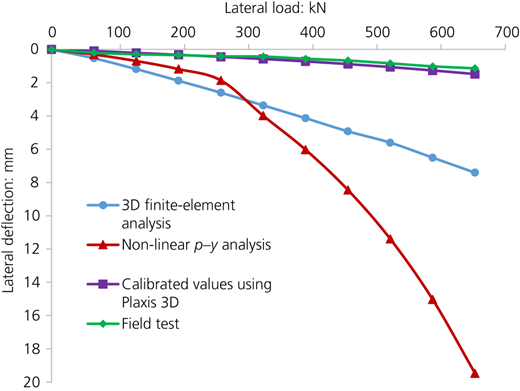
Lateral deflection plotted against lateral load for pile 1 using various methods
Lateral deflection plotted against lateral load for pile 1 using various methods
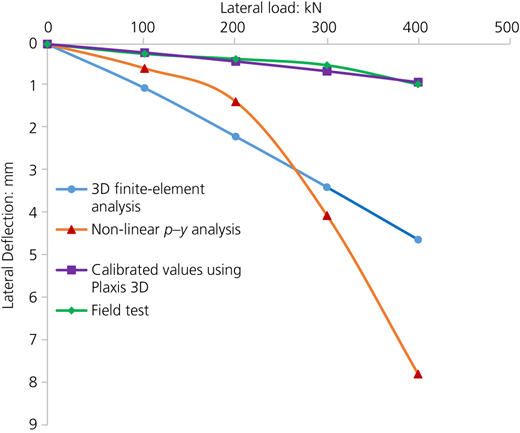
Lateral deflection plotted against lateral load for pile 2 using various methods
Lateral deflection plotted against lateral load for pile 2 using various methods
Lateral pile deflections obtained from various methods for pile 1
| Load: kN | Lateral deflection of the pile: mm | |||
|---|---|---|---|---|
| Non-linear p–y analysis (using the LPile software) | 3D finite-element analysis (using the Plaxis 3D software) | Field test | Calibrated values of deflection using the Plaxis 3D software | |
| 0.0 | 0.00 | 0.00 | 0.00 | 0.00 |
| 65.4 | 0.30 | 0.50 | 0.20 | 0.09 |
| 130.8 | 0.69 | 1.20 | 0.29 | 0.20 |
| 196.1 | 1.18 | 1.90 | 0.34 | 0.32 |
| 261.5 | 1.86 | 2.60 | 0.41 | 0.44 |
| 326.9 | 3.98 | 3.40 | 0.43 | 0.57 |
| 392.3 | 6.02 | 4.10 | 0.56 | 0.72 |
| 457.6 | 8.44 | 4.90 | 0.67 | 0.88 |
| 523.0 | 11.38 | 5.60 | 0.84 | 1.06 |
| 588.4 | 15.01 | 6.50 | 1.02 | 1.26 |
| 653.8 | 19.44 | 7.35 | 1.14 | 1.48 |
Lateral pile deflections obtained from various methods for pile 2
| Load: kN | Lateral deflection of the pile: mm | |||
|---|---|---|---|---|
| Non-linear p–y analysis (using the LPile software) | 3D finite-element analysis (using the Plaxis 3D software) | Field test | Calibrated values of deflection using the Plaxis 3D software | |
| 0.0 | 0.00 | 0.00 | 0.00 | 0.00 |
| 106.4 | 0.57 | 1.00 | 0.23 | 0.20 |
| 206.2 | 1.36 | 2.20 | 0.35 | 0.41 |
| 305.9 | 4.05 | 3.40 | 0.50 | 0.64 |
| 405.7 | 7.80 | 4.59 | 0.95 | 0.90 |
Conclusions
Based on various analyses conducted as part of this research work, conclusions and recommendations are summarised as follows.
Lateral deflections obtained from both numerical approaches were found to be very high compared with those magnitudes obtained from lateral pile load tests, thus underestimating the ground stiffness to a large extent.
Even though both methodologies effectively replicated the initial response observed in field test results, a significant margin of error was observed, which could be attributed to discrepancies in design input parameters. Yielding was observed in non-linear p–y analysis at very low applied loads.
Calibrated values of elastic modulus that yield lateral deflections of piles close to those obtained from pile load tests showed that ground stiffness parameters were highly underestimated.
Stiffness parameters from laboratory tests and empirical equations, used in determining the lateral deflection of piles through numerical analyses, were found to be very conservative. Hence, in projects where field pile load tests are not feasible, field tests such as pressure meter tests/seismic down-hole are recommended to be conducted to obtain more accurate stiffness parameters.
Acknowledgments
ADU author acknowledges financial support from Abu Dhabi University’s Office of Research and Sponsored Programs.

