

It is suggested that the teaching of basic soil mechanics has not changed much since the early days of soil mechanics, and appears be ‘stuck in a rut’. An obvious symptom of this is the absence of material on residual soils in soil mechanics courses. It is long past the time when such material should be an integral part of soil mechanics teaching. Failure to do this means that students and practising engineers routinely use a log scale for compression behaviour and assign values of overconsolidation ratio and compression index to residual soils. There is no basis for doing this, since residual soils are not formed by a consolidation process. Other aspects or soil behaviour of which students lack an adequate understanding at completion of their degree courses are: (1) the pore pressure state above the water table, especially in clays, (2) when to use total stress and effective stress analyses, (3) the use of the plasticity chart for evaluating soils, rather than for classifying them, and (4) the limitations of the theories they are taught at universities. Examples are given where soil behaviour in the field is clearly incompatible with theory.
Notation
- B
the diameter of a circular surface foundation on a soft clay in metres
- c
cohesion
- c′
cohesion intercept in terms of effective stress
- Cc
compression index
- Cs
swell index
- cv
coefficient of consolidation
- e
void ratio
- Ka
coefficient of active earth pressure
- mv
one-dimensional coefficient of compressibility
- Nc
bearing capacity factors
- Nγ
bearing capacity factors
- p
pressure
- q
ultimate bearing capacity
- Su
undrained shear strength of the soil
- s
shear strength of the soil
- u
pore pressure
- γ
unit weight of soil
- σ
total stress
preconsolidation pressure
- τ
shear strength of the soil
- φ′
angle of shearing resistance in terms of effective stress
Some general remarks
The background to the following comments to Santamarina (2016) is primarily the author’s ‘career’ as a geotechnical engineer up to the age of 50, in Indonesia, New Zealand and Malaysia. The climate in those countries is either wet tropical or wet temperate, and the soils are predominantly fully saturated clays, more often residual than sedimentary. At the age of 50 the author moved to Auckland University. He apologises if some comments are unnecessarily critical. His impression of soil mechanics teaching is that as far as basic concepts or principles are concerned, it is in a rut, or has become somewhat fossilised. In other words, the core material has not been subject to the thorough scrutiny it ought to have received over the past 50 or 60 years.
The author thinks that one of the reasons for this is that university teachers are often PhD graduates who move straight on from their PhD research to become university lecturers (or professors). They are naturally keen and capable researchers, and once in their new position, their prime objective is to advance their research interests, often continuing the line of research of their PhD thesis. This means they are not subject to the teaching or learning experiences that geotechnical engineers are subject to when they encounter a great variety of real soils in their workplace – and are stimulated to think more critically about what they learnt in undergraduate courses.
The author’s experience in breaking in or mentoring new graduates while working in government agencies and a consulting company is that they generally have a fairly good grasp of methods, but a weak understanding of the concepts and assumptions behind these methods. This reflects both the natural inclination of engineers, which is to design and build things, and the wish of employers, who want new graduates to perform immediately productive work. The author thinks the concentration on methods also reflects the fact that much of engineering teaching, in large classes in particular, is more akin to production-line knowledge transfer than true education.
The order in which material is presented in soil mechanics courses is often unsatisfactory. The first lecture should be on the principle of effective stress to stimulate the thinking and interest of students, followed by worked examples using the principle. The author’s aim when teaching was always to make students realise that this principle is not something esoteric or foreign to them – they already know why an empty sealed tin can and a sponge behave quite differently when loaded by water pressure than with lead weights! Once they grasp this idea, the effective stress equation can be introduced. Simple examples illustrating the principle are the influence of rainfall on the stability of a slope and the settlement of the ground when the water table is lowered. Examples of this are given by Wesley (2000). Clay mineralogy, phase relationships and index or classification tests do not normally stimulate the students and can be slotted in later in the course.
Universities need to be clear on what they aim to achieve in their courses. It is unfortunate that geotechnical engineering and soil mechanics are being used as if they mean the same thing, which is not the case. Soil mechanics is a theoretical discipline, while geotechnical engineering is a practical undertaking, more akin to a profession; it involves many components, including soil mechanics, geology, observation, experience and a large measure of judgement. The role of universities should be to teach soil mechanics and to be sure that what they teach is relevant to geotechnical engineering.
Universities should also recognise that in undergraduate classes they are normally teaching students who will become civil engineers. Only some of them will become geotechnical engineers, but even those who become structural engineers should have a reasonable understanding of basic soil mechanics. They should at least be able to ask geotechnical engineers the right questions when seeking soil parameters to put into their computer programs. The course content should therefore concentrate on core principles and design methods. Teaching material that has little or no relevance to practical engineering, such as critical-state soil mechanics, should find no place in undergraduate courses. Some observations on critical-state soil mechanics are made in the final section of this article.
Specific issues
Coverage of residual soils
Although residual soils are found on the Earth’s surface almost as commonly as sedimentary soils, their existence and properties are rarely mentioned in soil mechanics courses and textbooks. The result is that certain concepts developed from sedimentary soil behaviour are routinely applied to residual soils and routinely result in a mistaken understanding of their behaviour. This is surely an indictment on those who teach soil mechanics in universities. It is well past the time when residual soil behaviour should be an integral part of mainstream soil mechanics, in particular in its syllabus in university courses. This does not mean including extra lectures addressed specifically to residual soils. It means that in normal soil mechanics courses, the properties of residual soils should be addressed alongside those of sedimentary soils whenever they differ from the latter. This is the approach taken by Wesley (2010a). The most important points are the following.
The method of formation of residual soils does not involve the erosion, transport and sedimentation associated with sedimentary soil formation. These give sedimentary soils a degree of uniformity and predictability that is absent in residual soils.
Because residual soils do not undergo a sedimentation and consolidation process, stress history is an irrelevant concept for these soils. The logarithmic parameters C c and C s do not apply to residual soils because these do not have a virgin consolidation line or an unloading line. Their compression graphs should be plotted on a linear scale, and the linear parameter m v should be used in settlement estimates.
Residual soils are generally of much higher permeability than sedimentary soils, which has implications for interpreting the results of conventional laboratory tests and for their behaviour when loaded in the field. Only seldom will their behaviour be truly undrained during load application.
The need to include residual soils in university courses is not restricted to universities in countries where residual soils are common. Large numbers of students from developing countries such as India, China, South American countries and Indonesia undertake civil engineering courses at European or American universities. They often return home without having even heard of residual soils, let alone learnt anything about them, and proceed to apply irrelevant concepts to the residual soils abundant in their own countries. The author is aware of universities in some countries that are surrounded in all directions by residual soils, yet the teaching of soil mechanics is restricted exclusively to sedimentary soils.
Terminology
The terminology used in teaching soil mechanics needs to be more rigorous. This is particularly true of the basic equation for the shear strength of soils, namely
Bishop at Imperial College, London, used the following terminology
c′: cohesion intercept in terms of effective stress
φ′: angle of shearing resistance in terms of effective stress.
This terminology appears to be very appropriate, although rather long. To overcome this, the term friction angle can be used for φ′, but the term cohesion intercept should always be retained and should not be referred to as just cohesion. The term cohesion is confusing, as it may mean simply the property of cohering (sticking together) and is still commonly used in some parts of the world to mean the undrained shear strength.
Analysis using total stress and effective stress
A further issue of terminology is the terms drained and undrained. They are regularly misused, in particular with regard to stability analysis. As geotechnical engineers are all well aware, they have the choice of carrying out stability analysis (whether of a foundation, retaining wall or a slope) using either total stress or effective stress. A total stress analysis is based on the undrained shear strength S u of the soil, and an effective stress analysis is based on the effective stress parameters c′ and φ′. The total stress analysis can correctly be referred to as an undrained analysis, and the effective stress analysis is often referred to as a drained analysis. This might seem logical at first sight, but a little thought shows that it is not at all logical, and they are misleading terms.
When geotechnical engineers do a stability analysis using the effective stress parameters c′ and φ′, they simply determine the normal stress and the pore pressure on a possible failure plane and calculate the shear strength from the effective stress Mohr–Coulomb equation
They are therefore analysing a static (or pseudo-static) situation, and no assumption is made about whether any potential failure will be undrained or drained or somewhere in between. Whether failure is drained or undrained depends on the factors causing the failure. If failure occurs as a result of steadily rising pore pressures (as for example during prolonged rainfall), then the behaviour up to the point of failure is drained, but once failure is initiated, there is no time for flow of water and the behaviour changes to undrained. During earthquake loading, it is very unlikely that there will be time for water to drain into or out of the soil, so it is probable that the behaviour will be undrained.
Geotechnical engineers can, of course, carry out an effective stress analysis of an undrained situation. They may wish to do this to estimate the stability of an earth dam during an earthquake. This is not easily done, as it involves estimating the change in the pore pressure caused by the cyclic loading from the earthquake. For this reason, it is easier to do the analysis in terms of total stress using the undrained shear strength, possibly making an allowance for some loss of strength caused by the earthquake.
The choice geotechnical engineers have in carrying out an analysis is therefore not between an undrained and a drained analysis. It is between
a total stress (or undrained) analysis, using the undrained shear strength
an effective stress analysis, using the effective stress parameters c′ and φ′ and the pore pressure in the soil.
Both these methods are essential and, indeed, fundamental design procedures in geotechnical engineering and students need to understand clearly when to apply them.
Soil description and classification
This is not a subject that excites students, but it is important, and students should leave the university with a reasonable grasp of the basics. In particular, they should know what is meant by a clay and a silt. On this issue, the author teaches the following.
Clay. Clay consists of very small particles and possesses the properties of cohesion and plasticity, which are not found in sands or gravels. Cohesion refers simply to the fact that the material sticks together, while plasticity is the property that allows the material to be deformed without volume change or rebound and without cracking or crumbling. A material has the properties of clay primarily because it consists of clay minerals rather than particles of a particular size. (Thus, the term cohesion by itself should be used only with its normal everyday meaning, namely that the material coheres or sticks together. If it is being used in relation to its component of shear strength, it should be the cohesion intercept, as explained earlier.)
Silt. This is an intermediate material lying between clay and fine sands. Silts are less plastic than clays (strictly speaking, true silts hardly possess the property of plasticity at all) and more permeable, and display the distinctive properties of ‘quick’ behaviour and dilatancy, which are not found in clays. Quick behaviour refers to the tendency of silt to liquefy when shaken or vibrated, and dilatancy refers to its tendency to undergo volume increase when deformed.
The meanings given to the terms gravel, sand, silt and clay in soil mechanics are essentially the same as the meaning given to them in normal everyday usage. The classification into clay or silt is not made on the basis of particle size but on the behavioural characteristics mentioned earlier.
With regard to the Atterberg limits, the author is a firm believer in these tests, not so much as a means of classifying soils but as a means of evaluating them. The position that a clay or silt occupies on the plasticity chart is a very good indicator of its intrinsic engineering properties. Those that lie above the A line have undesirable properties, while those that lie below the A line generally have good properties. The position of the natural water content in relation to the plastic and liquid limits (the liquidity index) is also a very good indicator of the in situ state of the soil. The author does not mean that it indicates the undrained strength of the undisturbed soil, as there are plenty of firm soils with natural water contents above the liquid limit. It indicates whether the soil is in a compact or non-compact state and, thus, whether it will suffer loss of strength when disturbed or compacted.
The plastic limit test is particularly useful, first because for most clays it is close to the Proctor standard optimum water content. This is to be expected since the undrained shear strength of clay at the plastic limit is generally agreed to be in the range of 170–200 kPa, which is also the range of the soil compacted at Proctor optimum water content. Second, the test has the advantage that no equipment is needed to carry it out to determine whether the soil is dryer or wetter than the optimum water content for compaction. The soil can simply be rolled into threads on any convenient flat surface where the earthworks operation is being carried out.
It should be noted that there is a common error in the use of the plasticity chart, and this is the significance of the letters L and H in classifying silts and clays. These respectively mean low liquid limit and high liquid limit, not low plasticity and high plasticity. Thus, MH is a silt with a high liquid limit, not a silt of high plasticity. The latter term would be a contradiction; if the soil was of high plasticity, it would be a clay.
Interpretation of oedometer tests
It is astounding, to say the least, that the e–log(p) graph has become permanently embedded in soil mechanics practice, despite the fact that its defects have been pointed out by well-respected people such as Janbu (1998) and Terzaghi et al. (1996). Janbu (1998: p. 26), based on his experience with sedimentary soils, makes the following comment
It remains a mystery why the international profession still uses the awkward e–log p plots, and the incomplete and useless coefficient Cc which is not even determined from the measured data, but from a constructed line outside the measurements.
Misinterpretation of soil behaviour arising from the logarithmic scale is to be seen regularly in textbooks for idealised soils and in published papers for natural soils. Figure 1 illustrates this in the case of textbooks.
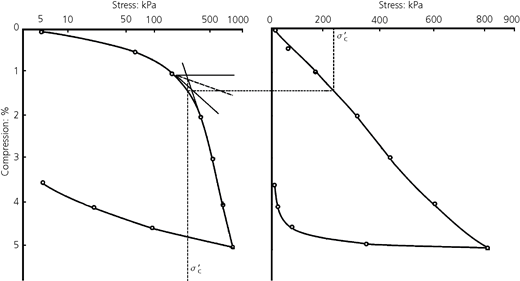
Conventional determination of the preconsolidation pressure redrawn using a linear scale. Adapted from Craig (1992) and Das (1998)
Conventional determination of the preconsolidation pressure redrawn using a linear scale. Adapted from Craig (1992) and Das (1998)
The figure shows the standard construction for determining the preconsolidation pressure. When the graphs are redrawn using a linear scale, it is seen that there is no evidence at all of a preconsolidation pressure. The apparent preconsolidation pressure is purely the result of the way the data are plotted and is not a soil property at all.
Figure 2 illustrates the same point for two natural soils. Figure 2(a) shows oedometer test results plotted in the usual manner using the logarithmic scale. These tests are from a residual soil known as the Piedmont formation, found in southern USA. Although these curves do not show a sharp change in gradient, from them values of the preconsolidation pressure have been determined and overconsolidation ratios (OCRs) have been calculated. When these curves are redrawn with a linear scale (Figure 2(b)), it is seen that they become smooth curves with opposite curvature. There is no indication of a preconsolidation pressure at all, so the values of OCR are meaningless.
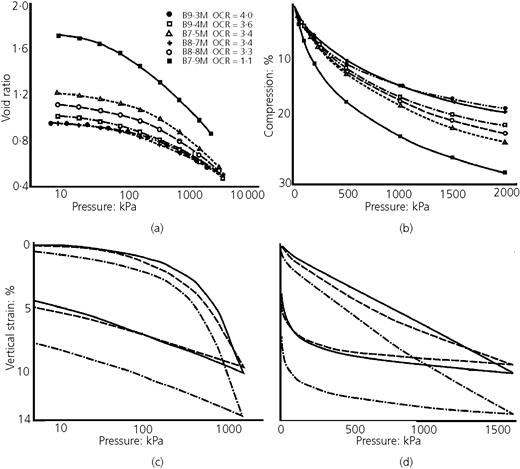
Logarithmic plots from natural soils redrawn using a linear scale. (a) Logarithmic and (b) linear scales for Piedmont residual clay (Wesley, 2000). (c) Logarithmic and (d) linear plots for Auckland residual clay, from sandstone (Pender et al., 2000)
Logarithmic plots from natural soils redrawn using a linear scale. (a) Logarithmic and (b) linear scales for Piedmont residual clay (Wesley, 2000). (c) Logarithmic and (d) linear plots for Auckland residual clay, from sandstone (Pender et al., 2000)
Figure 2(c) and 2(d) show oedometer test results from a clay found in Auckland, New Zealand, formed by weathering of a soft sandstone. In this case there appears to be a reasonably well-defined preconsolidation pressure in the vicinity of 400 kPa. However, when plotted using a linear scale, this apparent preconsolidation pressure disappears. It is not suggested that the logarithmic plot will always give a misleading pressure or that preconsolidation pressures do not exist in natural soils. However, only a linear plot will give a reliable picture of the compression behaviour.
If there is a clear increase in compressibility at a certain stress level, this is best referred to as a yield pressure rather than a preconsolidation pressure. The latter term is not relevant to residual soils and may also be misleading for sedimentary soils, as the effects of ageing and hardening may be more significant than stress history. If academics and geotechnical engineers were to always redraw their e–log( p) graphs using a linear scale, the logarithmic plot would disappear very quickly except for soft normally consolidated clays.
A second issue in the interpretation of oedometer tests is in the determination of the coefficient of consolidation c v. Many residual soils are of high permeability, which means that pore pressures dissipate very quickly on the application of load. It is readily shown that there is an upper limit to the value of c v that can be measured in a conventional oedometer test. With a sample thickness of 20 mm, this limit is about 0·01 m2/d.
Estimation of the consolidation rate of surface footings on clay
Textbooks and soil mechanics courses generally teach only the one-dimensional (1D) consolidation theory, which is an essential starting point. However, engineers are just as likely to be called on to estimate the settlement rate of a surface footing as of a wide fill. Teachers should make it clear to students that the 1D theory does not apply to surface footings, and it would be useful if textbook writers included solutions to the surface footing situation.
The pore pressure state in the ground and seepage behaviour
It is surprising that, despite a huge amount of research into soil behaviour, not much attention has been paid to the pore pressure state and seepage patterns in the ground. Students tend to leave university with the idea that the water table or the phreatic surface is the upper boundary of the pore pressure or seepage condition. This is only the case in a coarse-grained soil. Water does not drain out of clay under gravity forces; it becomes only partially saturated from evaporation at the surface. In wet tropics and in temperate climates, this zone of partial saturation is normally not more than a few metres. Careful measurements made by the author while working in Indonesia showed that volcanic clays were fully saturated to within about a metre from the surface despite deep water tables. Strictly speaking, there is no such thing as unconfined flow in a clay, as the upper boundary of the seepage zone is the ground surface. Seepage takes place above the water table according to the same laws as below it, and the phreatic surface is simply a line of zero (atmospheric) pressure. It is actually easier to sketch unconfined flow nets in clay because the upper boundary of the seepage zone is defined by the ground surface.
One of the reasons that the phreatic surface came to be regarded as the upper limit of the seepage zone is possibly because early studies of seepage patterns were carried out on sand models in glass-sided tanks. Dye tracers at various points give a very nice picture of the seepage pattern. Experiments of this sort are still a very good way of illustrating seepage behaviour, but students should be warned that what they are seeing is valid only for coarse-grained materials.
The author wonders how many teachers recognise that the settlement of a surface foundation is likely to be greater if the foundation is built during winter than if it is built in summer. This is little more than common sense. During summer the soil dries out, and once the surface is covered by a building, the soil will take up water to reach an (approximate) permanent long-term equilibrium state. The swelling associated with this water uptake may outweigh the compression resulting from the foundation load. This effect may be one of the reasons settlement of surface foundations is usually less than predicted values. Contractors prefer to build in summer!
Compaction of residual soils
Specifying compaction control tests in terms of dry density and optimum water content based on Proctor compaction tests has been an integral part of soil mechanics in practice and has generally served its purpose well. However, it does have disadvantages, namely that results of control testing are not immediately available and that when the soil is highly variable, a fresh Proctor test has be carried out every time a control test is undertaken. Residual soils, in particular, are highly variable, and it is often not practical to carry out large numbers of repeated Proctor tests. An alternative method, developed in New Zealand, is to use undrained shear strength and air voids as alternative control parameters. This makes the specification and control much simpler, as a single specification applies regardless of large variations in the soil. The normal practice in New Zealand is to require the undrained shear strength to be not less than 150 kPa and the air voids to be not greater than about 8%. The former ensures that the soil is not too wet and the latter ensures it is not too dry.
All of the above points are covered in the two textbooks the author wrote a few years ago and which are published by Wiley (Wesley, 2010a, 2010b).
The limitations of theory
It is important that students do not leave university with the idea that geotechnical challenges are always solved by using tidy analytical procedures. Terzaghi (1936: p. 63) in his address to the first international soil mechanics conference, made the following observation
However, as soon as we pass from steel and concrete to earth, the omnipotence of theory ceases to exist. In the first place, the earth in its natural state is never uniform. Second, its properties are too complicated for rigorous theoretical treatment. Finally, even an approximate mathematical solution of some of the most common problems is extremely difficult.
The emphasis here is primarily on the variability and complexity of natural soil. However, it is important to recognise that some basic theoretical methods of analysis come up with the wrong answers even if the soil is completely homogeneous.
A simple example of this is the maximum stable height of a vertical clay bank. Almost all textbooks present equations for calculating this maximum height. These are
To gain an impression of what these equations indicate in a practical situation, a typical firm to stiff soil will be considered. There are many soils, in particular residual soils, in this category with properties close to the following
unit weight = 16 kN/m3
undrained shear strength = 100 kPa
effective stress strength parameters c′ = 15 kPa and φ′ = 35°.
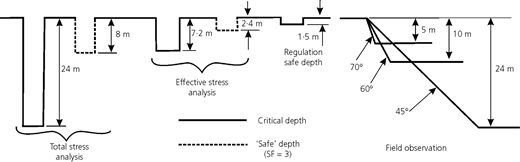
Equations 3 and 4 give the following maximum heights
effective stress analysis: 7·2 m
total stress analysis: 25 m.
The idea that a vertical clay bank could remain stable to a height of 25 m is utterly unrealistic, and even a height of 7·2 m is very optimistic. A simple observation of clay banks shows this to be the case. Agencies concerned with construction safety rightly place limits of 1–1·5 m on the depth of an unsupported trench that workers may enter. The book The Mechanics of Soils and Foundations (Atkinson, 1993) actually states that the solution ‘commonly used in design’ is H c = 3·8S u/γ . Statements like this in textbooks are a recipe for tragedy.
Figure 3 illustrates the theoretical heights, along with the author’s observations of actual cut slopes in clay. The fact that Equations 3 and 4 are presented in textbooks and soil mechanics courses is perhaps a reflection of a preference for theory rather than the observation of actual behaviour on the part of those who teach or write soil mechanics textbooks.
A second example of the limitations of theoretical methods is the estimation of the bearing capacity of clays. In theory, this capacity can be determined using either total stress analysis or effective stress analysis, with the understanding that for an effective stress analysis to be valid the load must be applied sufficiently slowly that no pore pressures are generated. Consider, for example, a circular surface foundation on a soft clay with the following properties
unit weight = 14 kPa
undrained shear strength = 12 kPa
effective stress strength parameters c′ = 5 kPa and φ′ = 25°.
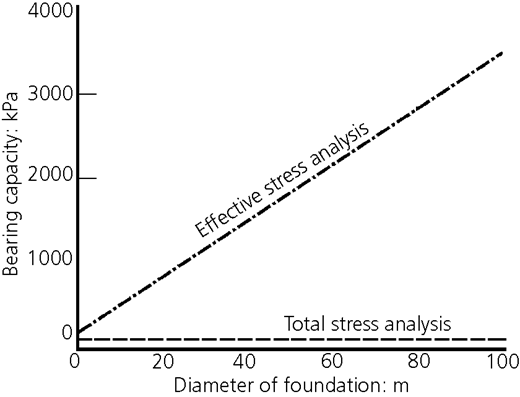
The total stress analysis gives q = S u N c = 12 × 6·3 = 75·6 kPa.
The effective stress analysis gives
where B is the diameter in metres.
In total stress analysis, the bearing capacity is independent of the diameter, but in effective stress analysis, it is proportional to the diameter. Figure 4 illustrates the results of the two types of analysis. The total stress value is constant at 76 kPa, while the effective stress value ranges from 154 to 3480 kPa. A 1-m-dia. circular footing would probably be unusual, but a storage tank with a diameter of 100 m would not be surprising. No geotechnical engineer would consider applying a foundation pressure much higher than that indicated by the total stress analysis, regardless of the diameter of the foundation, or the rate of loading. Thus, the analysis in terms of effective stress is of theoretical interest only.
Critical-state soil mechanics
The comment was made earlier that critical-state soil mechanics should not be taught in undergraduate soil mechanics courses. The author’s reasons for this view, in brief, are as follows.
The author first became aware of critical-state soil mechanics at a seminar at Laval University in Quebec City in 1965. The four speakers were Bishop, Skempton, Roscoe and Rowe. Roscoe presented tidy curves of stress and volume change against strain showing that, regardless of the initial state at the start of each test, soils all ended up at a uniform ‘critical state’. Bishop pointed out that with natural clays failure was generally brittle in form and took place on specific planes, so that the material tended towards the residual strength rather than the critical state. Roscoe replied, rather petulantly, ‘We know that, Alan [Bishop], we know it [critical state] doesn’t work with clay, I am talking about sand here’. Bishop’s point is the same as that made earlier by Professor Santamarina (2016: p. 2), namely that ‘Peak strength and critical-state void ratio are inferred even when specimens have experienced progressive failure and shear localisation’.
A critical shortcoming of critical-state soil mechanics was thus apparent in the early years of its development, namely the attempt to develop a behaviour model applicable to both sands and clays. These two materials are so very different in so many ways that such an approach was unlikely to succeed.
The difficulties associated with applying critical state to clays can be overcome to some extent by examining only the behaviour of remoulded or artificially created clays. This is the basis on which the critical-state model for clay was developed. This totally ignores one of the most important properties of almost all natural soils, namely the structure that gives them specific and distinct properties. Janbu (1998: p. 23), quoted earlier, recognised this and made the following observation
It is very surprising, to say the least, to observe all the efforts still made internationally in studying remoulded clays. If the aim of such research is practical application, it is obviously a total waste of money.
Even if clays could be ‘coaxed’ by some means into reaching a critical state and the value of the critical-state friction angle φ′ cv determined and the value of c′ found to be zero, the question arises as to what use these are. These parameters could not be applied to slope stability estimates or the design of embankments without producing absurd results.
It follows from the preceding comments that critical-state soil mechanics has had only minimal impact on the geotechnical profession, and, indeed, its impact has been negative in more than one way.
First, strong advocates of critical-state soil mechanics tend to approach the evaluation of natural soils with a very fixed view of how they ought to behave, namely that they should fit into critical-state concepts. When this is not the case, they look for ways to ‘bend’ them to bring them into line. This is not a healthy mind-set for geotechnical engineers; they should approach all soils with an open mind, and not seek to make them fit into preconceived ideas.
Second, the critical-state parameter φ′ cv has found its way into some design codes. This is not sensible, partly because the value of φ′ cv cannot be measured with clays, since it lies at an indeterminate value between the peak and the residual value and partly because soil failure is governed by the peak value of φ′. Zornberg et al. (1998), for example, conclude from their experimental testing of reinforced earth walls that failure is governed by the peak φ′ value.
Third, too much unproductive research into critical state is being undertaken in universities in various parts of the world, in particular in developing countries in Asia and South America. Students from these countries are returning home from some Western universities knowing a lot about critical-state soil mechanics and almost nothing about residual soils. Some undertake research projects applying critical-state concepts to local residual soils, only to find that the two are incompatible.
At Auckland University, some of the author’s colleagues are much better informed than he is about critical-state soil mechanics, but together they are of the view that replacing part of the current curriculum with critical state-soil mechanics would not help the graduates become better geotechnical engineers.
Conclusion
The author would like to close by thanking Prof. Santamaria for inviting him to contribute to this discussion on the teaching of soil mechanics. The author has attended more than one conference on the teaching of soil mechanics and has been a little disappointed that the emphasis has been on teaching techniques rather than the actual technical content. While it is very desirable to be continually thinking about and seeking better ways of getting the material across to students, it is equally important to make sure that what teachers endeavour to get across is correct and relevant to geotechnical engineering.
To conclude, an answer to the question posed by the title of the article, ‘(What) to teach or not to teach – that is the question’ is ‘Whether ’tis nobler in the mind to suffer the warts and defects of outdated traditions, or to take up the challenge of this messy state and by rethinking, correct it’ (apologies to Hamlet, or should they be to Shakespeare?).

