With the increasing importance of individuals willing to undertake international assignments in risky contexts, the purpose of this paper is to increase the understanding of the interplay between the challenges of such assignments in risky contexts and the motivations of individuals to undertake them.
The study follows a narrative approach to gain an understanding of individuals' subjective experiences. In-depth interviews were conducted with Swedish police officers who have been on international assignments. The narrative analysis comprised two steps: first, to identify motivations and challenges and, second, to capture how challenges and motivations interplay.
The main motivations for international assignments in risky contexts were thrill-seeking, meaningfulness and financial gain and were found to shift with experiences. The main challenges were related to danger, physical and mental hardship, family relations and repatriation and were experienced by police officers as both positive and negative. Three ways in which challenges interplay with motivations were identified. The dynamic interplay of initial motivations and expected and experienced challenges was found to shift motivations as well as willingness to undertake further assignments.
The findings have implications for the recruitment, management and support of individuals on international assignments in risky contexts.
The key contribution of this paper lies in identifying the interplay between challenges and motivations on international assignments in risky contexts. Challenges are not only deterring but can strengthen, or even be, what motivates international assignments, while others need to be compensated for. The study contributes to research on the impact of experiences of international assignments on motivations and on the willingness to go on additional assignments.
Introduction
Risky contexts expose expatriates to considerable physical and mental challenges, which warrant further research of such assignments from an individual perspective. Individuals have arguably become less willing to engage in global mobility in general (Quatrin et al., 2024) and with danger and challenges involved at the deployment location, it can be even more difficult to find individuals willing to take on international assignments (Ipek and Paulus, 2021; Wagner and Westaby, 2009). However, just as the same factors that drive individuals to engage in international mobility may not always be motivating (e.g. if outcomes for the career or family are expected to be negative) (Dickmann et al., 2008), we argue that even challenges of assignments in risky contexts may not always be deterring.
Risk and danger increasingly impact global mobility and have thus become a topical concern for assignees and organizations, as well as a growing area of interest for academics (Faeth and Kittler, 2020; Glorieux et al., 2023; Posthuma et al., 2019; Yusuf et al., 2022). As most understanding of what motivates or hinders individuals from undertaking international assignments comes from research in lower risk environments (Dickmann and Watson, 2017) not enough is known about the motivations of individuals for taking on the challenges of assignments in risky contexts (Stoermer et al., 2017).
Previously identified motivations for undertaking international assignments, such as perceived personal benefits for professional development, future career or a better lifestyle in an interesting location (Dickmann et al., 2008; Hippler, 2009), may not be relevant or enough to persuade an assignee to take on the challenges of deployment in risky contexts (Bader, 2015). It has been argued that stressors and experienced trauma should be taken into consideration when trying to understand motivations to undertake such assignments (Dickmann and Watson, 2017). Further research is needed on the importance of these motivations in different contexts and how these motivations shift with international experience (Ho et al., 2016).
Experiences of international assignments and how experienced challenges are handled influence motivations for further international experiences (Akkan et al., 2022; Crowley-Henry and Heaslip, 2014; van Emmerik and Euwema, 2009). Research on stressful workplace demands has shown that stressors (as in risky contexts) may not only be negatively perceived, but demanding conditions also can impact work satisfaction and motivation positively (Cavanaugh et al., 2000; LePine, 2022). In previous research on international assignments, adventure seeking and a search for challenges (Crowley-Henry and Heaslip, 2014; Näsholm, 2014; Suutari and Taka, 2004) have also been found to be important factors for the career choices of some expatriates indicating a relationship between challenges and motivations. This raises the question of how motivations and experienced challenges interplay and influence future assignment willingness.
With the need for individuals willing to sign up for international assignments in risky contexts (Glorieux et al., 2023; Lazarova et al., 2021), it is important to better understand both the challenges involved, the motivations of assignees and how motivations interplay with both expected and experienced challenges, as this affects assignment willingness. The purpose of this paper is therefore to increase the understanding of the interplay between the challenges of international assignments in risky contexts and the motivations of individuals to undertake them.
To address this purpose, we conducted in-depth interviews with Swedish police officers who have been on one or more assignments on international missions. International Police missions are an example of rescue, relief and peace-building missions where individuals are deployed by intergovernmental, non-governmental or humanitarian organizations to high-risk contexts, likely to involve considerable professional, physical and emotional challenges with far-reaching consequences (Glorieux et al., 2023; Lazarova et al., 2021). The impact of such missions is dependent on the willingness and engagement of individuals willing to undertake the challenges, making it a relevant setting for this study.
The study has a narrative approach to capture individuals' subjective experiences. The first step of the analysis thematically identifies the motivations for, and the challenges experienced on, international assignments in risky contexts. This constitutes a foundation for the second step of the analysis where focus lies on the interplay between challenges and motivations. We identify three distinct forms of interplay: the challenge itself can be the motivation and be strengthened with the experiences; the challenge may be accepted due to the motivation and additional moves would require a compensating motivation to be accepted; the challenge outweighs the motivation or does not fulfill motivations, which can deter from future assignments.
This paper contributes to research on international mobility in risky contexts (Faeth and Kittler, 2020) with empirical insights into the motivations for, and challenges experienced on, such assignments. With our focus on how the challenges interplay with the motivations for undertaking assignments, we build on research that has identified a range of motives (Dickmann et al., 2008) and contribute to a more dynamic understanding of expatriate motivations. We thereby contribute with an increased understanding of the impact of previous international experience, in particular experienced challenges, on assignment willingness (Ho et al., 2016). The study opens up for further research on how challenges and motivations interplay in other contexts and other types of international assignments, as well as on factors that can impact this interplay and how individuals perceive and cope with challenges, such as personality, peer- and family support and organizational factors.
Review of prior research
Challenges of assignments in risky contexts
While research in International Human Resource Management has long recognized that assignees in some locations may face risks related to, for example, terrorism and armed conflicts, research on such issues is increasingly needed as risk and danger have been demonstrated to impact those working abroad in any location (Bader et al., 2022). Risky contexts or hostile environments for expatriates, have been described as “any environment perceived to be vulnerable to events or circumstances that present a threat to expatriates' safety and security” (Fee et al., 2019, p. 1710). This includes both natural disasters as well as criminal and political violence, but also circumstances emanating from the expatriate's cultural ignorance or incompetence. In this paper, we refer to risky contexts, as Gannon and Paraskevas (2019) highlight that in such locations the assignees “are exposed to severe, pervasive or persistent levels of risk originating from a variety of man-made or natural threats and hazards” (1751), and we here include both the potentiality and actuality of harmful events (Hällgren et al., 2018).
Risky contexts are unpredictable and uncontrollable, and might be physically and mentally taxing in a way that the individual is not prepared or trained for; hence, influencing not only the work situation but overall life, including leisure, residence, travelling, etc. (Sarfraz et al., 2023). Contexts with frequent alarms of terrorist attacks, experiences of hostility and deadly threats and encounters with poverty and hardship for the inhabitants could impact both work attitudes and performance (Bader and Berg, 2014). On international assignments in conflict or post-war contexts, peacekeepers often face hostile and dangerous situations, witness distress or have life-threatening experiences (Glorieux et al., 2023; van Emmerik and Euwema, 2009). In a study of doctors on international assignments in war zones, one mental challenge was uncontrollable switches between periods of inactivity and standing by versus intense action (de Rond, 2017). It has been found that diverse types of risks or dangers lead to different perceptions of fear and use of different coping mechanisms (Faeth and Kittler, 2017; Koveshnikov and Lethonen, 2024). Bader (2015) suggests that if an expatriate has more experience in coping with risk, they could be better prepared to cope with the challenges of risky locations.
In risky contexts, short-term assignments (up to one year) may be preferable to limit the risks and dangers for the individual. However, short-term assignments also leave less time to adjust and be effective in the host country and may induce feelings of frustration (Bader, 2015; Saati and Wimelius, 2018). Moreover, even though a short-term assignment may have the advantage of not uprooting the entire family, the international assignment will still involve the entire family (Tahvanainen et al., 2005; Crowley-Henry and Heaslip, 2014) and may evoke challenges in family relationships.
International police missions, the empirical context for this study, often take place in post-war and conflict-ridden regions. Previous research on international police missions has, however, focused on the societal impact of such missions, and the organizational challenges involved rather than on the experiences of individuals assigned to them and the challenges they face (Neubauer et al., 2022; Saati and Wimelius, 2018). From the few studies that take a more individual perspective, we learn that the fulfilment of the mission was accompanied by considerable challenges stemming from local conditions, for example, tiresome bureaucracy, lack of continuity (Goldsmith, 2009), and the collaboration with other international and local police, as well as military operations (Greener, 2011). Previous research also shows that police officers may be dissatisfied with how their home organization values their experiences (Dupont and Tanner, 2009; Saati and Wimelius, 2018).
Motivations for international assignments
In the literature on expatriation, several motives for individuals to accept or pursue an international assignment have been identified, pertaining to the individual, the organization and the location, respectively (Dickmann, 2012; Dickmann and Watson, 2017). It is often assumed that individual motivations for undertaking international assignments stem from perceived potential benefits, although there may also be factors in the home country that push someone to go abroad (Ho et al., 2016). Key motivations include career development, learning opportunities, financial gain, family issues, interest in international experience and attractiveness of the location or job (Dickmann et al., 2008; Hippler, 2009). However, these same factors could also be deterring, for example, when expecting a negative impact on career or lifestyle, having concerns for the family or about the location (Dickmann et al., 2008). Focusing on individual factors, Suutari and Taka (2004) found that developing managerial competencies, looking for challenges and a better lifestyle were important for managers pursuing global careers. For self-initiated expatriates, dedication to a cause, wanting to make a difference, do good and help others was more important (Cerdin and Pargneux, 2010; McKenna and Richardson, 2007). It is important to note that a range of factors, of various relative importance for the individual, simultaneously can influence their decision of whether to go abroad (Dickmann et al., 2008).
Turning to international assignments in risky contexts, a study of short-term military assignments found quite similar motives, including career development, financial gains and adventure seeking (Crowley-Henry and Heaslip, 2014). Although similar factors seem relevant both in normal, safe locations and in hostile environments, the considerations and impact were different (Dickmann and Watson, 2017). In particular, how the individual can cope with traumatic events and stress, the organization's allowance for leaves, security in the specific location and trust that the risks would be handled well are important considerations when deciding to work in risky locations (Dickmann and Watson, 2017). Organizations may try to incentivize assignees using hardship or danger premiums when sending personnel abroad to so called “hardship locations” or “high-risk countries”, yet Bader (2015) argues that money may not be enough. In a study of why people sign up for mission-driven international assignments by non-profit organizations, altruism was found to be the most common motivation, whereas economic or career benefits were less important (Oberholster et al., 2013). Money appears less important also when the individual is high on sensation seeking, willing to accept risk and attracted to adventures (Stoermer et al., 2017). Personality traits impact expatriation willingness in different contexts in terms of safety (Ipek and Paulus, 2021) and individuals with global careers have been found to be drawn either to more challenging or to more comfortable locations (Näsholm, 2014).
Theoretical foundation
How motivations shift
The relative importance of the previously discussed motivations can vary, not only with contexts but also with international experience (Ho et al., 2016). Previous research findings in contexts of peacekeeping and military deployment highlight that motivations may shift over time, and with experiences (Crowley-Henry and Heaslip, 2014; van Emmerik and Euwema, 2009).
Research on international assignments has acknowledged the importance of previous international experiences as an influencing factor. Previous experience has, for example, been believed to positively impact expatriate adjustment, even though there is little empirical support for this (Selmer, 2002), possibly because the experiences can be of vastly different natures (Takeuchi and Chen, 2013). When taking in previous international experience as a factor, research often relies on the number of assignments or time spent abroad (Akkan et al., 2022; Maddux et al., 2021). In a review of literature on the impact of multicultural experiences, Maddux et al. (2021) argue that the construct of psychological appraisal, how experiences are appraised as positive or negative, is critical for how the experiences impact individuals and their perception of international experiences. In addition, how they assess and make sense of their experiences shapes their view of themselves, which in turn influences their further aspirations (Akkan et al., 2022).
While individuals' intentions to go on additional international assignments have been less researched, both push and pull factors can impact motivations to go out again (Ho et al., 2016). Going out again may not only be due to positive experiences, although the identified negative career outcomes of assignments may primarily be experienced shortly after repatriating (Suutari et al., 2018), the decision to undertake additional assignments may be due to disappointment with career development as well as experiences of reverse culture shock when returning (Ho et al., 2016). On the other hand, with experience, assignees can have greater confidence in their capabilities, believing that they can be successful, which is related to both preparation and previous experience, which is supported by high levels of self-efficacy positively influencing willingness for future assignments (van Emmerik and Euwema, 2009). Guttormsen and Lauring (2022) suggest that emotional dynamics can be relevant to explaining relocation decisions, i.e. how emotions relating to previous experiences of international assignments reflect upon the individual's motivation to accept new assignments in demanding settings.
How challenges are experienced
As described, in risky contexts international assignees are likely not only to encounter the common challenges of international relocation, but also to experience a number of additional, both physical and mental challenges which are assumed to make individuals less willing to take on international assignments (Ipek and Paulus, 2021; Wagner and Westaby, 2009). Despite this, as outlined in the previous section, research has indicated that some expatriates are motivated by looking for adventure and challenges (Stoermer et al., 2017; Suutari and Taka, 2004). These findings are, however, focused on relatively permanent aspects of individuals' personalities, overall career orientations and persistent career anchors guiding career choices (Cerdin and Pargneux, 2010; Ipek and Paulus, 2021; Stoermer et al., 2017; Suutari and Taka, 2004) and thereby does not speak to how challenges are experienced.
Research has shown that challenges may not always have negative consequences, and that tough work demands, contrary to expectations, may increase work motivation and performance. One theory that can explain this puzzle is the challenge-hindrance stressor framework (CHSF) that argues that how individuals perceive stressors needs to be considered to understand the effects they have (Cavanaugh et al., 2000; LePine, 2022). Work-related stressors can thus be divided into two types: challenge demands and hindrance demands. Additionally, Tuckey et al. (2015) proposed a particular type of hindrance demands, threat stressors, which are associated with potential harm or loss to the person, for instance anxiety and emotional exhaustion. Whereas hindrance demands and threat stressors only lead to personal stress and negative effects on work outcomes, challenge demands can be rewarding in terms of offering personal growth and meaningfulness (Cavanaugh et al., 2000; LePine, 2022). This suggests that, although some might be, not all challenges of risky contexts are detrimental to the individual's overall motivation for international assignments. In turn, individuals' motives for accepting international assignments may also impact how challenges are perceived, how individuals cope with difficulties, in turn influencing the satisfaction of the assignment and the willingness to go again (Pinto et al., 2012).
Bringing together the above insights, we argue that there is an interplay between challenges and motivations that warrants further research. First, motivations are dynamic and shift with experience, both positive and negative, which suggests that they are affected by challenges in risky contexts. Second, we suggest that individuals' motivations also affect the experience of challenges. Furthermore, individuals reflect on and assess their experiences not only during an assignment but also after and in relation to future possibilities. We therefore expect that this interplay will influence future assignment willingness. Further understanding of this interplay is crucial to the understanding of global mobility in risky contexts.
Methodology
With a focus on understanding individuals' subjective experiences qualitative, interpretative (Schwartz-Shea and Yanow, 2012) studies are appropriate. Narrative approaches allow for capturing how the individual reflects upon and makes meaning of experiences, both retrospectively and future-oriented (Becker and Renger, 2017). Narrative approaches have been used to understand international work experiences, in particular, how individuals make sense of their experiences and how they impact them (Kohonen, 2008; Näsholm, 2014). For our study, the narrative approach, involving in-depth, retrospective interviews, allows us to understand how the individual police officer retrospectively interprets the international assignment/s. As such, with our interest in how they perceive, appraise and choose to narrate their experiences, we regard it as valuable to stay close to their interpretations and in portraying their subjective experiences. Further, with explorative intentions, our study was mainly inductive, iterating between empirical findings and theoretical inspirations. With such an approach, in-depth understanding of a few cases with diverse experiences is sought (see Collins and Bertone, 2017; Wilczewski et al., 2020 for examples in the context of international assignments).
Context of international police assignments
This study focuses on police officers on international assignments, as the purpose of international Police missions usually places them in risky or dangerous locations. Police officers undertake international assignments under the direction of inter-governmental organizations where police authorities from several countries cooperate to re-establish security and public safety, promote peace, prevent conflict, strengthen the judicial system and reduce global crime in post-war or otherwise vulnerable contexts (UN, 2025a; EU, 2023; OSCE, 2023). The number of police officers deployed internationally, and the breadth and complexity of their tasks have increased (Neubauer et al., 2022; Greener, 2011). Particularly during the last decades, the role of the police in peace-keeping missions has become crucial to countering the collapse of law and order that often follows from armed conflicts and instability (Sipri, 2025; Saati and Wimelius, 2018). Although the international involvement of police from various countries across the world has expanded, and regional bodies as well as states have departments dedicated to international policing missions, finding police officers with appropriate skills and experiences for international missions can be difficult (Greener, 2011).
Mandates and terms of international police assignments vary across nations and missions. International police missions are headed by both the United Nations and the European Union, as well as the African Union (AU) and others (Neubauer et al., 2022). The mission of the United Nations Police is to support the peace and security of countries in conflict, post-conflict, and other crisis situations. UN Police can act as a substitute for the host-state Police capacity to prevent and detect crime, protect life and property and maintain public order and safety (UN, 2025b). As one department within the UN, the OSCE (Organization for security and co-operation in Europe) exerts field operations in areas such as community policing, criminal investigations and training of local police. Also, the European Union takes a leading role in peacekeeping operations, conflict prevention and the strengthening of international security in Europe, Asia and Africa. Deployments include both military personnel and civilian personnel (EU, 2023). Police assignments can be either military police assignments, i.e. to oversee the international military forces or civilian police assignments, including a large variety of tasks such as ordinary police work, training and education of local police officers and managers, as well as management of local police forces and the international mission. On the mission, police officers need to collaborate with their local counterparts and with the local community, but they will also cooperate with police officers from other nations and other national or international authorities, such as the UN or military personnel. In high-risk contexts involving war, civil war or other hostile situations with armed conflict, the police officers are placed in protected military camps detached from local society. On many police missions, they live in ordinary housing and are expected to interact with the local community both on and off work. Even when there is no open armed conflict, the context of the international police missions may be strenuous in terms of poverty, deficient infrastructure, lack of democracy and security but also related to climate or environment.
The Swedish Police take part in international police missions with approximately 180 Swedish police officers on international assignments annually (Polisen, 2025) The individual police officer applies for a position and is selected and trained by the Swedish national organization for foreign police forces. Assignees therefore apply on their own initiative and their local or regional Police organization is not involved. Still, the international assignment is related to the assignee's profession, and the police officer will have a position in the home organization when returning. Swedish international police assignments usually last one year or less and are carried out without accompanying family, so apart from being allowed a few leaves for home visits, police officers maintain contact with their family through mail, phone or skype. Over the last 20 years, the Swedish Police have been active in international missions in various countries, giving considerable scope in terms of risks and threats. The choice of this setting for study thus allows for empirically capturing contexts that vary with regard to how, specifically, the context is risky as well as varying challenges.
Data collection and analysis
Criteria for selecting respondents were that they should be a police officer, actively working in the Swedish Police, with experience from one or more international police assignments. Participation in the study was based on self-selection following a snowball principle. We contacted a police officer that had expressed an interest in improving the repatriation of police officers. After this initial interview, this respondent forwarded a generic e-mail from the researchers to other police officers they knew had been abroad, which led to replies from additional police officers agreeing to interviews. Nine interviews were conducted with international assignees, comprising a variety in terms of ages and type of police work, although most respondents were male. In line with our interpretative approach, and to open up for novel insights, the interviews were semi-structured, firstly addressing the person's background and professional ambitions as police officers; then asking them to tell the story of each international assignment in turn. The assignments display a considerable variety in terms of local context, type of mission and policing tasks. The most frequent location of assignments was Afghanistan. Other locations included Angola, Bosnia, Cambodia, Congo, Cyprus, East Timor, Kosovo, Lebanon, Palestine, Sudan and Ukraine. For each assignment, follow-up questions assured that the respondents' narratives covered both motivation and preparations beforehand, experiences and challenges during deployment and reflections on returning. Most of the interviews were conducted in person, while a couple were conducted online. During the interviews, we encouraged them to speak freely and to reflect on their experiences. We wanted to capture their stories and subjective experiences, also being aware that we do not share their professional background and lack experience of hostile, post-war or otherwise risky contexts, which may limit our ability to fully portray their perspective. Interviews varied between 1 and 2 h with an average length of 80 min and were recorded with respondents' informed consent. To ensure personal integrity, respondents are anonymized and only referred to as A–I, and details on specific assignments are left out. An overview of the assignments and the type of mission of each respondent is presented in Table 1.
Within narrative approaches, a variety of analytical methods can be applied, including thematic analysis focusing on what is told (Polkinghorne, 1995), as well as more structural analysis of how events are connected (Riessman, 2008). Similar to previous studies in the context of international work experiences (Collins and Bertone, 2017; Harry et al., 2019; Näsholm, 2014), we analyze the interviews in two steps, firstly thematic analysis focusing on motivations and challenges and, second, narrative analysis focusing on how each respondent makes sense of their experiences before, during and after assignments.
We transcribed all interviews in preparation for the empirically sensitive coding that laid the ground for the first, thematic step in the analysis, with the purpose of uncovering common themes across narratives. Our intention was to capture motivations and challenges in relation to the assignment; therefore, each of the assignments was coded separately. The codes were grouped into themes, based on the underlying affinity of included codes. Next, these themes were systematically compared and, after several rounds of iteration involving both researchers, the themes were grouped into eight main categories: three categories of motivations and five categories of challenges. Table 2 displays the final categories and underlying themes. In the first part of our results, we present the categories of motivations, emphasizing how the respondents describe their initial motivations and how these motivations shifted with experience.
In the second part of the results, we present the identified categories of challenges, and how the respondents describe their experience thereof. In this section, we also integrate our findings from the second step in the analysis on how the challenges interplay with motivations.
For the second step in the analysis, we returned to the interview transcriptions to follow each respondent's story over the course of one or several deployments to consider their reasoning more closely and how they make sense of their international assignments. A narrative approach attends to the subjective meaning that individuals attach to their experiences and attempts to capture the story of how things are interconnected (Riessman, 2008). How events are connected and made sense of can be captured by attending to the structure of the narrative (Czarniawska, 2004), which made it possible to uncover how the respondent's narration reflects a connection between challenges and motivations. In presenting our findings, we give precedence to their interpretations and remain close to how they choose to narrate their experiences. In our continued analysis, we draw on theoretical inspiration to make an aggregate interpretation of the various narratives of how motivations shift with challenges and how motivations reflect upon how challenges are experienced. This allows us to abstract the findings and identify types of interplay. We continue by discussing our conceptualization of the three types of interplay and how they influence assignment willingness. In light of the theoretical foundations, we further discuss the dynamics of the interplay.
Results
Categories of motivations and how they shift
We will first present the main categories of motivations (see Table 2 for an overview) identified in our thematic analysis and how these are described as motivations before undertaking assignments, as well as how our respondents describe these categories of motivation as shifting with experiences.
The first category of motivations, thrill-seeking, is based on respondents expressing looking for adventure. Most respondents held enthusiasm for going on an exciting assignment in a different country, and one common theme is to get a change from the ordinary, perhaps not so exciting, police work. As expressed by Respondent D: “[At home], you work in this routine, in this weather, not much happens, it sucks.” Another theme is emphasizing a personal drive for challenges; “I like challenges and excitement and all that. So, my expectation was to do something completely different.” (G, 1st assignment). This drive for adventure was often an initial motivation that could influence which host country the police officer wanted to go to or which assignments were considered less appealing.
This motivation was often strengthened by experienced challenges and experiences were often a drive for further excitement. Several respondents describe going on repeated assignments almost as an addiction. Gained experiences of the novelty and challenges involved in an international assignment and its context often awaken a lust for more. But as the use of “addiction” implies, this theme is not purely positive: “It is incredibly rewarding, […], unfortunately, you get stuck in it.” (F, after 2nd assignment). For some of our respondents, this motivation was something that emerged with an assignment, rather than something they had reflected on beforehand, while for others it was weakened.
The second category of motivations identified was a sense of meaningfulness relating to both the host country and personal development. As initial motivation, meaningfulness was often centered on personal development. This could be about the opportunity to experience interesting countries and places, professional interest in a certain assignment or in working abroad. Police officers A and F see a potential to widen one's horizons for personal and professional development, for instance in terms of: “… breaking the language barrier and leaving my comfort zone” (F, after 1st assignment) or to develop increased skills in a particular type of police work. Meaningfulness could also pertain to the prospect of contributing to societal development in the host country. Almost all respondents describe that they expect to be “doing good” on the mission.
Even when meaningfulness was not described as a key trigger for going out in the first place, it was strengthened or emerged for some of the respondents after experiencing an assignment. As expressed by one respondent: “I don't want to go on any mission just to go on a mission, […], I want to contribute something, that is the whole idea.” (I, after 1st assignment). Similarly, H expresses pride in how well the Swedish Police could convey experience and knowledge to the Afghan Police, whereas D was glad to have helped inhabitants in an Asian country. For some, getting external recognition confirmed the societal contribution of their international assignment.
A third category of motivations for accepting an international assignment, which was brought up by almost all respondents, is financial gain. Depending on the type of assignment, the police officer will receive extra beneficial pay as well as allowances, and this motivation seems to be either a major or an additional factor for the respondents. For some police officers, the money constituted a key motivator for accepting an assignment, leaving one's family and putting oneself into danger, although this may also be a bit shameful to admit. As expressed by one of the respondents: “It is fair to say that money then mattered quite a lot. [---] I can tell this to you, but I don't tell others that it was economy.” (D, 5th assignment). As a separate theme, even when economic gains are not the primary reason for a particular assignment, it can act as an additional incentive: “I think many go out for the money. And it was certainly a contributing factor [for me].” (H, 1st assignment).
Having experienced international assignments could make the potential financial gain more important for the willingness for additional assignments. Quite often, economic motives were explained as providing a better life for the family. While this could be argued by respondents to be the only reason for considering additional assignments despite challenges, it could also be seen as a justification for going out. On the other hand, insufficient compensation may also be deterring for taking an assignment: “The travel allowance was not good. If one is to go away from family, there needs to be some extra money.” (E, declining an assignment proposal).
Categories of challenges, how they are experienced and interplay with motivations
We now present the main categories of challenges identified (see Table 2 for an overview). We describe how these are described as experienced by our respondents and integrate the results of the second step in the analysis of the narratives on how the expected and experienced challenges in risky contexts interplay with the respondents' motivations.
One main category of challenges was the experience of danger. For example, one of the police officers describes being isolated in a protective camp due to the risks: “During a couple of months, it was exceptionally dangerous, we did not get out, we just stayed on the camp.” (B, 1st assignment). As could be expected, experiencing the local environment as life-threatening, with high risks to personal health and safety, raised significant challenges. In high-risk contexts, the assignment could give rise to life or health-threatening situations, such as being the target of direct attacks. All but one respondent had experienced threats or attacks towards their mission, also including wounding or deaths of colleagues; one police officer had been gun-shot wounded. The physical risks also meant psychological strain involving distress and anxiety, as mentioned by several respondents and having to cope with this for some respondents meant a constant preparedness: “I always slept fully dressed. [---] I had made a plan for evacuation and fight for life, I went to bed each night with this thought.” (F, 2nd assignment). However, the feelings of danger were not constantly present, and for some the risk was normalized. As illustrated by one respondent: “I am aware of what I have gotten into […] one cannot go around and be scared.” (C, 5th assignment).
These types of challenges were often described as stressful and destructive. For some of the respondents, the challenges were more than expected, outweighing motivation, for example, when having to endure attacks towards mission actors. However, such experiences were also highly appreciated and could be appraised as offering opportunities for development or in terms of fulfilling expectations as part of initial motivations of thrills and excitement. The thrill-seeking motivation also became more salient or emerged from the challenges for some respondents. For respondent A, the challenges and physical strain encountered on the first assignment were unexpectedly exciting, creating a lifelong taste for the thrill of international assignments. Monetary incentives could also be seen as compensating for danger, and some of the respondents also emphasize that good payment would even be a necessary condition for accepting the dangers of future assignments. Danger could therefore also be seen as strengthening the motivation for financial gain.
Physical hardship is the second category of challenges. Most of the respondents had experienced strenuous contexts and challenges related to these circumstances include facing extreme temperatures, poverty and street crime. They often lacked sufficient resources and adequate safety equipment. As explained by one respondent: “We were living in the middle of the jungle, had no electricity, we had to wire up some current from the local police station” (D, 1st assignment). Some police officers had experienced extremely poor living conditions that were problematic for personal health, for instance, with a shortage of food: “I lost 23 kg weight the first two months. [---] It was pure hell.” (F, 2nd assignment). The assignment itself was also experienced by several respondents as being physically demanding, e.g. carrying heavy equipment or enduring a high workload. Officer E describes being constantly on duty for three months, working every day of the week.
These types of challenges were described as strenuous and both physically and mentally taxing but also as personally rewarding to have coped with. For some of the respondents, the challenges, for example, of dysfunctional collaboration with local actors, or high workload, were more than expected, outweighing motivation. For others, these types of challenges gave rise to or strengthened motivations. The individual may feel personal satisfaction from being able to cope with hardships and tough tasks. For example, Respondent D, looking back at their first mission that was very rough, felt euphoric on the plane going home: “I had such boosted self-confidence.” Respondent F's latest assignment was extremely hard, leading to lasting health problems; nevertheless, F cannot wait to go out again. The satisfaction of succeeding with the mission gave new insights into how much F can endure, both physically and psychologically: “It was personal development on burning coal.” In some cases, the sense of accomplishment prompting further international assignments was the experience of having made a meaningful contribution to the host country, as mentioned by several respondents. Respondent B experienced a tough work situation in a high-risk context. Despite the hardships, it felt good to make a positive contribution to the local police, and B is open to going out again. Meaningfulness for the host society thus acts as a motivation that is either strengthened by or compensates for experienced challenges.
The third main category of challenges relates to the mental hardship of assignments. For some of the police officers, the assignment itself was psychologically demanding and resulted in psychological fatigue. Respondents describe feelings of inadequacy and experiencing that the assignment exceeded one's professional competencies. For example, Respondent A was placed in a managerial position despite having little preparation or leadership experience. Others were stressed by weak language skills and communication difficulties. The language barriers contributed to feeling isolated from society, and some respondents describe being met with distrust and negative attitudes from locals. Several respondents also describe experiencing frustration due to dysfunctional collaboration with the local police or with international actors in the mission. Respondent H saw the hierarchical chain of command among actors from other countries as detrimental to the mission; additionally, difficulties in collaboration could give rise to feelings that mission efforts were futile. Others mention instances of severe collaboration difficulties in terms of, e.g., sexual harassment or open conflict among mission-related actors.
Experienced mental hardships were mainly described negatively, and as threatening to reduce the individual's well-being and motivation. But there were also instances when it strengthened or gave rise to motivation. Respondent I was exposed to personal offenses from international actors and emerged victorious from the conflict, which confirmed a self-image of self-sufficiency and a motivation to go back again. A particular theme within mental hardship challenges described is experiencing boredom, a lack of excitement or meaning in the assignment. This was mentioned by several respondents as causing strain. For instance, police officer G struggled with boredom when locked in the camp during high-risk days. Respondent I did not feel that their work made an impact as they were assigned deskwork instead of working on the street: “Some days I had nothing to do. I sit there and feel as if my soul is dying.” (I, 1st assignment). Thus, this reflects that the initial motivations were unfulfilled and were not seen as compensated by others, thereby reducing police officers' overall motivation for international assignments.
The next category of challenges relates to family relations. A key challenge for most respondents was separation from the family, and staying connected could be hard, as access to means of communication may be limited. One of the respondents described having to queue at the local telephone station: “The lines were overloaded, lots of people were trying to phone” (E, 3rd assignment). Even though they describe making efforts to stay closely in touch with relatives and friends at home, the separation was personally challenging and created homesickness. Several respondents describe feeling disconnected and guilty for not being around to help with family matters. In hindsight, Respondent A reflects that going out on one of their assignments had been a mistake, considering that their children were young at the time. Some of the respondents describe that the relationship with their spouse was seriously damaged due to their absence. The main concern for the family described was, however, to protect parents, partners and children from worrying and from distressing details of the mission. Several respondents describe how they chose not to communicate any threatening information during phone or skype calls. As described by one respondent: “[In video calls], I could present a smile and act as if things are going well, all is quiet, we are safe. But it was not.” (F, 2nd assignment).
Even though family related challenges were often experienced, they did not necessarily deter the police officer from applying for further assignments. On the other hand, although family-related challenges may not be avoidable, they are sometimes described as requiring money as compensation. For Respondent A, good payment was motivation for going out again despite the toll A knew it would place on the spouse: “It was not only for the experience or getting away from home … we made good money for the family.” Concern for the family in terms of improving the financial situation was argued to be the reason why financial gains are a key factor for some police officers, thus strengthening or even giving rise to the motivation. Respondent D had experienced considerable strain in relation to the partner on an earlier assignment, but financial benefits played a considerable role in undertaking the next one. However, money was occasionally also used as a justification, or for bargaining permission to go away when other motivations were seen as outweighing the challenges of family relations.
Finally, one category of challenges described was after the official end of the assignment, at repatriation. It was common among the respondents to mentally remain on the mission long after returning home. Several of the respondents described that after an assignment, it takes a long time to wind down and get re-adjusted to everyday life in Sweden. There may even be a feeling of not being understood or of being an outsider at home. “Strangely enough, I was missing mission life.” (H, 1st assignment). Respondent G explains being frustrated with the problems people complain about at home after seeing how others are living under poor conditions. Another challenge was feeling unappreciated and unsupported by their home organization when returning. Experiences, knowledge and skills gained during the assignment are not asked for or utilized by managers or co-workers, as mentioned by several respondents. Some respondents experienced lack of organizational support even when returning from the assignment with persistent psychological or physiological health problems: “It was catastrophic, no debriefing at all in those days.” (A, 3rd assignment). Also, colleagues could have a negative attitude or show jealousy: “One does not get any acknowledgments. More like joking – where have you been now and made money?” (D, 1st assignment). Almost all respondents see international assignments as detrimental for a police career: “I applied for a position while I was away that I was qualified for and sure I would be offered, but I never made it even to references. [They assumed that I] will soon go abroad again.” (F, 2nd assignment). Some of the police officers undertake further international assignments knowing it might become an obstacle to professional or career development. “You actually kill your own career by going abroad”, says F who still plans on additional assignments: “that is the price we have to pay.” Respondent A decided after several assignments to stay at home for a while to support their career, whereas Respondent I chose to prematurely terminate an assignment to take on a new position at home.
These types of challenges were often seen as negative but unavoidable, and as something you either disregard or as deterring from going out again. Thus, other motivations could compensate for or outweigh these challenges, as something you just had to accept. For other respondents, these challenges outweighed even strong motivations for international assignments. In addition, a lack of understanding from colleagues and feeling like an outsider in the home organization was, in some instances, described as part of what makes undertaking additional international assignments attractive.
Discussion
This paper started with the question of how motivations and experienced challenges on assignments in risky contexts interplay and influence future assignment willingness.
The three categories of motivations that we identified, thrill-seeking, financial gain and meaningfulness, both in terms of personal development and contributing to the host society, mirror motivations identified for self-initiated expatriates, expatriates in non-profit, humanitarian and military assignments (Cerdin and Pargneux, 2010; Crowley-Henry and Heaslip, 2014; Oberholster et al., 2013), and, importantly, they are described as shifting with experiences. However, other key motivations in extant research on international assignments, such as career development, a better life and international experience for the family (Dickmann et al., 2008; Hippler, 2009) are notably absent due to the circumstances of risky contexts. The respondents experienced and appraised challenges of risky contexts not only as negative and deterring but also as rewarding. Out of the identified categories of challenges described by the police officers in our study, three were particularly connected to the assignment as such and the danger, physical and mental hardship related to the context. The other two categories, family relations and repatriation, are related to the police officers' life outside the assignment. Although these are not unexpected challenges for international assignees (Tahvanainen et al., 2005), they were experienced by our respondents as encompassing less expected themes, such as protecting the family from worry and dealing with the aftermaths pertaining to the risky context of the assignment.
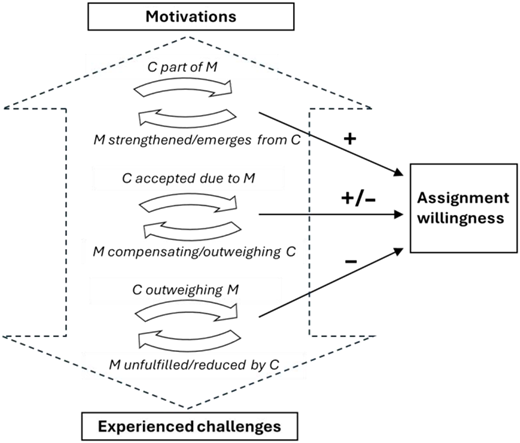
The narrative analysis shows how the initial motivations and expectations that the assignees have interplay with the challenges they experience. With this interplay, motivations may shift, which in turn impacts the willingness of assignees to undertake additional assignments. We find that experienced challenges interplay with motivations in three distinct ways, as illustrated in Figure 1.
Seeking challenges (C) can be a part of the motivation (M) to undertake an assignment. With the experienced challenges, the initial motivations can be strengthened, or another motivation may emerge as stronger, which in turn increases future assignment willingness. For example, when expectations of having an exciting change to ordinary police work were fulfilled, challenges of danger and hardships were experienced as tough but also as rewarding, spurring the police officers to apply for further assignments in search of thrill-seeking and meaningfulness. The personal development and satisfaction in overcoming such challenges described by police officers support previous findings that expectations, previous experiences and the belief that one can be successful can motivate accepting additional assignments (van Emmerik and Euwema, 2009). Our findings highlight that with experienced challenges, thrill-seeking motivation can become almost addictive, continuously raising the individual's expectations of exciting and meaningful work.
In a second type of interplay, the challenges experienced are accepted due to motivations being fulfilled. While these motivations may have been key to applying for an assignment, the experienced challenges shift the motivation to being something that compensates for the challenges. In turn, the consideration of how well the challenges are compensated for impacts assignment willingness, either positively or negatively. The situation in the host country implied challenges of physical and mental hardships for our respondents, for instance poor living conditions, psychological stress and physically or mentally taxing work. Such hardships could be, if not sought, acceptable due to the meaningfulness of the mission. Challenges are not positively experienced but rather endured due to motivations that compensate for expected or encountered strains during and after the assignment. Financial benefits, to better provide for the family, were a motivation for some police officers to go on international missions. As with military personnel (Crowley-Henry and Heaslip, 2014), the high-risk setting of international police missions means that the family does not accompany the police officer and thus means leaving a worrying spouse and children at home. With these challenges, monetary compensation, such as hardship premiums as argued by Bader (2015), can be an additional factor, impacting assignment willingness; yet, the question is whether financial benefits can compensate for the assignee's absence, and the challenges of family relations. As such, the motivation can outweigh the challenges.
With some assignments, the challenges become too much and end up outweighing the motivations. The motivation is then countered by the challenges, and the individual’ willingness for additional assignments is reduced. For example, several respondents described challenges in family relations as deterring additional assignments. However, too low work demands or lack of meaningfulness were described by our respondents as challenging, which is in line with previous findings by de Rond (2017) on assignees in war zones. These challenges were less expected and hard to accept, and as motivations of thrill-seeking and meaningfulness were unfulfilled, the overall motivation to go out again was reduced. Experienced challenges related to negative attitudes and lack of support from the home organization and after repatriating, as previously identified for international police assignments (Dupont and Tanner, 2009; Saati and Wimelius, 2018), were mainly deterring from future assignments. In addition, assignments could have negatively impacted their family relations, thereby outweighing motivations. As suggested by Ho et al. (2016), challenges when repatriating can become a push factor. Thus, even negative experiences can reinforce motivations for going out on assignments in risky contexts.
While these types of interplay appeared in relation to all the challenges and motivations, the dynamics of the interplay can be different. This can be traced to the different appraisals that the respondents make of their experiences. The dynamics in the categories of challenges connected to the assignment as such and the danger, physical and mental hardship related to the context were more often appraised as challenge demands, sometimes through motivations of meaningfulness or hindrance demands that could be compensated by other motivations.
For the categories of challenges related to the police officers' life outside the assignment, family relations and repatriation, these challenges were generally not part of the motivations for assignments in risky contexts and rather than strengthening any of the identified categories of motivations could act as push factors driving other assignments. These challenges were often appraised as hindrance stressors, negatively impacting the assignee and their performance. For some of the respondents, this triggered the second type of interplay where, although challenges were unwelcome, they could be accepted as motivations of thrill-seeking, financial gains or personal development outweighed and compensated for the challenges. When challenges within these categories were experienced as threat stressors, the identified motivations in risky contexts were reduced as the challenges outweighed them. As these challenges are related to the assignee's life outside the context of the assignment, this interplay made tensions with other aspects of their lives salient. For example, the motivations for international assignments, grounded in seeking challenges and personal development, could clash with the individual's broader career motivations or emphasize individuals' prioritizations between individual motivations and family concerns.
Conclusions
The purpose of this paper was to increase the understanding of the interplay between the challenges of international assignments in risky contexts and the motivations of individuals to undertake them. Contrary to assumptions, rather than deterring, challenges can be part of the motivation for undertaking assignments even in risky contexts, and what traditionally are motives for international assignments, such as improved lifestyle, family situation and career, become experienced challenges impacting assignees in risky contexts. Our findings show that challenges interplay with motivations, shifting motivations, in turn influencing assignment willingness. We identify three distinct types of interplay; the challenge can be part of the motivation, be accepted due to the motivation or outweigh the motivation. This shifts motivation, either strengthening or making a motivation emerge, making it compensatory to outweigh challenges or leaving it unfulfilled or reducing it. Which type of interplay comes into play relates to how challenges are appraised, but also to how closely related they are to the actualized motivations in risky contexts. The different types of interplay, in turn, can impact assignment willingness either positively or negatively. Our findings indicate that the dynamics of initial motivations, expected and experienced challenges during an international assignment and retrospective and prospective appraisals after assignments, could play out as a self-perpetuating cycle, making assignees go on additional assignments.
This paper contributes to the much-needed understanding of individual experiences of international assignments in contexts involving risks and danger, which is of increasing importance (Lazarova et al., 2021). As research has indicated that the importance of motivations can vary in different contexts, and that security and risk concerns should be considered (Dickmann and Watson, 2017), we first contribute to research on expatriate motivations in risky contexts. Second, we contribute with empirical insights on the challenges experienced on assignments in such contexts, and how those experienced challenges can be perceived. Future research could examine the experience of such challenges and shifts in motivation for other types of assignees and professions in risky contexts. In particular, how expectations of thrill-seeking, experiences of danger and hardships, can reinforce each other and strengthen the willingness for further assignments should be explored outside the context of international police assignments, as these assignees are in a profession where certain risks and adventures may be expected, and therefore can be better prepared to cope with such experiences (Bader, 2015).
The main contribution of this paper is a more dynamic understanding of how challenges and motivations interplay and how individuals' experiences of challenges reflect upon their motivations over the course of an assignment, as well as for additional assignments. Our study thereby contributes to research on the impact of experiences on international assignments on the willingness to undertake additional assignments (Ho et al., 2016). We suggest that an avenue for further research is to examine the dynamics of the interplay between challenges and motivations in other contexts of global mobility and examine and test the underlying mechanisms thereof more closely. Another fruitful avenue for further research would be to examine factors that could impact this interplay. For example, as the narratives of the studied police officers hint at the importance of both personal resilience and collegial support for dealing with challenges, particular attention should be paid to the role of personality and individual coping strategies in how challenges and motivations are interlinked. The effects of organizational factors on this interplay, such as support and training, also warrant further research. Such research is even more relevant as with increased digitalization and the possibilities of various tools, simulations and virtual interaction, experiences on assignments in risky contexts can be transformed (Jonasson et al., 2025). Nonetheless, physical postings in risky contexts would most likely still be required and continue to interest those seeking adventure. Additional studies could also specifically focus on the self-perpetuating cycle that our results point to: how thrill-seeking motivations and experienced challenges can become addictive and how family concerns and negative experiences when returning may push the assignee to additional assignments.
Understanding individuals' experiences of assignment in risky contexts contributes to strengthening organizations' ability to prepare and support individuals facing these challenges (Faeth and Kittler, 2020), which has been found to be important for the individual and in turn organizational performance (Bader, 2015; Bader et al., 2015). In particular, understanding of how expected and experienced challenges interplay with motivations is important for the recruitment of individuals willing and able to undertake assignments involving risks. While these findings are particularly applicable to international assignments for intergovernmental or non-governmental organizations, corporate assignees may increasingly face hardship and risky contexts (Lazarova et al., 2021). Although a high-risk premium can be motivating, financial gains may, as suggested (Bader, 2015), not be enough and the motivations of meaningfulness can be highlighted in recruiting assignees, both in terms of the impact in the host country and the potential for personal development. Additionally, our findings also point to the importance of the thrill-seeking motive and that the challenges of international assignments can be almost addictive, which are important insights for organizations in the selection of the right candidates.