


Using social influence theory, this study examines the relationship between self-initiated expatriates' (SIE) political skill, as a measure of their social effectiveness, and cross-cultural adjustment (CCA). It also tests whether the host employer's psychological contract (PC) fulfillment mediates this relationship.
Partial least square structural equation modeling (covariance-based SEM) technique is employed to analyze a sample of 209 SIEs.
The study finds SIEs' political skill positively and significantly associated with SIEs' work-related adjustment. The relationship with interactional adjustment is only marginally significant. It also finds that SIEs' PC fulfillment mediates the relationship between SIEs' political skill and work-related adjustment. The mediation is marginally significant for the relationship between SIEs' political skill and general living adjustment.
The study adds to the literature on expatriates' skills and CCA by theorizing and testing the hitherto unexplored role of SIEs' political skill in their work and non-work CCA. It also theorizes and examines the host employer's PC fulfillment as a mediating mechanism, through which SIEs' political skill facilitates their CCA. Finally, it advances the literature on political skill by testing the construct's application in the cross-cultural and non-work domain.
Introduction
Self-initiated expatriates (SIE) represent a significant source of valuable competencies and skills for host organizations (Furusawa and Brewster, 2019), yet their potential often remains unrealized because SIEs experience challenges during their relocation (Vaiman et al., 2015). In the absence of up-front organizational support mechanisms, SIEs are mostly self-reliant on their own skills and abilities when adjusting to the host environment (Doherty, 2013). However, our current understanding of different skills and abilities that can facilitate SIEs' adjustment to the host environment and organization remains limited. In this paper, we argue that SIEs' political skill, which captures SIEs' ability to be socially effective both at work and outside of it, may play a crucial role in their adjustment.
There are several reasons to expect the role of political skill, originally defined as “the ability to effectively understand others at work and to use such knowledge to influence others to act in ways that enhance one's personal and/or organizational objectives” (Ferris et al., 2005, p. 127), to be important for SIEs' adjustment. To adjust to the new work and non-work environment and feel psychologically comfortable in it, SIEs need to be able to deal effectively with its constituents, such as host country nationals, co-workers and employers, and with their mistrust and suspicion rooted in the foreign status of SIEs and cultural differences (see Moeller and Harvey, 2011). Relations between foreign employees and host country nationals are often characterized by power imbalances (Heizmann et al., 2018), whereby the latter perceive SIEs as “outsiders” and “exploiters” (Toh and Denisi, 2007; van Bakel, 2019), socially exclude (Köllen et al., 2020) and culturally stigmatize them (Moeller and Harvey, 2011), and exhibit hostility and ethnocentric biases toward them both at work and outside of it (Syed et al., 2014). Moreover, employers tend to perceive SIEs as neither committed to nor identified with their local organizations to the same extent as local employees or corporate expatriates (Zhang and Rienties, 2017).
In these circumstances, being socially effective through their political skill may enable SIEs to navigate the new work and non-work environment to pursue their interests and objectives. With no support from any home organization, being employed on local contracts, and generally occupying lower-level hierarchical positions as compared to corporate expatriates (Andresen et al., 2015; Doherty, 2013), the need for political skill becomes crucial for SIEs to secure the vital organizational endowments needed to adjust to the new context. Yet, to date, research on the role of SIEs' political skill in securing organizational endowments and facilitating adjustment remains limited (for conceptual exceptions see Harvey and Novicevic, 2002; Moeller and Harvey, 2011).
This paper analyses a sample of 209 SIEs and builds on social influence theory (see Levy et al., 1998), which draws attention to the role of interpersonal influence in determining individual and organizational outcomes (e.g. Ferris and Judge, 1991). Specifically, we pursue two objectives. First, we examine the relationship between SIEs' political skill, as a measure of their social ability and effectiveness, and cross-cultural adjustment (CCA), defined as the degree of SIEs' psychological (dis)comfort in the new environment (Black and Stephens, 1989). In this way, we complement extant research (e.g. Harvey and Novicevic, 2002; Moeller and Harvey, 2011) that has conceptually argued for the importance of expatriate assignments for the development of political skill among global leaders to ensure the overall success and competitiveness of global organizations by examining the role of political skill of SIEs, the most populous group of internationally mobile employees whose economic potential however often remains unrealized (Vaiman et al., 2015).
Second, we posit that SIEs' political skill is likely to increase their ability to negotiate and lock in crucial organizational endowments such as training, career prospects, fair pay, fringe benefits, from their employers. This ability is then likely to influence the extent to which SIEs adjust to different aspects of their new environment both at and outside work. To tap into a mechanism, through which SIEs' political skill affects their CCA, we test whether the host employer's fulfillment of its psychological contract (PC), i.e. the extent to which the employer fulfills its promised employment-related obligations toward SIEs (Robinson and Morrison, 1995), mediates this relationship. It is well established that the expatriate PC covers a wide range of work and non-work factors (Zhang and Rienties, 2017) and tends to be more transactional than relational (Pate and Scullion, 2010), thus signifying the short-term orientation of expatriates in their employment relations abroad and the criticality of the fulfillment of the PC by the employer for expatriates “here and now”. The employer's PC fulfillment is especially critical for SIEs who are dependent on their host country's employers to have resources and means to adjust successfully to their host country. Therefore, we argue that an important way in which SIEs' political skill is likely to affect their work and non-work adjustment will be via their political skill-influenced employer's PC fulfillment.
To sum up, in this study, we address the following research questions:
How does political skill impact SIEs' cross-cultural adjustment?
How does the host employer's fulfillment of its psychological contract mediate this relationship?
The paper makes three contributions. First, it adds to the literature on expatriates' abilities/skills and CCA (see Black and Stephens, 1989; Kim and Slocum, 2008; Koveshnikov et al., 2014; Malek and Budhwar, 2013; Wechtler et al., 2015) by theorizing and testing the hitherto unexplored role of SIEs' political skill in their work and non-work CCA. Political skill has been conceptualized as a comprehensive social effectiveness meta-skill measuring the degree to which employees are able to act upon their other social effectiveness skills and competences in a favorable manner (Davis and Peake, 2014; Munyon et al., 2015). We highlight the importance of political skill for enabling SIEs to succeed in their new work and non-work environments.
Second, we theorize and examine the host employer's PC fulfillment, capturing the extent to which SIEs can negotiate and lock in organizational endowments from the employer through social influence, as a mediating mechanism (see also De Ruiter et al., 2018; Guzzo et al., 1994), through which SIEs' political skill facilitates their CCA. In this way, we not only test empirically the applicability of the concept of political skill in the context of expatriation and global mobility more generally, but also explicate how SIEs' political skill facilitates CCA by enhancing SIE–employer relationship as captured by the extent to which SIEs perceive their employer's PC to be fulfilled. Our study enriches the currently limited knowledge on the underlying processes that explain how political skill affects expatriate work and non-work outcomes. Going beyond expatriation, we further advance the research that has highlighted the ability of politically skilled employees to shape their environment as well as their own attitudes to it (see Epitropaki et al., 2016; Öztürk and Emirza, 2022) by showing that such employees can also influence their employee–employer relationship quality through perceptions around the extent their employer has fulfilled its promised employment-related obligations.
Finally, we advance the literature on political skill per se (Blickle et al., 2010; Ferris et al., 2005; Kimura, 2015) by testing the construct's application in the cross-cultural and non-work domain (for conceptual contributions see Harvey and Novicevic, 2002; Moeller and Harvey, 2011). As for the former, we show that political skill plays an important role also in the context of international expatriation and international organizations in general, which are arguably even more political given their susceptibility to cross-cultural conflicts and tensions (e.g. Moeller and Harvey, 2011). As for the latter, even though originally the construct of political skill was developed for the organizational context (Ferris et al., 2005), we add to the nascent research that advocates for political skill effectiveness also outside of the work domain (Munyon et al., 2021) by showing that it positively, although marginally, facilitates SIEs' non-work adjustment as well. We proceed by explicating the relevance of social influence theory in light of the relationship between political skill, CCA and PC, followed by our methodology and findings.
Social influence theory and political skill
Social influence theory (see Gentry et al., 2012; Snell et al., 2014; Todd et al., 2009) offers a way to theorize how SIEs' political skill can facilitate positive outcomes such as work and non-work CCA. The theory states that individuals use influence tactics in their social environment to influence others effectively and to communicate and build trusting relationships in order to achieve desired outcomes (see Cialdini and Goldstein, 2004; Levy et al., 1998). It has been used in several contexts, e.g. to explain how managers employ persuasive strategies to convince employees to adopt new information systems (Sanchez and Hueros, 2010) or to understand why individuals adopt social networks and sites (Ifinedo, 2016). However, more relevant for this paper, it has also been used to explicate how employees, including CEOs, undertake influence behaviors to achieve certain positive outcomes at the workplace, such as higher compensation and performance appraisals, more frequent promotions and career success (Fiss, 2006; Todd et al., 2009).
Relatedly, Ferris and Judge (1991) conducted a meta-review of the literature on political (social) influence behaviors, as a means for social influence, and found that the engagement of employees in these behaviors leads to several positive outcomes. Among these are higher perceived similarity and liking of these employees among peers and superiors (Wayne and Ferris, 1990) as well as higher cognitive assessment of the employee's competence and performance (Ferris et al., 1994). It also produces a stronger perception that the employee “fits” the situation, driven by perceived or actual similarity with some standard of comparison (e.g. the target's own characteristics, the values or culture of the organization, etc.) (Ross and Ferris, 1981).
However, individuals vary in the extent to which they possess the required skills to influence others effectively. To explain this variability, researchers turned to political skill, which constitutes an ability that enables individuals to influence others more effectively (see Ferris et al., 2002, 2005; Todd et al., 2009). The concept of political skill, comprised of social astuteness, interpersonal influence, networking ability, and apparent sincerity, has been introduced, conceptualized and tested in the literature to explicate the mechanism through which individuals' personality characteristics produce various positive outcomes (Ferris et al., 2002, 2005, 2007; Kimura, 2015). Social astuteness is an individual's ability to understand and subsequently interpret social interactions in an appropriate manner to relate well to other individuals and groups. Interpersonal influence refers to an individual's ability to have influence over others to achieve their personal goals. Networking ability captures an individual's ability to establish diverse connections and relationships with others and use these relationships to advance one's interests and goals. Finally, apparent sincerity is an individual's ability to act in a manner that leads others to perceive him/her as being trustworthy and as having genuine integrity.
Because political skill is a social effectiveness construct, its distinctiveness vis-a-vis other related constructs, e.g. self-monitoring, political savvy, emotional intelligence, and cultural intelligence, requires clarification. Over the years, several studies and researchers have convincingly argued and shown that – despite some degree of conceptual overlap (Ferris et al., 2005, 2007) – the political skill construct is conceptually and statistically different from other supposedly similar constructs. Statistically, only low and/or moderate correlations between political skill and other social effectiveness constructs have been identified (see Ferris et al., 2005). Conceptually, notable differences and a more comprehensive nature of the construct have been discussed and noted (see the latest discussions in De Clercq et al., 2019 and Munyon et al., 2015), up to the point that political skill has been conceptualized as a meta-level skill that reflects the distinct ability to act upon and employ other social effectiveness skills and competences (Davis and Peake, 2014). Therefore, we can safely state that political skill is a distinct social effectiveness construct. It measures social effectiveness in the workplace in a more comprehensive manner, has adequate discriminant validity and conceptually refers to the ability of employees to act upon their social effectiveness skills, e.g. to regulate emotions, to read situations and make behavioral adjustments, and/or to understand power and political dynamics in organizations.
Political skill has been proclaimed among the most critical competencies for individuals in organizations to possess in the modern work environment (Bing et al., 2011; Harvey and Novicevic, 2002). Individuals with high levels of political skill “combine social astuteness with the capacity to adjust their behaviour to different and changing situational demands in a manner that appears to be sincere, inspires support and trust, and effectively influences and controls the responses of others” (Ferris et al., 2005, p. 128). People “high in political skill not only know precisely what to do in different social situations … but how to do it in a manner that disguises any ulterior, self-serving motives and appears to be sincere” (Ferris et al., 2005). Political skill provides people with the requisite knowledge and ability to read others (Ferris et al., 2005) and to use this information to help achieve desired goals. It enables individuals to use social influence tactics to advance their interests and goals and determine the extent to which these individuals are successful and effective in doing so.
Research has found political skill crucial for employees to cope effectively with workplace stressors (Kimura, 2015). It decreases employee strain (Perrewé et al., 2004, 2005), burnout (Jawahar et al., 2007), job tension (Hochwarter et al., 2010) and emotional labor (Treadway et al., 2005). In addition, it increases job satisfaction (Ferris et al., 2007), career success (Todd et al., 2009), promotability (Gentry et al., 2012), managerial effectiveness (Snell et al., 2014) and job performance rating (Hochwarter et al., 2007). Political skill relates closely to the ability of employees to use political influence behaviors at the workplace that, in turn, lead to career advancements, higher performance evaluations, and higher perceived liking, fit and similarity between the influencer and the target (see Ferris and Judge, 1991).
Next, we draw on social influence theory and the concept of political skill to hypothesize the relationship between SIEs' political skill and CCA, as well as the mediating role of the host employer's PC fulfillment in this relationship.
Hypotheses development
Political skill and cross-cultural adjustment among self-initiated expatriates
Compared to their domestic counterparts, expatriates are exposed to social pressures because local employees and employers might see them as outsiders and with suspicion (Heizmann et al., 2018; Toh and Denisi, 2007). It might be further exacerbated by cross-cultural conflicts and confrontations as well as the tendency of host country nationals both at and outside the workplace to stigmatize expatriates (Moeller and Harvey, 2011). We argue that given the context, a higher level of political skill is likely to help SIEs to effectively navigate these pressures and successfully adjust to their new environment. Doing so requires interpersonal skills, networking abilities and social influence tactics for successfully working with others and through others (Perrewé et al., 2000).
Considering the demanding levels of interpersonal and social requirements both at work and beyond during expatriation, we foresee that a possession of political skill will be positively associated with work-related and interactional dimensions of SIEs' CCA. It is likely to allow SIEs to exercise social influence on others and build trustful relationships and networks with others to ensure their adjustment. In support, extant literature points out that to succeed, it is crucial for expatriates to employ interpersonal skills and tactics aimed at influencing locals to behave in ways, which are beneficial for the expatriates. For instance, Mahajan and Toh (2014) have shown that when seeking advice from host country nationals, expatriates working in the United States achieved higher levels of work and interactional adjustment. Shin et al. (2007) noted that it is essential for expatriates to foster and maintain relationships with host country nationals, and get tasks accomplished through appropriate interactions and co-operation with local employees. Further, Olsen and Martins (2009) conceptually argued for the importance of the support that expatriates seek and receive from host country nationals for their success. Farh et al. (2010) emphasized the crucial need for expatriates working abroad to form network ties in the host country both at and outside work to obtain critical informational and emotional support resources, which then can help them to adjust to both work and non-work environments. Toh and Denisi (2007) stressed the role of host country nationals as socializing agents for expatriate newcomers and their successful socialization, whereas Moeller and Harvey (2011) conceptually underscored the role of political skill in decreasing the likelihood of expatriates being stigmatized by host country nationals both at and outside work.
To highlight the positive role of SIEs' political skill in facilitating SIEs' interactional adjustment, we refer to the work on political skill among salespeople that illustrates that the benefits of political skill extend to outcomes which are not confined to the physical workplace. For instance, research (see Munyon et al., 2021) has shown that political skill helps salespeople develop, maintain and leverage advantageous positions within a social network relevant for their work. Political skill has been linked to a salesperson's relational centrality (Bolander et al., 2015), the number and strength of social network ties (Fang et al., 2015), and communication centrality (Cullen et al., 2018), suggesting that political skill affects the structure and the quality of an individual's social network which extends beyond the workplace. In that respect, we can expect that political skill will help SIEs to be more effective not only in their work-related but also non-work-related interactions and encounters with host country nationals outside of the workplace. We argue that politically skilled SIEs are likely to use their networking skills (opposed to any of the other political skill dimensions) in the non-work domain to build social networks and pursue their non-work related–but critically important for their overall wellbeing and adjustment–social pursuits. In addition, research also posits that political skill facilitates employees to have a more positive interpretation of their social environment, thus shaping their attitudes to it and helping them to manage their stress reactions (see Ferris et al., 2007). As a result, politically skilled employees tend to have higher life and career satisfaction (Epitropaki et al., 2016; Munyon et al., 2015). This further suggests that political skill is likely to influence positively the interactional dimension of SIEs' non-work adjustment.
Thus, the literature underscores a connection between expatriates' ability to effectively influence host country nationals, both at and outside of the workplace, and their expatriation experiences and outcomes. In line with social influence theory, we foresee that political skill may be central for the ability of expatriates to exercise such influence as well as shape their social environment both at and beyond the workplace. At the same time, we do not expect SIEs' political skill to significantly facilitate their general living adjustment which focuses on the extent to which SIEs feel adjusted to their non-work environment's attributes such as food, healthcare facilities, transportation system and housing conditions among other attributes. We do not foresee competencies related to social effectiveness to be particularly relevant for this specific dimension of SIEs' adjustment. Therefore, we propose the following hypothesis:
The political skill of self-initiated expatriates is positively associated with the level of their (a) interactional and (b) work-related cross-cultural adjustment.
The mediating role of psychological contract fulfillment among self-initiated expatriates
To explicate the mechanism through which SIEs' political skill affects their work and non-work adjustment, we put forth the argument that by using their political skill, SIEs influence their employers to optimize the fulfillment of different aspects of PC, i.e. to what extent the employer has delivered in practice what it has promised. We expect political skill to be especially vital for SIEs to garner effectively rewards (e.g. pay), developmental training and other inducements from their employers at higher levels. Thus, we now turn to discussing the concept of employer PC fulfillment, which we theorize as a mediator between SIEs' political skill and CCA.
PC is a concept that defines the terms of the social exchange relationship between an employee and an organization (Robinson and Morrison, 1995). The exchange builds on the belief held and shared by the two parties that any voluntary action taken by one party will be responded to by the other and both will strive to ensure equity and reciprocity in the relationship by engaging in reciprocal behaviors (Rousseau, 1995). Research shows that perceived PC fulfillment has several positive outcomes among domestic employees such as lower turnover intentions and in-role performance, higher organizational citizenship behavior and employee performance (Turnley et al., 2003). At the same time, extant research on PC fulfillment and its implications among expatriates has so far exclusively focused on corporate expatriates. It shows that PC fulfillment positively influences corporate expatriates' organizational commitment (Guzzo et al., 1994) and job and career satisfaction (De Ruiter et al., 2018).
Yet, albeit acutely under-researched, there are reasons to expect that the role of PC fulfillment will be especially important in the case of SIEs, and PC fulfillment will be one of the key goals that SIEs will pursue in the relationship with their employer. It is also likely that PC fulfillment will affect SIEs' work as well as non-work adjustment (see Zhang and Rienties, 2017) since the positive effects of employer's endowments are likely to spill over into non-work aspects of the SIEs' CCA (cf. Takeuchi et al., 2002), thus improving their psychological comfort in the new cultural environment. To explain it, we need to look closer at SIEs' idiosyncratic characteristics, which make them distinct from corporate expatriates (see Dickmann et al., 2018 for a recent comparison of SIEs and AEs) and domestic employees.
First, SIEs neither are selected for international assignments nor receive pre-departure training or organizational support upon entering the new environment. It forces SIEs to rely solely on their own resources (e.g. psychological, relational and financial) while adjusting (Bozionelos, 2009), whereas other expatriate types receive support from their home organization during relocation, assisting their adjustment. Second, SIEs do not have a home organization to return to at the end of an assignment or in case of a premature return, which puts them under pressure to perform sufficiently well to secure their employment in the organization. In such conditions, SIEs benefit from a high level of political skill to build a trustful relationship with their employer and influence their employer to fulfill as many aspects of their PC as possible to feel comfortable during their expatriation. Finally, possessing boundaryless career orientations in their employment relationships (Biemann and Andresen, 2010), SIEs are more likely than corporate expatriates or locals to engage in proactive career self-management behaviors to “shape up” their work and non-work environments. In this way, they try to make it as beneficial for their subjective career satisfaction, wellbeing, and perceived internal and external marketability as possible. Together these characteristics suggest the crucial role of SIEs' political skill for their adjustment to their work and non-work environments and their ability to influence their employers to provide high levels of employer's PC fulfillment, which would enable and support their adjustment.
We put forward several arguments to argue that SIEs' political skill is likely to affect their employers' PC fulfillment. Research shows that exercising their political skill, employees build trustful and high-quality relations with the employer (Epitropaki et al., 2016), influence positively supervisor liking and perceived similarity (Liu et al., 2014; Wayne and Ferris, 1990), and performance appraisal ratings (Levy and Williams, 2004; Wayne and Kacmar, 1991). Employees were also found to use influence tactics to obtain higher financial compensation from their employers (Bartol and Martin, 1990), and the ability to employ such tactics has been found to be positively associated with employees' compensation and opportunities to refine and develop their skills (Kapoutsis et al., 2012). Relating specifically to PC, Rosen and Levy (2013) have argued that politically skilled employees have a better understanding of the behaviors that are rewarded in their organizations and thus are able to effectively engage in those behaviors. In this way, they are more likely to have their PCs fulfilled by the employer.
We therefore argue that SIEs' high levels of political skill are likely to influence the employer to treat these SIEs well by fulfilling its PC obligations. This in turn is likely to positively affect SIEs' CCA in both work and general living domains. Receiving solid financial support and remuneration from the employer, engaging in good social relationships with (local) co-workers and superiors and performing interesting job tasks, undergoing various training programs, which might also include cultural and language training, is likely to make SIEs feel psychologically comfortable both at the workplace and outside of it. Although originally the concept of political skill was developed to predict positive employee outcomes confined to the workplace itself, we believe that the ability of SIEs to use their political skill to lock in organizational endowments is likely to also affect their non-work adjustment. For instance, receiving a competitive salary is likely to make SIEs more flexible and secure when dealing with various aspects of their daily life such as food, healthcare, transportation and housing among other attributes, ultimately making their adjustment to these aspects easier. Therefore, we expect that higher levels of political skill are likely to lead to higher levels of both work and general living adjustment through higher host employer's PC fulfillment. Yet, we do not expect the mediation to operate in the same way for interactional adjustment for neither having a competitive salary nor good career prospects in the host organization is likely to facilitate SIEs' interactions with host country nationals at and beyond the workplace. Thus, we put forth the following mediation hypothesis:
The extent to which self-initiated expatriates lock in the fulfillment of employers' psychological contract obligations mediates the relationships between self-initiated expatriates' political skill and the level of their (a) general living and (b) work-related cross-cultural adjustment.
Methodology
Data collection
We collected data from SIEs through a two-wave data collection process using an online survey. The SIEs' contact information was obtained through a registration system of a large-scale online training program on leadership and management organized and run by a renowned public university in France. The program was offered to individuals who are employed full-time but would like to upgrade their professional qualifications in their free time. From altogether 30,000 targeted program participants, we collected 14,692 responses during the first wave (response rate = 49%), and 6,243 during the second wave (response rate = 42.5%). Among the latter 6,243 observations, we identified 209 useable responses from SIEs who participated in both waves. Based on Cerdin and Selmer (2014), we identified participants as SIEs if they were currently working outside of their home country, have expatriated without organizational support and were abroad for less than 10 years. Using these criteria, we were able to exclude students, migrants and assigned corporate expatriates from the sample.
The survey was administered in both French and English. In designing the French version of the survey, we adopted the French translations of the scales from published academic sources. To alleviate the common method variance bias, we followed the recommendation of Podsakoff et al. (2003) and administered the survey in two stages separated by approximately four calendar weeks that it took the participants to complete the course. At Time 1, at the beginning of the course, we collected responses concerning political skill (i.e. our independent variable) and employer's PC fulfillment (i.e. our mediating variable), whereas at Time 2, at the end of the course, we gathered data on CCA (i.e. our dependent variable). The sample characteristics as follows: the average age – 38.85 years; 55% female; 40% managers; 74% had prior experience in expatriation; the average experience abroad – 8.63 years, and the average length spent in the host country – 4.65 years (with the minimum of 1 month and the maximum of 10 years); 75% expatriated with their spouse/partner and/or children. SIEs in our sample were either French nationals (44% of the sample) currently living and working outside France in 41 host countries or foreign nationals (56% of the sample) from 39 home countries living and working in France. Although France is the dominant home country (44%) and host country (56%) by design in our sample, other European (25%, 23%) and African (18%, 12%) countries are also represented.
Measures
Political skill
To measure political skill, we used a shortened version of Political Skill Inventory (Ferris et al., 2005) developed and validated by Vigoda-Gadot and Meisler (2010). The measure is composed of eight items (e.g. “I always seem to instinctively know the right thing to say or do to influence others”) measured using a six-point Likert scale ranging from “1” (“totally disagree”) to “6” (“totally agree”). Cronbach's alpha was 0.77.
Host employer's psychological contract fulfillment
To measure the host employer's PC fulfillment, we used an 11-item scale from Coyle-Shapiro and Kessler (2000) (e.g. “The necessary training to do my job well”, “Pay increases to maintain my standard of living”). SIEs were asked to indicate, using a five-point Likert scale ranging from “1” (“not at all”) to “5” (“to a great extent”), the extent to which the items have been delivered or fulfilled by the employer in practice. Cronbach's alpha was 0.85.
Cross-cultural adjustment
To measure CCA, we used the construct developed by Black and Stephens (1989). It consists of three dimensions: general living adjustment (seven items, e.g. “Healthcare facilities”, α = 0.86), interactional adjustment (four items, e.g. “Interacting with host nationals on a day-to day basis”, α = 0.93) and work adjustment (three items, e.g. “Performance standards and expectations”, α = 0.91). The respondents were asked to rate how adjusted they were on the scale from “1” (“very unadjusted”) to “6” (“perfectly adjusted”).
Control variables
We used several control variables. First, prior research shows that female expatriates tend to adjust better (Koveshnikov et al., 2014; Selmer and Leung, 2003). Second, age has been found to function as both a positive (e.g. Wechtler et al., 2015) and a negative (e.g. Haslberger and Brewster, 2008) factor in expatriate adjustment. Third, organizational level or position is acknowledged as an expatriate resource during the adjustment process (Lazarova et al., 2010). At last, it is well established that previous experience abroad, time spent in the host country, and cultural novelty between the home and host country influence expatriate adjustment (e.g. Hemmasi and Downes, 2013; Hippler et al., 2015). Therefore, we controlled for gender (a dummy variable, “1” for woman), age (the number of years), organizational status (a dummy variable, “1” if the expatriate has managerial responsibilities), time spent in the host country (in years), previous expatriation experience (a dummy variable, “1” if an expatriate had experience prior to the current move) and cultural novelty (using the eight-item scale from Torbiorn, 1982; α = 0.88).
Common method variance bias
We undertook several measures to ensure that the common method variance bias is not a serious threat in our study. First, anonymity was guaranteed to the respondents. Second, in the survey we only included measures validated in extant literature (Spector, 1987). Third, as already mentioned, we collected our data at two different points in time (Podsakoff et al., 2003). The participants completed two different questionnaires. The two occasions were separated by four calendar weeks that it took the respondents to complete the course.
We also conducted several tests to examine the potential effect of the common method variance bias. First, following the procedure recommended by Podsakoff and Organ (1986), we performed Harman's one factor test. A principal component factor analysis with no rotation was done on all the items included into the study (the items related to CCA, employer's PC fulfillment and political skill). We found a 7-factor solution explaining 68% of the total variance. Only 23% was attributed to the first factor. Second, we performed the unmeasured latent method construct (UMLC) test following Podsakoff et al. (2003), where items were attached to their theoretical constructs and to a latent common method variance factor. The ULMC model fit was similar to the fit of the measurement model (Chi-square = 908.09 [df = 765], RMSEA = 0.04, GFI = 0.89, AGFI = 0.84, NFI = 0.81 versus Chi-square = 865.43 [df = 718], RMSEA = 0.03, GFI = 0.91, AGFI = 0.90, NFI = 0.85). Moreover, the examination of the structural parameters showed that the item loadings remained substantially the same across the two models. Altogether, these results indicate no evidence of the common method variance bias in our data.
Findings
As our model is theoretically driven, we used covariance-based structural equation modeling (CB-SEM) technique to estimate our model (e.g. Richter et al., 2016). First, we assessed the reliability and validity of our measurements (for guidelines, see Hair et al., 2012). All item loadings were superior to 0.4, Cronbach's alphas ranged from 0.77 to 0.93, average variance extracted (AVE) ranged from 0.52 to 0.76, composite reliability (CR) ranged from 0.88 to 0.93, thus demonstrating good reliability and convergent validity. Fornell–Larcker criterion was also met demonstrating the discriminant validity of each measure (see Hair et al., 2012). Table 1 summarizes the reliability, validity and discriminant-related statistics. Table 2 reports descriptive statistics and correlations for the variables included in our study.
Construct measurements
| Constructs | No. of items | Alpha | CR | AVE | DISC |
|---|---|---|---|---|---|
| SIE's political skill | 8 | 0.77 | 0.90 | 0.52 | 0.72 |
| SIE's general living adjustment | 7 | 0.86 | 0.89 | 0.54 | 0.73 |
| SIE's interactional adjustment | 4 | 0.93 | 0.93 | 0.76 | 0.87 |
| SIE's work adjustment | 3 | 0.91 | 0.88 | 0.70 | 0.84 |
| Host employer's PC fulfillment | 11 | 0.85 | 0.90 | 0.52 | 0.72 |
| Cultural novelty | 8 | 0.88 | 0.88 | 0.53 | 0.73 |
Note(s): Alpha: Cronbach's alpha; CR: Composite reliability; AVE: Average Variance Extracted; Disc: Discriminant validity
Correlations and descriptive statistics
| M | SD | 1 | 2 | 3 | 4 | 5 | 6 | 7 | 8 | 9 | 10 | |
|---|---|---|---|---|---|---|---|---|---|---|---|---|
| 1. General living adjustment | 4.88 | 0.79 | (0.86) | |||||||||
| 2. Interactional adjustment | 4.67 | 1.06 | 0.53 | (0.93) | ||||||||
| 3. Work adjustment | 4.82 | 1.04 | 0.39 | 0.29 | (0.91) | |||||||
| 4. Host employer's PC fulfillment | 2.99 | 0.82 | 0.22 | 0.08 | 0.37 | (0.85) | ||||||
| 5. Political skill | 4.62 | 0.63 | 0.15 | 0.13 | 0.19 | 0.17 | (0.77) | |||||
| 6. Female | 0.55 | 0.50 | 0.08 | 0.03 | −0.07 | −0.06 | 0.01 | – | ||||
| 7. Age | 38.85 | 9.18 | 0.18 | 0.12 | 0.19 | 0.06 | 0.04 | −0.01 | – | |||
| 8. Manager | 0.40 | 0.49 | 0.09 | 0.05 | 0.28 | 0.02 | 0.09 | −0.10 | 0.20 | – | ||
| 9. Cultural novelty | 4.02 | 1.15 | −0.12 | −0.07 | −0.17 | −0.01 | −0.11 | 0.02 | −0.05 | −0.04 | (0.88) | |
| 10. Time spent in the host country | 4.65 | 2.66 | 0.06 | 0.23 | 0.04 | 0.01 | −0.01 | 0.04 | 0.35 | 0.05 | 0.00 | – |
| 11. Previous expatriation experience | 0.74 | 0.42 | 0.05 | 0.15 | 0.01 | 0.09 | −0.07 | 0.01 | 0.08 | 0.18 | −0.16 | −0.16 |
Note(s): N = 209. Coefficients larger than 0.08 are significant at p < 0.05 level. Cronbach's alphas in brackets
We used SAS (V 9.2) and bootstrapped CB-SEM (5,000 iterations) to test the relationships between SIEs' political skill and CCA as well as the mediating role of employer's PC fulfillment in these relationships. As for the control variables, age and cultural novelty had significant – respectively positive (0.14; p = 0.02) and marginally negative (−0.12; p = 0.09) – relationships with general living adjustment. Being a manager was also positively and significantly associated with general living (0.13; p = 0.04) and work (0.23; p < 0.01) adjustment. Other relationships involving the control variables were nonsignificant.
Hypothesis 1 predicted that SIEs' political skill is positively associated with their interactional and work-related adjustment. As shown in Table 3 and Figure 1, we found a significant and positive relationship between political skill and work-related (b = 0.13; p = 0.05) adjustment, and a marginally significant and positive one between political skill and interactional (b = 0.09; p = 0.07) adjustment. Thus, Hypothesis 1 was supported.
Direct, indirect and total effects of SIE's political skill on SIE's adjustment
| Direct effects | Indirect effects | Total effects | |
|---|---|---|---|
| SIE's political skill → General living adjustment | 0.09 [0.02; 0.25] (0.06) | 0.04 [0.00; 0.10] (0.09) | 0.13 [0.00; 0.25] (0.06) |
| SIE's political skill → Interactional adjustment | 0.09 [0.01; 0.26] (0.07) | 0.01 [−0.03; 0.06] (0.46) | 0.10 [−0.01; 0.26] (0.08) |
| SIE's political skill → Work adjustment | 0.13 [0.00; 0.28] (0.05) | 0.06 [0.02; 0.13] (0.02) | 0.18 [0.05; 0.36] (0.02) |
Note(s): Estimate [confidence interval] (p-values in brackets)
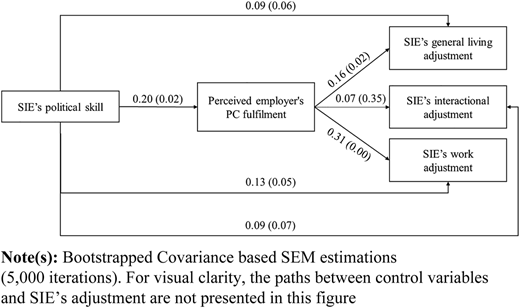
Hypothesis 2 predicted that SIEs' PC fulfillment mediates the relationships between SIEs' political skill and general living as well as work-related adjustment. First, our results show that SIEs' political skill is related positively and significantly to SIEs' PC fulfillment (b = 0.20; p = 0.02). Second, SIEs' PC fulfillment is related positively and significantly to SIEs' general living (b = 0.16; p = 0.02) and work-related (b = 0.31; p < 0.01) adjustment. Our results also demonstrate that the indirect effects of SIEs' political skill via SIEs' PC fulfillment are positive and marginally significant on SIEs' general living (b = 0.04; p = 0.09) and positive and significant on SIEs' work adjustment (b = 0.06; p = 0.02), increasing the total effects of SIEs' political skill on these two dimensions of adjustment (respectively b = 0.13, p = 0.06 and b = 0.18, p = 0.02).
Thus, we find complementary mediation – both mediated and direct effects in the same direction (Zhao et al., 2010) – by SIEs' PC fulfillment of the relationships between SIEs' political skill and general living and work adjustment. Thus, Hypothesis 2 was supported.
Discussion
Theoretical contributions
In this paper, we examined the role of SIEs' political skill in their CCA and explored whether the host employer's PC fulfillment mediates this relationship. By doing so, the study offers three main contributions.
First, it adds to the literature on expatriates' abilities/skills and CCA (see Kim and Slocum, 2008; Koveshnikov et al., 2014; Malek and Budhwar, 2013) by theorizing and testing the hitherto unexplored role of SIEs' political skill in their work and non-work CCA. As our literature review shows, extant research has examined a number of different skills and abilities that might be conducive to expatriate adjustment. However, the role of expatriates' ability to apply interpersonal influence and be socially effective has remained relatively unexplored. In this paper, we focused on SIEs' political skill and theorized this skill to be important and significant, as per social influence theory (Levy et al., 1998), in determining SIEs' CCA. Concretely, SIEs' political skill related positively to all three dimensions of their CCA, which indicates that political skill facilitates SIEs' adjustment not only to work-related but also – although only marginally significantly – non-work aspects of their new environment. The findings suggest that SIEs' ability to persuade, influence and control others in their work and non-work environments is beneficial and functional, ultimately allowing SIEs to proactively adjust better. Thus, political skill appears to be effective and functional in cross-cultural environments and interactions.
In this way, our study posits the influential role of political skill for expatriates' CCA. It suggests that political skill complements the current list of effective and practical skills for expatriate CCA such as emotional and/or cultural intelligence (Koveshnikov et al., 2014; Malek and Budhwar, 2013). Collectively, these skills present a set of mechanisms that enable SIEs to overcome their peripheral status (i.e. being new to the host country and organization) by aiding adjustment. Our analysis is also among the first ones to highlight the importance of examining expatriates' adjustment and employment relations through the lens of social effectiveness and interpersonal influence, thus underscoring the value and relevance of social influence theory (Levy et al., 1998) in increasing our understanding of expatriate experiences and outcomes.
Second, we theorized and examined the host employer's PC fulfillment as a mediating mechanism through which SIEs' political skill facilitates their CCA (see also De Ruiter et al., 2018; Guzzo et al., 1994). Because SIEs lead boundaryless careers and have great autonomy over career decisions, it is in the host organization's best interest to identify ways to support SIEs' adjustment to the workplace, with the intent to foster a culture/atmosphere that lessens their intention for turnover. In this vein, we offer a theoretical explanation for the influence of SIEs' political skill by explicating a mechanism, via which it affects central SIE outcomes, such as CCA, thus increasing our understanding of how this skill operates in the case of SIEs. So far, scholars have rarely studied the role of PC in SIEs' outcomes (for a rare exception see Zhang and Rienties, 2017). In general, research on the nature of SIEs' employment relationships and their implications remains limited despite the acknowledged challenges for organizations to retain and motivate SIEs (Vaiman et al., 2015).
Zhang and Rienties (2017) compared the differences in PC breach among corporate expatriates and SIEs and found that SIEs are much more likely to experience PC breach. They attribute this to a lower status of SIEs in the host organization, a lower degree of trust among SIEs toward employers, which is exacerbated by SIEs' unwillingness and reluctance to conflict with their employers (Zhang and Rienties, 2017). Whereas corporate expatriates see conflict as functional and manageable and, when facing a breach, initiate interactions with their employers, SIEs, who are employed on local contracts and often occupy lower-level positions (Andresen et al., 2015; Doherty, 2013), are more reluctant to defend and fight for the fulfillment of what has been promised to them.
Yet, our analysis shows that SIEs' political skill can help them overcome this reluctance and apply interpersonal influence and be socially effective in interactions and negotiations with employers. In this way, SIEs are likely to secure more endowments from employers and ensure that employers fulfill sufficiently and adequately their PC obligations toward SIEs. Having their PCs fulfilled then translates into better CCA among SIEs, at least in terms of general living (with marginally significant indirect and total effects) and work-related CCA. A possible explanation for no mediation effect in the case of interactional CCA might be the nature of this type of adjustment. It might be that better interactional adjustment is more likely to be achieved by relying on different types of culture-related and/or language skills and competencies rather than by ensuring the employers' fulfillment of PC obligations. It may also be possible that because networks of SIEs tend to be bigger/broader, opposed to denser/deeper, in size that SIEs experience broader satisfaction linked to interactional adjustment, without the need for employer's PC fulfillment. Broader networks do enable more employment possibilities. From these perspectives, the non-significant mediation effect in our study is understandable. Overall, our study joins research on various psychological effects of different expatriates' skills/abilities on their outcomes (Koveshnikov et al., 2014; Malek and Budhwar, 2013; Wechtler et al., 2015) by elucidating a mechanism of perceived PC fulfillment, thus concentrating on the quality of SIEs' employment relationships and their outcomes as perceived by SIEs (see also Epitropaki et al., 2016).
Finally, we advance the literature on political skill per se (Blickle et al., 2010; Ferris et al., 2005; Kimura, 2015) by testing the construct's application in the cross-cultural and non-work domain (for conceptual contributions see Harvey and Novicevic, 2002; Moeller and Harvey, 2011). The original concept has been developed and proposed to understand better the political behavior and its implications among employees in the workplace. Later, it has been proclaimed one of the most critical competencies for individuals in organizations to possess in the modern work environment (Harvey and Novicevic, 2002; Bing et al., 2011), because it improves the ability of employees to navigate and respond effectively to different social situations at the workplace.
However, the nature of work and careers today changes most notably because work and careers become increasingly more international, protean and boundaryless (e.g. Collings, 2014). Globally, employees take more and more responsibility for their careers and engage in more proactive career self-management, which often involves different types of international mobility (Collings et al., 2007). It implies that work stops being done exclusively at the workplace and the traditional boundaries of work need to be expanded to include non-work environments, which has been shown to affect the wellbeing and performance of internationally mobile employees (see Takeuchi et al., 2002).
In these circumstances, it seems crucial to assess the applicability and effectiveness of political skill outside of the traditional, physical workplace (see also Munyon et al., 2021). Our study offers initial evidence of the relevance – although only a marginally significant one – of political skill for SIEs' non-work CCA. However, we note the relatively weaker effects of SIEs' political skill for non-work as compared to work-related CCA. Overall, our analysis shows that political skill plays an important role also in the context of international expatriation and international organizations in general, which are arguably even more political given their susceptibility to cross-cultural conflicts and tensions (e.g. Köllen et al., 2020).
Practical implications, limitations and future research
As for practical implications, our analysis points to the importance of interpersonal influence skills for SIEs to succeed during their relocation. Together with cultural and emotional intelligences, as per previous research (e.g. Koveshnikov et al., 2014; Malek and Budhwar, 2013), our study suggests that also more proactive skills such as political skill are beneficial for SIEs to have to ensure their CCA and overall well-being needs are met in the new environment both at and outside work. Therefore, it is advisable for SIEs to invest in developing such a skill. In this respect, Ferris et al. (2005) state that, even though political skill relates to personality traits, some of its aspects are dispositional but some can be developed or shaped through a combination of formal and informal developmental experiences. As for host organizations, our results indicate that to ensure adequate contributions of SIEs and benefit fully from their skills and knowledge, host organizations need to invest into these employees, at least to the extent that SIEs feel that the host employer fulfills its PC obligations and promises. It is then likely to facilitate the psychological comfort of SIEs in the new environment, thus making them more likely to concentrate on their work to the host organizations' benefit.
An effective way for host organizations to build SIEs' political skill is mentoring (Ferris et al., 2007). Experienced mentors can help SIEs to acquire important pieces of contextual information and are likely to support their experiential development needed to build up their political skill. Furthermore, host organizations are advised to use the political skill measure as a selection criterion to identify and recruit SIEs with high potential (see Todd et al., 2009). At the same time, given that politically skilled SIEs can use impression management tactics to influence their performance evaluations by the supervisor (Wayne and Kacmar, 1991), host organizations should be cautious in how such evaluations are used for important organizational decisions, such as pay increases, promotions, responsibility allocation, involving the SIEs in question. In such situations, SIEs' evaluations need to be done collegially by several decision-makers rather than individually by the supervisor.
Our study has several limitations. First, we collected our data from the same source. However, we used a two-wave data collection procedure and collected data for our dependent and independent variables in two different questionnaires. We also conducted several statistical tests, which indicated that CMV is not a serious threat in our analyses. If possible, future research could try to obtain data from several sources to evaluate the effects of SIEs' political skill. For instance, SIEs' supervisors or host country national colleagues could be asked to assess SIEs' CCA.
Second, we surveyed SIEs who in their free time participated in an online training program that might have introduced a certain self-selection bias into our sample of respondents. Future research should study the role of political skill for CCA and other outcomes, such as performance or turnover intentions, among other groups of SIEs and draw comparisons with corporate expatriates. It might be interesting to investigate how the level of expatriates' political skill and its positive effects spill over into affecting the adjustment or wellbeing of expatriates' spouses and partners, or into influencing the performance of expatriates' host country national colleagues as well as these colleagues' attitudes and trust toward expatriates.
Third, we used a shortened version of the political skill measure. Although it has been validated (Vigoda-Gadot and Meisler, 2010), future research might consider using the full measure. It will allow examining the effects of different political skill's dimensions of social astuteness, interpersonal influence, networking ability and apparent sincerity on various outcomes, thus providing a more nuanced understanding of how political skill operates in the context of SIEs and expatriates in general. It will also allow assessing the relative importance of the dimensions for different outcomes.
More generally, given the alleged conceptual closeness of the political skill concept to other measures of social effectiveness (see Ferris et al., 2005, 2007), we need research comparing the roles and effects of political skill and other social effectiveness skills and competences, especially those that have been found particularly helpful for expatriates such as, for instance, cultural and emotional intelligence. Further, future research might examine other mediating mechanisms, for instance, SIE organizational status, organizational/supervisor/co-workers social support, job-related autonomy and role clarity, that are likely to explain the effects of political skill on SIEs and expatriates more generally. Finally, the role of contextual factors that can affect the effectiveness of SIEs' political skill, such as for instance organizational politics, the degree of centralization, cultural distance between the home and the host countries, and SIEs' personal attributes that can either enable or hinder SIEs' ability to apply their political skill, such as for instance their language skills, age, expatriation experience and gender, could be explored in future studies.

