

This contribution describes centrifuge and numerical studies conducted by the authors to establish the seismic behaviour of micropiles. The authors conclude that micropiles can offer improvements in the behaviour of structures founded on liquefiable soils.
In this discussion, we would like to emphasise two major factors that can influence the behaviour of micropiles. First, micropiles can suffer from instability due to their slenderness following liquefaction of the surrounding soil. Second, excess pore pressure edistribution can cause the soil within the pile group to suffer liquefaction, almost as quickly as that in the free field. Both of these effects have been experimentally observed at the University of Cambridge.
Instability of end-bearing micropiles
Recent centrifuge modelling at the University of Cambridge has studied the instability of single piles (Bhattacharya et al., 2004) and pile groups (Knappett and Madabhushi, 2005) during liquefaction, showing that slender end-bearing piles in liquefiable soils are vulnerable to failure by instability as liquefaction reduces the soil support, rendering the piles as effectively unsupported slender columns.
Micropiles are, by common definition, restricted to diameters of 250 mm or less (Fleming et al., 1991). The piles shown in Fig. 2 of the paper are within this diameter restriction and typical of unreinforced concrete micropiles. Imagining that these extended to bear in some firm layer, they are typically slender enough that instability may become an issue with deeper liquefiable layers, as shown in Fig. 12.
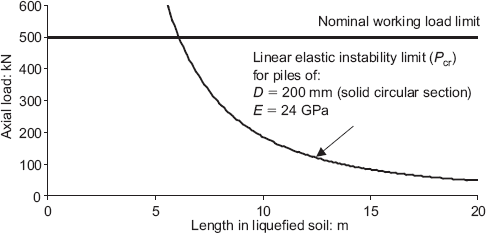
With regard to the centrifuge models, if they were to represent field micropiles (i.e. diameter of ⩽ 250 mm at prototype scale), the slenderness ratio (for the given length) should be ⩾ 136, which is much larger than the value of 31 quoted by the authors on p. 111. It is here assumed that slenderness ratio is defined as pile length/radius of gyration (√ (I/A). The bending stiffness (EI) derived from parameters given in the paper in this way also seems to be between one and two orders of magnitude larger than typical micropiles. This is shown in Table 2.
Comparison of model piles with typical micropiles
| Pile section | Slenderness ratio (10 m long pile) | E: GPa | I: m4 | EI: MN m2 |
|---|---|---|---|---|
| Polystyrene centrifuge piles* | 31 | 2·7 | 7·2 × 10−2† | 195 |
| Piles in FE study (Ousta, 1998), D = 200 mm, solid* | 200 | 24·0‡ | 7·9 × 10−5 | 2 |
| Steel tubular pile, D = 250 mm, t = 6 mm | 116 | 210·0 | 3·4 × 10−5 | 7 |
| Steel tubular pile, D = 250 mm, t = 12 mm | 119 | 210·0 | 6·4 × 10−5 | 13 |
Presented by the authors.
Estimated from given slenderness ratio (31) and total pile length (213 mm) and given at prototype scale for comparison.
Typical of unreinforced concrete.
Excess pore pressure redistribution
Centrifuge studies have been carried out into the effectiveness of using inclined non-end-bearing micropiles as a method of iquefaction remediation under existing buildings. The layout of the model and instrumentation used in one such centrifuge test is shown in Fig. 13. In this model, the micropiles were modelled by roughened, hollow aluminium tubes, inserted into the sand at 1g.
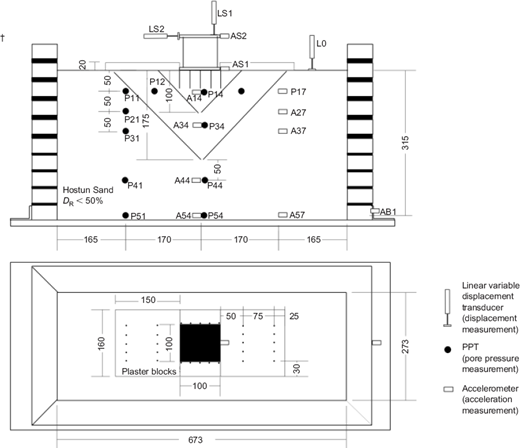
From these studies, it was found that the micropiles are not very effective at remediating the effects of liquefaction, as large settlements of the structure were still incurred (Mitrani and Madabhushi, 2005). In addition, excess pore pressures sufficiently high to cause liquefaction were generated inside the area bounded by micropiles, in contrast to the behaviour observed in the paper. This can be seen from Fig. 14, which shows time histories of pore pressures measured in the free field and at two locations within the micropiles.
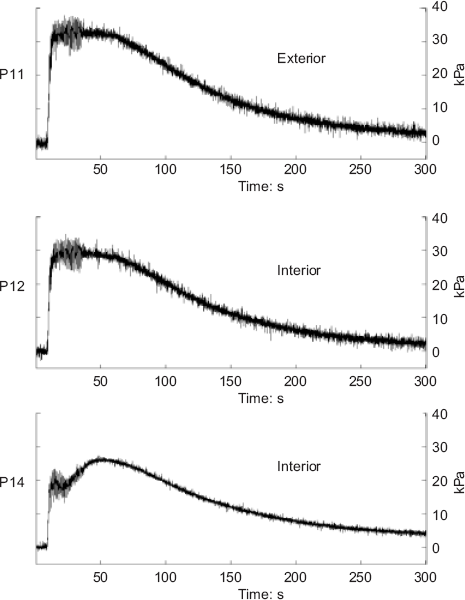
Initially the pore pressures within the micropiles and under the structure are less than those in the free field, owing to the increased total stress imposed by the structure. This establishes an inward hydraulic gradient after the earthquake shaking has ceased, and the pore pressures within the zone enclosed by the micropiles quickly increase as pore water migrates inwards from the free field and below.
After the earthquake, it can also be seen that the pore pressures take a long time to dissipate, in comparison with those presented in Fig. 11(b) in the paper. This may be due to the use of different pore fluid viscosities in the tests. In all centrifuge tests carried out at Cambridge, 50 cSt viscosity methyl-cellulose was used for testing at 50g, in conformity with scaling principles.
Conclusions
The centrifuge model presented by the authors does not represent the inherent slenderness and low bending stiffness of end-bearing micropiles, and thus neglects to account for the very real possibility of instability failure, which should be considered for the design of micropiles in liquefiable soils.
The redistribution of pore pressures is not considered explicitly in the paper. It has been observed that, unless some impermeable barrier is introduced, high excess pore pressures and liquefaction will occur within the zone of improvement if the free field liquefies.

