

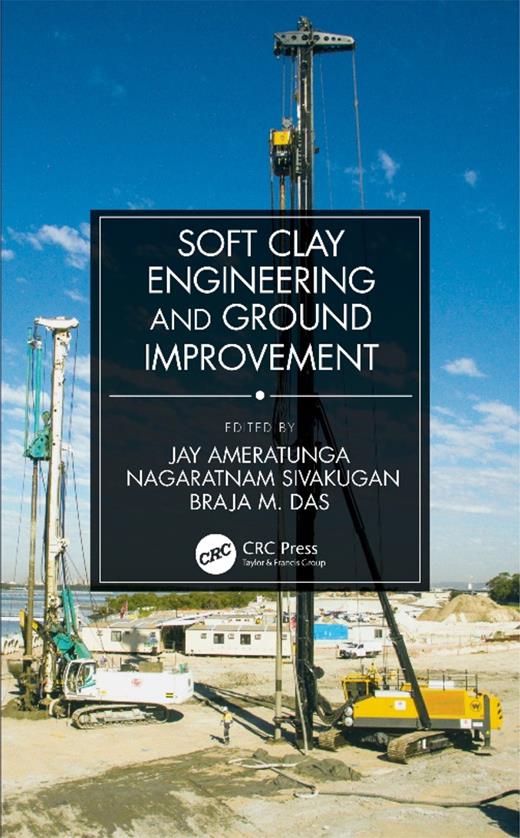
Ground Improvement is recognised as a rapidly and continually developing discipline, particularly in soft clay soils, driven by the need to develop marginal soft clay sites, often in low lying areas requiring extensive filling; in addition to land reclamation projects. Focusing on the design and implementation of ground improvement techniques applicable to soft clays this book is divided into seventeen chapters. Chapter 1 provides a useful introduction and sets the scene, with early chapters (2–5) covering the engineering geology of soft clay (emphasising the importance of the engineering geological model), basic soil mechanics, geotechnical testing and geotechnical parameter derivation for soft clays.
Chapter 6 provides a useful overview of ground improvement methods for soft clays, with Chapters 7–16 covering the most popular of these, including: replacement, pre-loading, pre-loading with band drains, stone columns, semi-rigid inclusions, lightweight fill, deep soil mixing, basal strength geotextiles, mass stabilisation, the observational approach (and geotechnical instrumentation). The final chapter (17) is reserved for geotechnical risk management. The chapters are presented in a well-structured format incorporating worked examples of design aspects, allowing the reader to follow the steps involved in a design, together with useful case history information allowing understanding of construction issues (including lessons learnt) and any significant risks. A useful reference list is provided at the end of each chapter. This should appeal to the target audience of professionals employed in the civil and ground engineering industry (consultants and contractors,) together with academics working on ground improvement in soft clays; additionally providing a useful reference source for early career geotechnical and civil engineers; also postgraduates and undergraduates undertaking modules in the subject area or allied subjects.
The contributing authors include both practitioners and academics, mainly from Australia (also New Zealand, Hong Kong and the U.S.), but with international soft clay ground improvement experiences. Understandably, not all the research associated with the wide subject matter is captured and there is some recognition that ground improvement has been the theme of several international conferences and that there are dedicated journals and reference books in this area. However, reference to other important academic research on the subject matter in Australia would have been beneficial. The book would also have benefitted from more photographs, particularly of some of the ground improvement techniques covered; the use of colour would have enhanced the clarity of some figures and tables, together with photographs. There is at least one case where figures from the original reference source have been used directly; these would have benefitted from being re-drawn to improve clarity.
Overall, the book achieves its objectives and should provide the target audience with a useful and practical introduction to ground improvement in soft clays, in addition to providing an important reference source.

