

Bio-based surfactants are increasingly important as an alternative to traditional petro-based surfactants owing to their renewable feedstocks and various applications in many industrial fields such as enhanced oil recovery (EOR). In this study, a new bio-based zwitterionic surfactant with a strong interfacial activity at high temperatures of up to 120°C was developed through the modification of methyl oleate derived from renewable non-edible oils. The synthetic route was optimized to promote the conversion rate of quaternization by precisely controlling and timely monitoring the residues of intermediates, and the interfacial activity of the final product was greatly improved after the optimization. This work consolidated the authors’ hypothesis that the removal of the residual intermediates of amidation and promotion of the conversion rate of quaternization certainly contribute to enhancing the interfacial activity of the final product, and it will facilitate the design of a sustainable alternative to petro-based chemicals used in EOR.
Notation
- ACMC
occupied area per molecule at the critical micelle concentration
- C
concentration of the surfactant
- IFTequ
equilibrium interfacial tension
- NA
Avogadro’s constant
- R
molar gas constant
- r
minor axis radius
- SFTCMC
surface tension at the critical micelle concentration
- T
temperature
- ΓCMC
surface adsorption amount at the critical micelle concentration
- Δρ
density difference between crude oil and water
- ω
rotating rate
1 Introduction
Bio-based surfactants are increasingly important as an alternative to traditional surfactants due to their renewable feedstocks, environmental friendliness and wide range of applications in many industrial fields such as enhanced oil recovery (EOR).1–6 Traditional surfactants, known as petro-based surfactants, were widely used in the ternary alkali–surfactant–polymer (ASP) flooding system to reduce the oil–brine interfacial tension (IFT) to an ultralow level (∼10−3 mN/m) for EOR in recent decades.7–9 However, it was found that the alkali in ASP systems resulted in both serious damage to reservoir permeability, due to the dispersion and migration of clay, and alkaline scaling in formations.10–12 Many studies from both the laboratory and industrial fields have proved that in the absence of alkali, a kind of additive for co-reducing IFTs with surfactants, most of the traditional surfactants in flooding systems failed to meet the required ultralow IFT and consequently failed in EOR.13–15 As a comparison, bio-based surfactants are highly competitive in alkali-free flooding systems in oil recovery, particularly in oil reservoirs with harsh conditions such as high temperature and salinity.16,17
Bio-based zwitterionic surfactants derived from non-edible plant oils as feedstocks are a group of bio-based surfactants owing to their excellent interfacial activity. Various renewable materials, including lignin, sugar and different non-edible plant oils, have been used as feedstocks to produce bio-based surfactants with different properties.18–20 Lignin was used to produce lignin sulfonate (an anionic surfactant) as a dispersing agent in cement admixtures and dye solutions.21 It was also used to synthesize lignin polyoxyethylene ether (a non-ionic surfactant) as a stabilizer for emulsion polymerization,22 carboxymethylated lignin (an anionic surfactant) as a dispersant in the mining industry (ore suspensions)23 and lignin polyether sulfonate (an anionic surfactant) with a good interfacial activity for EOR.24,25 Meanwhile, sugar was used to produce bio-based surfactants, such as sugar ester (a non-ionic surfactant) and alkyl polyglycoside (a non-ionic surfactant), and widely applied in medicine, food, cosmetics and agriculture owing to its good surface activity and emulsifying capacity.26–31 However, non-edible plant oils, including a vast amount of waste cooking oil,32 accounted for a large majority of renewable feedstocks in producing bio-based surfactants, because of their extensive renewable sources, environmentally friendly and cost-effective performance and flexible structural modifiability in production. Castor oil as a kind of non-edible plant oil was used to produce polyoxyethylated castor oil as an emulsifier,33 ethoxylated castor oil acid methyl ester (a non-ionic surfactant) with good detergency and biodegradability as a detergent constituent34 and ricinoleic acid methyl ester sulfonate (an anionic surfactant) with a good interfacial activity for EOR.35 More importantly, fatty acids and esters derived from waste cooking oil were successfully used for producing anionic surfactants (e.g. fatty acid methyl ester sulfonate) with excellent detergency and stable foamability as a phosphide-free detergent constituent36,37 and zwitterionic surfactants (e.g. phenyl fatty amide carboxyl and sulfo quaternary ammonium) with good ability to reduce substantially oil–water IFTs,17,38 which are therefore very promising for EOR in the oil industry.
The interfacial activity of bio-based zwitterionic surfactants derived from non-edible plant oils strongly depends on reaction routes adopted in the synthesis strategy in production, and the synthesis strategy, including reaction conditions, control of intermediate residues and the conversion rates of each step and the final step, is accordingly constrained by the cost and environmental factors in production and feasibility in applications. In general, the synthesis of bio-based zwitterionic surfactants using non-edible oils as their feedstocks took three steps of alkylation using aluminum trichloride as the catalyst, amidation using 3,4,5-trifluorophenylboronic acid as the catalyst and quaternization using sodium carbonate as the catalyst.17 For this synthetic route, many studies proved that under laboratory conditions, a catalyst such as aluminum trichloride showed a relatively high catalytic efficiency,17,38–40 but it was difficult to recover and reuse such a kind of catalyst, which naturally resulted in a large amount of secondary waste and would be limited in practical industrial production. In addition, the excessive residues and low conversion rates of intermediates in these steps may have a negative impact on the final product of bio-based zwitterionic surfactants. Yet the mechanism by which intermediate residues and conversion rates affect the performance of the final product remained unclear, and the knowledge about its role in cost-effectively produced bio-based zwitterionic surfactants using non-edible oils as their feedstocks is still limited.
In this study, methyl oleate was used as the starting material to develop a new bio-based zwitterionic surfactant (tolyloleamide ethyl hydroxysulfonyl quaternary ammonium salt (TEHSQA)) with ultralow IFTs between crude oil and formation brine at high temperature using an effective strategy realized by increasing the conversion rate of quaternization and controlling the residues of intermediates. The reason why methyl oleate was used as the starting material is that compared with nervonic acid, which is scarce and expensive, methyl oleate has more potential for production with a lower cost. Furthermore, the removal of the catalyst of alkylation requires washing with water, while using oleic acid with higher hydrophilicity as the starting material will lead to emulsification during this procedure, which makes it difficult to separate the alkylated product. The conversion rate of each step was monitored by gas chromatography (GC)–mass spectrometry (MS) and high-performance liquid chromatography (HPLC)–MS to optimize reaction conditions in a timely manner, and the structure of the final product obtained after the optimization of reaction conditions was characterized by hydrogen-1 (1H) nuclear magnetic resonance spectroscopy (NMR). The thermal stability, surface properties and IFTs of TEHSQA were evaluated, and its potential application in EOR in reservoirs with harsh conditions such as high temperature and salinity is discussed in this paper.
2 Experimental section
2.1 Materials
The raw material and reagents used in this study included methyl oleate (Aladdin, 99%), toluene (SCR, 99.5%), methanesulfonic acid (Meryer, 99%), N,N-dimethyl ethylenediamine (Aladdin, 98%), sodium hydroxide (Hushi, 99.7%), 3-chloro-2-hydroxypropane sulfonate (Meryer, 95%), sodium carbonate (Aladdin, 99.7%), ethanol (Aladdin, 99.5%), methanol (Maclin, 99.5%) and sodium chloride (Aladdin, 99.5%).
The crude oil was from the Daqing oil field, and the composition of the simulated formation brine is summarized in Table S1 in the online supplementary material.
2.2 Synthesis method
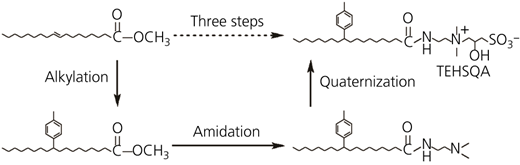
The target surfactant was synthesized from methyl oleate after alkylation, amidation and quaternization. In alkylation, methanesulfonic acid was used as the catalyst to replace aluminum chloride, avoiding the production of wastewater containing aluminum. Methyl oleate, toluene and methanesulfonic acid were reacted at a molar ratio of 1:5:6 at 65°C for 6 h. After alkylation, methanesulfonic acid was removed by water washing, and excess toluene was recycled by atmospheric distillation. In amidation, the one-step method (direct amidation) was used to replace the two-step method (first acyl chlorination and then amidation), the alkylated product reacted with five times the molar amount of N,N-dimethyl ethylenediamine at 155°C for 6 h and 1 wt% sodium hydroxide was added as the catalyst. For half of the amidated product, excess N,N-dimethyl ethylenediamine was removed by atmospheric distillation, while for the other half of the amidated product, vacuum distillation was used. In quaternization, the amidated product reacted with an equal molar amount of sodium 3-chloro-2-hydroxypropane sulfonate at 95°C for 6 h, and the same molar amount of sodium carbonate acted as the catalyst while a mixture of ethanol/water (volume ratio 2:1) was used as the solvent. All the reactions were conducted in a 5 l reactor that can be operated at high temperature and pressure.
After quaternization, the solvent was removed from the final product by atmospheric distillation and collected for subsequent use. The dried product was then dissolved in methanol to remove sodium carbonate and the by-product sodium chloride since they do not dissolve in methanol. Finally, methanol was recycled from the final product by atmospheric distillation, and the purified final product TEHSQA was obtained. The whole route of synthesis is shown in Scheme 1.
2.3 Identification of the products and calculation method of the conversion rate
The alkylated and amidated products were detected by GC–MS (Shimadzu TQ-8040), and the conversion rates of the two reactions were determined by using the peak area of the raw material and product while the causes of peaks of the raw material and products of alkylation and amidation were confirmed by MS. The quaternized product was detected by HPLC–MS (Shimadzu LCMS-8045) with the mobile phase of methanol (0.1% formic acid). The conversion rate of quaternization was determined by using the peak area of the residual amidated product and quaternized product, and the causes of peaks of the residual amidated product and quaternized product were confirmed by MS as well. The detailed calculation method of the conversion rate is summarized in the online supplementary material. The high-purity quaternized product was further identified by hydrogen-1 NMR (Bruker Avance III, 400 MHz).
2.4 Determination of surface tensions
The surface tension of the TEHSQA solution was measured by using a surface tension meter (Data Physics DACT-21) using the plate method. TEHSQA solutions with different concentrations were prepared using deionized water, and then the surface tensions were measured at 25.0 ± 0.1°C.
The adsorption amount ΓCMC and occupied area per molecule A CMC of TEHSQA were calculated by using the Gibbs adsorption isotherm equation, where η is 1 for zwitterionic surfactants, R is the molar gas constant (8.314 J/(mol K)), SFT is surface tension and N A is Avogadro’s constant (6.02 × 10²³ mol−1).41,42
2.5 Contact angle measurement
The contact angles of formation brine with and without TEHSQA on a simulated rock surface were measured at 25°C with a contact angle measuring instrument (Krüss DSA-25S). The rock surface was simulated by using a quartz sheet infiltrated with Daqing crude oil.
2.6 Determination of the decomposition temperature
The decomposition temperature of TEHSQA was determined by using a thermogravimetric analyzer (Shimadzu TGA-50). A sample of TEHSQA was heated from 30 to 800°C at a heating rate of 20°C/min with nitrogen purging (20 ml/min).
2.7 Determination of IFT
The IFT between Daqing crude oil and formation brine was measured by using a spinning drop IFT meter (Krüss SDT) with a rotating rate of 4500 revolutions per min (rpm). The instrument can calculate the IFT automatically by using Equation 3, where Δρ, ω and r are the density difference between crude oil and water, the rotating rate and the minor axis radius, respectively.43 The dynamic IFTs between Daqing crude oil and formation brine with different concentrations of the surfactant were measured at 45°C (reservoir temperature of the Daqing oil field) to confirm the relationship between IFT and the concentration of the surfactant.17
The effect of the quaternization conversion rate was confirmed by preparing the surfactant solution using quaternized products when adopting atmospheric distillation and vacuum distillation. The detailed relationship between the quaternization conversion rate and interfacial performance was determined by using a mixture of the amidated product and quaternized product. The temperature resistance of TEHSQA was determined by measuring the dynamic IFT between Daqing crude oil and the surfactant solution, and the test temperature changed from 45 to 120°C. The salinity tolerance of TEHSQA was determined by testing the dynamic IFT between Daqing crude oil and the surfactant solution, and extra sodium chloride and calcium chloride were added until the IFT could not be kept at an ultralow level.
The effect of adsorption on the rock surface was determined. The detailed experiment was as follows: first, 5.0 g of quartz sand was mixed with 45 ml of 3.0 g/l TEHSQA solution, which was prepared using formation brine in a 250 ml conical flask with a plug, and then the mixture was oscillated at 45°C for 24 h in a thermostatic water bath.17 After the aforementioned procedures, the mixture was centrifuged at 8000 rpm to obtain the supernatant. The dynamic IFT between Daqing crude oil and the supernatant was measured at 4500 rpm at 45°C. After that, the supernatant was mixed with one-ninth weight of quartz sand to be oscillated again. The aforementioned procedures were repeated until the equilibrium IFT (IFTequ) could not be kept at an ultralow level.
3 Results and discussion
3.1 Identification of intermediates and optimization of the synthetic route
The GC–MS and HPLC–MS showed that the conversion rates of the alkylation, amidation and quaternization products when adopting atmospheric distillation in the synthesis process were 92.9, 97.5 and 61.1%, respectively, according to the corresponding peak areas of the alkylated product (Figures S1–S3 in the online supplementary material), amidated product (Figures S4–S6 in the online supplementary material) and quaternized product (Figure 1). Obviously, the conversion rate of the quaternization was very low and this low rate certainly had a very negative impact on the expected interfacial activity of the surfactant. To solve this issue, an insight into the reactants and reaction pathways in the synthesis process was made, and it was found that the excess residue of N,N-dimethyl ethylenediamine in the reaction system was a key factor that inhibited the conversion rate of quaternization, since 1 mol of the residue of N,N-dimethyl ethylenediamine consumed up to four times the quaternization reagent (sodium 3-chloro-2-hydroxypropane sulfonate) in the reaction system (Scheme 2) and consequently resulted in a low conversion rate of quaternization.
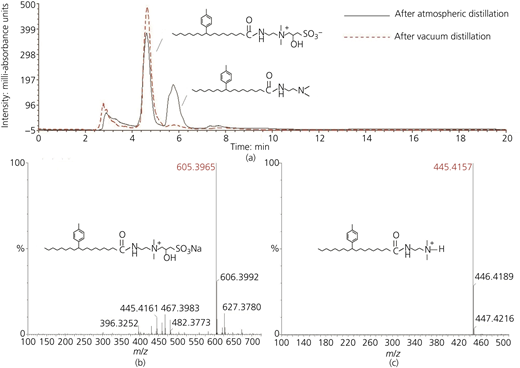
(a) HPLC of the residual amidated product and quaternized product obtained when adopting atmospheric distillation and vacuum distillation; mass spectra of the (b) quaternized product and (c) residual amidated product
(a) HPLC of the residual amidated product and quaternized product obtained when adopting atmospheric distillation and vacuum distillation; mass spectra of the (b) quaternized product and (c) residual amidated product
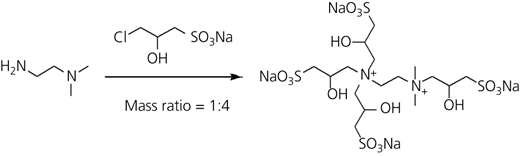
Reaction mechanism of N,N-dimethyl ethylenediamine and sodium 3-chloro-2-hydroxypropane sulfonate
Reaction mechanism of N,N-dimethyl ethylenediamine and sodium 3-chloro-2-hydroxypropane sulfonate
To improve further the conversion rate of quaternization, instead of atmospheric distillation, vacuum distillation was adopted to remove efficiently the residue N,N-dimethyl ethylenediamine in the reaction system, and it greatly promoted the conversion rate of quaternization. The HPLC-MS results showed that the conversion rate of quaternization in the synthesis process when adopting vacuum distillation increased to 92.1% (Figure 1(a), dashed line) from a rate of 61.1% when adopting atmospheric distillation (Figure 1(a), solid line).
Figure 2 shows the dynamic IFTs between Daqing crude oil and formation brine with different concentrations of the quaternized products when adopting atmospheric distillation (Figure 2(a)) and vacuum distillation (Figure 2(b)). For the quaternized product when adopting vacuum distillation, the IFTs between Daqing crude oil and formation brine can be reduced to an ultralow level (∼10−3 mN/m) at a minimum concentration of 0.3 g/l, corresponding to only one-tenth of the dosage of conventional surfactants used in oil recovery, and to an ultralow level on the order of ∼10−4 mN/m at a minimum concentration of 0.5 g/l (Figure 2(b)), which consolidated the authors’ hypothesis that the promotion of the conversion rate of quaternization certainly contributed to enhancing the interfacial activity of such bio-based zwitterionic surfactants.
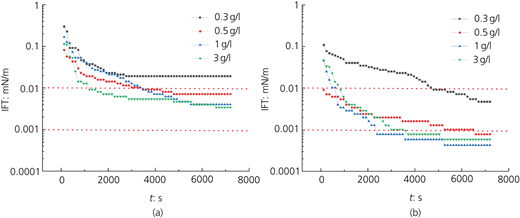
Dynamic IFTs between Daqing crude oil and formation brine with different concentrations of quaternized product when adopting (a) atmospheric distillation (purity: 61.1%) and (b) vacuum distillation (purity: 92.1%)
Dynamic IFTs between Daqing crude oil and formation brine with different concentrations of quaternized product when adopting (a) atmospheric distillation (purity: 61.1%) and (b) vacuum distillation (purity: 92.1%)
Figure 3 shows the dynamic IFTs between Daqing crude oil and formation brine with a 1.0 g/l mixture of the amidated product and quaternized product at different mass ratios. Unsurprisingly, the amidated product showed very poor interfacial activity, and increasing the mass fraction of the amidated product in the mixture would further damage the interfacial activity (Figure 3(a)). In contrast, with the increase in the mass fraction of the quaternized product in the mixture, the IFTs between Daqing crude oil and formation brine were accordingly reduced to an ultralow level (∼10−3 mN/m) at and above a mass fraction of 36.8% of the quaternized product in the mixture and reduced to an ultralow level on the order of ∼10−4 mN/m at 92.1% quaternized product (Figure 3(b)).
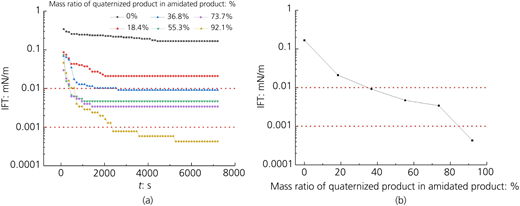
Dynamic (a) IFT and (b) IFTequ between Daqing crude oil and formation brine with a 1.0 g/l mixture of the amidated product and quaternized product at different mass ratios
Dynamic (a) IFT and (b) IFTequ between Daqing crude oil and formation brine with a 1.0 g/l mixture of the amidated product and quaternized product at different mass ratios
The poor interfacial performance of the amidated product can be attributed to its poor hydrophilicity, which makes it stay in the oil phase rather than at the oil–water interface. The low interfacial amount makes it unable to reduce the IFT effectively. Therefore, a high quaternization conversion rate is essential to having a good interfacial performance. As the ultralow IFT is an important measuring index, the purity of the final product should be higher than 36.8% to ensure that a good effect in oil flooding can be obtained.
In addition, the confirmed structure of the quaternized product when adopting vacuum distillation (TEHSQA) using hydrogen-1 NMR analysis showed the following results (Figure S11 in the online supplementary material): (400 MHz, deuterated methanol (CD3OD)): δ 8.57 (–CO–NH–), 7.15–7.00 (–C6 H 4–), 4.62 (–CH2–CH(OH)–), 4.15–4.11 (–CH2–CH(OH)–), 3.84–3.56 (–NH–CH 2–; –CH 2–SO3 −), 3.37–3.26 (–CH 2–N(CH3)2–), 3.09–2.89 (–N(CH 3)2–), 2.72 (–CH–C6H4–), 2.33–2.20 (–CH 2–CO–; –C6H4–CH 3), 1.61–1.55 (–CH 2–CH(C6H4–CH3)–; –CH 2–CH2–CO–),1.31–1.23(–(CH 2)n −3–CH2–CH2–CO–; –(CH 2)m −1–CH3), 0.92–0.85 (–CH2–CH 3).
3.2 Surface activity
The surface tensions of TEHSQA in solution decreased with the increase in surfactant concentration (Figure S12(a) in the online supplementary material). The critical micelle concentration (CMC) and the surface tension at CMC (SFTCMC) obtained at the inflection point of the broken line were 1.20 × 10⁻⁵ mol/l and 32.10 mN/m, respectively. The contact angle of the formation brine without TEHSQA on the simulated rock surface was 62.3° (Figure S12(b) in the online supplementary material), and the contact angle of the formation brine with 1.0 g/l TEHSQA decreased from 62.3 to 42.5° (Figure S12(c) in the online supplementary material).
The surface properties of TEHSQA are compared with that of a zwitterionic surfactant N, N-Dimethyl-N-[2-hydroxy-3-sulfo-propyl]-N′-phenyloctadecanoyl-1, 3-diaminopropane (SPODP) and an anionic surfactant 4-(1-heptadecyl) benzene sodium sulfonate (9ΦC17S) in Table 1.17,44 TEHSQA showed a lower CMC and a lower SFTCMC than those of SPODP and 9ΦC17S, which implied that TEHSQA possessed higher efficiency in reducing surface tension. The decrease in contact angle suggested that TEHSQA inherited a good ability to alter the wettability of the simulated rock surface, and the alteration in wettability toward hydrophilic in oil reservoirs consequently contributed to EOR in the oil production process.45,46
3.3 Thermal resistance
To evaluate the thermal stability of TEHSQA, both the decomposition temperature and IFTs between crude oil and the formation brine at different temperatures were determined. The thermogravimetric analysis (TGA) thermogram of the TEHSQA sample (Figure 4(a)) showed that the sample had a little weight loss (5%) when heated from 30 to 270°C and a large weight loss (65%) when heated from 270 to 490°C, and afterward, the weight loss showed little change up to a temperature of 800°C. As shown in Figure 4(a), for the TEHSQA sample, the very little weight loss (5%) with heating from 30 to 270°C corresponded to bound water and a small amount of light volatiles released from the TEHSQA sample.47 Its decomposition temperature stood at 270°C, which promised good compatibility in a wide range of oil reservoir temperatures.48–50 The 45% weight loss from 270 to 412°C could be attributed to the fracture of the quaternary ammonium bond, while the 20% weight loss from 412 to 490°C could be due to the breaking of the amide bond. Finally, the hydrophobic carbon chain broke gradually from 490 to 800°C.
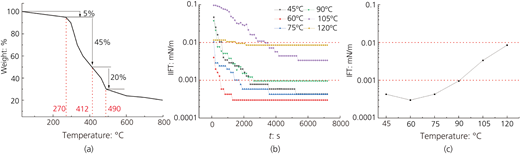
(a) TGA curve of TEHSQA; (b) dynamic IFT and (c) IFTequ between Daqing crude oil and formation brine with 1.0 g/l TEHSQA at different temperatures
(a) TGA curve of TEHSQA; (b) dynamic IFT and (c) IFTequ between Daqing crude oil and formation brine with 1.0 g/l TEHSQA at different temperatures
The change in dynamic IFTs between Daqing crude oil and the formation brine with a TEHSQA concentration of 1.0 g/l against temperature showed that the equilibrium IFTs (IFTequ) remained at ultralow levels on the order of ∼10−3 mN/m at temperatures up to 120°C and on the order of ∼10−4 mN/m at temperatures up to 90°C (Figures 4(b) and 4(c)), which suggests good stability of the interfacial performance of TEHSQA as a bio-based surfactant at high temperatures. As shown in Figure 4(c), IFTequ can remain at an ultralow level (∼10−3 mN/m) up to 120°C, which is higher than that of most reported bio-based surfactants.16,17,24–38 When the temperature rose from 45 to 60°C, the ionization degree of the hydrophilic head was improved; thus, the hydrophilicity of surfactant molecules increased. As a rule, the benzene ring and the long carbon chain would certainly offer considerable hydrophobicity, and an increase in hydrophilicity would be beneficial to the balanced arrangement of surfactant molecules at the interface and consequently result in reducing the IFTs. However, when the temperature further rose, the hydrophilicity of surfactant molecules tended to decline owing to the breakage of hydrogen bonds between surfactant molecules and water molecules.51 The decline of the hydrophilicity induced the surfactant molecules to leave the oil–water interface and finally altered the IFTs.
3.4 Salinity tolerance
The dynamic IFTs between Daqing crude oil and the formation brine with 1.0 g/l TEHSQA against concentrations of sodium chloride (NaCl) and calcium (Ca2+) ions are shown in Figure 5. As shown in Figure 5(a), IFTequ increased with increasing concentrations of sodium chloride, and IFTequ could remain at an ultralow level until the concentration of sodium chloride reached 15 g/l. When the concentration of sodium chloride increased, sodium (Na+) ions complexed with the sulfonyl group and chloride (Cl−) ions complexed with the quaternary ammonium groups owing to their charges, which affected the reduction of the self-interaction of surfactant molecules. As a result, the arrangement of surfactant molecules at the oil–water interface became loose and further resulted in the increase in IFTequ.52
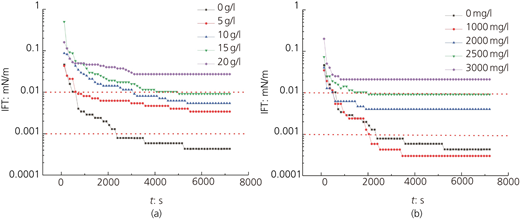
Dynamic IFTs between Daqing crude oil and formation brine with 1.0 g/l TEHSQA and different concentrations of (a) sodium chloride and (b) calcium ions
Dynamic IFTs between Daqing crude oil and formation brine with 1.0 g/l TEHSQA and different concentrations of (a) sodium chloride and (b) calcium ions
The equilibrium IFTs (IFTequ) remained at an ultralow level on the order of ∼10−3 mN/m at concentrations of calcium ions of up to 2500 mg/l (Figure 5(b)). Compared with sodium chloride, calcium ions had a more notable effect on the interfacial performance of the surfactants owing to their greater positive charge.53 IFTequ showed a little decrease first at a concentration of calcium ions of up to 1000 mg/l, which suggested that at a low concentration, calcium ions may undergo complexation with multiple surfactant molecules and consequently contribute to the tight arrangement of surfactant molecules at the oil–water interface. However, the IFTs increased with a further increase in the concentration of calcium ions up to 2500 mg/l, which implied that at high concentrations of calcium ions, the electrostatic attraction between the anionic groups of surfactant molecules and calcium ions with a strong binding capacity destroyed the self-electrostatic attraction between surfactant molecules. Meanwhile, the electrostatic repulsion between the cationic groups of surfactant molecules remarkably reduced their interfacial concentration and increased the equilibrium IFT.53
3.5 Adsorption on quartz sands from formation brine
The dynamic IFTs between Daqing crude oil and formation brine with 3.0 g/l TEHSQA against adsorption times are shown in Figure 6. It shows that IFTequ could remain at an ultralow level on the order of ∼10−3 mN/m after four iterations of adsorption on the quartz sands from formation brine. As shown in Figure 6(b), IFTequ increased with the increase in adsorption iterations and could remain at an ultralow level at up to four iterations of adsorption, which suggests that TEHSQA possesses an acceptable anti-adsorption stability. As the adsorption of surfactant molecules is an exothermic process, the adsorption of zwitterionic surfactants on the sandstone rock surface will decrease at high temperatures, which is unacceptable for anionic and non-ionic surfactants.54,55 As a result, the anti-adsorption stability of TEHSQA can be better at high temperature.
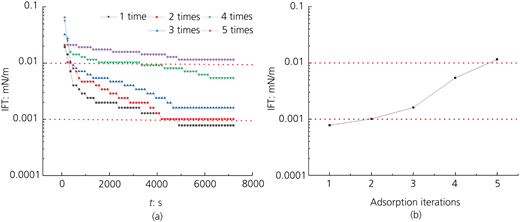
Dynamic (a) IFT and (b) IFTequ between Daqing crude oil and formation brine with 3.0 g/l TEHSQA after different iterations of adsorption
Dynamic (a) IFT and (b) IFTequ between Daqing crude oil and formation brine with 3.0 g/l TEHSQA after different iterations of adsorption
4 Conclusions
In summary, the conversion rate of quaternization had a great effect on the interfacial activity of the final product and it played a key role among the three steps in the synthetic process of a bio-based zwitterionic surfactant from waste oil as feedstock. By using the strategy of vacuum distillation to remove the residual intermediates of amidation and to promote the conversion rate of quaternization, the authors developed a new thermally stable bio-based zwitterionic surfactant, TEHSQA, from methyl oleate derived from waste oil that possessed a good interfacial activity at temperatures of up to 120°C. This is strong evidence to support the hypothesis that the removal of the residual intermediates of amidation and promotion of the conversion rate of quaternization in the synthesis of the bio-based zwitterionic surfactant contribute to the interfacial activity of the final quaternized surfactant. The IFT between Daqing crude oil and formation brine can be reduced to an ultralow level on the order of 10−4 mN/m at a very low dosage of 1.0 wt% of the surfactant TEHSQA in the formation brine under alkali-free conditions, which makes it highly competitive against most of the reported zwitterionic surfactants. Moreover, the bio-based zwitterionic surfactant TEHSQA demonstrated good thermal stability, strong salt tolerance, high wetting ability and acceptable adsorption behaviors. At a very low dosage of 1.0 wt% of the surfactant TEHSQA in the formation brine, the IFTs can be reduced to an ultralow level (∼10−3 mN/m) at a temperature up to 120°C. In addition, the IFTs remain at an ultralow level at calcium ion concentrations of up to 2500 mg/l and sodium chloride concentrations of up to 15 000 mg/l in the formation brine, which is promising for meeting the urgent needs of highly efficient surfactants for EOR in oil reservoirs under harsh conditions such as high temperature and salinity.
Acknowledgements
This research was supported by the National Key Research and Development Program of China (number 2017YFB0308900), the National Natural Science Foundation of China (number 51574125) and the Fundamental Research Funds for the Central Universities of China (number 222201817017).

