


The use of chitosan, a natural polymer, has recently increased due to its antimicrobial and antifungal character, null toxicity, biocompatibility and ability to form biofilms and hydrogels. The areas of application and research include biomedical, pharmaceutical, biomaterials, water treatment and haircare and skincare products. However, the applications of chitosan are limited due to the difficulty associated with modification of its structure and its poor solubility in water. Among the main chemical modifications for functionalising the chitosan structure are the N-substitution, O-substitution (with or without protecting the reactive sites of the chitosan) and cross-linking with other compounds; these chemical modifications allow improvement of its chemical and physical properties. In relation to the current importance of the use of chitosan with chemical modification, the present review attempts to explain in a simple way the main chemical reactions carried out with chitosan and its wide range of applications, and provides a future perspective.
1 Introduction
Chitosan is a polycationic polymer with more than 5000 d-glucosamine units (Figure 1). This biopolymer is obtained from the recovery of chitin (N-acetyl-d-glucosamine) from crustacean shells (shrimp, crab and krill shells), insect exoskeletons and cell walls of many fungi by an alkaline deacetylation process.1,2 Chitosan has been demonstrated to be non-toxic, biodegradable and biocompatible, and it is insoluble in water, but soluble in acidic solvents, such as diluted hydrochloric, formic and acetic acids. In acidic solutions (below pH 5·5), the amine groups (–NH2) on chitosan molecules are protonated and thus acquire a positive charge (–NH3+), influencing the antimicrobial activity, solubility and adsorption capacity.3,4
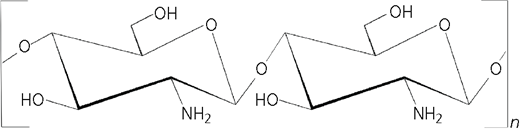
Chemical structure of fully deacetylated chitosan. Figure based on the paper of Hamed et al.5 with some modifications
Chemical structure of fully deacetylated chitosan. Figure based on the paper of Hamed et al.5 with some modifications
Due to the presence of amino groups and its accessibility, chitosan has been used for many applications in various fields such as the cosmetics industry (haircare and skincare), biomedical field (chitosan-based dressings), water engineering (bioadsorbence of heavy metals and dyes), drug delivery systems (allowing the controlled diffusion of drugs) and food technology (due to chitosan’s antimicrobial and antifungal properties).5,6 However, the utilisation of chitosan has been limited in terms of industrial applications as currently only a chemical method is used to obtain it (hydrolysis of acetamide groups of chitin with sodium hydroxide (NaOH) or 45% potassium hydroxide (KOH)); biological methods are not yet used for industrial-scale production of chitosan. Also, the chemical structure of chitosan obtained after the deacetylation process is found to lack solubility in a suitable solvent owing to the rigid crystalline structure caused by the formation of intra- and/or interhydrogen bonding between the amino and hydroxyl groups (soluble in dilute acid solutions below pH 5·5).7,8 These factors increase the production price of chitosan and make it difficult to use chitosan directly in all industrial areas.
However, due to a large number of amino (–NH2) and hydroxyl (–OH) groups with chemical activity in chitosan, it is possible to perform chemical modification to improve its physical and chemical properties.9 Furthermore, in order to perform precise and well-controlled structural modification of chitosan, it is necessary to provide a clear definition of the functional groups of chitosan in their repeating units, because it is crucial to exploit regioselectivity in the chemical modification reactions that render possible the synthesis of derivatives with well-defined structures.5,7 In addition, the chemical reactions carried out to improve the properties of chitosan should not affect its sustainability, since chitosan should retain its biodegradability, non-toxicity and antimicrobial and antifungal properties.
The most widely used method for the chemical modification of chitosan is N-substitution in which the amino group (–NH2) of chitosan is the functional group that reacts. Furthermore, O-substitution (–OH) of chitosan is commonly used and regularly requires the protection and deprotection of primary amino groups because of the higher reactivity of amino groups compared with that of hydroxyl groups.10 In line with this, Wang et al.11 and Kulkarni et al.12 mentioned that functional groups can be introduced to the chitosan backbone by grafting and the main modifications methods include but are not limited to N-substitution, O-substitution and free-radical graft copolymerisation. Moreover, among the main reactions are acylation, alkylation, carboxymethylation, N-phosphomethylation and Michael addition. Also, LogithKumar et al.13 discuss the currents trends in functionalising chitosan for bone tissue engineering, using chemical modifications as alternatives (quaternisation, carboxyalkylation, hydroxylation, phosphorylation, sulfation and copolymerisation).
Sulfonation reactions have been used to produce sulfated chitosan that displays new biological activities, such as antioxidant and anticoagulant properties.14 Seedevi et al.15 improved the antioxidant activity of chitosan obtained from Sepia prashadi by using sulfated chitosan carried by the chlorosulfonic acid in N,N-dimethylformamide. Campelo et al.16 used sulfonated chitosan for metallic implants that are in contact with blood, where it increases the roughness and hydrophilicity of the implants and decreases their calcium deposits. In line with this, Galhoum et al.17 presented a chemical modification involving grafting diethylenetriamine onto chitosan as a natural adsorbent for uranyl. Vakili et al.18 presented the chemical modification of chitosan with hexadecylamine and 3-aminopropyl triethoxysilane, improving the adsorption capacity of the colorant blue 4. Moreover, chitosan has been cross-linked with other chemical agents such as glutaraldehyde, epichlorohydrin, ethylene glycol, diglycidyl ether and sodium tripolyphosphate, which are generally being used to improve the chitosan hydrogels used in water treatment.19,20 Kousalya et al.21 reported an increase in the adsorption capacity of chitosan hydrogels with chemical modifications, based on protonation, carboxylation and grafting. Furthermore, Illy et al.22 formulated a cross-linked network of chitosan–epoxy as a hardener through an epoxy–amine reaction.
In addition, chemical modification has been used to improve biocatalysis from enzymes by inter- or intramolecular cross-linking or even intersubunit cross-linking in the case of multimetric enzymes or multienzymatic systems.23 Nwagu et al.24 mentioned the chemical modification of chitosan using phthalic anhydride for stabilising the enzyme amylase from Aspergillus carbonarius. In a similar work, O’Brien et al.25 reported the stabilisation of horseradish peroxidase by means of covalent modification using phthalic anhydride. In relation to the current importance of the use of chitosan with chemical modification, the present review attempts to explain in a simple way the main chemical reactions carried out with chitosan and its wide range of applications, and provides a future perspective.
2 Most common chemical modifications of chitosan
2.1 N-substitutions without protective agents
Quaternary ammonium chitosan is one of the most important hydrophilic chitosan derivatives and has been extensively studied for its antimicrobial activity and anticoagulant activity related to the protonated amino group.26 In this chemical modification, N-substitution is performed by turning the amino group (–NH2) into quaternary ammonium salt, introducing quaternary ammonium compounds or quaternary phosphonium compounds by a chemical reaction with chitosan. This process is commonly used due to the easy modification involved in obtaining derivatives with improved biological properties and water solubility due to a permanent positive charge on the polymer backbone.27,28
N,N,N-Trimethyl chitosan chloride (TMC) is one of the most important quaternary chitosan derivatives due to its excellent solubility in aqueous solution and being an absorption enhancer, antibacterial agent and gene vector. TMC can be obtained by four routes, including the one-step method, the two-step method, dimethyl sulfate (DMS) methylation and the hydroxyl protection method.29 The one-step method for obtaining TMC is carried out by reacting chitosan with methyl iodide (CH3I) under strong alkaline conditions at room temperature using N-methyl-2-pyrrolidone (NMP) as a solvent. Meanwhile, in the two-step method, N-methyl-chitosan or N,N-dimethyl chitosan is first obtained by reacting chitosan with formaldehyde under acid conditions to form a Schiff base, followed by a reaction with methyl iodide for the methylation process. Also, the two-step method has the advantage of avoiding O-methylation of the obtained TMC unlike the one-step method.29,30 In line with this, Pardeshi and Belgamwar31 prepared TMC in two steps: the reductive methylation of chitosan using methyl iodide in the presence of a strong base (sodium hydroxide) at 60°C, followed by treatment with sodium chloride (NaCl) solution, as can be observed in Figure 2. The TMC obtained improved the properties of bioadhesion, biocompatibility, solubility and viscosity, and increased the swelling index.
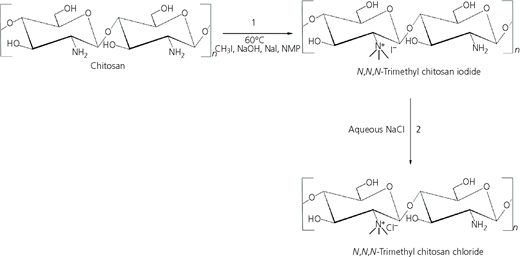
Synthesis of TMC by the two-step reductive methylation reaction. NMP, N-methyl-2-pyrrolidone. Figure based on the paper of Pardeshi and Belgamwar31 with some modifications
Synthesis of TMC by the two-step reductive methylation reaction. NMP, N-methyl-2-pyrrolidone. Figure based on the paper of Pardeshi and Belgamwar31 with some modifications
Another method used is the N-alkylation of chitosan through a reductive amino reaction. This is carried out by selective N-alkylation and N-arylation performed by way of Schiff base intermediates between the amino groups of chitosan and aldehydes and ketones, followed by the reduction of the Schiff base intermediates (imines) with sodium borohydride (NaBH3) or sodium cyanoborohydride (NaCNBH3),32,33 as shown in Figure 3. The reduction of imines with sodium cyanoborohydride is selective, stable in acidic media, presents good reactivity and is a rapid reaction at pH between 6 and 7, and the reduction of aldehydes or ketones is negligible at this pH range.28 This method has been used to prepare derivatives such as N-isopropyl and N-pyrrolidinone chitosans with acetone and levulinic acid in the presence of sodium cyanoborohydride, reaching a 100% degree of substitution. In connection to this, Ngimhuang et al. 34 prepared a novel surfactant agent by way of reductive N-alkylation of chitosan with 3-O-dodecyl-d-glucose in the presence of sodium cyanoborohydride, which was completely soluble in 0·1% aqueous acetic acid.
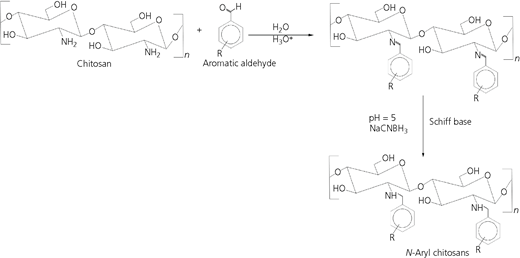
Pathways for N-alkyl chitosan derivatives by a reductive amination reaction. Figure based on the paper of Sajomsang et al. 32 with some modifications
Pathways for N-alkyl chitosan derivatives by a reductive amination reaction. Figure based on the paper of Sajomsang et al. 32 with some modifications
Also, Sajomsang et al. 32,35 synthesised 17 derivatives of chitosan, varying the N-aryl substituents (electron-donating or electron-withdrawing) by way of Schiff bases formed by the reaction between the 2-NH2 group of chitosan with aromatic aldehydes, followed by the reduction of the Schiff base intermediated with sodium cyanoborohydride (Borch reduction). Finally, the derivatives were quaternised with N-(3-chloro-2-hydroxypropyl)-trimethylammonium chloride (Quat 188), which reacted with either the 2-NH2 or –OH groups of chitosan. Kurita and Isogai36 performed N-alkylation of chitosan under aqueous conditions with sodium hydrogen carbonate (NaHCO3) as alkylator and promoter, obtaining both N-carboxymethyl and N-benzyl chitosans with a high degree of substitution. Dung et al. 37 reported obtaining N-carboxymethyl chitosan by N-alkylation using alkali halide and sodium hydrogen carbonate, almost reaching a 100% degree of substitution of the 2-NH2 group of chitosan.
N-Phosphomethylation is another important reaction for functionalising chitosan, improving its biological and physico-chemical properties (solubility, bactericidal, heavy metal chelant and tissue engineering properties).22 Datta et al. 38 prepared N-methylene phosphonic chitosan by microwave irradiation according to the Mannich-type reaction proposed by Moedritzer and Irani.39 This method allowed rapid synthesis and improved solubility and conductivity. Illy et al. 22 reported the N-phosphonomethylation of oligochitosan, obtaining dialkyl phosphoryl oligochitosan by way of epoxy–amine reactions with dialkyl (3-(oxiran-2-yl methoxy)propyl) phosphonates, pointing out that their proposed method is efficient for the preparation of phosphonated oligochitosan derivatives. Wang et al. 40 prepared N-methylene phosphonic acid chitosan grafted with magnesia–zirconia particles by way of a Lewis acid–base interaction for the design of a hydrophilic stationary phase with high electrostatic repulsion and ion-exchange interactions. Also, chitosan with poly(phosphoric acid) structured layer by layer has been used as a flame retardant on flexible polyurethane foams.41 In relation to this, Laufer et al. 42 developed nanocoatings with chitosan–montmorillonite clay as a flame retardant stopping the melting of flexible polyurethane foam.
Recently, the use of ionic liquids (ILs) for the chemical modification of chitosan has been given importance, due to the ability of ILs to dissolve biomass materials and their superior catalytic activity for derivation reactions and good degradation. These salts have earned the name ‘green solvents’.43 In connection to this, Mu et al. 44 reported the reaction of chitosan with 2,3-epoxypropyl-trimethyl quaternary ammonium chloride (Eptac) catalysed by 1-allyl-3-methylimidazolium chloride ([Amim]Cl) IL. The authors demonstrated that the –NH2 group is more reactive than the –OH and hydroxymethyl (–CH2OH) groups and also reported that there are six potential pathways for the reaction, as per Figure 4. The reaction did not benefit from the presence of water but was considerably assisted by the [Amim]Cl IL. Then, the authors used imidazolium-based ILs to promote the graft reactions of chitosan with epoxy compounds. Yang et al. 45 reported the graft reaction of chitosan with Eptac-catalysed chitosan with [Amim]Cl IL and mentioned an improved substitution degree and better regioselectivity compared to those obtained with water, acid and base. Moreover, Wang et al. 26 synthesised N-[2-(hydroxyl)-propyl-3-trimethylammonium] chitosan chloride using the [Amim]Cl IL as a homogeneous green reaction medium. The biopolymer obtained was a pseudoplastic fluid, with the ability to form gel-like structures, and the apparent viscosity of the solution was affected slightly by the temperature.
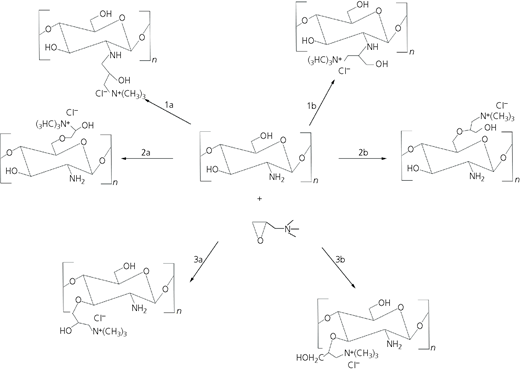
Pathways for the reaction of chitosan with Eptac. Figure based on the paper of Mu et al. 44 with some modifications. The six possible products obtained are due to the three reactive sites of chitosan (1-N, 2-O and 3-O) and the two reactive sites of Eptac (4-C and 5-C)
Pathways for the reaction of chitosan with Eptac. Figure based on the paper of Mu et al. 44 with some modifications. The six possible products obtained are due to the three reactive sites of chitosan (1-N, 2-O and 3-O) and the two reactive sites of Eptac (4-C and 5-C)
2.2 N-substitutions using protective agents
The protection of the –OH groups in the C3 and C6 of chitosan using chemoselective methods is an excellent strategy for synthesising homogeneous N-quaternarised chitosan derivatives without O-methyl substitutions, and O-silytation has been proposed for the protection of the –OH groups of chitosan in the presence of amines, by conversion into silyl ethers.12 Martins et al. 46 pointed out the protection of the –OH groups of chitosan using di-tert-butyldimethylsilyl (di-TBDMS) due to its good stability under acidic conditions and its ease of removal under strongly basic or moderate acid conditions without affecting the functional group. Benediktsdóttir et al. 47 reported the use of the O-silytation method for preparing for the first time full N,N,N-trimethylation of chitosan in order to obtain TMC (100% substituted) and highly substituted N-alkyl-N,N-dimethyl chitosan derivatives (65–72% substituted) using di-tert-butyldimethylsilyl-3,6-O-chitosan (di-TBDMS chitosan) as a precursor (Figure 5).
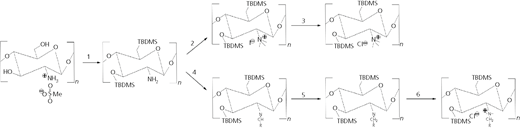
Synthetic route for the preparation of N,N,N-trimethyl chitosan and N-alkyl-N,N-dimethyl chitosan derivatives. Reagents and conditions: 1, chitosan solubilised in acid conditions, methanesulfonic acid, water, 10°C; TBDMS chloride (5 equivalents (equiv.)), imidazole (10 equiv.), dimethyl sulfoxide, nitrogen gas (N2), room temperature; 2, methyl iodide (15 equiv.), caesium carbonate (Cs2CO3) (4 equiv.), NMP, 60°C; 3, tetra-n-butylammonium fluoride (TBAF) (1 M), NMP, 50°C; 4, propyl aldehyde, hexyl aldehyde or dodecyl aldehyde (10 equiv.); triethylamine (1·1 equiv.); dichloromethane (DCM), 45°C; 5, sodium triacetoxyborohydride (4 equiv.), acetic acid (4 equiv.), DCM, room temperature; 6, DMS (16 equiv.), lithium carbonate (Li2CO3) (4 equiv.), NMP, 45°C, then TBAF (1 M), NMP, 50°C. Figure and reaction conditions based on the paper of Benediktsdóttir et al. 47 with some modifications
Synthetic route for the preparation of N,N,N-trimethyl chitosan and N-alkyl-N,N-dimethyl chitosan derivatives. Reagents and conditions: 1, chitosan solubilised in acid conditions, methanesulfonic acid, water, 10°C; TBDMS chloride (5 equivalents (equiv.)), imidazole (10 equiv.), dimethyl sulfoxide, nitrogen gas (N2), room temperature; 2, methyl iodide (15 equiv.), caesium carbonate (Cs2CO3) (4 equiv.), NMP, 60°C; 3, tetra-n-butylammonium fluoride (TBAF) (1 M), NMP, 50°C; 4, propyl aldehyde, hexyl aldehyde or dodecyl aldehyde (10 equiv.); triethylamine (1·1 equiv.); dichloromethane (DCM), 45°C; 5, sodium triacetoxyborohydride (4 equiv.), acetic acid (4 equiv.), DCM, room temperature; 6, DMS (16 equiv.), lithium carbonate (Li2CO3) (4 equiv.), NMP, 45°C, then TBAF (1 M), NMP, 50°C. Figure and reaction conditions based on the paper of Benediktsdóttir et al. 47 with some modifications
In addition, Sahariah et al. 48 developed three derivatives of chitosan (N,N,N-trimethyl chitosan, N-pegylated chitosan and N-2-acetopegylated chitosan) using TBDMS chitosan as an intermediate protecting 100% of –OH groups. The authors also mentioned that these products demonstrated improved water solubility and bioactivity. Furthermore, Skorik et al. 49 prepared N-(2-carboxyethyl) chitosan under regioselective conditions by protecting the hydroxyl groups and only controlling the alkaline medium. They reported that under neutral or mild alkaline conditions (pH 8–9, sodium hydrogen carbonate), it is possible to obtain 100% N-carboxyethylation (Figure 6).

Carboxyethylation of chitosan with 3-halopropionic acid. Figure based on the paper of Skorik et al. 49 with some modifications
Carboxyethylation of chitosan with 3-halopropionic acid. Figure based on the paper of Skorik et al. 49 with some modifications
2.3 O-substitutions using protective agents
Generally, chemical modification of chitosan is carried out on the 2-NH2 group (N-substitution) due to the higher reactivity of this group compared to those of the 3-OH and 6-OH groups, obtaining new structures and bioactivities.50 However, this reaction interferes with the amino group (–NH2) activities of chitosan, which could affect its bioactive properties (i.e. antimicrobial activity).51 In this way, the N-phthaloylation of chitosan with phthalic anhydride allows one to obtain a key intermediate for chemical modification by regioselective (O-substitution) and quantitative chemical modifications, due to the phthaloyl group being deprotected easily to regenerate the free amino groups, improving the solubility of chitosan.8,52
N-Phthaloyl chitosan is used widely for the regioselective and controlled modification reactions of chitosan, including the introduction of sugar branches and many short substituents. After the reaction, the phthaloyl group can be removed, introducing an electron-withdrawing group (e.g. –NO2, –Cl) into the phthaloyl aromatic ring, deprotecting the amino group.5 Hu et al. 51 protected the amino group of chitosan by phthaloylation to give three 6-N-substituted products (6-aminoethylamino-6-deoxychitosan, 6-butylamino-6-deoxychitosan and 6-pyridyl-6-deoxychitosan) by multistep reactions (Figure 7). The results showed an increase in the antifungal activity against Rhizoctonia cerealis, Fusarium oxysporum and Botrytis cinerea. Moreover, the antibacterial activity against Staphylococcus aureus, Bacillus subtilis, Bacillus anthracis, Escherichia coli and Salmonella typhi was also improved.
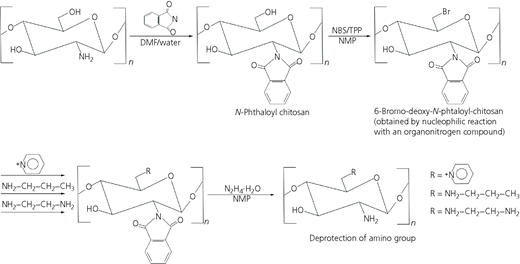
Synthesis of 6-N-substituted chitosan. DMF, dimethylformamide; NBS, N-bromosuccinimide; TPP, tripolyphosphate. Figure based on the paper of Hu et al. 51 with some modifications
Synthesis of 6-N-substituted chitosan. DMF, dimethylformamide; NBS, N-bromosuccinimide; TPP, tripolyphosphate. Figure based on the paper of Hu et al. 51 with some modifications
In a similar case, Chen et al. 52 prepared membranes with N-phthaloyl acylated chitosan obtained by the regioselective protection of the amino groups of chitosan with phthalamides followed by reaction with long-chain dodecanoyl chloride. Furthermore, it was mentioned that it is possible to hydrolyse the N-phthaloyl group using anhydrous hydrazine to provide free aminoacylated chitosan as required. Muthumeenal et al. 53 synthesised membranes by modifying chitosan with phthalic anhydride at 130°C and subsequently reacting it with sulfonated polyethersulfone. There was an improvement in film-forming capacity, flexibility and conductivity, although a decrease in methanol permeability was observed.
2.4 N,O-substitutions
The substitution of both the functional groups of chitosan (amino (–NH2) and hydroxyl (–OH)) is generally used to give an amphipathic character to chitosan, but it can also be used to improve the hydrophobic and hydrophilic character of chitosan. Among the principal chemical modifications used to improve the properties of chitosan is carboxylation, which is performed in two ways (C6-hydroxyl oxidation and C2-amino substitution), by which the insoluble chitosan becomes soluble. In line with this, Liu et al. 54 reported the synthesis of N,O-carbonylated chitosan synthesised by oxidation and substitution reactions. Specifically, the oxidation procedure was performed in an aqueous solution using the Tempo-mediated method (Tempo: (2,2,6,6-tetramethylpiperidine 1-oxyl), and for the substitution reaction, the product was dissolved in water containing 3-chloropropionic acid (Figure 8)). Meanwhile, Doshi et al. 55 synthesised N,O-carboxymethyl chitosan by carboxymethylation of chitosan in a hydroalcoholic medium at 50°C using chloroacetic acid. They mentioned that N,O-carboxymethyl chitosan destabilises marine diesel, showing good adsorption at seawater alkalinity and salinity.

Scheme of the preparation route of N,O-carbonylated chitosan derivative. Figure based on the paper of Liu et al. 54 with some modifications
Scheme of the preparation route of N,O-carbonylated chitosan derivative. Figure based on the paper of Liu et al. 54 with some modifications
Cai et al. 56 prepared N-benzoyl-O-acetyl-chitosan using selective partial acylation of chitosan with benzoyl chloride and acetic acid under high-intensity ultrasound (Figure 9). The product obtained showed good foaming stability related to its amphipathic character and exhibited an expanded antimicrobial spectrum against E. coli, S. aureus and Aspergillus niger. Woraphatphadung et al. 57 synthesised N-naphthyl-N,O-succinyl chitosan by reductive N-amination with 2-naphthaldehyde and N,O-succinylation using succinic anhydride (Figure 10). The results showed that N-naphthyl-N,O-succinyl chitosan would be desirable in developing the carrier meloxicam for oral drug delivery. Furthermore, Huo et al. 58 reported the synthesis of N-mercapto-acetyl-N′-octyl-O,N″-glycol chitosan with an amphiphilic character, improving the oral bioavailability of the drug paclitaxel compared with the commercially available Taxol.
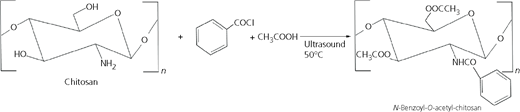
Synthesis by ultrasound of N-benzoyl-O-acetyl-chitosan. Figure based on the paper of Cai et al. 56 with some modifications
Synthesis by ultrasound of N-benzoyl-O-acetyl-chitosan. Figure based on the paper of Cai et al. 56 with some modifications
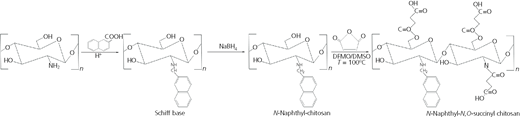
Synthesis of N-naphthyl-N,O-succinyl chitosan. DFMO, difluoromethylornithine. Figure based on the paper of Woraphatphadung et al. 57 with some modifications
Synthesis of N-naphthyl-N,O-succinyl chitosan. DFMO, difluoromethylornithine. Figure based on the paper of Woraphatphadung et al. 57 with some modifications
According to Oyervides-Muñoz et al.,59 chitosan grafting with ammonium salts can significantly improve antibacterial activity (i.e. against E. coli and S. aureus). Specifically, benzalkonium bromide (BZK-Br), pyridinium bromide (PYA-Br) and triethylammonium bromide (TEA-Br) can be synthesised by a quaternisation reaction between 1,4-dibromobutane and tertiary amines (N,N-dimethylbenzylamine, trimethylamine and pyridine), obtaining three ammonium salts with a bromide end group capable of reacting with functional groups from chitosan,59 as can be observed in Figure 11. In a similar study, Tan et al. 60 developed various chitosan ammonium salts with halogens (chitosan-bromoacetate, chitosan-chloroacetate, chitosan-dichloroacetate, chitosan-trichloroacetate and chitosan-trifluoroacetate), showing up to 70% more antifungal activity against F. oxysporum, Colletotrichum lagenarium and Phomopsis asparagi compared with the activity of chitosan.
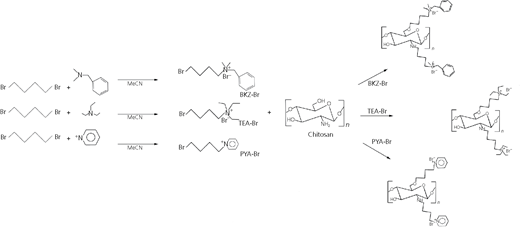
Synthetic pathway for the chemical modification of chitosan with ammonium salts. MeCN, methyl cyanide. Figure based on the paper of Oyervides-Muñoz et al. 59 with some modifications
Synthetic pathway for the chemical modification of chitosan with ammonium salts. MeCN, methyl cyanide. Figure based on the paper of Oyervides-Muñoz et al. 59 with some modifications
The N-substitution of chitosan improved the solubility of chitosan in organic solvents (dimethyl sulfoxide and dimethylformamide) and distilled water, due to the destruction of the strong intermolecular interactions of chitosan caused by hydrogen bonding between the –NH2 and –OH groups.10 Shown in Table 1 are some products and applications produced by the chemical modification of chitosan. As can be observed, the field of applications is wide, with several newfangled products.
Applications of chitosan with chemical modifications
| Product | Application | Reference |
|---|---|---|
| Chitosan quaternary ammonium salt | Agent coagulant and flocculant that helps remove Microcystis aeruginosa from drinking water (dosage 1·5 mg/l) | Jin et al. 61 |
| Chitosan quaternary ammonium salt mixed with nanoparticles of iron (II,III) oxide (Fe3O4) | Bioadsorbent for methyl orange and chromium (VI) following a homogeneous monolayer chemisorption process | Li et al. 62 |
| N,N,N-Trimethyl chitosan salt without ‘surface ion pairs’ eliminated by dialysis | Total inhibition of the bacteria E. coli in only 6 h of incubation | Martins et al. 46 |
| Chitosan-based glycopolymer modifying C6 | Good solubility in water and affinity with lectins | Koshiji et al. 63 |
| N-Quaternary ammonium-O-sulfobetaine-chitosan | Improved antimicrobial activity and water solubility with respect to the degree of substitution | Chen et al. 27 |
| Chitosan functionalised by N-cinnamyl-substituted O-amine | Increased hydrophobicity and improved antimicrobial activity against S. aureus, Bacillus cereus, E. coli and Pseudomonas aeruginosa | Tamer et al. 64 |
| Folic acid–cholesterol–chitosan micelles obtained by aminoacylation reaction | Micelles with amphiphilic character for delivery of paclitaxel (chemotherapeutic agent) | Cheng et al. 65 |
| Glycidol–chitosan–deoxycholic acid nanoparticles synthesised by grafting | Amphiphilic nanoparticles for delivery of doxorubicin (chemotherapeutic agent) | Zhou et al. 66 |
| O-Acylated chitosan nanofibers with fatty acid anhydrates as acylation agents | Nanofibers with different hydrophobic and hydrophilic ranges according to the chain length of the substituted acyl groups | Zhang et al. 67 |
| O,N-(2-Sulfoethyl)chitosan obtained by heterogeneous reaction of chitosan with sodium 2-chloroethanesulfonate | Water-soluble sulfoethylated chitosan with improved swelling property when forming films | Petrova et al. 68 |
| Gallic acid-grafted chitosan with the assistance of 1-ethyl-3-(30-dimethylaminopropyl) carbodiimide (EDC) | The grafting of gallic acid altered the macromolecular structure, improving polymer interaction with the environment; and the product was proposed as a potential material for the food industry | Xie et al. 69 |
2.5 Cross-linking reactions of chitosan
A cross-linking reaction of chitosan produces chemical bonds between chitosan chains and generates a strong three-dimensional network. The cross-linking agent plays an important role because it is known to stabilise well covalent cross-linking, the generation of ionic bonds or physical cross-linking due to van der Waals or hydrogen bonds. Introducing a cross-linking agent into the structure of chitosan depends on its chemical structure or arrangement, the existence of active groups and the molecular weight of chitosan.70 A graphical representation of the ionic cross-linking of chitosan using tripolyphosphate (TPP) is shown in Figure 12.
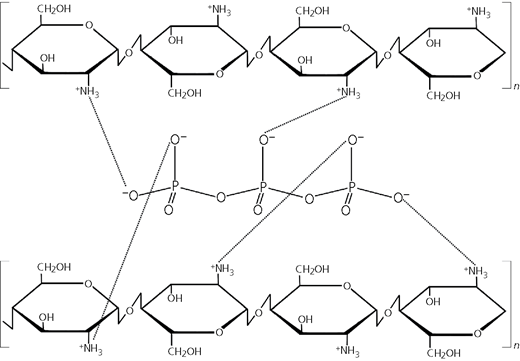
Graphical representation of chitosan cross-linking with TPP. Figure based on the paper of Yang et al. 71 with some modifications
Graphical representation of chitosan cross-linking with TPP. Figure based on the paper of Yang et al. 71 with some modifications
An important factor to be taken into account is the compatibility between the cross-linking agent and chitosan to produce suitable interactions. As previously mentioned, the molecular structure of chitosan could be subjected to cross-linking, if it has a low molecular weight (usually lower to 1 × 10⁴ g/mol). Chitosan with this molecular weight can be cross-linked, and it could achieve suitable mechanical, structural and thermal properties.72 The cross-linking of chitosan can be performed at room temperature or above room temperature (intermediate temperature), which is usually around 150°C, according to Tillet et al. 72 The cross-linking agents used at room temperature are those capable of reacting with the amine group of chitosan in aqueous solution. Typically, enzymatic reactions and the physical cross-linking of chitosan are performed at room temperature. The main uses of this type of cross-linking agents are in coatings, hydrogels, blend films of protein–polysaccharide, latex and emulsions with antimicrobial or antifungal characteristics and biological applications. Other cross-linking agents require a specific temperature to perform the reactions between chitosan chains or among chitosan and other biopolymers or synthetic polymers. The use of a specific temperature (between 40 and 150°C) is required because the chemical reaction of different functional groups occurs easily; moreover, some cross-linking agents exhibit multifunctionality or double reactivity, self-cross-linking and high yields of cross-linking densities, among other characteristics.
Chitosan polymeric networks modified by cross-linking treatments have been reported by several papers and reviews.73–75 The cross-linking modification of chitosan can ensure its structural or thermal stability and mechanical properties; this modification could be performed by two different reactions: using a Schiff base or using Michael-type adducts. In this overview, the authors focus on describing the most common cross-linking agents of chitosan with itself and with other biopolymers or synthetic polymers, as well as its applications. Table 2 shows the most common chitosan systems, cross-linking agents, fabrication processes and applications.
Most common chitosan systems, cross-linking agents, fabrication processes and applications
| Materials | Cross-linking agent | Fabrication process | Application | Reference |
|---|---|---|---|---|
| Chitosan–PVA | GA and sulfuric acid (H2SO4) | Chitosan was dissolved into 2 wt% acetic acid to prepare a 1 wt% chitosan solution. PVA was dissolved in hot water (100°C) and stirred for 6 h to prepare a 10 wt% solution and cast on a chitosan film. Then, the film was dried in a desiccator for 24 h, to be cross-linked with 0·01 wt% GA and 0·5 wt% sulfuric acid for 1 h. The film was washed with distilled water. | The film may be a promising material for food packaging applications. | Tripathi et al. 76 |
| Chitosan hydrogel | Genipin | Chitosan solution (1·5% with pH 7) was cross-linked with genipin solution (0·05–0·2%). Glycerol phosphate disodium salt was used to promote gelation. | The rheological properties of the gels can be varied with the genipin concentration. The authors reported strong elastic gels. | Moura et al. 77 |
| Chitosan microspheres | Genipin | Chitosan microspheres were obtained by cross-linking of genipin in inverse emulsion. The authors observed large swelling in water at pH values below 6·5 and small swelling at pH above 6·5. | The microspheres prepared by the water-in-oil dispersion method incorporated indomethacin. The authors observed that the indomethacin was released at a high dissolution rate when the microspheres are prepared at high pH. | Mi et al. 78,79 |
| Chitosan–gelatin films | Transglutaminase (TGase) and 1EDC | Chitosan–gelatin films (4:1 wt%) were produced by mixing 2 wt% chitosan solution (pH 5) and 25% gelatin. The mixture was stirred for 2 h and incubated at 50°C and centrifuged at 2000g for 15 min at 20°C. The solution at room temperature was mixed with TGase or EDC. The films were dried at room temperature for 24–48 h and 35–45% relative humidity. | Chitosan–gelatin films modified with TGase are hydrolysed by digestive enzymes. The enzymatically modified films can serve as edible packages or environment-friendly materials. | Sztuka and Kolodziejska80 |
| Chitosan–gelatin films | Proanthocyanidin (PA) | Chitosan–gelatin solutions were cross-linked with non-toxic PA. The cross-linked network of gelatin, chitosan and PA was by amide and ester linkages. | The cross-linked chitosan–gelatin films are non-toxic scaffolds that could be used in tissue engineering applications. | Kim et al. 81 |
| Chitosan films | Tannic acid (TA) | Chitosan solutions (1·5 wt%) were prepared by solubilisation in 1·5% v/v of acetic acid solution and stirring it for 24 h. Different concentrations of glycerol and TA were used. | Chitosan films with glycerol and TA simultaneously showed a synergic effect. The authors observed intermediate values; the physico-chemical properties were analysed. | Rivero et al. 82 |
GA, glutaraldehyde; PVA, poly(vinyl alcohol); EDC, 1-ethyl-3-(30-dimethylaminopropyl) carbodiimide
3 Conclusions
Chitosan has been widely studied and is used in many fields due its biodegradability, biocompatibility, non-toxicity, non-adhesiveness and film-forming properties, together with its antimicrobial and antifungal properties. However, the poor solubility of chitosan limits its applications (soluble only in acidic solution, pH < 6). Chemical modification represents a good option for overcoming this barrier, and the hydroxyl and amino functional groups in the chitosan backbone are the key. It is possible to obtain many derivatives by N-substitution, O-substitution and N,O-substitution reactions in chitosan, allowing improvement of properties such as water solubility, biocompatibility, biodegradability and antibacterial and antifungal activities. The cross-linking reactions of chitosan can enhance its physico-chemical properties, including mechanical and thermal properties. Natural cross-linking agents for chitosan have attracted attention owing to health concerns regarding the use of biomaterials with a chitosan matrix, as well as their economic aspects. Furthermore, this field of investigation has presented significant advancement in the past decade but is still unfinished and requires the development of more chitosan formulations with natural and synthetic polymers to impact on the food, pharmaceutical, bioprocessing and cosmetic industries, which marks an important change and promotes the use of chitosan on an industrial scale.
Acknowledgements
The authors would like to express their thanks to Consejo Nacional de Ciencia y Tecnología (Conacyt)-CB2015, with project number 252007, and Secretaría de Agricultura, Ganadería, Desarrollo Rural, Pesca y Alimentacion Sagarpa-Conacyt with project number 266891.

