– The purpose of the research paper is to provide the humanitarian logistics community with an overall picture about competencies and skills in humanitarian logistics and if there is a lack of professionalization of the logistics function in humanitarian context from an international perspective. Further this research elaborates practical approaches how the skills and competencies can be enhanced and developed for international education programs.
– An empirical survey as approach was used. Hereby a descriptive analysis provides in a comprehensive way education, skills and competencies in humanitarian logistics. The respondents are from different countries and continents as well as from different humanitarian sector, e.g. humanitarian organizations (HOs), logistics service providers, military services and researchers.
– In general, the findings of the research paper present valuable insights of mandatory contents of education in humanitarian logistics as well as competencies and skills on different levels based on European Qualification Framework (EQF). This research paper explores these and offers suggestions to improve and promote market and professional competencies and skills for the humanitarian logistics sector and to minimize their impacts.
– The field survey was due to access and motivation restriction mainly answered by academics in the field of humanitarian logistics or by leadership personnel with very high academic merits (MA/PhD). Further the objective of this research paper was purposefully limited to describing the education requirements, not gap analysis with existing education offers or development of new curricula content – this should be a task for further research setups.
– Specific requirements regarding negotiation and legal competences are named in the survey as well as the objective of specific, country-related adaptions and the time schedule form of education trainings in humanitarian logistics (during a professional career with as much time absent for learning as feasible).
– The paper highlights the increasing demand and still existing gap regarding education and training in humanitarian logistics in the field. All included institutions and persons have to re-evaluate their prioritization and budgeting in order to support further education and training for personnel in humanitarian logistics according to the results of the survey and addressing the need of logisticians in the humlog management and operations.
– This paper adds to the knowledge about the implications of education and training and measurement of skills and competencies based on EQF for theory and practice. Further the humanitarian logistics community requires rudimentary humanitarian logistics education to enhance the logistics operation in case of disaster toward the affected people.
1. Introduction
Starting point for this paper is a citation from the Fritz Institute report 2005 concerning humanitarian logistics education and gaps in the field of humanitarian logistics in general: “As we work with humanitarian logisticians around the world, a refrain that we hear over and over is that there is a lack of professionalization of the logistics function” (Thomas and Mizushima, 2005, p. 22). Since then an increasing number of activities have dealt with competencies, training and education in humanitarian logistics, e.g. a working group of the German logistics association has discussed this topic since 2010. In this paper we present the current state of the art regarding humanitarian logistics education in the second section. In addition to that, one initial question of this paper is, if there is still a “lack of professionalization of the logistics function” as mentioned in the citation – and how it can be closed. To find answers to these questions a questionnaire was developed as a basis for further analysis because empirical surveys results regarding humanitarian logistics education are not sufficiently available. In section three the field survey and main results are presented. The survey provides an overview about competencies in humanitarian logistics education from different perspectives: perspectives from different countries and continents as well as perspectives of different sectors (HOs, logistics service providers and researchers). Section four provides a discussion of implications and a coherent education concept based in the European Qualifications Framework (EQF).
First significance and actuality of the topic have to be described, looking at statistics about disasters and their consequences in 2011: in the Annual Disaster Statistical Review 2011 published by the Centre for Research on the Epidemiology of Disasters (CRED) 332 natural disasters are registered. The human and economic impacts of these disasters were massive: natural disasters killed more than 30,000 people and caused 244.7 million victims worldwide in 2011. Economic damages from natural disasters were the highest ever registered, with an estimated US$366.1 billion. The earthquake and tsunami incident in Japan was the most expensive natural disaster ever recorded, with estimated economic damages of US$210.0 billion. The disaster that caused the most victims in 2011 was the flood that affected China in June, causing 67.9 million victims. Furthermore, China was affected by a drought, a storm and another flood, contributing to a total of 159.3 million victims in China in 2011 (Guha-Sapir et al., 2012).
One thematic frame is pointed out in the mentioned statistical review – drought and its impacts: “As for almost every year, droughts strike everywhere on earth – their impacts increasing in magnitude and complexity due to the effects of a changing climate. Understanding the complex impacts of drought could be the key to enhancing drought mitigation and preparedness” (Guha-Sapir et al., 2012, p. 18). Education and specific competencies could be the key to understanding the complex impacts of drought and with a special focus on humanitarian logistics it can be crucial to enhance preparedness and therewith mitigate the consequences for affected people and countries. “The Sahel and West Africa are among the most vulnerable regions to future climate fluctuation” (Guha-Sapir et al., 2012, p. 19).
What was anticipated in the statistical review in fact has occurred during the year 2012. Many humanitarian agencies have been involved in the Sahel Food Crisis. To illustrate the complexity of the logistics operations we can have a look inside the logistics cluster, coordinated by the UN World Food Programme (WFP). The following citation is an extract from the logistics cluster operations weekly update from August 3-9, 2012 Logistics Cluster (2012):
In Mauritania roads between Nema and Bassikounou remain impassable, with trucks stuck 80 km from Bassikounou due to heavy flooding. As of 08 August, there are more than 98,000 Malian refugees in Mauritania. With the onset of the rainy season, 700 metres of the 1000 metres of the Bassikounou airstrip remain operational, with 300 meters under water.
In Mali UNHCR has reported that over 250,000 refugees have fled northern Mali since January 2012. There are currently 167,000 Internally Displaced Persons (IDPs) in Mali. WFP rented a new warehouse in Bamako with a capacity of 12,000 mt.
Ports Situation in Somalia: “Dar Es Salaam – The port remains congested, with 4 vessels at berth, and 13 vessels at anchorage waiting to berth. Rehabilitation works on one of the container berths are on-going. Humanitarian vessels and car-carriers continue to be given berthing priority […].
South Sudan Humanitarian organisations are working to meet the emergency needs of over 165,000 Sudanese refugees in Upper Nile and Unity States. The Logistics Cluster continues to respond to the urgent requests of the humanitarian community in both States with the transport of emergency medical, WASH, nutrition, and food items.
This shows the questions and challenges that humanitarian aid organizations and logisticians are facing: transportation has to be organized under complicated conditions like impassable roads, airstrips under water and congested sea ports, warehousing has to be facilitated fast and flexible, several organizations are integrated into the operations in different countries, and they deal with different humanitarian commodities as well as with infrastructure and last but not least people. Humanitarian logistics education will not avoid disasters like droughts, storms, floods or earthquakes – but it can be the key to lower the number of affected people and economic damages.
2. State of the art
2.1 Humanitarian logistics: definition
Thinking about competencies and education in humanitarian logistics we first have to define humanitarian logistics. It is defined “as the process of planning, implementing and controlling the efficient, cost-effective flow and storage of goods and materials, as well as related information, from the point of origin to the point of consumption for the purpose of alleviating the suffering of vulnerable people. The function encompasses a range of activities, including preparedness, planning, procurement, transport, warehousing, tracking and tracing, and customs clearance” (Thomas and Kopczak, 2005, p. 2). This definition is adopted by several authors and organizations and corresponds with more general definitions in logistics management and supply-chain management (Council of Supply Chain Management Professionals (CSCMP), 2012) with a special focus on “alleviating the suffering of vulnerable people” (Blecken, 2010, p. 59). Inside the definition some fundamental contents of education in humanitarian logistics are named:
management contents like planning, preparedness and implementation;
controlling-oriented contents dealing with efficiency and cost-effectiveness;
specific parts of logistics like transport and warehousing;
topics from supply-chain management (point of origin to point of consumption); and
information-oriented skills like tracking and tracing.
Further, more competencies, e.g. communication and social skills, languages and negotiation skills are relevant for people in humanitarian logistics. Such additional competencies are subjects of the following section.
2.2 Humanitarian logistics: aims and goals
When dealing with competencies in humanitarian logistics education we have also to consider the aims and goals of humanitarian logistics. Both, the private sector and the humanitarian sector, focus on the two important objectives service and costs. For most HOs a high logistic service level has a higher priority than logistics costs (Thomas, 2003). With a good logistic service level the supply is quick, safe and reliable. If the right goods (e.g. food and non-food items, medical items) are received by the right people (the most affected people) at the right place, at the right time (as fast as possible) and with the right quality (e.g. food or medical items are not of poor quality because of extreme weather conditions), then humanitarian logistics can contribute to alleviate the suffering of vulnerable people. Often it even safes lives. The “right” logistics costs (e.g. for infrastructure, human resources, food and non-food items) are part of the objectives as well. If HOs decrease logistics costs they can use this budget for the core tasks of humanitarian aid (a comparison of logistic costs and service indicators in different continents provide Keßler and Schwarz, 2011). Considering this the aim for humanitarian logistics can be defined as maximizing logistic service under the restriction of a given logistic budget (Bölsche, 2009). Education for humanitarian logisticians must be geared to these aims – in order to contribute to the mentioned objectives.
2.3 Humanitarian logistics education: analyses from the Fritz Institute
After introducing fundamentals as definition, aims and goals, the following contents of this section present the state of the art in humanitarian logistics education. Three different kinds of sources have to be taken into account: literature, empirical studies and further knowledge about existing trainings and academic studies in humanitarian logistics education (e.g. from the internet, experts, expert groups and conferences).
The first publications considering education in humanitarian logistics were published by members of the Fritz Institute (2012). The initiative started in 2003 and has been published in several journals, papers and conference documentations mainly until 2007. Researches did not only focus on education but on humanitarian logistics as a comprehensive area of research. Since the Asian tsunami in 2004 and hurricane Katrina in 2005 logisticians from different countries and branches have directed their attention to the field of humanitarian logistics (education) (Fritz, 2007). The researchers from the Fritz Institute analyzed external pressures on humanitarian logistics and worked out the main points in humanitarian logistics as a foundation for new strategies and actions which were named as the path forward (Thomas, 2003; Thomas and Kopczak, 2005). Drawing from lessons learned from the commercial world they formed to support the disaster relief chain (Thomas, 2004). Besides an essential “lack of recognition of the importance of logistics” and the points “inadequate use of technology” and “limited collaboration” two further gaps were identified – “a lack of professional staff” and a “lack of institutional learning.” The last two points address the centre of this paper. “Humanitarian organizations have long recognized that many of their key operating positions were filled by very talented and well-meaning individuals who had little formal training. There were never enough trained people in time of crisis, and the turnover rate often exceeded 50 percent per year. Therefore there is a need for training throughout the year […]” (Fritz, 2007, p. 21). As a result five strategies have been documented for the future, one of them denominated as standardized training and certification (Fritz, 2007): “Progressive training and eventually a standardized, externally recognized certification program are needed to create a market place of professionals able to meet the requirements of organizations in the humanitarian sector” (Thomas and Kopczak, 2005, p. 9). Even the conclusions of important papers have been designated as “learning as the basis for strategic contribution” (Thomas and Kopczak, 2005, p. 13) and one publication “Logistics training: necessity or luxury” focusses solely on training and education (Thomas and Mizushima, 2005). The training and certification should empower the staff of HOs to identify “which factors most affect cost, quality, complexity, risk and timelines” (Thomas, 2003, p. 12), thus they address the aims of humanitarian logistics already mentioned above. The following topics have been identified “as relevant for all international aid agencies: managing a humanitarian response, humanitarian supply chains, procurement, warehousing and inventory management, transport fleet management, and import/export procedures” (Thomas and Kopczak, 2005, p. 10). The researches until the year 2005 led to an initiative to create and implement a first certification program in humanitarian logistics which is still carried out in the year 2012 and has been complemented by two other certifications, one in humanitarian supply chain management and one in humanitarian medical logistics practices (Fritz, 2007; Fritz Institute, 2012). Papers from the years 2006 and 2007 worked out further requirements for humanitarian logistics and trainings, e.g. the necessity to cooperate with the private sector also regarding training and education (Thomas and Fritz, 2006: otherwise “differences in professional vocabulary, time horizons, expectations, and metrics may lead to misunderstandings.”) and the necessity to develop skills, experience and trainings inside the affected countries (Thomas and Bliss, 2007, p. 24): “Africa's humanitarian problems cannot be solved from the outside in.” The publications of the Fritz Institute are documented in detail in this paper because they represent one of the most elaborated research and documentation in the area of humanitarian logistics education and training until today.
2.4 Humanitarian logistics education: further analyses and publications
Scientific and applied researches by INSEAD and its Humanitarian Logistics Group, documented in several case studies and journal articles INSEAD (2012), have been contributed to a book Humanitarian Logistics by Tomasini and van Wassenhove (2009). Competencies, education and trainings are not a main part of this publication but the challenges for humanitarian logistics and a section about knowledge management give important foundations for the design and creation of education and training measures. Further publications in the year 2012 give new impressions for trainings and education, e.g. about transportation and fleet management (Pedraza-Martinez and van Wassenhove, 2012). In 2012 the Humanitarian Logistics Group of INSEAD published findings from an empirical survey which they generated in cooperation with the Humanitarian Logistics Association and its members. This is one of the few empirical overviews about humanitarian logistics and logisticians (van Wassenhove and Allen, 2012). Training and education programs are again not the main part of the research but some valuable information is given from the survey about competencies in humanitarian logistics education. “This report provides timely and informative view on the role of the logistician. As such it offers essential input to those who design training programmes” (van Wassenhove and Allen, 2012, p. 5). We can note that “logisticians want their job to become more professional,” that “technical logistics training” is named among the three most important areas for professional development (by 43 percent of the respondents) and that 26 percent of them disagreed or strongly disagreed that they had access to the training necessary to perform their job (56 percent had received some form of internal or external training in the previous year) (van Wassenhove and Allen, 2012). This result is in accordance with a first field survey of the Fritz Institute executed in 2004 and published in 2005. At that time 27 percent of respondents had indicated no access to logistics training (Thomas and Mizushima, 2005). Hence it can be assumed that the gaps mentioned above with view to education, training and professionalization still exist in 2012. INSEAD is one organization which offers a five-day executive education “Management in the Humanitarian Sector.” It has been developed for managers and logisticians from the humanitarian and the private sector INSEAD (2012).
Several publications, especially dissertations which are published in a book series of the Kuehne Foundation deal with education in humanitarian logistics as a side issue, e.g. Blecken has referred to the lack of training in his dissertation about humanitarian logistics: “Professional logisticians are rare and thus, employee reliability is hampered” and “Training has also become a major part of humanitarian operations” (Blecken, 2010, pp. 56, 63). The analyses in these publications do not focus on competencies in humanitarian logistics education as a central content, so they are not subject to a deeper description in this state of the art overview. But one important aspect has to be noted in addition: The support of the Kuehne Foundation and its H.E.L.P.-Centre (Humanitarian and Emergency Logistics Platform) concerning PhD students and the publication of their thesis books deliver a contribution to educate people for the humanitarian sector on a high academic level (PhD) and to make the research results available for logisticians. The Kuehne Foundation further has created a logistics and supply-chain management training for international organizations in Iraq (Willhaus and Stumpf, 2011; Kühne Stiftung – H.E.L.P., 2012).
The Kuehne Foundation is also a member of the working group Humanitarian Logistics founded by the German Logistics Association (BVL) in 2010. This working group has concentrated on education in humanitarian logistics as one of three main topics. Central results from the working group sessions have been published, some of them describe education and training in humanitarian logistics from different perspectives: The humanitarian sector, the private sector, national and international aspects and viewpoints from continents like Africa (e.g. Meier, 2011; Schmidt and Böhlke-Itzen, 2011). The publication about education and training in humanitarian logistics gives an overview about results from one of the few field surveys. The aims of the survey were to identify the main deficits and gaps of education in humanitarian logistics and to identify important contents of education and training for people who work in humanitarian supply chains. Summarizing the still existing deficits the working group has documented as central points (Bölsche, 2011):
(1) lack of education and training and missing transparency about existing programs;
(2) problem of closed access or high fees; and
(3) most deficits in developing and emerging countries.
The working group has worked out necessary developments and steps to reduce the identified deficits, labeled with transparency, further training and education, degree programs and on-site education and training. Moreover, the respondents had evaluated and rated the significance of different topics for education and training in a structured questionnaire (Bölsche, 2011). This 2011 survey of the German Logistics Association can be seen as a first test for the survey which is described in the following sections. With a small amount of 12 respondents from Germany this empirical study was not representative and limited to a German point of view. In addition the necessary orientation on competencies was missing. With the empirical work presented in this paper a wider foundation, a more international perspective and an inclusion of competencies should expand existing findings (e.g. Johansson et al., 2013; Wu, 2007).
2.5 Humanitarian logistics education: existing programs
Finally we enumerate in the state of the art those programs, that are already in existence in addition to the mentioned programs of Fritz Institute, INSEAD and the Kuehne Foundation. They can be classified into the following categories:
As one category, trainings created by the humanitarian sector have to be mentioned, like the logistics trainings of the WFP, which include technical trainings, emergency trainings and soft skills. Some of the trainings are open solely for members of the WFP, others are open for other organizations, as well. Besides logistical trainings in class-rooms also simulations and E-Learning are elements of the trainings World Food Programme (2012).
As a second category trainings by the private sector are relevant for humanitarian logistics education. As an example the program Get Airports Ready for Disaster (GARD) from the GoHelp initiative of Deutsche Post DHL can be denominated as a training with components in class-rooms and on-site fieldwork inside and outside airports (Meier, 2011). The working group Humanitarian Logistics of the German Logistics Association (BVL) is currently working on the question if a comparably program Get Seaports Ready for Disaster is needed and if so, which contents would be relevant.
As a third category the programs and certifications of organizations like the Fritz Institute and the Humanitarian Logistics Association have to be considered (already mentioned in this paper).
And finally the study programs at universities can be categorized. As one example the University of Lugano (2012) offers an Executive Master of Advanced Studies in humanitarian logistics and management. Programs such as humanitarian logistics or humanitarian supply-chain management on a bachelor degree level are rare and as well studies on a Master degree level besides Executive Master programs. But as a positive development it can be noted that modules inside studies in logistics or supply-chain management have been built up, e.g. in Germany at the Technical University of Berlin, the University of Münster, the Kühne Logistics University in Hamburg, the University of Applied Sciences Fulda and with an international perspective, e.g. at the Hanken School of Economics in Finland and at the Supply Chain and Logistics Institute at the Georgia Institute of Technology.
3. Research approach
3.1 Field survey
As described in the previous section, education and training in humanitarian logistics is increasing because of the dynamic humanitarian logistics processes. Therefore contemporary and practically relevant skills and competencies have to be developed and enhanced for the humanitarian logistics sector. To achieve relevant descriptive results, an empirical approach is applied with an online questionnaire, tested by seven researchers from different universities and countries. The questionnaire was then addressed to the recipients of humlog news of Humanitarian Logistics and Supply Chain Research Institute at Hanken University, the members of College of Humanitarian Operations and Crisis Management of POMS and to different German HOs and logistics providers. Altogether, 41 persons from relief organizations, universities, consultant companies, military and transport as well logistics providers worldwide participated in the survey in the timeframe of six months. To date the capture of respondents is hampered by the complex logistics structure of HOs structure and the challenging operations reliefs as well as the chaotic environment. Furthermore, due to the time pressure that HOs are facing there is no possibility to contribute to surveys with long-time requirements for an interview. Due to the steadily increasing interest in the humanitarian logistics sector, academia executes a manifold of interviews and surveys that HOs cannot respond to altogether due to the limited staff numbers, budgets and other resources.
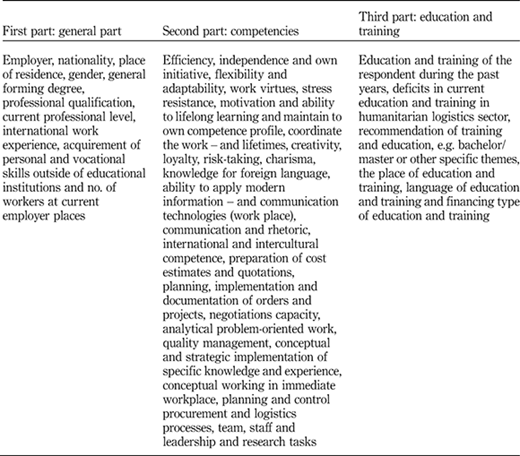
However, these 41[1] responses are valid and formed the basis of the humanitarian logistics sector as well as representativeness for this research. The questionnaire consists of three main parts as shown in the following Table I: the first part consists of 12 open questions as well as questions with given items for selection, the second part contains questions with 45 given items where the respondent has to rate the selected items by using a 1-5 scale (1=to a great extent, 5=not at all) and a column no specification, the third part contains five further open questions.
In the following section the results and evaluations of responses will be presented in different tables and graphic forms. This provides a preview of the responses as well as statistical analysis.
3.2 Results and evaluation
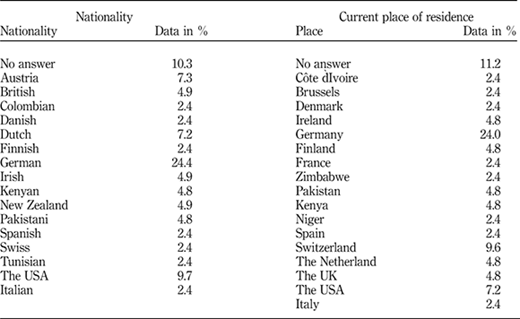
The 41 persons represent 75.6 percent male and 22.0 percent female respondents[2]. Even in humanitarian relief as a social sector business, logistics keeps to be a more “male business” according to the respondent shares in this survey. The respondents are employed with a share of 36.5 percent in HO, 31.7 percent in universities which collaborate with HOs in different humanitarian logistics projects, 4.8 percent in consulting companies and the remaining 27.0 percent are from military, logistics and transport providers and private companies. The majority (70.7 percent) works in companies with more than 500 employees, the other 22.0 percent[3] work in companies from 5 to 499 employees. 55.9 percent of the respondents have an European background followed by other countries of origin like the USA, Pakistan, Kenya, New Zealand, Tunisian and Columbia and work in different countries such as Zimbabwe or Côte dIvoire and further countries as shown in the following Table II.
The respondents represent various professional levels at their current working place. In total, 70.7 percent work at country level such as logistics management, qualified worker in the procurement division, training, safety officer, advisor for humanitarian relief followed by manager 9.8 and 7.3 percent unskilled workers. In all, 70.7 percent have international work experience, wherein 29.3 percent stayed abroad for less than 24 months followed by 41.5 percent who collected international experience between two and ten years in more than 50 different countries on the globe.
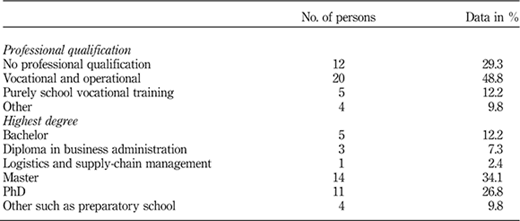
All respondents are highly educated but not all have professional qualifications as presented in the following Table III. Interesting is that the higher education degree Master of respondents is spread across a variety of disciplines such as humanitarian action, logistics, business science, finance and supply-chain management. Further, professional qualifications of respondents show a variety of skills and competencies in purchasing, supply-chain management, industrial clerk and engineering, emergency and relief logistics, logistics, mechanical engineering and readiness officer in the US Air Force.
Competence is defined as “the ability to successfully meet complex demands in a particular context. Its manifestation, competent performance (which one may equate to effective action), depends on the mobilization of knowledge, cognitive and practical skills, as well as social and behavioral components such as attitudes, emotions, values and motivations” (Hakkarainen et al., 2004). Competence demonstrates also the level of student achievement in the science education context (Liu, 2009). Competence is not only skills, qualification or knowledge but all these factors are the basis for the competence of a person. The 41 respondents were asked about the percentage of their competencies and vocational skills that were acquired outside an educational institution:
in total, 5-30 percent of competencies and vocational skills were acquired by 13.5 percent of respondents outside educational institution;
in all, 40-70 percent of competencies and vocational skills were acquired by 62.2 percent of respondents outside educational institution; and
in total, 75-100 percent of competencies and vocational skills were acquired by 21.6 percent of respondents outside educational institution.
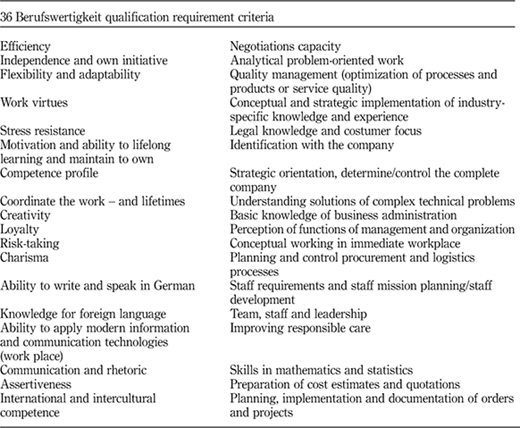
Furthermore, the respondents were asked for their personal current competencies and knowledge based on 36 qualification requirement criteria that are present in the modern daily work according to the Berufswertigkeit measurement[4] (Klumpp, 2007; Table IV).
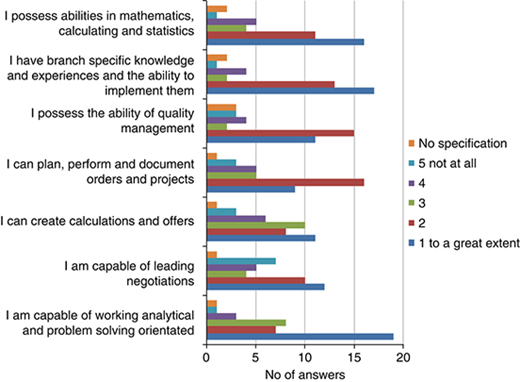
In the first question the respondents rated their technical requirements if they are enquired for their current activity. The respondent has to rate the selected items by using a scale 1-5 (1=a great extent, 5=not at all) and a column no specification (Figure 1).
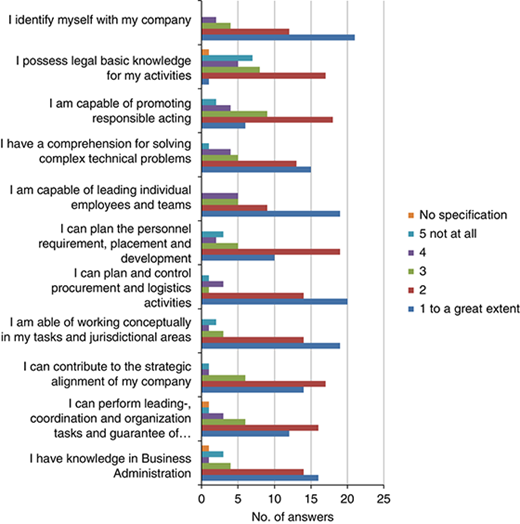
Referring to the above stated graph, respondents presented high analytical knowledge, further quality management in the humanitarian logistics sector. As a matter of course project management is essential too, because, e.g. the operations in the response phase can be regarded as projects, this explains why the most of the respondent fulfill the requirement project management. But one-third of respondents do not show that they can deal with projects. An alarmingly low knowledge about creation of calculation and offers as well as leading negotiations has to be increased. The possess of knowledge and competencies in creation of calculation and offers as well as leading negotiations are crucial for procurement of relief items, freight, etc. or negotiation with supplier or logistics service provider. In the second question they have to rate the fulfillment of their operational requirements in the context of their current activity. The results on this question is positive, then the most of the respondents identify themselves with own companies/institution even the job in such environment such as crisis, disaster is tough, the respondents carry responsibility and are ambitious to solve complex technical challenges. Further the most of the respondents are skilled worker and managers that are capable to plan the personnel requirements, placement as well as development in the humanitarian logistics sector. Further it seems relevant and essential to have experience and knowledge in procurement and jurisdictional tasks. To sum up legal question, leadership, project management and procurement are relevant competencies in the humanitarian logistics area and should be considered in different training and education programs. The design of this topic in education and training programs should be very practice oriented rather than theory oriented. For example, different cases based on real data have to be applied (Figure 2).
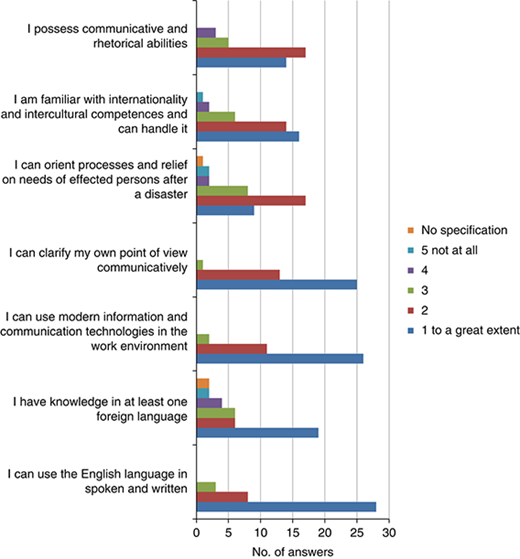
The following graph the respondents have to rate the fulfillment of service-oriented requirements in their current activities. The results presented demonstrate that intercultural competences, rhetoric abilities as well as knowledge in foreign languages have to be enhanced. The survey shows that the English language is the most used language in the logistics and in particular in humanitarian logistics (Figure 3).
In the humanitarian logistics sector work ethic is one important aspect to achieve humanitarian aid objectives.
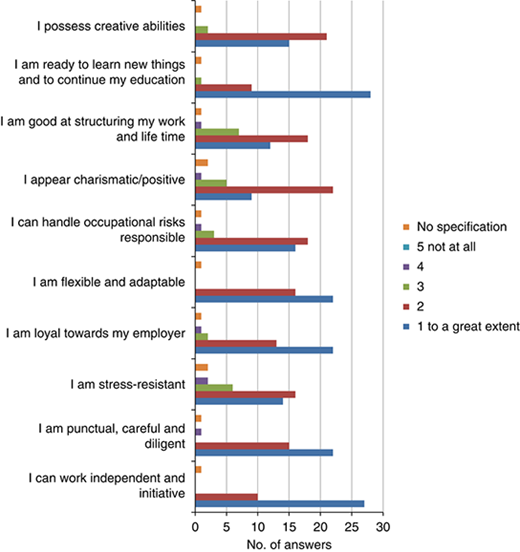
They stay neutral in case of natural or man-made disasters and work irrespective of race, religion, gender or political views. Furthermore they do not intervene to the political, economic or religious interests of a government. Another priority is to follow the ethical aspects which mean they treat the beneficiaries with dignity and they respect their religion and culture. Therefore the respondents rated fulfillment of work ethic in their current activity because it has a high effect on the access to the affected country or to increase the security standard of the staff and goods as well as to have success in the operational level, e.g. on procurement to avoid crimes and corruption. The outcomes outline that further education in humanitarian logistics is needed as the request is high and the persons are ambitious and interested to learn more as shown in the following graph. Further the humanitarian logistics sector requires persons which are stress-resistant, flexible and reliable as well as are capable to work independent and initiative. The corporate governance in the humanitarian logistics sector seems to be friendly and supportive toward employees; the most of the respondents have a charismatic appearance and are loyal. An important competence in this sector is that the persons should take and accept risk and be capable to manage their time carefully and independently as well as creative (Figure 4).
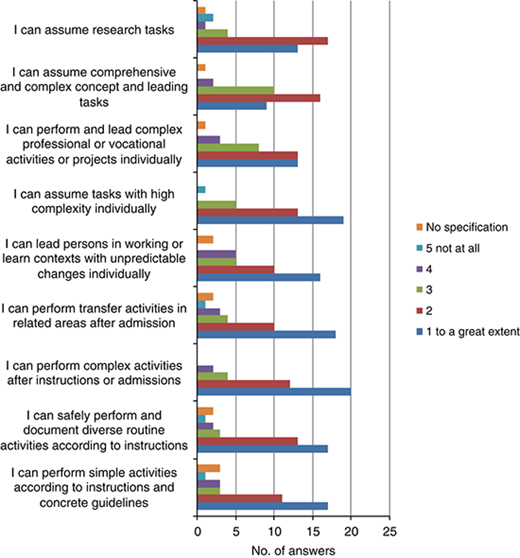
Figure 5 demonstrates the competencies of respondents which were achieved through academic studies and vocational training. Further they are capable to solve personally complex problem and to issue comprehensive concepts individually, independently or according to instructions. To admire is that the respondent from the humanitarian logistics sector can lead person in working learn contexts with unpredictable changes, this shows how flexible, ambitious, reliable and complex the person should be when they work in such environment that deals with disaster and unpredictable situations. By regarding the identified trends and the development of the humanitarian logistics structure it can be seen that innovative logistics learning solutions have to be designed for offering employees possibilities for lifelong learning. But the main challenge is to provide learning possibilities for employees without leaving their job. Employees have to increase their knowledge to tackle the tasks of humanitarian logistics goods and services in a high velocity.
4. Humanitarian logistics education: findings
4.1 Challenges to humanitarian logistics education
Humanitarian logistics is characterized by fast changing nature of aid information scenarios, aid components such as product, service and demand as well as fast acting for live saving, supply material and service and stabilization (Carroll and Neu, 2009). The scope of humanitarian logistics spans from procurement, transport, warehousing, tracking and tracing and customs clearance of aid materials through mobilizing people, resources, skills and knowledge to help vulnerable people affected by disaster (van Wassenhove, 2006). The most of the organizations concentrate on short-term relief rather than systems and processes optimization or improvement. This has the effect such as cost reduction and makes relief more efficient in the long term (Whiting and Ayala-Öström, 2009).
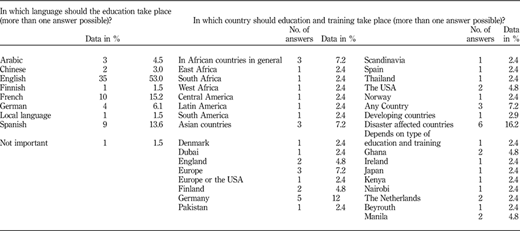
In this complex environment a common standard of cross-functional skills, high responsiveness and adaptable management capability, mental, intellectual and physical robustness and ability for formulation and use of novel solutions are required (Carroll and Neu, 2009). The main challenge in the logistics in particular humanitarian logistics is that the logistics competences and skills do not develop as fast as the practice environment do. The analysis of different job description of HOs indicates that different education and training have to be revised and suit to the high variety of sector-specific competences in humanitarian logistics such as fundraising, donor compliance, coordination, asset management, security, budget management, customs, fleet management, reporting, procurement, inventory management, information and communication technology, SPHERE compliance and standards as well as transport. It is an attempt to explore in which language and in which country the humanitarian logistics training should take place. The location of education and training can be observed as a further challenge and which is essential to reach different groups in different countries. Table V shows results of the executed survey by the authors. The most education measures and trainings are held in the English language, but the respondents recommend the execution of education and training in further languages such as French (15.3 percent), Spanish (17.2 percent), German (6.8), Arabic and Chinese (each 3.4 percent).
The spread of the languages is obvious, because different countries on the globe have the second mother tongue Spanish or French instead of English. And it is easier to motivate the employees to do further training and education in the humanitarian logistics field. The location of education and training has to be considered superficially. The majority of the respondents recommend African countries, developing countries, disaster-affected countries, South American and Asian countries. The results are coherent and there could be many reasons, e.g. costs, nearness to employees and volunteers, practice, time efficiency and sector-specific training.
4.2 Specific competences
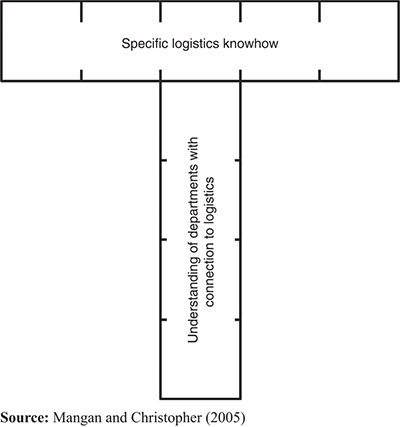
The capability of logistics learning mechanisms depends on four components: temporal, cultural, structural and relational components. The consideration of these four components is a major requirement of successful learning. The cultural component can be seen as a basis of learning because today the whole logistics sector is internationally oriented. The structural component regards the specifications of the employee's organization to realize learning activities on-the-job: flexible in time and location. Relational components assist the collaboration and communication within a strong cross-linked company structure and the temporal component supports the velocity of changes within the logistics sector and synchronizes them with the learning process (Esper et al., 2007). The goal of learning is to match employee's knowledge with the needs of the logistics industry. The needs can be displayed in the shape of a “T” (Figure 6).
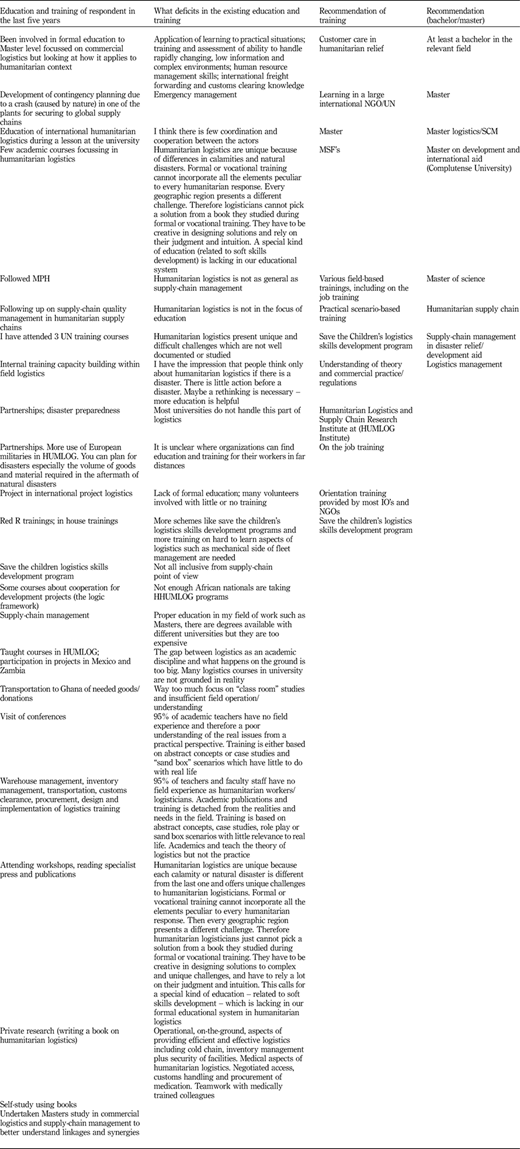
The horizontal level displays specific logistics knowhow and the vertical level displays the understanding of other company departments with connection to logistics, for example, process management, engineering or controlling. In best case, operative labor with practical experience has to be equipped with management tools and techniques and developed to logistics managers of the future. The “T” is adaptable to the specific competences requirement in humanitarian logistics. Based on the four following questions and different answers of the 41 respondents that participated in the survey (see Table VI) different requirements for humanitarian education and training can be gathered.
The respondents have attended different education and training programs to enhance their competencies and skills for the humanitarian logistics field. There are a variety of learning content that is needed in a case of disaster and before a disaster occur, e.g. disaster preparedness, the use of European military services, capacity building, development of contingency plan as well as quality management. Further the results show that universities should not offer theoretical course in this field and that humanitarian logistics should be more studied and documented before offering humanitarian logistics course. The competences and skills toward different geographic region and their challenges, mechanical contents, fleet management, information and communication technology, human resource management, international freight forwarding, customs clearing, coordination, planning and creativity in designing solution for complex environment. All these have to be conceptualized and offered by training on the job and close to developing countries such as in Africa, Asia or South America.
These competence and skills enhancement by education and training have to be financed too. Therefore the main question for that how should the education and training program should be financed. The majority (53.7 percent) of the 41 respondents prefer a mixed finance concept, e.g. by the attendants and organization or organization and sponsors or attendants and sponsors, this is followed by 12.2 percent of the respondents give priority to the finance concept only by sponsors, 9.8 percent should be financed by the organization and 9.8 percent should be financed by employer. The answer if the attendants should pay for the education and training program is weak.
4.3 Education systems and concepts
For designing education courses in logistics for working persons not only requirements with regard to content has to be regarded but structural requirements gain importance because of the development of this industry sector. These aspects are relevant because the logistics industry is marked by several special peculiarities: High velocity and flexibility of services, huge market shares of small and medium-sized companies and a large part of necessary tacit knowledge leads to the in Figure 3 mentioned structural requirements. This structure is deployed in accordance the EQF in order to facilitate the standardization and adaption especially for SME companies in logistics – usually there are less capacities and personnel in personnel education, therefore standards such as the EQF are useful (Brockmann et al., 2009; Deist and Tutlys, 2012). The target of the designed EQF for the humanitarian logistics sector is to connect qualifications concept of different countries to a common reference framework. HOs and other different actors in humanitarian logistics sector can use the EQF to enhance a better understanding. Furthermore they can compare the qualifications levels of different countries and different education and training concepts. “This approach shifts the focus from the traditional system which emphasizes ‘learning inputs’, such as the length of a learning experience, or type of institution. It also encourages lifelong learning by promoting the validation of non-formal and informal learning” EC Europa (2012).
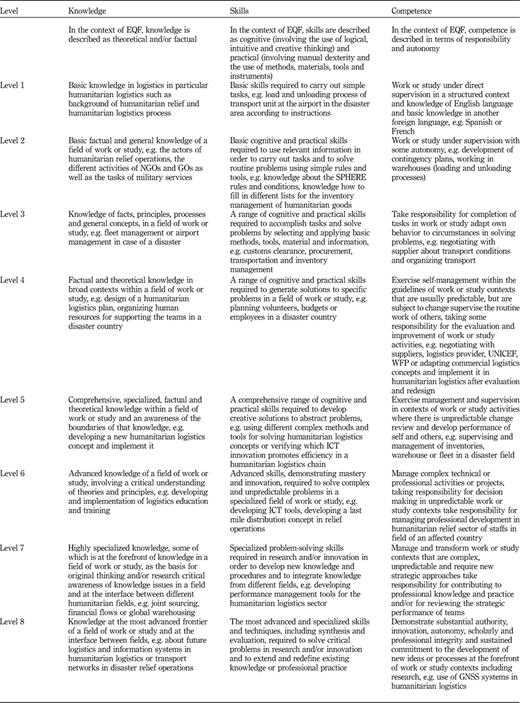
Based on the survey results that are described in Section 3 a first draft of an EQF for the humanitarian logistics sector is designed and suggested as shown in following Table VII. The EQF consists of eight level from basic (Level 1) to advanced (Level 8) and is classified in three categories namely knowledge, skills and competence. Generally it illustrates the learning outcomes on type of what a learner knows, understands and is capable to do.
5. Conclusion
This paper has presented on of only a few specific research results addressing necessary education and competence features in humanitarian logistics. In general the quoted gap in humanitarian logistics education stated by Fritz Institute in 2005 still can be recognized and detailed based on the survey presented here. Which skills and competencies are relevant for the humanitarian logistics sector? To achieve relevant descriptive results to this question an empirical approach has been presented in this paper. The respondents represent different sectors and countries, so that the results give an overview from different perspectives on humanitarian logistics education. Some central findings from the empirical research can be summarized as follows:
still the share of humanitarian logisticians without access to logistics training and education remains at 25 percent;
trainings and education curriculum content should be tailored to the conditions and frameworks in specific countries, e.g. in Africa;
specific requirements, topics and qualification gaps are stated regarding, e.g. leading negotiations, supply-chain coordination and basic legal knowledge; and
the form of education and trainings should be developed further in two directions – increased supply of basic education, e.g. bachelor study programs in humanitarian logistics on the one hand as well as continuing education programs with very short work leaves for a distinguished lifelong-learning approach in humanitarian logistics education.
Lifelong-learning has been worked out as one central finding in particular without leaving the job and close to developing countries such as in Africa, Asia or South America. The main challenge in humanitarian logistics is that logistics competences and skills do not develop as fast as the practice environments do. The analysis of different job descriptions of HOs indicates that different education and training measures have to be revised and suited to the high variety of sector-specific competences in humanitarian logistics. The (humanitarian) logistics sector is marked by several special peculiarities: High velocity and flexibility of services, huge market shares of small and medium-sized companies and a large part of necessary tacit knowledge leads to structural requirements. In this paper the structure is deployed in accordance the EQF. The target of the designed EQF for the humanitarian logistics sector is to connect qualifications concept of different countries to a common reference framework. HOs and other different actors in humanitarian logistics sector can use the EQF to enhance a better understanding with view to the needed knowledge, skills and competences. Because of the dynamic environment rather skills and competences are important for humanitarian logisticians than knowledge.
These presented survey results based on the Berufswertigkeit concept from Germany and the EQF should be used for further curriculum planning and design of trainings in the field of humanitarian logistics. This may contribute to an increased preparedness of HOs and the overall disaster and development relief chain worldwide.
References
Further reading
About the authors
Dorit Bölsche completed her studies in business administration at the Goethe-University Frankfurt in 1995 and her PhD in the year 2000. As a PhD student she worked at the logistics department of the Goethe-University and at the economic faculty of the Rutgers University New Jersey as a Scientist. After practical experiences as a consultant until 2004 D. Bölsche started her position as a Professor for Logistics at the University of Applied Sciences in Fulda. Her main fields of research are humanitarian logistics, cooperation and digital production plants. As Vice President for research of the University and Professor for Logistics D. Bölsche is a member of several committees, for example, she coordinates the working group Humanitarian Logistics Education inside the German Logistics Association (BVL) and is a committee member of the House of Logistics and Mobility (HOLM), located at the airport in Frankfurt. Dorit Bölsche is the corresponding author and can be contacted at: Dorit.Boelsche@w.hs-fulda.de
Matthias Klumpp studied economics and business administration after a vocational degree in logistics (Speditionskaufmann IHK, 1996) at University Leipzig and the IECS Strasbourg from 1995 to 1998 (Diplom-Kaufmann, Diplom-Volkswirt). Parallel to his professional consultant career in strategy management, logistics and education (zeb/, conoscope) he also obtained a PhD at University Leipzig in 2007 and started as a Professor at FOM University of Applied Sciences.
He founded the Institute for Logistics and Service Management (ild) at FOM in 2009. He is member of the scientific committee for the German National Excellence Cluster “LogistikRuhr” funded by the German National Ministry for research (BMBF) and has done research or EU ERASMUS teaching stays in Australia, China, Finland, France, Netherlands, Norway, Spain, Turkey and the USA.
Hella Abidi completed their training in 2002 as a forwarding Clerk (Speditionskauffrau IHK) at Dachser GmbH & Co KG in Cologne. After a stay in Switzerland, she studied the advanced vocational training as “Verkehrsfachwirtin (IHK)” at the Chamber of Commerce and Industry Cologne. Ms Abidi adopted various activities in the Department of International Transport Planning, Sales and Customer service in the company Dachser, Mannheim and Cologne. In 2007 she started at the FOM University of Applied sciences a part-time study program in business science, with the main subjects logistics and supply management. 2010 Mrs. Abidi finished the studies with success as Diplom-Kauffrau (FH). For her thesis she was awarded with the BVL Thesis Award 2010. Since March 2011 she works as a Research Associate in the BMBF project WiWeLo in line with the excellence cluster LogistikRuhr at the Institute of Logistics & Management Services (ild) of FOM University of Applied Sciences in Essen. September 2012 she starts her PhD at the VU University Amsterdam.
Notes
Concerning the response rate: there is no database about the number of recipients of humlog news, news of Humanitarian Logistics and Supply Chain Research Institute at Hanken University. 34 members of College of Humanitarian Operations and Crisis Management and FOM ild sent the invitation for the web questionnaire to 186 persons in different national and international humanitarian organizations, universities and logistics service providers.
And a respondent did not answer on that question (2.4 percent).
And three respondents did not answer on that question.
The output-oriented measurement concept “Berufswertigkeit” serves as a basic field-evaluation concept for the development of such an Industry Qualification Framework for the logistics industry as well as humanitarian logistics sector and integrates the required investigation of competences. The measurement concept fulfilled the needs of a general competence measurement instrument. “Berufswertigkeit” according to employability is not a usual term and cannot be found in literature. The main subject of “Berufswertigkeit” is a conception of competence measurement of person with different education degrees. The criteria for an effective competence measurement are adapted of the modern practice. Hereby the different education degree could be compared and the results are practice and output-oriented. The evaluation instrument “Berufswertigkeitsindex” is already developed and applied in previous “Berufswertigkeit” studies for different industries in 2007, 2009 and 2012 in Germany.