– Contemporary armed conflicts predominantly take place in developing countries and there are often non-state actors involved in them. Civilians have been deliberately targeted in recent conflicts, and the international community has paid more attention to their protection. Human security means that individuals’ safety is a priority on the security agenda. Organizational learning is necessary in crisis management in order to evolve and provide tools to ensure human security. Organizational learning in crisis management requires individual learning, but individual learning does not necessarily lead to organizational learning at the level of institutions. The purpose of this paper is to focus on the development of crisis management and peace-building when taking into account crisis management personnel's experiences and their value in organizational learning processes. The results are applied to the context of humanitarian logistics that have special features including pace in comparison to other crisis management contexts.
– The empirical material consists of a Delphi panel process representing 15 experts and interviews of 27 individuals who had served as employees in civilian crisis management and military crisis management duties in Kosovo. The interviewees from the military side had background of being either a reservist or professional officer.
– Interaction and communication abilities are required from crisis management personnel and institutions. Personnel in crisis management need opportunities to give and receive feedback. At the personal level, work in crisis management is important for an individual. Returning home may be more challenging for an individual than starting to work in a mission. The framework of organizational learning is adequate for developing crisis management and humanitarian logistics.
– Crisis management personnel's feelings and opinions in depth have been rarely studied and the present study provides information about this personal level. Because of using two methods focussing on organizational learning and feedback, partial methodological triangular was carried out, which increased the reliability of the results. In regard to humanitarian logistics, feedback arrangements are also important when intending to develop learning organizations. Return arrangements for personnel in humanitarian logistics are also an important focus of study.
Focus of the paper
This paper discusses what kind of learning should be promoted in crisis management and peace-building and whether this kind of learning focus can be applied to humanitarian logistics. Although the empirical parts of the paper introduce results not specifically focussing on humanitarian logistics, the results can be applied to this context.
Recent development of armed conflicts and the concept of human security
Since the end of the Cold War, the changes in warfare have raised a debate about the nature of contemporary wars. Today's wars and conflicts are more blurring than major wars in history. Non-state actors are often involved, more peaceful and violent phases often vary, and conflicts take place in developing countries. Often civilians are deliberately targeted in contemporary warfare (Kaldor, 2007, p. 3). In the 1990s, the suffering of civilians and human rights violations in warfare became a topic due to the failures of the international community to prevent mass atrocities in Somalia, Rwanda, and in the Balkans, especially in Srebrenica in 1995.
It is promising that the death rates in armed conflicts have been declining since the end of the Cold War (Human Security Report, 2005). Since the 1990s, the international community has more systematically intended to facilitate peace processes and make an end to the violence. These more systematic efforts to prevent conflicts and their continuation explain the decline in mortality rates. Between 1998 and 2010, the number of deployed personnel grew rapidly in the UN missions, and the operations became more complicated (Brenner et al., 2011, p. 14-16).
The concept of human security was launched in the UNDP's Human Development Report in 1994. The core issue in human security is that the individuals’ rights for safety and security are regarded as a priority on the security agenda. Traditionally security policy has focussed on the security of the states, the so-called national security. Human security is based on the idea of the universal human rights. Therefore, its historical roots lead to the 1860s when the International Committee of the Red Cross was established (Axworthy, 1999). Human security can be seen as a normative concept that is connected with an obligation to promote human rights. It makes a difference in comparison to the state-based security thinking although these views are complementary. States should promote human security when ensuring national security, but unfortunately this is not always the case.
There are different interpretations of human security. The narrow interpretation refers to human security as described above in the context of conflict or similar circumstances under which protection is needed. The broad interpretation of human security includes different aspects of human development. In terms of promoting human rights, the narrow definition is more accurate because it provides opportunities for analyzing human rights violations in conflict and post-conflict zones in such ways that may give some valuable conceptual contextualization. On the other hand, the broad definition of human security lacks conceptual significance (Howard-Hassman, 2012).
The responsibility to protect can be derived from the principle of human security. Ensuring civilians’ security is an obligation to the international community: it is a state's responsibility to guarantee protection to civilians. If states cannot guarantee protection to civilians, the international community has the secondary responsibility to ensure it. If there is a risk of mass atrocities, the international community should take action in order to prevent genocide or similar kind of broad violence from emerging. “The International Commission on Intervention and State Sovereignty” published a report entitled “Responsibility to protect” (International Development Research Centre, 2001). The principle of the responsibility to protect was adopted in the UN in 2005 and by the Security Council in 2006. According to this principle every member country of the UN accepts its responsibility to protect its own population from genocides, war crimes, crimes against humanity, and ethnic cleansing (Bellamy 2009).
Often humanitarian emergencies are needed in conflict areas or under post-conflict circumstances. They are motivated by the principle of human security. Duties in humanitarian logistics may be risky, and therefore the assessment of various aspect of protection required. On the other hand, people living in any conflict area need protection, but the protection of the personnel working for humanitarian operations should not be ignored either.
Humanitarian logistics is needed both in conflict-related and other emergencies, and the framework of human security is relevant to both kinds of contexts. Humanitarian logistics enables and facilitates the accessibility of humanitarian aid and many other functions in humanitarian operations. The context of a humanitarian emergency requires quick decisions and actions, and therefore, the need for immediate actions may challenge the will to strengthen local ownership, and pace of actions distinguishes humanitarian operations from long-term peace operations in which logistics is important but the operation does not so strongly rely on it.
Changing missions
Peace negotiations, crisis management and peace-building are usually building blocks of a sustainable peace. Lots of different actors are involved in peace-building and crisis management. Cooperation is needed from civilian and military actors coming outside the conflict region. They collaborate with local people to ensure local ownership of the peace process. The personnel of the operations should be able to handle complexity, because a post-conflict situation always consists of it. When resolving conflicts, it is important to understand their complexity.
Conflict resolution enhances the respect for human rights and human security. Since the 1990s, the human-security-based thinking has been strengthening in security analysis both within research communities and in the UN and EU. The international community has a lot of lessons to learn regarding its practices in crisis management and peace-building. Crisis management has changed since the end of the Cold War. Traditional peace-keeping has transformed into more demanding forms of military operations for ensuring peace (see Ramsbotham et al., 2008). Crisis management is divided into civilian and military crisis management. The former one is run by the armed forces and the latter one by civilians.
It is essential to combine different means that lead to stabilization and durable peace with respect to human rights. Civilian organizations and actors are focussed on the civilian side of crisis management. In militarily demanding operations, the use of capable military force may be needed. The challenges in crisis management often consist of combining different objectives in regard to security.
Human security requires that the protection of the civilians is a high priority on the security agenda in crisis management. Humanitarian aid is to be distributed to such people who need it regardless their opinions or background, and humanitarian aid is needed in war-torn societies. Unfortunately, the work of humanitarian agencies has been endangered by violence against aid workers (Kennedy, 2009). Besides state actors and UN agencies, there are plenty of national and international NGOs working in the humanitarian field. NGOs also play an important role in peace-building and peace negotiations (Evans, 2008). This multiplicity of actors makes peace-building a complexity that may be difficult to perceive by anyone involved.
Local ownership can strengthen human security. Tatham and Hughes (2011) have emphasized local ownership in humanitarian operations. For example, the humanitarian operation on Haiti following the earthquake in 2011 excluded the partnership of local people (Bajoria, 2011). The challenges to enhance local ownership also include the pace of humanitarian emergency operations, and therefore the idea of local ownership to humanitarian logistics may be even more challenging because in many humanitarian contexts the logistics need to be carried out quickly in order to make the humanitarian aid efficient. Humanitarian assistance operations are logistics centric (Vohr, 2011), and therefore, their features differ from more long-term peace operations.
Learning and competences required in crisis management and humanitarian logistics
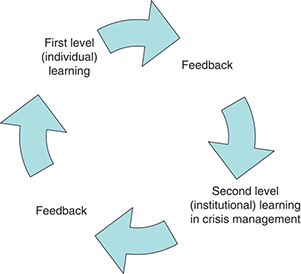
Attaining a durable peace is a challenge for organizational and individual learning in crisis management and peace-building operations and the personnel involved with them. These kinds of learning processes have rarely been examined, and a lack of knowledge regarding learning has also been problematic to the UN (Brenner et al., 2011). According to Howard (2008), the UN has had difficulties in applying the information from past peace operations. The challenge is how to make individual learning to transform into organizational or institutional learning. This requires organizational capacity to deal with the past successes and failures and interpret the information so that it leads to action. This process involves crisis management personnel's learning ability, which enables learning at the individual level that can be called first-level learning. Gathering information about failures and successes in such ways that later missions can handle it and avoid similar mistakes is institutional learning. The institutional learning means second-level learning (Howard, 2008).
Many scholars in contemporary research literature emphasize the social nature of learning (see Engeström, 1987; Wenger, 1998; Eteläpelto, 2007). Workplace learning mostly consists of informal learning and learning at work while learning as a result of educational efforts is often more limited (see Eteläpelto, 2007; Collin, 2005). Informal workplace learning has been an object of learning researchers mostly only since the 1990s. In the framework of learning in crisis management and peace-building, the focus has been more in formal education and training than in informal learning. A great deal of learning in any conflict context is not an outcome of official instruction or education but of informal learning at work. Traditionally, learning has been seen as a result of individual information processing that occurs during and after education or training.
In regard to competences, it is necessary to know what kind of tasks peace processes and crisis management will include in the future. Learning can be assessed in the context of achieving the necessary competences in crisis management. If human security of the civilians in the conflict or post-conflict areas is one of the priorities in crisis management tasks, this objective may also have an impact on required competences and learning.
From the perspective of human security, the peace operations are obliged to take civilians’ needs seriously. This requires capacity to communicate with local populations and pass forward messages from them. Traditionally soldiers working in peace-keeping have needed military skills. In their duties, requirements for competences of communication skills have been increasing. Adequate communication ability is also necessary for the communication within missions.
Individual and organizational aspects of learning are intertwined and relevant for the learning processes in crisis management. Feedback enables individual and institutional learning processes. At work, employees need feedback in order to learn, and the development of institutions is dependent on learning individuals and feedback from them. Although Howard (2008) does not emphasize the role of feedback in the learning processes within crisis management, it is essential for enabling both first-level individual as well as second-level institutional or organizational learning (Figure 1).
Organizational learning also consists of knowledge acquisition, advocacy to spread information and the institutionalization of new knowledge, after which an evaluation with feedback would be required (Brenner et al., 2011). The inability to learn in peace operations has been linked to inadequate or insufficient infrastructures for promoting learning. In the recent history, the UN has had difficulties to re-orientate its peace operations that would have required taking into account the complexity of the conflicts as well as military and humanitarian challenges (Brenner et al., 2011)
Personnel's coping with complexities of multicultural environments, complicated history of the crisis and multi-organizational missions are also a challenge for humanitarian logistics, and Christopher and Tatham (2011) consider visibility to be the answer to this challenge. Continuous learning is needed to deal with complexities. At the personal level, every individual working in the field of humanitarian logistics probably also face questions related to informal and institutional learning as well as potential difficulties when returning home.
Research procedure and methods
The empirical studies were made to answer the question what kind of learning should be promoted in crisis management. Two empirical studies were carried out, namely, a Delphi panel process on the future of conflicts, crisis management and crisis management personnel and practices, and, interviews of crisis management personnel. The Delphi technique is utilized in futures studies in order to find out the assessment of experts on a certain theme. The process evolves rounds based on the responses of the expert panel. This method can also used in order to identify the relevant arguments related to the future development of the subject. This type of the Delphi method is called as the Argument Delphi Method (Kuusi, 1999). The present research applies the Argument Delphi Method based on two rounds. The results of the second round are presented below. In the second round of the panel, panelists could answer to the theses by expressing their agreement with numbers from 1 to 5 (1=completely disagreeing with the thesis […], 5=completely agreeing with the thesis). The minimum for the consensus was average 4.00. The respondents’ opinions on the relevance of several arguments were also assessed with as wide a scale as with regard to the agreement with the argument.
In total, 15 experts in different fields of crisis management attended the first round of the Delphi panel process, and 14 of them participated in the second round. Both women and men were involved, and their expertise concerned different aspects of civilian and military crisis management broadly. The Delphi panel included two rounds, and the first one consisted of individual interviews and the second one of answering to the questionnaire that was based on the first round's interviews.
In the second empirical part of the research, the interviews of the crisis management personnel were carried out as focussed interviews that consisted of a set of similar kinds of questions to every interviewee. All the interviewees had work experience from Kosovo, and the peace-keepers were deployed into the Kosovo Force (KFOR) that is a NATO operation, and civilian crisis management interviewees were recruited by several organizations. Kosovo was part of the conflict in former Yugoslavia, and KFOR and the civilian administration of Kosovo were established in accordance with Un Security Council Resolution 1244 in 1999 (Lekha Sriram et al., 2010). In 2008, Kosovo declared its independence. The situation was relatively peaceful, while the interviewees worked in Kosovo.
The interviews dealt with positive and negative experiences during the mission, relations with local people, and cooperation of different actors in crisis management. However, the interviewees’ answers also lead to some further questions that were not asked in all the interviews.
The interviewed crisis management personnel were also asked the same questions that had been made for the first round of the Delphi panel process, and these answers were utilized as background information. The two empirical phases were carried out in 2008. Both the Delphi panelists as well as the interviewees representing crisis management personnel were Finnish.
Results
Delphi panel process
According to the Delphi panel, the futures conflicts will often resemble today's conflicts that mostly take place in Africa or in the Middle East and involve non-state actors. The panel also supported the idea of comprehensiveness in crisis management, and it did not find probable that Finland would specialize in any branch of crisis management.
The panel underlined the importance of co-operability. Interaction and negotiation skills are required from crisis management personnel, particularly with regard to the competences of civilian crisis management personnel (average 4.86/14 answers), and somehow less extensively to military crisis management personnel (average 4.29/14 answers), and the panel considered both of the arguments relevant. In the context of futures conflicts, cooperation will be relevant between civilian and military actors in crisis management as well as in contacts with development cooperation. However, the panel did not believe that the success of Finland would be based on specialization either in military crisis management (average 3.71/14 answers) or in civilian crisis management (average 3.43/14 answers). The experts thought that the specialization in civilian crisis management would not yet be possible. In the military side, specialization was more preferable but it was seen as a potential hindrance for Finland to attend some operation.
Information sharing and a clear division of labor between various institutions is required in crisis management (average 4.86/14 answers). However, the panel did not favor the idea of modeling different conflict and strategies to deal with them nor did it agree with the idea of utilizing internet-based information sharing in cooperation with local inhabitants. Cooperation with local residents is central and the panel even favored the idea of getting local inhabitants involved in the planning of rebuilding projects (average 4.86/14 answers).
According to the panel, both collaboration skills and awareness about realities in the conflict zone will be required from personnel, and processes enabling local residents to have active roles in peace-building support durable peace. Local ownership in a post-conflict environment requires understanding of multiculturalism on behalf of crisis management personnel, and therefore cultural competences are also important. Apart from communication skills, the professional skills of crisis management personnel were also emphasized.
Feedback systems in crisis management require further development work. The panel highly agreed with argument: “The feedback from crisis management personnel should be gathered in a systematic way in order to develop crisis management further” (average 4.64/14 answers). This idea is central when developing learning organizations in crisis management. Regarding personnel, there was also consensus about the need to provide opportunities for so-called debriefing conversations as well as to arrange opportunities to provide and receive feedback after crisis management duties abroad (regarding civilian crisis management personnel average 4.43/14 answers and regarding military crisis management personnel average 4.36/14 answers). Every individual who has served in civilian or military crisis management should have this option.
Interviews of crisis management personnel
The second empirical part of the research consisted of 27 thematic interviews with civilian and military crisis management personnel who had served in Kosovo. The interviewees were nine professional officers, ten peace-keepers who had been recruited from the reserves, and eight individuals who had worked in civilian crisis management. Ten of the interviewees were women, of whom five were peace-keepers recruited from the reserves and five worked in civilian crisis management duties.
The average age of the interviewed women were 37 years and of the men 42 years. Most of the interviewed women (80 percent) did not have children, but on the contrary only a minority (18 percent) of the interviewed men was childless. Consistently with this finding, it seems to be probable that family duties do have a stronger impact on women's choices whether to intend to work in crisis management duties.
A minority of the interviewees (26 percent) had experience from former crisis management missions. The average age of those working in civilian crisis management was 51 years, of the professional officers was 38 years and of the reservists was 33 years. The civilian crisis management employees worked for several organizations, and two of them were recruited by private enterprises.
Interaction during the mission
Many interviewees also highlighted that the communication with local inhabitants and other cross-cultural contacts had predominantly been positive experiences. Understanding local thinking facilitated cooperation. As one reservist peace-keeper described, the work with local inhabitants was rewarding:
It has been absolutely most rewarding, to get to know the local culture.
Multiculturalism was not limited to the interaction with local inhabitants. A multicultural peace-building mission is a unique environment for the personnel involved. One reservist had observed the outcome of a multicultural operation attentively:
[…] But first and foremost it was rewarding to get to work with people coming from other cultures. Because in a way working cultures differ from each other in different countries and especially when there differences in military education and training in different countries […] And it was especially interesting to observe how it appeared and what kind of working culture emerges due to it.
The frequency of contacts with local people varied in accordance with personnel's duties. The interviewees did not report about major problems in the cooperation between different international organizations in Kosovo, although the lack of sufficient English language skills of their communication partners sometimes caused problems. Deployed personnel in civilian and military duties could lack adequate skills in English, which made the cooperation more challenging and was a somehow surprising result. Insufficient coordination of different activities was also reported to be a problem by some of the interviewees.
Learning by doing
The interviewees’ experiences from Kosovo were mostly positive although some of them also described frustration that, however, did not dominate in their thinking. Some experiences consisted of multiple meanings, both positive and negative ones. Demanding experiences became rewarding, if an individual was able to deal with them. These experiences may be exceptional due to the unique nature of crisis management duties in a person's life span.
Learning episodes were often positive and informal in nature. These successful events had a positive impact on an individual's self-confidence. Crisis management personnel did not describe these processes in terms of learning but their descriptions could be interpreted as such. Often learning at work led to some kind of self-realization. This means that a person identifies something that already exists as part of his or her personality. However, the interviewees mostly considered that their identities or self-concepts had not changed due to the mission.
In crisis management duties, it is often necessary to think about one's own background and thinking. Understanding one-self was important in order to comprehend cultural differences as one civilian crisis management employee found the situation:
[…] different people are managed in different ways or they need different ways to collaborate with. And I cannot understand how to treat other people if I cannot understand myself.
Most interviewees were content with the courses and training that they had attended before the mission. All the personnel in the military duties had attended some training prior to the operation, and professional officers had attended further courses in comparison to the reservists. Five out of eight of the deployed in the civilian duties had not attended any mission-specific training, because there had not been such courses arranged. Some interviewees emphasized that the courses should have more focus on mission-related objectives and cultural issues.
The significance of guidance was mentioned by several interviewees. One professional officer told that he had not got any guidance due to special work arrangements that had taken place. Lack of guidance had been a notable problem for him at the beginning of his duties. Another officer had worked for some guidance material on a CD for his follower, which seems quite an innovative idea that could also be used on some other similar occasions. Because guidance is part of informal learning and it was found so important by the crisis management personnel interviewed for this study, guidance should be prompted and made at least partially formalized. Some principles of guidance could also be taught and its importance emphasized during mission-related formal courses. However, the interviewees described that the mission-related courses did not have any focus on informal learning and how to develop one-self during the mission.
Feedback arrangements and returning home
Organizational learning potential in crisis management can be interpreted from personnel's views and experiences. The interviewees were asked about both their opportunities to give feedback to the organization they worked for in crisis management as well as about the possibilities to receive feedback about their personal success in their duties.
The weakest feedback arrangements were reported by two persons who were recruited by private enterprises. They did not have any constant feedback system. According to some interviewees, adequate feedback in regard to their work would have been needed but it was not provided. The interviewees did not know how their feedback to the missions would be utilized. Feedback arrangements, at least in some cases, seemed insufficient. Nevertheless, feedback arrangements are important for learning organizations in crisis management, and therefore, further development of these arrangements may be required.
Compared with starting to work in Kosovo, returning to Finland from crisis management duties was more challenging for many individuals. Some interviewees said that the return had been difficult, although they had not had serious problems. Spontaneously many interviewees considered that crisis management personnel should have a right to have a return conversation that would function as a kind of debriefing. Even the knowledge that such an opportunity exists could facilitate the coping of the personnel, even though the opportunity might not always be utilized.
For an individual, it may be surprising that it is so challenging to come back home as one professional officer described it:
Interviewee: […] that peacekeeping world is like a shadow world, so that in a way it is not a real world […].
Interviewer: Yes.
Interviewee: […] like a terminal phase for a human being.
Interviewer: Okay.
Interviewee: And it works for a year, for a year. There are changes taking place inside, certainly, and when you return here, in a way you stop. And when you return here, in a way you’ve halted your time.
Interviewer: Yes.
Interviewee: And it is a shock for many people. […]
Since the interviews took place, the service for returning crisis management personnel has progressed. For example, there is a special telephone line for returning and returned peace-keepers organized by the national association of peace-keepers. Because the difficulties when returning home often make a surprise for personnel, it would be reasonable to communicate about this question during the mission-related courses. If coping with the return is a challenge, adequate support should be easily available for an individual. Some progress toward this direction has taken place since the interviews were made.
Comparison of the results from the empirical parts and assessment of the reliability
The results of the two empirical parts of the present research can be interpreted in the context of organizational learning, and the need to develop feedback and return arrangements. Regarding these issues, the focus of these empirical parts was partially similar.
The Delphi Panel emphasized that futures conflicts would resemble the contemporary ones. Many researchers share this view, and this conflict picture may probably prevail, when it is necessary to plan for single crisis management missions. The present study has intended to build a bridge between the structures in crisis management and individuals working in it. Learning at the level of the organizations as well as individuals can be seen as a cycle in which organizations are dependent on individuals and vice versa.
Although the Finnish background of the experts and interviewees who had worked in Kosovo, may limit the interpretation of the results in certain aspects, many of the results can be applied to other contexts. The research on feedback arrangements can be an important source of information for the promotion of organizational learning.
Validity covers the idea that empirical research measures in practice what it is meant to measure. In qualitative data, criteria of validity are based on several factors including the extent of triangulation. Validity is regarded in degree rather than as an absolute state (Cohen et al., 2007, p. 133). Using different methods on the same theme or object of study signifies methodological triangulation (Cohen et al., 2007, p.142). Utilizing two methods to study crisis management and learning can be interpreted as partial methodological triangulation. The focus of the two empirical parts was not exactly the same, and therefore the triangulation was partial. According to some theorists, reliability does not cover qualitative research and terms like credibility, neutrality, consistency, and trustworthiness can replace using the term reliability (Cohen et al., 2007, p.148). The intention in the present study was to make the interview questions crystal clear as Cohen et al. (2007) have suggested when intending to increase credibility.
Applications to humanitarian logistics
Some of the results can also be applied to humanitarian missions and logistics. Lots of activities within humanitarian logistics will probably occur in conflict or post-conflict zones. Providing human security to people in conflict or crisis areas is one of the fundamental goals of humanitarian logistics, and on the other hand, the security environment affects the personnel working for humanitarian logistics in terms of human security. The Delphi panel supports the idea of local involvement in the planning of crisis management, and Tatham and Hughes (2011) have recommended an increase of local ownership in humanitarian operations. It is important to remember this aspect when improving the security arrangements in humanitarian logistics.
Understanding this reality can be enhanced by further studies specialized in humanitarian logistics. Especially in riskier missions, the personnel require permanent and clear arrangements regarding mental support. The pace of humanitarian logistics also affects personnel's work and opportunities to deal with communication with local inhabitants.
There are private enterprises working for humanitarian purposes. Without a focussed study, it is impossible to know whether opportunities for feedback are insufficient in private companies that work in the humanitarian field or logistics as was found in the interviews of some of the recruited in this study. When compared with the duties in humanitarian logistics, the role of informal learning that was emphasized in the results of the present study can be seen as an important factor for developing humanitarian logistics. Could the nature and significance of informal learning be understood better in order to develop the practices of humanitarian logistics further?
The results of the present study may also be compared with the results of Kovács et al. (2012), who built the framework of skills required in humanitarian logistics emphasizing general management skills, functional logistics skills, interpersonal skills, as well as problem solving and personality traits. Similarities in competences required in humanitarian logistics and crisis management exist – and could be studied further in the future. As functional logistics skills emphasized by Kovács et al. (2012) can be compared to special skills in any duty in crisis management and problem solving (Kovács et al., 2012) refers to complexity management that is also necessary in crisis management in general, interpersonal skills that are highlighted resemble communication abilities that I have underlined in the present study.
Conclusions
According to Brenner et al. (2011), organizational learning in peace operations in the UN has been limited due to infrastructural deficiencies and political factors. Progress in them can, however, improve the circumstances. Individuals in peace operations can build up organizational learning, but their learning can be inhibited by unrewarding institutional environments. Success in organizational learning also depends on how well the organization institutionalizes learning arrangements and supports personnel's learning activities. Encouraging leadership is needed in order to promote this process both in crisis management and humanitarian logistics.
The results of the present study prompt to elaborate crisis management from the perspective of learning. Learning is required for developing crisis management practices. It is also essential to develop feedback systems in crisis management to enhance individual and organizational learning. The entire crisis management operation should also receive feedback in regard to its positive and negative outcomes. A crisis management operation is a learning environment and it should also be studied in this context. It is necessary to work on informal learning when developing crisis management education and opportunities for learning in crisis management.
The progress of crisis management personnel's communication and interaction skills is essential in order to attain sustainable peace processes, in which the inhabitants of a conflict or a post-conflict region are also involved. Crisis management personnel make efforts for peace-building across the conflict zones. Their experiences should be utilized efficiently in order to develop the best practices in crisis management and peace-building. The mission-related knowledge of the personnel should be gathered and analyzed in order to enable organizational learning. According to the results of my research, many persons who work in crisis management feel that their experiences and knowledge could be better understood and acknowledged.
Crisis management actors often work within a tense network of international agencies and institutions some of which are also related to humanitarian logistics. Collaborating with these networks may be challenging. But it is even more challenging when the objective of local ownership is kept in mind. Local ownership of a peace process is a prerequisite for human security. Taking into account the principle of human security has implications for the futures crisis management. Facilitating local ownership is a key question in promoting and maintaining sustainable peace. Because the roots of the conflict are often complicated, the work for crisis management personnel consists of complexity management as well. Local people need opportunities to influence peace processes at different levels. Otherwise, they may feel excluded which may also make harm to the peace process.
For understanding how to promote human security, it is necessary to understand the reality of the personnel who work for peace-building and how they can provide social change. Personnel are key actors in enhancing local ownership because they can facilitate social transformation that is needed in order to enhance local people's opportunities to take responsibility of the future of their own country or area. It is also important to understand the significance of local ownership in the management and leadership development of any mission focussing on conflict or post-conflict zones.
Due to the pace of humanitarian logistics, feedback systems need to be accommodated to these circumstances. Feedback from humanitarian logisticians could also provide new information about how they think about the issues related to strengthening local ownership in humanitarian operations. Therefore, it would be important to study the feedback from humanitarian logisticians in the framework of human security.
Personnel's return arrangements in the future will require further attention in order to improve their well-being. Opportunities for return conversations and other types of mental support should be provided to the personnel. Multidisciplinary research is needed for understanding the complexity of new conflicts and peace-building and crisis management operations aiming at ensuring peace.
References
About the author
Dr Ulla Mari Ainikki Anttila obtained her PhD from the National Defence University of Finland. She is now the Executive Director of KIOS (The Finnish NGO Foundation for Human Rights). Dr Ulla Mari Ainikki Anttila can be contacted at: ulla.anttila@pp3.inet.fi
This paper is based on the author's PhD dissertation at the National Defence University, Helsinki, Finland.