


The purpose of this paper is to address the inefficiency problems in procurement operations in disaster relief logistics which are mainly due to the lack of coordination among less organized suppliers and partnerships. Such problems lead to poor responsiveness and hinder timely procurement of required goods.
An auction‐based framework for procurement of goods, which is suitable for a single coordinating platform in disaster relief logistics, is proposed. Integer programming formulations are used in auctioning operations. A simulation model that generates problem instances is used to evaluate and tune system‐level design parameters.
Design parameters greatly affect the behaviour and responsiveness of the system and the performance of the auction‐based framework in different problem instances. Combinations of those parameters may allow suppliers with limited capacities to become more involved in the bidding process. In addition, the procurement shares of bidders may change substantially with different values of the parameters.
Even though the presented framework is inspired from real‐life applications, it is not implemented in real‐life disaster relief operations. The goodness of fit for the framework would best be evaluated by a real disaster case. In addition, transportation scheduling and vehicle routing considerations and budgeting issues are not considered in the framework.
This paper presents an auction‐based framework for less organized suppliers of goods and their partnerships, such as local humanitarian organizations, private companies, and standby partners. The presented framework offers a background for coordination during disaster relief operations which provides opportunities to act as a set of organized entities. This background also helps those entities coordinate their efforts to enhance the capabilities of local governments and NGOs.
1. Introduction
Resource allocation and procurement operations in disaster relief management are the fields that typically deal with the aftermath of natural disasters. They involve control, planning, and management of cumbersome operations in a disaster relief environment where short‐term crisis management strategies are used to push products out in parallel systems. In order to accomplish tasks immediately, effective information sharing, rapid state determination, proper need assessment, and timely decisions for assigning available resources to the disaster locations by skilled logisticians are required (Perry, 2007). However, there is often miscommunication or no communication between respondents that work in parallel. Sharing and dissemination of information is critical and problematic, beginning with whom to trust in unfamiliar settings (Manoj and Baker, 2007).
When a natural disaster strikes, local governments, the United Nations, and International Non‐Governmental Organizations (INGOs) act immediately. In addition to these organized efforts, less organized partnerships of individuals, local humanitarian organizations, private companies, and standby partners offer their help. However, each of these organized efforts and partnerships has different communication and decision‐making structures as well as different methods of performing operations (e.g. different types of supply chain networks, etc.). Although there have been some successful relief efforts in the past, the tacit knowledge gained by those partnerships is not passed to the others. Moreover, each disaster relief effort is unique in terms of location, type, and scale of the disaster, as well as participating organizations. A recent study by Kovacs et al. (2010) discusses the lack of coordination in disaster relief logistics and humanitarian supply chains where combined actions among different international organizations are required. The literature and informal interviews with professionals in the disaster relief field suggest that there is no accepted common method for procurement of goods.
The problems addressed in this paper are the inefficiency in procurement operations and the lack of timely responsiveness in disaster relief. An auction‐based framework for procurement operations is proposed that offers a background for coordination in a single coordinating platform. The proposed framework also provides opportunities for less organized suppliers and partnerships to act as a set of organized entities and enhance the capabilities of local governments and NGOs.
2. Literature review
A complete survey on OR/MS contributions in disaster relief operations is given in Altay and Green (2006). A more comprehensive review of literature, including logistics and supply chain management journals, is presented in Natarajarathinam et al. (2009). Both resources confirm that the studies published in disaster relief logistics and supply chain management can be classified by disaster operations’ lifecycle stages of mitigation, preparation, response, and recovery. The focus of this paper is procurement activities in preparation, response, and recovery stages.
Academic publications on disaster relief and humanitarian logistics are still in an infancy period when compared to empirical journals (Kovacs and Spens, 2007). Moreover, only 30 percent (15 percent in Altay and Green, 2006) of the disaster relief logistics and supply chain management literature is empirical and applied (Natarajarathinam et al., 2009). Academic research is at a point where implementation is needed for the confirmation of the analytical and conceptual work. However, it is not easy to find humanitarian organizations willing to experiment academic research in real life disaster operations. Nevertheless, there are good examples of applied research such as Pasupathy and Medina‐Borja (2008) and empirical research such as Kovacs and Spens (2009).
Research on corporate logistics is more prevalent than disaster relief and humanitarian logistics and cross‐learning opportunities are yet to be addressed (Binder and Witte, 2007; Van Wassenhove, 2006; Beamon and Balcik, 2008; Oloruntoba and Gray, 2009). Similar to corporate logistics, disaster relief and humanitarian logistics involves at least operations, processes, and procedures; people and their role; the use of appropriate technology; and (often non‐standard) flow of information among partners. Each of these characteristics brings different perspectives to the logistics system, and the efficiency and performance of these characteristics have not been analyzed quantitatively and systematically. Procurement auctions are effectively used in corporate logistics, and this paper is an attempt to adapt procurement auctions into disaster relief settings.
The majority of the procurement auction literature focuses on the winner determination problem (i.e. the bid evaluation phase in this paper). The announcement construction and bid construction phases are not covered extensively in the existing literature (de Vries and Vohra, 2004; Elmaghraby and Keskinocak, 2006). Nevertheless, the quality of the outcome from the auction is dependent on the earlier phases (Aissaoui et al., 2007). This paper explores the system parameters that need to be considered for a successful auction, especially the announcement construction phase. There have not been many studies focusing on a holistic framework covering these phases from start to finish for an auction (Abrache et al., 2004). This study aims to address this literature gap by connecting the aforementioned phases.
Although coordination among humanitarian organizations is necessary for efficient use of scarce resources (Thomas, 2003; Van Wassenhove, 2006; Altay et al., 2009), a lack of coordination is reported in several cases (Oloruntoba and Gray, 2006; Kovacs and Spens, 2009). For example in the case of Ghana, a lack of coordination among humanitarian organizations is “the most important challenge” (Kovacs and Spens, 2009). A centralized coordinating platform such as United Nations Logistics Clusters (UNLCs) (UNLC, 2010) is used to overcome the lack of coordination in relief operations. A coordinating platform is envisioned to conduct the procurement auctions proposed in this paper. Procurement activities can be performed either locally or remotely. Local and regional procurement is proven to be beneficial to the local economy's development (Coulter et al., 2007; Gong, 2003). Trestrail et al. (2009) address the US food aid procurement process from the bidders’ (i.e. suppliers’) perspective and exemplifies the remote procurement of the world's largest donor of food aid. The framework in this paper can be applied for local procurement.
A humanitarian organization is often required to choose which suppliers will satisfy the demand. Auctioning is one way to determine these suppliers. In the disaster relief context, a coordinating platform at the disaster location may be the auctioneer and suppliers around the disaster location may be the bidders. Several humanitarian organizations use auctions in their procurement of relief supplies. World Vision International and Oxfam use procurement modules in HELIOS software from Fritz Institute (Fritz Institute, 2007). International Federation of Red Cross and Red Crescent Societies, Federal Emergency Management Agency (FEMA) in the USA, and NATO Euro Atlantic Disaster Response Coordination Centre are three partners that use Aidmatrix Network® software, which includes in‐kind donations management, procurement, needs management, and online auction modules (Aidmatrix, 2009; FEMA, 2009). FEMA also uses FedBid™ as an online procurement auction platform (FedBid, 2007).
Motivated from the above real‐life applications of procurement auctions in disaster relief operations, an auction‐based framework for procurement of goods is developed in this study. The main objective of the research is to increase effectiveness of disaster relief efforts by providing a background for better coordination of inefficient humanitarian organizations. In addition, by supporting these organizations, supply bases would increase in terms of quantity and variety, which would enhance the capabilities of local governments and NGOs. Announcement construction, bid construction, and bid evaluation are three phases of the proposed framework that correspond, respectively, to the appeals management, suppliers’ bid quotation, and supplier selection activities in a disaster relief operation. Integer programming (IP) formulations are used in the bid construction and the bid evaluation phases.
3. Auction‐based framework for procurement
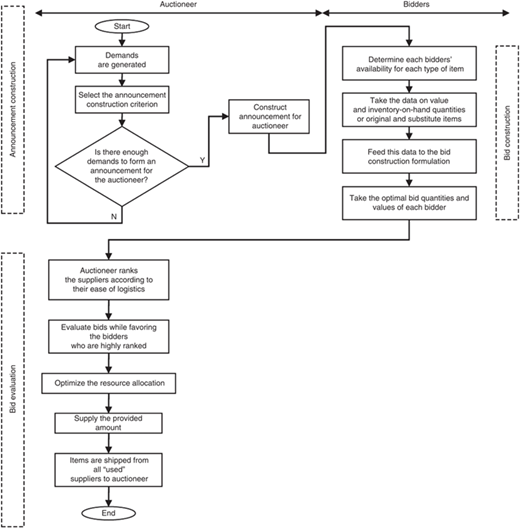
The proposed framework is developed for a single coordinating platform in disaster relief logistics; therefore, one auctioneer and multiple bidders are considered. The bidders are suppliers of good in the framework, whereas the auctioneer represents a coordinating platform (e.g. UN Logistics Cluster, etc.). Currently, UNLCs do not intervene into the procurement activities and mainly coordinate the use of logistics resources such as trucks, warehouses, and equipment (UNLC, 2010). The proposed framework provides an opportunity for the coordinating platforms’ involvement into procurement activities. The presented framework in Figure 1 is for a single echelon supply chain. Announcement construction, bid construction, and bid evaluation phases correspond, respectively, to the appeals management, the suppliers’ bid quotations, and the supplier selection activities (Thomas and Fritz, 2006; Thomas, 2003).
The announcement construction and bid evaluation phases are managed by the coordinating platform, and the bid construction phase is managed by the suppliers. The coordinating platform accumulates demands from humanitarian organizations and releases announcements based upon predefined thresholds. Once an announcement is released, the suppliers compare demanded items with on‐hand inventory quantities and their associated values. Suppliers use this process to determine the quantities and mix of their bids while minimizing the values of items. Then, using a general multidimensional knapsack problem (MDKP), bid quantities, and associated item values are maximized by the coordinating platform while favoring the suppliers that have easy access to the disaster location.
Substitution and partial fulfillment options are allowed by the coordinating platform based on fulfilling the received demands as much as possible with the current inventories of the suppliers. The substitution option provides suppliers with the opportunity to bid on the item even if they do not have the required original quantity. FedBid™ platform (FedBid, 2009) discusses this option and classifies in four scales: exact match only, brand name or equal, meet or exceed, or a similar line item. In this study, we assume that when substitution is allowed, a similar line item can substitute the original demanded item. The partial fulfillment option enables better usage of supplier inventories. For the in‐kind donations module of Aidmatrix Network® (Aidmatrix, 2009), humanitarian organizations are given the option to partially accept the offers of the supplier. In this study, the priority of items is used in three levels. The first level indicates urgent‐immediate, the second level indicates low‐priority, and the third level indicates non‐priority items (Van Wassenhove and Tomasini, 2003; Davidson, 2006; Chiu and Zheng, 2007; Sheu, 2010).
The ease of logistics concept is developed to include infrastructural and geographical convenience of the supplier and the disaster location. In addition, the concept considers the suppliers’ experience at the disaster location and in similar disaster types. The ease‐of‐logistics parameter is considered in three levels as an integer on the (1, 3) interval. The suppliers with better (i.e. higher) ease of logistics are favored in the bid evaluation. In a similar context, the HELIOS software (Fritz Institute, 2007) by Fritz Institute prioritizes suppliers; however, the aim is not to assess the ease of access to the disaster location, as proposed in this study.
In the auction process, the suppliers are assumed to act on humanitarian grounds and are trying their best to supply the requirements of the coordinating platform. In addition to this assumption, the following considerations are made:
Shipping and inventory replenishment decisions of the suppliers or the coordinating platform are not considered. Lead times are assumed to be addressed by the ease‐of‐logistics concept.
There is only one substitute for each item and two or more order substitutes (i.e. substitute of a substitute) are not allowed. This also implies that original and substitute items are paired as each other's substitutes.
An announcement cannot carry the original item and the substitute item.
3.1 Announcement construction phase
Demands from the appeals list are accumulated until a threshold is met, since considering economies of scale and announcing multiple item types together help the purchasing party to reach lower bid prices (Wagner and Schwab, 2004; Jap, 2007). The announcement is released as a bundle when one of the following thresholds is met:
- (1)
A threshold quantity (QT) is reached for any item type in the bundle (quantity).
- (2)
A time period (hours) t has passed since the last announcement (time).
- (3)
A total value ((Inline Equation 1)) is reached for the bundle having m item types where Rj is the reserve value of original item type j and Qj is the original quantity demanded for item type j (value).
- (4)
The number of urgent priority items in the bundle reaches to a priority count (count priority, CP).
- (5)
The weighted priority (WP) of bundle falls into the (lp⩽WP<up) interval. where lp is the lower priority limit and up is the upper priority limit.
WP is calculated with the following formula: ((Inline Equation 2)) where pj is the priority of item type j (weight priority).
Each criterion gives emphasis to a different design issue in a disaster relief operation. A limiting quantity is determined by the coordinating platform for any type of item in the first criterion. When one of the thresholds is met with the last demand, the bundle is announced. This criterion gives importance to the economies of scale. In the second criterion, the coordinating platform keeps track of demand times and releases all accumulated demands after a certain period. This criterion gives importance to time‐sensitive decisions. The bundle is released when a predetermined total value is reached in the third criterion. The reserve value (Rj) used in the third criterion can be considered as the previous purchase price or the current market price of a good. Monetary decisions are included in the framework with the third criterion. The CP and the WP criteria enable the coordinating platform to handle different priorities for different items by bundling them.
3.2 Bid construction phase
The decision in bid construction is whether to use substitute items or not while fulfilling the announcement. The formulation of the bid construction is as follows:
Objective function: inline Equation 3
With subject to: (Equation 1) (Equation 2) (Equation 3) (Equation 4) (Equation 5) (Equation 6) (Equation 7) (Equation 8)where Xj is the original bid quantity, Yj is the substitute bid quantity, Qj is the original demand quantity for item type j. Ij and Hj represent, respectively, the inventory of original item type j and its substitute. Vj and Wj correspond to the values of original item type j and its substitute, respectively. Pj and Sj are assigned a value of “1” if partial fulfillment and substitution are allowed, respectively; otherwise, they are assigned a value of “0.” zj is inventory availability parameter and M (i.e. Big‐M) is a sufficiently large integer. The zj value, which represents the availability of the bidder for the announcement, is calculated using the parameters given in the announcement and inventory on hand. The formula (Ij+SjHj⩾Qj) is used for each item in the announcement. If this inequality is valid (i.e. the bidder has enough inventory to satisfy this item in the announcement), then zj=0; else zj=1.
The value of an item is a function of its sales price, condition, and age. The value of each item in its inventory is known by the bidder a priori. The challenge here is whether to include substitutes and how much to include when it is allowed by the auctioneer. The bids are divisible and all‐or‐nothing bids are not accepted. Therefore, suppliers are considered as willing to give the quantity that is allocated by the auctioneer at the same value as they offered for the whole quantity (Wurman et al., 1998; Schvartzman and Wellman, 2007).
The objective function represents the bid value and is minimized to make use of the aged items as soon as possible. Decision variables represent the quantities of original and substitute items. The first two constraints are the announcement fulfillment constraints. In Equation (1), the first term represents the original quantity and the second term is present only when substitutes are allowed (i.e. Sj=1). The right hand side is the original quantity in the announcement. If there is not enough inventory (i.e. zj=1), then this constraint is redundant by the use of the Big‐M. Equation (2) forces substitute bids to be 0 when substitution is not allowed. Equations (3) and (4) prohibit the supplier from bidding more than the on‐hand inventory. Equations (5) and (6) oblige bidders to provide whatever they possess as a bid if they do not have enough inventory to fully satisfy the announcement. Equations (7) and (8) provide the integer constraints for the decision variables.
3.3 Bid evaluation phase
In corporate supply chains, supplier selection is an essential part of the procurement process. This framework, however, is designed for the disaster relief chains, where the differences among suppliers can be more substantial. In addition, system preferences may be different, because of the dynamics of disaster relief logistics. For example, a supplier closer to the disaster location with substitute items may be preferred to the distant supplier with original items. When all suppliers construct their bids, the coordinating platform needs to fulfill the announcement. An announcement can be fulfilled by only original items, only substitute items, or a mix of those depending on the bids received. The formulation of the bid evaluation is as follows:
Objective function: inline Equation 4
With subject to:
(Equation 9) (Equation 10) (Equation 11) (Equation 12) (Equation 13)where Aij is the original quantity of item j allocated to bidder i, Bij is the substitute quantity of item j allocated to bidder i, and Vij and Wij are the original and substitute values of the bidder i's inventory for item j. Note that Vij and Wij are exogenous for the auctioneer and declared by the bidder in the bid construction phase. Here, αi represents the ease‐of‐logistics parameter for bidder i. This formulation is a variation of the general MDKP (Akcay et al., 2007).
The objective function represents the value that the auctioneer is willing to receive from the bidders, which is maximized to receive the newest and the most valuable items possible. A value notion is introduced instead of a pure price model, because when price is the only criterion for bid evaluation, incumbent suppliers are reluctant to enter into procurement auctions (White et al., 2004; Jap, 2007). Moreover, when price is the only measure for procurement, the qualitative measures of product and the capabilities of the suppliers are not considered (Rothkopf and Whinston, 2007). The capabilities of suppliers are increased and diversified by partial fulfillment and substitution options. Equation (9) is the announcement fulfillment constraint. Equations (10) and (11) prohibit the auctioneer from allocating more than the bid quantities. Here, Cij and Dij correspond, respectively, to the original quantity of item j bid by bidder i and the substitute quantity of item j bid by bidder i in the bid construction phase. Equations (12) and (13) are integer constraints for the decision variables.
4. Experimental study
In this section, the proposed framework is evaluated with respect to different design parameters using simulation. Simulation models are chosen as the tool in this study essentially because of its suitability and appropriateness in theoretical and applied research in logistics and supply chain management. Several studies discussed in Spens and Kovacs (2006) have used simulation effectively in logistics research. Here, a simulation model is developed to generate different problem instances, to combine three phases of the framework, and to evaluate the disaster‐specific parameters. The model is coded using a Java Simulation Library (Rossetti, 2008), and CPLEX 10.1™ is called to solve IP formulations. All experiments are conducted on a PC with an Intel™ Pentium™ 4 2.8 GHz CPU and 2 GB RAM. The two sets of experiments conducted are the analysis of the announcement construction phase and the analysis of the bid construction and the bid evaluation phases. Six different scenarios are used to illustrate the effectiveness of the announcement options, the IP formulations, and the ease‐of‐logistics parameter. In both sets, ten original item types and ten substitute item types are used. Each original item type has one substitute type that can be used when the auctioneer allows; and ten bidders are used to introduce supply diversity with potentially different values and quantities of on‐hand inventory.
4.1 Announcement construction experiments
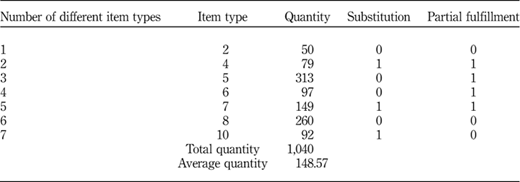
Demands for ten different item types are generated using a Poisson distribution (P(1)/hour). The demand for item types is uniformly distributed. A total of 1,000 individual demands are generated with 30 replications. The quantity of each demand is a random variable which follows a U(50, 100) distribution. Each incoming demand quantity is added to the same item type in the bundle and the threshold for the chosen criterion is checked. If the threshold is met, the bundle that includes quantities for different item types together with the substitution and partial demand fulfillment decisions is declared as an announcement to the bidders. A sample announcement constructed by a quantity threshold (i.e. 300) is given in Table I. In this announcement with seven item types, the demand for “Item Type 5” reaches 313 units.
Six different levels of threshold values are used to see their effects on the announcement parameters. The reserve values follow a U(50, 100) distribution and are generated as 51, 79, 60, 91, 80, 74, 68, 95, 92, and 88 for ten item types, respectively. Priority values are assigned as random integer numbers to each item type in the bundle from a (1, 3) interval, with one having the highest priority. The CP criterion counts the items in the bundle that have the highest priority and releases the announcement when a set threshold is met. The WP interval is used as an alternative to a single threshold to give more flexibility to the auctioneer.
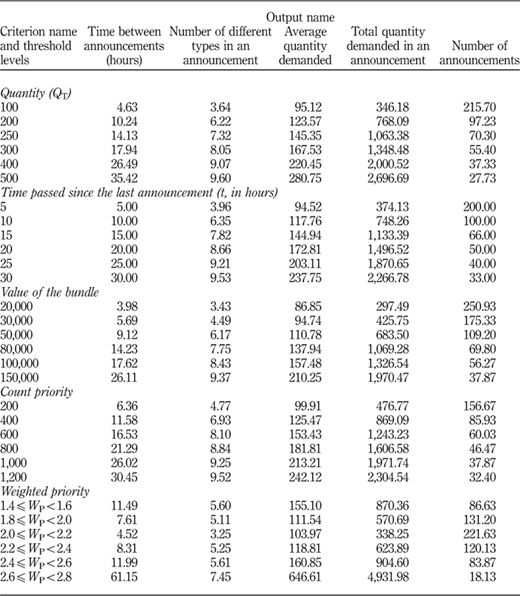
Selected metrics include time between announcements, number of different item types in an announcement, number of announcements, average quantity demanded by item type, and total quantity demanded in an announcement (see Table I for an example). Experimental design levels across different announcement criteria are determined to give comparable results with respect to the number of different types in an announcement and the total quantity demanded in an announcement. The results of the announcement construction experiments are given in Table II.
Quantity, time, value, and CP criteria give similar results in Table II. The time between announcements increases linearly with respect to increasing threshold levels. The number of different types in an announcement demonstrates a logarithmic increase with respect to increasing threshold levels. Average quantity demanded increases linearly with respect to increasing threshold levels, but the rate of the increase is smaller than time between announcements. Total quantity demanded in an announcement also increases linearly with respect to increasing threshold levels and the rate of the increase is about the same as average quantity demanded. It can be concluded that all output figures, except the number of announcements, increase as threshold levels increase. The number of announcements is inversely proportional to other output figures, because demand increases when the threshold levels are waiting to be met, which releases a fewer number of announcements per a given duration. Only the WP criterion shows different results among other criteria. Note that this criterion is designed to consider the expected value of random item priorities. This criterion releases announcements more frequently when the expected WP of the bundle falls into the chosen interval.
Announcement construction criteria determine the timing of the announcement, the number of different item types, and the quantity of the item types in the bundle. Although the criteria provide alternatives for the coordinating platform to release the appeals for items with varying considerations, they produced similar announcements. The bid construction and bid evaluation phases take the announcement as given. Therefore, the announcement construction experiments are not performed again in these phases. The quantity criterion is chosen among the announcement construction criteria to be experimented with different levels in the bid construction and bid evaluation experiments, because quantity of the item is used in showing the supply coverage percentage of demand.
4.2 Bid construction and bid evaluation experiments
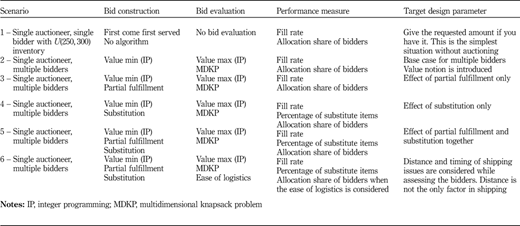
When an announcement is released, the bidders need to construct their bids according to the quantities and values of their on‐hand inventory. Then, the auctioneer evaluates the bids and the demand requirement is met at the end of the auction process. The effectiveness of the announcement options, the IP formulations, and the ease‐of‐logistics parameter are evaluated with six scenarios. Each scenario provides insight about a different design parameter. Table III summarizes these scenarios, the performance measures, and their targeted design parameter.
Selected metrics for this analysis include fill rate, allocation share of bidders, percent of substitute item types, and percent of substitute items in all supplied items. Fill rate is a common performance metric in disaster relief operations (Davidson, 2006), which can be defined as the proportion of the fulfilled amount over the requested amount for an auction. Allocation share of a bidder is a performance metric, which is defined as the portion of the announcement that is supplied from a particular bidder. Percent of substitute items in all supplied items is a performance measure for the use of substitute items by bidders. The reader is referred to Beamon and Balcik (2008) for a thorough analysis of performance measurement systems in disaster relief and humanitarian logistics, Pettit and Beresford (2009) for critical success factors, and Pasupathy and Medina‐Borja (2008) for a successful implementation of performance measurement.
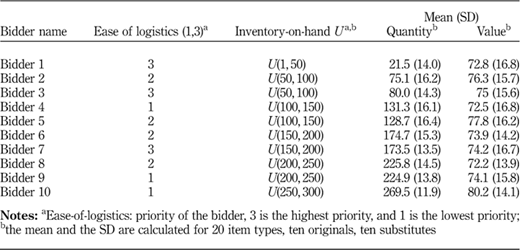
A diverse supply base positively affects bundle performance (Schoenherr and Mabert, 2008); therefore, ten bidders with different on‐hand inventory levels are used to satisfy demands. Since capacity (i.e. on‐hand inventory) is one of the attributes of a supply base heterogeneity in auctions (Hazra and Mahadevan, 2006), bidder inventory levels are determined by drawing from uniformly distributed random variables with different parameters. Moreover, the diversity of a supply base is further enhanced with the ease‐of‐logistics parameter. Table IV gives the parameters of inventory distributions for the ten bidders including ease of logistics.
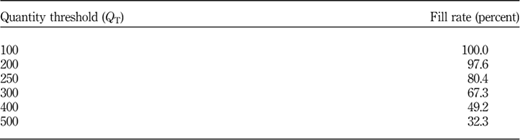
While determining inventory levels for bidders, distribution parameters are set to satisfy some portion of all announcements. This is practical in disaster relief operations, because on hand inventory levels are usually inadequate (Balcik et al., 2007). The announcement satisfaction rates of the first scenario in Table III with different levels of quantity thresholds are shown in Table V.
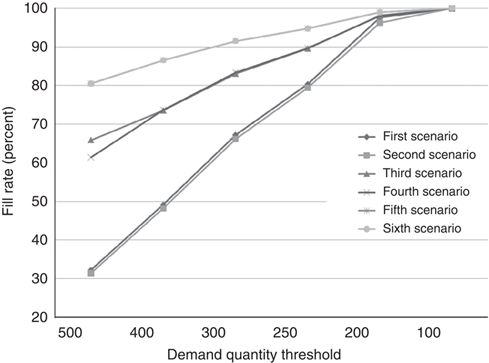
In order to create a comparable base, bidder inventory levels in the second set of experiments are set to the values as in Table IV. Figure 2 gives the results of the scenario fill rates with respect to different levels of threshold quantities. Figure 2 shows that the fifth and the sixth scenarios overlap and provide the highest fill rate. The third and the fourth scenarios differ in higher quantities and the third scenario performs slightly better than the fourth scenario. It can also be concluded that the fill rate increases with a decreasing quantity threshold. For higher threshold levels, the difference among scenarios is more apparent than for lower threshold levels.
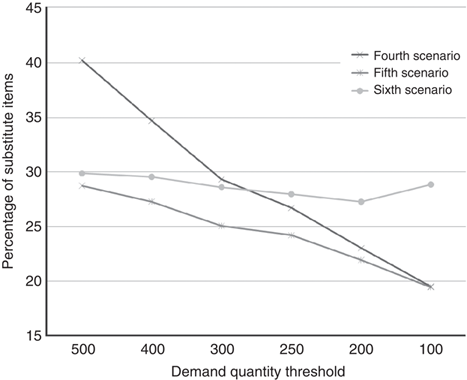
The substitution option is allowed in the fourth, the fifth, and the sixth scenarios. The percentages of substitute items in all supplied items for these scenarios are given in Figure 3. The fourth and the fifth scenario percent values decrease linearly with decreasing demand quantities. The rate of decrease in the fifth scenario is smaller than the fourth scenario. The sixth scenario percent values are similar with changing demand quantities.
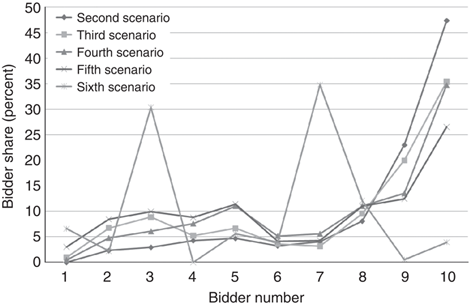
The allocation share of bidders with respect to the scenarios is depicted in Figure 4. The second scenario allocates more shares for higher‐inventory bidders, whereas the third, the fourth, and the fifth scenarios allow lower‐inventory bidders to attain more portion of total share. Neither the third scenario nor the fourth scenario creates a substantial difference in bidder shares. The fifth scenario gives the highest share to the lower‐inventory bidders. The peaks in the sixth scenario stem from the ease‐of‐logistics parameters. In the sixth scenario, Bidder 7, Bidder 3, and Bidder 1 are utilized as much as possible. Bidder 4 and Bidder 9 have almost no share, because they are not easily accessible to the disaster location. Bidder 10 receives the lowest share in the sixth scenario among all other scenarios.
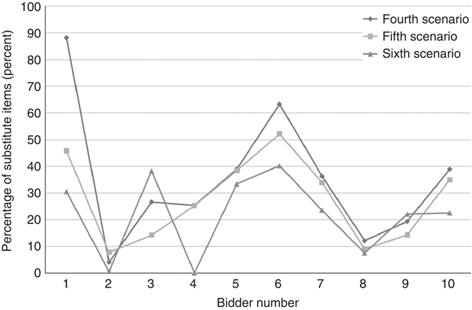
The percentage of substitute items in all supplied items is given in Figure 5. Bidder 1 uses substitute items more in the fourth scenario, and this percentage decreases in the fifth and the sixth scenarios. Bidder 2 and Bidder 3 differ in the rank of scenarios regarding the percentages, and it can be seen that Bidder 3 uses more substitutes in the sixth scenario since it has higher priority when the ease‐of‐logistics parameter is considered. Bidder 4 gives 0 percent substitutes in the sixth scenario, because of its lower priority. Bidder 5 uses more substitutes than Bidder 4 in the fourth and the sixth scenarios, since Bidder 5's inventory has a higher asset value on average when compared to Bidder 4, and Bidder 5 is has better ease‐of‐logistics. Bidder 6 and Bidder 7 use more substitutes in the fourth scenario because partial fulfillment is not allowed in the fourth scenario. Bidder 9 uses more substitutes than Bidder 8 because Bidder 9's inventory has a higher asset value on average when compared to Bidder 8. Bidder 10 uses fewer substitutes in the sixth scenario, because it has a lower ease‐of‐logistics parameter.
5. Discussion and conclusion
Disaster relief and corporate logistics have their own unique characteristics with similarities and dissimilarities. Motivated by a large number of applications in corporate logistics and potential use in disaster relief operations, an auction‐based framework for procurement of goods is presented in this study to address the inefficiency in procurement operations and the lack of timely responsiveness. The proposed framework, which offers a background for coordination in a single coordinating platform, would be applied in practice by inefficient suppliers of good and partnerships. The framework introduces some disaster‐specific system parameters. From bundling demands and creating announcements, to constructing bids for each announcement, and to evaluation and selection of the bids, there is a series of decision‐making processes that determine the system behavior.
In the announcement construction phase, determination of the criterion and decision for the appropriate threshold levels are important tasks that should be disaster specific and dynamic during disaster relief operations. For example, in the first couple of days after a disaster, announcements can be constructed with a lower‐interval level WP criterion. This allows for having more frequent announcements with higher priority items. In the sustainment phase, the announcement construction phase can be switched to the value criterion for budgetary reasons. In the experimentation, cases with only a partial fulfillment option is allowed, perform slightly better than the cases when only a substitution option is allowed. The highest fill rate is reached when both announcement options are used. Options in announcements almost double the fill rate that is vital in disaster relief performance. In disaster relief operations, substitutions and partial fulfillment options should be allowed to maximize the fill rate.
In the bid construction phase, when substitution is the only announcement option, bidders utilize more of substitution. When the partial fulfillment option is allowed, the effect of substitution degrades. The use of announcement options changes the allocation share of bidders depending on their inventory levels. In a real disaster relief case, these options can be regulated for better involvement of smaller suppliers. The ease‐of‐logistics parameter stabilizes the use of substitution option to the 25–30 percent range. The fill rate does not change with the introduction of this parameter though. The allocation share of bidders changes substantially when the ease of logistics parameter is used, but the degree of this change is dependent on the dispersion of the interval where that parameter is withdrawn.
The framework is limited in three ways. First, it does not include the scheduling and routing of the transportation resources. Second, the budgeting operations after the procurement auction are left out of the framework. Finally, the framework assumes that humanitarian organizations are willing to accept the governance of a coordinating platform in their procurement operations, which might not always be the case.
Since the framework would best be evaluated by a real disaster scenario, we propose the following steps to test the applicability:
- (1)
A coordinating platform is determined (e.g. UN Logistics Cluster, etc.) by the local government.
- (2)
The coordinating platform (CP) determines the ease of logistics of available suppliers. These suppliers accept the conditions of the procurement auction (e.g. all‐or‐nothing bids are not accepted, etc.).
- (3)
Humanitarian organizations in the disaster location submit their appeals to CP using a common software package.
- (4)
CP bundles the appeals according to disaster‐specific requirements and the phase of a relief operation. Then, CP releases the announcement.
- (5)
Suppliers bid on the announcement.
- (6)
CP evaluates the bids while favoring suppliers with better ease of logistics.
- (7)
Demands are assigned to winning suppliers.
- (8)
Items are shipped to the designated locations.
Here, a common software package is used by CP, humanitarian organizations, and the suppliers. If FedBid™ is used, a similar line item option is selected for substitution where needed. Aidmatrix Network® can improve its software by extending partial acceptance of an offer from the in‐kind donations module to its procurement and online auction modules. HELIOS software can be improved by differentiating the suppliers using the ease‐of‐logistics parameter. All three software packages can be improved by prioritizing items and bundling the appeals with a WP scale.
An extension of this study would include evaluating the goodness of fit for the framework using the data from real disaster relief operations. We believe that the current structure of the UN Logistics Clusters allows the introduction of this expanded framework. In addition, transportation scheduling and vehicle routing considerations could be incorporated in the auctioning process. Similarly, budgeting issues in the procurement processes could be addressed in the future. Each humanitarian organization operates with different budgets and further research is needed in this area.

















References
About the authors
Mustafa Alp Ertem, PhD, is an Assistant Professor of Industrial Engineering at Çankaya University. Before joining Çankaya University, he worked at J.B. Hunt Transport Services Inc. (NASDAQ100: JBHT) as a Logistics Engineer II. He holds a PhD degree from the University of Arkansas, an MS degree from Middle East Technical University, and a BS degree from Istanbul Technical University, all in industrial Engineering. His research interests are logistics in disaster relief operations, procurement auctions in supply chain management, and forecasting applications in intermodal transportation. He is a member of the Institute of Industrial Engineers and the Institute for Operations Research and Management Science.
Nebil Buyurgan, PhD, is an Associate Professor of Industrial Engineering, Director of the AT&T Material Handling Laboratory, and Co‐director of the AT&T Manufacturing Automation Laboratory at the University of Arkansas. After receiving his PhD degree in Engineering Management from the University of Missouri‐Rolla, he joined the Industrial Engineering Department at the University of Arkansas in 2004. As the author or co‐author of over 40 technical papers, his research and teaching interests include auto‐ID technologies, humanitarian and healthcare logistics, healthcare informatics, and modeling and analysis of discrete event systems. He has directed several projects funded by National Science Foundation, Air Force Research Lab, and Wal‐Mart Stores. Nebil Buyurgan is the corresponding author and can be contacted at: nebilb@uark.edu

