


The purpose of this paper is to review the current application of organization theory (OT) in the humanitarian supply chain (HSC) and identify the future OT-based research opportunities that can advance knowledge of humanitarian operations.
The study uses a systematic literature review methodology to identify the current status and future direction of the OT-based study in HSC literature. The applied theories are those that have been mentioned in at least two research articles in the HSC literature. The proposed theories are either adopted from the top four referred organizational theories in the supply chain literature or those that can explain the issue of information asymmetry in HSC.
The study identifies and describes eight organizational theories and their possible future research questions in HSC. Among these, the first four theories (i.e. resource-based theory, resource dependence theory, social exchange theory and contingency theory) have already been initially applied in the humanitarian field, while the remaining theories (i.e. institutional theory, stakeholder theory, transactional cost theory and information theory) have potential for future application.
The reviewed literature is limited to peer-reviewed journals listed in Thomson Reuters’ journal citation reports.
This study may help future researchers better understand and solve, using organizational theory, the behavioral challenges faced by humanitarian operations.
The study presents current applications of and future prospects for OT-based research in HSC, effectively providing the first review of OT applications in this area. The novel framework and new theories proposed herein may enable fresh directions for HSC research.
1. Introduction
Natural disasters, political or economic crises, pandemics and other emergency situations put enormous pressure on governmental institutions and humanitarian organizations (HOs), which are responsible for providing both short- and long-term aid to affected populations (CRED, 2017; World Disaster Report, 2018). It is imperative that HOs effectively manage the flow of goods and services in order to help victims cope with emergency situations. In this vein, humanitarian supply chain (HSC) management has emerged as a specialized field within supply chain management (Holguin-Veras et al., 2012a; Kovács and Spens, 2007). Comprising networks of donors, HOs, beneficiaries and other stakeholders, HSC seeks to reduce human suffering through relief activities (Kovács and Spens, 2007; Van Wassenhove, 2006a). These activities can enhance human well-being and improve resilience, but they require humanitarian actors to coordinate and manage the smooth flow of supplies, information and resources from donors to beneficiaries, as well as develop local infrastructure and institutions (Altay and Green, 2006; Kovács and Spens, 2007; Maon et al., 2009). However, HOs face considerable complexities while managing the HSC (Kovács and Spens, 2007; Tatham and Houghton, 2011), such as material convergence, the cascading effect of disaster, political unrest and other externalities.
In such complex and chaotic situations, effective and efficient management requires knowledge about organizational issues, such as information diffusion, culture, power politics, capabilities, collaboration building and the role of different institutions and stakeholders (Altay et al., 2018; Gunasekaran et al., 2018; McLachlin and Larson, 2011; Pazirandeh and Norrman, 2014). As research on supply chain management has proven, organization theory (OT) is useful for creating knowledge about such issues in various supply chains (SCs) (e.g. sustainable or green supply chains) (Ketchen and Hult, 2007; Sarkis et al., 2011; Touboulic and Walker, 2015). Operations management scholars have defined OT as the collection of theoretical frameworks—borrowed from broad areas of human endeavor, such as psychology, political science, economics and sociology—used to explain or describe organizational behaviors, designs, structures and decisions (Ketchen and Hult, 2007; Sarkis et al., 2011). However, this theory has not yet been well developed in humanitarian operations (Gunasekaran et al., 2018; Jahre et al., 2009; Oloruntoba et al., 2016; Tabaklar et al., 2015).
In fact, the HSC field has been criticized for an overwhelming number of articles that lack theoretical grounding (Gunasekaran et al., 2018; Jahre et al., 2009; Oloruntoba et al., 2016). The extant literature suggests that HSC needs to focus on OT in order to create new knowledge about organizational issues in the humanitarian context (Gunasekaran et al., 2018; Jahre et al., 2009; Oloruntoba et al., 2016; Starr and Van Wassenhove, 2014). Some scholars, like Prasad et al. (2016) and Larson and Foropon (2018), have reviewed the application of OT in the HSC domain and demonstrated its usefulness. However, these studies were limited to a single issue and did not provide a holistic view of OT's potential applications in HSC. In order to facilitate studies that integrate OT with HSC (Gunasekaran et al., 2018; Ketchen and Hult, 2007; Sarkis et al., 2011), the present research reviews the current state of OT application in HSC studies, as well as highlights other organizational theories that would be relevant to this domain. The theories considered herein were selected based on issues that HSC scholars are currently discussing (Cliffe, 2016; Gunasekaran et al., 2018; Moshtari, 2016).
Our review focuses on HSC studies that have utilized the OT framework or concept to investigate their research questions. We selected those theories that have been mentioned or linked to in at least two peer-reviewed papers that have been published in journals indexed in Thomson Reuters Journal List (2018). In order to expand the application of OT in HSC, we introduced novel OT theories that have been highly referred in the supply chain literature or that can explain the issue of information asymmetry in HSC. In sum, the present study makes three main contributions: first, this paper provides an overview of studies that utilize an OT framework to explain or describe HSC issues. Second, this paper describes the application of several organizational theories that are new in the HSC domain. Third, this paper presents a novel framework that integrates organizational theories with HSC. The findings highlight a great potential for growth in OT-based research in HSC.
In the next section, we contextualize the recent shift toward emphasizing OT-based research in the HSC, explaining what OT is and why OT and HSC can be beneficial for each other. In section 3, we present our research methodology. In sections 4.1 and 4.2, we review 25 research studies that use organizational theories in the context of humanitarian operations, whereas in section 4.3, we introduce four new theories that have yet to be adopted in the field. In section 5, we present a framework that integrates OT with HSC. Section 6 outlines the conclusions and avenues for further research.
2. Background
2.1 The humanitarian supply chain (HSC)
The HSC has many unique features distinguishing it from the commercial SC, such as the uncertain demand, unsafe supply networks and damaged infrastructure (Van Wassenhove, 2006b; Holguin-Veras et al., 2012a; Tatham, 2012). Furthermore, it is often unclear whether HSC performance metrics should revolve around efficiency, effectiveness or equity while distributing relief goods and services (Gutjahr and Nolz, 2016). Thus, HSC has multiple goals and multiple stakeholders competing for many of the same resources (Gralla et al., 2014). The available funds do not often meet all the needs, which makes resource allocation critical. Moreover, the end consumers (in this case, beneficiaries in need) have no power over the relief provider; indeed, most decisions are influenced by donors or policymakers (Rodríguez-Espíndola et al., 2017).
As the number of humanitarian crises has increased, so has the range of stakeholders involved in responding to humanitarian crises (Moshtari, 2016; Besiou and Van Wassenhove, 2019), which has made the HSC setting highly complex (Besiou et al., 2011). The uniqueness of each disaster creates ambiguity about the possible interactions among humanitarian stakeholders and the resulting outcomes (Tatham and Houghton, 2011). Coupled with high employee turnover, this challenging scenario makes it difficult to create effective organizational knowledge (Tomasini and Van Wassenhove, 2009; Van Wassenhove, 2006a).
The complexity and uncertainty of HSC demand that HOs evolve differently than other businesses in terms of capabilities, routines, decision processes and objectives (Jahre et al., 2009; Oloruntoba et al., 2016). Because HOs are the integral part of HSC, it is important to study the interaction of HOs in order to delineate the HSC from the commercial SC (Tomasini and Van Wassenhove, 2009; Van Wassenhove, 2006a).
However, early research efforts that sought to delineate the aim and scope of HSC were primarily based on anecdotal evidence and problem-specific mathematical models; thus, their conceptual advancements mainly related to the logistical aspects of HSCs (Besiou et al., 2018; Jahre et al., 2009). Not only have many studies been too hypothetical to create practical and theoretical knowledge (Besiou et al., 2018), but only a few studies have investigated how HOs' organizational issues galvanize practical problems (Gunasekaran et al., 2018; Besiou et al., 2018; Heaslip, 2018). The present study addresses this gap by compiling the current application of organizational theories in the HSC domain and delineating opportunities for new knowledge.
2.2 Organization theory (OT) and humanitarian supply chain (HSC)
Over the years, researchers have explored questions pertaining to organizations, institutions and their relationships with humans. The body of knowledge that has emerged from such explorations is known as organization theory (OT) (McAuley et al., 2007).
Through the lens of organizational theory, we can understand HSC operations as mutually interdependent, requiring people to interact in order to cooperate and coordinate their efforts toward a common goal of reducing human suffering (Holguin-Veras et al., 2012b). All humanitarian operations—such as response planning, prepositioning, procurement, distribution and recovery—demand cooperation and coordination among humanitarian actors. The processes of orchestration are influenced by the interactions among stakeholders: for example, power and authority influence SC relationships (Pazirandeh and Nomann, 2014), while trust and commitment among humanitarian actors affect collaboration (Moshtari, 2016). OT can thus serve as a keystone for creating knowledge about the organizational interactions (Handfield and Melnyk, 1998) among HSC entities.
Of course, creating new knowledge requires that research studies possess validity (how well they reflect reality) and generalizability (how useful the findings are) (Amundson, 1998; Anand and Gray, 2017). Fortunately, OT-based studies have demonstrated both (Ketchen and Hult, 2007; Sarkis et al., 2011). Hence, integrating OT with HSC can benefit the field by creating new knowledge about the organizational interactions among stakeholders, which may then impart theoretical and managerial implications.
In a similar vein, OT can also benefit from research in the HSC context. HSCs always work in unique environment settings (Holguín-Veras et al., 2012a), with a lot of uncertainty, stakeholder and so on (Besiou and Van Wassenhove, 2019). Such differences between commercial and HSC can involve organizational capabilities, objectives or cultures; in the case of humanitarian operations, they often relate to method, process and technique (Kovács and Spens, 2007; Kovács and Tatham, 2009; Holguín-Veras et al., 2012a). For example, there are major differences in the SC of developed Western countries and the HSC in a war-torn Middle Eastern country (Holguín-Veras et al., 2012a). Unfortunately, commercial OT research does not always address such differences among the subjects under investigation (Andersson et al., 2006 pp. 30).
Furthermore, disasters create a unique context; therefore, each disaster will act as a control environment for building and testing theory (Carlile and Christensen, 2005). For instance, the work routine of a manager operating in a commercial SC is generally stable and predictable. By contrast, a Middle Eastern field officer in the HSC works at an extreme level of uncertainty and under different situational norms. For example, people may adopt different norms about helping others outside of their own immediate group during times of crisis versus peace. Exchange theories help to explain such norm-based behavior, but how these norms operate during extreme uncertainty, especially when coupled with racial and ethnic differences, is virtually unknown (Andersson et al., 2006, pp. 31). Hence, integrating HSC with OT can benefit the latter field by testing and modifying old theories while building new theories on organizational interactions that may generate broader managerial insights.
3. Research methodology
This study undertakes a systematic and scientific assessment of the literature (Pearson, 2014). To this end, we considered four widely used electronic databases: Wiley, Emerald Insight, ScienceDirect, and EBSCOhost. To the best of our knowledge, our search included all the major publishers of peer-reviewed journals related to HSC. Some authors (Altay and Green, 2006; Kovács and Spens, 2007; Van Wassenhove, 2006a) have expressed that HSC only began to receive significant research attention after the 2004 Indian ocean tsunami and the 2005 Hurricane Katrina. However, to ensure that our search included all the related articles, we expanded our time horizon: from 2003 to 2018. Our list of keywords includes: “organization theory”, “humanitarian logistics”, “humanitarian operations”, and “humanitarian supply chain.”
As suggested by Burkart et al. (2016), the first stage involved a keyword search for relevant articles only, revealing: 3,422 articles in Wiley; 273 articles in ScienceDirect; 1,436 articles in Emerald Insight; and 168 articles in EBSCOhost. For the second stage, we applied the databases' filter operators in order to screen research articles that did not satisfy our selection criteria. Such filters allowed us to narrow the results according to, for example, area of study or year of publication. This process reduced the number of articles to 154 (Wiley), 113 (ScienceDirect), 95 (Emerald Insight) and 43 (EBSCOhost). The third and final filtration involved manual filtering: after downloading the articles, we carefully chose only those research studies that were underpinned by an OT framework in the humanitarian setting. Additionally, we only considered research articles that were published in peer-reviewed journals indexed in the SCI/SSCI/ESCI list of current Thomson Reuters’ journal citation reports. Based on these criteria, we ended up with 25 total articles.
4. Organization theory (OT) in the humanitarian context
This section comprises three subsections. Subsection 4.1 introduces all theories that were mentioned in at least two humanitarian-operations-related articles. These four theories are:
Resource-based view: explains how HOs gain and sustain capabilities in the humanitarian setting (Kovács and Tatham, 2009).
Resource dependence theory: explains why some HOs are powerful and how to counter such power (Pazirandeh and Norrman, 2014).
Social exchange theory: explains the social aspects associated with all types of exchange relationships (Tatham and Kovács, 2010).
Contingency theory: explains the changing characteristics of HOs with respect to external and internal factors (Haavisto, 2014).
Subsection 4.2 summarizes the studies in the HSC field that present multitheoretical explanations and whose theories have appeared in less than two journal articles.
In subsection 4.3, we introduce four theories for future applications. We selected these theories based on two criteria: first, the theories are among the most highly referred organizational theories in the SC literature (Touboulic and Walker, 2015). It should be noted that we selected theories from the SC tradition because of their shared several conceptual similarities (i.e. network structure, business processes and management component) with SC (Tabaklar et al., 2015). Second, the theories can explain information asymmetry among HOs in the field:
Institutional theory: explains the influence of institutional pressure in shaping practices, methods and techniques (Hirsch, 1975).
Stakeholder theory: explains the importance of communities that have a direct or indirect stake in the humanitarian relief work (Freeman, 1984).
Transactional cost theory: explains the economic transaction between two entities (Williamson, 1975).
Information theory: explains the information-seeking and -sharing mechanism of individuals or organizations in asymmetric information environments (Spens, 1978).
Table 1 presents a summary of this section.
Summary of four organization theories (OT) used in HSC research and questions answered
| Resource-based theory | (1) What are the capabilities of supply chain network to respond to disruptions? (Kovács and Tatham, 2009) (2) What are the core capabilities of humanitarian actors? (Apte et al., 2016) (3) How can HSC be an agile supply chain? (L'Hermitte et al., 2016) (4) How can agility and resilience in humanitarian supply chains be deployed and what influence can these capabilities exert on performance? (Altay et al., 2018) |
| Resource dependence theory | (1) How do small buyers purchase from relatively big suppliers? (Pazirandeh and Norrman, 2014) (2) What is the usefulness of resource dependence theory in the humanitarian context? (Prasad et al., 2016) |
| Social exchange theory | (1) What is the importance of trust and how can it be applied in quickly formed networks? (Tatham and Kovács, 2010) (2) How does relationship building take place in the humanitarian sector? (McLachlin and Larson, 2011) (3) How do trust and commitment affect collaborative performance in the humanitarian setting? (Moshtari, 2016) (4) How do information sharing and behavioral certainty affect the swift trust? (Dubey et al., 2017) |
| Contingency theory | (1) What factors explain the process of improvement in humanitarian operations? (Larson and Foropon, 2018) (2) What is the link between supply chain performance and the impact of humanitarian activity in the humanitarian context? (Haavisto, 2014) (3) How are contingency factors considered in efforts to enhance the sustainability of disaster rehabilitation work? (Kunz and Gold, 2017) |
4.1 Applied theories in the humanitarian setting
As detailed earlier, the systematic literature review revealed four theories that have been utilized in the humanitarian setting. For each theory, the following subsections offer a definition, brief information about the related HSC studies and future research applications.
4.1.1 Resource-based view
This theory explains how organizations can achieve sustainable competitive advantages. It states that a resource configuration that is valuable, rare, inimitable and nonsubstitutable creates such an advantage for HOs (Barney, 1991; Kovács and Tatham, 2009). HOs' resources are defined as capabilities, knowledge, processes and methods, as well as tangible and nontangible assets (Barney, 1991; Kovács and Tatham, 2009). The dynamic capability view, an extension of the resource-based view, can also be used to examine capabilities in a dynamic environment. Teece et al. (1997) suggested that organizations cope with highly dynamic environments by developing capabilities to build, integrate and reconfigure resources. The dynamic capability view provides a better explanation of organizational competitiveness for the dynamic, fast-changing environments that often characterize HSCs.
With new resources and capabilities, HSCs can respond to humanitarian crises more efficiently; in doing so, they can fulfill the demands of their donors and sustainably reduce the suffering of mankind. These capabilities encompass agility, responsiveness and flexibility, which align with the rarity, inimitability and nonsubstitutability aspects of the resource-based view (Charles et al., 2010; Kovács and Spens, 2007; L'Hermitte et al., 2016). Studying the resources and capabilities of HOs in detail, Kovács and Tatham (2009) have argued that activating the dormant organization in itself is a vital capability when responding to disruption. They further suggested that understanding what makes a successful HSC begins with considering how different humanitarian actors manage resources internally, as well as across their supply network. Building on this, Apte et al. (2016) studied the specific resources and generated capabilities of different humanitarian actors. They presented a framework of multiactor partnerships wherein actors complement each other's capabilities. L'Hermitte et al. (2016) studied the capabilities of agile HSC, which provided a basis for Altay et al. (2018) to investigate the effect of agility and resilience on HSC performance during different disaster phases. Notably, the latter study was theoretically underpinned by the dynamic capability view. In a similar vein, Dubey et al. (2018) studied big data and predictive analytics (BDPA) as an organizational capability. They demonstrated that BDPA exerts significant influence on HSC visibility and coordination. Overall, the resource-based view offers a better understanding of humanitarian actors' capabilities and competencies, which could enable HOs to formulate better plans and thereby improve their effectiveness and efficiency.
In commercial settings, most SCs strive to build capabilities that render them efficient (typically for functional products) or responsive (typically for innovative products) (Ramdas and Spekman, 2000). However, humanitarian settings complicate this situation. The HSC simultaneously manages two different capabilities (efficiency and responsiveness) in a single SC since the organizations typically operate both development and relief programs simultaneously (Kovács and Spens, 2007; L'Hermitte et al., 2016). For example, the International Federation of Red Cross and Red Crescent Societies (IFRC) has five regional centers (Gatignon et al., 2010). In most cases, the suppliers provide items to one of the regional centers (RCs) and then the RC provides relief items to the national society (NS). The NS will then work to deliver the items to the victims. However, the part of the SC that connects suppliers to RCs is peaceful in comparison to the part that connects NS to the humanitarian crisis area (which is unstable and uncertain). Hence, we imagine that the former part should be more efficient than the latter part, but less responsive during an emergency. Also, when the disaster phase changes from response phase to recovery phase, the whole SC becomes efficient (L'Hermitte et al., 2016). However, the HSC-OT literature has very few studies on how the capabilities of HOs change with the dynamic needs of the disaster management phase. Such studies can provide interesting insights into capacity building during the preparedness phase, in terms of local geographical requirements and proximity to different types of crises. Future research questions could include:
How do the capabilities of HOs change with the changing needs of the disaster management phase?
4.1.2 Resource dependence theory
All organizations are embedded in environments from which they obtain resources (Pfeffer and Salancik, 1978). Building from this notion, this theory seeks to explain broad questions such as “What is the goal of an organization?” (Nienhüser, 2008)—namely, by postulating that organizations are interdependent on each other, and further, that whoever has the highest concentration of resources within the environment will have power over other organizations (Emerson, 1962; Pfeffer and Salancik, 1978). Resource dependence theory assumes that the environment is source of uncertainty and constraints (Aldrich and Pfeffer, 1976); the more that organizations depend on others, the higher the uncertainty will be. In the humanitarian context, donors are more powerful than HOs. On the other hand, beneficiaries depend on HOs for help and support. In the unique power network scenario of HSC, HOs engage in a tug-of-war with stakeholders. For example, local HOs often feel that they are being used by their international counterparts, leading to ineffective collaboration (Brown, 2011). In short, resource dependence theory can explain the dynamics of power struggles between different actors.
Using resource dependence theory, Pazirandeh and Norrman (2014) studied the relationship between the purchasing strategies of small, less-powerful buyers and their power. Their findings suggest that purchasing strategies of HOs are a response to individual constraints and not to power positions. Moreover, HOs deploy different purchasing strategies in response to constraints induced by the different power sources. Meanwhile, Prasad et al. (2016) studied the applicability of resource dependence theory in the development SC. They posited that HOs are not self-contained, so they depend on cooperation. Consequently, counterparts can exert external power on HOs to control their behavior. The findings of this research suggest that resource dependence theory may be applicable in the HSC setting.
It is important to note that power dynamics between partner organizations have varied effects (Gaski, 1984). In the presence of a large power difference, coercion leads to reduced organizational performance, while a lack of coercion leads to better-coordinated decisions and improved performance (Nyaga et al., 2013). However, we expect that the nonprofit orientation of humanitarian organizations will entail different power dynamics in HSC compared to the commercial SC. Unfortunately, the SC-OT literature only provides limited insights here, as it has barely studied the conceptual difference between the HSC and commercial supply chains in terms of power dynamics.
Power dynamics have two types: (1) power advantage, which occurs when one exchanging partner is more dependent on another partner (Emerson, 1962; Pfeffer and Salancik, 1978). (2) Joint dependency or mutual dependency, which occurs when both exchanging partners in a dyad are equally dependent on each other (Emerson, 1962; Gulati and Sytch, 2007). Studies conducted in commercial SCs have reported that when mutual dependency is high in a dyad, partners exert countervailing power on each other. However, the effects of power and countervailing power are different across research settings. For example, in Chinese settings, power is helpful for establishing better coordination, but in American settings, the use of power attracts resistance (countervailing power), which reduces the effectiveness of coordination (Meehan et al., 2012). Interestingly, in humanitarian settings, joint dependency is possible even though local HOs are smaller than international HOs. For example, local HOs (which are dependent on donors or international HOs) are aware that they possess unique knowledge of local culture and geography that makes international organizations dependent on them for implementing relief response plans. Therefore, when international organizations exert coercion (e.g. not respecting their autonomy), local organizations can respond by exerting countervailing power (e.g. not complying with the partner's demand), which will end the relationship.
Extant literature suggests that resource dependence theory assumes greater relevance as governments, international agencies and international HOs increasingly call for interorganization partnerships and collaborations with local HOs in order to achieve efficient and effective humanitarian operations (Moshtari, 2016; Prasad et al., 2016). Indeed, studying such partnerships and collaboration is a critical first step in solving the problems of resource scarcity, material convergence (accumulation of large number of HOs and in-kind donations create problems of congestions) and suboptimal operation (Balcik et al., 2010; Starr and Van Wassenhove, 2014). Therefore, future research questions should focus on exploring the power dynamics in exchange relationships (partnership, collaboration).
How do power dynamics (i.e. power advantage, joint dependency) impact collaboration effectiveness in the HSC setting?
4.1.3 Social exchange theory
Social exchange theory states that the presence of norms (i.e. commitment and trust, solidarity, reciprocity, flexibility among others) in exchange relationships is central to successful collaboration, more so than power and the ability to control others (MacNeil, 1985; Morgan and Hunt, 1994). In striving to explain the nature of exchange relationships, this theory assumes that organizations do their business in a cooperative market. Theorists agree that partnership interactions involve a give-and-take of resources that generates a sense of obligation (Emerson, 1976). For example, donor agencies fund their local partners, which then creates interdependency between the exchanging parties (e.g. donor agencies depend on local partners for local capacity, as well as knowledge of local culture and geopolitical condition; on the other hand, local partners depend on donors for funds) (Blau, 2017). These interdependent interactions can generate high-quality relationships.
In the realm of HSC, Tatham and Kovács (2010) started the discussion by studying the importance and development of swiftly established trust (or “swift trust”) in quickly formed networks during postdisaster chaos. Later, McLachlin and Larson (2011) studied the partnership-building process in a humanitarian setting and proposed trust as a key ingredient in a successful partnership. Likewise, Moshtari (2016) established that mutual trust and commitment are the two key factors for creating successful collaboration. Dubey et al. (2017) also discussed the idea of swift trust and commitment in HSC, conceptualizing a theoretical framework that establishes the link between information sharing and swift trust.
It is critical to mention that all types of exchange relations depend on a foundation of norms (Morgan and Hunt, 1994). Norms include trust, commitment, flexibility, mutuality, reciprocity and solidarity (MacNeil, 1985), which help to mitigate the possibility of exchange hazards such as opportunism and conflict (MacNeil, 1985; Morgan and Hunt, 1994). For a more detailed discussion, the reader can refer to MacNeil (1985). Commercial SC research has investigated such norms-based behavior during peace time, but how these norms affect operational outcomes during extreme situations (e.g. armed conflicts or natural calamities) is virtually unknown (Andersson et al., 2006). Additionally, in the humanitarian setting, trust is a core principle in coordination (Tatham and Kovács, 2010). One norm that is critical for coordination in the humanitarian setting is trust. In multiactor teams working in complex and uncertain environments, such as humanitarian crises, trust facilitates effective collaboration among different actors, individuals and communities (Moshtari, 2016).
Trust has two components: competence-based trust and integrity-based trust (Connelly et al., 2018; Usoro et al., 2007). Available research studies in the commercial sector suggest that competence-based trust is more effective in manufacturing settings (Lee, 2004). However, in the humanitarian context, employee turnover is very high and most volunteers are unskilled (Starr and Van Wassenhove, 2014); thus, it is most likely that integrity-based trust is more effective. Unfortunately, the HSC-OT literature has yet to validate such arguments with empirical evidence. Therefore, future research endeavors could aim to answer:
How do different types of trust (i.e. competence-based, integrity-based) affect collaboration effort in the humanitarian context?
4.1.4 Contingency theory
Contingency theory is one of the major research theories used to study organizations. The theory explains how organizations adapt their processes, methods and routines to fit with contingent (contextual) factors (e.g. customer demand, culture and the political environment) in order to achieve high-performance outcomes (Sousa and Voss, 2008). The theory contributes to the organizational literature in three ways: first, it helps to explain how different operational modes are contingent on contextual factors. For example, different operational modes of HSC (i.e. responsive and efficient) depend on the disaster management cycles (i.e. response phase and recovery phase). Therefore, disaster phases can be considered as contingency (contextual) variables of HSC operational modes. Second, the theory advocates for grouping contextual factors based on their similar characteristics. For example, variables such as geopolitical situations and socioeconomic factors can be grouped as external factors, whereas variables such as human resources and organizational routines can be grouped as internal factors (Stonebraker and Afifi, 2004). Third, this theory helps to align the operational context with its most suitable operational mode (Drazin and Van de Ven, 1985; Sousa and Voss, 2008). For example, a stable environment may demand centralized control and processes to produce a more efficient system. However, a dynamic and uncertain environment may require a customized and decentralized approach to make the system more effective and responsive to the dynamic environment (Jones and Ryan, 2002).
Haavisto (2014) made one of the first attempts to apply contingency theory to the humanitarian sector, on the basis that the HSC context is an uncertain environment and HOs abide by a decentralized structure. The study also strove to explain performance objectives in humanitarian context under multiple levels of goal. More recently, Kunz and Gold (2017) considered disaster rehabilitation operations through the lens of contingency theory. Their findings suggest that the HSC design should be aligned with both internal and external enablers (e.g. socioeconomic and government contingency factors). Likewise, Larson and Foropon (2018) studied the possible applications of contingency theory in the HSC setting, particularly in regard to operations management. They found that the purpose of the operation (i.e. immediate response or long-term developmental) and the size of the organization (i.e. number of employees) are important contextual variables when seeking to explain process improvements. Further, they found that both nonreligious HOs and large HOs with a broad operational spectrum are more inclined to formalize their processes.
During the response phase of humanitarian crises, the HSC aims to rescue the highest number of victims in the shortest possible time. During the recovery phase, however, the priority changes to long-term developmental goals to make the population more resilient. These phases require coordinated effort from all humanitarian actors to set up effective and efficient humanitarian relief operations. To achieve this, HOs need to comprehensively consider the external contextual factors behind the deployed program, such as the political environment, the culture identity and the type of HO (i.e. religiously oriented or not) serving as an implementing partner. These external contextual factors (which are generally outside of organizations' control) influence trust building in interorganizational relationships (Luo, 2002). Building trust is important for facilitating coordination among multiple actors during humanitarian crises (Tatham and Kovács, 2010). However, the humanitarian literature has not yet produced any study on the contingent factors of trust building. Considering the contextual uniqueness of HSC compared to commercial supply chain—in terms of the uncertainty, complexity and uniqueness of HOs' organizational objectives, structures and routines (Apte et al., 2016)—we believe that the contingent variable of trust building could be different in the HSC setting relative to the commercial setting. Possible contingent variables include cultural similarity (Luo, 2002), political view (Dwivedi et al., 2017), religious identity (Welch et al., 2007), national origin (Jiménez et al., 2010) and goodwill (Jiménez et al., 2010), but the HSC-OT literature has no empirical evidence to validate such arguments. In short, future studies can use contingency theory to understand the interaction of contingent factors on trust building.
How do contingent variables influence trust building in the humanitarian setting?
4.2 Other theoretical studies in the humanitarian context
In this subsection, we discuss research articles that have either used multiple theories to explain the humanitarian challenges that they study, or alternatively, their employed theory has appeared in fewer than two journal articles in the humanitarian literature.
Altay and Pal (2014) studied the UN's cluster approach through the information processing perspective, finding that the cluster lead can produce smooth information diffusion and a prompt humanitarian response by acting as an information hub. Moreover, the study demonstrated that information quality is critical for effectively utilizing resources. Salem et al. (2017) studied the challenges related to collaboration between locals and expatriates. They built a theoretical model, developed from theories of boundary-spanning leadership and in-group prototypicality, to explain learning and creativity in the field. The authors established that boundary-spanning leadership had a positive impact on collaboration and field learning, while in-group prototypicality acted as a catalyst for boundary-spanning leadership. In a similar vein, Dwivedi et al. (2017) studied coordination behavior among humanitarian actors. They explained humanitarian actors' negative attitudes via a theoretical model grounded in cognitive dissonance theory. The authors established that conflict, political bias and professional growth had a significant impact on the actors' attitudes. Naor et al. (2018) developed this idea further by using complementary theory to study coordination among civil and military actors. Exploring the importance of individual-level effort, Gunessee et al. (2018) drew from behavioral economics and social psychology to conceptualize a theoretical model linking behavioral operations with HSCs; their study clarifies the effective role of social media as a coordination tool.
Lastly, Heaslip and Kovács (2018) advanced knowledge about buyer–supplier relationships in the HSC setting by building a theoretical framework atop agency theory and governance theory. In sum, scholars have utilized different organizational theories to study the interface of HSC with information science, political science, organization behavior, sociology and psychology.
4.3 Promising theories for future research
Touboulic and Walker (2015) found that institutional theory, stakeholder theory and transactional cost theory have received the most referrals in the operations and supply chain management contexts. Given the conceptual similarity between HSC and SC (Holguín-Veras et al., 2012a), we are proposing institutional theory, stakeholder theory and transactional cost theory for future application.
Indeed, research has already recommended that future studies investigate the role of institutions and different stakeholders in the HSC setting (Gunasekaran et al., 2018). These two theories (i.e. institutional theory, stakeholder theory) have been useful for understanding how institutional environments and business stakeholders influence operation-related decisions. They specifically focus on factors that shape supply chain decisions, such as government regulations, political environment and primary and secondary stakeholders (i.e. suppliers, customers, media, etc.). HSC similarly faces many issues related to adhering to government regulations, operating in politically volatile conditions and responding to media and community pressure on humanitarian organizations. Transactional cost theory, meanwhile, is a widely used theoretic framework that explains how much effort and cost are required for two parties to accomplish a task together (Sarkis et al., 2011). Recently, researchers and practitioners have begun advocating for effective disaster risk governance in order to mitigate the negative effects of crises. Transactional cost theory can offer valuable insights in this regard (Williamson, 1981).
Additionally, we dedicate attention to information theory, which can help to explain how information asymmetry is handled in humanitarian crises (see Bergh et al., 2014). This is particularly relevant in HSC, as many studies have highlighted how lack of information leads to issues such as material convergence. The following sections will discuss all four promising theories—institutional, stakeholder, transactional cost and information theory—in greater detail.
4.3.1 Institutional theory
This theory explores the question of what makes organizations adopt industry practices (Sarkis et al., 2011). Assuming organizations in the same domain are acting rationally, they will inevitably “drift” toward similar processes and methods. This process of change is known as isomorphism (Hirsch, 1975), which Hawley (1986) described as “a constraining process that forces one unit in a population to resemble other units that face the same set of environmental conditions.” In other words, isomorphism is a means of homogenizing a population. Later, DiMaggio and Powell (2000) classified isomorphism into three categories: coercive isomorphism, which stems from pressure induced by business regulation and the legal environment (i.e. environment regulation, humanitarian principal, human rights, etc.); mimetic isomorphism, which arises when organizations adopt the best processes and practices of market leaders; and normative isomorphism, which occurs when organizations change in response to humanitarian associations, HO clusters and local chapters.
Like in commercial organizations, isomorphism shapes HOs' methods, processes and techniques all around the globe. In the humanitarian sector, isomorphism is induced by international communities and UN agencies. As key groups that promote humanitarian operations, they have established institutions, forums and think tanks that advocate for the best practices in humanitarian operations. For example, coercive pressure is crucial during the early response phase where HOs work to establish coordination in the disaster-stricken area (known as coercive coordination). The national HOs “mimic” the method and process of international HOs because the latter are more experienced in designing and executing an effective humanitarian response. For example, the UN Logistics Cluster was formed by an interagency standing committee in order to provide logistical support across the globe to humanitarian organizations during disasters (Lewin et al., 2018). Different countries followed this effort by incorporating cluster-based coordination as the primary response to humanitarian crises (Altay and Pal, 2014). Another example of mimetic pressure could originate from the Sendai framework, which is a nonbinding agreement signed by UN member states in the city of Sendai, Japan. This agreement aims to achieve four priorities and seven targets as outcomes for disaster risk reduction (https://www.unisdr.org/we/coordinate/sendai-framework).
In summary, global actors play an increasingly important role in HSC for addressing the challenges and consequences of disasters. Academia has also bolstered its involvement in order to address humanitarian issues in a more holistic way, while international organizations (e.g. religiously oriented groupings) and informal social networks (e.g. networks of donors, volunteers) apply greater pressure on HOs with respect to disaster relief and recovery. However, the OT-HSC literature has not yet investigated how these transformations (e.g. formation of religiously oriented groupings and informal social networks), institutional changes (e.g. creation of Sendai framework) and new humanitarian actors (e.g. emergence of academia) at the global level are influencing operational processes at the local level. For example, research in academia has shaped the last mile delivery (Balcik et al., 2008), inventory prepositioning (Balcik et al., 2016) and fleet management (Martinez et al., 2011) at ground level. However, the mechanism by which HOs absorb academia's innovative ideas into their operational processes, as well as how these changes influence performance, remains unexplored. Therefore, some interesting future studies could address:
How do institutional pressures influence the performance of humanitarian organizations?
4.3.2 Stakeholder theory
Stakeholder theory emphasizes the importance of groups that have a direct or indirect stake in the business (Freeman, 1984). By extension, the theory highlights the importance of investing in these relationships to maintain the organization's stability—which itself depends on stakeholders' shared values or principles (Freeman and McVea, 2001).
Donaldson and Preston (1995) have outlined three perspectives with which to categorize stakeholder theory: descriptive (determining who the stakeholders are); instrumental (evidencing the success of firms who protect the interests of all their stakeholders); and normative (describing why firms should consider their stakeholders). Mitchell et al. (1997) devised a framework to identify stakeholders using the qualitative criteria of urgency, legitimacy and power (Meixell and Luoma, 2015; Parmar et al., 2010).
The HSC consists of multiple stakeholders (i.e. donors, governments, implementing partners, communities, militaries, media and international agencies) who seek to establish stable relationships with each other (Samii and Van Wassenhove, 2004). The more that international/local HOs get involved in humanitarian crisis management, the more stakeholders there are to coordinate with (Balcik et al., 2010). By applying stakeholder theory to supply chain management, business organizations can better understand the interactions between organizations and other stakeholders (e.g. third-party logistics, customer communities, environment pressure groups) (Shubham et al., 2018). For example, in developing economies, secondary stakeholders try to influence organizations indirectly via primary stakeholders. This knowledge can help managers understand their interactions with other stakeholders and establish balanced relationships with them. The same can be said for HOs in the humanitarian sector. For example, donors have been an important force in shaping performance metrics and procedural transparency (Burkart et al., 2016; Haavisto, 2014). Moreover, donors and local communities use secondary stakeholders, such as news media and pressure groups, to influence the HOs (Hunter et al., 2017). By adopting stakeholder theory, the field can link different sectors, actors and organizations through the common thread of stakeholder relationships. Some possible future research endeavors could include:
How do different stakeholders interact with HOs in the humanitarian supply chain?
4.3.3 Transactional cost theory
In transactional cost theory, the properties of a transaction determine the most cost-efficient relationship structure—whether that is an instant transaction, collaboration or integration (Williamson, 1975). Transactional cost theory explains the problem of transactional costs associated with any economic exchange relationship. Such costs are defined as the costs of activities (other than the production costs of a product or service) that are required to exchange a product or service between two entities. The primary factors responsible for transactional costs are opportunism, bounded rationality, information impactedness and small numbers bargaining (McIvor, 2009).
Opportunism involves human behavior where decision-makers act with guile to serve their own self-interests. Bounded rationality involves the human mind's cognitive limitations for processing information. Information impactedness reflects the presence of information asymmetries between exchange partners. Lastly, small numbers bargaining relates to an exchange partner's limited number of available alternatives for meeting its requirements. In other words, if one exchanging partner lacks alternatives, then it has small numbers bargaining. Transaction costs increase when transactions are characterized by uncertainty, asset specificity and infrequency. Asset specificity is regarded as the most critical in defining transaction cost: it includes site specificity, physical asset specificity and human resource specificity (Zsidisin and Siferd, 2001). Asset specificity reflects the capital that a partner invests in the relationship, which has near-zero value when the relationship is terminated. The basic assumptions of transactional cost theory are that the market is perfectly competitive and partners are rational (Williamson, 1981). However, these assumptions do not always hold during humanitarian crises, which can involve damage to local institutions and markets (Kovács and Spens, 2007). Additionally, people tend to act more emotionally during humanitarian crises, making decisions based on cultural values and norms rather than economic rationality (Tomasini and Van Wassenhove, 2004). Therefore, transaction cost economics (TCE) application is limited to situations where the theory's assumptions can hold, such as the buyer–supplier relationship in the humanitarian context.
In recent years, international communities and governments have called on all stakeholders (i.e. nongovernmental organization, corporates, government, communities) to better manage humanitarian crises through coordinated and coherent efforts. Likewise, academia has also advocated for multisector/actor collaboration (Moshtari, 2016). However, the extant literature suggests that successful collaboration is not easy to achieve in the humanitarian context (McLachlin and Larson, 2011; Moshtari, 2016). Therefore, HOs are formulating written agreements and investing more resources in order to establish successful relationships with their implementing partners (Moshtari, 2016). However, there is little known about how useful these efforts are at building long-term relationships in the humanitarian setting, especially with regard to asset specificity. Moreover, there is little known about how asset specificity is related with contracts and how these variables are helpful in building long-term relationships in the humanitarian settings. By better understanding these problems, HSC can formulate better contracts and promote more effective collaboration. In this regard, future research questions could address:
How do contract-based governance and asset specificity relate with the opportunism in humanitarian collaboration?
4.3.4 Information theory (signaling theory and information asymmetry)
Information theory is a popular way of explaining information asymmetries and effective decision-making by studying how stakeholders convey and receive information (Connelly et al., 2011). Information theory is closely connected to signaling theory, which provides a theoretical framework that describes or explains how signals, or extrinsic signs, are applied by one exchange partner to convey unknown information to another exchange partner to facilitate a sharing of resource (Spens, 1978; Walker and Johnson, 2009). In distribution channels, signaling theory has been used to understand the uncertainty and information asymmetry in seller–buyer relationships (Mavlanova et al., 2016).
Like most fields of management research (Singh et al., 2011; Spence, 2002), HSC faces challenges associated with information asymmetries and uncertainty. For example, implementing partners may have more information about the HO's performance that they want to convey to donors and the government. This situation, where one entity holds more information over others, is defined as information asymmetry. It is likely to happen when donors and their implementing partners are globally situated with different cultural and social values. The resulting social distance creates communication problems for organizations, thereby fostering the conditions for high information asymmetry and possible conflict. In one example, information asymmetry developed between the World Food Program (WFP) and the Mozambique government due to the cultural gap between Mozambique and Western countries (Tomasini and Wassenhove, 2004). This asymmetry led the WFP to wrongly decide to transport genetically modified grain to Mozambique, which the government eventually declined to accept.
In order to reduce information asymmetry, organizations seek to communicate their information to other HOs. Sometimes organizations withhold information from or pass wrong information to their partners in order to generate higher values from the joint relationship. For example, international HOs do not share credit for successful humanitarian programs with their implementing partners. They deliberately hide this information (Brown, 2011) from the general public in order to gain higher influence in society. Furthermore, during humanitarian crises, signaling the right information to the right stakeholders (i.e. donors and partners) is one of HOs' most critical, and thus effort-absorbing, activities (Eftekhar et al., 2017). For example, positive news (i.e. good signals) about an HO on television can fetch millions of dollars worth of in-kind donations. Curiously, HSC has not yet produced a study related to information asymmetry. Furthermore, HOs want to associate themselves with reputed consortia (e.g. credibility alliance), or at least achieve certification/registration from the local government or UN bodies. These special certifications or memberships act as signals that could help convey HOs' credibility to donors (http://www.credibilityalliance.org/). Such signals could also help donors differentiate credible HOs from noncredible ones. Therefore, some future research questions could address:
How can HOs maximize their chances of receiving donations, or how do donors select trustworthy HOs to which they provide funds (see Terlaak and King, 2006)?
5. Synthesized framework for future research
Based on the synthesis of the existing research studies, this paper proposes a research framework for HSC, illustrated in Figure 1. The framework reveals the interfaces— conceptualized as either internal or external—between various HSC actors and the possible theories that can be used to examine them. The internal and external interfaces respectively capture interactions between internal (i.e. employees, volunteers, internal processes, routines and other internal resources) and external (i.e. donors, beneficiaries, implementing partners and other context-related) factors. Donors, partners and beneficiaries have direct involvement in humanitarian operations (Martinez et al., 2011), whereas contextual factors (e.g. institutional pressure, secondary stakeholder influence and external socioeconomic conditions) generally exert indirect influence on humanitarian response efforts. For example, electronic or print media (secondary stakeholders) are not humanitarian organizations, but the news broadcasted by them can influence the outcome of a humanitarian response. Therefore, we conceptualized contextual factors as separate factors. Building on the extant literature, the framework anchors OT in the HSC context and suggests possible OT applications in the respective interfaces.
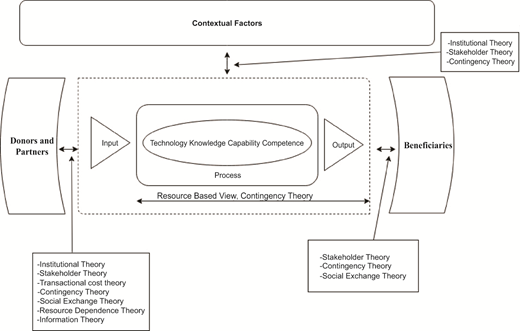
Framework for organization theory (OT) and the humanitarian supply chain (HSC)
Framework for organization theory (OT) and the humanitarian supply chain (HSC)
The framework places HOs at the center and characterizes them as actors responsible for processing inputs into outputs by means of technology, knowledge, competency and capabilities. The focal HO interacts with external humanitarian actors (i.e. donors and partners) to fulfill various goals, such as acquiring complementary resources, relief supplies, funds and so on. For instance, HOs interact with local partners to gain knowledge about local geography and culture (Jabbour et al., 2017), as well as to access distribution channels that local partners have already built (Altahir, 2013). These interactions continuously evolve with time, with the aim of managing the trade-offs between various HSC-related strategic decisions (Gralla et al., 2014). Hence, the decision of whether to establish a long-term relationship with suppliers or adopt an arm's-length purchasing strategy needs to be continuously evaluated to attain optimum outcomes (McLachlin and Larson, 2011). Understanding organizational interactions through the lens of OT can make such decisions more effective and impactful.
This framework also illustrates possible applications of OT to explain the antecedents and consequences of particular interfaces. For example, when skills and competencies interact with technology, the result is greater organizational capability (Apte et al., 2016). The widely accepted theory for capability building is the resource-based view (Barney, 1991); thus, we placed the resource-based view in the internal interface. Similarly, many external factors (i.e. donors, beneficiaries, contextual factors) also affect the strategic directions and decisions of a focal HO. For example, IFRC failed to effectively respond to Hurricane Mitch (1998), which attracted fierce criticism from donors (primary stakeholder), media (secondary stakeholder) and governmental and international organizations (institutions). These external factors made IFRC to take several strategic decisions to revamp its humanitarian response management method and techniques, such as incorporating fast assessment and coordination teams (FACT) and so on (Samii and Van Wassenhove, 2004). For given situations like this, we located institutional theory, social exchange theory, transactional cost theory, stakeholder theory and resource dependence theory in the external interface. For example, the relation-building process during interorganization exchange, which takes place between focal HOs and other external actors (Tomasini and Van Wassenhove, 2009), can be understood by adopting social exchange theory (McLachlin and Larson, 2011; Moshtari, 2016), transactional cost theory (Williamson, 1975) and resource dependence theory (Pazirandeh, 2017). Further, HOs have shaped their policies and mandates (which significantly influence the operations of the HSC) in line with institutional pressure, which comprises governmental regulations, donors and local communities (Dube et al., 2016; UNISDR, 2015). Furthermore, the influence of other actors can be understood through the lens of stakeholder theory and institutional theory, while information theory can be used to mitigate uncertainty (due to scarce information) in the HSC setting. The extant literature on contingency theory (Sousa and Voss, 2008) suggests that it is applicable to both interorganizational and intraorganizational interactions. Therefore, we placed contingency theory in both interfaces.
The proposed framework has some limitations that should be noted here. First, the framework is not an exhaustive illustration of OT and its applications. Second, OT application highly depends on the stage of research advancement. As more complex studies emerge, theory can be used in a complementary manner to explain complex phenomena (Astley and Van de Ven, 1983; Touboulic and Walker, 2015; Van Maanen, 1995). For example, the resource-based view has been utilized with other theories, such as TCE, agency theory, institutional theory and so on. (Hitt et al., 2016).
In summary, any growth in the number of HSC studies underpinned by the OT framework should be motivated by a strong practical relevance. HOs are tasked with solving complex humanitarian challenges, and organizational theories constitute useful frameworks for making sense of these complexities. Van de Ven (1989) rightly noted that a “good theory is practical precisely because it advances knowledge in a scientific discipline, guides research toward crucial questions, and enlightens the profession of management” (p. 486). In this vein, the proposed framework will hopefully galvanize studies that utilize theory to generate managerial insights with strong practical relevance in the humanitarian context.
6. Conclusion
This study primarily highlighted the relevance of OT in the HSC. It reviewed the HSC-related literature and identified useful organizational theories that can potentially expand our knowledge regarding HOs. The paper also introduced, explained and outlined future research questions based on eight theories: namely, the resource-based view, resource dependency theory, social exchange theory, contingency theory, institutional theory, stakeholder theory, transactional cost theory and information theory. The paper underscores that humanitarian research that explicitly applies theory is in a nascent phase and has ample room to grow.
In conclusion, the present study makes several observations. First, OT offers several theoretical frameworks for investigating and furthering HO research. Second, future HO research offers many opportunities to use previously utilized and well-understood theories and thereby address many unanswered questions. Third, the new theories described herein offer ample opportunity to examine the HSC setting; institutional theory and stakeholder theory, in particular, have yet to receive significant attention. Fourth, most research applying OT in the HSC context has been recent, revealing that we are in an early stage of understanding the linkages between HSC and OT. This study hopes to help define the future direction of HSC research.
6.1 Limitation and future research direction
As a field, OT is very broad, which is why our study adhered to the boundaries set by Touboulic and Walker (2015) and Sarkis et al. (2011). Consequently, the biggest limitation of our paper is that the proposed theories and research questions are not exhaustive: we did not, for instance, consider organizational theories such as agency theory, organizational information processing theory (OIPT), complexity theory, social networks and behavioral theory. However, we will present a brief overview of these theories and their potential for future research in the next paragraph.
Agency theory explains the dynamics in a principal–agent relationship (Halldorsson and Skjott-Larsen, 2006) and helps organizations devise the most efficient contract for governing said relationship (Fayezi et al., 2012). One possible research question stemming from this theory might be: “How do participants within the HSC align incentives and manage risks?” Meanwhile, OIPT explains the relationship between information processing needs, information processing capability and organizational performance (Srinivasan and Swink, 2018). One possible research question could be: “What factors define various types of uncertainty (i.e. environment uncertainty, relationship uncertainty, task uncertainty) in the humanitarian context?” Complexity theory states that as complexity (i.e. the diversity in environmental factors such as suppliers, donors, partners and beneficiaries) increases, planning for and predicting organizations' actions (e.g. prepositioning, forecasting, collaboration) becomes more difficult (Chakravarthy, 1997). This theory proposes that organizations should be aware of interdependencies and coevolution in order to reduce complexities (Sarkis et al., 2011). One possible research question could be: “How are donors sensitive and responsive to interdependencies with the implementing partner in serving the beneficiaries?” Social network theory states that organizational outcomes are a function of the social ties among organizations or individuals in an organization (Jones et al., 1997). The two important concepts of this theory are: density (number of ties in the social network of individual/organization) and centrality (the position of an individual/organization in the social network) (Seyfang, 2006). A potential future research question is: “What is the role of the cluster lead's social ties in terms of establishing effective coordination during a humanitarian response?” Behavioral theory explains the effects of psychological, emotional and cognitive factors on the decision-making of individuals and organizations (Villa et al., 2018, pp. 127). In this regard, future research could study the contract preference profile for both the buyer and supplier by using a mental accounting-based utility structure (see Kalakbandi, 2018). Future research could also examine other aspects of OT-based research—such as research methodologies, tools and measurement instruments—that could be used to investigate the HSC-OT linkage.

