


The purpose of this research is to understand whether an organization knows if it is ready to respond to a disaster and whether it has the capabilities to deliver relief. Our initial motivation was to identify unique resources possessed by the United States Navy (USN) and United States Marine Corps (USMC) due to their unique and critical capabilities for humanitarian operations. The recent frequency of disasters around the world suggests these events will continue to create demand for relief capabilities. For this reason we need to understand readiness metrics not just for USN and USMC but for humanitarian organizations (Hos) in general.
We survey relevant literature for understanding how HOs define and develop readiness metrics and associated factors. We studied documents including peer-reviewed scholarly articles, government documents, white papers, research papers and Department of Defense (DoD) briefings. We study literature that is significantly written for DoD, one, the vast experience of USN and USMC and two, the lessons learned have been documented. The literature offers substantial information on what readiness means and why it is important. This documented information is critical because it is known to the researchers in humanitarian operations that data is hard to come by.
The framework for readiness proposed at the end of this article is context the emergency responder probably uses in an informal fashion. The validation of readiness framework, we find exists in the supporting literature we review.
The understanding of readiness metrics for humanitarian operations for the organizations we study may offer insight into other HOs. The insights we gain may not be pivotal or counterintuitive to the conclusions based on commonsense. However, they are supported by the literature review. We formalize the concept based on conclusions of a set of diverse set of researchers and practitioners such as academic scholars, DoD personnel and government officials involved in humanitarian missions, USAID representatives that are repeatedly tasked for being ready, military and government officers from host and foreign countries and many more.
Introduction
Significant suffering and casualties due to natural disasters across the world initiate response from humanitarian organizations (HOs). In this research, HOs are defined as those organizations that provide humanitarian relief, whether military or non-military (NMO) and whether government or non-government (NGO). In spite of extensive challenges in humanitarian logistics (Kovács and Spens, 2009), HOs provide humanitarian assistance based on their core competencies (Apte et al., 2016). The questions addressed in this research, through literature review, are whether an organization knows if it is ready to respond to a disaster and whether it has the capabilities to deliver relief. The lessons learned from past disasters provide performance indicators. The lessons learned also draw attention to gaps between demand and supply. Together these offer insight into readiness metrics.
After the 2010 Haiti earthquake, the functional organization and staffing of the US military commands found out that there were significant gaps affecting their ability to provide an effective and efficient response. A strategic plans officer for the United Nations said, “The military's planning capability is not the most expensive part, but it is probably the most valuable. The international coordination structure would not have stood up if they weren’t there—we tapped into the Joint Task Force (JTF) planning capacity” (DiOrio, 2010). Given vast areas of responsibility, the number of disasters in the last decade, and the lack of lead time to prepare for relief for certain types of disasters (Apte, 2009), organizations need to be prepared and such preparation includes understanding the readiness metrics.
The United States Navy (USN) and United States Marine Corps (USMC) have been active and major suppliers of disaster relief due to their unique and critical capabilities (Apte et al., 2013; Apte et al., 2016). When a disaster strikes, the host nation requests outside assistance if needed. When requested, the USN and the USMC, under the guidance of United States Agency for International Development (USAID), get deployed for humanitarian operations. Other HOs provide assistance based on their core competencies and capabilities. Some governments also offer humanitarian assistance. Figure 1 shows the donor governments that contributed the most dollars to humanitarian assistance in 2012.
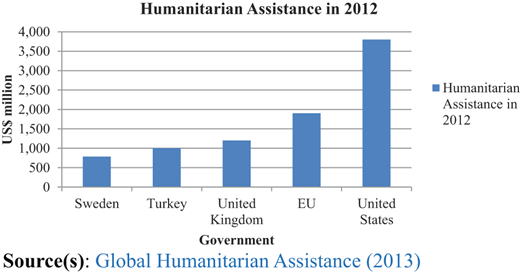
Humanitarian assistance costs money and the United States, like other countries, spends a significant amount (Global Humanitarian Assistance [GHA], 2013). The amount of humanitarian aid given by the US government from 2008 to 2016 can be found in Margesson (2015) and is illustrated in Figure 2.
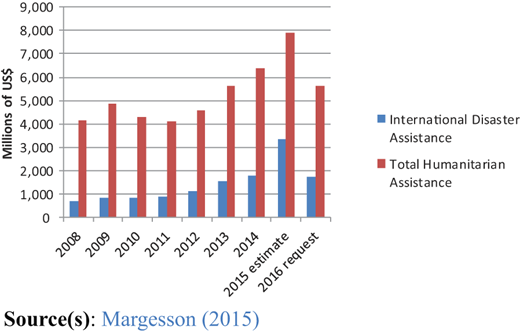
Whether this effort will continue and be sustained in an environment of fiscal austerity and budget cuts is not known. Our initial motivation was to identify unique resources possessed by the USN and USMC. The USN, due to its core competencies and capabilities, supports humanitarian logistics, and the USN's readiness level needs to be understood in order to utilize these resources. The USMC can rapidly respond to disasters because it maintains high levels of readiness on a constant basis. The USMC provides critical resources for humanitarian missions through its Marine Expeditionary Units (MEUs), which are flexible and adaptable enough to accomplish a wide range of operations, including non-combat missions (Apte and Yoho, 2014).
Given the recent frequency of disasters around the world, it is probable that the occurrence of these events will continue, thus creating a demand for relief capabilities (Ferris, 2008). For this reason, we believe we need to explore literature to identify readiness metrics not just for the USN and the USMC but for HOs in general. However, the understanding of readiness metrics for humanitarian operations for the organizations we study may offer insight into other HOs. The insights we gain compared to the conclusions based on common sense may not be pivotal or counterintuitive. However, they are supported by the literature review. The framework for readiness proposed at the end of this article is context the emergency responder could probably use in an informal fashion. Here, we formalize the concept based on the conclusions of a set of diverse researchers and practitioners such as academic scholars, Department of Defense (DoD[1]) personnel and government officials involved in humanitarian missions, USAID representatives that are repeatedly tasked for being ready, military and government officers from host and foreign countries and many more. The contribution we make is the validation of a readiness framework through an understanding of what readiness in humanitarian missions means as supported by literature.
Due to the vast experience of the USN and USMC in responding to disasters around the world, we study literature that is significantly written for the DoD. The lessons learned by the USN and the USMC, and more importantly documented by those organizations, offer substantial information on what readiness means and why it is important. This documented information is critical because such data is hard to come by Holguin-Veras et al. (2012). The possible reasons are that there is a small number of individuals that practice in emergency response, hence public documentation of disaster relief efforts is not readily available.
We offer the following literature review that we believe supports our understanding of readiness metrics for humanitarian operations. Our literature review is based on the following logical strain: lessons learned help understand the gaps between relief provided and unmet demand. These gaps suggest how to be ready for better outcome in the future disaster. We develop our conceptual framework on this basis in the conclusion of this article.
Literature review
The relevant literature was surveyed for understanding how HOs define and develop readiness metrics or factors associated with the metrics. We studied literature including peer-reviewed scholarly articles, government documents, white papers, research papers and DoD briefings. Altay and Green (2006) offer valuable information about operations in disaster management. To assist in this process, we divided the literature into four categories: disasters and lessons learned, civil and military collaboration, core competencies and capabilities and challenges in humanitarian operations. These topics help develop a path for recognizing readiness in HOs. Figure 3 describes the reasoning behind and the process of the literature review.
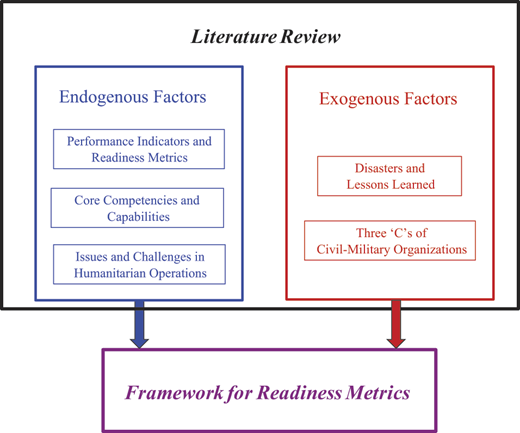
The methodology described in Figure 3 is followed systematically in the literature review. In the section titled “Endogenous Factors”, we discuss the articles based on the topics of performance indicators and readiness metrics as defined by the organization, core competencies and capabilities of an organization, and the internal issues and challenges in humanitarian operations of the organization. In the subsection titled “Exogenous Factors”, we discuss articles describing past disasters and lessons learned from them. We focus on four disasters for the lessons learned: the 2010 earthquake in Haiti, the 2011 earthquake and tsunami in Japan, 2013's Typhoon Haiyan (Yolanda) in the Philippines and the 2014 earthquake in Nepal. Disaster relief is given by different organizations—military, non-military and non-government. The communication, coordination and collaboration among these organizations, “Three Cs” of Civil-Military Organizations (Poole, 2013), are key to the efficiency and efficacy of the humanitarian operations that in turn influence performance from the past and readiness for the future.
When disaster relief does not adequately meet the demand of the affected region and the population, the HOs involved seek the cause of this gap between supply and demand. The reviewed articles help explain the reasons that these gaps occur. Understanding the reasons for these gaps also helps the organization know how to be ready the next time a disaster strikes. Measuring the readiness that is embedded into the core capabilities and competencies of the organizations is another way to mitigate the shortcomings of the relief. Relief falls short for many possible reasons, including the scope and scale of the disaster; the ill-managed distribution and transportation of critical supplies and services, resulting in further suffering of the affected population; inadequate needs assessments, resulting in mismatch of delivered commodities; and a lack of transfer of information and knowledge from previous humanitarian missions to identify lessons learned. In some cases, lessons were learned, but no after action reports were generated, and as a consequence, no metrics were formulated to mitigate the next disaster (Government Accountability Office [GAO], 2016).
The literature on performance evaluation and readiness in humanitarian logistics (HL) has evolved over the years. As we will describe in the literature review, scholars and practitioners have considered measuring the performance and readiness from many aspects such as sustainability angles, approaches from the private sector, through the lenses of gender, customer-oriented perspective and flexibility of the supply chain network. In this article, we look at the framework from a different perspective. Certain functions are endogenous to the organization and some are exogenous (Leonard, 2018). We study the endogenous and exogenous factors of an HO. From this view point, our research adds a new dimension to the literature of HL.
Endogenous factors
Performance indicators and readiness metrics
The absence of clear performance indicators and/or readiness metrics in HOs has been recognized by the humanitarian community. Davidson (2006) says that, due to their incapability and lack of time, HOs do not measure performance indicators. The organizations lack any fundamental framework to understand the readiness metrics because they do not have a good measure of performance indicators after the disaster. There are several factors that contribute to the difficulty of defining and measuring either the performance indicators or readiness metrics in HOs (Davidson, 2006).
However, since then, there have been significant contributions to the literature discussing performance and readiness in humanitarian logistics. Mat Daud et al. (2016) offer a literature review for humanitarian logistics and its challenges, demonstrating the importance of HL. A systematic survey for future studies in HL and supply chain management (SCM) is done by Jabbour et al. (2017). We, in this research, perform a somewhat informal survey of the literature to understand measurement of performance and readiness metrics for HOs. In fact, performance measurement in humanitarian logistics recently has become a key driver in warranting efficiency and efficacy. Our motivation to understand readiness metrics by exploring the literature has been supported by the articles discussed in this section.
Santarelli et al. (2015) offer a holistic performance measurement system that can be applied to the humanitarian supply chains. However, the authors indicate that the empirical testing demonstrates low use of existing performance measure by HOs in humanitarian supply chains.
Salvado′ et al. (2017) discuss the sustainable performance measures for humanitarian operations in a supply chain in terms of source, make and deliver. The sustainability angles are based on people, planet and profit. They suggest a basis for decision support system in humanitarian operations planning.
Bolsche (2013) discusses the performance measures in HL. The author uses approaches from the private sector and applies these models to humanitarian sector. The finding is that performance measure is more than the collection of data and indicators. It is combining process-oriented logistics and SCM that gives appropriate performance measure by giving basis for preparedness and continuous improvement in humanitarian operations. Abidi and Scholten (2015) study available performance measurement framework from the private sector to evaluate their applicability to humanitarian supply chains. They find that the framework does have some potential of applicability to humanitarian supply chains.
Kovács and Tatham (2009) discuss performance in HL through the lenses of gender—specifically,sex segregation in logistics and gendered access to humanitarian aid. Kovàcs and Tatham (2010) discuss the skillset of HL. Their study for testing the T-shaped model for logistics skills from the perspective of performance focuses on HL. They conclude that the certain male skills may prevent women from becoming logisticians.
Schiffling and Piecyk (2014) look at performance measures in HL from a customer-oriented perspective. Their study takes into account key stake holders. They claim that the beneficiaries are the customers and donors are the stake holders. Their framework combines complexities of humanitarian supply chain and customer-oriented focus.
Baharamand et al. (2017) indicate that the performance of humanitarian supply chain depends on the definition and flexibility of the supply chain network. The success depends on how flexible the supply chains are to adapt to needs, infrastructure conditions and the behavior of other organizations. They specifically study the 2015 earthquake in Nepal.
Humanitarian operations’ researchers understand that the collection of realistic data is a tough task (Holguín-Veras et al., 2012). Some of the factors hindering data collection are the small number of practitioners in the field, which makes it hard to collect the data, and the lack of availability of accounts of disaster relief efforts. Tatham and Hughes (2011) indicate that though need for readiness metrics is recognized in the humanitarian logistics collecting data is hindered due to constraints on communication and information technology.
In the DoD literature, there are discussions about military readiness metrics. However, these are predominantly about conflict readiness (GAO, 2016). In a broad sense, the DoD defines readiness as the ability of the forces to combat, meet the demands to achieve security objectives and meet the needs of the national strategy. One observation is that the DoD's rebuilding efforts for readiness may not work if there is no comprehensive plan in place. A framework is necessary for combat readiness (GAO, 2016). This observation further accentuates the lack of any specific framework for readiness metrics for missions other than war, and it demands that such a framework be developed. Vast amounts of money, to the tune of $350 billion, invested for this purpose indicate the importance that the DoD places on the readiness of its services for current and future operations (Trunkey, 2013). Readiness is assessed at the individual service level and at the joint forces level. Typically, the DoD reports readiness through the Status of Resources and Training System (SORTS). Recently, SORTS, due to its limitations, was transitioned into the Defense Readiness Reporting System (DRRS), which uses a dashboard style display. DRRS has major improvements over the previous system, some of which are given in Table 1.
Improvements of DRRS
| SORTS | DRRS | |
|---|---|---|
| Mission | Readiness is reported for one highlighted mission that the unit was designed for (usually the unit's core wartime mission) | Readiness is reported for a range of missions and tasks including a unit's wartime mission |
| Assessment | An overall readiness score is calculated from scores in four resource areas | A commander gives an overall assessment for each mission based on assessments of tasks and the resources available |
| Sources of data | Unit commanders track data and make calculations | Calculations are automatic, using service wide databases |
| Reporting units | Deployable combat and support units such as ships, squadrons and brigades | Deployable combat and support units such as ships, squadrons, and brigades, plus detachments, headquarters (including Combatant Commands), National Guard units (all missions) and installations |
| Standardization across the services | The services have different reporting procedures, but all reports have the same formatting | Each service has a distinct DRRS system. The systems are electronically compatible and are part of one common system |
Source(s): Trunkey (2013)
Performance measures for humanitarian supply chains offer insight into possible readiness metrics for HOs. Haavisto and Goentzel (2015) offer a review of literature based on supply chain performance measure. Table 2 describes their contribution.
Review of literature on performance objectives
| Humanitarian supply chain performance measure | Author |
|---|---|
| Output | Beamon and Balcik (2008), Blecken et al. (2009) |
| Flexibility | Beamon and Balcik (2008) |
| Efficiency (resources) | Beamon and Balcik (2008), Blecken et al. (2009) |
| Cost | Blecken et al. (2009) |
| Service level (customer/beneficiary/donor) | Schulz and Heigh (2009), van der Laan et al. (2009), de Leeuw (2010) |
| Accuracy | Davidson (2006), van der Laan et al. (2009) |
| Financial control and efficiency | Davidson (2006), Schulz and Heigh (2009), de Leeuw (2010) |
| Process adherence | Schulz and Heigh (2009) |
| Time (e.g. donation-to-delivery) | Davidson (2006) |
| Coverage, equity | Davidson (2006), Balcik et al. (2010) |
| Utilization | Blecken et al. (2009) |
| Innovation and learning | Schulz and Heigh (2009), de Leeuw (2010) |
| Quality of life and well-being | Tatham and Hughes (2011) |
Source(s): Haavisto and Goentzel (2015)
Van der Laan et al. (2009) offer a review of literature identifying the necessary conditions for performance measures for humanitarian supply chains. The authors present a framework that involves two phases: design and implementation. The first phase depends on strategically important functions—the will of the organization to measure operational performance and the implementation of an information system to do so. The second phase, which depends on implementation, includes the framework being future-oriented and aligned with the selected strategy. The framework should also strike a balance between financial versus non-financial with quantitative and qualitative indicators.
There are many aspects to a supply chain (such as material and information flow, players of the supply chain), but one prevalent issue, especially in the commercial supply chain, is the last-mile delivery problem. Efficiency or minimizing the cost is the objective. However, in response supply chains (RSCs), the goal is broader than in a commercial supply chain because humanitarian concerns are part of the picture. Huang et al. (2011) focus on meeting the need through quick and sufficient but equitable distribution. They measure the performance of supply chains based on three criteria—number of vehicles, routes and impact of demand—and their observations provide practical insight into relief operations. The performance measures suggest possible readiness metrics, such as maintaining a larger number of small vehicles for effective and equitable distribution of critical supplies and services, and they suggest some rules of thumb for quick decisions by emergency responders.
A similarly focused approach, but one that is concentrated specifically on the rapid needs assessment that is defined as a core competency for HOs (Apte et al., 2016), is discussed by Benini and Chataigner (2014). With a needs assessment as the key objective for determining the state of the affected region and population, the authors describe a “prioritization matrix”, a tool that has been used recently to determine demand of the affected region. They offer expansion of this tool. The matrix is based on composite indicators that are managed through spreadsheets, and the methodology is at the intersection of decision science and humanitarian operations. They use the data from the 2013 Typhoon Haiyan (Yolanda) in the Philippines to substantiate their analysis.
Norio et al. (2011) review the causes and impacts of the 2010 Japan earthquake and tsunami. The management of the expanded capacity and capability after the 1995 Hanshin-Awaji earthquake in Japan provided a significant benefit in the disaster relief for the 2010 earthquake. However, they believe more can be done. When there is potential for a disaster to turn into a crisis (as in the 2011 earthquake and tsunami in Japan), it is necessary to deploy a collaborative framework based on available resources. Such a framework should take into account the geographic scope of the disaster, thus enabling different governance approaches and mutual assistance and recovery systems. Norio et al. (2011) believe that centralized power for sudden and dispersed disasters is vital, that existence of a new international platform for joint management is essential and that further research of such frameworks is needed; the lessons learned from the 2010 Japan earthquake and tsunami mandate that infrastructure around the nuclear power plants be robustly planned and designed.
All HOs, including the DoD, currently face the challenge of measuring the impact of their work (Bonventre, 2008). Boaventre (2008) lists at least three reasons why the DoD should measure the impact of humanitarian assistance programs. First, measuring the impact of HOs offers opportunities for future and mid-course corrections in the projects through feedback loops, enabling planners to underscore activities that are cost-effective. Second, the collection and sharing of data prevent the duplication of activities performed by all HOs. Not duplicating activities help researchers understand the core competencies and capabilities of HOs. Third, analysis based on collected data offers transparency and quantifiable results that do not leave any ambiguity. The presence of several HOs when a disaster strikes is common. In the Philippines during assistance and relief for Typhoon Haiyan in 2013, there were 29 foreign militaries also present. The key point here is to understand core competencies and capabilities of all the organizations involved so duplication of efforts is reduced.
In summary, readiness metrics for humanitarian operations can be identified if performance indicators can be measured. For this reason alone, the impact of humanitarian operations ought to be measured. Many factors impede this measurement. Availability of combat readiness may assist in formulating readiness metrics for humanitarian missions since war and disaster share many attributes. Humanitarian supply chain and combat supply chain along with commercial supply chain share one key trouble point that is last mile delivery. Performance of this step in the supply chain has to be measured post disaster in order to identify readiness metric pre-disaster. Understanding demand for assessing need of the affected region offers insight into cause and impact of the disaster.
Core competencies and capabilities
Apte et al. (2016) identify the competencies and capabilities that are core to US military and non-military organizations (NMOs) for humanitarian assistance and disaster relief (HADR). The authors believe that both military organizations and NMOs bring assets, skills and capabilities to a humanitarian crisis; however, their competencies and capabilities are very diverse. Identification of the specific competencies and capabilities that are core to these types of organizations can enable better planning by both military and NMOs, allowing them to achieve greater effectiveness and efficiency in their humanitarian responses. Apte et al. (2016) build on existing literature on the core competency of corporations in the private sector. In their research, Apte et al. (2016) extend the concept of identifying, cultivating and exploiting the core capabilities of the private sector to the organizations that seek to respond efficiently and effectively to disasters. They develop a core competencies test for such organizations. They also identify the top five essential services and capabilities for disaster relief as information and knowledge management, needs assessment, supply, distribution and deployment and health services support.
One of the substantial players in humanitarian assistance and disaster relief around the globe is the USN. Roughead et al. (2013) offer an in-depth analysis of the USN's humanitarian assistance, especially in the face of budget cuts and austerity. Their research does not focus on a specific disaster, but rather studies the proactive engagement or strategic pre-positioning (Apte, 2014) of humanitarian assistance. Roughead et al. describe the principal benefits of their research: strengthening relations in critical geographic areas through greater cultural understanding, improving the capabilities and readiness of USN humanitarian assistance and reinforcing other capabilities such as health systems of host nations.
HADR by the USN is evaluated by Apte et al. (2013) using a structured, qualitative evaluation schema complemented by expert ratings. They evaluate the capabilities and utility of ships in the USN. They find that there are specific types of vessels with significant disaster response utility and recommend a flotilla type that would be best suited for humanitarian operations. Utilizing an exploratory framework that evaluates three diverse disaster cases, they measure the utility of each vessel through the help of subject matter experts. They find the type of ships most useful for contributing to effective disaster response.
Apte and Yoho (2014) study the USMC resources, including the MEU, that are primarily responsible for the humanitarian response. They study recent HADR events to determine how demands were met by the USMC. They identify the supplies that can meet these demands by examining both assets and capabilities of the USMC. By exploring significant gaps, if any, that can be improved by the MEU, they suggest ways to increase the effectiveness of the USMC's response to HADR. A primary take-away from their work is the challenge faced by the USMC to match the capabilities of the USMC to the demand created by future disasters. Issues and challenges in humanitarian operations that deliver disaster relief are described in the next section.
To summarize, humanitarian assistance can be improved if the organizations exploit their core competencies. Cultivating the core competencies is especially critical in austere environment. The USN and USMC bring their unique capabilities to the humanitarian operations. Identifying these capabilities is necessary to be efficient and effective in disaster relief so that the resources are best utilized.
Issues and challenges in humanitarian operations
Roughead et al. (2013) list the operational challenges for the USN, such as short-term or discontinuous engagement in HADR, lacking enduring coordination and development, insufficient integration with host nations and NGO operatives, dependence on sole assets of vessels that may not serve the necessary demand, inadequate and irregular funding, and most notably, difficulty in measuring the alignment of humanitarian efforts with strategic goals. They recommend that the USN clarifies and focuses on the motivation behind the humanitarian assistance to fund the operations sufficiently and without rigidity, and increase the scope and scale of the planning process of HADR allowing coordination with NGOs and host nations. But most importantly, they point out that the USN needs to develop and implement a robust set of metrics for readiness in humanitarian missions.
A major challenge in any SCM is measuring the performance of that supply chain. In the commercial sector, the focus is on resources for optimizing the input (cost) or output (profit). However, for a supply chain established to respond to a disaster, RSC, the focus must be on the time required to respond or the ability to meet the demand. An RSC is designed to be efficient based on the amount or number of resources used to meet the goal of that organization and to be effective based on the level at which it meets the preset goal (Beamon, 2004). Developing such a system for measurement is one of the issues associated with RSCs. Beamon (2004) lists the issues as structure of the RSC, distribution network, inventory control, type of measuring system, coordination with other organizations involved in humanitarian assistance (HA), acquisition of supplies, and finally, the actual measurement.
Beamon and Kotleba (2006) describe the stochasticity of the demand of the disaster, and if the disaster is large scale, the strain that it creates on the physical distribution. Figure 4 shows the complexity and hence difficulty of humanitarian operations (Yoho and Apte, 2014).
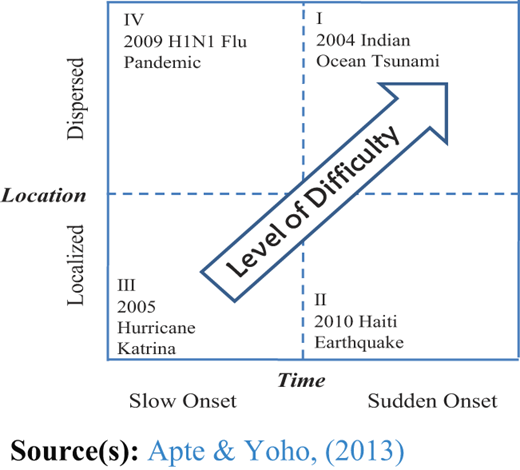
Other challenges for RSCs are the inadequate or incorrect estimation of demands that lead to further casualties and suffering in the affected area (Apte and Yoho, 2011; Duran et al., 2011; United Nations, 2007; World Meteorological Organization, 2009). Estimating where and when such demand is needed (Apte, 2009; Apte et al., 2013; McCoy, 2008) is even harder. Demand in the host nation is external to the organization providing relief. The next focus is on such exogenous factors.
In short, even if the organizations execute humanitarian operations from their core competencies, the operational challenges still exist for any organization—public or private. Realizing these challenges and wanting to mitigate the after-effects of the disaster compel the organizations to assess their readiness for delivery of relief. However, the challenges have diverse origins. Understanding the geneses of these issues in the RSC, whether they are dependent on the type of the disaster or operational issues or supply/demand constraints, will facilitate the formulation of readiness metrics.
Exogenous factors
Lessons learned: Haiti
On January 10, 2010, a 7.0 magnitude earthquake struck Haiti near Port-au-Prince. The earthquake caused 316,000 casualties. In addition to the Haitian losses, the earthquake also claimed the lives of members of the United Nations Stabilization Mission in Haiti. This earthquake decimated Haiti's infrastructure. The paralyzed Haitian government was overwhelmed and requested immediate assistance from all over the world. The Dominican Republic received thousands of refugees, but, being a small country, it had limitations. Haiti's urgent request to the US government prompted an immediate response.
Even before the disaster, Haiti had fuel and water shortages and medical support was scarce. After the disaster, conditions worsened quickly. Poor infrastructure and inadequate disaster preparedness limited the delivery of relief (McCunn et al., 2010). Though access to the airport was limited, the US Air Force (USAF) stepped in to maintain security and air traffic control. After this rapid and successful transition, medical support was delivered by many HOs, including the US military and other military organizations, NGOs and government organizations.
The earthquake damaged the Port of Haiti, and it was not operable. The bulk of supplies for immediate sustainment had to be delivered by sea. The lack of a designated logistics team within the Global Response Team at the Joint Task Force (JTF) headquarters meant that deployment planning had to be done at short notice, thus increasing obstacles to an already challenged supply chain. Many in the JTF team were not in contingency status and, hence, were deployed with suboptimal preparation. This resulted in the supplies being pushed quickly, but in an ad hoc way without formal planning, sourcing and tracking processes; this meant that a substantial part of the bureaucracy was eliminated, which enabled a quick response.
“The military's planning capability is not the most expensive part, but it is probably the most valuable. The international coordination structure would not have stood up if they weren't there– we tapped into the JTF planning capacity” as stated by UN strategic plans officer (DiOrio, 2010). The accomplishments of the JTF during Haiti HADR can be divided into the following areas: airport, sea port, DoD medical support, shelters, overall support and a secure environment for the operations (DiOrio, 2010). Best practices emerged from these activities: deployment and support from strategic level liaisons to tactical level (national response); the use of unclassified operation environment for information sharing and collaboration between all stakeholders; the establishment of a JTF Force Flow working group (force projection), the interface between Humanitarian Assistance Coordination Center and Joint Operational Task Center and NGOs, private voluntary organizations (PVOs), and UN systems (coordination); and the establishment of a Joint Interagency Information Cell.
One of the important findings from the HADR provided by the Joint Center for Operational Analysis (JCOA) was the swift establishment of a response structure (DiOrio, 2010). Also, civilian and military resources were pushed not only to resolve but to overcome the problems. This was done by (1) a pre-established response management team (RMT) dependent on the classification of the disaster performed in five functional areas: management, planning, logistics, administrative and communications; and (2) a Joint Staff team plugging in with RMT. This last finding turned out to be the best practice despite the region not having connectivity other than commercial Internet (although USAID had visibility for the movement of DoD resources).
Haiti also taught a few lessons to the USN (Keen et al., 2010). They had to overcome internal organizational issues, gain situational awareness, and satisfy an extraordinary demand for information. The use of “open” communications and unclassified information sharing over BlackBerry devices allowed for expanded coordination and collaboration with DoD organizations. Personal and professional relationships among key leaders permeated all levels of interaction and engagement within organizations. And lastly, the quick establishment of land-based headquarters reassured the affected population and enhanced coordination with the host country, state government, USAID, UN and NGOs.
Lessons learned: Japan
On March 11, 2011, a 9.0 magnitude earthquake struck Japan. A tsunami followed soon after and the losses incurred were extremely severe. Several nuclear power plants were heavily damaged resulting in rolling blackouts. The earthquake also affected the transportation system, and for a short time, all the ports were closed. Part of the high speed rail line was shut down, and the Sendai airport suffered extensive damage due to the tsunami. But the devastating blow that pushed this disaster into a crisis was the meltdown of the Fukushima nuclear power plant.
Carafano (2011) assesses the response to the 2011 earthquake in Japan and outlines the lessons for the United States to evaluate its own capacity to deal with a future crisis. Carafano studies critical areas and the corresponding key findings and resources in the United States (see Table 3).
Critical areas and key Findings, 2011 Japan earthquake
| Preparedness and response | Effective planning, preparedness and mitigation measures with possible decentralization for execution of this plan is necessary |
| Need to nurture a national culture of preparedness by concentrating on self-reliance in communities as well as individuals is essential | |
| Communicating the risk | Community awareness and understanding risk through communication fetches better cost-effective results than protection measures such as building seawalls |
| Communicating risk of low-dose radiation and building confidence for that risk | |
| International assistance | The United States and, based on history, Japan have difficulty receiving aid. The United States needs to bolster its capacity to accept and apply international aid efficiently |
| Critical infrastructure | Need to focus on the most “vital” infrastructure (United States–Canada grid) to maintain resilient infrastructure that can recover quickly in case of disaster |
| Industry and federal regulators need to work together to understand lessons from Fukushima and how they can be adapted for nuclear disasters in the United States |
Source(s): Carafano (2011)
Wilson (2012) focuses on the United States' response to the 2011 earthquake and tsunami in Japan, called Operation Tomodachi. The response efforts and the collective use of the military stationed abroad offer a model for further US efforts across the globe. Wilson identifies the activities that worked well, such as the value of maintaining US forces abroad, the use and capabilities of remotely piloted aircrafts, the voluntary evacuation of US dependents, bilateral coordination between Japan and United States and the benefit of social media throughout the disaster response. These lessons learned—such as improving bilateral coordination, removing control and command confusion and preparing for large-scale decontamination—are also critical for handling future disasters. The author concludes that describing the success of Operation Tomodachi will induce fewer cuts in the DoD's budget because it will bring humanitarian assistance to the forefront, as opposed to the DoD's current focus on combat operations in Iraq and Afghanistan.
Terada (2012) notes that during the assistance and relief following the 2011 earthquake in Japan, information should have been shared and appropriate tasking should have been implemented among the participants. There should be more training and exercises for US Joint Forces as the DoD's support for HADR increases so that professionalism is enhanced and roles are clarified (Staff, 2012).
Japan is a developed nation and fairly self-sufficient in disaster relief. However, it did not have much experience in receiving aid from across the world. Thus, one of the lessons learned was to institute training for international guidelines among relief providers (Smart, 2012). It is also imperative to establish an effective media strategy for controlling and disseminating information when there is a need for receiving real-time facts.
Katoch (2012) stresses that information must flow freely among collaborators and no silos should be permitted. Clear protocols should be set with a chain of control at all levels of the departments involved from the host government, military organizations and NGOs. Organizational structures and processes, in compliance with humanitarian and military doctrines, must be pre-established at local, national and international levels. Having close ties with such organizations, however, is not adequate for productive civil–military coordination. This was evident during the 2011 earthquake in Japan in the coordinating pains experienced by the United States and Japan, despite their relationship as Allies (Katoch, 2012).
Wambach (2012) emphasizes establishing relationships in order to share information before a disaster strikes. The author also emphasizes that agreements have to be in place for practical methods of coordination, and that relief needs to be planned in advance to make use of the specific strengths of the responding organizations. Finally, better preparation by the host country will always help mitigate suffering.
The 2011 earthquake in Japan also taught lessons about having a geographical perspective. Developing a tsunami response system using inundation maps helps disaster managers model the potential effects of a tsunami so that the most suitable shelter locations and optional evacuation routes can be planned (Hong, 2012). Such lessons were also learned during Super Typhoon Haiyan (Yolanda) in the Philippines in 2014. For example, a shallow draft in the ocean surrounding the land adds to the destruction because it produces more surges. Therefore, to understand threats, warnings must be accompanied by an analysis of the impacts on the ground (Center for Excellence in Disaster Management and Humanitarian Assistance [CFE-DM], 2015).
Lessons learned: Philippines
On November 8, 2013, Typhoon Haiyan (Yolanda), one of the strongest cyclones ever, made landfall in the Philippines causing extensive damage. The extensive damage to the internal infrastructure made transportation of goods extremely difficult to the point that signs of assistance and relief were only visible three to five days after the typhoon struck the Philippines (CFE-DM, 2014). The DoD, supporting the Armed Forces of the Philippines, and USAID played a significant role in HADR. UN agencies also responded immediately with teams for initial rapid assessment.
The heavy vertical lift capabilities of the DoD and other military organizations helped in the face of infrastructure destruction. Their capabilities also helped in scouring the thousands of affected islands that were remote and almost impossible to access. The tactical military forces provided support immediately. There were many DoD assets stationed in Japan and Okinawa. These included the USS George Washington naval task force and 31st MEU to form JTF 505. Approximately 1,000 US DoD personnel were deployed. Military aircraft provided support in needs assessments of remote areas, brought aid workers and supplies to these remote areas and evacuated the affected population to other locations. The Marines helped clear roads and distribute supplies and services (Lum and Margesson, 2014).
One of the lessons learned (CFE-DM, 2014) during the Super Typhoon Haiyan assistance and relief was that civil-military collaboration needs to happen far faster than it did. It is also important to have trust among participating organizations, and this could be achieved through informal networks formed during training and exercises. It was also noted that the people in the most disaster-prone areas have to be evacuated. But two concepts that are important and applicable in any disaster are the necessity of pre-positioning supplies and the resilience of the local population.
In addition, visual messaging in the form of accurate scenario-based storm surge inundation maps facilitated a shared framework of the operating environment. Every foreign disaster response is a bilateral agreement between the assisting state and the affected state. The response in Super Typhoon Haiyan showed that the optimal use of defense assets is best coordinated through the Multinational Coordination Center (MNCC). Recognizing the need for the MNCC to operate at strategic and operational levels simultaneously, the MNCC in Camp Aguinaldo became fully operational 48 h before Super Typhoon Hagupit made landfall the year after Haiyan (CFE-DM, 2015). Recognizing the need to augment the government's response capabilities, private sector–led organizations, such as the Philippine Disaster Resilience Foundation (PDRF) 88, began putting mechanisms in place for a disaster operations center aimed at coordinating and collaborating disaster risk management initiatives of businesses across all industrial sectors. The notable difference between the after-effects of the two typhoons is shown in Table 4.
Comparison of effects of typhoons Haiyan and Hagupit
| Overview | Super Typhoon Haiyan | Super Typhoon Hagupit |
|---|---|---|
| Philippine area of responsibility | November 6, 2013 (entered) November 9, 2013 (exited) | December 4, 2014 (entered) December 10, 2014 (exited) |
| Families affected | 3,424,593 | 944,249 |
| Individuals affected | 16,078,181 | 4,149,484 |
| Deaths | 6,300 | 18 |
| Injuries | 28,689 | 916 |
| Total houses damaged | 1,084,762 | 290,670 |
| Completely damaged | 489,613 | 42,466 |
| Partially damaged | 595,149 | 248,204 |
Source(s): CFE-DM (2015)
Lessons learned: Nepal
On April 25, 2015, a 7.8 magnitude earthquake struck Nepal followed by 20 aftershocks. On May 12, 2015, a 7.3 magnitude earthquake with five aftershocks struck near Mount Everest. The earthquakes and their aftershocks resulted in more than 5,000 landslides, flooding many streams with sediments and causing floods in low lying areas. This made the task of transporting supplies and services nearly impossible (CFE-DM, 2016).
The DoD deployed soft and hard assets for HADR. The 3rd Marine Expeditionary Brigade (MEB) and other forces formed the JTF 505 to respond to this disaster under the guidance of USAID. There was substantial support for evacuation by JTF aircraft and transportation of local ambulances by JTF 505 medical personnel, including squadron flight surgeons and Disaster Assistance Response Team physicians (Bock, 2016). However, being a landlocked country at a high elevation presented its own set of issues (Schear, 2016). This tested rotary wing and tilt rotor aircraft endurance. Another unique obstacle in providing relief was complications due to diplomatic requirements for coordinating overflight and clearances from multiple countries surrounding the affected area.
In addition to the substantial HADR delivered by the DoD, the government of India—which shares long history, close cultural ties and open borders with Nepal—responded within four hours (Chand, 2017). India also has an established relationship with the Armed Forces of Nepal and bilateral pre-disaster planning and training. The Chinese government also responded at the request of the Nepalese government with search and rescue teams, helicopters and 900 personnel. United Nations Office for the Coordination of Humanitarian Affairs (OCHA) and World Food Program (WFP) had completed a major preparedness training just one month before the earthquake, which facilitated in the relief effort. The World Health Organization, the UN Cluster System, international military forces and other HOs added their support to the disaster relief.
One of the toughest challenges was properly caring for children whose parents were missing (Tarantino et al., 2016). Urgent repair of roads to enable immediate transportation was also a formidable challenge that could have been mitigated through helipads in rural areas. The inadequate collection of field information and dissemination of the same turned out to be a major handicap. Establishing call centers in each village would help overcome this difficulty. Due to damaged government structures, the basic problem of lack of office space, though not life-threatening, was a deterrent. This meant the building codes had not been followed and strict monitoring should have been implemented. Inadequate search and rescue capabilities turned out to be devastating, so one lesson learned was to strengthen the overall search and rescue capability through security forces and international support.
Wendelbo et al. (2016) outline the challenges in executing disaster relief and the lessons learned after the Nepal earthquake, as described in Table 5.
Challenges and lessons learned in Nepal
| Planning | In spite of sound planning for disasters, the efforts fell short. The framework with rules and regulations were not fully funded and therefore not enforced |
| Building codes | The scientifically strong building codes that exist in Nepal were not enforced |
| Household damages | Though the damage to the infrastructure and public facilities was mitigated through inside as well as outside help, the rural households remained damaged |
| Logistical challenges | Being a poor and underdeveloped country, the infrastructure in Nepal was inadequate. The country has a single airport, which turned out to be the bottleneck. The relief efforts could not be utilized in spite of sufficiently available supply, and some teams had to return without delivering the aid |
| Communication | Nepal's communication networks physically and virtually collapsed, so the local responders could not convey the existing conditions and needs to the authorities |
| Coordination | The inadequate physical infrastructure, before and after the disaster, intensified the lack of coordination between HOs delivering support |
| Misdirected focus | Trendy methodologies were used by some HOs that are costly for locals to sustain, such as K9 teams for search and rescue instead of more efficient methods |
| Funding | Though about U.S. $4 billion was pledged within a month, when Nepalese government launched the recovery efforts, not all the funds came through. Perhaps it was due to lack of fulfilling the promises on the donors' part or not having faith in utilization of the funds by the host nation |
Source(s): Wendelbo et al. (2016)
The overwhelming support from HOs across the globe complicated relief efforts in Nepal (Leaning, 2016). Nepal had an airport with only one runway and very few helicopters to transport relief workers to the inaccessible mountainous areas. Unfortunately, the lessons learned in the 2004 Indian Ocean tsunami were not well understood or implemented (Salmeron and Apte, 2010). After the tsunami, the donated supplies that could have mitigated needs to a large extent could not be distributed due to a single airstrip and a single forklift in Banda Aceh (Apte, 2009).
Summary of lessons learned
No amount of planning for disasters can prevent casualties, suffering and damages. But “good” planning, based on lessons learned from past disasters, can mitigate the effects of the disaster. However, a significant theme that emerges from the literature review is articulated by Markus (2012)—the sharing of information among stakeholders in terms of their mandates, activity scope, capacity, technical expertise and funding capital has to happen before a disaster strikes.
The DoD is one of the organizations providing HADR in the Asia–Pacific region with other government organizations and NGOs. Moroney et al. (2013) claim that the following changes need to be made to spread goodwill through HADR: improve the DoD's efficiency in HADR, enhance interagency coordination, develop coordination with the host nation, increase work with the UN and NGOs and align security activities and regional HADR capabilities. Tables 3 and 6 (presented before in the section titled Lessons Learned: Japan) summarize the key findings after the 2010 earthquake in Haiti and 2011 earthquake in Japan.
Long-term Planning, 2010 Haiti earthquake
| The president's declaration about making the disaster relief a priority would help the administration and the country focus on the effort |
| Civilian and military resources may be pushed to mitigate the disaster by establishing the national response structure rapidly |
| Roles, responsibilities, authorities and essential capabilities need to be clarified at the outset |
| Division of labor within the DoD should be clearly defined |
| Integration of HOs may raise many policy issues that need to be resolved |
| Incomplete data on the ground at the onset of the disaster is a challenge for logistics requirements and priorities |
Another organization that plays a major role in humanitarian operations is the Logistics Cluster of the United Nations (UN). The Global Logistics Cluster (2016) has extensively studied the relief provided in past disasters to understand the lessons from these experiences. The lessons learned are tabulated in Table 7.
Lessons learned by global logistics cluster
| Coordination | Mechanisms such as meetings for unifying response, reduction of duplication in logistics operations and identification of common needs facilitate coordination |
| Information management | Website managed by the cluster providing maps, Geographic Information System (GIS), situation reports and consistent and timely meetings notes |
| Logistics service delivery | Humanitarian staging areas need to be pre-established so they can be activated immediately, thus reducing delays in delivery. Existing support services such as pre-positioned equipment and their handlers, fleet of vehicles with smaller secondary vehicles and air ambulances operated by local staff added significantly to the success of certain occurrences. The shortcomings, however, were delays in air transport capacity that led to reduction in cost-effectiveness |
The Global Logistics Cluster (2016) recommends that investments should be made in pre-preparedness activities that have turned out to be invaluable in certain disasters. They also comment on the information management tools used, such as having an accessible system to enrich the competency further. In terms of accountability, the authors suggest that there should be clarification of roles and responsibilities associated with them in addition to pre-established tracking system. Most importantly, coordination efforts between the strategic partners in preparedness planning and the advisory board for decision-makers should be done with priority given to logistics.
Evans (2016) outlines the necessity of interagency training as the lesson learned. He describes the lessons as (1) a mobile training team traveling to disaster-prone areas and offering training to country teams, (2) adding more of such courses at the end of annually held conferences at United States Pacific Command, and (3) incorporating specific and significant disaster management content into existing preparatory courses.
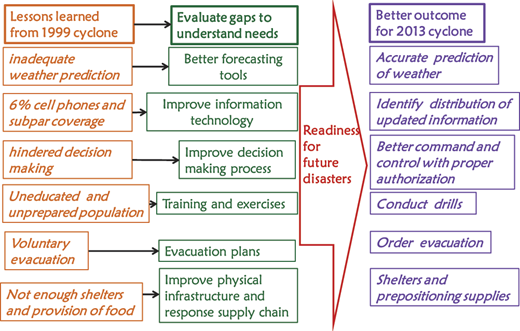
In this section, the lessons learned illustrate gaps encountered between demand from affected population and delivered disaster relief. In addition to the disasters discussed in this section, we would like to point out other instances that are peculiar in the sense that the disasters struck the same place with the same intensity more than a decade apart. Ten thousand people died in the first cyclone that struck India in 1999, while just 30 perished in the cyclone that struck at the same location 14 years later. What changed? Technology, bureaucracy, strategic and operational prepositioning to name a few. Figure 5 illustrates how learned lessons and evaluated gaps can lead to readiness metrics in this instance.
Issues and challenges in the “Three Cs” of civil–military organizations
Civil–military organizations are needed to establish, maintain, influence and exploit relations among military, government and non-government organizations, including the host country of the disaster. The Three Cs for civil–military organizations are communication, coordination and collaboration. With complimentary capabilities and competencies, other government and non-government organizations participate with military organizations in HADR. Therefore it is essential that coordination and communication among all these organizations be explored and enhanced. The premise is that such processes will enable the HOs to respond efficiently and effectively with the unique capabilities that they possess in the future of limited budgets (Apte et al., 2016; Moroney et al., 2013).
The type of collaboration between military and NMOs is predominantly determined by the disaster classification. Similar issues have been expressed by Poole (2013). Logistical support and delivery of supplies continues irrespective of the alliance (Pettit and Beresford, 2005). The authors present issues and challenges for measuring disaster preparedness and response. These factors can help in developing the framework for readiness metrics. More importantly, the authors describe the possible conflicts arising from military involvement in humanitarian crises. Table 8 describes these conflicts.
Conflicts arising from military involvement
| Medical care | Military medicine is not necessarily appropriate for humanitarian crises. Supplies readily available to military forces may be inappropriate for refugees and disaster victims, although at the outset of a crisis they may be all that is available |
| Conflict resolution | Military forces are not well suited to aid long-term redevelopment efforts. The imposition of security by outside military forces may also impede negotiation and conflict resolution |
| Interaction with other organizations | Military commanders may be unfamiliar with the roles of major international organizations, and conversely, civilians will have little experience with military organizations. There will be differences in strategy, objectives and tactics |
| Conflict with humanitarian agenda | Using military resources to achieve humanitarian goals creates tension and can undermine the appearance of neutrality of relief organizations |
| Adequacy of training | Few military officers receive training in disaster relief or humanitarian assistance. There is also likely to be ambiguity over the role of military physicians in complex emergencies in international humanitarian law |
| Limited commitment to disaster response | The principal mission of the military is to resolve military conflicts, and generally, less effort and fewer resources are devoted to humanitarian aid unless an HA-specific mission is being conducted |
Source(s): Pettit and Beresford (2005)
US Forces in Japan (USFJ) maintained necessary coordination and daily workings with the State Department (Embassy in Japan) and Japan Self-Defense Forces (JSDF; Terada, 2012). This was informally done without any structured support at operational level of command and control.
Yoshitomi et al. (2012) describe the bilateral coordination between JSDF and USFJ. They suggest that the solution to preparedness issues may be establishing a standing bilateral coordination center that is staffed with people from both forces so they can share information and plan before the disaster strikes. They also recommend that for effective coordination, more activities and exercises are needed. This will enable clarification of communications, roles, missions and capabilities with the counterparts of other nations. Acquisition and interagency agreements are necessary to pre-position supplies and services. For successful coordination, it is also essential to understand the capabilities and equipment of the host nation counterparts.
Japan is one of the best prepared countries for earthquakes in the world but had limited experience in receiving international assistance (Katoch, 2012). Absence of institutionalized civil-military coordination is a significant void that is exacerbated when a country is facing a super disaster or crisis. In spite of this, the Great East Japan Earthquake (GEJE) of 2011 is a great example of coordination among JSDF, USFJ, Swiss Humanitarian Aid Unit (SHA) and German Federal Agency for Technical Relief (THW; Terada, 2012; Smart, 2012; Fichter, 2012).
At a national level, cooperation between the Red Cross and Red Crescent Movement (RCRC) and military is common, but this cooperation gets complex when military assets are involved in an international context in the case of natural disaster (Markus, 2012). Guidelines from the RCRC state that “while maintaining a dialogue with armed forces at all levels, the components of movement preserve their independence of decision-making and action, in order to ensure adequate access to all people in need of humanitarian assistance” (International Federation of Red Cross and Red Crescent Societies, 2005).
Super Typhoon Haiyan (Yolanda) was notably one of the best instances of civil–military coordination following a disaster (CFE-DM, 2014). There were many previous experiences from disasters in the Philippines that contributed to the lessons derived from disaster relief. However, connections between personnel involved in the relief and other players helped expedite the collaboration between civil and military organizations.
There were 57 countries contributing to the relief operations in Super Typhoon Haiyan. The MNCC was set up for this purpose, with 29 foreign militaries that responded to the disaster. The coordination predominantly revolved around warehousing, transportation and distribution—that is, logistics. However, a lack of framework for a common operating process and a lack of consensus on needs assessment ended up causing a duplication of efforts in the face of scarce resources. The study by the Center for Excellence in Disaster Management (CFE-DM, 2015) outlines best practices for civil–military coordination that are listed in Table 9.
Best practices in disaster management
| Best practice 1 | A commonly understood “end-to-end warning system” prepares a nation for crises |
| Best Practice 2 | Bilateral commitment executed multilaterally on the ground through the Multinational Coordination Center (MNCC) promotes optimal civilian use of foreign defense assets |
| Best Practice 3 | When closely coordinated with the government, the private sector multiplies a nation's surge capacity to meet the life-saving needs of the affected population |
Source(s): CFE-DM (2015)
The authors of CFE-DM (2015) conclude that advances in civil–military coordination occur when (1) consensus in the operating environment paves the way for unity of effort; (2) systemic changes through an inclusive multi-sectoral approach streamlines disparate efforts on emergency response preparedness; (3) a convergence in concepts, frameworks, protocols and procedures maintains a clear distinction of responsibilities and national sovereignty; and (4) institutionalized internal and external partnerships augment a country's latent ability to surge.
The US Operational Detachment-Alpha (ODA) served in the Philippines during Super Typhoon Haiyan. This was not unique to the Philippines. ODA also served in Nepal. In the aftermath of the 2015 Nepal earthquake, two teams of the ODA, 1121 and 1126, happened to be in Kathmandu, Nepal (Elwood, 2016). They stayed on to help with the HADR mission since US Special Forces Green Berets are known for their capability in diverse tasks of special warfare during combat missions and in training with partner forces in coordinating exercises. This benefited the relief operations in Nepal. The beneficial aspect of ODA can be exploited methodically if the team can be incorporated in a contingency plan for military–military collaboration. The competencies of Special Forces to react instantly with pre-established relationships and resources, critical language skills and flexibility could then be utilized.
There was significant anticipation for a catastrophic earthquake in Nepal among many international governments and military organizations. This projection helped in a broad response from all the organizations when the actual disaster occurred. The UN Office for the Coordination of Humanitarian Affairs led the effort for civil–military coordination through the Humanitarian Military Coordination Center (Tarantino et al., 2016). In Nepal, the military participation came in the areas of logistics and transportation, in addition to health and medical support.
The model for civil–military cooperation in disaster relief is the support provided by JTF 505 and USAID to the 2015 Nepal earthquake (Bock, 2016). Bock credits the success to the Mission Tasking Matrix Process. The major contributions of this tool are the following: transparency of information about needs, number of response participants, requirements and coordination challenges; military planners' ability to expedite the planning process and analyze whether JTF has the resources and authority to fill it; the DoD's doctrine of supporting USAID; maintaining cost efficiency; and the constraining focus on specific requirements to avoid mission creep.
To summarize, HOs are involved in humanitarian assistance and disaster relief with primary objective of mitigating the suffering. They all bring their own resources that support their core competencies. However, “playing nice” does not necessarily always work because of the different cultures of the organizations, their diverse capabilities and varying agendas. Organizations, civil or military, however, have to get along to accomplish their primary objective. When 57 countries and 29 foreign military are involved in humanitarian operations, as during Super Typhoon Haiyan, a framework of a common operating process is essential. Such coordination, in many instances, cannot come about without metrics in place because the metrics can outline the reach of each organization and circumventing unplanned long-term commitment.
Summary and conclusion
The absence of quantifiable or measurable performance indicators or readiness metrics in HOs has been acknowledged by organizations involved in HADR, both military and non-military. In recent years, scholars have begun to fill this void. Literature on critical best practices for performance measurement describe that the metrics should be aligned with the objective.
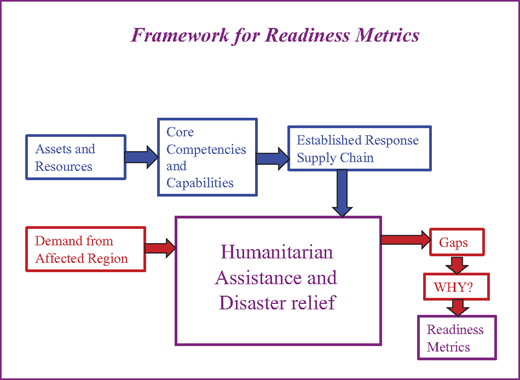
The primary objective in this research is to review the literature to understand the readiness metrics necessary for humanitarian operations. For this purpose, we follow the methodology described in Figure 3. The performance indicators and the readiness metrics are decided from within the organization. The core competencies and capabilities are also internal to the organization since they are based on assets and resources of that organization. The issues and challenges faced by the organization while getting ready to or actually delivering the relief originate from the vulnerabilities of that organization. The aforementioned factors are endogenous to the organization. However, the aftermath of the disasters and the lessons learned depend on the environment external to the organization. Communication, coordination and collaboration are the “Three Cs” of civil–military relations. The Three Cs are efforts from within the organization that depend on other agencies with which the relationships are being established. Therefore, this paper considers these factors as exogenous to the organization. The Endogenous Factors section of the literature review is divided further into Performance Indicators and Readiness Metrics, Core Competencies and Capabilities and Issues and Challenges in Humanitarian Operations. The Exogenous Factors’ section is further divided into Lessons Learned and the “Three Cs” of Civil–Military Organizations.
Due to the unique capabilities and resources of the DoD, the organizations such as USN and USMC are actively involved in HADR. Although this paper's inspiration for defining and developing readiness metrics came from these organizations, the framework—which is not specific in nature—may be applied to other HOs. Figure 6 shows this framework.
Readiness is defined by the DoD as the ability of the military to fight for and meet the needs of the national strategy. However, no comprehensive plan exists for humanitarian missions, thus emphasizing that a readiness framework is necessary. Many similarities exist between combat and disaster that result in military combat supply chain being comparable to humanitarian RSC. Drawing on these similarities, we believe some of the reasons that any organization should measure the impact of humanitarian assistance programs are as follows: (1) Measuring them offers opportunities for future and mid-course corrections in the projects through feedback loops, enabling planners to underscore activities that are cost-effective, (2) the collection and sharing of data decrease the likelihood that HOs duplicate activities, and (3) analysis based on collected data offers transparency and quantifiable results that do not leave any ambiguity. These reasons represent fundamental principles of humanitarian assistance; any HO will benefit from taking these measures. However, operational challenges exist for all HOs. Lessons learned due to lack of planning, point to deficient integration that affects host nations and other HOs.
HOs offering essential services in case of disaster can be broken down into three categories: what is needed to be ready, an awareness of being ready and a metric for readiness. The essential services and capabilities for disaster response, as outlined by Apte et al. (2016) for military and NMOs, are information and knowledge management, needs assessment, supply, deployment and distribution and health service support.
The disasters, responses and lessons learned, as described in this research based on the literature review, provide a conceptual framework for readiness metrics. This framework needs to be developed further to formulate an assessment model that can be used as a playbook for an organization involved in HADR. The output of such a model must answer questions such as the following: What do the organizations need to respond to a disaster? Do the organizations have those competencies and capabilities? What must they do? Can they do that? How do they close the gap between relief delivered and needs assessed? How should they have done it differently? How can they be ready next time?
The author thanks Acquisition Research Program at the Naval Postgraduate School (NPS) and the NPS Foundation for funding in launching this research project.
Note
In this research, DoD refers to the United States Department of Defense.

