


The authors investigate the role of community engagement in the connection between disaster mitigation and disaster preparedness. Using a vulnerability-to-hazard framework built by the European Union, the authors study the case of Aceh province, Indonesia, which was hit hard by Asian tsunami in 2004.
The research design uses a single case study research. The authors study the case of Aceh province, Indonesia, by comparing improvements in disaster mitigation and disaster preparedness in a period longer than ten years beginning in 2004, right before the Asian tsunami that devastated the province. Aware that the connection between mitigation and preparedness is a broad research topic, the authors focus on the domain of pre-disaster evacuation.
The authors find that Aceh province has made substantial improvements in healthcare facilities and road quality (mitigation) as well as early alert systems and evacuation plans (preparedness). Socio-economic indicators of the community have improved substantially as well. However, there is a lack of safe sheltering areas as well as poor road signaling maintenance, which threatens the effectiveness of infrastructural improvements. The authors propose that community engagement would connect disaster mitigation and disaster preparedness. The connecting element is community-based maintenance of critical infrastructure such as road signals, which the government could facilitate by leveraging on operational transparency.
The findings open avenues for future research on the actionable engagement of communities in disaster mitigation and disaster preparedness.
This paper contributes to three areas of humanitarian logistics research: disaster management cycle (DMC), pre-disaster evacuations and community engagement in disaster management.
1. Introduction
The phases of preparedness, response, rehabilitation and mitigation shape the disaster management cycle (DMC) (Altay and Green, 2006; Tomasini and Van Wassenhove, 2009). These four phases connect as preparedness affects future response; response affects rehabilitation and so on (Van Wassenhove and Pedraza-Martinez, 2012). Besiou and Van Wassenhove (2020) find gaps in research in the interconnected phases of DMC. In their assessment of three special issues (Starr and Van Wassenhove, 2014; Pedraza-Martinez and Van Wassenhove, 2016; Besiou et al., 2018), only one paper focuses on the disaster mitigation phase as opposed to the other three phases (three, nine and seven for preparedness, response and development/rehabilitation, respectively). Disaster mitigation includes long-term actions that reduce vulnerability of communities and potential risk from a natural hazard in the future (FEMA, 2013; Görmez et al., 2011). As is evident, there is a dire need for research in disaster mitigation and its connection to the other phases of the DMC.
In the DMC, disaster preparedness follows disaster mitigation. Disaster preparedness refers to “measures taken to prepare for and reduce the effects of disasters” (He and Zhuang, 2016). Gatignon et al. (2010) state that better preparedness reduces the cost of humanitarian operations. Telford and Cosgrave (2007) state that investing in community-based preparedness activities saves lives. Disaster mitigation and preparedness activities together lead to better risk management (Christoplos et al., 2001) and reduce disaster impact (Chikoto et al., 2013). Because better risk management benefits from the concurrent study of mitigation and preparedness, it is valuable to study the link between these two DMC phases. But, as we discuss in the next section, this link is missing in the humanitarian operations literature. To fill this gap in the literature we study the question of, how do the DMC phases of mitigation and preparedness connect to each other?
Our research question is exploratory. Aware of its broad nature, we restrict our attention to pre-disaster evacuation, one of the critical activities within the DMC. Pre-disaster evacuation occurs after the warning and before the potentially catastrophic event hits a vulnerable community. By nature, pre-disaster evacuation belongs to the phase of preparedness. Moreover, we focus on the role of the community in the connection of mitigation and preparedness.
We use a case study approach to document the connection between mitigation and preparedness. Our choice of research method arises from the lack of operations management literature on the research topic. Moreover, we study an extreme event over a long period of time, which provides us with revelatory information. Yin (2017) recommends a case study when the case provides revelatory information by analyzing an extreme event over a long period of time. We remark that single-case research design is a valid methodology for theory building (Eisenhardt, 1989; Ketokivi and Choi, 2014; Yin, 2017). For example, using a single case Corley and Gioia (2004) document the birth of a new organization based on a top-performing organizational unit. Mair and Hehenberger (2014) use a single case to study the emergence of venture philanthropy in Europe. Moreover, Yin (2017) argues that analytical generalization can be used in a single case study (Yin, 2017, p. 42). Thus, we use a single-case design to build our argument on the role of community engagement in the connection of disaster mitigation and disaster preparedness. The case presented here allows us to develop a theory using inductive methods (Eisenhardt, 1989; Eisenhardt and Graebner, 2007).
Following Yin (2017), we choose the case of Aceh province, Indonesia for two reasons. First, Aceh was hit hard by a mega disaster more than a decade ago, which allows enough time for long-term mitigation actions post disaster. Secondly, one of the coauthors of this paper is Indonesian; this researcher is familiar with the local language and the geographic region, which facilitated the data collection process.
The 2004 Indian Ocean tsunami was a megadisaster, which affected countries like Indonesia, Sri Lanka, Maldives and Thailand the most (WHO, 2009). Indonesia was impacted 30 min after the initial earthquake as opposed to 2 h for Sri Lanka, Maldives and Thailand (Goff, 2005; UNICEF, 2006). The tsunami impacted Indonesia the worst, with close to 170,000 deaths (out of 227,898 total casualties globally) in the country (Folger, 2018). Within Indonesia, the city of Banda Aceh faced the worst impact of the tsunami. In our research, we study Aceh province, Indonesia's various aspects in relation to disaster mitigation and preparedness activities. Originally, we wanted to compare the mitigation improvements in Aceh, Indonesia, from 2004 to 2014. However, we could not find all the information from 2014 to match the 2004 baseline, so our analysis of the latter state of mitigation spans 2014 to 2017 instead. We believe the comparison is valid because the period of study is greater than or equal to ten years, which is enough for long-term mitigation projects to be operational following the 2004 disaster.
Deficiencies in pre-disaster evacuation aggravated the impact of the 2004 tsunami in Aceh province. Pre-disaster evacuation issues stemmed from the absence of a functioning tsunami warning system in the Indian Ocean (Giles and Marris, 2004). The Pacific Tsunami Warning Centre in Hawaii detected the tsunami, but the information was not relayed because there was no system to contact in the Indian Ocean region (Penberthy, 2014). Yet, the tsunami struck Indonesia less than one hour after the earthquake and there was neither enough time nor infrastructure in place for people near the epicenter to reach higher ground (Folger, 2018).
The overwhelming devastation led the Indonesian government to substantially improve disaster mitigation and disaster preparedness for pre-disaster evacuation. For instance, following the 2004 tsunami response, the Government of Indonesia invested heavily in an early alert system, called the Indonesian Tsunami Early Warning System – Ina-TEWS (CEDMHA, 2015). The government also invested on building more hospitals and improving the road infrastructure. Many of these investments strengthened the Aceh province.
We study the investments and the subsequent improvements in mitigation and preparedness in Aceh province. We use the ENSURE framework, which stands for “enhancing resilience of communities and territories facing natural and na-tech hazards.” The ENSURE framework is a tool to assess the different facets of vulnerability that play a role during natural disasters (Menoni et al., 2012) and it was originally proposed by the European Union. We assess the infrastructure and social systems in Aceh over time. These assessments allow us to describe the relation between mitigation and preparedness policies in Aceh regarding pre-disaster evacuation. Moreover, we do not examine the involvement of humanitarian organizations in mitigation improvements in Aceh province, because mitigation is a responsibility of the government (Luna, 2001).
We collect data from multiple sources including (1) secondary data such as local Indonesian newspapers, international news forums and websites, scholarly journals, international organizations' publications and local Indonesian government agencies' websites and (2) primary data through an interview with the Planning Officer at the Indonesian Red Cross (IRC). These data fed the ENSURE assessment ( Appendix).
Our analysis shows that Aceh Province, Indonesia has improved substantially on disaster mitigation over the years. Regarding pre-disaster evacuation, besides better roads, mitigation improvements include better socio-economic conditions for the local population. These are surely expected when huge investments are made by a governing body over a long-time span. Aceh province has made substantial improvements on preparedness as well. Regarding pre-disaster evacuation, besides early alert systems, preparedness improvements include evacuation plans. We argue, however, that all these DMC improvements need to be followed up with simple actions aimed at community engagement. This is because community engagement strengthens the connection between disaster mitigation and disaster preparedness for pre-disaster evacuation. In particular, when the community engages in the maintenance of critical infrastructure, the community becomes a connecting element between mitigation and preparedness. On the flip side, lack of simple actions directed toward community engagement threatens the effectiveness of expensive, long term investments on disaster mitigation.
The rest of the paper is structured as follows: We review the relevant literature on disaster mitigation and preparedness in section 2. In section 3, we elaborate on our research methods and make the case for using Aceh province, Indonesia. In section 4, we discuss the secondary data that we fed in the ENSURE framework and how Indonesia changed from 2004 to 2017. In section 5, we draw hypotheses from our research. In the final section 6, we present managerial insights, talk about the limitations of our paper and scope for future research in this area.
2. Literature review
We contribute to three areas of humanitarian operations management literature: DMC, disaster evacuations and community engagement on disaster management.
2.1 Disaster management cycle (DMC)
Although different authors have grouped DMC phases differently, we follow the classifications by Altay and Green (2006) and Van Wassenhove and Pedraza-Martinez (2012). These authors list four DMC phases: preparedness, response, rehabilitation and mitigation.
As argued by Kunz et al. (2014) and Görmez et al. (2011), humanitarian logistics research has sought to connect disaster preparedness and disaster response. The main body of work models disaster preparedness decisions related to inventory prepositioning and network planning (e.g. Natarajan and Swaminathan, 2014; Jahre et al., 2016; Stauffer et al., 2016). The inventory modeled in the literature ranges from in-kind aid such as water and food to assets such as vehicles and electric generators. The extant literature assesses the impact of inventory-prepositioning decisions on different metrics of disaster response such as cost, response time and demand fulfillment. Salmeron and Apte (2010) and Stauffer et al. (2016)—and many other authors—study the connection between disaster preparedness and disaster response (Jahre and Heigh, 2008; He and Zhuang, 2016).
The extant literature in operations management, however, has largely overlooked the connection between disaster mitigation and disaster preparedness. The research in the respective phases is performed in silos. Yücel et al. (2018) investigate the fortification of roads as a mitigation strategy. They report that structural investments on roads mitigate the future damage of disasters such as earthquakes. Rezapour et al. (2019) illustrate the substitution effect between disaster mitigation and disaster preparedness. They focus on facility fortification instead of road fortification. The authors show that early fortification of storage facilities allows the reduction of later investments on inventory prepositioning for disaster response. Besiou et al. (2018) call for research on disaster mitigation in operations management. We respond to their call. We use qualitative methods to study long term investments on disaster mitigation as well as investment on disaster preparedness. Moreover, we propose that the connection between disaster mitigation and disaster preparedness lies in community engagement.
The disaster-studies literature, on the other hand, has investigated policy aspects of disaster mitigation and preparedness. Christoplos et al. (2001) highlight the need to re-define risk management in order to match the challenges of disaster mitigation. Rocha and Christoplos (2001) document collaborations between the nonprofit sector and municipalities in order to strengthen (local) institutional development in the aftermath of 1998 Hurricane Mitch in Nicaragua. Luna (2001) introduces the concept of community-based disaster management as observed in the Philippines over a period of 16 years. According to the author, community involvement ranges from training activities to the creation of village committees for disaster response. Nonprofit organizations support community-based disaster management through capability building. Taking an organizations approach, Chikoto et al. (2013) compare the approach of nonprofit organizations, governments and private corporations to disaster mitigation. They conclude that both nonprofits and governments participate more on mitigation than private corporations. Our research builds upon the disasters-studies literature on disaster mitigation and preparedness. But instead of looking at policy aspects of mitigation and preparedness, we focus on operational connections between the two DMC phases. Moreover, we propose avenues for future research on the operational connection between disaster mitigation and preparedness.
2.2 Disaster evacuations
We focus on evacuation of civilians under the imminent threat of natural disasters. Regnier (2008) analyzes the tradeoff between evacuation times and economic losses in the threat of Hurricane. The author concludes that technological advances in the area of Hurricane trajectory prediction support later evacuations of smaller areas as opposed to earlier evacuations of larger areas. Pidd et al. (1996) develop a simulator tool to help organizations and emergency planners in creating evacuation plans. They argue that well-tested evacuation plans facilitate quick evacuation in case of a disaster and reduce the risk to human populations. Yi and Ozdamar (2007) build an optimization model to minimize the delay in delivering commodities and transferring wounded people during a disaster. Baou et al. (2018) study evacuation time when there are people with disabilities involved in the evacuee population. They also study how a fleet made up of different types of vehicles affects the evacuation time. Their research illustrates that evacuation is quicker when large capacity vehicles are used as opposed to private vehicles. These large capacity vehicles also improve evacuation time for people with disabilities. We investigate the connection between disaster mitigation and disaster preparedness regarding evacuation decisions. To the best of our knowledge, ours is the first paper in humanitarian logistics to research this important topic.
2.3 Community engagement in disaster management
The extant humanitarian logistics literature highlights the need to conduct more research about community engagement on disaster management. Holguin-Veras et al. (2012) identify seven pressing research areas to improve disaster management; community engagement is one of them because more resilient communities will lead to more effective disaster response. Jahangiri et al. (2011) find that involving community in different stages of the DMC can lead to improved disaster management. Sodhi (2016) and Besiou and Van Wassenhove (2020) add that the mitigation of future disasters will benefit from more local community empowerment. FEMA (2015) argues that empowerment is about engaging the community in an active dialog with stakeholders—such as the government—to identify their assets and needs, which will ultimately lead to an improvement in the community's capacity to prepare for disasters, respond, rehabilitate and mitigate future ones.
Studying the case of Nepal through a literature review and field research, Pandey (2019) argues that local communities have the resources, skills and traditional knowledge to support different phases of the DMC such as disaster mitigation, preparedness and disaster response. The author also confirms that communities are the first responders and engage actively in the humanitarian imperative of saving lives and alleviating human suffering. Other stakeholders such as the government and private sector can facilitate community engagement as well. Hossain (2012) studies the role of social work on community engagement in disaster management in Bangladesh. The author uses the DMC framework to describe current disaster management practices in government policy. Using document analysis, Hossain (2012) concludes that social workers are in a position to improve community engagement on disaster management. Behl and Dutta (2019) investigate the role of corporate social responsibility and crowdfunding to fund disaster relief. Using a structured questionnaire, they survey private Indian firms that donated to disaster relief in the 2008–2018 period. Based on 232 responses, they build structural equation models that allow them to find a positive effect of corporate social responsibility initiatives on crowdfunding-based donations. Yan and Pedraza-Martinez (2019) investigate the value of social media during the DMC phases of preparedness, response and rehabilitation in the case of Hurricane Sandy, 2012. They find that official response organizations such as the American Red Cross and the Federal Emergency Management Agency (FEMA) engage community members such as volunteers and donors even though these organizations target their messages to disaster victims. This illustrates that the community wants to engage in the response operation. While extant research identifies the need to investigate community engagement in the DMC and some papers have already responded to this call, their insights on the connection between mitigation and preparedness are mostly at the policy level. Papers that provide operational insights do it mostly about disaster preparedness and response. In contrast, we identify operational insights related to community engagement that would strengthen the connection between mitigation and preparedness.
3. Research methods and case study
Our qualitative analysis builds upon a case study. Next, we discuss our methods in detail and include contextual details of our case setting.
3.1 Research methods
We conduct exploratory research. First, we define our research question (Figure 1). The literature on DMC helps us define our research area. We find a gap in the operations management literature about the connection between mitigation and preparedness (Holguin-Veras et al., 2012; Sodhi 2016; Besiou and Van Wassenhove, 2020). We realize this is a very broad research topic and narrow down our scope to the domain of pre-disaster evacuation. Next, we select a case study.
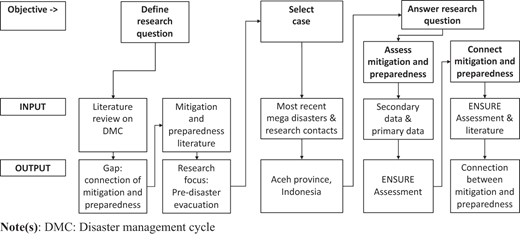
We study the case of Aceh province, Indonesia. Yin (2017) recommends a single-case design when the case can provide revelatory information by analyzing an extreme event over a long period of time. Using these criteria, multiple authors have studied single cases in logistics and operations management. Morales and Sandlin (2015) study airflow management during the Haiti earthquake. They uncover in-depth information on capabilities like airflow plans, operations and reports which can improve airflow management during a disaster. Oliva and Watson (2010) study the role of sales and operations planning (S&OP) process in a supply chain. They provide revelatory information on how S&OP process facilitates cross-functional integration by not only coordinating information flow but also conducting information processing and meeting problem-solving requirements of the demand and supply planning. Simons and Russell (2002) research the function of batching in mass service operations. They state that a case study methodology helps reveal the importance of schedule complexity and human resource utilization in batching decisions. These papers focus on one function and study it in detail to generate new hypotheses. Similarly, we focus on one country as opposed to every country that was impacted by the 2004 tsunami. Indonesia was affected the most and was an extreme case (Folger, 2018). Since the other countries were affected less than Indonesia, the findings in this paper can be adapted to these countries.
Additionally, we take advantage of the fact that one of the co-authors is from Indonesia. Hanson (1994) argues that a researcher who is familiar with the setting of the study can consider aspects which others might overlook, can avoid misinterpretation of data, and consequently, lead to reliable outcomes in qualitative research. Papadopoulos and Lees (2002) further strengthen the argument by proposing that same ethnic background provides the researcher with more favorable access to information and a genuine interest in the phenomenon being researched. Hofmeyer et al. (2012) argue that it is desirable to have a researcher with links to the community being studied if the researcher has established local knowledge. Furthermore, the co-author from Indonesia could also read the national language and consequently had access to Indonesian newspapers and resources. We are aware that having an Indonesian author can lead to a bias in the paper. We address this and other limitations in section 6. As Indonesia was the most affected country and we have access to an Indonesian author, Aceh, Indonesia lends itself to be the primary case of our study.
After selecting a case, we establish a timeline. We assess the improvements in Aceh over 10 years after the tsunami. Disaster mitigation refers to long-term actions which reduce potential risk from a natural hazard in the future (FEMA, 2013). “Long-term” is explained in different ways in prior research. Park et al. (2017) study effective stakeholder management in long-term complex mega construction projects. It defines long-term projects as projects that require more than 10 years of multipurpose development. Fujikura and Nakayama (2013) assess long-term impacts of resettlement programs after dam construction projects. In their research, long-term impacts were studied 20 years after the resettlement programs were completed. Following prior research, we also study long-term actions in Aceh province in a period longer than years (2004–2017) following the 2004 tsunami.
Next, we assess the improvement on disaster mitigation and preparedness in Aceh, Indonesia. Our analysis builds on the ENSURE framework. ENSURE's measurement parameters can be adjusted to assess different natural disasters. It also considers the temporal aspect and compares how a region develops over time. We study Aceh in two different points of time, and we need a framework which can be easily modified to assess disaster mitigation and preparedness in the event of earthquakes and tsunamis. As a result, we choose the ENSURE framework. We understand that using the framework and its parameters could result in loss of some other aspects and reduce granularity of data. ENSURE primarily assesses vulnerability and infrastructure for disaster mitigation. It can be extended to study other aspects as we accomplish here. Due to these reasons, we choose ENSURE as the conceptual framework for this paper.
The ENSURE framework is central to our analysis. Menoni et al. (2012) illustrate the use of ENSURE by assessing flood vulnerability in Sondrio, Italy. Following Menoni et al. (2012), we created the matrices to assess Aceh province's vulnerability to earthquakes and tsunamis. To fill the ENSURE matrices, we gathered secondary data from various sources. The data in the matrices are compiled from many different secondary sources.
Primary data complete our data gathering efforts. In addition to the ENSURE framework assessment, we reached out to the IRC to conduct a semi-structured interview regarding Aceh's pre-disaster evacuation capabilities. In order to understand Aceh's current pre-disaster evacuation capabilities, we interviewed Mr. John Mamoedi, the Planning Officer at the Indonesia Red Cross (IRC) in 2017. Mr. Mamoedi participated in the 2004 Asian Tsunami operation. He was appointed Planning Officer in March 2011. At the time of the interview, Mr. Mamoedi had been with IRC for over 30 years. We asked Mr. Mamoedi about the evolution of disaster mitigation and disaster preparedness in Aceh, as well as main areas of improvement of the current evacuation system in Indonesia.
3.2 Case of the Aceh province, Indonesia
Aceh province is located in the island of Sumatra with a population of around five million people in total [1]. It spans an area of 22,540 sq. miles. Comparing it to the United States, Aceh has a land size similar to the state of West Virginia and a population that is similar to the state of Colorado.
The tsunami impacted Aceh heavily because of Aceh's proximity to the epicenter of the catastrophic event. The epicenter of the Indian Ocean earthquake and tsunami that occurred on 26th December 2004 was approximately 100 miles off the west coast of island Sumatra. The tsunami was caused by a slipping of 600 miles of boundary between the India and Burma plates off the west coast of northern Sumatra, which caused the convergence plate to strain the area and resulted in the earthquake formation and tsunami (CNN, 2016). The earthquake had a magnitude of 9.3 on the Richter Scale (SciencaGiovane, 2005) and the tsunami that followed the quake traveled at a recorded maximum height of 100 feet in some areas when traveling inland. This event was listed as the third largest earthquake ever recorded on a seismograph [2]. To put it in context, within eight minutes the fracture spanned over 700 miles and it released energy that is equivalent to 23,000 times more than the atomic bomb that destroyed Nagasaki, Japan (Folger, 2018).
In Indonesia, the tsunami killed close to 170,000 people and displaced 500,000 people [3] (Folger, 2018). The casualties comprised of 13% infants, 37% people under the age of 18 and the remaining demographic made up of adults. This tragedy destroyed most of the infrastructure in the area such as health facilities, schools, transportation networks and communication systems. Coupled with the long-standing conflict that the Free Aceh Movement (GAM) had with the Government of Indonesia, which resulted in more than 15,000 deaths over the past 30 years, the impact of the disaster was worsened due to poor social unity.
The Indonesian government and the World Bank estimated that the loss to rebuild the infrastructure and businesses due to the disaster will cost more than $4.4 billion (Brown, 2005). Although the cost seemed very high, an unprecedented humanitarian response was given by the international community which consisted of around 500 organizations from 40 different countries. These organizations took part in helping Indonesia recover and pledged more than $7 billion to meet the rebuilding costs.
The rebuilding that the government and the other organizations put into action has enhanced the disaster monitoring and forecasting systems in Aceh, improved the infrastructure in terms of road networks and medical facilities, and lastly, it has raised the social welfare and standard of living of people in Aceh. We shall use the ENSURE framework to discuss how these improvements relate to disaster mitigation and preparedness.
4. ENSURE framework assessment
The Indonesian government, with the help of other governments and many international organizations, has built back Aceh province to be more resilient toward any potential natural disasters. Using the ENSURE framework, we have analyzed the 2004 and 2017 state of Aceh's mitigation and we have identified various improvements that have been executed in terms of Aceh's recovery and resiliency to disasters (see Table 1 at the end of the section for a summary). For ease of presentation, the following description excludes the sources of data, which can be found in the ENSURE matrices included in Appendix of the paper.
2004–2017 comparison. Summary
| Item | 2004 | 2017 |
|---|---|---|
| Infrastructure and resilience | ||
| Monitoring stations (In Indonesia) | 31 | 191 |
| Disaster management authority | Less resources, less authority | More resources, more authority |
| Time to alert after the event | 15 min | 5 min |
| Decision-making | Less decentralized | More decentralized |
| Institutional logistics | Unknown | Fleet of vehicles for disaster response |
| Hospitals | 31 | 50 |
| Clinics | 1,300 | 1,661 |
| Roads | 17.8% in good (paved) condition | 58% in good (paved) condition |
| Social system | ||
| Life expectancy | 67.7 years | 69.5 years |
| Infant mortality | 36.1 per 1,000 births | 12.1 per 1,000 births |
| Average education | 7.8 years | 8.9 years |
| Minimum wage | US$55 (2004 prices) | US$210 (2017 prices) |
| Political situation | Internal armed conflict | Peace |
4.1 Infrastructure system
After 2004 the government created a new law that helps speed up the disaster management process (before, during and after disasters). The BNPB agency further decentralizes decision making during the time of disasters to speed up recovery process. The government has also established the Indonesia Rapid Response and Assistance Organization, which has the authority to utilize a fleet of vehicles and planes that can be deployed during the event of natural disasters. As the local officials in Aceh usually work in the office for a two-year period, it often happens that the government officials who have already understood the disaster management system are replaced with new inexperienced personnel. Most of the new personnel may not understand the mechanism initiated by the previous officials and may not pay attention to key aspects and processes set by the predecessor. This issue results in repetitive work being done and inability to sustain best practices that are already in place.
When it comes to funds for fast repairs, the government improved the response time for funds availability. The government took steps such as allocating a portion of the budget toward the disaster management contingency funds, establishing risk financing and insurance options and creating a multi donor funds facility to ease the process of donations. These protocols will ensure availability of funds to aid preparedness activities and will speed up recovery in future events.
In 2004, there were only 31 hospitals and around 1,300 clinics throughout Aceh. But since then, 19 hospitals and 361 clinics opened their doors to the public. By having access to more health care facilities, people in Aceh will likely be able to receive medical support faster during disasters.
Aside from the healthcare facilities, the transportation network in Aceh has also improved. Following Hayat and Amaratunga (2012) and Badan Perencanaan Pembangunan Daerah (2014), we classified the road networks into good, fair and poor based on the materials that were being used to build those roads. Back in 2004, only 17.8% of all the roads in Aceh were considered as good or in other words they were built using asphalt material while 22% of the roads were poor or built from just soil or pebbles. Since then, the state government and the national government have invested heavily in upgrading their road network to enable better flow of vehicles, especially during relocation situations. According to latest statistics in 2016, the roads that were considered good have reached 58% which leave around 42% to be in fair or poor condition.
However, there are infrastructural problems that affect the effectiveness of good roads for pre-disaster evacuation. These problems include lack of road signs and temporary safety shelter during disasters. Moreover, disaster simulation training is only available in few select schools in Aceh while leaving the others without proper training.
4.2 Mitigation resilience capacity
We assess (1) the availability and quality of monitoring technologies and (2) forecasting system technologies in preparing and responding to possible natural disasters in the future. In terms of monitoring technologies, in 2004, the Indonesian National Meteorological board operated a total of 31 disaster monitoring stations across Indonesia. After 2004, the government of Indonesia as well as other countries pooled together resources to build 160 additional disaster monitoring stations that significantly enhance the accuracy of monitoring signs of natural disaster.
The Indonesian government formed a new organization that replaces the previous national disaster management board, BAKORNAS PB. The new organization for disaster management, also known as Badan Nasional Penanggulangan Bencana (BNPB), has more authority and resources to speed up response time during the event of natural disasters. BNPB has strengthened its local reach through the establishment of smaller subset units called the Badan Penanggulangan Bencana Daerah (BPBD) in each province across Indonesia. By having a local disaster management unit in place, each province and city can respond faster and more accurately based on the direct needs of the local disaster in that area.
Regarding forecasting, Indonesia owned and operated only one tsunami forecasting system device in 2004, which was below the requirements of a country of Indonesia's size and exposure to risk. Two years after the tsunami, the Indonesian government, jointly with the German government, funded a new advanced tsunami warning system which is called the Indonesian Tsunami Early Warning System (Ina-TEWS). The new tsunami warning system obtains data from over 165 seismograph stations and 134 tide gauges across Indonesia and the data or potential warning alert can be broadcasted through the 55-siren system under 5 min. This was a significant improvement compared to the 15 min lead time in 2004. Overall, the significant improvements made by the government in terms of observing the natural environment showed Indonesian advancement in creating a more resilient disaster monitoring and forecasting system.
4.3 Social system
We focus on the demographics of the population, education level, local living condition, poverty level, employment rate and income, criminality rate and the presence of conflict among social or ethnic group in the community. Long-term socio-economic gains improve disaster mitigation (Subanti et al., 2019).
In terms of the demographic, the life expectancy in Aceh increased from 67.7 in 2004 to 69.5 in 2016 and infant mortality reduced from 36.1 per 1,000 births in 2004 to 12.1 per 1,000 births in 2012. The two indicators of life expectancy and infant mortality rate suggest that the quality of life or health services have improved in Aceh. The years of formal education for Aceh's population have gone up from 7.8 years in 2004 to 8.9 years in 2016 which demonstrate an overall higher literacy level. The demographics in Aceh in 2014 were very similar to 2004. 31.11% of the population was under the age of 14 and 4.05% of the population was over the age of 65 years old. In the facet of local living conditions, there has been a considerable development in the field of healthcare. This is demonstrated by the increase in the number of healthcare facilities mentioned above as well as in the increase in the life expectancy in the region.
The most popular transportation mode in Aceh is motorcycle. Because of their lower weight, motorcycles deteriorate roads slower than cars. Slower deterioration helps roads to keep conditions for longer periods of time. The better road conditions contribute to easier and safer vehicle mobility which will enhance disaster response in Aceh.
In employment and local economy, Aceh in 2004 was performing quite well with unemployment rate of just around 6% which was lower than the Indonesian average of 9.9%. Post 2004, the devastation that was generated by the tsunami wiped out a large portion of businesses, which left a significant number of people with no jobs. In 2005, the 12.08% unemployment doubled the unemployment rate in 2004. But, in 2013 due to government funding efforts to revive local businesses, the unemployment percentage dropped to 8.38%. Even though unemployment rate is still higher compared to 2004, the minimum wage for the people in Aceh has increased dramatically. The government raised the minimum wage of the people in Aceh from $55 per month in 2004 to around $210 per month in the year 2015. Higher income and higher purchasing power might certainly help them prepare better during the event of a disaster.
Finally, we assess the criminality rate and the presence of conflicts within the areas. Since we were unable to obtain the crime rates in 2004, we compare the crime rates of recent years. From our research, we found out that in the year 2007 the crime rates are significantly higher than in the recent years. The decline in crime rates from 2007 to 2008 is 14.23% which showcases an improvement in safety level in Aceh. The 30 years long standing conflict between the GAM group, also known as the Free Aceh Movement, and the Government of Indonesia has come to an end in 2005 where both representatives signed a peace treaty agreement in Helsinki, Finland to end the conflict. The decline in the crime rates as well as the elimination of social conflicts between GAM and the government will probably enhance the population's ability to unite and cooperate in the time of natural disasters.
5. Analysis
In this section, we build the argument that community engagement strengthens the connection between mitigation and preparedness for pre-disaster evacuation. Following Ketokivi and Choi (2014), we use the case of Aceh for theory elaboration. So far, we have framed our general question in the existing theory of DMC. Then we narrowed the scope of our research to the connection between disaster mitigation and disaster preparedness, two of the four phases of the DMC. Next, we formulate hypotheses on the role of the community in connecting these two adjacent DMC phases. We use the definition that community engagement seeks to better involve the community to “achieve long-term and sustainable outcomes, processes, relationships, discourse, decision-making, or implementation.” The objectives of community engagement include “to build trust, enlist new resources and Allies, create better communication (Agency for Toxic Substances and Disease Registry (ATSDR), 2011)” Regarding our research problem, the objective the community needs to achieve is effective pre-disaster evacuation.
In the case of Aceh, recall that the 2004 tsunami hit Indonesia 30 min after the occurrence of the originating earthquake. In the 2004–2017 period, the tsunami alert time went down from 15 min to 5 min. This produces ten extra-minutes for evacuation. Thus, improving alert time means people will have 25 min to reach a safe place instead of 15 min. Although this is a significant improvement, 25 min is a narrow time window for early evacuation as a protective measure. For early evacuation, high mobility of the community is imperative. Motorcycle is the main mode of transportation in Aceh province. Unemployment is low in Aceh, which means most adults will work (taking the family vehicle with them) during daytime. Additionally, families in Aceh often include children and elder people. Consequently, either by day or night, it is likely that children and elder people will have to evacuate by walking. A healthy adult can walk at a speed of 5 km per hour, or 2.1 km per 25 min; children and elder people are not that fast. During the 2004 tsunami, waves traveled up to 2 km inland. This leaves little time for hesitation or mistakes from the affected community during pre-disaster evacuation, which makes the Aceh case ideal to study community engagement in disaster management.
5.1 Community engagement in disaster mitigation
Disaster mitigation involves long-term infrastructural investments, which are critical for community resilience (Holguin-Veras et al., 2012). As discussed in section 4.1, one of the remarkable infrastructural investments in Aceh province was the construction of healthcare facilities. Another important infrastructural investment was the improvement of road quality. Over 1 decade, the percentage of paved roads in Aceh province grew substantially. Good roads are critical for fast pre-disaster evacuation. Although there is an evacuation plan, it does not seem to include enough shelter areas, which undermines the benefit of good roads. Shelter areas must be fortified (Rezapour et al., 2019) and must be located close enough to the community such that community members can reach them within evacuation time.
Engaging the community in the selection of shelter areas would leverage the benefits of community's indigenous knowledge about effective evacuation (Hossain, 2012). It would also help the government earn goodwill and encourage future collaboration (Agency for Toxic Substances and Disease Registry (ATSDR), 2011). Moreover, it would help the government inform better, which would help people know where to go at the time of evacuation. This is important because the time window for pre-disaster evacuation is very short. Thus, we formulate the following hypothesis.
Community engagement enhances disaster mitigation for pre-disaster evacuation.
5.2 Community engagement and disaster preparedness
Compared to 2004, Aceh province benefits from a better disaster management authority in 2017. This authority has more local presence than its 2004 predecessor. Unfortunately, the authority suffers from high rotation of key staff, which is due to tenure in public offices being linked to short political cycles. According to the IRC Planning Officer “this results in repetitive work being done and inability to sustain best practices that are already in place.” Although it seems unlikely that political cycles can change easily, it is possible to engage the community in order to reduce the issues associated with high rotation of personnel. Community-based organizations could document the best practices that different authority staff members develop over time. These organizations could, moreover, audit the transition of staff at the disaster management authority. As such, community engagement regarding the disaster management authority practices would improve disaster preparedness. In turn, this would benefit the community when disaster strikes. This symbiotic relationship would ensure that the authority's operations are strengthened, and the community would be in a better shape in the face of a disaster (Rocha and Christoplos, 2001; Luna, 2001). It would also help the disaster authority to keep a continuous communication with the community. Effective communication of policies pre-disaster is crucial to reduce the potential severity of disasters (FEMA, 2015).
Moreover, disaster preparedness relies on an effective early alert system. As discussed in section 4.2, during the decade following the 2004 tsunami Indonesia multiplied the number of monitoring stations by six, which benefited Aceh province. But early alert must be followed by effective evacuation. However, the IRC Planning Officer remarked that “disaster simulation training is only available in few select schools in Aceh while leaving the others without proper training.” Currently, only a fraction of the community of Aceh province has been trained on the implementation of the evacuation plan. Also, evacuation does not seem to be part of school curriculum in Aceh province. It is likely, however, that children will have to evacuate directly from their schools. Baou et al. (2018) find that evacuation is quicker when large capacity vehicles are used as opposed to private vehicles. In addition to the existing fleet of vehicles of the government, school buses could be used for evacuation if the alert occurs during daytime. Besides including evacuation drills in the school curriculum, the government could rely on community-based organizations to disseminate and test the evacuation plan, which is important because well-tested evacuation plans are more effective (Pidd et al., 1996). Moreover, community engagement favors better communication about evacuation, which improves information diffusion (Altay and Pal, 2014; Yoo et al., 2016).
In summary, community engagement would improve the odds of a successful evacuation. Moreover, it could reduce the managerial issues that come with staff rotation at the disaster management authority. Thus, we formulate the following hypothesis.
Community engagement enhances disaster preparedness for pre-disaster evacuation.
5.3 Community engagement and the connection between disaster mitigation and disaster preparedness
We propose that community engagement enhances disaster mitigation due to better selection of shelter areas. Then we propose that community engagement improves the communication of evacuation plans, which enhances disaster preparedness. Now we discuss that community engagement creates a link between public infrastructure and evacuation plans that otherwise would not exist. We argue, moreover, that the connecting element between mitigation and preparedness is community-based maintenance of critical infrastructure.
Even though Aceh province has a remarkable increase in good quality roads, in section 4.1, we find that road signaling is not well maintained. The IRC Planning Officer mentioned that “there are problems in the infrastructure such as lack of road signs and temporary safety shelter during disasters.” Road signaling issues occur despite the existence of a government fund for repairs. Perhaps this is because of budget constraints; the United Nations estimate that recipient aid countries invest less than 1% of their development aid on disaster mitigation (Hares, 2017). However, sustaining the critical infrastructure lessens the severity of disasters (FEMA, 2015). Thus, given the short evacuation times Aceh province would have in case of tsunami, road signaling should be maintained systematically. Otherwise, people could take the wrong route during evacuation.
The community could play a crucial role in addressing lack of road signaling maintenance. Sodhi (2016) states that building capabilities of local communities can affect mitigation of future disasters. Buell et al. (2020) show that community engagement helps maintain public infrastructure. Community members could alert the government about decaying or lacking signals. In turn, the government could inform the community about signal repairs. This interaction would introduce operational transparency, which would increase the trust the community has in the government (Buell and Norton, 2011; Buell et al., 2020). This is critical because lack of trust in the government would reduce the likelihood that the community will evacuate (Regnier, 2008). More trust in the government would increase the likelihood that the community will follow official evacuation plans.
By taking part in the maintenance of public infrastructure related to evacuation, the community would become a connecting element between mitigation and preparedness. Moreover, this connection would strengthen as more community members join the effort, which is feasible because local disaster management units already exist. Also, in section 4.3, we illustrate that Aceh has achieved substantial socio-economic gains the decade after the 2004 tsunami. Thus, the community has skills and resources to contribute to disaster management (Pandey, 2019).
As the number of engaged community members increases, the adoption of mitigation and preparedness measures increases (Chikoto et al., 2013). In contrast, the lack of community engagement in infrastructure maintenance (road signaling) decreases the mitigating potential of large investments on public infrastructure (good quality roads), which weakens the connection between mitigation and preparedness. Thus, we formulate the following hypothesis.
Community engagement strengthens the link between disaster mitigation and disaster preparedness for pre-disaster evacuation.
6. Conclusions
We study how community engagement connects disaster mitigation and disaster preparedness. We investigate the case of the Aceh province in Indonesia by comparing the 2004 to 2017 disaster response system. The Indonesian government has come a long way since 2004 and has made tremendous improvements to its disaster mitigation practices in Aceh. We propose that community engagement can enhance such improvements. Moreover, we propose that community engagement strengthens the connection between disaster mitigation and disaster preparedness through the maintenance of critical infrastructure.
Our work has important managerial implications. We argue that when governing organizations make large scale investments for disaster mitigation, community engagement is important to inform the investments. Furthermore, it is crucial these investments are followed by simple disaster preparedness actions that engage the community. Having a two-way flow of information benefits the community and the governing organizations (Godlee et al., 2000). In the case of Aceh, large scale investments include healthcare infrastructure, road quality and creating shelter areas. Simple improvements include having better road signs and signal infrastructure, educating the community better about evacuation plans and implementing stricter standard operating procedures for disaster management in the area. The lack of these simple actions can lead to disconnection between mitigation and preparedness, which can hurt the whole system and the region when the next natural disaster strikes. This disconnection can nullify the positive changes made in the past and cause problems during disaster response.
Perhaps the main limitation of our study is that we rely on the opinions of a single interviewee. Besides the IRC Planning Officer, we reached out to other people in Aceh through websites, LinkedIn and emails but did not hear back from any of them. We extensively looked for potential interviewees through contacting local newspapers agencies, local personal contacts and natural disasters agencies; but none responded either. The Indonesian author provided access to local sources of information and had prior knowledge about the region. However, this can also be a limitation of our research. The author can have personal biases which affect the data collected and its interpretation. We reduced the biases by using multiple sources for corroborating data, representing various development activities undertaken in Aceh and conducting independent analysis by other authors to ensure accuracy (Smith and Noble, 2014). We also use a framework which is not developed by the author and is validated by previous research. Getting primary data was the main challenge in our research. While lack of primary may be an issue, we mitigate this limitation through the extensive use of secondary data.
Finally, our research opens several avenues for future research. Until now, the humanitarian operations literature took the community as a passive element in the DMC (Jahangiri et al., 2011). However, this paper shows that making the community an active participant in mitigation and preparedness activities strengthens the link between the two phases. By strengthening these phases, when a disaster strikes, the disaster response can be strengthened as well (Jahre and Heigh, 2008). Furthermore, our paper is of qualitative nature. There is potential to carry out quantitative work in this area where community engagement and its impact on the two phases is analyzed. First, researchers could use optimization models to analyze the problem of pre-selection of safe shelter sites. The final selection of safe shelter could involve input from the community. Second, we highlight the importance of short-notice evacuation. Researchers could build simulation models to provide insights on how to improve the evacuation times of large numbers of people following the alert of tsunami. Third, researchers could propose operational transparency models to increase community engagement regarding the maintenance of public infrastructure for evacuation. Finally, researchers could use optimization models to inform community training plans, such that scarce budgets available for disaster preparedness would be used efficiently.
Notes
https://www.ga.gov.au/news-events/features/ten-years-on-2004-indian-ocean-tsunami (accessed 28 July 2020).
https://www.history.com/this-day-in-history/tsunami-devastates-indian-ocean-coast (accessed 10 August 2020).
References
Further reading
Appendix
The Appendix is available online for this article.

