


To extend humanitarian supply chain relationships beyond logistics concerns of delivery, quality and cost. As humanitarian actors continue to face increasing numbers of natural disasters, armed conflicts and attacks on aid workers, security (risk) and sustainability are issues of growing importance. Aiming to inspire discussion, the paper concludes with a research agenda.
This is a conceptual paper inspired by relevant statistics, news reports and academic literature.
Worldwide natural disasters and armed conflicts are on the rise. So are deliberate attacks on aid workers. Thus, humanitarian supply chain design must include considerations of security and sustainability. Agencies have several options for integrating matters of security and sustainability with the delivery of aid, from being reactive to creating internal solutions to forming proactive relationships with security and sustainability experts.
There are numerous opportunities for research in the areas of security, sustainability and supply chain relationships.
Through advocacy and supply chain relationships, humanitarian agencies can enhance security for aid workers and civilians affected by conflict and disasters. Looking to the future, they can also make a positive difference on issues of sustainability.
There is an opportunity to enlarge the “humanitarian space” – and increase security for aid workers and civilians, especially in areas of armed conflict. In the long term, aid agencies can also help eliminate social problems such as gender inequality.
This appears to be among the first papers to discuss matters of security and sustainability in the context of humanitarian supply chain collaboration.
Introduction
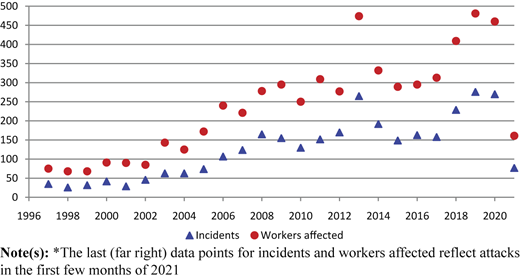
Despite the ongoing “war on terror” and armed conflict in the world, global climate change has been noted as “today's most significant threat to human survival” (Munslow and O'Dempsey, 2009). Since the sixties, the number of reported natural disasters affecting Earth's inhabitants has increased dramatically. In 2020, the number of armed conflicts involving substantial loss of life on the battlefield reached an all-time high. Similarly, deliberate attacks on aid workers have been increasing – both the number of incidents (276) and number of aid workers affected (481) peaked in 2019 and then declined just slightly in 2020.
This amount of armed conflict and natural disaster in the world has numerous implications for humanitarian supply chains and logistics, including implications for relationships among players in the “humanitarian space.” The purpose of this paper is to explore several perceived gaps in the humanitarian supply chain collaboration literature, inspired by the changing landscape. In the first section to follow, statistics and narrative describe the increasing numbers of conflicts and disasters in the world. Next, the second section profiles and briefly discusses the shrinking humanitarian space phenomenon. The third section presents a selected review of literature on humanitarian supply chain relationships. Then, the fourth and fifth sections adapt the supply chain framework for security and sustainability, respectively. The paper ends with a research agenda in section six.
Conflicts and disasters
The world is witnessing an increasing number of natural disasters and armed conflicts.
The Center for Research on the Epidemiology of Disasters (CRED) launched the Emergency Events Database (EM-DAT) in 1988, with support from the World Health Organization (WHO) and the Belgian Government. It consists of data on the occurrence and impact of more than 22,000 major disasters, starting in 1900. Today, the International Disaster Database involves collaboration with the International Federation of Red Cross and Red Crescent Societies (IFRC), the Max Planck Institute of Biogeochemistry, the United Nations Secretariat for the International Strategy for Disaster Reduction (UNISDR), and the United States Agency for International Development (USAID).
The database includes natural disasters, along with industrial and transport accidents (e.g. oil spills). EM-DAT Guidelines classify natural disasters as follows: biological (epidemics and insect infestation); climatological (droughts and wildfires); geophysical (earthquakes and volcanoes); hydrological (floods and landslides); meteorological (storms and extreme temperature events); and extra-terrestrial (https://public.emdat.be/about).
Figure 1 is a plot of the number of reported natural disasters in the world, from 1900 to 2021. (The last data point at the lower right of the figure reflects disasters in 2021 up to mid-May.) Natural disaster occurrences rose slowly but steadily from 1900 to 1960. After that, reported occurrences climbed steeply, from 29 in 1962 to 532 forty years later. Since reaching that peak in 2002, occurrences have declined slightly, with incidents per year appearing to become more volatile.
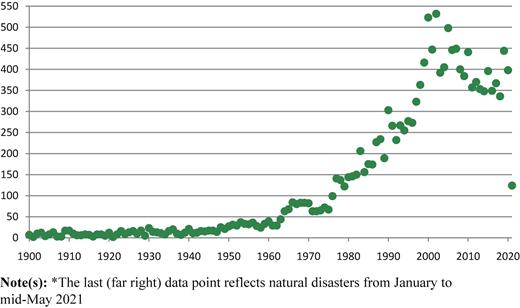
The EM-DAT website also publishes a “Disasters of the Week” section. For instance, for week 20 (May 10–16, 2021), these 7 natural disasters were featured: floods and landslides in Sri Lanka; a tropical storm in the Philippines; tornadoes in China; floods in Kenya; “severe weather” in south-eastern France; landslides in Tajikistan; and floods and storms in Rwanda. These “natural” disasters are all connected to climate change. In addition, one technological disaster was noted, a shipwreck with migrants aboard off the coast of Tunisia (https://www.emdat.be/).
Turning to the disaster of war, development and updating the Armed Conflict Dataset is a joint initiative between the Uppsala Conflict Data Program (UCDP) at the Department of Peace and Conflict Research, Uppsala University, Sweden and the Center for the Study of Civil War at the International Peace Research Institute in Oslo, Norway (PRIO). State-based armed conflict is defined as: “a contested incompatibility that concerns government and/or territory where the use of armed force between two parties, of which at least one is the government of a state, results in at least 25 battle-related deaths in a calendar year.”
The database tracks four types of conflict, in decreasing order of occurrence as follows:
Intrastate: Conflict between a government and one or more rebel groups, without (troop) involvement of foreign governments.
Internationalized intrastate: Conflict between a government and one or more rebel groups, with (troop) involvement of foreign governments.
Interstate, i.e. the sides in the conflict are both states.
Extra-systemic: Conflict between a government and a non-state group outside its territory; the government is fighting to keep control of territory outside the state system.
Figure 2 plots armed conflicts in the world from 1946 to 2020. By far, the most common type of conflict has been intrastate, accounting for 1,864/2,506 or nearly 75% of all conflicts. The next most common type of conflict is internationalized intrastate (389 conflicts), followed by interstate (136 conflicts) and finally extra-systemic (117 conflicts). After a decline and lull in activity from 1995 to 2006, the number of armed conflicts had risen to an all-time high by 2020.
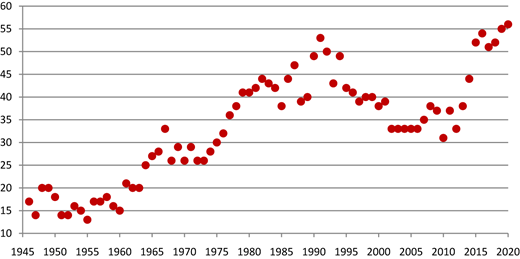
The database also classifies conflicts in terms of two levels of intensity within a calendar year. Minor conflicts, i.e. conflicts resulting in 25–999 battle-related deaths during any given year, accounted for 1,860/2,506 or over 74% of all conflicts. The remaining conflicts, called “wars,” resulted in at least 1,000 battle-related deaths in a given year (Pettersson, 2021).
The shrinking humanitarian space
The Aid Worker Security Database (AWSD) is a global compilation of reports on major security incidents involving deliberate acts of violence against aid workers. “Major incidents” include murders, kidnappings and other attacks resulting in serious injury. Aid workers are employees and associated personnel of (national and international) not-for-profit aid agencies that provide material and technical assistance for humanitarian relief. Lack of security for aid workers can greatly reduce access to beneficiaries in need, limiting the amount and quality of aid provided, as well as increasing costs and reducing delivery reliability.
Figure 3 reveals the general increase on attacks on aid workers in terms of number of incidents and the number of aid workers affected (AWSD, 2021). Incidents and aid workers affected have both risen since 1997, with peaks approaching 500 workers murdered, kidnapped or injured in 2013 and 2019. (The last two data points, at the lower right of the figure, reflect incidents and workers affected in the first few months of 2021.)
During the 1990s, Alexander and Parker (2021) argue that aid agencies operated rather freely, with few security limitations, even in the most dangerous places. Local populations perceived humanitarian aid workers to be truly neutral and autonomous vis-à-vis political agendas. But things changed after 2000. “9/11” happened; perceived neutrality began to fade away; attacks on aid workers began to rise. The humanitarian space was shrinking.
There are several definitions of the “humanitarian space,” depending on whom or what is the center of attention (https://humanitariancongress.at/humanitarian-space/). One approach is to focus on the aid agencies and their ability to operate freely and in alignment with principles of humanitarian action. A second perspective focuses on affected communities and the rights of beneficiaries to relief and protection. A third approach stresses international humanitarian law – and the responsibilities of warring parties to protect civilians and to allow impartial aid agencies to provide humanitarian relief. (الكحلوت غسان 2020) argues that the humanitarian space implies operating environments that permit humanitarian actors to deliver aid according to humanitarian principles and in line with international law.
According to Brassard-Boudreau and Hubert (2010), aid agencies point to increased targeting of civilians, deliberate attacks on aid workers, and assimilation of humanitarian response within counter-insurgency operations as evidence of shrinking humanitarian space. Nonetheless, like Kool et al. (2021), they question whether the humanitarian space is actually shrinking and argue for a focus on civilians at risk, on those in need rather than the aid agencies.
Collinson and Elhawary (2012) agree “there is an overwhelming consensus among humanitarian actors that ‘humanitarian space’ is shrinking.” They note that most of the large NGOs are from North America and Western Europe – and that humanitarian assistance supported by Western governments is often developed to advance political and security goals of those governments. Perhaps this neo-colonial approach breeds suspicion and distrust among local populations.
The neutrality and independence of the humanitarian NGOs is increasingly compromised by donors, peacekeepers and battlefield rivals seeking to appropriate aid efforts and exploit the situation. There is evidence that the increasing attacks on aid workers follow from perceptions that they are no longer impartial, that they are agents of foreign governments.
Al Jazeera reports that humanitarian aid is being used as a “weapon of war” in Syria and other places, as aid workers are attacked and their ability to make a difference, safely and effectively, wanes (Bin Javaid, 2017). According to the European Union (2010), “humanitarian space” refers to the ability to deliver aid in an unhindered and secure environment. The shrinking creates “double victims” – first by conflict or disaster; second by being denied humanitarian aid. The shrinking also reduces the efficiency of aid operations, as resources are spent on security rather than on providing relief.
While the nature of the “humanitarian space” may be controversial (Anonymous, 2012), it seems all agree that the objective is to create a safe space for aid workers to meet people in need; a place to ease their suffering rather than worsen it.
Humanitarian supply chains
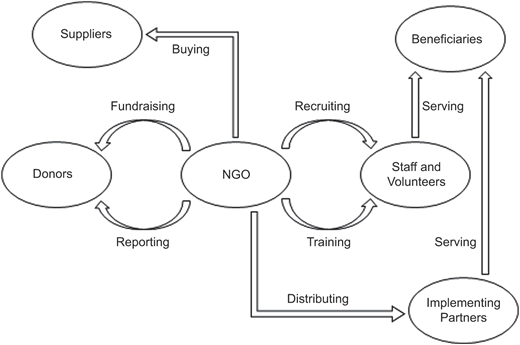
Figure 4 is an abbreviated map of a humanitarian supply chain, depicting a selection of primary actors and activities. The diagram positions suppliers and donors upstream from a focal NGO. Buying from suppliers and fundraising targeted at donors are among the NGO’s main upstream activities. The NGO also engages in recruiting and training of staff and volunteers. While some staff members are hired to interact with suppliers and donors, many are destined for fieldwork, working with implementing partners to serve beneficiaries. Beneficiaries, NGO staff, volunteers and implementing partners are the ones living and working in the humanitarian space.
The humanitarian aid coordination problem has been discussed in the disaster literature for at least 16 years (Stephenson, 2005). Seybolt (2009, p. 1,027) argues that “To cut through the inefficiency and unintended consequences of aid efforts, observers have long called for better coordination among humanitarian, political and military organizations.” In 2010, a surge of academic papers were published on humanitarian supply chain collaboration, cooperation and coordination. Balcik et al. (2010) describe the variety of relief actors, in terms of mission, focus, capacity and logistical expertise and conclude that research on “coordination in humanitarian relief chains is still in its infancy.”
In a study of “clusters” as an approach to attain functional coordination, Jahre and Jensen (2010) found that horizontal coordination within clusters distracts attention from matters of vertical coordination among NGOs, suppliers, donors, military units and beneficiaries. Schulz and Blecken (2010) study barriers to and logistical benefits of horizontal cooperation in relief supply chains. The primary barriers to greater cooperation among NGOs were differences in organizational culture, along with a lack of transparency and trust. Benefits centered on the traditional trinity of logistics performance measures: delivery, quality and cost. Interestingly, they found that the NGOs tend to focus more on delivery and quality and less on cost.
The more recent literature on humanitarian logistics and supply chain collaboration spans internal relationships (e.g. Makepeace et al., 2017) and horizontal relationships (e.g. Toyasaki and Wakolbinger, 2019); along with a more extensive focus on vertical relationships (Maghsoudi and Pazirandeh, 2016; Nurmala et al., 2017; Al Adem et al., 2018; Prasanna and Haavisto, 2018; Moshtari and Vanpoucke, 2020). In terms of logistics and supply chain performance, prior research focuses on traditional measures.
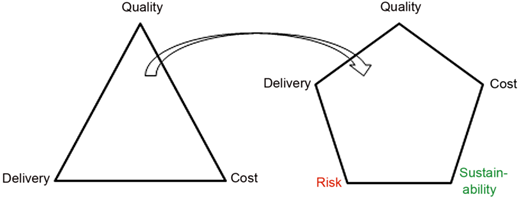
The traditional dimensions of logistics and supply chain performance are (product) quality, delivery and cost (see Figure 5). The objectives call for material of acceptable, agreed-upon quality to be delivered on time at a total cost in line with the budget. In response to changing global conditions, two additional dimensions of performance have become highly salient – risk and sustainability. Businesses are paying more attention to risk and sustainability, but these factors are particularly important for humanitarian agencies in light of the increasing number of armed conflicts and natural disasters. These five dimensions are shown at the vertices of the pentagon.
Harvey (2013, p. S154) observes that “There have always been two interlinked strands of humanitarian action: one relating to conflicts and the other to natural disasters.” As noted above, both these triggers of humanitarian action are on the rise (see Figures 1 and 2). The (debatably) good news is this may help solve the dormant supply chain (Kovács and Tatham, 2009; Larson, 2011) and swift trust (Tatham and Kovács, 2010; Dubey et al., 2019) problems, as the “action” never stops, the “armies” never demobilize.
Security
In security, humanitarian NGOs have a growing short-term problem, on top of their traditional logistics problem of delivering the goods. To deliver aid, humanitarian workers need a safe space to meet and serve people in need. Aid efforts will be compromised by a lack of security in several ways. Insecurity makes beneficiaries less accessible. It also puts aid workers in peril and makes it more challenging to recruit new humanitarians. In addition, insecurity disrupts logistics activities, i.e. the transport and storage of material in support of humanitarian work, such as food, shelter and medicine.
Falagara Sigala and Wakolbinger (2019) note certain risks involved in outsourcing humanitarian logistics to commercial service providers, i.e. service quality, provider capacity and risk of price fluctuations in the face of fixed budgets. However, their focus excludes direct consideration of security risks in humanitarian supply chains. In an earlier study on the strategies humanitarian actors use to handle supply chain risk, Jahre (2017) focuses on inventory management, rather than security management.
The literature on humanitarian supply chain management has rarely brought security into the discussion. In a sign that this may be changing, Mackay et al. (2019) include two factors of risk (probability or likelihood of occurrence and consequence or severity of impact) among their six dimensions of disasters. Type of disaster, including risk profile, has apparent implications for supply chain design. If the likelihood and/or impact of security issues are high, humanitarians need to incorporate security risk into supply chain design. Deliberate attacks on aid workers are disasters within disasters.
In areas of extreme security risk, development aid work is often suspended until the war is over and peace prevails. On the other hand, the need for humanitarian relief is heightened by war, despite the danger of delivering it. In this high-risk context, situation and needs assessments should include an assessment of risk. Is the host national government willing and able to create a safe space for aid workers and beneficiaries? Will all parties in an ongoing conflict respect the role of humanitarians? Can aid be delivered without political and/or military interference?
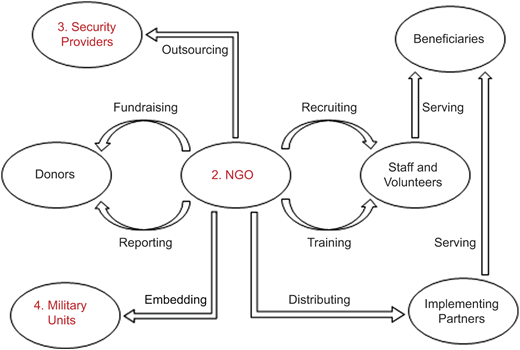
Humanitarian logisticians should be part of any discussions/negotiations with host government military personnel, rebel (insurgent) groups, and intervening foreign military personnel. The first decision might be how to enter a particular theater of operation, or whether to even step onto the stage. If an agency decides to enter a high-security risk situation, there appear to be at least four strategic options to consider, resulting in an increasing loss of autonomy:
Be reactive. Under this approach, the humanitarian agency comes in, performs its usual activities to help those in need, and hopes for the best. As security problems arise, the agency may alter its methods of delivery. In the extreme, this may entail temporary or permanent withdrawal from an area of conflict.
Provide security internally. This approach implies a need to broaden the skills needed to be a humanitarian logistician, with a special focus on security management and the ability to work under pressure/in harsh environments (Kovács et al., 2012). The inclusion of security among the functions of humanitarian logistics has clear implications for the recruitment, hiring and training of aid workers.
Hire a commercial security provider. This is similar to hiring commercial logistics service providers (Falagara Sigala and Wakolbinger, 2019), but with a focus on security services. An example of such a firm is G3 Security Limited (https://www.g3security.co.uk/), based in London. Of course, engaging such services is sure to have budgetary implications, as well as reputational implications, for any aid agency.
Embed with a military unit. This would entail “humilitarian” collaboration (McLachlin and Larson, 2011; Larson, 2012). The military unit could be attached to the national (host) government, NATO or UN peacekeepers, an intervening foreign government or even insurgents. The Provincial Reconstruction Teams (PRTs) in Afghanistan are an example of this approach (Munslow and O'Dempsey, 2009). Whatever entity is supporting the military unit, its purpose is to assure a safe operating environment for aid workers and the local civilian population. As noted above, this approach maximizes aid agencies' loss of perceived autonomy.
Figure 6 modifies prior Figure 4 to reflect the three proactive security options briefly discussed above. The question is, “To what extent are humanitarians willing to sacrifice their perceived independence (in the minds of the local population) for enhanced security?” Unfortunately, even with the reactive approach, loss of perceived autonomy and independence, in the minds of local people, may precede serious consideration of security issues by an aid agency. Local peoples' perceptions do not necessarily match reality.
Sustainability
While security is an immediate problem for the humanitarian NGOs, particularly in war zones, they also face a long-term problem – sustainability.
Climate change appears to increasingly cause or exacerbate “natural” disasters. Sphere (2019) suggests that humanitarian relief should neither compromise the conservation of natural resources nor increase the likelihood of environmental disasters. Yakupitiyage (2019) states the case that environmental and humanitarian action should be linked. Unfortunately, Zein (2019) observes: “Ecological concerns rarely factor in humanitarian situations.” This is urgent: “with 68 million refugees and climate-related disasters threatening to displace as many as one billion people by 2050, this needs to change.” Emilia Wahlstrom of the United Nations Environment Programme (UNEP) leads an initiative called Connecting Environment and Humanitarian Action. As relayed by Zein (2019), Wahlstrom notes that humanitarian NGOs tend to view people as separate from their environment – and the goals of environmental protection and humanitarian action can be quite different.
In terms of social sustainability, conflict and disasters create or intensify economic disparities and exacerbate gender inequality and human rights abuses (VanRooyen, 2013). The connection between gender-based needs and gender inequality is poorly understood by humanitarian policymakers and practitioners. Gender equality programming (GEP) can yield more effective humanitarian response and more efficient use of resources. Unfortunately, GEP “is chronically underfunded” during disaster relief efforts (Lafrenière et al., 2019).
Thus, humanitarian logisticians should also be involved in matters of sustainability, such as climate change and gender inequality. In the long term, development aid programs can make a difference in ameliorating the problems of climate change and gender inequality. In the short term, at a minimum, disaster relief efforts should not make matters worse. As in the case of risk management, there are several strategic options for humanitarian aid agencies:
Be reactive. Again, the humanitarian agency performs its usual activities and hopes for the best. As sustainability issues arise, agency staff may be in an awkward position. How should staff respond upon witnessing gender discrimination? What should they do if pressured to participate in environmental harm? The reactive approach implies a lack of direction on such matters.
Address sustainability internally. As in the case of risk, this approach has implications for the humanitarian logistics skill set. Now, the additional skill requirements are in the areas of social and environmental sustainability. Training must include knowledge on responding to issues while at times balancing core humanitarian principles with local cultural norms. Aid workers may need training and guidance on the differences between ethical imperialism and relativism (Donaldson, 1996). The important questions include Is gender inequality ever acceptable? Is environmental harm ever acceptable? If so, under what conditions are these things acceptable?
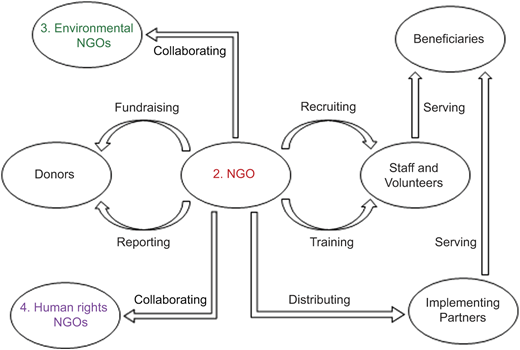
Collaborate with environmental groups. This is similar to NGO-to-NGO “humanitarian” collaboration (Larson, 2012), but in this instance, the partner is an environmental NGO, e.g. Greenpeace (https://www.greenpeace.org/international/). Greenpeace “uses non-violent, creative action to pave the way toward a greener, more peaceful world, and to confront the systems that threaten our environment.” Their focus is environmental, but Greenpeace ships have sailed to bring humanitarian relief to communities affected by extreme weather events.
Collaborate with human rights groups. These groups include Amnesty International (https://www.amnesty.org/en/) and Human Rights Watch (https://www.hrw.org/), which “defends the rights of people in 90 countries worldwide, spotlighting abuses and bringing perpetrators to justice.” An important question is, Would working with a group like Human Rights Watch be complementary to a humanitarian NGO's core mission, or would it be a distraction.
Figure 7 modifies Figure 4 to reflect the proactive sustainability options briefly discussed above. Collaborating with environmental and social justice, NGOs in the field might thrust aid workers into an advocacy role. To what extent are humanitarians willing to intervene as advocates for environmental and social justice? Should advocacy work be kept separate from direct delivery of humanitarian aid?
Research agenda
Security and sustainability are issues of increasing importance in humanitarian supply chains. Thus, the paper ends with a brief research agenda, noting opportunities to learn more about the role of humanitarian supply chain relationships in security management and sustainability.
Case studies could be useful to better understand the issue of security in humanitarian supply chains. An initial case could focus on a single NGO operating in multiple conflict zones or on a specific conflict in which multiple NGOs are involved. Important questions might include the following: How do humanitarian NGOs currently handle security management and the risk of deliberate attacks on aid workers? Why do they handle it as they currently do? Under what conditions are various approaches (i.e. reactive, internal, hiring private security or embedding with military units) preferred? Are there any opportunities to improve security management performance? How is security performance measured? How do security concerns impact the recruitment and training of aid workers? What specifically is being done to protect aid workers, beneficiaries and other civilians in conflict and disaster zones? Is the “humanitarian space” really shrinking? How do images of aid workers distributing relief items under the protection of military units (Heaslip et al., 2012) impact the humanitarian space? What are the contextual or contingency factors (e.g. social, cultural, economic and political factors) that affect matters of security? What works in Haiti or Tahiti may not work in Thailand. When and where should advocacy (for peace and non-violence) be integrated with the work of delivering aid?
Case studies could also be useful to better understand issues of sustainability in humanitarian supply chains. How do humanitarian NGOs currently address sustainability and issues of environmental and social justice? Why do they address these matters as they currently do? Under what conditions are various approaches (i.e. reactive, internal, collaborating with other NGOs on environmental or social issues) preferred? Are there any opportunities to improve sustainability performance? How is sustainability performance measured? How do concerns about sustainability impact the recruitment and training of aid workers? What contextual or contingency factors (e.g. social, cultural, economic and political factors) affect sustainability? When and where should advocacy (e.g. against environmental harm and/or gender inequality) be integrated with the work of delivering aid?
While issues of sustainability – and the Sustainable Development Goals (SDGs) – are particularly relevant in development aid work, these issues should not necessarily be discarded during the provision of disaster relief. CARE is an example of a humanitarian NGO that recognizes the links between development aid and disaster relief, along with inter-relationships among the SDGs. Global gender inequality and climate change have common roots (Otzelberger, 2014; McArthur, 2019). Environmental and social injustices are co-conspirators and close collaborators of natural disasters, armed conflicts and deliberate attacks on aid workers and other civilians.

