


The research areas of humanitarian supply chain (HSC) and disaster and humanitarian operations (DHO) have evolved through the use of managerial models. Recent studies, however, point to the need for the empirical validation of such managerial models in real-life scenarios. Therefore, the present study aims to investigate the validation of recent managerial models based on empirical data of two disasters in Haiti: the earthquake in 2010 and Hurricane Matthew in 2016.
This research developed two case studies from the perspective of the Brazilian Navy (BN), a part of the Brazilian Armed Forces that led the United Nations Mission for Stabilization in Haiti (MINUSTAH) in both disasters. The case studies focused on empirically validating managerial models for stakeholder identification, stakeholder satisfaction, response processes, strategies for collaboration and the integration of these models.
The results revealed that compared to the response to the earthquake in 2010, the response to Hurricane Matthew in 2016 was superior. The collaborative strategies of the BN and other stakeholders used after the earthquake were more reactive, while the strategies after Hurricane Matthew aimed more at planning and anticipating adverse situations.
This research reinforces the investigated managerial models and indicates their suitability as planning tools for practitioners of HSC and DHO, which is essential for the further development of academic contributions related to integrating the models into more robust solutions.
1. Introduction
Research on the humanitarian supply chain (HSC) and disaster and humanitarian operations (DHO) has attracted increasing attention from academics and practitioners, as they rely on various analytical tools to improve how relief is provided to beneficiaries (Behl and Dutta, 2019; Yadav and Barve, 2019). Different studies suggest that inserting traditional practices and theories from commercial supply chains into DHO would allow HSCs to be more efficient and effective (Tabaklar et al., 2015; Dubey and Gunasekaran, 2016; Behl and Duta, 2019; Grange et al., 2020; Prakash et al., 2020). Consequently, models and frameworks based on managerial theories have been developed by considering the specifics of disaster and humanitarian issues, which have improved the comprehension of topics with scarce literature (Wamba, 2020; Behl and Dutta, 2019; Banomyong et al., 2019). The academic literature has also demonstrated that in commercial environments, integration practices along the supply chain improves companies’ performance and competitive capabilities, but the empirical research on these integration practices in humanitarian organisations is still limited (Olaogbebikan and Oloruntoba, 2019; Ataseven et al., 2020; Fekete et al., 2021). Tatham and Houghton (2011) argue that the professionals engaged in DHO face “wicked problems” and that they rely on multi-faceted management decisions in disaster response. Gupta et al. (2016) and Ha (2020) also stress that operations focused on integration are essential for effective DHO and indicate the need for more integrated models.
Despite the recent increase in research addressing managerial theories, models and tools in HSC, empirical validation of these concepts is still needed (Gupta et al., 2016; Olaogbebikan and Oloruntoba, 2019). Behl and Dutta (2019) also point out a dearth of review on critiquing empirical models developed by previous research. Moreover, Pagell (2021) considers that such replications are essential to Operations Management and Supply Chain Management as they increase the generalisation of research findings and more substantial claims about the theories in these areas. Besides, it allows significant inferences, especially when the results are different from previous research or unexpected (Pagell, 2021). In this sense, Paciarotti et al. (2021) also verified that professionals engaged in HSC acknowledge that standardisation of procedures and tools – which might also come by replication and empirical validation of propositions – are essential to the area. Some examples of such empirical validation of previous theoretical and model propositions are presented by Sabri et al. (2019) and Lamenza et al. (2019). Sabri et al. (2019), when discussing processes for stakeholder collaboration, provided evidence that the proactive usage of the processes improved the collaboration among the stakeholders engaged in DHO in Kenya. Lamenza et al. (2019), when discussing purchasing strategies for relief items, produced evidence that context characteristics improve the adjustment of managerial models for HSC and DHO.
While the literature points out the need for more research on managerial models and their integration in HSC and DHO (Gupta et al., 2016; Ha, 2020), some researchers also indicated the need for more theory tests as a fundamental approach for science progress (Behl and Dutta, 2019; Pagell, 2021). This perspective comes up with the following research question: to what extent are the managerial models for integrated operations in HSC and DHO adherent to real-life settings? Consequently, this work aims to discuss the empirical validation of recent managerial models for HSC and DHO. Such empirical validation focused on responses to two significant disasters in Haiti in the past decade. The first disaster was the earthquake in 2010, which affected more than 2.8 million people (Echevin, 2011). The second disaster was Hurricane Matthew, a tropical cyclone that affected Jamaica, Cuba, the Dominican Republic, the Bahamas and mainly Haiti in 2016, resulting in large-scale losses and damage and more than 1.4 million people needing immediate humanitarian assistance (World Bank, 2017). This research thus contributes to the HSC and DHO research areas by providing evidence of the validity of managerial models based on real-life cases and corroborates disaster response planning by focusing on managerial models. The current research also contributes with an HSC and DHO perspective in comparing these two disasters, which have been discussed in terms of political and local community initiatives (Schuller et al., 2019; Hsu and Schuller, 2020).
Section 2 presents recent research on HSC and DHO managerial models. Section 3 offers methodological procedures that guide the empirical validation of such managerial models and Section 4 shows the results of the empirical validation by considering the two disaster responses in Haiti. Section 5 summarises the research contributions, implications, and future research directions and Section 6 presents the main conclusions.
2. Managerial models in the HSC context
Over the years, several studies have addressed specific managerial models and topics in HSC and DHO, resulting in literature reviews that aim to enhance the comprehension of such topics (Behl and Dutta, 2019). Nevertheless, such research provides limited empirical validation on real disaster life-setting, and more empirical validation is needed (Behl and Dutta, 2019; Pagell, 2021). Besides, recent research also argues the importance of integrating different managerial models to improve HSC and DHO. To this end, Fontainha et al. (2019) proposed an integrated managerial model for DHO – which involves the adoption of all types of resources (e.g. information, material, equipment, technology, people/stakeholder) to meet the beneficiaries’ needs – and that specifically addresses the following issues: stakeholder identification, stakeholder satisfaction, disaster response processes and inter-organisational collaboration strategies. Thus, this section continues with a brief discussion about the Stakeholder Theory (ST) and then the managerial models for each of these issues, focusing on the contributions made by recent literature reviews and their limitations on empirical validation.
The ST emerged in 1984 based on the work of Freeman (1984), where a stakeholder is defined as “all groups or individuals that affect or are affected by the business”. Since then, the ST evolved through a descriptive perspective, by determining who are the stakeholders; an instrumental perspective, by evidencing the success of organisations who protect the interests of all their stakeholders; and a normative perspective, by describing why organisations should consider their stakeholders (Donaldson and Preston, 1995). Although the diverse nature of such perspectives and eventual divergence between the ST and other managerial approaches, such as Strategic Management and Corporate Social Responsibility, Freeman et al. (2020) argue that they have some overlapping areas and that some of the tensions among them might provide exciting ways to put the different areas of scholarship and practice together. In this sense, the ST is one of the theoretical bases that calls for more links and connections among various stakeholders within the HSC and DHO (Prakash et al., 2020).
In terms of stakeholder management in HSC and DHO, the first models were developed by Kovács and Spens (2007), Cozzolino (2012) and Yokouchi (2015). Fontainha et al. (2017) later presented a structured literature review and identified 10 main stakeholders in DHO in 3 groups: public (Legislative and regulatory, Government and Military), private (Media, Direct supplier and Private sector) and people (International aid network, Local aid network and Donor), with the Beneficiary as the central stakeholder. In addition to identifying stakeholders, there are other relevant issues regarding stakeholder management in HSC and DHO. For instance, Neely et al. (2008) suggest the relevance of stakeholders’ wants and needs (stakeholder satisfaction) for better stakeholder management and performance in commercial supply chains. In this context, Fontainha et al. (2020) developed a literature review to investigate stakeholder satisfaction in disaster response by focusing on complex relationships (i.e. more than two stakeholders simultaneously). The authors also considered the relevance of the differences between the flow of resources and the flow of ideas, influence and interests (III). The flow of resources in complex relationships involves financial, material and information resources that move between stakeholders (Frooman, 1999). The flow of III describes interference in stakeholders’ behaviour when there is a compatible or incompatible position between them (Rowley, 1997). Fontainha et al. (2020) identified 30 stakeholders’ satisfaction in complex relationships according to the flow of resources and flow of III.
In terms of process models, Van Wassenhove (2006) already indicated the relevance of process management as a managerial issue for HSC and DHO. Since then, several studies have proposed specific process models, with most focusing on disaster responses (e.g. Blecken, 2010; Wang et al., 2014; Leelawat et al., 2015; Chen et al., 2017; Horita et al., 2017). Considering that these process models focus on partial perspectives (i.e. particular stakeholders or particular disasters), Fontainha et al. (2022) more recently provided a literature review to provide a more comprehensive perspective. They identified patterns among existing models, which allowed a reference model from different disaster and stakeholder perspectives to be used and reused. The process model describes the disaster response at two levels: the general level, which has nine processes, and the partial level, which has 62 processes. This model’s main contribution lies in its consideration of alternative flows that may or may not be implemented in the response, according to the specific characteristics of the disaster (Fontainha et al., 2022). According to the authors, this is the first model that addresses all stakeholders in the disaster response and improves its planning.
In terms of strategic models, Kunz and Gold (2017) discussed combining relief organisation enablers, the population’s long-term requirements and contingency factors as components that lead to sustainable HSC. L'Hermitte et al. (2016) explored the collaboration, learning-orientation, action-focus and purposefulness are strategic elements of an agile HSC. In terms of structured literature reviews, Moshtari and Gonçalves (2017) and Wankmuller and Reiner (2020) investigated collaboration in HSC and DHO. The first focused on barriers to coordination, and the second focused on the need to distinguish between coordination, cooperation and collaboration. Jahre (2017) also conducted a literature review investigating the use of strategies in HSC and DHO, identifying collaboration as one of the main strategies. Jahre (2017) indicated that HSC stakeholders could adopt any of the following elements in collaboration strategy in HSC: coordination (by command, consensus or default), supplier relations, commercial-humanitarian cooperation, collaborative contracts, civil-military coordination, orchestral adaptability and network.
Considering integrated perspectives, Fontainha et al. (2019) acknowledged that individual managerial models offer specific contributions to HSC and DHO. Nevertheless, they argued that combining models allowed additional contributions. When, for example, stakeholder models and process models are combined, the association of specific stakeholder(s) with the process(es) can be precisely identified. Therefore, it is not only essential to enhance the empirical validation of managerial models in HSC and DHO, as indicated by Behl and Dutta (2019) but also to determine how they contribute to each other (Fontainha et al., 2019). In addition, Fontainha et al. (2020, 2022) already provided an initial empirical validation that considered two disaster responses in Brazil by addressing stakeholder satisfaction and disaster response processes, respectively. However, these initial empirical validations address the independent perspectives of each managerial model. Table 1 synthesises each of the recent managerial models that can be combined for integrated operations in HSC and DHO as indicated by Fontainha et al. (2019) and their limitations on empirical validation.
Managerial models approach overview
| Managerial models for HSC and DHO | Characteristics | Empirical validation |
|---|---|---|
| 3PR stakeholder model (Fontainha et al., 2017) | Identifies 10 main stakeholders in DHO and provides a stakeholder model to promote better stakeholder management in DHO | Hypothetical examples |
| Stakeholder satisfaction (Fontainha et al., 2020) | Identifies 30 stakeholders’ satisfaction in complex relationships according to the flow of resources and flow of III. These stakeholders’ satisfactions represent specific topics that must be addressed within the stakeholder management in DHO | Empirical validation based on disaster scenarios in Brazil |
| Reference Process Model (Fontainha et al., 2022) | Provides a reference process model with 2 levels: the general level with 9 processes, and the partial level with 62 processes. This process model contributes to guide and support disaster response planning | Empirical validation based on disaster scenarios in Brazil |
| Strategies for collaboration (Jahre, 2017) | Identifies 7 elements in collaboration strategy in HSC, which enable acknowledge the current and future perspectives of strategies for stakeholder management | No validation |
| Integration of managerial models (Fontainha et al., 2019) | Provides recommendations for the integration of different DHO models | No validation |
Source(s): The authors
3. Research methodology
The characteristics of current research, which involves empirical validation of managerial models for HSC and DHO, resulted in adopting the case study as the primary research method. Yin (2013) indicated that the case study benefits research on previously developed theoretical propositions and suggested the following six steps to conduct a case study: plan, project, preparation, data collection, data analysis and reporting.
The first step accounts for the justification to adopt the case study method. As indicated in the Introduction, the current study addresses real-life disaster responses and focuses on a research objective characterised by empirically validating previous models for HSC and DHO, which are essential to the case study method, as indicated by Yin (2013).
The project stage considers the logic connecting the data collected and the research questions that discuss the case(s) (Yin, 2013). Regarding the purpose of exploring the empirical test of managerial models for HSC and DHO, the present work considers a multiple-case approach to bring more evidence and different real-life settings to such discussion. Thus, the research analyses the responses to two Haitian disasters: an earthquake (2010) and a Hurricane (2016). Analysing these two disasters brings an additional opportunity to compare the HSC and DHO in both situations, emphasising how the response evolved from one disaster to another. Moreover, the analysis of the cases considers the Brazilian Navy’s (BN) perspective, as it was one of the leading stakeholders responding to both disasters. The military’s engagement with other stakeholders is thus considered essential to success in a DHO (Heaslip and Barber, 2016; Costa et al., 2017).
A research protocol is determined during the preparation stage, as Yin (2013) recommended. The protocol defines questions that will be used to gather empirical data to contrast with findings from the four managerial models for DHO and HSC. These managerial models are detailed in the previous section, summarised in Table 1, and they are the basis for this empirical validation. These managerial models are:
Stakeholder identification – based on Fontainha et al. (2017) – focuses on identifying the stakeholders that interacted with the BN in the cases analysed. Fontainha et al. (2017) also proposed a quantitative approach using this model, which is suggested by investigating the strength of such stakeholders’ relationships based on a five-point Likert scale. This approach is considered in specific questions regarding the interaction between the BN (Military) and each of the other stakeholders identified in the stakeholder model developed by Fontainha et al. (2017);
Stakeholder satisfaction – based on Fontainha et al. (2020) – focuses on identifying how well the BN met the stakeholders’ satisfaction and how the flow of resources and III was performed. Table 2 summarises seven indicators that involve the military’s satisfaction with other stakeholders;
Disaster response processes – based on Fontainha et al. (2022) – focus on the identification of the processes that the BN performed;
Strategies for collaboration – based on Jahre (2017) – focus on identifying the strategies for collaboration adopted by the BN.
Integration of managerial models – based on previous managerial models (Fontainha et al., 2017, 2020, 2022; Jahre, 2017) – focus on the identification of the interaction among the models, such as the relationship level between the stakeholders and the importance of meeting stakeholders’ satisfaction; which stakeholders interacted with the BN in the disaster responses processes; whether stakeholders’ satisfaction was discussed during the disaster response processes; and strategies for collaboration that are connected to other managerial models (i.e. stakeholders’ identification, stakeholders’ satisfaction and response processes).
Military satisfaction in complex relationships with other stakeholders in responding to disasters
| Flows | Satisfactions | Stakeholders involved | |
|---|---|---|---|
| Military | III | The Military expects to have its knowledge of the disaster scenario and operational recommendations recognized by the International Aid Network and the Government, also combined with the Private Sector and Direct Suppliers return to their operations in commercial and essential services | Government, International aid network, Private sector, Direct supplier |
| Military | III | The Military expects to have coordination, alignment and integration of actions among all the stakeholders involved in the disaster response | Local aid network, International aid network, Donor, Government, Legislative and regulatory, Media, Private sector, Direct supplier and Beneficiary |
| Military | Resources + III | The Military expects to have news about the disaster transmitted by the Media, which will lead to the engagement of professional volunteers (Local aid network) to integrate the missions | Local aid network, Media |
| Government | III | The Government expects the Local aid network to implement the Government’s decisions and supervise its actions in a close relationship. The Government also envisions the creation of an atmosphere by the Media to incentivise engagement of the Local aid network and deployment of actions by the Private sector in accordance with the Government’s plans as well as operational support of the Military | Local aid network, Media, Private sector, Military |
| Direct supplier | Resources + III | The Direct supplier expects to receive information from the Military and Government to align its operation with the Local aid network | Local aid network, Military, Government |
| International aid network | Resources + III | The International aid network expects the Direct supplier or Private sector will provide essential or auxiliary resources as requested, along with support from the Government in delivering such relief to the Beneficiary, with support from the Military and the Local aid network | Direct supplier, Private sector, Government, Military, Local aid network, Beneficiary |
| Beneficiary | Resources | The Beneficiary expects collaboration of the Local aid network, the Donor, the Private sector, the Government and the Military to coordinate and provide the relief required in disaster response and/or have the Media disseminate alarm and information related to the disaster | Local aid network, Donor, Military, Government, Media, Private sector |
Source(s): Adapted from Fontainha et al. (2020)
Voss et al. (2002) highlighted triangulation during data collection, which consists of using multiple sources of evidence, thus increasing the reliability of results. The sources for this research were documents and semi-structured interviews. The documents consisted of four mission reports from the Marine Corps (MC) that refer to the earthquake and seven mission reports referring to Hurricane Matthew. Four in-person interviews were conducted, ranging from 60 to 90 min in duration. All the interviews were recorded, transcribed and stored electronically to create a database combining sources. Two respondents participated in response to the earthquake, and three participated in response to the Hurricane; one respondent participated in both; the respondents represented the following positions:
Commander of the Operational Group of the Marine Corps;
Officer of Command and Control and Officer of Social Communication;
Immediate of the Combat Services Support Component; and
Commander of the Logistics Detachment.
Data analysis consisted of pattern-matching, in which a fundamental empirical standard is compared to the theoretical standard (Yin, 2013). In the inter-case analysis, the results for both the earthquake and the Hurricane were compared to the literature according to the four managerial models presented in the research protocol (preparation step). In stakeholder identification, the analysis produced a stakeholder model for each case; the stakeholders’ relationship was analysed according to the intensity of the military’s relationship with other stakeholders as measured by a Likert scale directly answered in the semi-structured interviews with the professionals involved in the cases. Considering that the average and standard deviation from the Likert scale results could hide discrepancies among the respondents, the research adopts the Chi-square test as an auxiliary approach to reinforce the reliability of such statistical measures. This specific test investigates a general hypothesis (H0) that there is consensus among the interviewees. If the hypothesis is confirmed, the validity of the average and the standard deviation is reinforced, indicating that the respondents share the same perception of the relationship among the stakeholders. Even though the primary method is qualitative, Choi et al. (2016) suggest that the use of a multi-methodological approach, using both qualitative and quantitative perspectives, contributes to developing rigorous and relevant studies, besides verifying and validating the research results and conclusions – which is the vital point to the current research that seeks the empirical validation of the managerial models for HSC and DHO. Regarding stakeholder satisfaction, the analysis is shown in a table comparing both disasters’ main aspects. In the process dimension, the study detailed the number of processes at the partial level developed by the BN, a percentual proportion from the number of processes indicated in the reference process model developed by Fontainha et al. (2022), and whether the empirical evidence was from interviews or reports. In strategies for collaboration, the elements reported by Jahre (2017) were the reference for empirical validation and the centre for integrating other managerial models. An inter-case analysis considered and compared all the data in combination. Therefore, these analyses provide evidence on empirical validation to the managerial models for HSCM and DHO discussed in Section 2 through real-life operations and an additional contribution on whether the operations in Haiti evolved from 2010 to 2016 considering the analysis of the two disasters. Finally, the reporting stage disseminates the research via this paper, focusing on issues relevant to academics and practitioners interested in HSC and DHO.
4. Empirical validation of managerial models in two disaster responses in Haiti
This section presents the response operations to two disasters in Haiti, the earthquake in 2010 and Hurricane Matthew in 2016, considered from the BN perspective. From 2004 to 2017, the Brazilian Armed Forces led the United Nations Mission for Stabilization in Haiti (MINUSTAH), comprising troops from 16 countries.
BN troops were employed through the Operative Group of Marines of Haiti (GptOpFuzNav-Haiti), a military group that provides gradual employment and integrates capacities and competencies for combat and support operations, such as disaster responses. During the response to the earthquake in 2010, the BN was already in the country and performed an operation that demonstrated five characteristics of Naval Power: mobility, permanence, flexibility, versatility and expedition capacity (Brazilian Navy, 2017). The BN troops were in the last phase of the MINUSTAH mission when Hurricane Matthew hit. This Hurricane resulted in hundreds of deaths, affected thousands of people and destroyed Haiti’s already-fragile infrastructure. The GptOpFuzNav-Haiti was also asked to support United Nations (UN) agencies by restoring the essential structures necessary for the arrival of humanitarian aid (Walker, 2018).
Reviewing the BN’s response to the two disasters, through both the final mission reports and semi-structured interviews, the following subsections discuss the empirical validation of four managerial models: stakeholder identification, stakeholder satisfaction, response processes and strategies for collaboration, and then an integrative perspective of the four. These sections are structured according to the managerial models defined in the case study protocol and indicated in the previous section. Therefore, such managerial models are considered the prognostic basis for discussing to which extent they are adherent to such real-life setting disasters.
4.1 Stakeholders involved in two disaster responses in Haiti
Fontainha et al. (2017) identified 10 stakeholders engaged in DHO. Data collected through interviews and operational reports revealed eight stakeholders in common to both disasters: Government, Military, Donor, Local aid network, International aid network, Private sector, Media and Beneficiary. Responding to the earthquake, only the first six stakeholders were cited in all the reports and by all the respondents. Although all the respondents identified the Media and Donor, they were not mentioned in the reports. In response to Hurricane Matthew, all the respondents recognised the involvement of seven stakeholders: Government; Military; Donor; Local aid network, International aid network, Media and Beneficiary – all of which were also confirmed by the final mission report. Only one interviewee mentioned the participation of the Private sector stakeholders, although it was mentioned in mission reports regarding a market organised by an International aid network where the Military provided security. Regarding the response to the Hurricane, two respondents identified interactions with Direct suppliers, classified as essential service providers in telecommunications. All the respondents reported intensive involvement with the government and emphasised that direct interaction with Donors was non-existent, even though they distributed donations in both disasters. Considering all the efforts aimed at helping the affected population, there was a great deal of interaction between the Military and Beneficiaries in both disasters. Nevertheless, it is essential to note there was already an interaction with the Haitian population due to the MINUSTAH mission that started before the disasters occurred.
On a Likert scale (1 for weak interactions to 5 for strong interactions), the interviewees scored each stakeholder to evaluate the interactions; Table 3 presents the results with their respective averages. To test whether there was agreement among the interviewees, the Chi-square test was applied with an alpha significance level (α) of 99% and seven degrees of freedom. The Chi-square test resulted in 0.9998, which, compared to the reference presented by Pearson and Hartley (1966), indicates the H0 hypothesis cannot be rejected, meaning there was a consensus among the interviewees. The stakeholders’ relationships, from the BN perspective, are summarised in Figure 1. Following guidelines in Fontainha et al. (2017), the dashed lines represent the least intense relationships (with an average from 1 to 2 in Table 3), and the thickest lines define the most significant relationships (with an average from 4 to 5 in Table 3). The arrow pointing in a single direction indicates a coordination relationship, while arrows pointing in both directions indicate collaboration.
Intensity of the interactions between military personnel and other stakeholders in responding to the disasters
| Stakeholder | Earthquake | Hurricane Matthew | ||
|---|---|---|---|---|
| Average | Standard deviation | Average | Standard deviation | |
| Government | 3.5 | 2.1 | 5 | 0 |
| Legislative and regulatory | 1.5 | 0.7 | 1 | 0 |
| Media | 3.5 | 2.1 | 4 | 1 |
| Private sector | 1 | 0 | 1.7 | 1.2 |
| Direct supplier | 2.5 | 2.1 | 3.3 | 1.2 |
| Local aid network | 2 | 1.4 | 4 | 0 |
| Donor | 1 | 0 | 1 | 0 |
| International aid network | 4.5 | 0.7 | 4.7 | 0.6 |
| Beneficiary | 5 | 0 | 5 | 0 |
Source(s): The authors
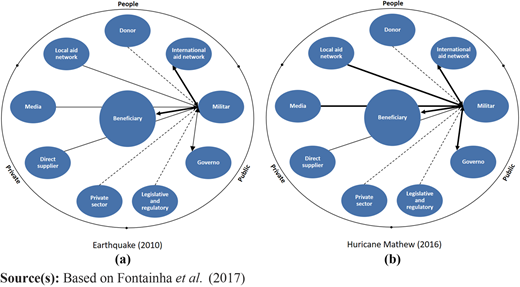
3PR stakeholder model adapted to the disaster response in Haiti from the BN perspective
3PR stakeholder model adapted to the disaster response in Haiti from the BN perspective
By comparatively analysing the stakeholders observed in the earthquake response in 2010 and the Hurricane Matthew response in 2016, an improvement was noted by including organisations identified as Direct suppliers. This was acknowledged as enhancing the Military’s operational capacity and performance. Moreover, the BN did not interact with the Donor or the Legislative and regulatory stakeholders in either disaster but developed a more significant interaction with the International aid network, Government and Beneficiary, and had at least a weak interaction with the Private sector. These findings are a relevant diagnostic and indicate opportunities for exploring stakeholder management in disaster response situations, reinforcing the need for proposals for stakeholder management in HSC and DHO, as Fontainha et al. (2017) outlined.
4.2 Stakeholder satisfaction in two disaster responses in Haiti
Based on stakeholders’ satisfaction identified in Fontainha et al. (2020), Table 4 synthesises the BN perspective in responding to the earthquake in 2010 and Hurricane Matthew in 2016. BN satisfaction was met by other stakeholders, as reported in Fontainha et al. (2020); however, the Media involvement in broadcasting news to engage volunteers was not perceived as relevant to the earthquake. The BN also reported meeting the satisfaction of other stakeholders in both disaster responses. The case study considered a possible BN contribution with additional stakeholder satisfaction from the Military perspective. Nevertheless, none of the interviewees or reports noted other satisfactions in the earthquake in 2010 and the Hurricane in 2016 besides the ones mentioned in Fontainha et al. (2020). Lastly, BN reported a high impact of stakeholder interference in the flow of III in both disaster responses in addition to interference in the flow of resources in 2016, which had not been an issue in 2010. One of the interviewees highlighted that the military valued planning, security and organisation, while the other stakeholders were more concerned with speed than planning.
Resources arrived in a disorderly way, without planning, often without an escort, and often stopped on the way. The capital sent resources, ‘pushing’ them, and it is very difficult for the disaster area to absorb this, stock it correctly, and control traffic, so the result was traffic jams and looting. The great dilemma of the military component and the civilian component in this type of operation is this: the military prioritises the organisation with planning and security first, while the other agencies have a great need for results, pushing resources.
Summary table of stakeholder satisfaction in responding to disasters
| Analysis guidance | Synthesis of the results of the earthquake analysis | Synthesis of the results of the Hurricane analysis |
|---|---|---|
| Was the military’s satisfaction met by other stakeholders? | BN satisfaction was met by other stakeholders; however, there was no need for the BN to use the media to obtain professional volunteers in their operations | BN satisfaction was met by other stakeholders |
| Were there any other military satisfactions that are not described in the literature? | The BN did not identify needs other than those mentioned in the literature | The BN did not identify needs other than those mentioned in the literature |
| Was the satisfaction of the other stakeholders met by the military? | Stakeholder satisfaction was met through the military's logistics and operational support | Stakeholder satisfaction was met through the military's logistics and operational support |
| Were there other satisfactions from other stakeholders that included the military and that are not described in the literature? | No other want or need was reported or identified in the reports | No other want or need was reported or identified in the reports |
| How did the differences in resource flow and III flow affect these interactions? | The flow of resources was satisfactory without interfering in the stakeholders' relationship. Regarding the flow of III, the BN observed interference mainly in interactions with the UN, especially in high-level command decisions | BN data (interviews and reports) provided evidence of a disparity of stakeholders' interests. While the BN had security and planning as a priority, other organizations prioritized speed of action, which often generates uncoordinated and ineffective actions in practice. The BN indicated interference in both flows (resources and III), which directly affected the DHO, especially the collaboration with other stakeholders |
Source(s): The authors
Therefore, the results contribute to the validation of stakeholder satisfaction defined in Fontainha et al. (2020), which reinforces it as a tool for diagnosis, planning and management of stakeholders in HSC and DHO.
4.3 Disaster response processes in two disaster responses in Haiti
Nine processes were performed by the BN in both disasters at the general level in the reference model developed by Fontainha et al. (2022). In response to the earthquake, concerning the general process “Recognition of the occurrence of a disaster”, all the partial processes were executed. By contrast, this number was reduced in response to the Hurricane. The interviewees indicated that this was due to differences in the disasters’ characteristics, which enabled containment and protection measures in the Hurricane response. In the general process “Assessment of the current situation”, despite the quantitative difference in partial processes, there were similarities in both disaster response operations due to the management centre installed due to earlier missions. The general process “Search and rescue” was initially performed by the BN in both disasters but was subsequently performed by civilians in the earthquake response. The BN had entirely performed this activity in the Hurricane response due to the availability of its trained personnel. In the general process of “(Re)establishment of infrastructure in the response”, BN equipment was deployed, and main roads were cleared to improve mobility in the country in both cases. In the general process “Resource request for response”, a similar number of partial processes was performed in both disasters; according to the reports, however, the destination for these requests differed in the two disasters. While resources were scarce and purchased locally for self-sufficiency in response to the earthquake, many requested resources in response to the Hurricane were to sustain the troops, and not the affected population. Despite the similar partial processes performed in “Service to the population” in the two disasters, the detailed operation differed. The BN participated extensively in distributing products donated by the UN or non-governmental organisations (NGOs) to beneficiaries in the earthquake response, but other stakeholders performed these activities in the Hurricane response. The BN completely engaged the “Demobilization of the response” in both disasters, mainly demobilising temporary facilities. According to the interviewees, there was an extensive BN performance in “Response support operations” to the earthquake response, but it was reduced in the Hurricane response.
Of the 62 partial processes in the reference model, the BN acted directly in 45 in the earthquake response, and 26 were not described in the reports. In response to the Hurricane, the BN reduced the partial processes to 37, and 23 were not described in the reports. A comparison of 2010 and 2016 is presented in Table 5 and detailed in Appendix, which indicates that the main differences lie in how the partial processes relate to these general processes: “Recognition of disaster occurrence” and “Response support operations” – both of which were reduced in 2016 compared to 2010.
General and partial processes in responses to the earthquake and Hurricane Matthew
| General Processes | Partial Processes | |||||||||
|---|---|---|---|---|---|---|---|---|---|---|
| Performed | Performed but not described in the reports | Military depended on other stakeholders | Other stakeholders depended on the military | Military and other stakeholders acted together | ||||||
| Earthquake | Hurricane Matthew | Earthquake | Hurricane Matthew | Earthquake | Hurricane Matthew | Earthquake | Hurricane Matthew | Earthquake | Hurricane Matthew | |
| Recognition of disaster occurrence | 5/5 (100%) | 3/5 (60%) | 3/5 (60%) | 1/3 (33%) | No | Yes | Yes | No | Yes | No |
| Assessment of the current situation | 9/10 (100%) | 8/10 (80%) | 5/9 (56%) | 6/8 (75%) | Yes | Yes | Yes | No | Yes | Yes |
| Search and rescue | 2/3 (67%) | 2/3 (67%) | 1/2 (50%) | 0/2 (0%) | No | Yes | Yes | Yes | Yes | Yes |
| (Re)establishment of infrastructure in the response | 2/5 (40%) | 4/5 (80%) | 1/2 (50%) | 3/4 (75%) | No | No | Yes | Yes | Yes | Yes |
| Resource request for response | 3/10 (30%) | 2/10 (20%) | 3/3 (100%) | 2/2 (100%) | Yes | No | Yes | No | Yes | No |
| Resource transport during response | 8/9 (89%) | 7/9 (78%) | 3/8 (38%) | 4/7 (57%) | No | No | Yes | Yes | Yes | No |
| Service to the population | 4/7 (57%) | 3/7 (43%) | 3/4 (75%) | 2/3 (67%) | No | Yes | Yes | Yes | Yes | Yes |
| Demobilisation of the response | 3/3 (100%) | 3/3 (100%) | 3/3 (100%) | 3/3 (100%) | No | No | Yes | No | Yes | No |
| Response support operations | 9/10 (90%) | 5/10 (50%) | 4/9 (44%) | 2/5 (40%) | No | No | Yes | No | Yes | No |
| Total | 45/62 | 37/62 | 26/45 | 23/37 | 2 | 4 | 9 | 4 | 9 | 4 |
Source(s): The authors
As also noted in Table 5, the BN depended on other stakeholders in “Assessment of the current situation ‘to determine the type and magnitude of the disaster with information from the population and ‘Resource request for response’ when purchasing local products, a process in which it also depended on the local market (Private sector). While this ‘dependence’ was more significant in the Hurricane response, the interviewees indicated the BN relied on the Government for “Recognition of disaster occurrence” and for the population to evacuate areas at risk in this stage. One interviewee affirmed a dependence on the International aid network and Government stakeholders to implement certain partial processes of the “Assessment of the current situation” and information from the Local aid network. Two interviewees acknowledged the dependence on human and medical resources from the International aid network in carrying out the “Search and rescue” and in “Service to the population”. In the earthquake response, it was observed that other stakeholders depended on the BN in all the general processes, with the majority being requested by NGOs, Government and the UN (International aid network). These requests included partial processes, including identifying changes in local characteristics, communicating the event to higher managerial levels, deploying a disaster management centre, and developing emergency plans, among others. On the other hand, the level of “dependence” on the BN by other stakeholders was reduced from 2010 to 2016. The respondents claimed the International aid network and the Government widely requested the BN to perform “Search and rescue”, “(Re)establishment of infrastructure in the response”, “Resource transport during response” and “Service to the population”, mainly due to their operational capacity and available resources, especially machinery, transportation and trained human resources.
The BN acted with other stakeholders in all the general processes in the earthquake response but not in the Hurricane response. In the earthquake response, the BN, NGOs and UN forces worked together to locate wounded people and move them to safety, as well as “Assessing type and quantity of resources required”; “Performing search and rescue”; “Clearing main roads and restoring access routes”; “Delivering products to the affected population”; and “Confirming normalcy restoration”. In the Hurricane response, all the respondents acknowledged carrying out some processes with other stakeholders. Two respondents indicated a direct interaction with the International aid network in “Assessing the current situation”. One interviewee also mentioned a joint action with the International aid network, the Local aid network and the Beneficiary during “Search and rescue”. It should be noted that the Beneficiary often had information about people who might need help. All the interviewees indicated that “(Re)establishment of infrastructure in the response” also occurred in conjunction with the International aid network and the Government, as well as in “Service to the population”.
It is worth mentioning that the decrease in the number of partial processes in 2016 compared to 2010 did not correspond to regression since it was identified as a consequence of the better planning and performance of the response processes. In both disasters, most partial processes were identified only through interviews, with no evidence described in reports. Consequently, some relevant information about the responses was not included in the lessons learned, which also demonstrated the vital contribution of the reference process model proposed by Fontainha et al. (2022) as a guide in operations planning, even though the analysis discussed retrospective case studies.
4.4 Stakeholder strategy in two disaster responses in Haiti
In analysing the strategies for collaboration reported by Jahre (2017), the BN performed four out of the seven strategies present in the literature in its earthquake response: coordination, civil-military coordination, adaptability and orchestral networks. In addition to these, the supplier relations strategy was also considered by the BN in the Hurricane response.
Regarding the coordination strategy, the interviewees recognised three types in the Hurricane response (by command at more strategic levels, by consensus and by default at operational levels) and only two (by command and by default) in the earthquake response.
The armed forces have a doctrine called interagency operations that seeks to bridge the gap between stakeholders with meetings and sharing of resources, yet there is still a final decision maker in the figure of a general. There is always a final decision. Just as there were civil-military operations.
The civil-military coordination strategy in the earthquake was characterised by the civil-military cells of GptOpFuzNav-Haiti and in the Hurricane by the Civil-Military Coordination (CIMIC) cell, both of which were responsible for the relationship between the military and other civil organisations. In the adaptability strategy, one interviewee involved in the earthquake response reported that his strategy occurred intensely during the preparation phase, describing how every military unit in a peace-keeping mission receives a card with rules of conduct, a dictionary, the history of the country, as well as lectures with teachers and diplomats to introduce the personnel to the place they will be sent and to reduce possible conflicts with the local population. In the Hurricane response, this strategy occurred because the military was already engaged in peacekeeping in Haiti even before the disaster occurred. Consequently, there was readiness for more information about the history and culture of Haiti that reduced conflicts with natives. The strategy of orchestral networks in both the earthquake and the Hurricane responses was identified by deploying a resource network with different stakeholder engagements. The supplier relations strategy, which was only identified in the Hurricane response, was characterised by acquiring necessary services to maintain the operation during the disaster response, such as telecommunication infrastructure and services.
4.5 Integrated perspective of the managerial models in two disaster responses in Haiti
Analysing stakeholder identification and stakeholder satisfaction considered the intensity of the relationship between the BN and other stakeholders, as indicated in Table 3. In the earthquake response, the BN had strong interactions with the Beneficiary, the Government and the International aid network. In addition, the BN also had strong interactions with the Media and Local aid network in the Hurricane response. In its interactions with other stakeholders, changes in intensity were observed in both disasters. Regarding the Government, there was an increase in perceived interaction in 2016, which may have resulted from the improved political structure in Haiti. The Direct supplier in the Hurricane appeared to have had a considerable increase in interaction level, as did the Local aid network. There was a slight increase in interactions with the Media, the Private sector and the International aid network, which generally demonstrated more significant interactions with other stakeholders in the Hurricane than in the earthquake. Such improvements might have resulted from the prolonged presence of the BN in the country, which enabled the identification of the satisfaction of other stakeholders over time. However, there are still opportunities for improvement and further investigation into which stakeholders’ satisfaction must be pursued by the BN. Satisfaction from stakeholders with more intensive interaction with the BN should be prioritised, moving to the inclusion of other stakeholders’ satisfaction according to the level of interaction indicated in Table 3.
When a disaster occurs, everyone loses everything, we consider the satisfaction and needs of the stakeholders, but we analyse it according to the course of the operation. We received a certain mission, and we must comply. However, nothing prevents us from carrying out an assessment of stakeholder needs and changing the strategy to meet these needs based on the information collected. In addition to having an assessment of the urgency of the need.
In combining stakeholder satisfaction and response processes, it was observed that stakeholder satisfaction was considered in executing processes in both disasters. In the earthquake, for example, the BN considered stakeholders’ satisfaction in processes related to the activation of emergency support and food distribution. NGO, for example, would not have been able to distribute the necessary support safely without military support. In the Hurricane, the interviewees indicated that depending on the intensity of the interaction, type of relationship, coordination and urgency, the needs of a particular stakeholder were considered over others. There was also a convergence of interviewee perceptions that in both disasters, the flow of resources was more noticeable at the operational level and that the flow of III was more evident at the strategic level. These results identify additional complexities within response processes related to stakeholder satisfaction.
In the combination of stakeholders’ identification and response processes, it was observed in both disasters that in most processes, there was the involvement of the Government, Beneficiary and International aid network (Subsection 4.3), as shown in Table 3 (Subsection 4.1). The interviewees also indicated that the BN recognises its dependence on other stakeholders in several processes, similar to the processes for which other stakeholders depends on the BN performance, suggesting a higher level of collaboration.
From the integrated perspective, strategies for collaboration permeate the discussion of other managerial models (e.g. stakeholder identification, stakeholder satisfaction and response processes). Thus, all the strategies for collaboration discussed in Section 4.4 contribute to identifying and prioritising stakeholders to engage in the DHO, whose satisfaction needs to be met and which process each stakeholder should perform. However, such strategies were not considered when the BN performed the DHO in response to both disasters in Haiti, however. The integrative perspective discussed by Fontainha et al. (2019) demonstrates great potential to improve the DHO, but the contribution lies in a high-level discussion about DHO management and planning. Table 6 summarises all the results obtained through the empirical validation of managerial models applied in the analysis of military operations in response to the two disasters in Haiti.
Synthesis of the empirical validation of the managerial models for DHO
| Dimension | Response to the earthquake in 2010 | Response to Hurricane Matthew in 2016 |
|---|---|---|
| Stakeholders | BN interacted with 6 stakeholders: Government, Local Aid Network, International Aid Network, Private Sector, Media and Beneficiary | BN interacted with 7 stakeholders: Government, International Aid Network, Local Aid Network, Direct supplier, Private Sector, Media and Beneficiary |
| Wants and needs | The other stakeholders met the satisfaction of the Military, except for the Media | The other stakeholders meet all the satisfactions of the Military |
| The Military meets the satisfaction of the other stakeholders | The Military meets the satisfaction of the other stakeholders | |
| The flow of resources is noticeable, while the flow of III has more evidence at more strategic levels | The interviewees point out the need of the Military for coordination and communication among all stakeholders | |
| The flow of resources is perceptible, while the flow of III has more evidence at more strategic levels | ||
| Processes | The military carried out all 9 general processes, having 54 partial processes | The military carried out all 9 general processes, with 46 partial processes |
| Greater emphasis: “recognition of the occurrence of disaster”, “assessment of the current situation”, “search and rescue” and “demobilisation of the response” | Greater emphasis: “recognition of the occurrence of the disaster”, “assessment of the current situation”, “search and rescue”, (re)establishment of infrastructure in response, “transportation of resources during response”, “demobilisation of response” and “operations response support” | |
| Minor emphasis: “(re)establishment of infrastructure in response” and “request for resources for response” | Minor emphasis: “request for resources for response” and “service to the population” | |
| Strategies | A greater degree of interaction with: Government, International aid network and Beneficiary | A greater degree of interaction with: Government, International aid network, and Beneficiary. It presents high interaction with a greater number of stakeholders |
| The military considered the wants and needs of other stakeholders in the execution of certain processes | The military considered the wants and needs of other stakeholders in the execution of certain processes | |
| Low degree of structuring for a process view, being purely descriptive | Low degree of structuring for a process view, being purely descriptive | |
| In most cases, there was the involvement of the government, beneficiary, and international aid network | In most cases, there was the involvement of the government, beneficiary and international aid network | |
| The military's strategic role in the earthquake has more reactive characteristics without discussing anticipation in extreme situations | The military strategy discussion is more focused on planning and anticipating extreme situations | |
| Identification of 4 collaboration strategies: coordination (by command and by default), civil-military coordination, orchestral networks, and adaptability | Identification of 5 collaboration strategies: coordination (by command, by consensus, and by default), civil-military coordination, supplier relationships, orchestral networks and adaptability |
Source(s): The authors
5. Research contributions, implications and future research
5.1 Propositions to the BN and other stakeholders in DHO
Although the time lag between the two disasters is one element that explains the improvement in BN’s disaster response, the difference in the disaster type also had a significant effect. The earthquake was unexpected, while Hurricane Matthew was forecast, and for this reason, the Hurricane response included planning, while the earthquake response was purely reactive. This situation justified the “supplier relations” collaboration strategy that BN adopted in its Hurricane, but not earthquake response. This response was based on pre-positioning resources, such as something decided prior to a disaster occurrence. Consequently, the response to the Hurricane was considered superior to the response to the earthquake. It is essential to consider these contextual factors in observing more interactions and the greater intensity of relationships of the BN and other stakeholders, which resulted in more stakeholders' satisfaction being met and the execution of fewer processes. The strategies adopted by the BN in the earthquake response were also affected by its existing involvement in UN missions in Haiti, but adaptations were also required.
The results provide evidence that the managerial models represent powerful tools for assessing the HSC and DHO, also contributing to better preparation and response to disasters. Besides, the connection among such managerial models is also transparent, reinforcing the importance of adopting independent models to support DHO in a real-life context that contributes to partial improvements. Therefore, the BN and other stakeholders that engage in DHO can consider that the managerial models considered here represent relevant tools to support DHO planning from an integrative perspective.
The BN already has internal doctrines that support disaster response planning. One of the doctrines reported by the interviewees is the inter-agency approach, which was considered efficient in achieving collaboration with other stakeholders. Nevertheless, data analysis of both cases revealed opportunities for improvement by the BN in DHO. It is essential to review the BN’s internal doctrines to include more practical tools for DHO planning and better reporting following the disaster response. On the one hand, the current research indicates that the managerial models for stakeholder identification (Fontainha et al., 2017), stakeholder satisfaction (Fontainha et al., 2020), disaster response processes (Fontainha et al., 2022), stakeholder collaboration (Jahre, 2017) and integrated operations (Fontainha et al., 2019) can indeed contribute to the BN doctrines and open venues for improvements in the DHO. On the other hand, other stakeholders engaged in DHO can also consider the managerial models analysed to better plan and respond to disasters and improve their interaction with the BN or the militaries in general and within themselves.
5.2 Implications for academics and practitioners and future research
Current research offers possibilities to both academics and practitioners. First, it draws attention to the need for empirical validation of managerial models for HSC in DHO (Behl and Dutta, 2019) and their integration for better disaster response (Fontainha et al., 2019). The main strength of empirical validation in this research lies in (1) selecting recent and extended managerial models developed through structured literature reviews and (2) data from two disasters of considerable magnitude. Second, the research results provide evidence of the suitability of these managerial models as tools for better DHO planning in HSC, which is vital for the practitioner. A discussion of each specific managerial model is provided next.
Regarding stakeholder models, the main value for academics lies in the first empirical validation of the stakeholder model developed by Fontainha et al. (2017), also showing that researchers should focus not only on identifying them but also on the different types and levels of interactions between them. Moreover, the systematisation of the stakeholders in a stakeholder model can be considered input for further research on stakeholder management, such as swift trust indicated by Fontainha et al. (2017) and also mentioned by Behl and Dutta (2019). For practitioners, the contribution is to have a tool that identifies stakeholders and levels of interactions in a visual representation that promotes improved stakeholder collaboration and performance in different DHO.
In terms of stakeholder satisfaction, it was possible to say that both disaster responses reinforced the findings presented by Fontainha et al. (2022). Neely et al. (2008) already indicate that such stakeholder satisfaction is vital for better performance in general, which is reinforced by Fontainha et al. (2020) in the DHO context. Despite being the second empirical validation of the stakeholder satisfaction synthesised by Fontainha et al. (2020), the case studies brought new insights into stakeholder satisfaction and reinforced the consequences of stakeholder intervention on the flow of resources and flow of III. Thus, for academics, the case studies provide evidence that suggests the need for new research on this topic by investigating the perception of other stakeholders in DHO and by adopting other research methods (e.g. survey). Future research could enlarge the comprehension of the diversity of the stakeholder satisfaction in DHO and the interconnection between the flow of resources and flow of III, as already indicated by Fontainha et al. (2020). For military professionals and other practitioners, there is the possibility of using the work of Fontainha et al. (2020) as a practical tool for identifying stakeholder satisfaction and discussing how to meet DHOs’ satisfaction adequately.
In the reference process model for disaster response, no new additional processes were identified other than those mentioned in the literature (Fontainha et al., 2020), which has comprehensive coverage. Therefore, the current research reinforces the completeness of the reference process model for disaster response as a second empirical validation of this model. Nevertheless, Fontainha et al. (2022) already indicated that the model is static, and academics might choose to investigate dynamic interactions (e.g. simulation approaches), which seems reasonable in a complex context, such as disaster response. The contribution to the military and other practitioners lies in using the process model to identify processes in which a specific stakeholder is more directly or indirectly involved and alternatives for improvements. Practitioners might also indicate the most requested processes and whether their skills and resources are adequate to execute them.
In the strategy for collaboration, this research provides evidence of similar approaches in both disaster responses at the same time as provides first empirical evidence of the strategies for collaboration identified by Jahre (2017). In addition to reinforcing some strategies, it leaves open to future investigation by academics the reason for not identifying other strategies and potential prescriptive recommendations for disaster response collaboration. In this sense, the case studies provide some evidence that the disaster type and the proactive or reactive approach to DHO might directly influence the strategies for collaboration in DHO. For the practitioners in general and the military, more precisely, the BN, the implications are evident as having their disaster response procedures and doctrines improved based on reanalysis of the field experience.
In the integrative approach, this research provides an essential contribution to academics and practitioners. By identifying stakeholders, their satisfaction and the processes that need to be executed, the case study provided evidence that it is possible to outline better strategies for collaboration that result in improved DHO and value to beneficiaries. As a first empirical validation of this proposition from Fontainha et al. (2019), this research opens up the discussion of integrative DHO planning and stakeholders’ self-assessment, as well as the use of practical tools in an integrative perspective based on such managerial models. Future research could also enlarge the managerial models for DHO considered in the integrated perspective suggested by Fontainha et al. (2019). For instance, Behl and Dutta (2019) indicate that future research on HSC and DHO should consider technology models such as big data, cloud computing and drones. For practitioners, the research corroborated that the different managerial models for DHO indeed contribute a broader perspective for planning and executing the disaster response.
Finally, this research is limited by the number of respondents and consideration of only one stakeholder (the military) in the empirical validation of the managerial models. Future research, therefore, can enlarge the comprehensive perspective of DHO through a more holistic approach by considering other stakeholders’ perspectives. For instance, future research should add the stakeholders’ perspectives who interacted with the BN in response to both disasters in Haiti, which would identify how different perspectives on the same DHO resemble, complement or contradict the military’s perspective. Other empirical validations or applications of managerial models for DHO in HSC, in a real-life context, should also consider recommendations for a more holistic perspective among different stakeholders.
6. Conclusions
Current research on HSC and DHO indicates a need to validate managerial models in real-life scenarios. This research, therefore, first investigated recent managerial models focused on stakeholders’ identification, satisfaction, process and strategy and then on their integrated combination. Two of these managerial models have some evidence of empirical validation – stakeholder satisfaction (Fontainha et al., 2020) and the reference process model (Fontainha et al., 2022) – another one presents only a hypothetical example – the stakeholder model (Fontainha et al., 2017) – and other managerial models remain with no empirical validation yet – strategies for collaboration (Jahre, 2017) and integration model for DHO (Fontainha et al., 2019). This research next investigated such managerial models through responses to two disasters that occurred in Haiti – an earthquake in 2010 and Hurricane Matthew in 2016 – enlarging the perspective of empirical validation of such managerial models for DHO, filling a research gap identified by Behl and Dutta (2019) in their systematic literature review on HSC and DHO.
The adoption of the case study method was fundamental to the empirical validation since more details of the data were obtained in the final reports and interviews with professionals involved in the two disaster responses. The analysis indicated that the BN response to Hurricane Matthew in 2016 was superior to its response to the earthquake in 2010. In the earthquake, the BN’s intense interaction with some stakeholders led to a reasonable amount of satisfaction and performance. The strategies focused on reaction, and there was little discussion about anticipating adverse situations. In the Hurricane, there were more significant interactions of the BN with almost all the stakeholders, and the strategies were more focused on planning and anticipating adverse situations. In addition to direct analysis, several contributions, implications and future research needs are discussed for those interested in HSC and DHO. The case studies provide evidence that some of the managerial models investigated are already mature (i.e. stakeholder model and reference process model); however, there remain opportunities to explore their integration, especially in transforming them into tools for HSC and DHO.
The authors thank the militaries that participated in the research for their time and willingness to provide information on the disaster response operations in Haiti. The authors also thank the anonymous reviewers for their careful reading of the manuscript and their insightful comments and suggestions.
Funding: The study was funded by Fundação Carlos Chagas Filho de Amparo à Pesquisa do Estado do Rio de Janeiro [award number: E-26/201.384/2021], Fundação Carlos Chagas Filho de Amparo à Pesquisa do Estado do Rio de Janeiro [award number: E-26/211.611/2019], Coordenação de Aperfeiçoamento de Pessoal de Nível Superior [award number: 001], Coordenação de Aperfeiçoamento de Pessoal de Nível Superior [award number: 88887.091739/2014-01], Coordenação de Aperfeiçoamento de Pessoal de Nível Superior [award number: 88887.387760/2019-00] and Conselho Nacional de Desenvolvimento Científico e Tecnológico [award number: 308084/2019-5].
References
Appendix
Processes executed by the military in both disasters
| General Level | Partial Level | Earthquake | Hurricane Matthew |
|---|---|---|---|
| Recognition of the disaster occurrence | Identifying changes in local features | Reports and Interviews | Reports and Interviews |
| Communicating the event to higher levels | Interviews | Interviews | |
| Triggering alarms | Interviews | – | |
| Evacuating risk areas with activated alarms | Interviews | – | |
| Implementation of containment measures or protection | Reports and Interviews | Reports and Interviews | |
| Assessment of the current situation | Deploying disaster management centre | Interviews | Interviews |
| Deploying exploratory team | Reports and Interviews | Interviews | |
| Identifying type and magnitude of the disaster | Reports and Interviews | – | |
| Deploying emergency team | Reports and Interviews | Interviews | |
| Development of emergency plans | Interviews | Interviews | |
| Deploying of emergency plans | – | – | |
| Assessing needs and numbers of beneficiaries | Interviews | Interviews | |
| Assessing type and quantity of resources required | Interviews | Interviews | |
| Assessing local sources of supply | Interviews | Reports and Interviews | |
| Assessing local infrastructure | Reports and Interviews | Reports and Interviews | |
| Search and rescue | Performing search and rescue | Reports and Interviews | Interviews |
| Performing screening for medical care | Interviews | Interviews | |
| Transfer patient for medical care | – | – | |
| (R)establishing infrastructure in the response | Requesting infrastructure restoration | – | – |
| Mobilising equipment | Reports and Interviews | Interviews | |
| Clearing main roads and restoring access routes | Interviews | Reports and Interviews | |
| Restoring water, energy, and communications supplies | – | Interviews | |
| Deploying temporary infrastructure for services to the population | – | Interviews | |
| Resource request for the response | Prioritising requirements | Interviews | Interviews |
| Requesting emergency products in stock | – | – | |
| Consolidating product requests | – | – | |
| Buying products | Interviews | – | |
| Hiring of transport resources | – | – | |
| Specifying special products | – | – | |
| Specifying human resources required | Interviews | Interviews | |
| Specifying necessary financial resources | – | – | |
| Communicating priorities to donors | – | – | |
| Receiving donations/funds | – | – | |
| Resource transport during the response | Consolidating the transport | Reports and Interviews | Interviews |
| Selecting the transport route | Reports and Interviews | Reports and Interviews | |
| Scheduling transport | Interviews | – | |
| Preparing shipping documents of resources | – | – | |
| Loading resources on vehicles | Reports and Interviews | Reports and Interviews | |
| Transporting resources during the response | Reports and Interviews | Reports and Interviews | |
| Tracking and locating resources in transit | Interviews | Interviews | |
| Downloading resources from the vehicles | Reports and Interviews | Interviews | |
| Confirming receipt of resources | Interviews | Interviews | |
| Service to the population | Accommodating the affected population | – | Interviews |
| Receiving resources | – | – | |
| Deploying inventory policy | Interviews | – | |
| Identifying and marking the resources | – | – | |
| Storing products required for the response | Interviews | – | |
| Allocating resources according to the requests | Interviews | Interviews | |
| Delivering products to the affected population | Reports and Interviews | Reports and Interviews | |
| Demobilisation of the operations | Confirming normalcy restoration | Interviews | Interviews |
| Demobilising provisional infrastructure | Interviews | Interviews | |
| Demobilising unused resources (return/disposal) | Interviews | Interviews | |
| Response support operations | Establishing communication with stakeholders | Reports and Interviews | – |
| Operating operational and support systems | Interviews | Reports and Interviews | |
| Maintaining the order in the disaster area | Reports and Interviews | Reports and Interviews | |
| Creating special orders report | – | – | |
| Creating asset and inventory report | Reports and Interviews | – | |
| Creating damage and loss report | Interviews | Interviews | |
| Creating donations and donors report | Reports and Interviews | – | |
| Creating needs assessment report | Interviews | – | |
| Assessing the disaster response performance | Interviews | Interviews | |
| Creating emergency summary report | Reports and Interviews | Reports and Interviews |
Source(s): The authors

