


Mismanagement and corruption in disaster relief operations (DROs) have created a demand for transparency and visibility in humanitarian logistics and supply chains. The global relief organisations and recent research endorse the adoption of digital solutions in DROs. The purpose of this research is to examine the moderating role of digitalisation in enhancing transparency in humanitarian logistics and supply chains of DROs in Pakistan.
Employing the quantitative research method, the data were collected from 340 disaster relief workers through survey questionnaires using the snowball sampling technique. The data were analysed in the SmartPLS3 software of PLS-SEM.
The findings suggested that in Pakistan, where corruption and mismanagement in humanitarian logistics and supply chain have been the greatest concerns of all the stakeholders, digitalisation of the DROs is a way forward to create transparency in the system and build the trust of the donor organisations and public.
The sample included only 340 disaster relief workers, future researchers may test the proposed model on a larger sample size and from different stakeholders' perspectives such as the disaster victims, government agencies and NGOs.
The ultimate beneficiaries of a digitalised and transparent humanitarian logistics and supply chain will be the society as a whole and particularly the victims of the disasters. By adopting the appropriate technologies in DROs, the victims will receive timely and entitled resources, and early warnings will save many lives.
The paper contributes to the body of knowledge by providing the first empirical evidence of examining the moderating role of digitalisation in creating transparency in humanitarian logistics from one of the top ten most disaster-affected nations.
1. Introduction
Among the most vulnerable countries to climate-induced disasters, Pakistan is ranked in the top 10 (Ullah et al., 2020). According to Jaganmohan (2021), nearly 409 natural disasters took place across the globe in 2019 affecting 32.8 million people. In the same year, Pakistan suffered from 11 natural disasters (Ullah et al., 2020). Natural disasters have caused Pakistan economic losses of $29 billion since independence, according to The Express Tribune (2018) report. Moreover, approximately 113,000 people have been killed. As estimated in the report, the country needs nearly $40 billion to cope up with climate change adaptation and to deal with the disasters that are expected to be fivefold over the coming 50 years. Disasters cause causalities, disabilities and losses of assets having both financial and psychological repercussions (Raza, 2017). The government of Pakistan tasked National Disaster Management Authority (NDMA) to devise strategies to deal with natural disasters and emergencies and establish a mechanism for distributing the resources among victims. However, unfair distribution and lack of effectiveness remained prevalent due to the increasing corruption level in relief operations (Blecken, 2010).
In recent years, rapid urbanisation, increasing globalisation, uncertain cataclysmic incidents and climate change have contributed to increasing natural disasters (Nikbakhsh and Farahani, 2011). These natural disasters not only cause a negative environmental effect, but they also impose adverse effects on humans by disrupting their living and economic conditions (Zheng et al., 2015). Disaster response operations intend to safeguard as many victims as possible in a minimal period, with little consideration of the socio-economic context. The perspective needs to be widened, and the local environment needs to be considered comprehensively during the phase of disaster rehabilitation. It has been observed that such disasters cause adversity and hardship for the residents and badly disrupt the functionality of the affected locality (Bealt et al., 2016). Resultantly, environmental, economic and material losses are usually beyond the control of authorities even if all the resources are employed (Ibrahim and El Ebrashi, 2017).
At all stages of a natural disaster, the logistics of humanitarian relief plays a crucial role in successful disaster management (Modgil et al., 2020). Humanitarian logistics is a broad and multi-faceted domain; thereby, it is not possible to fit it into a single definition (Holguín-Veras et al., 2012). Humanitarian logistics is an umbrella term for a diverse array of disaster operations wherein both developmental and response phases of disasters are covered (Banomyong et al., 2019). Technically, it includes transportation, procurement, warehousing and relief materials. Globally, the disaster relief agencies (DRAs) are fundamentally responsible to provide all these services during the disaster relief operations (DROs). However, recent research shows that many countries, including Pakistan, fail to provide effective and timely humanitarian logistics mainly due to poor coordination, mismanagement and corruption (BouChabke and Haddad, 2021; Gammelgaard, 2015; Khan et al., 2019; Wenzel, 2021).
The mismanagement of resources has created the demand for transparency and visibility in humanitarian logistics to ensure that all donations and resources provided to welfare trusts for distribution reach the victims of disaster (Hall et al., 2013). Hence, both for-profit and non-profit organisations engaged in DROs across the world face extensive pressure from the donors and other stakeholders for transparency in all aspects of welfare relief operations especially in humanitarian logistics (Abidi et al., 2015). In welfare relief operations, donors are considered the significant stakeholders that hold substantial power in humanitarian logistics. Upon finding the discrepancies in the logistics, the donors can discontinue funding these organisations (Kovács and Spens, 2011). Transparency in the humanitarian logistics and supply chain of DROs holds great significance in ensuring relief operations effectiveness and attracting government and other independent donors (Shafiq and Soratana, 2019).
The recent research suggests that the digitalisation of humanitarian logistics can help in mitigating corruption and improving the transparency in humanitarian logistics (Cohen and Salaun, 2017; Kersten et al., 2017; Rodríguez-Espíndola et al., 2020). The digitalisation of humanitarian logistics refers to the use of technology-based solutions to track the transition of the resources from the warehouse to the beneficiaries and ensure transparency in the resources distribution process (Quarshie et al., 2016). Digitalisation possesses the potential to assist in the efficient management of resources and their effective tracing. It helps to ensure transparency in the supply chain and humanitarian logistics of relief operations (Shafiq and Soratana, 2019).
While transparency in the supply chain, in general, is a well-explored domain in the existing literature (Chen et al., 2019; Egels-Zandén et al., 2015; Sodhi and Tang, 2019), the transparency in the context of humanitarian logistics is relatively less explored research area. Some of the significant studies on transparency in humanitarian logistics include Altay and Pal (2014), Dubey et al. (2018), Dubey et al. (2020), Dubey et al. (2021) and Khan et al. (2019).
Similarly, research on digitalisation of the supply chain has a strong footing in the contemporary literature, nevertheless, digitalisation in the context of humanitarian logistics has recently gained the attention of scholars such as Cohen and Salaun (2017), Caon et al. (2020) and Fallucchi et al. (2016). However, it is still an under-researched area that invites further investigations, especially from a geographic perspective. Digitalisation as a general domain is very well-explored in various disciplines from numerous perspectives. It has also been studied as a moderating variable in several studies across various disciplines (Djou et al., 2020; Lee et al., 2019; Smania et al., 2021). Though from a slightly different perspective, the role of digitalisation as a moderator in supply chain management was examined in the recent literature (Braganza et al., 2021; Eslami et al., 2021; Ju et al., 2020). However, in these studies, the focus remained on the industrial supply chain while humanitarian supply chain/logistics remained neglected in this context.
In a nutshell, transparency and digitalisation in the context of humanitarian logistics are relatively under-researched domains that require further investigations from various perspectives. Most of the existing research addressed either variable concerning humanitarian logistics. Only a handful of studies have examined both transparency and digitalisation together in humanitarian logistics context. However, the role of digitalisation as a moderating variable between transparency and humanitarian logistics remained untouched. Accordingly, this study aims to contribute to the body of knowledge by achieving the following two main objectives:
Examine the impact of transparency on humanitarian logistics and supply chain management in the context of Pakistan.
Investigate the moderating role of digitalisation between transparency and humanitarian logistics and supply chain management.
To achieve these objectives, the study aims to develop the research hypotheses and statistically test the conceptual framework on the data collected using survey questionnaires from the employees working in various disaster relief organisations operating across the country. Based on the findings, the study aims to highlight the theoretical, practical and social implications. The rest of the paper is organised as follows. Section 2 details the literature review of the study variables. Section 3 presents the research model and hypothesis development. In section 4, the methodology used in the research is discussed. In section 5, data analysis and empirical results are presented. Section 6 focuses on discussion and implication and limitation and future research directions, and section 7, concludes the overall study.
2. Literature review
Natural disasters and emergencies are unpredictable phenomena that create adverse effects on the Earth and human beings (Zheng et al., 2015). Natural disasters, including hurricanes, tsunamis, droughts and floods, profoundly create negative effects resulting in property damage, injury, loss of livestock and economic crises (Afshar and Haghani, 2012). In the year 2020 alone, 416 natural disasters occurred globally (Jaganmohan, 2021). The most prominent forms of natural disasters include storms, floods, wildfires, earthquakes, landslides and droughts. Globally, floods alone affect around 250 million people every year (OECD, 2016). In 2019, storms and floods have caused damage of 59.3 and 36.8 billion USD, respectively (Szmigiera, 2021). In the same year, in Pakistan, approximately five million people were affected by drought in 26 districts of the Sindh and Baluchistan provinces (Reliefweb, 2019). Such disasters, whether natural or man-made (terrorist attack or industrial or nuclear accidents, etc.), severely disrupts the functionality of society and needs an immediate response of the local and federal governments and non-governmental organisations in the form of a DRO (Jiang and Yuan, 2019; Kovács and Spens, 2007). The DROs are established to assist the victim by lending them food, financial assistance, shelter and necessary medical support (Modgil et al., 2020; Schiffling and Piecyk, 2014). In DROs, humanitarian logistics play a central role in the success and failure of the DRO Dubey et al. (2020), as two-thirds of funding is spent on humanitarian logistics (Reliefweb, 2021).
2.1 Humanitarian logistics
Humanitarian logistics comprises the supply of goods and equipment, relocating disaster-affected individuals, transporting the casualties to the nearest health facilities, releasing the aid and mobilising the relief workers and volunteers to the disaster-affected areas (Reliefweb, 2021). Humanitarian logistics is a broader domain that includes both the development and response phase of disasters (Khan et al., 2019). Humanitarian logistics is regarded as the supply chain process that focuses on storing, maintaining and distributing materials and resources among affected people during an emergency created by natural disasters (Mangan and Lalwani, 2016). Nikbakhsh and Farahani (2011) specified four phases of humanitarian logistics, namely, mitigation, preparation, response and recovery. The process is considered effective when welfare agencies and government bodies together successfully manage the crisis and provide timely humanitarian assistance to affected areas with an adequate number of resources and settle them at some secure and reliable place Bealt et al. (2016).
However, the exploitation of resources, poor management of logistics and corruption in donations are the prevailing issues in several developing countries like Pakistan where the disaster management system remained less effective due to a lack of transparency and visibility in humanitarian logistics and fundings (D'Uffizi et al., 2015). In addition, poor management of resource distribution leads to inefficiency and eventually the victims suffer (Seifert et al., 2018). Whereas, the countries that always remain well prepared for natural disasters tend to possess an efficient humanitarian logistics and supply chain management that is transparent in all aspects (Cozzolino, 2012). Such countries focus on devising long-term strategies before the occurrence of disasters Rabta et al. (2018). The UK is an example of how developed countries prepare for disasters. As reported by The BBC (2020), the Environment Agency of the UK used the demountable lightweight metal flood barriers to prevent flood-prone areas. These barriers are removed when water levels recede, thus, lowering the threat of flood. This evidence indicates the preparedness of the UK government towards disaster management and proper management of resources for people's safety. On the other hand, Pakistan is an example of developing countries' preparedness for disasters. Where every year heavy monsoon rains cause flooding in rural and urban areas of Pakistan that adversely affect hundred and thousands of people (Warraich et al., 2011). Corruption, along with lack of readiness, poor disaster management and ineffective measures triggered locals' anger towards the government bodies and responsible authorities (Peres et al., 2012). Corruption and mismanagement are the major concerns of national and international aid agencies and donors. All the stakeholders demand transparency and visibility in the humanitarian logistics and supply chain to ensure the effective utilisation of funding and resources. The following section elaborates transparency in context of humanitarian logistics and supply chain.
2.2 Transparency
Transparency in humanitarian logistics in developing countries is the paramount concern of donor organisations. In recent years, transparency in the supply chain has gained firm ground in the operations management literature. Sodhi and Tang (2019) defined supply chain transparency as the disclosure of information to the public about its upstream operations and the products. In the context of humanitarian logistics and supply chain transparency refers to the disclosure of information regarding the funds and resources to donors, the public and global organisations such as Transparency International and United Nations bodies. In the supply chain literature, some scholars investigated the supply chain visibility, see, for instance, Barratt and Oke (2007), Williams et al. (2013) and Dubey et al. (2018). However, Sodhi and Tang (2019) distinguished visibility from transparency and argued that it “refers to managers' efforts to gather information about operations upstream and downstream in their supply chains”. This study focuses on transparency because in humanitarian logistics and supply chain disclosure of information to the donors and other stakeholders is the major concern.
The absence of transparency in humanitarian logistics leads to corruption and mismanagement of funds and resources. Corruption in relief operations has become a global concern, especially in developing countries (BouChabke and Haddad, 2021) where the anti-corruption mechanism is weak. For instance, Pakistan was ranked 124th among 180 nations scoring 31 out of 100 according to the Transparency International Corruption Perception Index of 2020 (Transparency International, 2021). Around 31.3% population of Pakistan lives below the poverty line, and these people are highly relying on NGOs and government welfare agencies during natural disasters (The Express Tribune, 2019). However, due to the high corruption perception index, there is a widespread threat or fear that funds might not reach the victims. Consequently, the emergency relief and aids from international countries to Pakistan have slowed down in recent years (Transparency International UK, 2010).
The level of bribery and corruption is fuelled up during such disasters due to a weak or lack of transparency structure. The News (2020) claimed to have evidence of politicians and government officials involved in the considerable and moderate level corruption in the emergency procurement processes set out to expedite the health response during the COVID-19 pandemic. In Pakistan, the distribution of relief funds and resources during COVID-19 were highly politicised in the Sindh province and political parties blamed each other for corruption (Dawn Newspaper, 2020). The lack of transparency and accountability is the central issue that encourages people to engage in corrupt practices (Calossi et al., 2012). To effectively manage the humanitarian logistics, dedicated and trustworthy relief workers are required who ensure the proper delivery of resources to deserving victims and ensure transparency in the process Khan (2018). Apart from trustworthy and dedicated relief workers, there should be a system of accountability in place that makes each individual answerable for their decisions and actions Warraich et al. (2011). Ferris (2010), however, disagreed and argued that the practice of accountability and transparency seems to be an unrealistic idea at the governmental level or in national operations because of the excessive involvement of many people that are dispersed geographically. The interconnectedness and mutual agreement of people towards corrupt activities strengthen the roots of corruption in relief operations.
The existing research identified various causes of corruption in the developing countries, as discussed in the preceding paragraphs and enumerated various recommendations to encounter corruption and incorporate transparency in humanitarian logistics and supply chains (Ahmed et al., 2019; Francis and Armstrong, 2011; Maxwell et al., 2012). Illegal appointments, misuse of resources, unfair distribution, low quality, embezzlement of funds and influence of local people are some of the main causes of corruption and ineffective disaster relief management in humanitarian logistics in countries like Pakistan (Ahmed et al., 2019). Towards, the solution, Transparency International (2021), in its handbook, presented the remedy for preventing corruption in humanitarian logistics. These solutions include tracking the flow of resources, detecting aid diversion and confronting extortion. The handbook suggests a series of procedures and guidelines regarding accountability, integrity and transparency in humanitarian work, followed by the strategies to manage the supply chain system. Likewise, CIPE (2013) presented specific guidelines to eliminate humanitarian corruption and employ stringent policies for transparency. Following these recommendations, the Philippines launched an online platform named Foreign Aid Transparency Hub (FAiTH) to track donations and provide donors with status updates regarding rehabilitation and relief efforts. However, Roy et al. (2012) argued that despite employing rigorous control and information system, corrupt officials and scammers still find loopholes to exploit the resources for personal gain and benefits. Nevertheless, most scholars and practitioners consider the digitalisation of humanitarian logistics as one of the most effective solutions to combat corruption and enhance transparency.
2.3 Digitalisation
The extant research and global organisations recommend the adoption of digital solutions to track the flow of donation and resources from source to destination and detect the flows in the system to ensure transparency in relief operations (Roy et al., 2012). The essential purpose of humanitarian logistics is to ensure the delivery of resources at the right time and right location to the intended persons (Reis, 2018). The humanitarian logistics system of any state should be fair, transparent and fast to obtain practical results (Kunz and Reiner, 2012). The issues about transparency in humanitarian are global because corruption and unfair means are evident in many states (Holguín-Veras et al., 2012). The emergence of technology and its capability to provide efficient solutions has increased the reliance of rescue teams and agencies on digital solutions to ensure the timely delivery of service (Fajardo and Oppus, 2010). Digital solutions are regarded as the most significant factor in determining the success and failure of DROs set out by the governing bodies (Jung and Chung, 2015). The regional actors and authorities require the appropriate information to develop reliable disaster scenarios to create better strategic decisions (Sinha et al., 2019). In recent years, humanitarian aid organisations and governmental agencies have adopted the blockchain technology that makes the logistics system tamper-proof and highly transparent (Westlund, 2012). The blockchain technique helps in holding the electronic records in a tamper-resistant way, and users are only allowed to access, add, or observe the relevant data (Ahmadi et al., 2015). The original information updated initially remains unmodified, which helps in obtaining the authentic chain of transactions. Organisations can utilise the special purpose coordination software to connect all regional and local actors in humanitarian logistics through a single platform (Pasha et al., 2015). In addition, digitalisation can significantly improve the decision making process in disaster management and relief operations (Dorosh et al., 2010). For instance, the use of spatial decision support system can effectively facilitate decisions making in disaster management.
In the context of Pakistan, digitalising the humanitarian is a challenging task due to numerous reasons. The volunteers and government officials engaged in humanitarian logistics and relief operations are not technically sound to support and adopt digitalisation in humanitarian work. Overall, the humanitarian logistics faces a significant shortage of logistics experts (Kawasaki et al., 2013). Moreover, an overall weak transparency structure and culture of bribery and corruption require stringent controls and robust solutions (Prusty and Mohanty, 2019). In addition, the adoption and implementation of digital solutions to observe transparency in humanitarian logistics require substantial financial resources to hire experts and develop the information system that can help track the movement of resources in the supply chain system of humanitarian relief (Jung and Chung, 2015). The limited financial resources are the main barrier to the adoption of digitalised humanitarian logistics in the relief operations in Pakistan.
3. Research model and hypothesis development
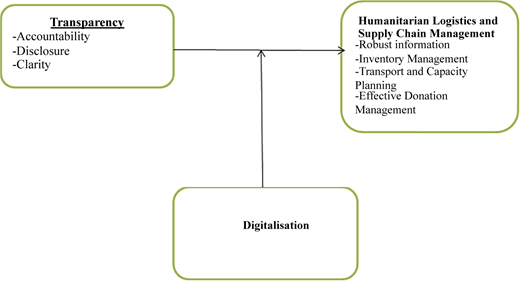
Based on the critical review of the literature presented in the previous section, this study developed the research framework, as shown in Figure 1. In the research model, transparency as an independent variable constitutes three facets, namely accountability, disclosure and clarity. Humanitarian logistics and supply chain management, as a dependent variable, constitutes four dimensions, namely robust information, inventory management, transport and capacity planning and effective donation management; whereas, digitalisation serves as a moderator that influences the relationship between transparency and humanitarian logistics. Hypothesis development is presented in the following subsections.
3.1 Transparency in humanitarian logistics and supply chain
Transparency in humanitarian logistics and supply chain is a worldwide flaming concern of local and international donor organisations and individuals, governments, victims of disasters and the public. It equally attracted the attention of scholars who then investigated the causes and suggested the remedies for improving the transparency in humanitarian logistics. Apart from scholars, international organisations such Organisation for Economic Co-operation and Development (OECD), Transparency International and the United Nations Office for the Coordination of Humanitarian Affairs (OCHA) firmly believe that the effectiveness of humanitarian logistics and supply chain primarily depends on transparency. In this regard, these organisations have provided detailed guidelines on making humanitarian logistics transparent.
Research on transparency in the commercial supply chain has gained firm ground and has been explored well from various perspectives. Most scholars advocate the positive impact of transparency on the supply chain. Sodhi and Tang (2019), for instance, drew a comparison between supply chain visibility and transparency and identified several benefits of transparency in commercial supply chains. Similarly, Egels-Zandén et al. (2015) highlighted the importance of transparency and its role in sustainable supply chains. Whereas, Chen et al. (2019) examined the impact of supply chain transparency on sustainability under NGO scrutiny. Numerous other scholars, naming few, such as Francisco and Swanson (2018) (Bastian and Zentes, 2013) and (Egels-Zandén and Hansson, 2016) also emphasised the importance of transparency in the supply chain. Though these studies have provided a strong foundation for the role of transparency in the supply chain, the focus remained on the commercial/industrial supply chain. Yet, the findings can be replicated to humanitarian logistics and supply chain, as the recent studies (though relatively handful) have augmented the claim while purely focussing on transparency in the humanitarian supply chain. These include Altay and Pal (2014), Dubey et al. (2021), Dubey et al. (2020), Dubey et al. (2018) and Khan et al. (2019).
Among them, Khan et al. (2019) examined the role of transparency in humanitarian logistics. However, in their study, the direct impact of transparency on humanitarian logistics was not examined. Rather, the impact of transparency on public trust was examined that lead to humanitarian logistics. Similarly, Dubey et al. (2018, 2020, 2021) investigated the role of transparency in humanitarian logistics. Though all these studies highlighted the role of transparency in humanitarian logistics, the relationship between these two variables was not empirically measured. Rather, the focus remained on the use of information diffusion, blockchain technology and big data to create transparency. Likewise, Altay and Pal (2014) also emphasised the importance of transparency in humanitarian logistics but they also did not empirically examine the relationship.
Thus, it is evident that despite having profound literature support, the impact of transparency on humanitarian logistics has not been empirically examined yet, inviting researchers for empirical evidence of the claims. Based on strong literature support, this study, therefore, aims to study the relationship between these two variables in the geographical context of Pakistan (one of the 10 most disaster vulnerable countries) and postulates the following hypothesis:
There is a significant relationship between transparency and humanitarian logistics and supply chain management of relief operations.
3.2 Moderating role of digitalisation
Digitalisation involves using an information technology-based solution to perform certain operations in an efficient, optimised and timely manner (Heaslip, 2013). In recent years, rapid technological advancements and developments have played a significant role in enhancing how specific tasks or operations are performed in logistics and supply chain management (Ortuño et al., 2013). The commercial supply chain has shifted towards digital platforms to manage the processes systematically and to bring efficiency and effectiveness (Kunz and Reiner, 2012). Nevertheless, humanitarian logistics and supply chain is different from the commercial supply chain. In contrast, it involves procurement of resources using available fundings and providing these resources (medicines, food, shelter, transportation and information) to the people at the right time in a sustainable, cost-effective and reliable way Reis (2018). Scholars believe that the adoption of ERP systems and mobile technology in humanitarian logistics can significantly assist the donors and authorities to track the effective delivery of their donations and observe the complete process systematically (Fallucchi et al., 2016). Digitalisation not only enhances the effectiveness of humanitarian logistics but also assists in attaining transparency in humanitarian logistics and the supply chain by establishing a common platform where donors can observe and trace their funds (Sigala et al., 2020).
The existing research as well as the global organisations recommends the adoption of digital solutions to track the flow of donation and resources from source to destination to ensure transparency in relief operations (Roy et al., 2012). The scholars agree with the fact that digitalisation in humanitarian logistics is a way forward for creating transparency. The research on digitalisation and technology adoption is plenty across various disciplines where it has been studied from various perspectives. Many such studies adopted the unified theory of acceptance and use of technology (UTAUT) theory which explains user intentions to use an information system and subsequent usage behaviour (Francisco and Swanson, 2018). In recent literature, its role has also been recognised and appreciated in the context of supply chain transparency. However, in these studies, various forms or specific aspects of digitalisation have been examined instead of a holistic view. For example, Bailur et al. (2020), Dubey et al. (2020), Francisco and Swanson (2018) and Dubey et al. (2018) examined the role of blockchain and big data in supply chain transparency. Sigala et al. (2020) emphasised the ERP system for humanitarian logistics, Wamba and Queiroz (2020) focused on blockchain diffusion, and Caon et al. (2020) studied it from the healthcare perspective.
In addition, digitalisation has been examined as a moderating variable in numerous studies across various disciplines, see, for instance, Lee et al. (2019), Smania et al. (2021), Djou et al. (2020) and Del Giudice et al. (2021). Recently, Braganza et al. (2021), Eslami et al. (2021) and Ju et al. (2020) explored the moderating role of digitalisation in operations, logistics and supply chain. However, the moderating role of digitalisation was examined with completely different sets of dependent and independent variables such as job engagement, financial performance and integration quality. Yet these studies provided profound foundations for the use of digitalisation as a moderator between transparency and humanitarian logistics.
Overall, literature on supply chain suggests that digitalisation enhances the effectiveness of humanitarian logistics as well as it is a way forward to eradicate corruption and mismanagement or in other words creates transparency. Most of the existing research has found a direct positive impact of digitalisation on both, humanitarian logistics and transparency. However, its impact as moderating variable transparency in humanitarian logistics remained unexplored.
Thus, considering its frequent use as a moderator variable in other disciplines as well in supply chain literature, this study endeavours to examine the moderating role of digitalisation between transparency and humanitarian logistics and forwards the following hypothesis:
The digitalisation moderates the relationship between transparency and humanitarian logistics and supply chain management of relief operations.
4. Method
4.1 Population and sampling
This study follows the quantitative research design because it helps in statistically estimating the relationship between transparency and humanitarian logistics and supply chain management followed by the moderating effect of digitalisation. The quantitative research design helps in quantifying opinions and statistically justifying the influence of one variable over another. The primary data were collected through questionnaire surveys.
The population of this study included the employees working in DRAs in Pakistan. There are many international, national and regional DRAs operating throughout the country as government or non-government organisations. Apart from National Disaster Management Authority (NDMA) and Earthquake Reconstruction and Rehabilitation Authority (ERRA) and the International Rescue Committee (IRC), some of the most effective organisations include Edhi Foundation, Al-Khidmat Foundation, Pakistan Red Crescent Society and UN-OCHA Pakistan. Due to the absence of a sampling frame, where the exact total population was not known, a non-probability technique, snowball sampling, was employed. First, the authors approached their contacts and requested to fill the survey and provide details of further potential respondents or forward the link to their acquaintances across the country.
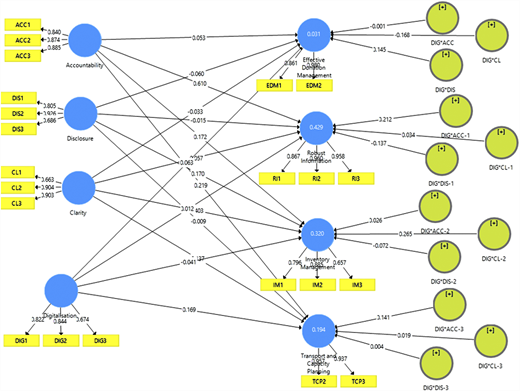
The sample size was determined following Hair et al. (2017) guidelines. Hair et al. (2017) recommended a 10:1 respondent to item ratio for multivariate analysis. This study contains 3 latent variables and 24 items/indicators as shown in Figure 2. Thus, the minimum sample size for this study should be 240 (10 × 24).
4.2 Questionnaire development and data collection
This study followed Saunders et al. (2016) guidelines on questionnaire development and instrument validity and reliability. To operationalise the study constructs, the measurement instruments (scale) were adapted from existing relevant literature. The measurement scale for transparency was adapted from (Khan et al., 2019), whereas, the scale for humanitarian logistics and supply chain was adapted from Haavisto and Goentzel (2015) and the scale for digitalisation was extracted from (Dubey et al., 2018), Francisco and Swanson (2018) and Dubey et al. (2018). To measure participants' response for each statement, a five-point Likert scale was used where 1 indicated “strongly agree” and 5 indicated “strongly disagree”. Based on the nature of the study and previous similar researchers and to make it easier for respondents to spend less time and efforts and to enhance effective response, a five-point Likert scale was used, though a seven-point Likert scale is usually preferred (Dawes, 2008; Joshi et al., 2015).
To establish the face validity, the questionnaire was reviewed by 3 professors of operations and supply chain management. A pre-test was conducted with 25 participants to ensure the validity and reliability of the instruments. Based on the feedback of experts and pre-test results, the questionnaire was finalised for main data collection. To ensure the confidentiality of respondents, the questionnaire did not require any personal information of the participants, and the participation was made voluntary. The participants were approached by email and were requested to fill out the online survey created in QuestionPro.
The questionnaire was distributed (via email/link) to around 500 participants. However, only 360 responses were received. Out of 360 responses, 20 incomplete responses were discarded, leaving adequate sample data of N = 340. Among them, 80% of respondents were male, whereas 20% were female in the selected population. Most of the respondents (57%) were field workers whereas 27% were first-line managers and 16% belonged to middle and top management in disaster relief organisations.
5. Analysis and results
The data were analysed in SmartPLS3 software that utilises PLS-SEM (partial least square-structural equation modelling). As per guidelines by Hair et al. (2017), the research model was analysed in two phases. In the first phase, the measurement model was analysed to establish the validity and reliability of the model. In the second phase, the structural/path model was assessed for hypothesis testing. The reliability of the measurement model was ensured through factor loadings and composite reliability and Cronbach’s alpha; whereas, validity of the model was ensured through discriminant and convergent validity tests. After validating the measurement model and ensuring its reliability, hypothesis testing was performed for the structural model.
5.1 Data screening and preliminary analysis
Before hypotheses and model testing in PLS-SEM, the data screening process was conducted, and preliminary analysis was performed. In this regard, common method bias, non-response bias and normality of data tests were conducted. A common method bias test was conducted using Harman's single factor test. As suggested by Podsakoff et al. (2003), if the resulting percentage variance explained by a single factor is less than 50%, it can be claimed that the data set does not suffer from common method bias. In this study, 31% of the variance was explained by a single factor indicating that the dataset did not suffer from a threat of common method bias. Likewise, anindependent sample T-Test was performed to observe the equality of means for non-response bias in early and late responses. The statistically insignificant values of the T-test demonstrated that these two groups did not have a difference of opinion concerning study variables; whereas, data distribution analysis was performed using skewness, kurtosis and the Shapiro–Wilk tests. The results showed that skewness and Kurtosis values for most of the variables were out of the recommended range (−1.96 and + 1.96) (Gravetter and Wallnau, 2014). The significant (p-value < 0.05) Shapiro–Wilk test values also suggested that the data in this study were non-normally distributed which justifies the use of PLS-SEM (Hair et al., 2017).
5.2 Assessment of measurement model
The objective of this study is the prediction and development of theory instead of confirmation, therefore a PLS approach is more appropriate in contrast to the covariance-based (CB) approach Hair et al. (2017). In PLS, latent variable values are used if the structural model is complex. This study contains a complex structural model as it has reflective constructs, observed variables and latent variables and all variables possess common themes. Hence, using PLS-SEM, the data were analysed in the aforementioned two essential steps suggested by Hair et al. (2017). In the first step validity and reliability of the latent variables are established. The reliability of the measurement model was assessed through factor loading, Cronbach’s alpha and composite reliability scores. All the items of the scales were retained since all satisfied factor loading requirements (>0.7). To ensure reliability, factor loadings and Cronbach’s alpha values should be higher than 0.60, and composite reliability values should be higher than 0.70. These results indicate that measurement scales for all the variables were internally consistent (See Table 1).
Determination of reliability and convergent validity
| Cronbach's alpha | Outer loading | Composite reliability | Average variance extracted (AVE) | |
|---|---|---|---|---|
| Accountability | 0.834 | 0.837 | 0.900 | 0.751 |
| Clarity | 0.781 | 0.867 | 0.868 | 0.691 |
| DIG*ACC | 1.000 | 1.000 | 1.000 | 1.000 |
| DIG*ACC-1 | 1.000 | 1.000 | 1.000 | 1.000 |
| DIG*ACC-2 | 1.000 | 1.000 | 1.000 | 1.000 |
| DIG*ACC-3 | 1.000 | 1.000 | 1.000 | 1.000 |
| DIG*CL | 1.000 | 1.000 | 1.000 | 1.000 |
| DIG*CL-1 | 1.000 | 1.000 | 1.000 | 1.000 |
| DIG*CL-2 | 1.000 | 1.000 | 1.000 | 1.000 |
| DIG*CL-3 | 1.000 | 1.000 | 1.000 | 1.000 |
| DIG*DIS | 1.000 | 1.000 | 1.000 | 1.000 |
| DIG*DIS-1 | 1.000 | 1.000 | 1.000 | 1.000 |
| DIG*DIS-2 | 1.000 | 1.000 | 1.000 | 1.000 |
| DIG*DIS-3 | 1.000 | 1.000 | 1.000 | 1.000 |
| Digitalisation | 0.690 | 0.729 | 0.824 | 0.613 |
| Disclosure | 0.734 | 0.791 | 0.851 | 0.658 |
| Effective donation management | 0.832 | 0.885 | 0.760 | 0.522 |
| Inventory management | 0.700 | 0.768 | 0.826 | 0.616 |
| Robust information | 0.920 | 0.921 | 0.950 | 0.864 |
| Transport and capacity planning | 0.673 | 0.802 | 0.827 | 0.632 |
Subsequently, convergent and discriminant validities for the measurement model were established. According to Hair et al. (2017), the measurement model should fulfil three criteria for claiming convergent validity: AVE > 0.5; CR > 0.70 and CR > AVE. Table 1, demonstrated below, shows that all the constructs are based on the AVE, as none of the values is lower than 0.5. Additionally, the findings suggested that the constructs used for this study are reliable as the minimum value for the composite reliability is estimated at 0.729, and for the Cronbach’s alpha, the minimum value is estimated at 0.690. Based on this finding, the outer loading threshold is acceptable, implying that there is no dropout. Also, the significance of the outer loadings was identified using the bootstrapping technique, and hence it was identified to be statistically significant. For convergent validity, AVE is used as the statistical technique as it has a threshold value of 0.5, and it can be assessed that all variables possess convergent validity since the least AVE is estimated at 0.522.
To determine the discriminant validity the researchers used heterotrait-monotrait (HTMT) ratio. HTMT ratio is mainly used to evaluate the distinctiveness in the latent constructs in the SEM models (Hair et al., 2017). To claim the discriminant validity, all the values should be below 0.85. As presented in Table 2, all the values are well below the threshold. This shows that the study constructs are discriminant or not significantly correlated, hence, establishing the discriminant validity of the measurement model.
Determining discriminant validity using HTMT ratio
| 1 | 2 | 3 | 4 | 5 | 6 | 7 | 8 | |
|---|---|---|---|---|---|---|---|---|
| 1. Accountability | ||||||||
| 2. Clarity | 0.540 | |||||||
| 3. Digitalisation | 0.698 | 0.767 | ||||||
| 4. Disclosure | 0.503 | 0.736 | 0.646 | |||||
| 5. Effective donation management | 0.133 | 0.049 | 0.076 | 0.063 | ||||
| 6. Inventory management | 0.411 | 0.577 | 0.477 | 0.526 | 0.066 | |||
| 7. Robust information | 0.698 | 0.334 | 0.436 | 0.329 | 0.056 | 0.278 | ||
| 8. Transport and capacity planning | 0.437 | 0.462 | 0.493 | 0.317 | 0.051 | 0.486 | 0.743 |
5.3 Assessment of structural model
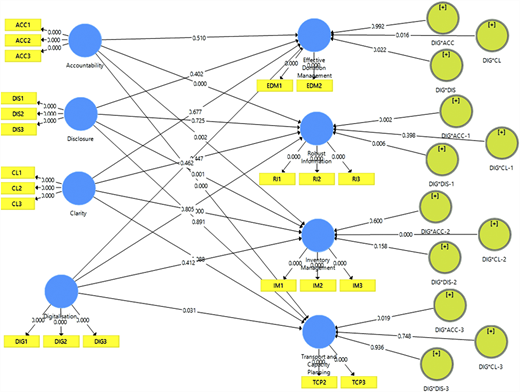
Once the validity and reliability of the measurement models are established, the structural model is assessed for hypotheses and model testing. To evaluate the structural model, the researcher has used bootstrapping techniques, which resamples for obtaining p-values or the significance values. The results presented in Table 3, Figures 2 and 3 imply the role of transparency in humanitarian logistics and supply chain management in Pakistan DROs with the moderating role of digitalisation [B = 0.219; p-value = 0.000 < 0.01]. In case of accountability with the effective donation management, the results seem to be insignificant as the p-value is above the threshold value of 0.05 [B = 0.049; p-value = 0.000 < 0.05]. For the accountability and inventory management, it can be observed that the results are significant [B = 0.169; p-value = 0.000 < 0.05]. In case of Disclosure → Transport and Capacity Planning, the results seem to be insignificant as the p-value is above the threshold value of 0.05 [B = −0.0008; p-value = 0.891 > 0.05]. Therefore, the following results surmise that there is a significant role of transparency in Humanitarian logistics and supply chain management in Pakistan DRO with the moderating role of digitalisation. However, the impact is identified concerning certain variables of the study.
Path analysis using bootstrapping
| Path coefficient | Sample mean (M) | T statistics | P values | |
|---|---|---|---|---|
| Accountability → Effective donation management | 0.049 | 0.044 | 0.659 | 0.510 |
| Accountability → Inventory management | 0.169 | 0.166 | 3.126 | 0.002 |
| Accountability → Robust information | 0.610 | 0.605 | 12.242 | 0.000 |
| Accountability → Transport and capacity planning | 0.219 | 0.213 | 3.764 | 0.000 |
| Clarity → Effective donation management | −0.036 | −0.039 | 0.416 | 0.677 |
| Clarity → Inventory management | 0.410 | 0.408 | 6.494 | 0.000 |
| Clarity → Robust information | 0.050 | 0.055 | 0.761 | 0.447 |
| Clarity → Transport and capacity planning | 0.137 | 0.141 | 1.704 | 0.088 |
| DIG*ACC → Effective donation management | 0.001 | 0.001 | 0.009 | 0.992 |
| DIG*ACC-1 → Robust information | 0.214 | 0.221 | 3.068 | 0.002 |
| DIG*ACC-2 → Inventory management | 0.026 | 0.025 | 0.524 | 0.600 |
| DIG*ACC-3 → Transport and capacity planning | 0.141 | 0.147 | 2.346 | 0.019 |
| DIG*CL → Effective donation management | −0.175 | −0.176 | 2.411 | 0.016 |
| DIG*CL-1 → Robust information | 0.033 | 0.032 | 0.846 | 0.398 |
| DIG*CL-2 → Inventory management | 0.268 | 0.271 | 4.269 | 0.000 |
| DIG*CL-3 → Transport and capacity planning | 0.018 | 0.017 | 0.322 | 0.748 |
| DIG*DIS → Effective donation management | 0.147 | 0.150 | 2.297 | 0.022 |
| DIG*DIS-1 → Robust information | −0.141 | −0.143 | 2.747 | 0.006 |
| DIG*DIS-2 → Inventory management | −0.074 | −0.076 | 1.412 | 0.158 |
| DIG*DIS-3 → Transport and capacity planning | 0.005 | 0.002 | 0.081 | 0.936 |
| Digitalisation → Effective donation management | 0.062 | 0.069 | 0.736 | 0.462 |
| Digitalisation → Inventory management | −0.053 | −0.045 | 0.820 | 0.412 |
| Digitalisation → Robust information | 0.018 | 0.016 | 0.246 | 0.805 |
| Digitalisation → Transport and capacity planning | 0.168 | 0.171 | 2.159 | 0.031 |
| Disclosure → Effective donation management | −0.059 | −0.064 | 0.838 | 0.402 |
| Disclosure → Inventory management | 0.179 | 0.179 | 3.379 | 0.001 |
| Disclosure → Robust information | −0.019 | −0.018 | 0.352 | 0.725 |
| Disclosure → Transport and capacity planning | −0.008 | −0.007 | 0.137 | 0.891 |
5.4 Quality of the model and predictive relevance
The quality of the model and predictive relevance was estimated through coefficients R Square. The values of R Square mainly evaluate the overall portion of the variables for the endogenous variables, which are explained with the structural model and indicate the adjusted quality of the model. As recommended by Henseler et al. (2009) and cited by Ahmad et al. (2020) and Syed et al. (2019) the R-Square = 2% will have a negligible effect, R Square = 13% will have a medium impact, and R-Square with 26% will have an enormous effect. As shown in Table 4, apart from effective donation management, all other constructs have stronger R-Square values, especially, inventory management and robust information with 30 and 41% explanatory power.
Quality of the model and predictive relevance
| R square (Adjusted) | Q square | The magnitude of Q square | |
|---|---|---|---|
| Effective donation management | 0.010 | 0.031 | Low |
| Inventory management | 0.306 | 0.320 | High |
| Robust information | 0.417 | 0.429 | High |
| Transport and capacity planning | 0.177 | 0.194 | Medium |
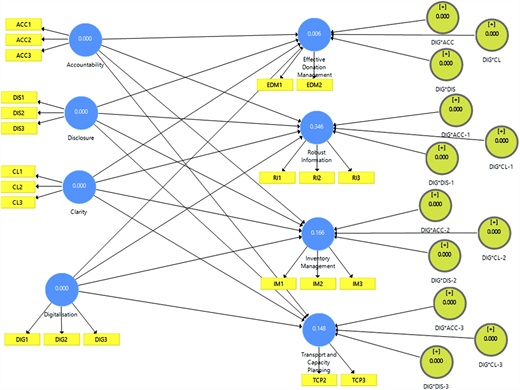
Blindfolding is a significant technique for SEM modelling focused on determining the predictive relevance of the model. The blindfolding technique was used to determine Q-square that assists in measuring the predictive relevance of the model (See Figure 4). Hair et al. (2017) mentioned that a Q-square value greater than zero represents the existence of predictive relevance whereas a value of zero or below represents the absence. It is evident from Table 4 that the values of the Q-square are above 0, suggesting the existence of predictive relevance of the model. With regard to predictive relevance values, Jacobs (2014, p. 182) suggested four categories: (1) 0 > Q2 < 0.02 refers to “model has the predictive validity”; (2) 0.02 ≥ Q2 < 0.15 refers to “low”; (3) 0.15 ≥ Q2 < 0.35 refers to “medium”; and (4) Q2 ≥ 0.35 refers to “high”. As per these criteria, effective donation management has low predictive relevance, inventory management, and robust information have high predictive relevance, whereas “transport and capacity planning” has medium predictive relevance. Thus, the results indicated that the structural model had satisfactory predictive relevance since the values for all the constructs are well above the threshold value.
Based on path analysis presented in Table 3, and explanatory power (R-Square), and Predictive relevant (Q-Square) presented in Table 4, the findings are summarised in Table 5. Thus, it is concluded that transparency has a significant positive relationship with humanitarian logistics and supply chain management of relief operations. In addition, this relationship is partially moderated by the digitalisation of DROs. The findings are discussed in detail in the following section.
Hypothesis assessment summary
| Hypothesis | Decision |
|---|---|
| H1: There is a significant relationship between transparency and humanitarian logistics and supply chain management of relief operations | Accepted |
| H2: The digitalisation moderates the relationship between transparency and humanitarian logistics and supply chain management of relief operations | Partially accepted |
6. Discussion, implications and limitations
The objective of this study was to examine the moderating role of digitalisation in enhancing transparency in humanitarian logistics and supply chains. The findings suggest that in Pakistan, where corruption and mismanagement in humanitarian logistics and supply chain have been the greatest concerns of all the stakeholders, digitalisation of the DROs is a way forward to create transparency in the system and build the trust of donor organisations and public. Overall, the findings of the study are consistent with existing research which contends that transparency enhances the effectiveness of humanitarian logistics and supply chain that mainly contains donations management, transport and capacity, along with inventory management. To take a broader view of humanitarian logistics within Pakistan DROs, transparency was also examined from a multidimensional perspective in this study. The results showed that all three dimensions including disclosure, clarity and accountability are positively related to the humanitarian logistics and supply chain. It implies that the lack of clarity, accountability and disclosure decreases the transparency in humanitarian logistics. On the contrary, the three variables increase humanitarian logistics effectiveness and build transparency in DROs.
In addition, digitalisation of DROs, on one hand, can significantly enhance the effectiveness of humanitarian logistics and supply chain and on the other hand, helps in creating transparency in it. Digitalisation being a broader concept encompasses several forms of technology adoption. Its role in improving the efficiency and effectiveness of the system is acknowledged and well researched in numerous other disciplines, as discussed in section 2.3 and section 3.2. In serval studies, its role as a moderator between certain variables was examined and confirmed. The findings of this study confirm and extend the role of digitalisation as a moderator between transparency and humanitarian logistics and supply chain.
The regulatory authorities and disaster relief organisations are primarily liable for guaranteeing viable administration and responsiveness to the crises. In any case, the lack of resources and unreasonable dispensing has raised the requirement for truthfulness in helpful coordination for disaster reliefs. Due to corruption and mismanagement in DROs in Pakistan, the relief usually does not reach the victims on time. In such a situation, few financially well-off individuals manage to recover with self-support, however, 31.3% population lives in deprived areas, and these areas are profoundly dependent on DROs by the government with the assistance of national and international NGOs. This amplifies the need for transparency in relief operations. Since in Pakistan, different natural calamities occur, it is necessary to have a transparent set of policies and strategies for effective management of disasters. Pakistan, being in the list of top 10 most vulnerable countries to disasters, faces such calamities every year. Thus, the existing disaster relief management system is in dire need of an effective and transparent humanitarian logistics and supply chain, which, as the findings of this study and previous research suggest, is achievable through the digitalisation of the whole disaster relief management system. The findings have important theoretical, practical and social implications, discussed below.
6.1 Theoretical implications
The theoretical contributions of this study are threefold: First, the importance of transparency and the role of digitalisation in humanitarian logistics and supply chain are well acknowledged in the operations and supply chain literature. Numerous studies have been conducted so far on transparency in humanitarian logistics and the benefits of technology adoption in the field. However, as discussed in detail in the earlier sections, all these studies have been conducted from different perspectives and with different sets of variables. For instance, the most relevant studies on transparency in humanitarian logistics including Altay and Pal (2014), Dubey et al. (2018, 2020, 2021) and Khan et al. (2019), examined either of the two variables. This study, however, examined all the three variables together and contended that digitalisation is the way forward to implant transparency in humanitarian logistics and supply chains.
Second: though research on digitalisation or technology adoption in operations and supply chain has a very strong footing, in humanitarian logistics and supply chain it has gained momentum in recent years. The existing studies examined specific aspects of digitalisation such as the use of blockchain technology (Francisco and Swanson, 2018), artificial intelligence (Min, 2010), machine learning (Carbonneau et al., 2008) and robotics (Sharma et al., 2020). This study, however, examined it from a holistic perspective. In addition, this study examines its role as a moderator in humanitarian logistics and supply chain literature for the first time, while it has been extensively examined as a moderator in other disciplines (Djou et al., 2020; Lee et al., 2019; Smania et al., 2021).
Third, this study provides empirical evidence on the role of digitalisation in creating transparency in humanitarian logistics and supply chain from one of the top ten most disaster-affected nations: Pakistan. Where frequency of various disasters is higher and so is corruption and mismanagement in DROs. Thus, this study contributes to the body of knowledge from a geographic perspective, i.e. empirical evidence from a developing country where research, in general, is limited and very handful when it comes to humanitarian logistics and supply chain.
6.2 Practical implications
The findings of this study have practical implications for the government of Pakistan and disaster relief organisations operating in Pakistan. In 2010, the government of Pakistan established National Disaster Management Authority (NDMA) to deal with the whole spectrum of disaster management activities and to provide one window operation for all stakeholders including government ministries/departments/organisations, armed forces, NGOs and UN agencies. However, its performance remained dissatisfactory and was even criticised by the prime minister of the county (Dorosh et al., 2010). During various disasters in recent years, for example, 2005's Kashmir earthquake, 2014's flash floods, 2019's earthquake in Mirpur Azad Kashmir (UNDRR, 2020) and numerous terrorist attacks across the country, mismanagement, lack of coordination, delayed and insufficient response, lack of accountability and corruption have been the core reasons behind the substandard performance. Given the findings of this study, it is recommended to digitalise the disaster management system. Digitalisation will ensure transparency, clarity, accountability and trust that will eventually lead to an effective humanitarian logistics and supply chain. For instance, the most common of all the disasters in Pakistan are floods. Using an ICT-based warning system for floods, the impact can be significantly mitigated, and effective relief operations can be initiated on time. Once the system exhibits transparency in the use of funding and dispensing of the resources reaching the affected people at the right time, in the right quantity and right place, it will enhance the country's image in the eyes of national and international, individual and organisational donors.
Likewise, all national and international NGOs can play a crucial role in bringing transparency through the digitalisation of humanitarian logistics. Though they do not have direct any direct authority and control over the national disaster relief system, together they can lobby and influence the government for digitalisation of the system. In addition, they can offer to provide financial and technical support in the digitalisation process. Nevertheless, digitalisation of humanitarian logistics in Pakistan initially may not be quite effective due to the low literacy rate and technical know-how of the employees or social workers involved in the relief operation. However, this issue will be transitory and can be overcome by providing relevant training.
6.3 Social implications
Above all, the ultimate beneficiary of a digitalised and transparent humanitarian logistics and supply chain will be the society as a whole and particularly the victims of the disasters. Not only that the disaster-affected people will receive timely and entitled resources, but with the help of technology early warnings will save many lives. Especially, during expected floods, or in rare cases, earthquakes, people will be moved to safe places on time. Due to transparency in the system, pilferage and shrinkage of resources will be reduced and resources (food, medicines, shelter, etc.) reach eligible people in the right proportion.
6.4 Limitation and future research directions
Like every research, this study has certain limitations. Thus, its results should be examined bearing in mind its limitations. Nevertheless, these limitations create opportunities for future researchers. First, the sample size is relatively smaller, and the proposed model is examined from the perspective of employees working in the DRO. Future researchers may test the proposed model with larger sample size and from different stakeholders' perspectives such as the disaster victims, government agencies and disaster relief organisations. In addition, the study was conducted in the geographic context of Pakistan, hence, its findings may not be generalised to other countries. However, the proposed model can be adopted in similar research in other geographic regions, and at a later stage, a cross-country analysis can be conducted. Lastly, the study is based on questionnaire survey results, and these findings can be enriched by mixed methods in future research.
7. Conclusion
Lack of transparency in DROs is a major concern of donor organisations and disaster victims in Pakistan. Mismanagement, corruption and inefficiency in resource distribution and funds management demand transparency in the humanitarian logistics and supply chain to build the trust of the donors and victims. This study examined the role of digitalisation in creating transparency in humanitarian logistics and supply chains. The findings are consistent with the existing literature on technology adoption in the supply chain that suggests improved performance, efficiency, effectiveness and transparency of systems resulting from digitalisation. The results imply that to overcome the issues facing National Disaster Management Authority (NDMA) in disasters relief operations and to build back the trust of donors and victims, there is a dire need of creating transparency in humanitarian logistics and supply chain; and digitalisation is the way forward. This will benefit the NDMA in early preparedness and the disaster victims in getting timely relief and appropriate resources to meet their needs. The study contributes to the body of knowledge by providing the first empirical evidence of examining the moderating role of digitalisation in creating transparency in humanitarian logistics from one of the top ten most disaster-affected nations.

