


– Whilst implementation of a broad range of reverse logistics (RL) practices is increasingly the norm within commercial supply chain management, they have had limited impact in the humanitarian logistics (HL) sector. The purpose of this paper is to analyse the challenges and opportunities for the application of RL in a HL context.
– Through a broad review of both the academic and practitioner literature, supplemented by informal discussions with senior humanitarian logisticians, the paper summarises the current state of RL within the HL sector before recommending ways in which practices that are increasingly found in a commercial context could be implemented.
– The findings indicate that, to date, the use of commercial RL practices is extremely limited within the HL sector, but there are a number of areas where their introduction be possible in the future.
– Whilst the reviews of the literature were comprehensive, further and more detailed research into the RL practices (if any) undertaken by aid agencies needs to be undertaken in order that appropriate lessons and experiences can be implemented across the sector as a whole.
– Given the overall desire of humanitarian agencies to “do no harm” it will be increasingly important for such organisations to embrace RL practices in order to improve the sustainability of their disaster preparation and response activities.
– In light of the generally increased awareness of the need to reduce the environmental footprint as well as improving the social and economic impacts of their supply chain activities, there is likely to be increasing pressure on aid agencies to adopt RL practices. This paper identifies some of the potential areas in which this can be undertaken, and the associated barriers to be overcome.
– To date, it would appear that no academic research has been undertaken into the RL practices within the HL sector. To this extent, the research represents a first look at a new sub-topic within the overall HL field.
1. Introduction
Humanitarian logistics (HL) is a fast growing area of international academic study with a broadening literature base and, since 2011, its dedicated outlet – the Journal of Humanitarian Logistics and Supply Chain Management (JHLSCM). However, in common with many other emerging academic disciplines, the early years reflect the need to develop a common understanding of the core concepts, their inter-relationships and indeed, the vocabulary and its meanings. For example, at a basic level, the challenge facing the humanitarian logistician is, arguably, the same as that in the “for profit” world namely to align supply with demand in an efficient, effective, secure, resilient and sustainable way (Melnyk et al., 2010). Typically, however, the responsibilities of a humanitarian logistician cover the management of the whole of the supply network (purchasing through to last mile distribution), together with a range of ancillary duties such as facilities management and security. It is, thus, significantly more complex than the oversight of “trucks and sheds” that often reflects the commercial perspective of this role (Kovács et al., 2012).
This breadth of responsibility is reflected in the frequently quoted definition of HL: “The process of planning, implementing and controlling the efficient, cost-effective flow and storage of goods and materials as well as related information, from the point of origin to the point of consumption for the purpose of meeting the end beneficiary’s requirements” (Thomas and Mizushima, 2005, p. 60). Indeed, it is worth reflecting that there are actually only a few thousand individuals world-wide who would lay claim to the job title of “humanitarian logistician” (Holguín-Veras et al., 2012), and yet the annual global spend is of the order of $15Bn (Tatham and Pettit, 2010).
Importantly, however, the definition of HL quoted above only relates to the outbound flow of goods, its associated information and by extension, services. It will be noted that it is silent on the topic of “reverse logistics” (RL) which, as we will expand on later, we define as: “The process of planning, implementing and controlling the efficient and cost-effective flow of raw materials, in-process inventory, finished goods and related information from the point of consumption to the point of origin for the purpose of recapturing or creating value or proper disposal” (Rogers and Tibben-Lembke,1999, p. 2). This lacuna is understandable given the HL context in which the major challenge is perceived to be the effective and efficient movement of potentially life-saving materials to those affected by a disaster or emergency, or in a developmental context (Tomasini and Van Wassenhove, 2004).
That said, there is an increasing appreciation of the importance of RL as evidenced by its appearance as a specific section within the United Nations (UN) Logistics Cluster Logistics Operational (Log Ops) Guide (Log Cluster, 2013). Moreover, it is well established that the introduction within commercial supply chains of RL best practices results in economic savings in addition to reductions of environmental impact. It is suggested, therefore, that adoption of such an approach in the humanitarian context would lead to improvements in efficiency that could then be translated into improved effectiveness of an aid agency’s logistic spend.
2. Aim
With this introduction in mind, approximately ten years ago, De Vore (2004, p. 6) noted that “often the reverse supply chain is overlooked, not planned for, and not used when deploying for […] humanitarian relief operations”. However, as outlined above, the last decade has seen the visibility and importance of RL issues increasing in a commercial context and so the authors of this research were keen to understand whether this situation has been mirrored in the changed practices in relation to HL during the intervening period. Thus, the aim of this paper is to describe and analyse the challenges and opportunities for the application of RL practices in a HL context. In doing so, and particularly in light of the relative youth of HL as a field of study, the authors are mindful of Stock’s (1997) recommendation that business logistics, which was then in a similarly emergent state, should “borrow” from other disciplines as a means of advancing knowledge and understanding.
3. Research limitation
A further aspect of the essential scene-setting is the observation that HL frequently focuses on the ways in which the management of the supply network can be improved in a rapid onset disaster or emergency. In such a scenario, where speed is frequently the essence, it is understandable – and, indeed ethically acceptable – that actions that might improve the RL outcomes take second place, particularly if such actions have the effect of reducing the speed of response and, hence, adversely impacting those affected. However, this paper will particularly focus on the development context where a more measured approach is possible with the result that RL practices can potentially be embedded as part of the whole flow of goods and materials. As a result issues such as those raised by Destro and Holguín-Veras (2011) and Holguín-Veras et al. (2014) which relate to the management of unsolicited donations that frequently challenge the logistician in the aftermath of a rapid onset event will not be considered in depth.
We intend, therefore, meeting the paper’s aim by outlining the ways in which RL is operationalised in the business context and analysing the challenges and opportunities for employing similar practices in the preparation and response in a development context as well as to disasters/emergencies – especially those that fall into the slow onset category. To achieve this goal, the next sections of the paper will first give an overview of the research methodology before the results of the review the literature relating to RL first in a business and, second, in an HL context are discussed. This latter analysis is underpinned by the results of informal discussion with HL practitioners in order to test their understanding of commercial RL concepts and their applicability. This will be followed by a section in which we develop an understanding of the challenges and opportunities for RL as part of the overall HL spectrum of activities. Finally, we will offer our view of the potential avenues for further research in relation to this topic.
4. Methodology
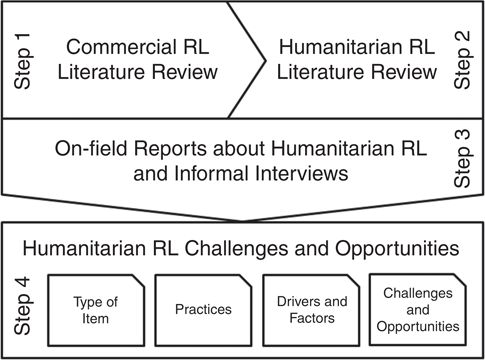
The overall research methodology is outlined below and depicted in Figure 1 where four steps are highlighted, with the detailed procedures being explained in next sections. The initial step was to review the literature relating to RL within a commercial context. The rationale for this approach reflects the general perception that HL lags behind its commercial counterpart in terms of the development and implementation of new approaches and ideas. Whilst it was argued by Thomas and Kopczak (2005, p. 7) that “Today’s underdeveloped state of logistics in the humanitarian sector is much like corporate logistics was 20 years ago”, the authors of this paper take a less pessimistic view evidenced by, for example, the 2006 European Supply Chain Excellence Award that was won by the International Federation of Red Cross and Red Crescent Societies (IFRC). Nevertheless, it is believed (and as will be demonstrated in the literature review that follows) that the commercial sector, driven by public and shareholder pressure, is ahead of the humanitarian sector in respect of its RL practices.
Having analysed the commercial RL literature, the second step was to undertake a similar review of the HL literature. However, as indicated in the introduction to the paper, the canon of literature is relatively small – for example, the recent review by Leiras et al. (2014) identified just 228 papers that had been published in the last 20 years.
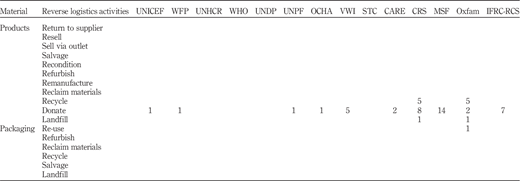
As a result, in Step 3, this element of the review was expanded to include consideration of the annual reports of the Top 14 HL organisations extracted from Tatham and Pettit (2010) (Table I). Given the clear desire of humanitarian agencies to “do no harm” it was reasoned that achievements in improved RL practice would be highlighted as a positive aspect of their work in such publications. However, as will be explained in greater detail below (Section 6), there was only limited mention of the subject and therefore a confirmatory “deep dive” was undertaken by reviewing all of the IFRC’s post-mission reports for the period January 2011-November 2013. The choice of the IFRC for this more detailed analysis was driven by a number of factors: first, as indicated above, through its receipt of the European Supply Chain Excellence Award, the IFRC has clear credentials as being amongst the most innovative HL organisations within the sector. Second, it deals mainly in non-food items (NFI) and it is this generic range of commodities that (compared with food and medical items) is perceived to be most easily integrated into a reverse supply chain. Third, the IFRC makes all of its post-mission reports available on its web site and thus, in a sector where access to data is often challenging, this represents an excellent source that was able to be searched in the same way as the academic literature relating to the commercial sector. The final stage of the review process was to undertake a number of informal discussions over the general challenge of achieving sound RL practices with a number of senior humanitarian logisticians in UK and Australia. This element of the overall research is discussed in more detail in Section 6.
In the final phase, Step 4, the RL challenges and opportunities were defined and analysed introducing a new classification of the items in function of their use and final destination. Several drivers and factors were highlighted and discussed.
5. Review of the RL in the academic literature
5.1. Academic RL literature in the “for profit” context
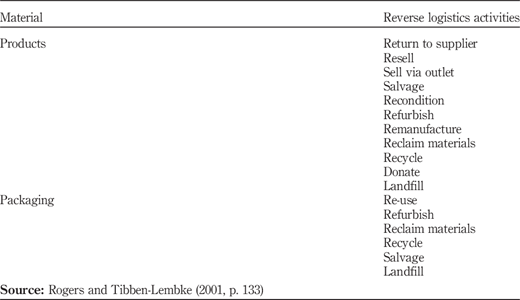
There is a broad swathe of literature relating to RL that has been developed over the last two decades and, inevitably, this approaches the concept from a variety of perspectives. Thus, at the relatively strategic level, Rogers and Tibben-Lembke (2001, p. 133) outline the scope of RL drawing on the then extant literature that encompassed a range of activities including:
remanufacturing;
refurbishing;
recycling;
landfill;
repackaging;
returns processing; and
salvage.
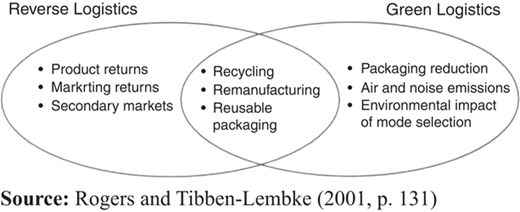
These authors also noted that there is a clear overlap between the research in to RL and the (even) broader field of “Green Logistics” as demonstrated in Figure 2.
This overlap between these two areas is also found within the limited literature relating to RL in an HL context where, for example, the UN’s Log Ops Guide has a separate section relating to Green Logistics, but in this it is noted that: “The main objective of Green Logistics is to coordinate the activities within a supply chain in such a way that beneficiary needs are met at “least cost” to the environment. It is a principle component of reverse logistics” (Log Cluster, 2013a) (emphasis added). The above quote reflects the general sense of the desire amongst humanitarian agencies to “do no harm” – be this to individuals or, as is becoming increasingly important, the environment in which they are operating. However, the research reported in this paper is focused on the RL component of the overall drive towards a more eco-friendly approach as it is believed that the use of commercial RL techniques has the potential to improve the efficiency and effectiveness of a humanitarian agency’s actions in a development/slow onset situation (as well as, potentially, in a rapid onset disaster context). In doing so, we are following the lead of a number of authors including Kovács and Spens (2007) and Swanson and Smith (2013) who suggest that the humanitarian response can benefit from lessons identified and best practice in commercial logistics.
Separately, Tibben-Lembke and Rogers (2002) compared and contrasted the forward and RL practices in a retail environment; whilst other authors have considered a more detailed sub-set of the overall RL challenge. Thus, Atasu and Cetinkaya (2006) discuss the ways in which the process can be optimised in order to allow for efficient remanufacturing, whilst Blackburn et al. (2004) consider the issues surrounding the decision to adopt re-use, recycling and remanufacturing alternatives for a given product. Other significant contributions include Fleischmann et al. (1997), Bloemhof-Ruwaard et al. (1999) and Lee et al. (2008) who focus on channels, location, routing problems; whilst Teunter et al. (2000), Minner (2001) and Dobos (2003) discuss the impact of RL on inventory through the study of costs, products and policies. In considering the opportunity to re-use the returned product “as is” or after minor repairs Srivastava (2007, 2008) researches yet another dimension of the RL concept; whilst Hazen et al. (2012) have identified seven components that should be considered when deciding which RL approach to adopt, together with a decision-making framework.
Given the ambit of the potential RL field that can be deduced from the above small sample of the literature, it is clear that core to understanding it applicability in an HL context is both a definition of RL and the consequential potential activities that are in scope. In light of the genesis of the definition of HL quoted in Section 1 which clearly reflects the former Council of Logistics Management Professionals (CLMP) (and current Council of Supply Chain Management Professionals (CSCMP)) definition of logistics, we have adopted the approach of Rogers and Tibben-Lembke (1999, p. 2) who reverse the sense of the CLMP/CSCMP approach and define RL as: “The process of planning, implementing and controlling the efficient and cost-effective flow of raw materials, in-process inventory, finished goods and related information from the point of consumption to the point of origin for the purpose of recapturing or creating value or proper disposal”. In adopting this definition, we note that it is broadly similar to others suggested by those researching within the field, for example, Dowlatshahi (2000) and De Britos (2003).
Expanding this definition, it can be seen that it covers a broad range of activities as demonstrated by Rogers and Tibben-Lembke (2001, p. 133) in Table I.
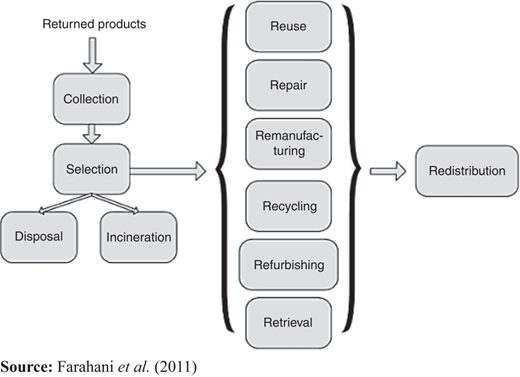
A similar approach is offered by other authors, for example, the flow diagram representation of Farahani et al. (2011) in Figure 3 – albeit this does not differentiate between the product and its associated packaging. However, in the HL context, discussion of RL as it relates to packaging is perceived to be an important aspect. For example, as will be discussed further in Section 8.4, it is understood that one commercial supplier has designed the box used to transport large (family size) tents in such a way that it can subsequently be employed as the framework for a field latrine. For this reason, the typology in Table I will be used as the basis for the analysis in the remainder of this paper and, for example, the entries within Table I were used as the keywords for the search of the academic and practitioner HL literature.
5.2. Academic RL literature in the “not for profit” context
In relation to the academic literature, and as noted in the introduction to this paper, this is relatively small in volume. For example, the review by Kunz and Reiner (2012) uncovered a total 174 papers published between 1993 and 2011, of which 128 (74 per cent) were from the last three years of their sample. This research, together with the associated literature reviews from Altay and Green (2006), Kovács and Spens (2007), Natarajarathinam et al. (2009), Pettit and Beresford (2009), Overstreet et al. (2011) and Caunhye et al. (2012), were analysed to uncover any discussion of RL (as defined in Table I). This was achieved by inspection of the title, abstract and keywords of each of the papers within the sets of literature reviews, together with the titles of works noted within the informal bibliography of Tatham (2014). The result of this review shows that the management of RL in an HL context has only achieved limited attention in the academic literature.
Whilst a number of researchers (e.g. Guide and Van Wassenhove, 2003; Dekker et al., 2004; De Vore, 2004; Hall, 2013) suggest that RL should be incorporated into the HL supply network, these authors are silent as to the mechanisms/approaches that should be adopted. On the other hand, there are some specific examples of a discussion of RL issues, albeit these are generally from a relative broad “green logistics” perspective. Thus, Sarkis et al. (2012, p. 199) underline the general importance of an environmental perspective in the evolution of the humanitarian response in order to meet “a variety of pressures faced by the [responding] organization including regulatory, competitive, and community/public pressures”. However Sarkis et al. (2012, p. 205) also note that there are considerable internal organisational barriers that limit the application of new practices and procedures, but these authors underline the importance of future studies “to overcome the barriers and hopefully aid in greening the relief supply chains”.
This paucity of consideration of RL is further emphasised by Kovács (2011, p. 258) who notes the serious environmental impact of humanitarian activities in the field and particularly that “ […] there is an almost total absence of reverse logistic processes”. Indeed, taking this environmental theme further, researchers at INSEAD (Humanitarian Research Group, 2010) have analysed the impact of the humanitarian response in the aftermath of the 2010 Haiti earthquake, and their work underlines the enormous volume material that needs to be removed and the associated challenge facing the humanitarian logistician. The importance of green logistics in humanitarian operations is also presented by Eng-Larsson and Vega (2011) where the difficulty of achieving environmental goals without compromising the short-terms humanitarian objectives is studied. Since the humanitarian operations inevitably generate substantial amounts of waste, the research underlines the importance of adopting a green operations perspective. However, Larsson and Vega fully acknowledge that there are some clear gaps between green logistics practices and disaster relief operations, and as a result that have developed a framework of objectives that could be used to drive humanitarian actions.
Taking a somewhat different approach, Hu and Sheu (2013) develop a system that considers three different RL aspects: logistic operations, environmental protection and psychological recovery, and they propose a system that models the transport, recycling, reproduction and final disposal of debris. In a similar transport-related approach, Liberatore et al. (2014) consider the possibility of using some RL procedures (such as reverse flows) in the modelling of distribution problems in recovery operations.
In summary, the academic literature surrounding the potential operation of commercial RL practices is in its infancy. Thus, although there is a clear acknowledgement of the importance and relevance of this topic, but there is almost zero discussion of its operationalisation.
6. Review of the RL in non-academic literature and informal interviews
6.1. Annual reports review
The next element of the literature review was to consider the non-academic literature – i.e. that which is available from the publications and web sites of humanitarian organisations (as distinct from regular academic journals). This was approached by examining the material available from the Top 14 HL organisations as noted by Tatham and Pettit (2010, Table I, p. 611). The annual reports are general documents that show not just what has been done in the last year by the organisation but they are used to indicate the way the organisation is going to take in the future years. The most recent annual reports (i.e. those from 2011 or 2012 – CARE, 2012; CRS, 2012; (International Federation of Red Cross and Red Crescent Society) IFRC-RCS, 2011; MSF, 2011; OCHA, 2012; Oxfam, 2012; Save the Children, 2011; UNDP, 2012; UNFPA, 2011; UNHCR, 2012; UNICEF, 2011; WHO, 2012; WFP, 2011; World Vision, 2012) of each of these organisations were reviewed using the key words from Table I as the search criteria, with the results as shown in Table II. Inselecting the annual reports as the source, it will be recognised that they are both easily accessible and also provide a vehicle through which the organisation is able to tell its story to the wider community. Thus, such annual reports are not just focused on field operations; rather they typically expose the future direction of the organisation. It was therefore reasoned that, particularly in light of the global desire of such organisations to operate more sustainably, if RL was becoming an important feature of future operations, it was likely to be emphasised in such annual reports. However, as will be see from Table II, the reality is that there was almost no discussion of RL within these documents. In fact findings show that just few annual reports deal with RL practices with a focus mostly on recycling and the management of donations – which can be seen as a form of RL from the perspective of the original owner of the item – with just limited attention on landfill and re-use.
6.2. Review of IFRC field reports
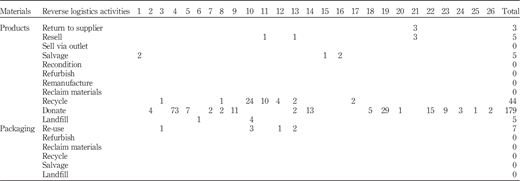
Given the paucity of “hits” from the above process, a “deep dive” was undertaken by reviewing all of the post-mission reports held on the IFRC data base for a three-year period January 2011-November 2013. This process led to an examination of 116 such reports which were, again, searched using the keywords from Table I. These reports are focused on single operations that are conducted by IFRC in different part of the world. The information is possible to have from these are more operational that in the annual reports and allow to understand what kind of practices are used in the operational fields.
Of the original number, 15 were not published in English and so were discounted from the analysis. And of the remainder, 75 (74 per cent) had zero mention of RL. A total of 26 reports did include mention of the topic, and these are shown in Table III, with the specific details of the report to be found in the Appendix.
The advantage of the “deep dive” approach was that it was targeted at the more operational level mission reports, as distinct from the strategic level annual reports, however it will be seen that the results were broadly the same as the latter (Table I), with the majority of the discussion being around the area of donations and recycling. At the same time the on-field reports do emphasise some other RL activities such as salvage, reselling and returning items to suppliers.
6.3. Informal interviews
The third part of the analysis was aimed at corroborating the results of phases 1 and 2 (Figure 1) by conducting informal discussions with a small number of senior humanitarian logisticians based in the UK and Australia in order to understand their personal perspective, and their perception of the perspective of their organisation. The respondents were selected through a “snowball” sampling approach that utilised the network of contacts already known to the authors of this paper and consisted of a total of six individuals – five from international NGOs and one from a UN agency.
The discussions were conducted on a semi-structured basis using the following script as the guide:
What does the concept of “RL” mean to you?
To what extent is this perspective shared by your organisation?
More broadly, how do think the RL concept could be implemented into humanitarian operations:
In the context of rapid onset disasters?
In the context of slow onset disasters/development activities?
Are there any specific commodities to which RL can particularly be applied?
To the extent that the organisation does engage in RL, is this carried out in house, or is it outsourced?
Does the organisation engage in any recycling practices? If so, to what commodities does this apply and how is it undertaken?
The responses from this small sample supported the findings from the literature review. For example, the head of logistics for a major international NGO indicated that “they did not engage in any form of RL”. Similarly, whilst the head of logistics for another major international NGO fully accepted that RL was an area on which his organisation needs to focus in the future, “it was not currently on their agenda”. In particular, he emphasised the division of responsibility between the programmes and logistics teams, with the role of the latter being that of meeting the former’s requirements as efficiently and effectively as possible. Thus, he indicated that it would be for the relevant programme’s team to make create a requirement for the movement of items out of the affected area, he noted that in his experience, this had yet to happen.
A further observation from the head of logistics for another NGO was that, in effect, they treated items brought into the country as donations to the affected population and, hence, they did not make any specific arrangements for their subsequent re-use etc. as this was a matter for those who had received the donations. A further challenge highlighted was the need to comply with the importation regulations with a given country. For example, these might allow NGOs to bring items into a country free of any import duties, but that these might be levied retrospectively if material was subsequently “exported”.
In summary, it will be seen from the above analysis of the literature that, whilst RL is recognised as a process that should, in an ideal world, form part of the HL preparation and response to a disaster/complex emergency, in reality it has received little attention in either the academic or practitioner literature, and indeed, amongst the small sample of practitioners with whom this subject was discussed. With this in mind, the next section of the paper will consider the various activities that are in scope (Figure 2), and the ways in which they might be operationalised by humanitarian logisticians.
7. Humanitarian RL challenges and opportunities
In considering the potential for RL in an HL context, it is relevant to recognise that there is a broad spectrum of materiel that is procured, transported and distributed by the humanitarian logistician. This is generally categorised as:
Food Items (FI). Items such as rice, flour, nutrition bars, etc.
Non-Food Items (NFI). Items such as tents, blankets, tarpaulins, etc.
Medical Items (MI). Items such as drugs and medical equipment.
To which, in this context, should be added an additional category of:
(4)Agency Owned Items (AOI). Items such as trucks and radios that belong to the responding agency.
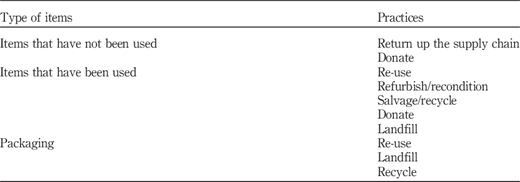
Whilst in theory, all of the approaches to RL offered in Table I could be applied to each of the above categories, a brief reflection on the reality HL and its current maturity would clearly indicate that not all of the commercial concepts are applicable. In particular, it is important to distinguish between those items that have not been used, those that have been used and packaging. Whilst each of these categories has a potential residual value, Table IV offers an overview of the areas where the opportunities for the use of RL would appear to be most favourable. It will be noted that noting that this table broadly aligns with the extent to which RL is discussed in the academic and practitioner literature.
The challenges and opportunities will now be discussed, first in relation to a number of general issues, and then using the categorisation within column 1 of Table IV.
7.1. General challenges and opportunities
As indicated in the earlier part of this paper, the whole area of RL in a humanitarian context has yet to achieve the traction that it is increasingly enjoying in the “for profit” environment. In a sense, this is entirely understandable. Given the absence of a profit motive (and associated shareholder pressure) to drive behaviour, and also in the face of a challenging funding situation that has worsened since the Global Financial Crisis, it is clearly difficult for aid agencies to justify the expenditure of the additional resources that would be necessary to manage RL operations over and above the demands of the life-saving outbound network. Put simply, the current view is that the scarce resources that are available would be better spent on disaster relief.
However, there are many opportunities for the application of RL practices in this field. At one level improved management of the supply chain, and the associated improved matching of demand and supply, would help ensure that the right products are, indeed, delivered to the right place at the right time. In doing so, wastage – and hence the need to even consider the RL challenge would be – avoided (as would the impact of under-provision). One example might be the use of 3D printing technologies that have the potential to deliver “logistics postponement” – in other words the manufacture of an item of equipment only when the demand has crystallised. However, discussion of ways in which the outbound supply network could be improved is beyond the scope of this research. Furthermore the broader application of “green thinking”, be this in the guise of improved vehicle operation, improved procurement practices of the substitution of information for inventory are also beyond the scope of this paper which is focused on ways the generic practices outlined in Table I and, in particular, the sub-set in Table IV.
That said, and reflecting on the suggestion that agencies feel that scarce resources are best spent on direct developmental and/or disaster response activities, it is arguably the donor mindset that needs to change – be this institutional or governmental donors, or members of the general public. In other words, until and unless the imperative to operate in a more sustainable way becomes part of the “normal way of doing business”, it is clear that agencies will struggle in the development and/or operation of similar RL approaches that are increasingly found in the commercial context. In reflecting on this challenge, it will also be appreciated that the cost of implementing a broad range of RL policies does (in the same way as for the outbound leg), not just consist of the transport and storage costs, but also those related to the management of the associated information. These costs are unlikely to be trivial given both the challenging nature of the physical environment (e.g. the potential damage to pre-existing communications infrastructure), but will also reflect the time lag between the supply of a given item or commodity and any decision to return any surplus back up the supply network.
7.2. Items that have not been used
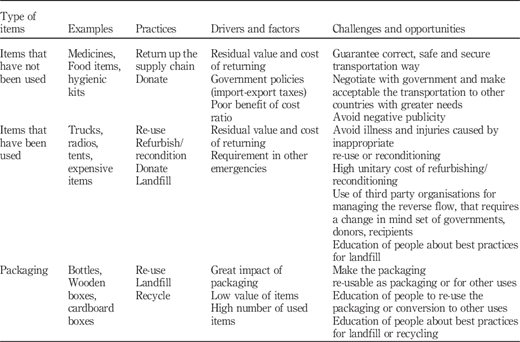
Turning to the groupings in Table IV, items that have not been used for the designated or planned project can potentially be made available in two different ways. First, they could be shipped back up the supply chain to, for example, a warehouse in the affected country, to a regional warehouse or even to the supplier. Alternatively, they could be donated to the affected country. The main drivers for the choice of action in this scenario would appear to be the item’s residual value and the cost of returning the item back up the supply chain. In this respect, the determination of “cost” would include both the actual expenditure involved in the process of taking an item back up the supply chain, as well as softer aspects such as the potential for adverse publicity if unwanted items are left in the country.
However, there will also be a number of other factors that may influence such a decision. For example, the government of an affected country may be more than happy to waive any import taxes for incoming relief goods, but it is understood that some countries will retrospectively impose taxes on good that are taken back out. A second challenge is that, in the case of complex emergencies, agencies may have to resort to unconventional means of importing relief goods in order to avoid them being impounded by one faction or another in a confrontation. In this situation, and in the unlikely scenario that they are not needed, any attempt to move them back up the supply chain would cause considerable difficulties and is, thus, unlikely to be contemplated. A further issue relates to, in particular, food items and consumable medical items. Attempts to recycle these are clearly challenging as the aid agency would need to be able to guarantee to any future recipient that they have been correctly stored and that they are safe to be sent to a new location for use.
Finally, it must be recognised that some aid agencies follow a policy in which goods are donated to the recipients and, thus, the concept of taking goods back up the supply network is not contemplated. In short, the poor benefit to cost ratio for the return of the majority of new items makes this an unattractive option, and thus the option of local donation is likely to be adopted. As an aside, although from a commercial perspective this can be seen as a “RL” process, this is arguably not the case in the humanitarian scenario where it can be seen as a variant on the original purpose of the supply chain which was to deliver material to the beneficiaries. Nevertheless, and notwithstanding the arguments against the return of unused goods back up the supply network, there is, in principle, no reason why such an approach should not be adopted. For example, the policies of aid agencies could be amended to reflect the potential for return of goods and their subsequent use in a more pressing scenario. Similarly, it may prove possible to negotiate with governments so that they, too, accept that other countries may be in greater needs of items that are surplus to requirements in their own country. By the same token, the return of medicines and foodstuffs could be achieved in a safe and secure way – however, as indicated earlier – all of these approaches would require a greater focus on the importance of the RL supply chain than is currently the case.
7.3. Items that have been used
In principle, the same arguments discussed above will apply to items that have already been used. Therefore, as before, the hard and soft benefit to cost ratio is likely to be the key determinant. That said, in the case of agency owned items (such as trucks and radios), the default setting is likely to be that of returning the items for re-use in another operation (after any necessary repair or refurbishment). A similar approach may be used for other expensive items – for example, the Italian Civil Protection organisation uses a particular type of tent that is valued at some 10,000 Euros and so such items are also likely to be returned for subsequent re-use. More broadly, and unlike the commercial scenario, the volume of material that is returned back up the supply chain is likely to be small and, furthermore, the volume that requires refurbishing and/or reconditioning is also likely to be extremely low, making the unit cost of such activities high.
The practice of salvaging or recycling materials is one of the few areas that are mentioned in the study of the operational reports. In particular IFRC encourages “the use of salvaged materials” (IFRC, 2011, pp. 32) and their reports underline the extent to which families in developing countries can make use of such materials. However, there is clearly potential for both negative publicity here as well as a real danger of injury or illness being caused by inappropriate salvaging techniques. This could, in part, be mitigated by the introduction of appropriate contractual arrangements whereby, in addition to using a third-party organisation to manage and operate the outbound supply chain, it is theoretically entirely possible for aid agencies to let contracts with appropriately qualified and experienced companies who can operate as their agents in the salvaging/recycling of materials. Once again, however, this would require a considerable change of mind set amongst many parties including national governments, donors, recipients, as well as the agencies themselves before such an approach is likely to gain traction.
As indicated earlier, the donation of used items is a well understood and well used practice within the sector, and indeed is the major subject that was uncovered in the literature review. Clearly there is a double benefit here in that the aid agency is making a contribution to the population of the affected country, whilst at the same time it is avoiding the potential costs of alternative scenarios such as returning the item up the supply chain or ensuring an appropriate means of its final disposal. However, even the donating of material to those affected by a disaster has potential challenges in that some items may not be serviceable after their initial period of use and may, therefore, cause unintentional illness or injury. The question then becomes one of assessing the implicit risks of a donation policy which, in turn, will consume scare manpower and financial resources.
Within the RL literature, disposal of products into landfill is seen as the ultimate fall-back position – i.e. the one to be adopted when there are no other alternatives available that will capture the residual value in a cost-effective way. Given the potential for negative publicity and also mindful of the general sustainability orientation of aid agencies, there is a considerable focus within the literature on achieving appropriate practices in this regard. However, the literature is also clear that one of the main challenges for these activities is that of engaging with the disposal practices adopted within the affected community and, where appropriate, attempting to reduce the environmental impact of poor practices. As in the case of the return of unused or used good up the supply network, it is entirely feasible for aid agencies to engage local or international contractors to undertake the waste disposal in an appropriate and sustainable way – although it is fully recognised that such an approach would not only be extremely costly in cash terms, it would also run counter to the prevailing cultural norms in many countries.
7.4. Packaging
The issue of the appropriate disposal or recycling of packaging materials is one of the most challenging facing the aid organisations as demonstrated by the work of the INSEAD, Humanitarian Research Group (2010) who noted that some 7 million bottles of water were donated by North American companies to Haiti during the first two months after the 2010 earthquake. Interestingly, and notwithstanding the clear potential environmental impact of such packaging, there is relatively limited discussion of this subject within either the academic or the practitioner literature. It is suggested that this is an area on which agencies should focus in the future as being one which would have clear benefit in terms of both practice as well as from a publicity perspective. On the one hand, the issues around the proper disposal of such packaging are broadly the same as those relating to used products as discussed above. Thus, there is the potential, at cost, to become stricter in ensuring that the disposal actions are appropriate and do not cause further environmental or other damage.
As an alternative, a number of companies across the globe have developed packaging that is re-usable, or can be used for a secondary purpose. As an example, the “Clip-Lok” company has developed a wooden box, the primary use for which is to transport large tents (such as food halls). However, it is designed in such a way that it can subsequently be converted as the basis for a field latrine. It is suggested that similar initiatives can potentially be developed and, thereby, reduce both the inflow of relief items as well as reducing the volume of material that would otherwise require disposal. That said, it is recognised that, in addition to the cost of development of such multi-use packaging, there is a cost associated with educating the final users who may view such packaging as having some form of residual value (such as an alternative source of fuel), and who may, therefore, be reluctant to embrace its return up the supply chain or conversion to another use (Table V).
8. Conclusions and recommendations for further research
The aim of this research was to describe and analyse the challenges and opportunities for the application of commercial RL practices in a HL context. In doing so, it has sought to understand the current state of RL practices within the HL field, and the extent to which commercial approaches can be brought to bear. Unfortunately, it is clear from the above analysis that there remains a considerable gulf between current and developing commercial practice and that found in a development context or in the aftermath of a disaster or emergency. At one level, this is entirely understandable. In essence, and in light of their exceedingly taught budgets and the increase in the numbers of beneficiaries needing assistance, it is totally unsurprising that aid agencies see the outbound supply chain as their priority. However, this situation broadly reflects that scenario of commercial supply chains prior to, say, the turn of the millennium. However, since then there has been a sea change in thinking, driven by both the pressure of public opinion as well as recognition that RL need not necessarily be a huge drain on resources. Indeed, with the increase in the use of the internet as a sales medium, the easy return of unwanted purchased is now an essential element of many business propositions. Given that the research has clearly demonstrated that there are relatively few examples of RL being undertaken in the HL environment, this represents something of a “green field” opportunity for organisations to introduce such practices and, indeed, use these as a “selling point” in respect of their increasingly competitive funding situation. However, it is also clear that further detailed research is needed to establish the ways in which commercial RL practices can be introduced with the support of host governments, aid agencies, donors and most important of all, the affected populations.
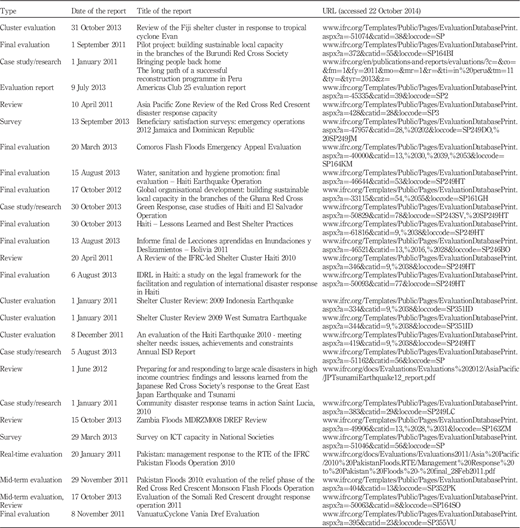
IFCR database available at www.ifrc.org/en/publications-and-reports/evaluations/
IFCR database available at www.ifrc.org/en/publications-and-reports/evaluations/

