


– Within the emerging research field of humanitarian supply chain management (HSCM) the use of existing theoretical concepts and frameworks to provide explanation and understanding of the phenomena under scrutiny is not yet well understood. There is still a lack of research on which theoretical approaches are used in this field, and to what extent this emerging field “borrows” theories from other disciplines. The purpose of this paper is therefore to deepen the understanding of HSCM from a theoretical point of view by identifying and evaluating the use of theories in HSCM literature.
– A literature review is conducted based on academic journal articles included in a well-recognised and publicly available bibliography on HSCM articles (Tatham, 2015). A content analysis is applied to the articles in terms of level of theory, research methodology, disaster management stages, disaster types, and disaster name/region.
– A trend towards using more established, “middle- range” theories, is evident. However, the use of theoretical approaches is not evenly spread between the different phases of disaster relief. A strong emphasis on SCM as a background discipline is also mirrored in the choice of theories used, which indicates the solidification of humanitarian logistics as a primarily supply chain discipline. The lack of use of other theoretical perspectives and grand theories is, however, still evident, which provides an interesting research agenda for future research.
– The use of the bibliography limits the generalisation of the findings although some trends are evident.
– This is a first review of theories used in HSCM. It provides an overview of the state of the art of HSCM research but contributes to the maturation of research in this field. The paper concludes with a research agenda.
1. Introduction
Humanitarian supply chain management (HSCM) is an emerging field within supply chain management (Kovács and Spens, 2007a) that marks a development of principles and practices for at least three reasons. First, as an object of study, humanitarian aid, in a broad sense, allows for the exploration of contextual factors that shape the conditions for an effective flow of goods and materials, and that are distinct to circumstances in other industries, e.g. automotive, retail, and transportation. An openness to the context of research – here particular disasters and disruptive events – has been called for in the recent methodological debate in logistics, e.g. the opportunities in action-oriented research (Näslund, 2002), classification of research schools (Gammelgaard, 2004), abductive reasoning (Kovács and Spens, 2005), and an overall calling for approaches that allow for theory development rather than theory testing (Arlbjørn and Halldórsson, 2002). Second, research on HSCM has increased the understanding of social and even political issues from a supply chain management (SCM) point of view. The role of principles such as postponement and speculation in inventory management is not limited to commercial purposes only; the ability and efficiency of material flows can be related to wider functions of society such as people’s well-being and the availability of basic needs such as food, water, and medicine for survival. Third, as Stock (1997) emphasises, borrowing and applying theories from other disciplines to advance knowledge and understanding is important for the development of logistics and SCM as discipline. Logistics management has borrowed theories from a variety of disciplines ranging from economics to psychology, mathematics to political science (Stock, 1997). More recently, the use of theory in SCM research has been further emphasised in a series of recent papers (e.g. Halldorsson et al., 2007; Defee et al., 2010; Chicksand et al., 2012; Kembro et al., 2014; Spina et al., sine anno). Common to these papers is a rather broad view on SCM, with a commercial focus as an underlying assumption.
Although there is ample literature in the field of HSCM, with a clear boom in volume of publications since 2009 (Kunz and Reiner, 2012), the area has been criticised for a lack of a theoretical base (Jahre et al., 2009). In particular, it is not well understood which theoretical concepts and frameworks are currently used to provide explanation and understanding of the phenomena, and even which disciplines HSCM “borrows” its theories from. Such an overview would provide a perspective of both the theoretical foundation on which HSCM builds, and the potential future direction of the field. Against this backdrop, the aim of this paper is to deepen the understanding of HSCM from a theoretical point of view by identifying and discussing the use of theories in humanitarian supply chain literature. Based upon a review of extant literature, this study is guided by the following two research questions:
RQ1. Which theories are used in HSCM?
RQ2. Which disciplines does HSCM borrow theories from?
The contribution of the paper is twofold. First, it provides a structured review of the use of theories in recent literature within the field of HSCM. In order to do so, content analysis was applied to identify the theories, as well as the various levels of theories used in this field. Content analysis is considered appropriate for conducting literature reviews in SCM (Seuring and Gold, 2012; Kache and Seuring, 2014). Relevant literature was identified and sampled through the use of Peter Tatham’s bibliography of HSCM (version January 2015; Tatham, 2015).
Second, the paper identifies the disciplines whence HSCM researchers have borrowed theories from. This does not only show the current state of the art and the current state of (theoretical) maturity of the field, but also possible related disciplines that impact on the development of HSCM. Importantly, this analysis indicates similarities but also differences between mainstream commercial SCM and HSCM research.
The paper is structured as follows. Section 2 revisits insights from prior literature in SCM and more specifically in HSCM. Based on this, a set of three propositions is developed. A methods section, Section 3, explains how content analysis was used for this literature review. Section 4 presents the findings, and the paper concludes in Section 5 with implications and suggestions for further research.
2. Theories in HSCM
Theories play an important role in helping us “to make sense of the complex environment in which we live and work” (Chicksand et al., 2012, p. 456). As said, HSCM has been criticised for a lack of a theoretical base, which would though be needed for the maturing of the discipline (Jahre et al., 2009). Both the application and modification of existing theories and the building of new ones are important for knowledge creation in SCM (Arlbjørn and Halldórsson, 2002). Knowledge creation in SCM has been shaped by different theoretical as well as methodological initiatives in the field: Abductive reasoning (Kovács and Spens, 2005), and overview of research approaches (Spens and Kovács, 2006), theory building (Kovács and Spens, 2007b; Randall and Mello, 2012), research schools (Gammelgaard, 2004), and theories used in SCM and logistics (Defee et al., 2010; Chicksand et al., 2012; Kembro et al., 2014).
Emerging fields often push the boundaries of the discipline, as is the case with HSCM in light of SCM. Yet it is not necessarily self-evident, which disciplines, and which streams of research HSCM is expanding on. “Humanitarian logistics” as well as “humanitarian operations” have been used as umbrella terms for a variety of streams in research, originating from various research traditions. For example, a strong tradition of SCM research originates from business logistics and even marketing (Gripsrud et al., 2006), whereas other traditions such as operations research and their views on SCM also inform HSCM. For the sake of clarity between the various traditions and to be able to trace the origins of HSCM, in this paper we distinguish between “SCM” as pertaining to the business logistics/logistics management tradition, and “OR” as pertaining to the operations research one.
Similar to SCM, that has grown out of related fields (Larson and Halldórsson, 2002: discuss purchasing vs SCM; Larson and Halldórsson, 2004: discuss logistics vs SCM), some of the earlier reviews of HSCM literature were focused on particular streams. For example, Altay and Green (2006) explicitly focus on OR articles, whereas Kovács and Spens (2008) have SCM as their focal point of reference. In combination, these research traditions inform the fundamental underpinnings of HSCM. By suggesting this, we imply that albeit performance and key objectives of HSCM may differ from the more traditional view of SCM, the former shares some fundamental assumptions of the latter, including the three key components identified by Cooper et al. (1997) and Lambert et al. (1998, p. 15): supply chain network structure; supply chain business processes; and management components. OR has since the very beginning of the emergence of HSCM been an influential perspective with its focus on application of analytical methods to improve decision making. Albeit it might overlap with operations management, it stands out by providing tools to explain the potential of maximum (such as profit, performance, or yield) or minimum (such as loss, risk, or cost) (INFORMS, 2015). In particular, OR supports the allocation of limited resources in HSCM (Van Wassenhove and Pedraza Martinez, 2012).
The fact that researchers from different research traditions have contributed to HSCM implies a broad range of methodological approaches along with a variety of theoretical backgrounds being prevalent and also impacting on research in this context. In addition, HSCM can include activities ranging from disaster management to development aid to even health care operations in emergencies and public sector management. Just as in other, more interdisciplinary research, one would expect these other disciplines to contribute to the richness of theories used in HSCM – in this case, theories that originate from, or are commonly used in development studies to peace research to health care.
2.1. Disciplines informing the use of theories in HSCM
Which is thus the “mother discipline” in HSCM when it comes to the use of theories? When it comes to the definition of “humanitarian logistics”, it is clearly based on the SCM research tradition in that the most commonly used definition of it by Thomas and Mizushima (2005) adapts the Council of Supply Chain Management Professionals’ (CSCMP) definition of logistics management to the humanitarian context:
Humanitarian logistics is the process of planning, implementing and controlling the efficient, cost-effective flow and storage of goods and materials, as well as related information, from point of origin to point of consumption for the purpose of meeting the end beneficiary’s requirements (Thomas and Mizushima, 2005, p. 60).
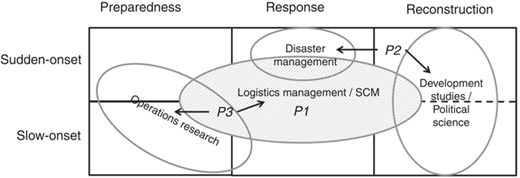
In fact, Thomas and Mizushima (2005) have merely replaced “end customer” with “end beneficiary” in their adaptation of the CSCMP definition of logistics management. Though small, this replacement bears many important implications. In any case, the wide acceptance of the Thomas and Mizushima (2005) definition would indicate the following of the research tradition of SCM. Hence we suggest that it is SCM rather than other disciplines (such as disaster prevention and management, development studies, etc.) that forms the backbone to HSCM research. Taking this one step further, one would expect the theories used in SCM research to be the ones dominating in HSCM as well. Our first proposition is thus:
P1. HSCM research is dominated by theories that are used in the SCM research tradition.
An obvious next question is which those theories would be. In the SCM research tradition itself, there have been various attempts to trace the origins of the discipline, and the origins of theories used in the discipline (Stock, 1997). Yet, the use of some theories has been emphasised over others. For example, Halldórsson et al. (2007) discuss agency theory (AT), transaction cost economics (TCE), (industrial) network theory (INT), and the resource-based view (RBV) as the typical theories used in SCM research. Hitt (2011) identify RBV, TCE, organisational learning theory, and social capital theory as the ones typically borrowed from strategic management to SCM, whereas Defee et al. (2010) identify TCE and RBV as most frequently used theories in SCM. But the disciplines from which theories are borrowed also depend on the studied subject area. For example, albeit focusing on organisational theory overall, Sarkis et al. (2011) highlight that green SCM has equally benefited from theories that stem from a variety of natural sciences and inform the ecological aspect of green SCM.
In light of P1, HSCM research should reflect the traditions of borrowing theories in SCM, including in choices of theories. That said, there are important differences to be acknowledged between the “humanitarian” and “commercial” contexts. These include the urgency (Beamon, 2004) and agility emphasis of HSCM (Oloruntoba and Gray, 2006), social development and equity considerations instead of profitability aims (Thomas and Mizushima, 2005; Huang et al., 2012), and the role as a public service in between donors, tax payers, and beneficiaries who do not typically pay for the service themselves (Jahre and Heigh, 2008; Choi et al., 2010). Given these differences we want to further investigate the distribution of theories currently used in HSCM. What is more, prior research has paid much attention to differences in the phases of disaster relief, and even suggested there to be differences in the principles followed in supply chain design across these phases. Next, we will therefore delve deeper into the various phases of disaster relief and the use and usability of different theories and research traditions in these phases.
Phases in disaster relief and the use of theories in HSCM
A number of literature reviews have been published in HSCM, which categorise publications either in terms of the phase of disaster relief (Kovács and Spens, 2007a, 2008; Natarajarathinam et al., 2009; Overstreet et al., 2011) or types of disasters they focus on (Kovács and Spens, 2011), or both (Altay and Green, 2006; Galindo and Batta, 2013; Kunz and Reiner, 2012; Leiras et al., 2014). Others are topical reviews on, e.g. game theory applications in HSCM (Muggy and Stamm, 2014), and optimisation models (Caunhye et al., 2012). Another stream of research seems to be structured around “phase models” in disaster management.
In terms of phases in disaster relief, there is a common distinction between preparedness and immediate response (the relief itself), to which reconstruction phase afterwards has been added (Kovács and Spens, 2007a). Preparedness refers to the necessary preparation when anticipating disasters. Preparedness is important from a supply chain perspective, as it includes activities such as warehousing and inventory management in pre-positioning stock for disasters (Kovács and Spens, 2007a; Chandes and Pache, 2010; Apte, 2010), as well as preparing for disasters in terms of evacuation and distribution plans and early warning systems and trainings (Van Wassenhove, 2006). Parallel to preparedness, mitigation may also take place, but as those are the responsibility of government, Cozzolino (2012) excludes it from an HSCM focus. Immediate response, on the other hand, refers to relief activities in the immediate aftermath of a disaster, though after search and rescue operations. Finally, reconstruction includes long-term rehabilitation and restoration, and can even be linked to development activities. Apart from phase models, another important taxonomy in disaster relief distinguishes between natural vs man-made disasters, and potentially more importantly from an SCM perspective, between their warning times for their onset (cf. Van Wassenhove, 2006).
Importantly, different supply chain principles may be applied in the different phases. Although Oloruntoba and Gray (2006) argue for an agility maxim in HSCM, and Charles et al. (2010) highlight the various levels of agility in humanitarian organisations, Taylor and Pettit (2009) distinguish between agile response and lean reconstruction. The reconstruction phase is a turn from the emergency aspect of relief towards more developmental considerations. Therefore we propose that, complementary to the theories that are borrowed from SCM:
P2a. Disaster management research informs the choice of theories in HSCM when studying the immediate response phase.
P2b. Development studies inform the choice of theories in HSCM when studying the reconstruction phase.
In a meta-analysis of HSCM literature, Kunz and Reiner (2012) found a clear focus of prior studies on the (immediate) response phase, mostly related to sudden-onset natural disasters, followed by articles in preparedness and last, reconstruction. There is though another distinction implied in this literature: sudden-onset disasters are characterised by surges of demand, short lead times for a wide array of supplies, a lack of resources, and high stakes associated with adequate and timely delivery (Balcik and Beamon, 2008). All this is combined with an overall lack of data in the first days of response (Kovács and Spens, 2011). Analytical models often focus on the preparedness phase instead where data are available – or are conceptual in nature. The development of new technologies is expected to improve the possibilities to collect as well as compute quantitative data during response (Kovács and Spens, 2011; IFRC, 2013), but until then perspectives that rely upon OR are expected to focus more on preparedness problems, whereas research with a more managerial SCM background is used to focus on immediate response. Hence we formulate the following proposition:
P3. OR informs the choice of theories in HSCM when studying preparedness.
Figure 1 positions these three propositions in a framework that illustrates the different phases of disaster relief and the speed of the onset of a disaster. The distinction between sudden-onset and slow-onset disasters becomes blurry during reconstruction where the cause of the disaster is less of essence, and activities are akin development aid.
3. Research methods
3.1. Sampling and data collection
Data for our study was comprised of scientific journal articles that have been written in the context of HSCM. Peter Tatham’s (2015) bibliography of HSCM formed the basis of our sample. The sampling for the bibliography itself follows a combination of keyword searches together with snow-balling through the references in the articles that are found. It can therefore be attested to be very comprehensive, even more so than any of the literature reviews published in this field so far. The bibliography extends to not only scientific research but also white papers and practitioner-oriented publications, and includes peer-reviewed journal articles as well as book chapter and even papers from various conference proceedings.
Due to the focus on the use of theories, we only included articles from scientific journals in our sample. The criteria to identify these were as follows: we extracted articles that were published in scientific journals first. Next, we excluded viewpoints, editorials, and other non-reviewed articles from the sample. On the other hand, articles from a 2014 special issue in Production and Operations Management that focused on humanitarian operations were missing from the bibliography but added to our sample. Altogether, this resulted in 279 articles that were published in scientific journals during the period of 1995-2014.
3.2. Data analysis
Content analysis was applied as a systematic method to analyse the articles in the sample. Seuring and Gold (2012) review a number of different methods that have been used for systematic literature reviews in SCM and highlight content analysis as one of the most structured and systematic approaches with the clear steps of material collection, descriptive analysis, category selection, material evaluation, and assessing the quality of the study. Krippendorff (2004, p. 18) defines content analysis as “a research technique for making replicable and valid inferences from texts (or other meaningful matter) to the contexts of their use”.
Content analysis can be applied qualitatively for evaluating latent content, or quantitatively for word counts, or counting instances something is mentioned in a text. Both ways of using content analysis have been applied in SCM research before (Seuring and Gold, 2012), as well as in HSCM (Haavisto and Kovács, 2014; Kovács et al., 2012). In this study, the content analysis needed to evaluate both explicit and latent content, as, e.g. the term “theory” could be mentioned in just phrases such as “in theory”, not denoting the use of any theory in particular. Also, many articles mentioned what other authors had used as the theoretical frameworks of their research, without applying these in their own study. Thus, eventually, we reviewed not just keywords but read all the articles carefully, and discussed ambiguous uses of terminology among several coders. We used a discursive alignment of interpretation to resolve ambiguities as a way to address the reliability of the study, foremost used when primarily latent content is being assessed (Seuring and Gold, 2012). All articles were assessed by at least two coders.
To deepen the understanding of the use of theories in SCM, the categorisation of theories that were used was broken down to various levels. Following Arlbjørn and Halldórsson’s (2002) approach, we assigned level 0 to articles that did not mention nor use any theory, level 1 to those presenting hypotheses and propositions, level 2 to models and frameworks, level 3 to “middle-range theories” such as RBV, TCE, etc., and level 4 to “grand theories” such as chaos theory, complexity theory, and even philosophy of science perspectives. We further assessed the articles in terms of the phase of disaster relief.
4. Findings from the content analysis
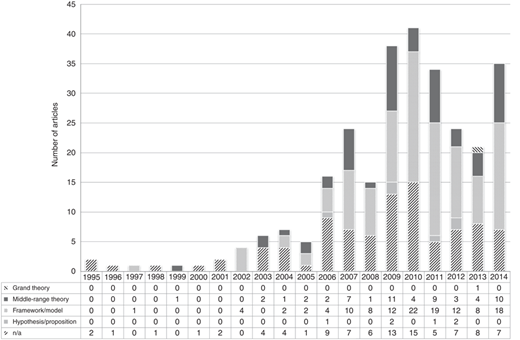
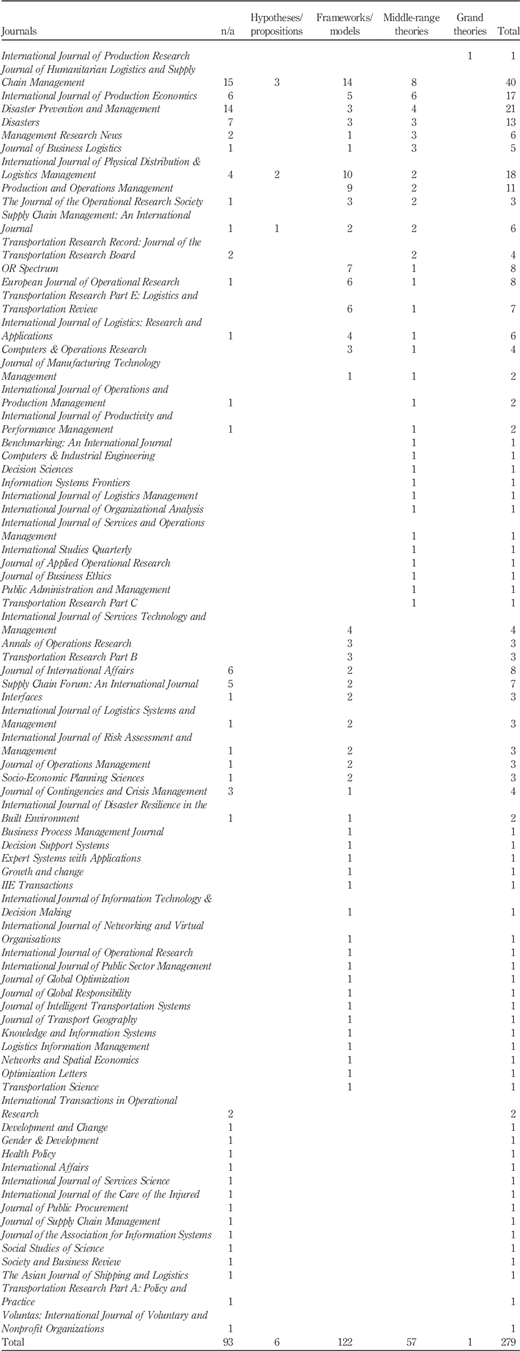
To date, a large number of articles have been published in the Journal of Humanitarian Logistics and Supply Chain Management, which is dominantly dedicated to humanitarian research in logistics and SCM. The second and third journals with most articles in HSCM are the Disaster Prevention and Management and the International Journal of Physical Distribution and Logistics Management (see Table AI), mostly due to various dedicated special issues published in these journals. Special issues in various journals further explain the peaks in number of publications in Figure 2.
The resultant sample included articles from a number of academic disciplines, which indicates that HSCM is of interest to several research traditions and audiences. However, 45 of the journals HSCM research could be identified in had only published one article pertaining to HSCM. These journals ranged from Benchmarking: An International Journal, to Development and Change, from Gender and Development to Social Studies of Science, or from International Affairs to Health Policy. This dispersion of HSCM over wide range of academic journals suggests that HSCM has a strong profile as an interdisciplinary field of research.
4.1. An inventory of theories in HSCM
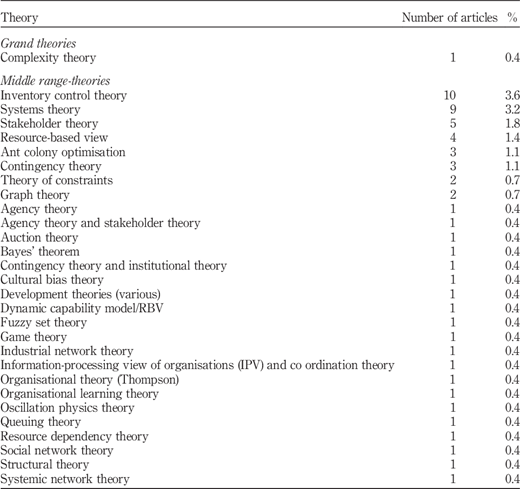
A vast range of theories could be found in HSCM, though only one article used a grand theory (in this case complexity theory). A total of 57 articles made use of a middle-range theory, and an additional three used a grounded theory approach to develop theory. In the subsequent analysis, we exclude grounded theory from middle-range theories since it is a methodological approach for theory development. Amongst middle-range theories, with ten instances, the most frequent one was inventory control theory, which could be found in various OR-related journals such as the International Journal of Production Economics, Journal of the Operational Research Society, OR Spectrum, and Computers & Operations Research (see Table I), closely followed by systems theory, stakeholder theory, and varieties of the RBV. Table I lists the grand, and middle-range theories that were identified in the sample.
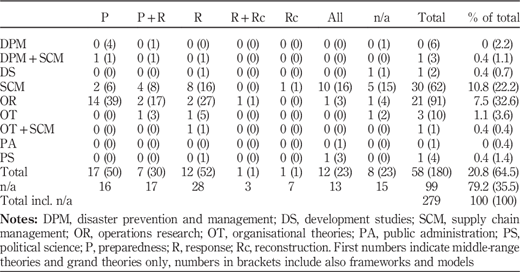
OR-related middle-range theories included inventory control theory, ant colony optimisation, queuing theory, graph theory, fuzzy set theory, Bayes’ theorem, game theory, oscillation physics theory, and auction theory. The frequency of their application in HSCM varies, some middle-range theories are used more frequently, some of them are used only once in our sample. Similar spread has been identified in the SCM literature; some theoretical perspectives that are borrowed from other disciplines seem to have gained a distinct role relative to SCM whereas other perspectives are used less frequently (see, e.g. Defee et al., 2010; Chicksand et al., 2012). Most theories that were identified could be associated with SCM (30 articles, representing 51.7 per cent of those using a grand or middle-range theory but only 10.8 per cent of all articles) compared to 21 articles (36.2/7.5 per cent) pertaining to OR. Interestingly, however, if including also frameworks and models, the distribution between OR and SCM is reversed, with a total of 91 articles using frameworks, models, middle-range theories, and grand theories following the OR research tradition, compared to 62 from the SCM research tradition (see Table II). Overall, thus, P1 could not be supported, and our findings do not indicate one clear tradition HSCM follows but two: OR and SCM.
Only few theories could be identified in HSCM that would not be commonly used in OR nor SCM. Of these, one article refers to “various development theories”, others discuss “cultural bias theory” or “structural theory” – the latter two originating from political science. Interestingly, we could not identify any middle-range theories used in HSCM that would clearly originate from disaster management. The contribution of disaster management is more visible on the level of frameworks and models, such as the disaster response model or disaster crisis pyramid. (A list of all frameworks and models that were identified can be found in Table AII). As for development studies, we found only one article (McEntire, 2004) that used various development theories. To conclude, it is SCM and OR that informs HSCM in the choice of theories. More is borrowed from other disciplines on the level of frameworks and models, but by large, HSCM has developed a rather coherent focus on SCM and OR, with relatively little influence from other disciplines.
4.2. The maturity of HSCM research
The number of HSCM studies using theories is steadily on the rise. Looking at the 20 year time span of our analysis (1995-2014), there is a clear downwards trend of articles lacking a clear theoretical foundation, from representing 67 per cent of articles published between 1995 and 1999 down to 27 per cent of those published between 2010 and 2014. The use of various frameworks and models has risen steadily during the same time, from 17 per cent in 1995-1999 to 51 per cent in 2010-2014. The use of frameworks and models starts to appear by 1997, but middle-range theories only come in by 1999 (see Figure 2). Thus, our findings show that HSCM as a discipline has been maturing over the years, answering Jahre et al.’s (2009) call.
From a different angle, we also looked at the spread of theoretical levels across journals. Not surprisingly, the Journal of Humanitarian Logistics and Supply Chain Management sticks out not only in total number of articles – this being the dedicated journal to HSCM – but also in the spread across various theoretical levels. The sample per journal is too small to clearly state which journals would prefer which level of theory, however, though there was a stronger attribution between research following the OR research tradition and being published in journals dedicated to OR.
4.3. Theoretical lenses to study different phases of disaster relief
For a further analysis across the various phases of disaster relief, we cross-tabulated the results with the phase(s) of disaster relief an article focused on, noting also studies that focused on more than one phase, on all phases, or that did not discuss their actual focus from this perspective. Due to the paucity of middle-range theories from other disciplines being prevalent in HSCM, in this analysis, we included also frameworks and models from other disciplines (see Table II).
Findings indicate that frameworks and models in disaster management are used in preparedness and response, though not in studies focusing on the reconstruction phase of disaster relief. The one article that actually borrows from development studies applies these theories to the response phase. Notwithstanding these results, the subsamples of these articles are too small to draw any further conclusions for the propositions P2a and P2b. Theories borrowed from public administration and political science are used in response, or in “all phases”, i.e. where authors do not distinguish between phases of disaster relief, but again, there are too few of these in the sample for attributing these results any significance.
Investigating P3 yielded very interesting results. Theories from the OR research tradition were used in all phases but the reconstruction phase (one article in response and reconstruction together). Whilst their prevalence in preparedness is in line with Kovács and Spens’ (2011) suggestion of the availability of data in preparedness prompting the development of more OR models in this phase, their frequency in response, where data are still difficult to obtain, is surprising. However, a closer analysis of these articles revealed that only three of them used any primary data in their model development or testing, others were conceptual-analytical in nature or used secondary data only. The same usage pattern appears for theories that were leaning on the SCM research tradition, with articles focusing exclusively on the reconstruction phase not using any middle-range theories or frameworks. In conclusion, we could not find any support for P3.
5. Conclusions
The aim of this paper was to deepen the understanding of HSCM from a theoretical point of view by identifying and evaluating the use of theories in HSCM literature. SCM has been criticised for a lack of theories, leading to both a discussion on how to borrow them from other disciplines and apply them in this field (Stock, 1997), as well as to an endeavour to develop an own logistics theory (Mentzer et al., 2004). As HSCM is emerging as a stream of research, its positioning is less clear. This paper therefore provides a perspective on the current state by identifying the borrowed theories to the field and disciplines that the field borrows theories from. Interestingly, HSCM has made use of both the OR and SCM research traditions, but of only few frameworks and models that would not typically be used in these. Whilst this may help in delineating the boundaries of HSCM, research in this field could in fact benefit from looking more into other related disciplines from public health to crisis management, disaster management, etc. After all, HSCM has many traits also in common with these fields, from a not-for-profit aim to considerations of equity as performance criteria. There would be ample room for HSCM to learn from other, related disciplines. HSCM research would gain from embracing interdisciplinarity, both to benefit from but also to contribute to related disciplines, and to contribute back to SCM research overall.
Generally, there is a trend towards using more middle-range theories in HSCM, and towards using various frameworks and models. This development shows that HSCM is gaining in maturity as a discipline. Our results show that there is a lack of theoretical approaches (on all levels) when it comes to the reconstruction phase of disaster relief, in spite of this phase being the most comparable to steady, lean supply chains – though whilst claiming this, Taylor and Pettit (2009) in fact discuss the applicability of value chain analysis in all phases of disaster relief. Similarly to their article, much of the extant HSCM literature proposes the application of various concepts and frameworks from other disciplines but remains on a conceptual level in doing so. In conclusion, more empirical research would be needed in HSCM to move from suggesting the use of various theories to actually testing and/or developing them.
A different problem with the response phase may be its emphasis on speed, agility, and flexibility, which are difficult to encapsulate in any of the rather “static” middle-range theories that are used in both the OR and SCM research traditions. Some supply chain decisions such as outsourcing, postponement, and speculation, are based upon comparative analysis of two or more alternatives, but these remain static in the sense that they provide little guidelines as regards to “how” to get there. These decisions are more typical in preparedness, however, whereas response focuses on the how and when of activities. Instead, the response phase calls for more procedural approaches, and theories that allow for procedural analysis in terms of the flow of events, chronologies, and mechanisms, in which process is defined as “a sequence of individual and collective events, actions, and activities unfolding over time in context” (Pettigrew, 1997, p. 338).
In this sense, theories and frameworks that enhance the further understanding of response would not be bound to SCM in general, but more specifically to those SCM concepts and frameworks that imply a “process vocabulary”. It seems that current HSCM research is locked in a vocabulary of static states when trying to explain and work with response. Instead, it would be important to develop concepts that inherently share the assumptions of the process of response in order to increase our understanding of this phase of disaster relief. Further research should therefore focus on the development of suitable, procedural theories for response, and most importantly, theories that are borrowed should fit with the purpose of the research, and the research topic at hand. Similarly, as commercial supply chains look at humanitarian ones as benchmarks of flexibility and agility, also commercial SCM research would benefit from embracing more procedural theories in being able to more accurately capture flexibility and ultimately, devise concrete ways for supply chains to become more flexible.
Disciplines HSCM borrows theories from
Disciplines HSCM borrows theories from
Number of HSCM articles and their use of theories over 20 years
Number of HSCM articles and their use of theories over 20 years
Grand theories and middle-range theories used in HSCM research
Grand theories and middle-range theories used in HSCM research
The use of frameworks, models, middle-range theories, and grand theories in HSCM
The use of frameworks, models, middle-range theories, and grand theories in HSCM
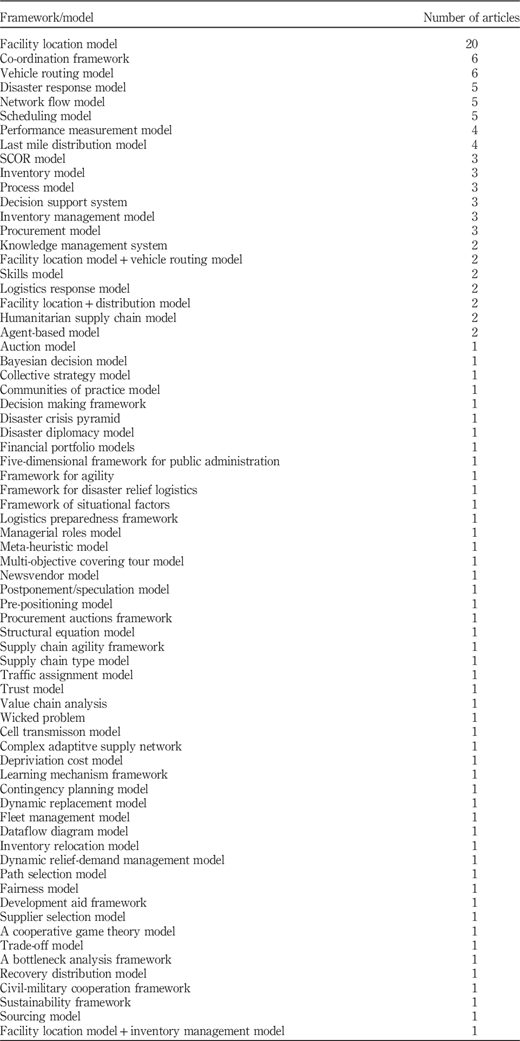
Frameworks and models used in HSCM
Frameworks and models used in HSCM
References
Appendix
This research would not have been possible without the kind support of the Academy of Finland, through the project (No. 251467) “Resilience in Disaster Relief and Development Supply Chains”. The author, Tunca Tabaklar, would also like to thank Marcus Wallenberg Foundation for their support of his research.

