


Billions of entrepreneurs at the Base of the Pyramid (BoP) operate as small-scale producers within multi-tiered supply chain networks. Unfortunately, a majority of these entrepreneurs are simply unable to derive sufficient value from the network and are vulnerable to disasters and poverty. The purpose of this paper is to develop a typology that examines dynamic and triadic power relationships in order to create value chains for BoP producers.
This paper builds upon the available literature and a relevant historical case study to develop a typology. The validity of the typology is ascertained by examining and comparing two current BoP silk weaver communities in India.
The typology captures essential environmental variables and relates them to mediated and non-mediated forms of power which, in turn, shape the value derived from the supply chain network.
The typology provides specific recommendations for BoP producers, such as the formation of cooperatives, engaging in political unionization and ensuring that their social networks expand beyond local communities.
The typology brings together structuration theory and power and provides a framework for understanding supply value. This typology is generalizable to dynamic multi-tiered supply chain networks.
1. Introduction
In the developing world, over four billion individuals live on $5 or less per day and form the Base of the Pyramid (BoP) (Rangan et al., 2011). These individuals are particularly vulnerable to man-made and natural disasters and often fall into poverty. Individuals at the BoP are often unable to tap resources from the formal sector and must rely on creating opportunities through entrepreneurial opportunities in the informal sector, thus becoming part of local and global supply chain networks. Unfortunately, in spite of their best efforts, these entrepreneurs can drift into poverty in difficult times because they operate within inherently poor value supply chains.
The BoP approach originated when Pralahad (2004) suggested that multinational corporations (MNCs) could increase profits while simultaneously improving their public image by tapping into the BoP market. In general, the BoP approach refers to for-profit activities aimed at poverty alleviation and development. Although the predominant view looks at individuals at the BoP as consumers that can be turned into a market for multinationals (Pralahad, 2004), alternative interpretations see the poor as co-producers, not just consumers (Hart, 2005; Pervez et al., 2013). The knowledge base of the BoP area can be expanded by examining the unique beliefs and power dynamics in this population and by understanding the context of the local empowerment of BoP entrepreneurs and their supply chains through a study of power relationships and dynamic patterns within the supply chain structure.
To enable us to understand power relationships among BoP entrepreneurs and their supply chains, we first examine the current literature on power dynamics in supply chains. Unfortunately, much of the current research in this area takes a dyadic perspective of power between buyers and suppliers in a supply chain (Ambrose et al., 2010); although a few (e.g. Tachizawa and Yew, 2014; Varoutsa and Scapens, 2015; Yang, 2016) examine more complex sets of behaviors including the interplay that exists at vertical dyadic, horizontal dyadic, triadic and chain levels (Stevenson and Spring, 2009). In addition, although the literature acknowledges the importance of understanding the dynamic context of the study of buyer-supplier relationships given the shifting power and dependency asymmetries (Petersen et al., 2008), the evolving nature of relationships between agents and structures and power relations in supply chain networks has not yet been thoroughly examined. Finally, although recent literature indicates the importance of investigating local conditions including culture (Brennan et al., 2009), this link has yet to be fully uncovered.
In this research, we seek to overcome the limitations of the current literature by examining the links between local conditions, power, and best value supply chains in the context of the BoP. Specifically, we develop a prescriptive typology (model) that focuses on the role of governance structuration, exertion of power and best value supply chains. The typology allows us to disassemble complex phenomena into basic components and then reassemble those components into a relatively simple prescription, thus enabling us to examine power in BoP supply chains through dynamic, context-based perspectives.
The typology is generalizable over time and context and captures the dynamic interplay between supply chain agents and local structures at multiple levels found in BoP operations in developing countries. We also ensure a degree of accuracy based upon the following: conceptual knowledge derived through the relevant literature; historical knowledge obtained by analyzing the operations of East India Company (EIC); and two current BoP cases. Historical knowledge is relative and paradigm specific, while conceptual knowledge is not relative or paradigm specific (Murphy et al., 2006). By blending the two approaches, we create a valuable model while simultaneously compensating for the potential biases in the two approaches. This typology is then applied to two current BoP cases so as to assess the validity (accuracy) of the model and to identify how communities can improve their economic well-being over time.
The model developed in this research can help provide specific recommendations to agents (such as non-governmental organizations (NGOs), micro-credit institutions, international developmental agencies, local governments, and even MNCs) seeking to minimize the poverty premium of BoP resources. The model can, thus, help agents create best value for BoP entrepreneurs over the long run, enabling BoP entrepreneurs operating as part of domestic and international supply chains to successfully escape poverty over time. Underpinning such change for BoP entrepreneurs is the role of power and environment. The next section discusses the methods used in the research; the following section examines the power dynamics in supply chains at the BoP and draws connections to Gidden’s (1984) adaptive structuration theory.
2. Multi-methodology
This research relies on multi-methods to ensure a degree of internal and external reliability. Specifically, a literature review is combined with typology development, historical data, and case study. The literature review helps in developing the typology, which is then validated using historical evidence and compared with current BoP cases.
To ensure proper rigor, we followed the prevailing practices of the respective methods. For typology development, we rely on research in management (Melcher and Melcher, 1980), whereas for case study, we rely upon the approach suggested in the operations management literature (McCutcheon and Meredith, 1993; Meredith, 1998; Prasad et al., 2016; Voss et al., 2002). Finally, the data from EIC is analyzed through historical analysis. To provide additional validity and compensate for biases, we triangulate findings from the three methods.
3. Power, supply chains and adaptive structuralization at the bop
Organizations adopting the BoP approach believe that linking their financial success with that of their constituents and engaging the community in which they operate to co-produce and become part of their supply chain can be mutually beneficial. Research suggests that engaging BoP co-producers in organizational supply chains is likely to be most effective in the subsistence and low-income segments of the BoP population (Rangan et al., 2011); individuals in this segment can make products for people higher up in the pyramid, thus earning greater income which can then be invested in improving their quality of life through improved sanitation, health care and education.
We focus on best value supply chains based upon power relationships among multi-level network partners (including BoP entrepreneurs) that operate within a constantly evolving international environment. The power between supply chain partners ebbs and flows reflecting a dynamic environment; in essence, an interplay among variables over time (Bititci et al., 2006; Star et al., 2016). To understand these relationships, we examine various power constructs derived from the literature. We also review the relevant literature related to power in channels and supply chains in the light of multi-tier and dynamic environments and adaptive structuration.
3.1 Forms of power
The concept of power has been well established over the last few decades especially in the social psychology and organizational literature (Fleming and Spicer, 2014). Although there are numerous definitions and theories of power, here we adopt the perspective that power is simply the ability of one actor (typically the buyer) to influence the intensity and actions of another actor (typically the BoP supplier) relative to other actors in the same network. The concept of subjective expected utility (Tedeschi et al., 1972) connects the probability of an outcome with its worth as a driver of power and identifies two forms of power: mediated and non-mediated power (Nyaga et al., 2013). Mediated power represents a deliberate attempt by the buyer to guide a targeted response from a BoP supplier, while non-mediated power is a result of the supplier deciding independently the degree to which he or she will be influenced by the buyer (Maloni and Benton, 2000; Nyaga et al., 2013).
The literature identifies mediated power as developing through either reward or coercive power. Reward power is defined as the perceived ability of one party (e.g. a buyer) to administer positive valences or remove negative valences (French and Raven, 1959; Mittal and Elias, 2016). In a similar vein, coercive power can be viewed as the BoP supplier’s perception that a buyer would inflict punishment or withdraw positive valence in the event the supplier fails to conform to a buyer’s influence attempt. The strength of this power is a function of the probability that a threat will be administered and the negative valences are associated with such a threat (French and Raven, 1959; Mittal and Elias, 2016).
Non-mediated power has been identified in the literature as developing through referent and expert sources of power. Referent power is a function of the identification of one party with another (French and Raven, 1959; Mittal and Elias, 2016) (e.g. the BoP supplier with a buyer). If a buyer (or a buyer community) is highly attractive, then the BoP supplier (or supplier community) will likely want to remain closely associated with the buyer. Expert power is the extent of knowledge or perceived knowledge attributed by a BoP supplier to a buyer and is a function of the actual or perceived knowledge differential between the two parties.
Both mediated and non-mediated forms of power exist along supply chains. Next, we explore power dynamics in supply chains in the context of the BoP.
3.2 Power in BoP supply chains
Power is critical in understanding relationships among supply chain partners (Cox, 2006; Reimann et al., 2016). BoP supply chains need to be viewed through a contingency approach where power is a function of the value that different partners bring to the network. In fact, judicious use of power can improve performance (Reimann et al., 2016) as it helps to integrate elements of the supply chain.
Sources of power asymmetry
The literature provides some direction as to the factors that create power over one party relative to another along the supply chain. Power is created in a BoP supply chain when one party owns proprietary networks, can draw on significant volumes of material (Webster, 1995), and is able to mitigate uncertainty (Maloni and Benton, 2000; Reimann et al., 2016) and relative dependency on suppliers (Awaysheh and Klassen, 2010; Sancha et al., 2015). Differing attributes between suppliers and buyers in terms of market share, ratio of the number of buyers to suppliers, dependency on a single source of revenue, relative cost of switching, standardization of commodity and information asymmetry (Cox, 2006; Reimann et al., 2016) all influence relative power. This asymmetry might also be augmented with specific local and international regulations or conditions that MNCs seek to influence. Although the literature (e.g. Brennan et al., 2009) emphasizes the value of examining local conditions, this issue has not as yet been thoroughly investigated.
Role of power on coordination and integration
Power asymmetries between members of BoP supply chains allow one party to deploy coercive and non-coercive tactics in order to generate a greater degree of coordination and integration with its partners (Fleming and Spicer, 2014; Zhao et al., 2008). Power can be helpful in promoting coordination among BoP supply chain partners to reduce uncertainty (Brown et al., 1983). Connections in the literature have been drawn between the various forms of coercive and non-coercive sources of power, information integration, and the quality of buyer-supplier relationships (Fleming and Spicer, 2014; Williams and Moore, 2007; Yeung et al., 2009; Zhang and Huo, 2013). As such power can play a strategic role in shaping BoP supply chain relationships and outcomes.
Performance in supply chains
Although it is assumed that judicious use of power can improve network performance (Hoejmose et al., 2013; Maloni and Benton, 2000; Nyaga et al., 2013) as it helps coordinate different actors of an international supply chain, there is a possibility that one party might take advantage of the relative power. The literature indicates that there can be significant power asymmetries among various supply chain players, and that these asymmetries affect both the performance of the supply chain network and the performance of supply chain partners (Brown et al., 1995; Wang et al., 2016). In some power regimes, the supplier or buyer is in a powerful enough position to block the passing of value along the chain (Cox et al., 2001; Schleper et al., 2017), which could affect the long-term resilience of the network.
Dynamic context of power
The literature also notes the importance of understanding the dynamic context of the study of buyer-supplier relationships (Stonebraker and Afifi, 2004; Yang, 2016) given shifting power and dependency asymmetries (Petersen et al., 2008). The evolving connection between agents and structures in relationship to power dynamics in supply chain networks, however, has yet to be defined. Also, the literature largely examines power through dyadic relationships in a supply chain, although a few examine more complex relationships (Tachizawa and Yew, 2014; Yang, 2016). Investigating these issues is especially important in the context of organizations with co-producers from the BoP.
3.3 Adaptive structuration and power
We use Anthony Giddens’ (1984) Structuration Theory to capture the influence of a dynamic environment on power relations. This theory is formulated as the production and reproduction of social systems (such as BoP entrepreneurs and their supply chains) through members’ use of rules and resources, with structure and interaction as a mutually constitutive duality (Giddens, 1984); the central concern is the relationship between agents and society wherein a social phenomenon is the product of both structure and agency (Jones and Karsten, 2008). DeSanctis and Poole (1994) adapted Giddens’ theory to study the interaction of groups and organizations with information technology in pursuit of a common goal, and called it Adaptive Structuration Theory. In the course of their interaction with each other, actors in the supply chain (i.e. buyers and BoP suppliers) use varied levels of controlling and power modes (their actions) that lead to different governance structures. In this research, we examine BoP entrepreneurs within this context.
The link between structures and power (influence) in buyer-supplier relationships was first noted by Scott (1995), who pointed out three behavioral structures based on Giddens (1984) that influence buyer behavior: a structure of domination, a structure of legitimization and a structure of signification. The structure of domination is based on explicit contracts or contractual mechanisms that regulate buyer action and behavior. Institutional structures firmly regulate individual actions and behavior and individuals draw upon these structures to ensure parity within institutional rules, thereby avoiding organizational sanctions. The structure of legitimization is based on relevance and context, where the prevailing structures validate specific behavior as being appropriate and buyers use these structures as normative templates to assure the legitimacy of their actions. Structures of legitimization occur from the internalized values of a supplier that dictate that the buyer has a legitimate right to influence the supplier and that the supplier has the obligation to accept such an influence (French and Raven, 1959; Mittal and Elias, 2016). Reward and coercive power can be drawn from structures of legitimization and domination. The structure of signification is based on practices, where the prevailing structure yields meaning and/or understanding and buyers use these prevailing structures as cognitive guides to understand how to conduct themselves.
The structures of legitimization, domination, and signification derive mediated and non-mediated power relationships in BoP supply chains. This power affects supply chain resilience and distribution of resource benefits among supply chain partners. The next section uses the above literature on power and supply chains along with a historical case study to develop a typology of dynamic power relations in supply chains at the BoP.
4. A typology of power dynamics in supply chains at the bop
In this research, we develop a typology (theory) to gain a better understanding of the multi-echelon dynamic relationships along supply chains affecting BoP entrepreneurs. Typologies provide a mechanism to simplify a complex phenomenon without a significant loss in accuracy. Furthermore, they provide a way to identify outcomes based upon a unique set of combination of attributes and variables (Knott, 2006). A properly constructed and defined typology lays the groundwork for theory development (Doty and Glick, 1994). Typologies are generally created using the literature and, at times, are augmented by using information from specific case(s). For example, in ascertaining the international context of an Indian organization, Pillania (2008) relied upon evidence from a single organization to identify important patterns. Thus, the theory developed can be validated by the outcomes from the case study.
A typology enables us to link independent variables with mediating variables and dependent variables in a formal approach. For the purpose of this research, a typology provides us with the opportunity to capture the interplay between governance structures (independent variables), power relationships (mediator variables), and value along the supply chain (dependent variable), thus allowing for a dynamic understanding of the relationships among the variables as opposed to simply connecting the governance structures (independent variables) with value along the supply chain (dependent variable). Therefore, in this research, we develop a typology based on both the literature as well as historical evidence from the EIC’s international networks that connected a multitude of Indian agents and individuals at the BoP over multiple time periods.
Over the eighteenth and nineteenth centuries, the EIC supply chain networks in India and abroad not only allowed for major shifts in the volume of production and the development of downstream operations, but also brought about changes in the relationships between buyers and suppliers, many of whom were at the subsistence level of the BoP (Rangan et al., 2011). In our analysis, we examine the power relationships between weavers, merchants and the EIC and extend our perspective to include spinners further upstream and customers downstream when necessary. British India was a vast subcontinent with scores of principalities, events, and influences occurring simultaneously. To narrow the scope of this study, we primarily examine the relationships within the South Indian context along the Coromandel Coast during the eighteenth century. We believe that this typology can provide a road map to today’s BoP entrepreneurs.
In typologies, the structural variables are the elements of a system. This structural variable could be made up of two or more properties (Melcher and Melcher, 1980). Once the properties of structural variables are defined, the various process variables can then be generated. Process variables are characterized by the activities that can be observed and are the results of the interaction of two or more structural variables (Melcher and Melcher, 1980). To create a classification of the process variables, a product of structural variables needs to be generated. To simplify the approach, it is possible to group the structural variables into array clusters, and then cross-classify these array clusters themselves. The typology which results provides a basis for theory with the necessary precision for prediction and understanding.
Our typology assesses supply chain responsiveness in a dynamic environment based upon mediated and non-mediated power process variables. These process variables are defined by three structural variables: structure of domination, structure of legitimization, and structure of signification. Non-mediated power is created by the cross-classification of three levels of legitimization structural and signification structural variables to create 9 (3×3) cells with different degrees of power encapsulating expert and referent power. A 3×3 cross-classification is typically used in typology development; a 2×2 cross-classification does not provide sufficient precision in analysis, while 4×4 cross-classifications might overwhelm the analysis without adding to the theory development.
Similarly, for our typology of mediated power, we cross-classify domination and legitimization to create different degrees of mediated power encapsulating reward and coercive power. Given the impact of the structure of legitimization on the typologies of both mediated and non-mediated power, we start with a discussion of the structure of legitimization as a structural variable.
4.1 Legitimization as a structural variable
The concept of legitimization emphasizes normative rules that create prescriptions as well as obligations in social life; for example, the conventions of trade associations can be thought of as norms. Norms define how things should be done, create standards to which behavior can be compared and assessed, and define appropriate activities for individuals in specific positions or roles. These normative systems constrain behavior as well as enable social action by bestowing rights as well as responsibilities. Thus, norms create expectations that are held both by the individuals themselves as well as by social others.
In the context of supply chains at the BoP, the structure of legitimization is defined by a number of supply chain properties including control over information and communication, and supply chain integration (Cousins and Crone, 2003).
Control over information and communication
The literature emphasizes the importance of effective interaction and communication for supply chain management (Krause, 1999). Chen and Paulraj (2004) defined effective inter-organizational communication as frequent, genuine and involving personal contacts with the parties willing to share sensitive information. Careful development of interaction mechanisms can result in the formation of strong power relationships with both direct and indirect supply chain partners, resulting in an easy flow of information and resources along the supply chain.
At the time of the EIC, weavers, because of their relatively small numbers, were at a disadvantage when trying to obtain information and cooperation from larger supply chain partners, such as the EIC. The EIC tried to improve quality by directly negotiating with weavers by offering higher prices (Parthasarathi, 2001) but such reward power was unsuccessful. Instead, the EIC resorted to other forms of interaction and communication, some of which were perceived by the weavers as being coercive. For example, the EIC used merchants to lead the negotiations and enforce debt obligations (Government of Madras, 1788) and recruited head weavers within villages to serve as intermediaries between the EIC and the weavers (Chingleput Collectorate Records, 1799). However, this simply pushed down the conflict into the hands of the weavers (Chingleput Collectorate Records, 1799). Other types of communication strategies included setting up standards and having a different scheme of pricing based on the quality (Parthasarathi, 2001), but these were resented by the weavers. EIC developed formal contracts which were coercive in nature and specified penalties related to tight delivery schedules (English East India Company, 1711; Chaudhuri, 1978), quality (Parthasarathi, 2001), rights to breach contracts (Parthasarathi, 2001), and selling to outside parties (Andhra Pradesh State Archives, 1768-1799; Government of Madras, 1768).
Supply chain integration
Integration refers to the level of inter-connection and coordination among supply chain partners. The broader the range of coordinated and interconnected activities between an enterprise and its direct and indirect supply chain partners, the greater the level of integration. Forward integration refers to coordination of information and logistical flows through the supply chain from the supplier to the manufacturer and customer. Backward integration refers to flows from the customer to the manufacturer to the supplier (Cousins and Menguc, 2006). The EIC recognized the value of inter-connection and coordination among supply chain partners through backward integration. For example, the EIC went as far as setting up a system of direct advances to control production at 1,000 looms within a large administrative network (Parthasarathi, 2001). This network was coordinated by a British Company servant (the Commercial Resident) and supported by a number of Indian subordinates (gumashtahs) who each had three to four of their own servants. These servants were responsible for receiving and sorting cloth as well as debt collection. Such a network was viewed as coercive by the weavers especially because the EIC pushed for quality improvement and lower prices (Parthasarathi, 2001). The EIC also invested in providing resources to the weavers, and overseeing the repair of looms and dealing with looms that were worn out (Parthasarathi, 2001). In terms of resources, the EIC advanced money and yarn (South Arcot Collectorate Records, 1779, 1786). Such advancements and investments could be viewed as forms of reward power, which the EIC effectively used. EIC even moved further upstream by procuring yarn for the spinners (Parthasarathi, 2001). Next, we discuss the structure of domination.
4.2 Domination as a structural variable
The concept of domination suggests that regulatory processes can be used to establish rules and influence behavior by manipulating rewards and punishments, that is, by exerting reward and coercive power. Powerful entities can impose their will on others by either threatening sanctions or by providing inducements. Contracts can also be used to influence behavior, especially when monitored and regulated by third parties.
The structure of domination, by virtue of its regulation of individual actions and behaviors, includes a number of properties including the ability to control trade through monopolies and regulations, the ability to mitigate uncertainty, and the volume or scale of production. We apply these to the context of the EIC and its BoP co-producers.
Monopolies and regulations
The EIC was able to disrupt the traditional supply chain material and information flows through interference and monopolies in a coercive manner. Coercive power was gained through a variety of means, such as limiting the export of cloth, disturbing indigenous relationships between supply chain partners, applying taxes and levies, and changing the nature of contracts.
Asian, Mogul (Sudhir and Swarnalatha, 1992; Tanjore Collectorate Records, 1795) and even Dutch companies (South Arcot Collectorate Records, 1786) complained about the interference by British and EIC entities with their trade. Specifically, restrictions on exports to Britain were enacted by the British Parliament (English East India Company, 1732; Parthasarathi, 2001). At a local level, weaver villages were allocated and assigned to various European companies (Dutch, French, and English) for exclusivity; thus forcibly limiting the villagers’ production opportunities (Parthasarathi, 2001). The EIC also coerced villagers to repay debts by sending in sepoys (Indian soldiers employed by the EIC) to cut the cloth from the handlooms and sabotage the weavers (Parthasarathi, 2001). Additional sources of interference included imposing taxes and levies contrary to local customs (Andhra Pradesh State Archives, 1799) and disrupting the traditional supply chain and production relationships between ordinary weavers, foremen, and merchants (Parthasarathi, 2001). This coercive power was then used to ensure that the supply chain outcomes were re-aligned for the maximum benefit of the EIC.
Uncertainty mitigation
Along the cloth supply chains, there were multiple sources of uncertainty including quality and lead times (Government of Madras, 1792), wars or famines (English East India Company, 1732), inclement weather (Parthasarathi, 2001), demand fluctuations (Parthasarathi, 2001), and lack of capital. In these supply chains, uncertainty could be particularly devastating to the upstream players (weavers, spinners) given the bullwhip effect.
In the context of the EIC, various players along the cloth supply chains were able to reduce different forms of uncertainty, and hence create both coercive and reward power in the supply network. For example, merchants were able to garner reward power relative to the weavers by absorbing some of the risks weavers faced by investing their capital or advancing monies (Parthasarathi, 2001). Further upstream, EIC took a different approach to generate reward power by providing long-term contracts (Parthasarathi, 2001) with protection clauses against unusual disruptions caused by wars and famines (English East India Company, 1701, 1706, 1711, 1732, 1724). The EIC was also able to acquire coercive power by setting up contracts with detailed delivery specifications (quality, lead times, and prices) and respective penalty clauses (English East India Company, 1711). The ability of the EIC to reduce uncertainty for the weavers brought both coercive- and reward-mediated power to EIC relative to other actors along the network.
Volume and scale
Historically, when the demand for cloth was high, weavers could be in a stronger bargaining position relative to the merchants (Parthasarathi, 1998). The demand for cloth was indeed quite high between 1770 and 1800 (Parthasarathi, 2001) and the EIC and other private traders were quite keen to procure supplies (Arasaratnam, 1996). However, under such circumstances, the weavers were unable to translate the additional demands to their favor. In fact, many weavers complained that the production quantities demanded went beyond their long-term capacity and were leaving them in debt (Government of Madras, 1775). Thus, increases in demand from powerful buyers had negative implications on suppliers at the BoP.
Next, we will examine how mediated power is created within supply chain networks as a combination of domination and legitimization structural variables.
4.3 Mediated power process variable
Following our typology development, we propose that our mediated power process variable is a function of the structures of legitimization and domination structural variables (Figure 1). The cells emanating from these two structural variables are clustered for simplification and ease of understanding. For example, very low levels of mediated power are found when structures of legitimization and structures of domination are both low (cell 1,1), while very high levels of mediated power are found when structures of legitimization and structures of domination are both high (cell 3,3).
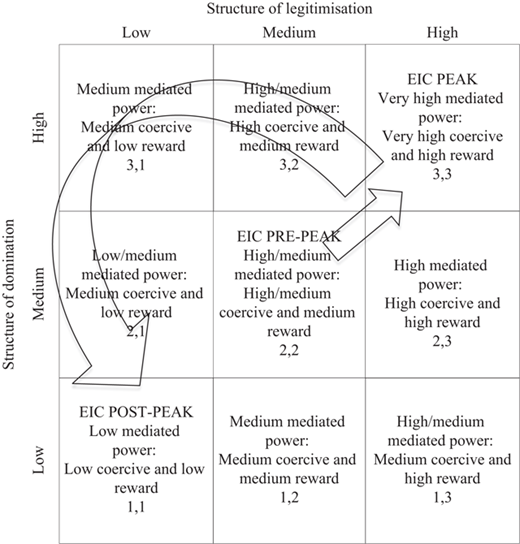
This typology allows us to classify EIC-mediated power over time. As the EIC was establishing its influence in Southern India, we can assume that it initially had a moderate level structure of domination and legitimization gaining a high/medium level of mediated power with a high/medium degree of coercive power and medium level of reward power (cell 2,2). As EIC’s influence grew through high level of structures of domination and legitimization, its mediated power in terms of coercion and reward power grew immensely (cell 3,3) with additional control of information and communications, supply chain integration, reduction in uncertainties and increased volume/scale of production. However, over time, as EIC’s structures of domination and legitimization dropped due to its waning influence, it had low levels of mediated power with low levels of coercion or reward power (cell 1,1). As such the degree to which the EIC could enforce supply chain alignment deteriorated over time. These three cells represent clusters along the mediated power continuum.
4.4 Signification as a structural variable
The concept of signification refers to the shared conceptions that constitute social reality. Compliance occurs because routines and behavior are taken for granted and other types of behavior cannot be conceived. In contrast to the mutual obligations of the legitimization perspective, signification focuses on the importance of templates and scripts for action. Scripts and systems of meaning influence behavior. In the context of supply chains at the BoP, the structure of signification includes the property of identification with the buyer.
Identification with buyer
Signification depicts a structure wherein prevailing institutional structures yield meaning and understanding. National culture may play a significant role in international supply chains (Pagell et al., 2005), and adaptation may be necessary to accommodate cultural differences (Metters, 2008). The EIC successfully blended English traits with Indian ones in their local operations. Many merchants and educated classes wanted to emulate these traits (Bhabha, 2004) because being associated with the EIC would be an important avenue through which Indian suppliers could promote their products to the outside world.
4.5 Non-mediated power process variable
We propose that non-mediated power is possible through a combination of signification and legitimization structural variables. In mapping out the non-mediated power process variable, we rely upon signification and legitimization as structural variables (Figure 2).
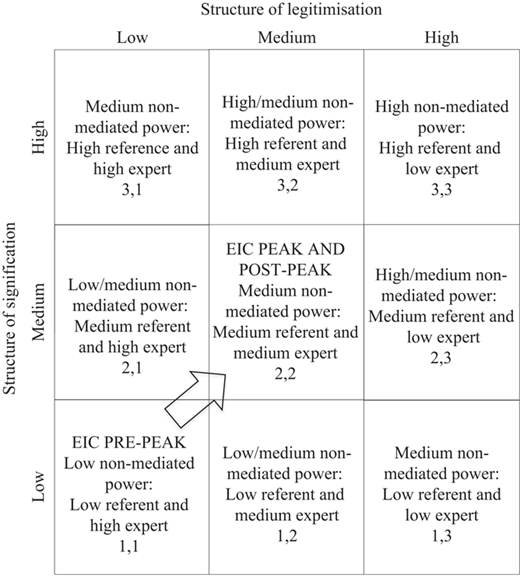
By taking the “alternate” diagonal combinations, we generate a continuum for non-mediated power: low degree (low level of signification × low level of legitimization; cell 1,1), moderate degree (moderate level of signification × moderate level of legitimization; cell 2,2), and high degree (high level of signification × high level of legitimization; cell 3,3). If greater detail in the model is required, other cells can be derived from the respective environmental structural variables.
As seen in Figure 2, 3,3 represents high levels of both signification and legitimization, with high referent power and low expert power. Thus, while a high level of signification propels better meaning and understanding of institutional structures by both parties (buyers and suppliers), a higher level of legitimization will narrow information barriers and the knowledge gap, therefore reducing expert power that the buyer may exert over the supplier. When the levels of both legitimization and signification are low (cell 1,1), a situation similar to that of EIC operations pre-peak is created (i.e. before the height of their influence). At this pre-peak stage, EIC had high expert power and low referent power. We can assume that over time the weavers and local Indian merchants gained additional knowledge in managing supply chain networks and that the desire by some Indians to emulate western traditions gained more traction. Both these dynamics increased non-mediated power (cell 2,2). Thus, our typology indicates that non-mediated power facilitates a supply chain’s network to adapt in the long run to a changing environment.
4.6 Best value supply chains
As the environment changes, it is crucial that all partners in the supply network are willing and have the capacity to adapt (Stonebraker and Afifi, 2004), else the entire network deteriorates. A poor network disenfranchises all supply chain partners, especially BoP players.
Supply chain networks need to be agile and adaptable with network partners aligned so they can thrive in the long run (Ketchen et al., 2008). Mediated and non-mediated power can potentially foster the alignment and capacity of a network to adapt and reshape networks in the medium to long run. Mediated power can also provide tighter integration and provide networks a degree of agility in the short run (Vachon and Klassen, 2006); Handfield et al. (2009) noted benefits of tighter integration in terms of direct cost savings, increased market share and protection against risk. Finally, non-mediated power is likely to ensure that network partners are equally represented in the supply chain.
The reward, coercive, and expert power exerted by the EIC meant that it was able to improve overall supply chain alignment for the textile network in Southern India in terms of overall lead-times (Chaudhuri, 1978), quality (English East India Company, 1724; South Arcot Collectorate Records, 1779; Government of Madras, 1792), margins (Government of Madras, 1794) and volume (Parthasarathi, 2001). This assured the EIC a degree of agility to respond to customer and environmental needs for a period of time. As such, the EIC was able to accrue vast profits and wealth (Government of Madras, 1771, 1774) created through the supply network. Unfortunately, the imbalance in power resulted in upstream players at the BoP (such as weavers) suffering a steep drop in margins (Government of Madras, 1768, 1771, 1774, 1775, 1788, 1792, 1794). The midstream merchants were also squeezed (South Arcot Collectorate Records, 1779, 1786) and often operated for the EIC at zero or negative margins (English East India Company, 1724). Correspondingly, the weavers and merchants did not have the capability to adapt as the environment changed in the long run, which ultimately affected the bottom line of the EIC. This deterioration could have been avoided if there was a greater sense of consistency of purpose (alignment) among supply chain partners which could have been achieved through additional non-mediated power within the network.
In developing our typology, we propose a best value process variable created through a cross-classification of the mediated and non-mediated power variables (Figure 3). The cells emanating from these two variables are clustered for simplification. We divide each power variable into three regions: low, medium and high. This yields a total of nine cells (3 (mediated: low, medium, high) × 3 (non-mediated: low, medium, high)). In Figure 3, we look at the combination of the two process variables. For example, very low level of value occurs when both mediated and non-mediated power is low (cell 1,1). On the other end of the continuum, a very high value occurs (high efficiency coupled with high degree of agility and adaptability) when both mediated and non-meditated sources of power exist at high levels (cell 3,3).
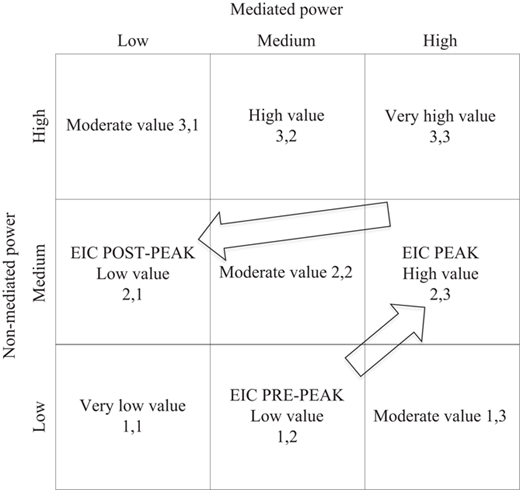
In its earlier phase, the EIC had relatively little non-mediated power to draw upon. It had some degree of mediated power creating supply chains with a low/medium level of value (cell 1,2). As the EIC gained a high degree of mediated power and a moderate level of non-mediated power, the supply chains became much more aligned and a bit more agile (cell 2,3). This high degree of mediated power resulted in EIC acquiring most of the wealth from the supply chains, leaving little to the BoP operators. When the environment changed, the EIC-mediated power dropped dramatically without a supporting non-mediated power base to rely upon. Correspondingly, the supply chains became much less aligned and the upstream supply chain players did not have the ability to adapt (cell 2,1).
The previous section uses the typology developed in this paper to classify and track EIC operations over time. The supply chains were dynamic reflecting a constant evolution of interactions between agents (EIC, weavers, BoP entrepreneurs) and structures. The model developed through the typology will now be used to analyze current BoP operations and provide specific recommendations in improving the livelihood of micro-entrepreneurs in the developing world.
The proposed model looks at the complex dynamic relationships among the multiple supply chain network partners. Rather than focusing on a single partner (e.g. weavers), the analysis provides recommendations for the supply chain network.
5. BoP cases
To demonstrate the generalizability of the typology (model) in today’s context, we will examine silk weavers in two different localities in India: Ram Nagar (within greater Varanasi) in Northern India and Kanchipuram in Southern India. The rationale for selecting the two locations was based upon the directions of Working Woman’s Forum (WWF) (www.workingwomensforum.org). WWF has been working with the weavers in Kanchipuram over the years and has seen their incomes increase, while at the same time the weavers in Varanasi were experiencing drastic losses. Both groups of BoP silk weavers have faced dramatic changes in customer taste and competition. Today, the younger generation in India prefers to wear salwar kameez or jeans, while synthetic sarees have become quite popular, resulting in declining demand for the silk sarees produced by the weavers.
In this research, we relied upon multiple sources of data to ensure validity (Yin, 2003) as diverse sources of evidence provide multiple measures of the same phenomenon. First, the BoP operations in Kanchipuram and Ram Nagar were observed directly by researchers. In addition, we interviewed weavers, cooperative and NGO workers and officials in charge of on-the-ground implementation, and shopkeepers; the supply chain partners were identified by either the NGO or supporting activists. In addition to interviews and direct observations of the sites, archival records (e.g. e-mails, reports and other administrative documents) were also used in the data collection. Finally, we observed the production processes and the range of output from the different silk weaving operations. The convergence of observations allowed us to classify the operations within the typology. Once a preliminary model was developed, it was shared with the weavers in Varanasi for feedback. A survey was also conducted among the weavers in Varanasi, capturing socio-economic dimensions of the community. Tables I and II present details about the Varanasi and Kanjipuram weavers for each property of the structure of legitimization, domination, and signification.
Legitimization, domination and signification of silk weavers in Ram Nagar and Kanchipuram
| Silk weavers in Ram Nagar, near Varanasi (India) | Silk weavers in Kanchipuram (India) | Recommendations for BoP weavers | |
|---|---|---|---|
| Legitimization | Low | High | |
| Control over information and communication | Medium – Information in terms of design pattern and color scheme shared indirectly through middlemen | High – Information in terms of lead-time, cost, design pattern and color scheme provided | Develop cooperatives to deal directly with shops. Facilitate the flow of information and integrate the supply chain from shops to raw material providers |
| Supply chain integration | Low – Limited or no supply chain integration | High – Cooperative integrates with marketing of products | |
| Domination | Low | Medium | |
| Uncertainty mitigation | Low – There are no long-term contracts or forward visibility | High – Provide long-term contracts | Develop cooperatives to increase the scale of production. Use economies of scale to make forward contracts |
| Volume/Scale | Low – Middlemen operate individually with each weaver. Batch size can be as small as one | High –Aggregation by cooperatives. Cooperative is the interface with raw material providers and shop | |
| Regulations and monopolies | There are 600,000-700,000 weavers in Varanasi area, all of whom compete with each other. Middlemen control the supply chain by providing poor weavers the raw-material needed for production. Middlemen and politicians are interconnected and sometimes siphon off government grants and benefits that should have been allocated to the weavers | In Kanchipuram, there are 15,000-30,000 weavers. The cooperatives allow for some monopolistic behavior by the weavers | Create unions, gain political influence via voting banks, create branding to monopolize on the name of Benaras silk or Kanchipuram silk products |
| Signification | Medium | High | |
| Identification with buyer | The silk weavers generally belong to the Muslim community. The middlemen also belong to the same Muslim community. The large aggregators that buy from the middlemen are Hindu. Muslim silk weavers are largely isolated from the mainstream community, especially due to illiteracy | The weavers are part of the buying cooperative. Cooperatives are women run. Women are literate and direct participants in the weaving/production process | Increase literacy among BoP players, expand social networks beyond local communities and integrate with the mainstream community |
Classification of mediated power, non-mediated power and supply chain value for BoP weavers in Ram Nagar and Kanchipuram
| Mediated power | Structure of legitimization | |||
| Structure of domination | Low | Medium | High | |
| High | ||||
| Medium | Kanchipuram | |||
| Low | Ram Nagar | |||
| Structure of legitimization | ||||
| Non-mediated power | ||||
| Structure of signification | Low | Medium | High | |
| High | Kanchipuram | |||
| Medium | Ram Nagar | |||
| Low | ||||
| Mediated power | ||||
| Supply chain best value | ||||
| Non-mediated power | Low | Medium | High | |
| High | Kanchipuram Annual income $ 500/yr with 30% in debt. Earn between 36 and 67 cents/hour | |||
| Medium | Ram Nagar Annual income $ 250/yr with 30% in debt. Earn 6-8 cents/hour | |||
| Low | ||||
5.1 Findings
We found that weavers in Kanchipuram were much more empowered with no middlemen. We observed many state-run cooperatives in Kanchipuram operating quite efficiently and supplying to large state-run handloom corporations. In addition, weavers in Kanchipuram had direct access to many shops and in some cases directly transacted with prospective buyers (see Figure 4). The weavers in Kanchipuram also work with the WWF on a cooperative basis for raw material sourcing and financial assistance.
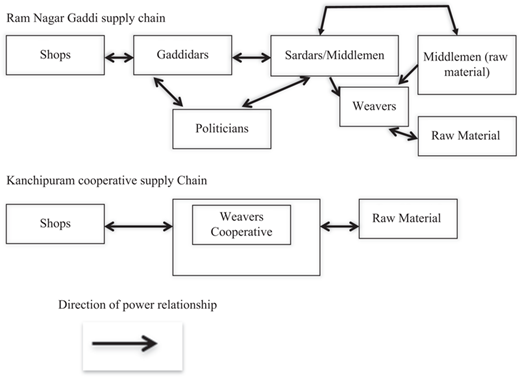
The Ram Nagar (Varanasi) weavers indirectly catered to markets across India as well as abroad. Their supply chain network relies upon the concept of Gaddi, which translates to “seat” in English and reflects the central role of a power broker. The Gaddidars control the flows of sarees from weavers to shops (see Figure 4). In Ram Nagar, the majority of weavers are Muslim and sell their products to Sardars or locality chiefs, who are also Muslims. The Sardars then sell silk sarees to Gaddidars aggregators (primarily Hindu) (see Figure 4). Many of the older silk weavers in Ram Nagar are illiterate. Based upon observations (Table I), we were able to classify weavers in Ram Nagar as having a low degree of legitimization and low degree of domination. As such, the BoP operators in Ram Nagar have very low levels of mediated power (Table II). Given a medium level of signification, the degree of non-mediated power would be low/medium. Correspondingly, the supply chain for the Ram Nagar BoP operators would be of very low value, earning about 6-8 cents/hour and with a majority of the weavers in debt. On the other hand, the weavers in Kanchipuram have a high/moderate level of mediated power given a high degree of legitimization and medium level of domination. Furthermore, they possess a high degree of non-mediated power given legitimization and signification. Combined, the two types of power create an environment where the weavers in Kanchipuram enjoy a high level of supply chain value and earn between 36 and 67 cents/hour with only 30 percent being in debt.
The supply chain network that the Kanchipuram weavers belong to has the ability to rapidly respond to changes in the demand and supply situation, adapt in the long run to changing customer expectations, and ensure that their interests are taken into account by the other network partners. Unlike the supply chains of the EIC, in which the BoP co-producers had very little power, the weavers in Kanchipuram and, to a lesser degree, those in Varanasi have greater levels of mediated and non-mediated power. This, ultimately, translates into higher levels of success for the supply chains.
6. Discussion and conclusion
The BoP approach aims to alleviate poverty in a socially and economically sustainable manner without losing sight of the poor as individuals. Supply chains at the BoP exist in specific sociological, economic and political ecosystems, and parties within supply networks need to adapt to the constantly changing ecosystem, and align the network to ensure proper value. Using the literature and a historical case study, we develop a typology that attempts to capture the dynamics of structures of signification, domination and legitimization, and applies that knowledge to power and supply chain value for BoP producers. The typology allows us to collapse a complex structure into a relatively simple, yet accurate representation of BoP operations, and can be used to provide specific recommendation for BoP entrepreneurs to avoid poverty.
6.1 Recommendations
The typology also enables us to make comparisons between two communities of BoP silk weavers and to provide recommendations that are generalizable beyond the two cases to different industries and other developing countries. In Table I, we see that the level of mediated power for the Ram Nagar weavers could be increased by an additional degree of legitimization and domination. This can occur through the creation of cooperatives, which can bring about increased volume and scale of production and allow for direct communication with the shopkeepers downstream and raw material suppliers upstream (Table I). With additional forward visibility, weavers can then engage in forward contracts and reduce uncertainty throughout the supply chain. Another approach would be to create political unions to ensure that regulations are in favor of the weavers’ interests and that their brand can be monopolized. Finally, BoP producers often belong to minority or marginalized groups. It is essential that BoP producers are able to garner additional non-mediated power along their network by networking beyond their narrow group and tapping into the mainstream social network. Increasing literacy among marginalized BoP producers would be a catalyst to intra-community networking. Such endeavors should allow BoP producers to create additional value within their supply chain networks.
6.2 Policy implications
Based upon the recommendations in Table I, we can draw specific policy implications for government entities and NGOs to help BoP entrepreneurs increase structures of legitimization, domination, and signification. Additional legitimization, domination, and signification would result in increased mediated and non-mediated power, with a corresponding increase in value for all network partners.
Governments can play a critical role in increasing the legitimization of BoP entrepreneurs, for example, by facilitating the development of cooperatives; governments could provide seed funding for the creation of cooperatives, while NGOs could facilitate the training and management of these new entities. The development of cooperatives could potentially help increase structures of domination by allowing BoP entrepreneurs to scale up and take advantage of economies of scale. This can also accrue through improved informational flows and integration of the supply chain networks. For example, since the use of mobile phone technology by BoP entrepreneurs is ubiquitous even in developing countries, governments and corporations could collaborate in creating mobile phone applications of material flow systems to ensure better visibility and provide a portal to executing forward contracts. Structures of domination can also be augmented for BoP entrepreneurs by elevating the status of their products through branding and obtaining trademarks. Governments can provide the legal space and enforcement for BoP acquired trademarks and NGOs can help in the application process and monitoring for trademark infringements. Furthermore, governments could facilitate the creation BoP unions, support voting blocks and attend to their community interests.
BoP players can also increase structures of signification. Often, BoP entrepreneurs belong to marginalized or immigrant communities and many BoP enterprises are women owned. Given customs and language barriers, women and marginalized groups are often unable to effectively communicate and network with current and potential supply chain partners belonging to the mainstream community. Literacy campaigns supported by governments can be designed to expose BoP players to mainstream language and customs; NGOs can help provide better networking opportunities between BoP entrepreneurs and supply chain partners operating in the mainstream.
7. Conclusion
In this research, we expand the BoP concept to include this population as producers within dynamic multi-tiered supply chains. By developing a typology, we provide specific recommendations on how supply chains can provide better value to BoP producers and act as mechanisms to keep marginalized citizens out of poverty.

