This study aims to propose a group decision-making model designed to support the assessment of supplier-related risks.
The model uses the possibility distribution hesitant fuzzy linguistic term sets combined with the technique for order of preference by similarity to ideal solution (PDHFLTS-TOPSIS) to categorize suppliers within a segmentation matrix. While PDHFLTS is used to represent the judgments of decision makers (DMs), the TOPSIS algorithm is applied to generate the overall scores of the suppliers. A pilot application was conducted in a civil defense organization. Sensitivity analysis tests were performed to assess the impact of varying criteria weights on the results.
The criteria related to cost (C1), import instability (C2) and delivery time (C4) received greater weights. Suppliers A3 and A4 were classified as low risk, while A1 and A2 were categorized as intermediate risk.
Implementing the proposed model requires structured protocols for identifying risk criteria and training DMs in HFLTS. Integration into routine processes demands adapting digital systems to enable real-time processes. In addition, the use of consensus-based evaluations calls for a cultural shift toward collaborative decision making.
This is the first supplier risk assessment model that performs supplier segmentation while allowing DMs to use linguistic expressions to evaluate supplier risk levels under conditions of hesitation. It is also the first to incorporate possibility distributions associated with judgments for risk assessment and support the weighting of DM opinions based on the degree of concordance with the group, enhancing the reliability and representativeness of the final assessment.
1. Introduction
The growing uncertainties in the global business environment – driven by natural disasters, social disruptions, economic volatility and political instability – have increasingly exposed supply chains to a wide array of risks (Saputro et al., 2024; Lima and Carpinetti, 2020). These factors often lead to supply shortages, delivery delays, cost escalations and reduced service levels, compromising overall supply chain performance and resilience. In this context, assessing supplier-related risks has become a critical element of supply chain risk management (Lima and Carpinetti, 2020; Ersahin et al., 2024).
Supplier risks may arise from various sources, including financial instability, operational inefficiencies, quality issues, environmental disruptions and geopolitical tensions. Such risks are often interconnected and cannot be fully captured through financial indicators alone (Ersahin et al., 2024; Gurtu and Johny, 2021). Accordingly, risk assessments are essential not only to anticipate disruptions and prioritize mitigation efforts but also to ensure procurement continuity and reinforce supply network robustness (Chiu et al., 2024; Mukherjee et al., 2024).
In humanitarian aid supply chains (HASCs), supplier risk assessment plays a vital role in ensuring the timely and effective delivery of aid to populations affected by crises. These operations are particularly vulnerable due to limited infrastructure, unpredictable demand, political unrest and tight time constraints (Santos et al., 2025). Any disruption in the flow of essential goods such as food, medicine or shelter can have severe impacts on affected communities. Therefore, identifying and mitigating supplier-related risks is essential to improving responsiveness, optimizing resource allocation and strengthening coordination among humanitarian actors (Santos et al., 2025; Alturki and Lee, 2024).
Supplier risk assessment is commonly approached as a group decision-making process, in which experts (or decision makers, DMs) evaluate suppliers based on multiple criteria with varying degrees of importance (Santos et al., 2025). Given the complexity of evaluating numerous suppliers across potentially conflicting dimensions, multicriteria decision-making (MCDM) methods are often used to provide structure, transparency and analytical support (Mukherjee et al., 2024; Santos et al., 2025). These approaches are particularly valuable in today’s volatile environment, as they enable broader and more consistent perspectives for strategic risk management (Nascimento et al., 2025).
However, several challenges remain. One key difficulty lies in the uncertainty faced by experts when assigning risk scores, often due to incomplete, outdated or imprecise information (Chiu et al., 2024; Mukherjee et al., 2024; Nascimento et al., 2025). This can lead to hesitation, where evaluators are unsure between linguistic assessment terms (e.g. “medium” or “high”), revealing a lack of confidence in their judgments (Nascimento et al., 2025; Lima et al., 2023; Wu et al., 2019). This hesitation reflects the cognitive difficulty in making precise evaluations under uncertainty, indicating that DMs may perceive overlapping meanings among linguistic terms or fear the consequences of misclassification, which ultimately affects the reliability of the assessment (Lima et al., 2023; Wu et al., 2019).
Another critical issue is the lack of consensus among DMs. Differing experiences, priorities and interpretations can result in divergent assessments, undermining the coherence and reliability of final decisions (Saputro et al., 2024; Gurtu and Johny, 2021). This divergence often indicates the subjective nature of human judgment, where individual biases and contextual understanding influence the perception of risk or performance levels, potentially leading to conflict or misalignment in group-based decision-making (Mukherjee et al., 2024; Lima et al., 2023). To address these issues, it is essential to adopt decision support methods capable of managing both expert hesitation and consensus building, thereby improving the consistency and credibility of supplier risk evaluations (Alturki and Lee, 2024; Nascimento et al., 2025; Lima et al., 2023; Wu et al., 2019).
A bibliographic review conducted for this study - drawing on databases such as Emerald Insight, Science Direct, Scopus, Taylor and Francis and Google Scholar – identified 21 studies that propose MCDM models for supplier risk assessment. Based on an analysis of these studies (detailed in Section 3.2) and recent literature reviews of this field (Santos et al., 2025; Alturki and Lee, 2024; Nascimento et al., 2025; Lima et al., 2023; Wu et al., 2019; Tay et al., 2025; Löffel et al., 2025; Silva et al., 2020; Balan and Handfield, 2025), the following research gaps have been identified:
Previous models do not support supplier segmentation. No existing model was found that enables the classification of suppliers within a segmentation matrix to guide the development of tailored risk mitigation strategies for each supplier group (Chiu et al., 2024; Mukherjee et al., 2024; Alturki and Lee, 2024; Nascimento et al., 2025; Tay et al., 2025; Silva et al., 2020; Balan and Handfield, 2025). Most available approaches are designed to support risk assessment for supplier selection, aiming to identify the single best alternative (Saputro et al., 2024; Chiu et al., 2024; Nascimento et al., 2025; Lima et al., 2023; Wu et al., 2019; Tay et al., 2025). Consequently, they focus on producing a global ranking of suppliers rather than segmenting them into meaningful categories based on their risk profiles (Santos et al., 2025; Alturki and Lee, 2024; Nascimento et al., 2025; Lima et al., 2023).
They are not capable of addressing DM hesitation. None of the models identified is appropriate for supporting DMs in situations of hesitation. Addressing hesitation is particularly important in supplier risk assessment, as inaccurate or oversimplified judgments can lead to a misclassification of suppliers and ineffective risk mitigation strategies (Alturki and Lee, 2024; Nascimento et al., 2025; Lima et al., 2023; Wu et al., 2019; Silva et al., 2020).
Lack of models that support consensus building in risk assessment. In supplier risk evaluation, it is crucial that MCDM models facilitate consensus among DMs, given the diversity of their backgrounds and perspectives (Saputro et al., 2024; Nascimento et al., 2025; Wu et al., 2019). However, none of the existing models identified provides explicit support for the consensus-building process (Chiu et al., 2024; Alturki and Lee, 2024; Nascimento et al., 2025; Lima et al., 2023; Balan and Handfield, 2025).
To address these gaps, this study proposes a novel decision-making model to guide the supplier risk assessment process. The model was applied in a case using data collected from a public organization operating within an HASC in Brazil. To guide the study toward its main objective, the following research questions (RQs) have been established:
How can suppliers be segmented based on supplier risk assessment factors?
How can DM hesitation be addressed in the supplier risk assessment process?
How can the consensus-building process among DMs be supported during supplier risk assessment?
The originality of this study lies in the development of the first supplier risk assessment model that enables supplier segmentation under conditions of hesitation. Furthermore, it is the first model to support the consensus-building process among DMs and to incorporate possibility distributions associated with their judgments.
2. Methodological procedures
This work is characterized as a normative axiomatic study (Bertrand and Fransoo, 2002), which is characterized by obtaining solutions based on quantitative models to provide insights into this problem. Figure 1 illustrates the organization of this study and the methodological procedures. In view of the proposed objective, the following steps were adopted:
 The diagram presents a bibliographic survey followed by stages for developing and applying a supplier risk assessment model. The left column shows Section 3.1 titled bibliographic survey on supplier risk assessment. The central column shows Section 3.2, which contains three steps. Step 1 is initial screening using a search string that includes supply risk and supplier risk and multicriteria terms. Databases include Science Direct with 690 results, Emerald with 623 results, Taylor and Francis with 179 results and Google Scholar with 12,300 results. Step 2 lists inclusion and exclusion criteria selecting studies from 2005 to 2025, published in scientific journals, selecting 50 first studies and restricting to English and Portuguese. Pre selection results show 50 studies for each database. Step 3 selects studies by eliminating duplicates and reading titles, abstracts and texts. Final selections list Science Direct with 7 studies, Emerald with 3, Taylor and Francis with 4 and Google Scholar with 7. A gap research box appears beneath these stages. Below this, a section titled development of the proposed model contains criteria for supplier risk assessment, development of a new model for risk supplier assessment, procedures for classifying supplier risk and a box titled the hesitant fuzzy linguistic T O P S I S method with possibility distributions. At the bottom, the application and validation section includes application in a humanitarian aid S C, sensitivity analysis and theoretical and practical implications, followed by limitations and conclusion.
Overview of the study’s organization and methodology
The diagram presents a bibliographic survey followed by stages for developing and applying a supplier risk assessment model. The left column shows Section 3.1 titled bibliographic survey on supplier risk assessment. The central column shows Section 3.2, which contains three steps. Step 1 is initial screening using a search string that includes supply risk and supplier risk and multicriteria terms. Databases include Science Direct with 690 results, Emerald with 623 results, Taylor and Francis with 179 results and Google Scholar with 12,300 results. Step 2 lists inclusion and exclusion criteria selecting studies from 2005 to 2025, published in scientific journals, selecting 50 first studies and restricting to English and Portuguese. Pre selection results show 50 studies for each database. Step 3 selects studies by eliminating duplicates and reading titles, abstracts and texts. Final selections list Science Direct with 7 studies, Emerald with 3, Taylor and Francis with 4 and Google Scholar with 7. A gap research box appears beneath these stages. Below this, a section titled development of the proposed model contains criteria for supplier risk assessment, development of a new model for risk supplier assessment, procedures for classifying supplier risk and a box titled the hesitant fuzzy linguistic T O P S I S method with possibility distributions. At the bottom, the application and validation section includes application in a humanitarian aid S C, sensitivity analysis and theoretical and practical implications, followed by limitations and conclusion.Overview of the study’s organization and methodology
Bibliographic research: to map the existing decision-making models dealing with the evaluation of supplier risk, a search was made of articles in the databases Science Direct, Scopus and Taylor and Francis, as well as the Google Scholar tool. The searches used the string (“supply risk” OR “supplier risk” OR “supply chain risk”) AND (“Multicriteria” OR “Multi-criteria” OR “MCDM”). Figure 1 depicts the outcomes resulting from the bibliographic searches. The following inclusion criteria were considered: studies published from 2005 onward (to obtain a sample of more recent studies), and papers published in journals, written in either English or Portuguese. The exclusion criteria were: studies that do not present MCDM models for supplier risk evaluation; systematic review articles; and book chapters, theses and dissertations. Additional searches were also conducted in these databases to identify articles on related subjects, such as risk management, HASCs and the PDHFLTS-TOPSIS method. In this step, the search string combined the following terms: “risk management,” “multicriteria,” “multi-criteria,” “Hesitant Fuzzy Linguistic Term Sets” and “Humanitarian Aid Supply Chain.” This step was essential for structuring the proposed model and for selecting both the evaluation criteria (or risk factors) and the decision-making technique applied in this study.
Development of the proposed model: Based on Mukherjee et al., 2024; Wu et al., 2019; Silva et al., 2020; Parkouhi et al., 2019, a decision-making model was developed to orient the DMs in the supplier risk assessment process. To operationalize the proposed model, two computational models were developed based on the PDHFLTS-TOPSIS method (Wu et al., 2019). Microsoft Excel was used to implement these models, which makes it possible to replicate and use this model in a simplified manner. The risk criteria were defined by employees of the participating organization, based on a list of potential criteria identified in the literature. This list includes all of the criteria that were used in three or more studies within the identified supplier risk assessment models in Step “i.”
Application: During this step, field research was conducted to obtain data for the pilot application. It took place in a Brazilian governmental body that provides protection and civil defense. The risk assessment was executed using suppliers that provide items that are strategic to the governmental body’s supply chain. The data was collected by DMs involved in acquiring the designated materials, such as humanitarian aid for victims of natural disasters. The DMs evaluated the importance assigned to the risk criteria and the scores for the suppliers. The collected information was inserted in the computational models to classify the suppliers in accordance with the selected risk factors.
Validation: Finally, the results obtained were analyzed and plotted on a supplier segmentation matrix. These results were then presented to the DMs, who assessed their consistency in terms of the relative importance of the criteria and the resulting supplier rankings. Moreover, a sensitivity analysis was conducted for each computational model to examine the impact of varying criteria weights on supplier classification outcomes. Finally, a comparative analysis was performed to evaluate the features of the proposed model against existing approaches in the literature, highlighting the potential benefits of the method developed in this study.
The selection of a Brazilian public civil defense organization to validate the proposed model is justified by its central logistical role in humanitarian relief operations. Additionally, supplier risk assessment is critically relevant in this context, which is characterized by high urgency, variable demand and strong dependence on suppliers. The organization coordinates emergency responses across dozens of municipalities. For example, in October 2023, it reported more than 28,000 people affected across 61 municipalities and distributed over 22,000 roofing tiles, 1,030 mattresses, 950 bedding kits, 764 hygiene kits and 484 food baskets to affected communities. This operational scale underscores the organization’s broad scope and logistical complexity, encompassing the procurement, transportation and distribution of essential humanitarian items under urgent and high-risk conditions. Such operational characteristics make the scenario particularly representative of the complexities involved in managing supplier risk in HASCs. Nevertheless, it is important to note that the results are not generalizable, as they are directly influenced by the specific risk criteria adopted and the judgments provided by the consulted DMs.
3. Theoretical framework
3.1 Supplier risk assessment
Organizations and their supply chains are increasingly exposed to various types of risk (Magableh, 2021; Emrouznejad et al., 2023). The ISO 31000 standard (ISO-International Organization for Standardization, 2018) establishes guidelines concerning risk management and conceives of risk as having an uncertain effect on objectives. According to this norm, the risk management process involves actions and practices related to identifying, analyzing and assessing risks, as well as their treatment, monitoring, critical analyses and registering and reporting risks.
Supplier risk assessment is the process of identifying, analyzing and evaluating potential threats that may affect a supplier’s ability to deliver goods or services as expected (Wiedenmann and Größler, 2021). By detecting deficiencies in products and processes, supplier risk assessment helps anticipate disruptions, understand their root causes and minimize their impact (Emrouznejad et al., 2023; Aven and Renn, 2009). This practice is especially relevant for enhancing supply chain resilience, particularly in contexts of uncertainty or responding to emergencies (Chiu et al., 2024).
In HASCs, where uncertainty and urgency are the norm, assessing supplier-related risks becomes even more essential to ensuring an agile, coordinated and effective response (Mukherjee et al., 2024). HASCs often operate under volatile conditions, facing challenges such as sudden demand spikes, damage to infrastructure, a limited availability of supplies and logistics bottlenecks (Silva et al., 2020; Abbas et al., 2022). Large-scale disasters exacerbate these challenges by disrupting supply flows and exposing inequalities in the distribution of critical resources. In this context, supplier risk assessment emerges as a key strategic activity to improve preparedness and diminish vulnerabilities (Cao et al., 2021).
Civil defense organizations play a pivotal role in this ecosystem, especially in countries like Brazil, where public agencies are often the first line of response in disaster situations. These organizations are responsible for coordinating emergency operations, mobilizing resources and delivering immediate assistance to affected communities (Santos et al., 2025). Their effectiveness depends heavily on reliable and responsive supply chains, often supported by a complex network of suppliers (Abbas et al., 2022; Cao et al., 2021). The risk matrix, which considers the probability of their occurrence and the severity of their impact, is commonly used in Brazilian civil defense organizations to assess threats by evaluating their likelihood and potential consequences. Meanwhile, the Ishikawa diagram is used to identify root causes of problems by categorizing contributing factors. These tools support initial qualitative analyses. However, they lack the ability to handle multiple, often conflicting criteria (Nascimento et al., 2025; Wiedenmann and Größler, 2021).
A comprehensive evaluation of supplier risk requires the consideration of a diverse set of factors that may jeopardize the continuity, quality and efficiency of supply chain operations (Nascimento et al., 2025; ISO-International Organization for Standardization, 2018). Moreover, risk constructs in HASCs differ substantially from those in commercial contexts. While traditional supply chains emphasize efficiency, cost reduction and competitive advantage, humanitarian operations prioritize speed, flexibility and equity in aid distribution under conditions of extreme uncertainty (Löffel et al., 2025; Abbas et al., 2022). Thus, each category of risk assumes specific humanitarian characteristics that reshape its theoretical framing and operational implications. The key categories of supplier risk include the following (Löffel et al., 2025; Silva et al., 2020; Wiedenmann and Größler, 2021; Abbas et al., 2022; Cao et al., 2021; Öztek and Kabak, 2022; Kellner et al., 2019):
Operational risk: is related to failures or inefficiencies in the supplier’s internal processes that may disrupt production or service delivery. In HASCs, operational risk is magnified by the need for rapid mobilization, dependence on volunteers and unstable field operations, where even minor disruptions can critically delay life-saving interventions.
Financial risk: concerns the economic stability and creditworthiness of the supplier, which affect its ability to fulfill obligations. In HASCs, this risk is compounded by reliance on donor or government funding, which is often unpredictable or earmarked for specific purposes, limiting suppliers’ financial flexibility and continuity.
Quality risk: involves the supplier’s consistency in meeting required quality standards and specifications. In humanitarian operations, inadequate quality can jeopardize not only efficiency but also human safety, for instance, through substandard medical supplies, shelters or food items distributed to affected populations.
Geopolitical or location risk: arises from the supplier’s exposure to political instability, regulatory changes or natural disasters. This is particularly critical for HASCs, which frequently operate in fragile or conflict-affected regions where access restrictions, embargoes or infrastructure collapse can abruptly cut off supply channels.
Logistical risk: pertains to transportation or distribution issues that may delay or hinder the delivery of goods or services. In humanitarian contexts, this risk is intensified by damaged infrastructure, limited transport availability and the lack of real-time visibility in last-mile delivery.
Compliance risk: is linked to the supplier’s adherence to legal, ethical and environmental regulations and standards. For humanitarian actors, this includes conformity with international humanitarian principles, donor procurement guidelines and ethical sourcing practices that safeguard vulnerable populations.
Capacity risk: refers to the supplier’s ability to meet demand, particularly under conditions of sudden or increased volume. In HASCs, this type of risk is especially pronounced during large-scale disasters, when suppliers may face simultaneous requests from multiple agencies and countries, creating severe supply bottlenecks and competition for scarce resources.
Cybersecurity risk: involves vulnerabilities in the handling, sharing and protection of sensitive or operational data. In HASCs, breaches in data integrity can compromise beneficiary privacy, expose field locations or disrupt coordination across agencies.
Given the variety and complexity of these risk types, the adoption of MCDM models is increasingly pertinent. The next section explores the key characteristics and methodological strengths of these models within the context of supplier risk evaluation.
3.2 Multicriteria decision-making models for supply risk assessment
The literature presents several quantitative models developed to support supplier risk assessment. These models provide a structured and transparent approach, allowing DMs to assess multiple risk dimensions and prioritize suppliers through comprehensive analysis (Nascimento et al., 2025; Silva et al., 2020). As noted in Section 2, we identified 21 studies proposing decision-making models for this purpose. Table 1 summarizes these models by outlining the techniques used, the application sectors and the specific focus of the supplier risk assessments. It also indicates whether the models support GDM, incorporate consensus-building processes or use linguistic terms and comparative expressions.
A Mapping of prior supplier risk assessment models
| Author(s) | Decision techniques(s) | Application sector | Focus of risk assessment | Supports GDM | Supports consensus building | Uses linguistic terms | Uses comparative linguistic expressions |
|---|---|---|---|---|---|---|---|
| Talluri et al. (2006) | Chance-constrained DEA | Pharmaceutical | Monitoring of supplier performance | No | No | No | No |
| Blackhurst et al. (2008) | Factor weighting procedure | Automotive | Product-focused risk assessment | No | No | No | No |
| Kull and Talluri (2008) | AHP (analytic hierarchy process) and goal programming | Automotive | Supplier selection | Yes | No | No | No |
| Chaudhuri et al. (2013) | FMEA | Aviation | Development of new products | Yes | No | Yes | No |
| Chen and Wu (2013) | Modified FMEA and AHP | Electronics | Supplier selection | Yes | No | No | No |
| Ganguly and Guin (2013) | Fuzzy AHP | Not specified | Supplier selection | Yes | No | Yes | No |
| Viswanadham and Samvedi (2013) | Fuzzy AHP and fuzzy-TOPSIS | Not specified | Supplier selection | Yes | No | Yes | No |
| Ganguly (2014) | AHP and Dempster–Shafer theory | Not specified | Supplier selection | Yes | No | No | No |
| El Mokrini et al. (2016) | Fuzzy-AHP and PROMETHEE | Pharmaceutical | Outsourcing logistics | No | No | Yes | No |
| Govindan and Jepsen (2016) | ELECTRE TRI | Services | Supplier selection | Yes | No | Yes | No |
| Helbig et al. (2016) | AHP | Energy | Supplier selection | Yes | No | No | No |
| Kellner et al. (2019) | Multi-objective programming and ANP (analytic network process) | Automotive | Supplier selection | Yes | No | No | No |
| Yu et al. (2021) | Stochastic multi-criteria acceptability analysis | Automotive | Supplier risk monitoring | Yes | No | No | No |
| Ilyas et al. (2021) | Best worst method and fuzzy TOPSIS | Automotive | Supplier selection | Yes | No | Yes | No |
| Öztek and Kabak (2022) | AHP | Defense | Sustainability-focused risk assessment | Yes | No | No | No |
| Zhou et al. (2022) | Stochastic programming and greedy algorithm | Not specified | Selection of supplier development programs | No | No | No | No |
| Balan and Handfield (2025) | Integrated best-worst goal programming | Technology | Supplier risk monitoring | No | No | No | No |
| Chiu et al. (2024) | Natural language processing and AHP | Electronics | Sustainability-focused risk assessment | No | No | Yes | No |
| Lo et al., 2024 | Modified Pythagorean fuzzy SWARA–TOPSIS | Aerospace | Assessment of disruption risks | Yes | No | Yes | No |
| Saputro et al. (2024) | Fuzzy-AHP and fuzzy-SWARA-FMEA (stepwise weight assessment ratio analysis) | Manufacturing | Supplier selection | Yes | No | Yes | No |
| Wang et al. (2024) | QFD and gray clustering | Numerical example | Supplier selection | No | No | Yes | No |
The application of the supplier risk assessment techniques listed in Table 1 offers several advantages. Methods such as AHP, ANP and goal programming enable the structured breakdown of complex problems and alignment with organizational goals (Chiu et al., 2024; Öztek and Kabak, 2022; Kull and Talluri, 2008; Chen and Wu, 2013; Ganguly, 2014; Kellner et al., 2019). Hybrid approaches, such as fuzzy AHP, fuzzy TOPSIS, fuzzy SWARA–FMEA and Pythagorean fuzzy SWARA–TOPSIS, enhance the ability to handle subjectivity and linguistic judgments, which are common in supplier evaluations (Saputro et al., 2024; Chiu et al., 2024; Ganguly and Guin, 2013; Viswanadham and Samvedi, 2013; El Mokrini et al., 2016; Helbig et al., 2016).
Techniques like ELECTRE TRI and stochastic multicriteria acceptability analysis support robust ranking and classification under uncertainty, while models based on stochastic programming or DEA improve risk quantification by incorporating constraints and measuring performance efficiency (Talluri et al., 2006; Govindan and Jepsen, 2016; Yu et al., 2021; Zhou et al., 2022). These techniques are particularly valuable in HASCs, where urgent decisions must often be made with limited data and high degree of uncertainty, which requires flexible, transparent and adaptive decision-making frameworks that can support both risk mitigation and resource prioritization.
However, the models presented in Table 1 also exhibit important limitations. Most notably, while existing models typically perform only a global supplier ranking, we identified no approaches that support the segmentation of suppliers into distinct risk-based categories. This limitation impairs the ability to define targeted mitigation strategies according to supplier profiles (Silva et al., 2020; Balan and Handfield, 2025).
In addition, while over half of the models allow DMs to articulate preferences using linguistic terms, none accommodates comparative linguistic expressions, which is an essential feature for capturing hesitation and subtle distinctions between closely rated risk levels (Nascimento et al., 2025; Wu et al., 2019). The absence of this feature restricts the flexibility of evaluations and may lead to oversimplified or forced judgments (Lima et al., 2023; Oliveira et al., 2023).
Furthermore, none of them incorporates structured consensus-building mechanisms within GDM, limiting their ability to manage divergent opinions and enhance the quality of collective judgments (Oliveira et al., 2023). This gap is particularly relevant in supplier risk assessment, where divergent opinions among DMs can undermine the coherence of judgments, reduce stakeholder buy-in and compromise the perceived legitimacy of decisions (Nascimento et al., 2025; Chaudhuri et al., 2013).
To address these gaps, this study proposes a novel model design to enhance the elicitation of preferences under hesitation, to support consensus formation and enable supplier categorization based on risk factors. The following section outlines the methodological foundations of the MCDM method adopted in this study.
3.3 The hesitant fuzzy linguistic TOPSIS method with possibility distributions
Wu et al. (Wu et al., 2019) proposed a GDM method named PDHFLTS-TOPSIS using a combination of possibility distribution hesitant fuzzy linguistic term sets (PDHFLTSs) and the TOPSIS method. This method was selected in this study due to the several advantages it offers over traditional MCDM techniques and other fuzzy logic-based approaches. The distinctive features that justify its adoption include:
its ability to support GDM under conditions of hesitation;
the incorporation of linguistic expressions and the use of possibility distributions to represent the uncertainty associated with each DM’s judgment, which thereby reduces information loss (Lima et al., 2023); and
its capacity to facilitate the consensus-building process by weighting DM judgments according to their level of agreement with the group (Oliveira et al., 2023).
In the PDHFLTS-TOPSIS method, each linguistic term selected by a DM to evaluate the alternatives is associated with a degree of possibility. For each PDHFLTS, the sum of the degrees of possibility must be equal to 1. For instance, considering the set of linguistic terms S = {s0: null; s1: very poor; s2: poor; s3: medium; s4: good; s5: very good; s6: extremely good}, if a DM just selects the term “s3: medium” without hesitation, this judgment will be quantified by s3 (1.0). In selecting “between s4:good and s6:extremely good,” this judgment will be quantified by [s4 (0.33); s5 (0.33); s6 (0.33)] (Alturki and Lee, 2024; Lo et al., 2024).
The PDHFLTS-TOPSIS steps are described as follows (Wu et al., 2019):
Step 1: Structure the individual decision-making matrices, which are obtained based on the scores attributed to the alternatives by t DMs. There can be criteria that are considered benefit criteria and others that are considered cost criteria, with the Neg operator being applied to the latter as in Equation 1. With S = {s0, s1…,}, the basic set of linguistic terms, and ϑ = {sL, sL+1,…, sU}, the set of terms referring to the DM scores, we have:
Step 2: We support the consensus-building process. To achieve this, the level of agreement between each DM and the group is first calculated using the geodesic distance. The greater the agreement of a DM with the group, the higher the weight assigned to their preferences in the aggregation process. Thus, the weight of each DM is obtained in accordance with equation (2). The DM weights should be normalized using equation (3), in which k (k = 1,…,t) corresponds to the index of each DM. GCIk is obtained based on equation (4), where l and k correspond to the DMs in question, n (i = 1,…,n) is the number of alternatives and m (j = 1,…,m) corresponds to the number of criteria. The normalized weights are applied in Step “iv” to consolidate individual judgments into a collective group preference:
Step 3: Calculate the individual decision-making matrices with a possibility distribution referring to each HFLTS. Using equation (5), it is possible to calculate each PDHFLTS of the matrix. Considering the set of linguistic terms S = {s1, s2,…, sg} and which is an HFLTS in S, the possibility distributions that correspond to in S are defined as p = (p0, p1,…, pl,…, pg), in which pl (l = 0,1,…, g) denotes the possibility that the alternative has an sl evaluation so that and 0 ≤ pl ≤ 1. These values of the possibility distributions are associated with the degree of certainty that the DM has in choosing each term. For example, considering set S for a linguistic judgement defined as Hs = {s1:poor, s2:medium, s3:good}, the distribution will be p = (0; 0.33; 0.33; 0.33; 0; 0; 0; 0). For Hs = {s3:good, s4:very good}, the distribution will be p = (0; 0; 0.5; 0.5; 0; 0; 0). Thus, if the DM selects a larger number of linguistic terms, the value of pl attributed to each term individually will be smaller:
Step 4: Aggregate the PDHFLTS matrices using the hesitant fuzzy linguistic weighted average (HFLWA) operator, which will weigh the matrices with DM weights resulting in an aggregated matrix. If S = {s1, s2,…, sg}, the set of linguistic terms, AH = {H1, …, Hn} is a PDHFLTS set, and ω = {ω1, …, ωn} the vector of the DM weights, then 0 ≤ ωi ≤ 1, with . Each Hk has its possibility distribution represented as . The operator HFLWA is defined by equation (6), with , so that pl indicates the possibility that sl ∈ S can be attributed by the DMs:
Based on the aggregated matrix, the average and variance of each of its elements can be calculated. Considering ϑ ∈ Hs, the distribution of the corresponding possibilities for ϑ is p = (p0,…, pl,…, pg). The average E (ϑ) for ϑ is defined by equation (7), in which NS (sl) corresponds to the adopted linguistic scale. The variance Var (ϑ) for ϑ is defined by equation (8). It is important to point out that the values of E (ϑ) and Var (ϑ) must be calculated only if the relative ideal solutions were adopted in Step 5:
Step 5: Define the positive and negative ideal solutions (PIS, NIS). To find the relative PIS and NIS, we apply the respective equations (9) and (10). Equations (11) and (12) should be used to obtain the absolute ideal solutions:
Step 6: Calculate the distances of the alternatives in relation to the ideal solutions. The m-dimensional Euclidean distance is calculated using equations (13) and (14):
In the calculation of the distance between two PDHFLTSs, the subsets to be manipulated are indicated by ϑ and η. p = (p0,…, pl,…, pg) and Q = (q0,…, q,…, qg) indicate, respectively, the distributions of the possibilities for ϑ and η. Equation (15) is used to calculate the distance between ϑ and η based on P and Q, in which NS (sl) represents the adopted linguistic scale:
Step 7:Equation (16) should be applied to calculate the relative closeness value (RCi) for each alternative:
Step 8: Perform the classification of all of the alternatives Ai (i = 1, 2,…, n) as a function of the RCi values, where the greater the value, the better the final performance of alternative Ai.
The method proposed by Wu et al. (Wu et al., 2019) ends with Step 8. For the application of this method to our supplier risk assessment, the following adaptations have been made:
the implementation of two PDHFLTS-TOPSIS models combined within a bi-dimensional segmentation matrix, which converts the PDHFLTS-TOPSIS output into category classes (e.g. “low” or “high”);
the use of absolute ideal solutions [equations (11) and (12)] instead of relative ideal solutions; and
the application of triangular fuzzy numbers (TFNs), fuzzy arithmetic means and the center-of-area operator to evaluate the criteria weights.
The procedures described in “Step 3” should be performed prior to Step 6, where the normalized criteria weights are required. Accordingly, the following steps must be carried out:
After collecting the linguistic judgments of the DMs regarding the importance of each criterion, the corresponding TFNs need to be aggregated using the fuzzy arithmetic mean, as defined in equation (17). In this equation, represents the judgement of each DM in relation to the weight of each criterion, t is the number of DMs and = (lj, mj, uj) is the fuzzy arithmetic mean:
For the defuzzification of, we will use equation (18), in which lj,mj, and uj represent the vertices of a TFN, with mj corresponding to the central vertex. Considering j = (1, 2, …, m) as the indices of the criteria, ω′ = (, …, )T will indicate the weights of the defuzzified criteria after the normalization using equation (19):
4. Proposed model for supplier risk assessment
Figure 2 details the steps of the model proposed in this study to aid DMs in assessing supplier risk. It is mainly designed to help organizations within supply chains that seek or already have long-term relationships with their suppliers and seek to incorporate risk assessment in their supply chain management. It is important to emphasize that the evaluation focuses on the risks associated with the suppliers themselves and not specific items.
 The diagram outlines three sequential stages for supplier risk assessment. Stage 1 is problem definition and contains steps 1.1 to 1.6: assembling a team of decision makers, defining risk assessment criteria, defining the suppliers to be evaluated, defining linguistic scales, defining the relative importance of criteria and evaluating the scores of alternatives. Stage 2 is application of the computational models and contains steps 2.1 to 2.6: calculating criteria weights, performing normalisation of cost criteria and consensus based decision maker weights, aggregating the P D H L F T S matrices, defining ideal solutions P I S and N I S, calculating the relative distance between alternatives and ideal solutions and obtaining the coefficient of relative closeness R C. Stage 3 is supplier classification and contains step 3.1, which categorises the results in a segmentation matrix with four risk categories labelled 1 high risk, 2 intermediate risk, 3 intermediate risk and 4 low risk, plotted on axes showing supplier risk intensifying factors and supplier risk reducing factors. Step 3.2 instructs developing actions for each group.
Model for support risk analysis and assessment
The diagram outlines three sequential stages for supplier risk assessment. Stage 1 is problem definition and contains steps 1.1 to 1.6: assembling a team of decision makers, defining risk assessment criteria, defining the suppliers to be evaluated, defining linguistic scales, defining the relative importance of criteria and evaluating the scores of alternatives. Stage 2 is application of the computational models and contains steps 2.1 to 2.6: calculating criteria weights, performing normalisation of cost criteria and consensus based decision maker weights, aggregating the P D H L F T S matrices, defining ideal solutions P I S and N I S, calculating the relative distance between alternatives and ideal solutions and obtaining the coefficient of relative closeness R C. Stage 3 is supplier classification and contains step 3.1, which categorises the results in a segmentation matrix with four risk categories labelled 1 high risk, 2 intermediate risk, 3 intermediate risk and 4 low risk, plotted on axes showing supplier risk intensifying factors and supplier risk reducing factors. Step 3.2 instructs developing actions for each group.Model for support risk analysis and assessment
Stage 1 of the proposed model identifies the criteria and suppliers to be evaluated and collects the DM judgments for the criteria weights and supplier scores. The following steps should be taken in this stage:
Step 1.1: Assemble a team of organization employees responsible for decision-making. Professionals from various areas can participate, such as purchasing, logistics, quality, sustainability, finance and product development.
Step 1.2: Choose the criteria that will serve as the basis for the risk assessment. The DMs should select them based on a list of criteria extracted from previous studies and brainstorming. Table 2 presents the set of criteria developed for this study, derived from the models shown in Table 1 and Saugo et al. (Saugo et al., 2025). It includes factors that intensify supplier risks as well those associated with reduced supplier risk. Supplier risk-reducing factors refer to characteristics, practices or conditions that decrease the likelihood of supplier-related problems or mitigate their potential impacts. By contrast, risk-intensifying factors are elements that increase the probability of supplier failures or amplify their negative effects on the supply chain. Additional criteria can be defined based on an analysis of the documents that define purchasing flows.
List of possible criteria for supply risk assessment
| Evaluation criteria | |||
|---|---|---|---|
| Risk intensifiers | |||
| () | Cost | () | Delivery time |
| () | Natural disasters | () | Energy use |
| () | Greenhouse gas effect | () | Water pollution |
| () | Residue generation | () | Work time |
| () | Import instability | ||
| Risk reducers | |||
| () | Physical assets | () | Political stability |
| () | Productive capacity | () | Product project |
| () | Reliability | () | Training programs |
| () | Conformity with legislation and norms | () | Market position |
| () | Contract stability | () | Financial position |
| () | Contribution to economic development | () | Geographic proximity |
| () | Contribution to cultural development | () | Quality |
| () | Economic compatibility | () | Human resources |
| () | Availability of resources | () | Profitability |
| () | Ethics and human rights | () | Reputation |
| () | Flexibility | () | Health and occupational safety |
| () | Residue management | () | Information security |
| () | Physical infrastructure | () | Physical safety |
| () | Know-how and innovations | () | Post-sales support |
| () | Availability of logistics | () | Health and safety standards |
| () | Raw materials | () | Social opportunities |
| () | Technological level | ||
Step 1.3: Define the suppliers to be evaluated. The focus should be on the suppliers of critical items for the organization.
Step 1.4: Define the linguistic scales to be used to evaluate the suppliers and the criteria. DMs can consult previous studies on HFLTSs during this step to support the choice of linguistic term scales.
Step 1.5: DMs should evaluate the relative importance of each criterion using a set of linguistic terms.
Step 1.6: DMs should estimate supplier scores for the selected criteria using linguistic terms and/or comparative linguistic expressions.
Stage 2 is dedicated to processing the information using the PDHFLTS-TOPSIS computational models. While Model 1 realizes the processing of risk-intensifying criteria, Model 2 computes risk-reducing factors. The following steps are repeated in both computational models:
Step 2.1: Compute the criteria weights using equations (17) and (18).
Step 2.2: Convert the cost criteria into benefit criteria using equation (1). The weights of the DMs are calculated using equations (2) and (3).
Step 2.3: Calculate a possibility distribution for each element of the matrix used in equation (5). Equation (6) is applied to aggregate the scores of the DMs using the HFLWA operator.
Step 2.4: Define the absolute PIS and NIS using equations (11) and (12), respectively.
Step 2.5: Obtain the Euclidean distance between the score for each alternative in relation to the values of PIS and NIS using equations (13), (14) and (15).
Step 2.6: Apply equation (16) to calculate the relative closeness coefficient (RCi) for each alternative. This coefficient can be understood as the supplier’s degree of risk in a specific dimension of the proposed matrix.
Stage 3 focuses on classifying supplier risks and developing mitigation actions, according to the following steps:
Step 3.1: Use the outputs of each PDHFLTS-TOPSIS model (RCi) to categorize the suppliers in the two-dimensional segmentation matrix illustrated in Figure 3. This matrix is composed of the dimensions “supplier risk-intensifying factors” and the “supplier risk-reducing factors.” In each dimension, if RCi ≥ L, the supplier’s degree of risk is classified as “high.” Otherwise, it will be classified as “low.” The values of L should be defined according to the demands of the organization in relation to supplier performance. In this study, we have adopted L = 0.60 for the risk-reducing factors and L = 0.40 for the risk-intensifying factors.
 The diagram presents a square segmentation matrix used for classifying supplier risk. The horizontal axis shows supplier risk reducing factors from 0 at the left to 1 at the right, with low and high labels. The vertical axis shows supplier risk intensifying factors from 0 at the bottom to 1 at the top, with low and high labels. The matrix is divided into four quadrants. Quadrant 1 in the upper left is labelled high risk. Quadrant 2 in the lower left is labelled intermediate risk. Quadrant 3 in the upper right is labelled intermediate risk. Quadrant 4 in the lower right is labelled low risk. Three arrows inside the matrix point from quadrant 1 toward quadrant 4, quadrant 3 toward quadrant 4 and quadrant 2 toward quadrant 4. To the left of the matrix, a box labelled P D H F L T S T O P S I S computational model 1 outputs R C i toward the matrix. Beneath the matrix, a second box labelled P D H F L T S T O P S I S computational model 2 outputs R C i upward into the matrix.
The proposed supplier segmentation matrix
The diagram presents a square segmentation matrix used for classifying supplier risk. The horizontal axis shows supplier risk reducing factors from 0 at the left to 1 at the right, with low and high labels. The vertical axis shows supplier risk intensifying factors from 0 at the bottom to 1 at the top, with low and high labels. The matrix is divided into four quadrants. Quadrant 1 in the upper left is labelled high risk. Quadrant 2 in the lower left is labelled intermediate risk. Quadrant 3 in the upper right is labelled intermediate risk. Quadrant 4 in the lower right is labelled low risk. Three arrows inside the matrix point from quadrant 1 toward quadrant 4, quadrant 3 toward quadrant 4 and quadrant 2 toward quadrant 4. To the left of the matrix, a box labelled P D H F L T S T O P S I S computational model 1 outputs R C i toward the matrix. Beneath the matrix, a second box labelled P D H F L T S T O P S I S computational model 2 outputs R C i upward into the matrix.The proposed supplier segmentation matrix
Step 3.2: Define the position of the combination of the classification results in both dimensions for a supplier in one of the four groups displayed in Figure 3, which are:
Step 3.3: high risk;
Step 3.4: intermediate risk;
Step 3.5: intermediate risk; and
Step 3.6: low risk.
Step 3.7: This information gives the managers the possibility of evaluating the supplier risk profile to orient their decisions in this step. Based on the results of the classification, the DMs will be able to prepare actions that seek to reduce the supplier degree of risk, thus moving them to Group 4. To accomplish this, they can propose development actions to the suppliers designed to improve performance in the criteria that present low ratings.
5. Application of the proposed model
The pilot application of the model was realized in a Brazilian public organization dedicated to protection and civil defense. In Brazil, the Civil Defense has its policy defined by Law 12,608/2012, which institutes the National Protection and Civil Defense Policy (PNPDEC), including the actions of “prevention, mitigation, preparation, responses, and recovery related to protection and civil defense.” The objectives of the PNPDEC consist of emergency aid and assistance to populations affected by disasters, with items of humanitarian aid to be acquired from suppliers for distribution to the affected communities.
The purchasing organization encompasses four levels of operations: direction, advising, management and program execution. The purchasing sector is within a division that deals with administration and finance. This sector is oriented by steps, namely, the elaboration of announcements, bidding and the examination and receiving of material and logistics. Given the specificities of the presented organization, especially in terms of the unpredictability of natural disasters and the need to rapidly provide assistance to the public, supply risk assessment is a useful tool for the management of suppliers of humanitarian aid.
The data was collected during an in-person meeting held at the organization’s premises, using the form provided in Appendix. The criteria selection and weighting processes were explained, and together, the DMs selected those of greatest relevance to the organization. After this, each DM individually attributed a weight for each criterion. Finally, the DMs attributed their scores for each supplier in an individual manner. The collected scores were inserted into the computational models to process the information. The results are detailed in the following section.
5.1 Stage 1: problem definition
In Step 1.1 of Stage 1, a team was assembled made up of three DMs. Among the participating professionals was the head of purchasing (DM1), who had 27 years of experience with four years in the current position. DM2 was the head of logistics, who had 18 years of experience with five years in the current position. DM3 was an assistant in the receiving and distribution sector who had 16 years of experience with four years in the current position.
In Step 1.2, based on the list of criteria presented in Table 2, the DMs selected eight criteria to be applied as factors for the supplier risk assessment. The factors that intensify risk were: cost (C1), import instability (C2), work time (C3) and delivery time (C4). The factors that reduce risk were contract stability (C5), availability of resources (C6), availability of logistics (C7) and financial position (C8).
In Step 1.3, after defining the criteria, the DMs selected four strategic suppliers to be evaluated named A1, A2, A3, and A4. These suppliers provide the organization with various items that the government provides the population affected by disasters, such as tarps, roofing, food baskets, blankets, mattresses and hygienic and cleaning materials.
In Step 1.4, the scales used in making DM judgments were structured based on HFLTS studies (Wu et al., 2019; Oliveira et al., 2023). Table 3 presents the linguistic scale used by the DMs to evaluate the criteria weights, which included seven linguistic terms. Table 3 also shows the values of the TFNs corresponding to each linguistic term. Table 4 presents scale defined to represent the DM scores for the suppliers, including linguistic terms and expressions that can be adopted.
Linguistic terms used in the evaluation of criteria weights
| Linguistic term | Abbreviation | Triangular fuzzy numbers (l, m, u) |
|---|---|---|
| “Null” | “N” | (0, 0, 0.17) |
| “Very low” | “VL” | (0, 0.17, 0.33) |
| “Low” | “L” | (0.17, 0.33, 0.50) |
| “Medium” | “M” | (0.33, 0.50, 0.67) |
| “High” | “H” | (0.50, 0.67, 0.83) |
| “Very high” | “VH” | (0.67, 0.83, 1.00) |
| “Absolute” | “AB” | (0.83, 1.00, 1.00) |
Terms and linguistic expressions used in the evaluation of suppliers
| Linguistic terms | Abbreviation | Representation | HFLTS |
|---|---|---|---|
| “Extremely poor” | “EP” | s0 | [0] |
| “Very poor” | “VP” | s1 | [1] |
| “Poor” | “P” | s2 | [2] |
| “Medium” | “M” | s3 | [3] |
| “Good” | “G” | s4 | [4] |
| “Very good” | “VG” | s5 | [5] |
| “Excellent” | “E” | s6 | [6] |
| Linguistic expressions | Mathematical expression | Example | HFLTS |
| At least Si | sj | sj ∈ S and sj ≤ si | At least VG: [s5, s6] | [5, 6] |
| Between Si and Sj | sk | sk ∈ S and si ≤ sk ≤ sj | Between M and G: [s3, s4] | [3, 4] |
| At most Si | sj | sj ∈ S and sj ≥ si}; | At most P: [s0, s1, s2] | [0, 2] |
In Step 1.5, the DMs evaluated the relative importance of the criteria. The values attributed by them are presented in Table 5. In Step 1.6, the terms and linguistic expressions presented in Table 4 were used by the DMs to realize their evaluation of the suppliers. The DM evaluations for each supplier are shown in Table 6.
Linguistic weights attributed by the DMs
| Risk intensifiers (Model 1) | Risk reducers (Model 2) | ||||||
|---|---|---|---|---|---|---|---|
| Criteria | DM1 | DM2 | DM3 | Criteria | DM1 | DM2 | DM3 |
| C1 – Cost | [H] | [AB] | [H] | C5 – Contract stability | [VH] | [AB] | [H] |
| C2 – Import instability | [H] | [VH] | [AB] | C6 – Availability of resources | [M] | [VH] | [VH] |
| C3 – Work time | [M] | [M] | [L] | C7 – Availability of logistics | [H] | [VH] | [VH] |
| C4 – Delivery time | [H] | [VH] | [VH] | C8 – Financial position | [VH] | [AB] | [M] |
Evaluation of the DMs in terms of the supplier scores
| DM | Supplier | Intensifying-risk factors (Model 1) | Reducing-risk factors (Model 2) | ||||||
|---|---|---|---|---|---|---|---|---|---|
| C1 | C2 | C3 | C4 | C5 | C6 | C7 | C8 | ||
| DM1 | A1 | G | G | M | P | VG | G | P | G |
| A2 | G | G | M | M | VG | VG | G | G | |
| A3 | G | G | VG | VG | VG | VG | VG | VG | |
| A4 | G | G | M | G | VG | VG | M | VG | |
| DM2 | A1 | G | Between M and G | P | EP | G | At least VG | G | G |
| A2 | G | G | G | P | At least VG | At least VG | G | At least VG | |
| A3 | G | Between M and G | At least VG | At least VG | G | G | G | G | |
| A4 | G | Between G and VG | At least VG | At least VG | At least VG | G | At least VG | At least VG | |
| DM3 | A1 | G | M | M | P | G | G | VG | M |
| A2 | G | M | M | P | VG | M | VG | VG | |
| A3 | G | M | P | P | G | M | G | G | |
| A4 | G | VG | G | M | VG | M | G | VG | |
5.2 Stage 2: application of the computational models
5.2.1 Calculation of the criteria weights
In Step 2.1 of Stage 2, based on Table 3, the linguistic values presented in Table 5 were converted to TFNs. Equation (17) was used to aggregate the DM scores. The resulting values were defuzzified in accordance with equation (18). Later, the weight values were normalized using equation (19). Table 7 shows the results obtained by the Computational Models 1 and 2.
Results of the criteria weight calculations
| Model | Criterion | Aggregated scores | Defuzzified values | Normalized weights | ||
|---|---|---|---|---|---|---|
| l | m | u | ||||
| PDHFLTS-TOPSIS model 1 | C1 | 0.61 | 0.78 | 0.89 | 0.77 | 0.27 |
| C2 | 0.67 | 0.83 | 0.94 | 0.82 | 0.29 | |
| C3 | 0.28 | 0.44 | 0.61 | 0.44 | 0.16 | |
| C4 | 0.61 | 0.78 | 0.94 | 0.78 | 0.28 | |
| PDHFLTS-TOPSIS model 2 | C5 | 0.67 | 0.83 | 0.94 | 0.82 | 0.27 |
| C6 | 0.56 | 0.72 | 0.89 | 0.72 | 0.23 | |
| C7 | 0.61 | 0.78 | 0.94 | 0.78 | 0.25 | |
| C8 | 0.61 | 0.78 | 0.89 | 0.77 | 0.25 | |
According to the values of the normalized weights of Table 7, we can verify that, among the risk-intensifying criteria, the one that received the greatest weight was import instability (C2), followed by the delivery time criterion (C4). Meanwhile, the lowest value was attributed to the work time criterion (C3). The particular dynamics of importing products, added to the need for agility in the delivery of these items, helps us understand the importance of these criteria, given that the aspects represented by them are crucial to the organization’s ability to achieve its emergency aid and assistance objectives during disasters.
On the other hand, among the risk-reducing criteria, contract stability (C5) and the availability of logistics (C7), respectively, present the highest weights, while the availability of resources (C6) obtained the lowest weight. It should be emphasized that the quick response to support populations in disasters imposes a supply regime of a more difficult structure. This helps explain why the DMs pay greater attention to the availability of logistics and contract stability.
5.2.2 Calculation of the supplier ratings
In Step 2.2 of Stage 2, the collected scores (shown in Table 6) were converted to HFLTSs based on Table 4. Table 8 displays the results of this conversion. In the case of criteria C1 to C4, since these represent cost-related criteria, the suppliers’ scores on these criteria were converted using equation (1). For example, the score of A1 with respect to criterion C2 according to DM2 is “Between Medium and Good.” Considering the linguistic expressions presented in Table 4, the activated terms are [s3:M, s4:G]. By applying the negation operator from equation (1), the resulting terms are [s2, s3]. The boundary values of the HFLTS envelopes are obtained based on the indices of their linguistic terms, which results in [p2 = 2, q2 = 3].
Evaluations of the DMs in the HFLTS format
| DM | Supplier | C1 | C2 | C3 | C4 | C5 | C6 | C7 | C8 | ||||||||
|---|---|---|---|---|---|---|---|---|---|---|---|---|---|---|---|---|---|
| p1 | q1 | p2 | q2 | p3 | q3 | p4 | q4 | p5 | q5 | p6 | q6 | p7 | q7 | p8 | q8 | ||
| DM1 | A1 | 2 | 2 | 2 | 2 | 3 | 3 | 4 | 4 | 5 | 5 | 4 | 4 | 2 | 2 | 4 | 4 |
| A2 | 2 | 2 | 2 | 2 | 3 | 3 | 3 | 3 | 5 | 5 | 5 | 5 | 4 | 4 | 4 | 4 | |
| A3 | 2 | 2 | 2 | 2 | 1 | 1 | 1 | 1 | 5 | 5 | 5 | 5 | 5 | 5 | 5 | 5 | |
| A4 | 2 | 2 | 2 | 2 | 3 | 3 | 3 | 3 | 5 | 5 | 5 | 5 | 3 | 3 | 5 | 5 | |
| DM2 | A1 | 2 | 2 | 2 | 3 | 4 | 4 | 6 | 6 | 4 | 4 | 5 | 6 | 4 | 4 | 4 | 4 |
| A2 | 2 | 2 | 2 | 2 | 2 | 2 | 4 | 4 | 5 | 6 | 5 | 6 | 4 | 4 | 5 | 6 | |
| A3 | 2 | 2 | 2 | 0 | 1 | 6 | 0 | 1 | 4 | 4 | 4 | 4 | 4 | 4 | 4 | 4 | |
| A4 | 2 | 2 | 1 | 0 | 1 | 6 | 0 | 1 | 5 | 6 | 4 | 4 | 5 | 6 | 5 | 6 | |
| DM3 | A1 | 2 | 2 | 3 | 3 | 3 | 3 | 4 | 4 | 4 | 4 | 4 | 4 | 5 | 5 | 3 | 3 |
| A2 | 2 | 2 | 3 | 3 | 3 | 3 | 4 | 4 | 5 | 5 | 3 | 3 | 5 | 5 | 5 | 5 | |
| A3 | 2 | 2 | 3 | 3 | 4 | 4 | 4 | 4 | 4 | 4 | 3 | 3 | 4 | 4 | 4 | 4 | |
| A4 | 2 | 2 | 1 | 1 | 2 | 2 | 3 | 3 | 5 | 5 | 3 | 3 | 4 | 4 | 5 | 5 | |
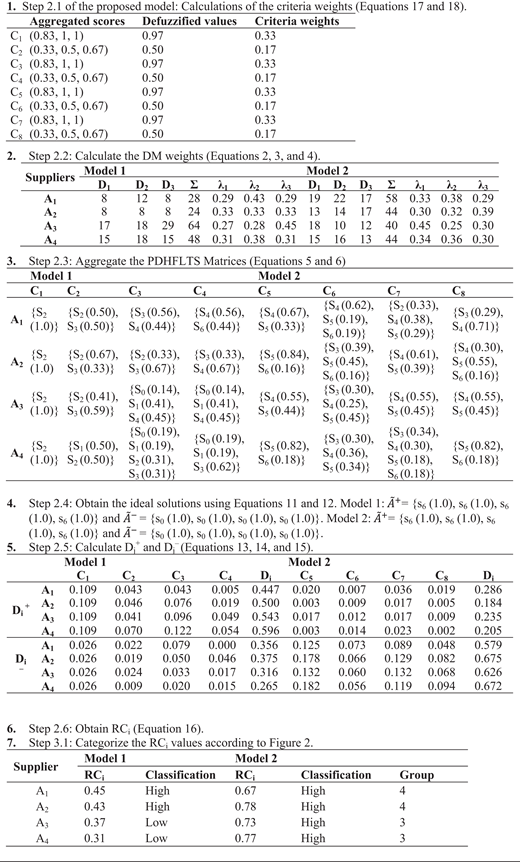
Next, the weights of the DMs for each alternative were calculated using equations (2), (3) and 4. The resulting weights are denoted as λ1, λ2 and λ3 as shown in Table 9. Then, in Step 2.3, we performed the calculation of the individual DM matrices with the possibility distributions using equation (5). The results are presented in Tables 10, 11 and 12. After defining the individual matrices, equation (6) was applied to calculate the aggregated matrix, which resulted in the values exhibited in Table 13.
Calculations of the DM weights based on the degree of consensus
| Suppliers | Model 1 | Model 2 | ||||||||||||
|---|---|---|---|---|---|---|---|---|---|---|---|---|---|---|
| D1 | D2 | D3 | Σ | λ1 | λ2 | λ3 | D1 | D2 | D3 | Σ | λ1 | λ2 | λ3 | |
| A1 | 8 | 12 | 8 | 28 | 0.29 | 0.43 | 0.29 | 19 | 22 | 17 | 58 | 0.33 | 0.38 | 0.29 |
| A2 | 8 | 8 | 8 | 24 | 0.33 | 0.33 | 0.33 | 13 | 14 | 17 | 44 | 0.30 | 0.32 | 0.39 |
| A3 | 17 | 18 | 29 | 64 | 0.27 | 0.28 | 0.45 | 18 | 10 | 12 | 40 | 0.45 | 0.25 | 0.30 |
| A4 | 15 | 18 | 15 | 48 | 0.31 | 0.38 | 0.31 | 15 | 16 | 13 | 44 | 0.34 | 0.36 | 0.30 |
Decision-making matrix with the possibility distribution for DM 1
| Model 1 | Model 2 | |||||||
|---|---|---|---|---|---|---|---|---|
| Suppliers | C1 | C2 | C3 | C4 | C5 | C6 | C7 | C8 |
| A1 | {S2 (1.0)} | {S2 (1.0)} | {S3 (1.0)} | {S4 (1.0)} | {S1 (1.0)} | {S2 (1.0)} | {S4 (1.0)} | {S2 (1.0)} |
| A2 | {S2 (1.0)} | {S2 (1.0)} | {S3 (1.0)} | {S3 (1.0)} | {S1 (1.0)} | {S1 (1.0)} | {S2 (1.0)} | {S2 (1.0)} |
| A3 | {S2 (1.0)} | {S2 (1.0)} | {S5 (1.0)} | {S1 (1.0)} | {S1 (1.0)} | {S1 (1.0)} | {S1 (1.0)} | {S1 (1.0)} |
| A4 | {S2 (1.0)} | {S2 (1.0)} | {S3 (1.0)} | {S2 (1.0)} | {S1 (1.0)} | {S1 (1.0)} | {S3 (1.0)} | {S1 (1.0)} |
Decision-making matrix with the possibility distribution for DM 2
| Model 1 | Model 2 | |||||||
|---|---|---|---|---|---|---|---|---|
| Suppliers | C1 | C2 | C3 | C4 | C5 | C6 | C7 | C8 |
| A1 | {S2 (1.0)} | {S2 (0.5), S2 (0.5)} | {S4 (1.0)} | {S6 (1.0)} | {S4 (1.0)} | {S5 (0.5), S6 (0.5)} | {S4 (1.0)} | {S4 (1.0)} |
| A2 | {S2 (1.0)} | {S2 (1.0)} | {S2 (1.0)} | {S4 (1.0)} | {S5 (0.5), S6 (0.5)} | {S5 (0.5), S6 (0.5)} | {S4 (1.0)} | {S5 (0.5), S6 (0.5)} |
| A3 | {S2 (1.0)} | {S2 (0.5), S3 (0.5)} | {S0 (0.5), S1 (0.5)} | {S0 (0.5), S1 (0.5)} | {S4 (1.0)} | {S4 (1.0)} | {S4 (1.0)} | {S4 (1.0)} |
| A4 | {S2 (1.0)} | {S1 (0.5), S2 (0.5)} | {S0 (0.5), S1 (0.5)} | {S0 (0.5), S1 (0.5)} | {S5 (0.5), S6 (0.5)} | {S4 (1.0)} | {S5 (0.5), S6 (0.5)} | {S5 (0.5), S6 (0.5)} |
Decision-making matrix with the possibility distribution for DM 3
| Model 1 | Model 2 | |||||||
|---|---|---|---|---|---|---|---|---|
| Suppliers | C1 | C2 | C3 | C4 | C5 | C6 | C7 | C8 |
| A1 | {S2 (1.0)} | {S3 (1.0)} | {S3 (1.0)} | {S4 (1.0)} | {S4 (1.0)} | {S4 (1.0)} | {S5 (1.0)} | {S3 (1.0)} |
| A2 | {S2 (1.0)} | {S3 (1.0)} | {S3 (1.0)} | {S4 (1.0)} | {S5 (1.0)} | {S3 (1.0)} | {S5 (1.0)} | {S5 (1.0)} |
| A3 | {S2 (1.0)} | {S3 (1.0)} | {S4 (1.0)} | {S4 (1.0)} | {S4 (1.0)} | {S3 (1.0)} | {S4 (1.0)} | {S4 (1.0)} |
| A4 | {S2 (1.0)} | {S1 (1.0)} | {S2 (1.0)} | {S3 (1.0)} | {S5 (1.0)} | {S3 (1.0)} | {S4 (1.0)} | {S5 (1.0)} |
Aggregated decision-making matrix
| Model 1 | Model 2 | |||||||
|---|---|---|---|---|---|---|---|---|
| Suppliers | C1 | C2 | C3 | C4 | C5 | C6 | C7 | C8 |
| A1 | {S2 (1.0)} | {S2 (0.50), S3 (0.50)} | {S3 (0.56), S4 (0.44)} | {S4 (0.56), S6 (0.44)} | {S4 (0.67), S5 (0.33)} | {S4 (0.62), S5 (0.19), S6 0.19)} | {S2 (0.33), S4 (0.38), S5 (0.29)} | {S3 (0.29), S4 (0.71)} |
| A2 | {S2 (1.0) | {S2 (0.67), S3 (0.33)} | {S2 (0.33), S3 (0.67)} | {S3 (0.33), S4 (0.67)} | {S5 (0.84), S6 (0.16)} | {S3 (0.39), S5 (0.45), S6 (0.16)} | {S4 (0.61), S5 (0.39)} | {S4 (0.30), S5 (0.55), S6 (0.16)} |
| A3 | {S2 (1.0)} | {S2 (0.41), S3 (0.59)} | {S0 (0.14), S1 (0.41), S4 (0.45)} | {S0 (0.14), S1 (0.41), S4 (0.45)} | {S4 (0.55), S5 (0.44)} | {S3 (0.30), S4 (0.25), S5 (0.45)} | {S4 (0.55), S5 (0.45)} | {S4 (0.55), S5 (0.45)} |
| A4 | {S2 (1.0)} | {S1 (0.50), S2 (0.50)} | {S0 (0.19), S1 (0.19), S2 (0.31), S3 (0.31)} | {S0 (0.19), S1 (0.19), S3 (0.62)} | {S5 (0.82), S6 (0.18)} | {S3 (0.30), S4 (0.36), S5 (0.34)} | {S3 (0.34), S4 (0.30), S5 (0.18), S6 (0.18)} | {S5 (0.82), S6 (0.18)} |
In Step 2.4, to obtain the absolute ideal solutions, we defined the value of S6 (1.0) as the PIS and S0 (1.0) as the NIS for each criterion [equations (11) and (12), respectively], because these values represent the extreme ends of the seven possible linguistic terms. The resulting ideal solutions are presented in Table 14.
Positive and negative ideal solutions
| Ideal solutions | C1 | C2 | C3 | C4 | C5 | C6 | C7 | C8 |
|---|---|---|---|---|---|---|---|---|
| PIS | {S6 (1.0)} | {S6 (1.0)} | {S6 (1.0)} | {S6 (1.0)} | {S6 (1.0)} | {S6 (1.0)} | {S6 (1.0)} | {S6 (1.0)} |
| NIS | {S0 (1.0)} | {S0 (1.0)} | {S0 (1.0)} | {S0 (1.0)} | {S0 (1.0)} | {S0 (1.0)} | {S0 (1.0)} | {S0 (1.0)} |
In Step 2.4, through the application of equations (13), (14) and (15), we calculated the values of the distances between the alternative scores and the ideal solutions. Table 15 presents the values of the distance obtained for the separation matrices in relation to the PIS (D+) and NIS (D–).
Positive (D+) and negative (D−) separation matrices
| Model 1 | Model 2 | ||||||||
|---|---|---|---|---|---|---|---|---|---|
| Distance measures | C1 | C2 | C3 | C4 | C5 | C6 | C7 | C8 | |
| D+ | A1 | 0.089 | 0.073 | 0.021 | 0.008 | 0.016 | 0.009 | 0.028 | 0.028 |
| A2 | 0.089 | 0.078 | 0.037 | 0.031 | 0.003 | 0.012 | 0.013 | 0.008 | |
| A3 | 0.089 | 0.070 | 0.046 | 0.081 | 0.014 | 0.016 | 0.013 | 0.013 | |
| A4 | 0.089 | 0.119 | 0.059 | 0.090 | 0.003 | 0.018 | 0.018 | 0.003 | |
| D− | A1 | 0.022 | 0.038 | 0.038 | 0.000 | 0.103 | 0.099 | 0.068 | 0.070 |
| A2 | 0.022 | 0.032 | 0.024 | 0.076 | 0.146 | 0.090 | 0.098 | 0.120 | |
| A3 | 0.022 | 0.041 | 0.016 | 0.028 | 0.108 | 0.081 | 0.100 | 0.100 | |
| A4 | 0.022 | 0.015 | 0.010 | 0.025 | 0.149 | 0.076 | 0.090 | 0.138 | |
In the last step of Stage 2, the final scores referring to each alternative were obtained through the calculation of RCi using equation (16). This procedure generated two RCi values for each alternative, one referring to risk-intensifying factors and the other referring to risk-reducing factors. Table 16 represents the values calculated for RCi, as well as the supplier classification results based on these values. In relation to the risk-reducing factors, we may observe that Supplier A2 presented the highest score and Supplier A1 presented the lowest score. In terms of the intensifying factors, the supplier with the highest score was A2, while A4 presented the lowest one.
RCi values and the classification of the evaluated suppliers
| Risk-intensifying factors (Model 1) | Risk-reducing factors (Model 2) | Group | Degree of risk | |||
|---|---|---|---|---|---|---|
| Suppliers | RCi | Classification (L = 0.4) | RCi | Classification (L = 0.6) | ||
| A1 | 0.42 | High | 0.68 | High | 3 | Intermediate |
| A2 | 0.45 | High | 0.78 | High | 3 | Intermediate |
| A3 | 0.38 | Low | 0.73 | High | 4 | Low |
| A4 | 0.31 | Low | 0.77 | High | 4 | Low |
5.3 Stage 3: supplier classification
In Step 3.1 of Stage 3, based on the results obtained for RCi, the suppliers were classified in the segmentation matrix of Figure 3. To categorize a supplier in the “low risk” group, which is the desirable group, it was necessary to obtain a value for RCi equal to or greater than 0.6 for risk-reducing factors and less than 0.4 for risk-intensifying factors.
Figure 4 presents the results of the supplier classification based on Table 16. Suppliers A1 and A2 were positioned in Quadrant 3, which indicates that they present an intermediate degree of risk. Suppliers A3 and A4 appear in Quadrant 4, which is considered low risk. No supplier appears in Quadrant 1, which represents high supply risk.
 The image shows a scatter plot with two axes labeled as Risk-reducing factors (horizontal) and Risk-intensifying factors (vertical), both ranging from zero to one. The plot is divided into four quadrants, with key labels: (1) High Risk in the top left, (2) Intermediate Risk in the top right, (3) Intermediate Risk in the bottom left, and (4) Low Risk in the bottom right. Points labeled A1, A2, A3, and A4 are positioned within the quadrants, indicated by arrows pointing to their respective coordinates. The layout visually connects the concepts of risk-reducing and risk-intensifying factors, guiding the viewer in understanding their spatial relationship.
Results of the supplier classification in the segmentation matrix
The image shows a scatter plot with two axes labeled as Risk-reducing factors (horizontal) and Risk-intensifying factors (vertical), both ranging from zero to one. The plot is divided into four quadrants, with key labels: (1) High Risk in the top left, (2) Intermediate Risk in the top right, (3) Intermediate Risk in the bottom left, and (4) Low Risk in the bottom right. Points labeled A1, A2, A3, and A4 are positioned within the quadrants, indicated by arrows pointing to their respective coordinates. The layout visually connects the concepts of risk-reducing and risk-intensifying factors, guiding the viewer in understanding their spatial relationship.Results of the supplier classification in the segmentation matrix
The results of the pilot application of the proposed model were presented to the DMs. In terms of the weights of the risk-reducing criteria, the DMs expressed total agreement with the result. In relation to the weights of the risk-intensifying criteria, the team expected that C4 (delivery time) would present the greatest weight followed by C2(import instability). The DMs explained that import instability affects supply in a decisive manner but only affects imported items. Delivery time, on the other hand, affects all supplied items. In terms of import instability, the team of specialists was unanimous that it is of notable importance, especially in recent moments such as the COVID-19 pandemic and the war in Ukraine.
In terms of the profile of supplier risk, the DMs thought that the obtained classification was consistent in terms of risk-intensifying factors as well as risk-reducing factors. It is important to point out that the suppliers analyzed in this study had been supplying the purchasing organization for some time, which makes its acquisitions based on the applicable legislation. Thus, it makes sense that these suppliers were classified in Quadrants 3 and 4, because they already met the minimum requirements for contractors.
Finally, in Step 2.3, the DMs verified that to enhance the supplier risk profile, they needed to reduce the risk intensity factors for suppliers A1 and A2. This can be accomplished by supplier development actions that seek to improve the performance of these suppliers in the criteria of work time (C3) and delivery time (C4), given that they obtained the worst scores in these criteria. Therefore, an improvement in Suppliers A1 and A2 in terms of Criteria C3 and C4 could result in their classification in Quadrant 4.
6. Sensitivity analysis
In the sensitivity analysis tests conducted in this study, changes were made to the weights of all of the criteria, while the scores of the alternatives were not altered. Four scenarios were tested, as described in Table 17. The scale of linguistic terms used in the sensitivity analysis is the same as that used in the application case, which ranges from “Null (N)” to “Absolute (AB).” The scenarios were composed by alternating the judgments of the criteria weights to include only two linguistic values in each scenario. In Scenarios 1 and 2, the weight values “Medium (M)” and “Absolute” were tested, alternating between the criteria. Similarly, in Scenarios 3 and 4, the extreme values of the judgment scale (“Null” and “Absolute”) were used alternately. The evaluations of the considered suppliers were those obtained during the application case, shown in Table 6.
Judgments considered for each DM in the sensitivity analysis
| Computational models | Cj | Scenario 1 | Scenario 2 | Scenario 3 | Scenario 4 |
|---|---|---|---|---|---|
| Model 1 | C1 | (0.83, 1, 1) | (0.33, 0.5, 0.67) | (0.83, 1, 1) | (0, 0, 0.17) |
| C2 | (0.33, 0.5, 0.67) | (0.83, 1, 1) | (0, 0, 0,17) | (0.83, 1, 1) | |
| C3 | (0.83, 1, 1) | (0.33, 0.5, 0.67) | (0.83, 1, 1) | (0, 0, 0.17) | |
| C4 | (0.33, 0.5, 0.67) | (0.83, 1, 1) | (0, 0, 0,17) | (0.83, 1, 1) | |
| Model 2 | C5 | (0.83, 1, 1) | (0.33, 0.5, 0.67) | (0.83, 1, 1) | (0, 0, 0.17) |
| C6 | (0.33, 0.5, 0.67) | (0.83, 1, 1) | (0, 0, 0,17) | (0.83, 1, 1) | |
| C7 | (0.83, 1, 1) | (0.33, 0.5, 0.67) | (0.83, 1, 1) | (0, 0, 0.17) | |
| C8 | (0.33, 0.5, 0.67) | (0.83, 1, 1) | (0, 0, 0,17) | (0.83, 1, 1) |
Table 18 presents the RCi values achieved in the application case and in each of the tested scenarios. In all of the scenarios, there were variations in the RCi values compared to the application case. In Model 1, with the changes in the weights of the criteria related to risk-reducing factors, there was an inversion in the ranking of Suppliers A1 and A2. In Model 2, the RCi values showed less variation compared to the application case, with no inversions occurring. These results are justified by the fact that there is greater variation among the input scores of the suppliers in Model 1. Since the supplier scores are very close to each other in Model 2, the changes in weights altered the RCi values but did not result in ranking inversions.
Sensitivity analysis results (RCi and the ranking of the alternatives)
| Model | Ai | Application case | Scenario 1 | Scenario 2 | Scenario 3 | Scenario 4 | |||||
|---|---|---|---|---|---|---|---|---|---|---|---|
| RCi | Rank | RCi | Rank | RCi | Rank | RCi | Rank | RCi | Rank | ||
| Model 1 | A1 | 0.42 | 2° | 0.45 | 1° | 0.43 | 2° | 0.45 | 1° | 0.41 | 2° |
| A2 | 0.45 | 1° | 0.43 | 2° | 0.46 | 1° | 0.39 | 2° | 0.50 | 1° | |
| A3 | 0.38 | 3° | 0.37 | 3° | 0.39 | 3° | 0.35 | 3° | 0.40 | 3° | |
| A4 | 0.31 | 4° | 0.31 | 4° | 0.30 | 4° | 0.31 | 4° | 0.30 | 4° | |
| Model 2 | A1 | 0.68 | 4° | 0.67 | 4° | 0.68 | 4° | 0.67 | 4° | 0.69 | 4° |
| A2 | 0.78 | 1° | 0.78 | 1° | 0.78 | 1° | 0.79 | 1° | 0.77 | 1° | |
| A3 | 0.73 | 3° | 0.73 | 3° | 0.73 | 3° | 0.74 | 3° | 0.72 | 3° | |
| A4 | 0.77 | 2° | 0.77 | 2° | 0.76 | 2° | 0.77 | 2° | 0.76 | 2° | |
Table 19 compares the results of the sensitivity analysis concerning the categorization in the proposed supplier segmentation matrix. It can be observed that A3, classified in Group 3 in the application case, migrated to Group 4 in Scenario 4. In the other scenarios, there were no changes. Thus, the results of the sensitivity analysis tests indicated that, due to the characteristics of the PDHFLTS-TOPSIS method, changes in the weights of the criteria have less influence on the results than the judgments the DMs assigned to the suppliers. Therefore, the changes in the weights of the criteria led to minor changes in the supplier classification results, highlighting the robustness and consistency of the results.
7. Implications
7.1 Theoretical contributions
The results obtained in this study were compared with previous works that proposed MCDM models for supplier risk assessment (Table 1), with emphasis on the selection of evaluation criteria and methodological approaches. This comparison underscores the theoretical contributions of this study, which may be summarized as follows:
Scalability and usability: Unlike methods such as AHP (Chiu et al., 2024; Öztek and Kabak, 2022; Kull and Talluri, 2008; Ganguly, 2014; Helbig et al., 2016), fuzzy AHP (Saputro et al., 2024; Ganguly and Guin, 2013; Viswanadham and Samvedi, 2013; Ganguly, 2014; El Mokrini et al., 2016) and ANP (Kellner et al., 2019), which are limited by the need for exhaustive pairwise comparisons and consistency checks, the proposed PDHFLTS-TOPSIS model allows for the use of an unrestricted number of criteria and alternatives. It uses a simplified linguistic evaluation scale and minimizes cognitive burden, enabling faster decision-making. These features make it particularly suitable for large-scale or dynamic environments, such as those found in humanitarian logistics operations.
Bidimensional supplier segmentation: By classifying suppliers in a matrix based on risk-intensifying and risk-reducing factors, the model provides a more granular and strategic view than unidimensional ranking approaches. Suppliers with similar overall risk scores can be distinguished based on the nature and source of their risks. This segmentation framework contributes theoretically by linking supplier classification with risk typology, offering a conceptual basis for more targeted supplier development initiatives and contingency strategies tailored to each supplier’s risk profile. This approach allows DMs to identify the source of each supplier’s risk, differentiate suppliers with similar overall scores and implement targeted mitigation and contingency strategies. The model distinguishes between risk-intensifying and risk-reducing factors by organizing them into separate dimensions within the segmentation matrix. Risk-intensifying factors represent characteristics or conditions that increase a supplier’s likelihood of failure or amplify its potential negative impact on the supply chain. By contrast, risk-reducing factors capture attributes or practices that decrease the probability of problems or mitigate their consequences. The model treats these factors through distinct computational streams, scoring each supplier on both dimensions and classifying them as “high” or “low” according to predefined thresholds. While Table 2 presents an illustrative list of criteria, DMs play a central role in assigning new or context-specific criteria to either the intensifying or reducing category, based on their knowledge of supplier performance and organizational priorities.
Handling of uncertainty and hesitation: In contrast to previous models – especially fuzzy models (Saputro et al., 2024; Viswanadham and Samvedi, 2013; Ganguly, 2014; El Mokrini et al., 2016; Ilyas et al., 2021) that typically rely on single-term linguistic inputs – the proposed approach supports the use of multiple linguistic terms and expressions through possibility distributions. This allows for more nuanced modeling of uncertainty and hesitation, reducing information loss and better capturing the degree of confidence in each judgment. It advances the application of HFLTSs by providing a richer representation of DM preferences, surpassing traditional HFLTS-TOPSIS and HFLTS-VIKOR methods.
Consensus-building in GDM: The model introduces a dynamic weighting mechanism that strengthens consensus-building. Instead of assigning equal importance to all DMs, it adjusts weights based on the alignment of each DM’s evaluations with the group consensus. This approach mitigates the influence of outlier opinions, fosters balanced and representative outcomes and supports a more democratic decision process. Theoretically, it contributes by embedding structured consensus building into MCDM, which is notably absent in the earlier models listed in Table 1.
Finally, it is important to note that the most frequently adopted criteria in prior studies (Table 1) are cost, quality, delivery, reliability and technology. In this study, cost (C2) and delivery time (C4) were also prioritized by the DMs, indicating alignment with the literature. Furthermore, the study corroborates findings from systematic reviews of MCDM applications in HASCs (Alturki and Lee, 2024), particularly regarding the cost, delivery, availability and reliability dimensions (including factors such as import instability and contract stability).
7.2 Practical implications
The proposed PDHFLTS-TOPSIS model addresses the complex and dynamic risk landscape typical of HASCs by integrating the capabilities of a decision-making framework with advanced linguistic modeling tools. In environments where suppliers face operational, financial, logistical and geopolitical risks, DMs often lack precise or consistent data to support quantitative evaluation. The model overcomes these constraints by using possibility distributions associated with HFLTSs, allowing DMs to express varying degrees of confidence and hesitation. This feature minimizes information loss and supports a more faithful representation of uncertainty, enabling a realistic assessment of suppliers’ exposure to disruptions such as delivery delays, import instability or capacity shortages.
Furthermore, by combining the strengths of MCDM and group decision-making, the model enables the integration of multiple risk dimensions into a single, coherent analytical structure. The dynamic weighting mechanism enhances the group decision process by assigning greater influence to experts whose judgments are more aligned with the collective consensus, thereby balancing diverse viewpoints and improving the representativeness of the final evaluation. The bidimensional supplier segmentation matrix transforms the results into actionable insights for supplier prioritization and development. Together, these features provide a practical means of translating heterogeneous and uncertain information into transparent, consensus-driven decisions, ultimately improving the agility and coordination of supplier management in HASCs.
The adoption of the proposed supplier risk assessment model introduces a range of managerial implications. The following topics outline key considerations for effective implementation and contextual adaptation, including applications in HASCs:
Organizational adaptation for implementation: The successful deployment of the proposed model requires organizations to establish structured internal protocols for identifying relevant supplier risk criteria, which may vary across industries or operational units. DMs must be adequately trained in the use of HFLTSs and the interpretation of possibility distributions, since these tools signify a conceptual departure from traditional deterministic evaluation methods toward more flexible, ambiguity-tolerant frameworks. Accordingly, companies should consider investing in awareness programs and technical training to promote the consistent application of these novel assessment tools. Training programs should include hands-on exercises in linguistic expression assignment, aggregation of hesitant judgments and sensitivity analysis to ensure DMs can effectively evaluate supplier risk under uncertainty.
Integration into routine processes and systems: To ensure its sustainable adoption, the model should be incorporated into existing supplier evaluation routines and decision-making frameworks. While initial deployment may be supported by spreadsheet-based tools for low-cost implementation, long-term effectiveness will likely depend on the development or customization of integrated digital systems. The model can be implemented using platforms such as Python, or similar programming languages that support numerical computation. Such tools facilitate real-time updates, alignment with procurement cycles and support continuous monitoring, ultimately institutionalizing risk-aware supplier management practices. Moreover, the computational system should be capable of storing historical evaluations, tracking changes in criteria weights and generating reports to support audit and decision traceability. Integration with enterprise resource planning (ERP) or supply chain management software can further enhance usability and allow automated alerts when supplier performance deviates from predefined risk thresholds.
Cultural and strategic implications for decision-making: The integration of consensus-based evaluations into supplier risk assessments may necessitate a cultural transformation toward more collaborative and transparent decision-making. Managers should adapt to frameworks in which individual judgments are aggregated and weighted through group consensus, potentially challenging hierarchical norms. However, this shift can enhance collective accountability and foster stronger strategic alignment across departments such as procurement, logistics and compliance. Clear guidelines on role responsibilities and weight adjustments can further enhance transparency and foster trust in the decision-making process. Effectively leveraging the model also requires strong human capabilities, including analytical skills to interpret linguistic and hesitant data, as well as collaborative skills to participate in consensus-building. Moreover, personnel responsible for supplier evaluation must have a solid understanding of humanitarian operational constraints, logistics bottlenecks and supplier capabilities in crisis scenarios. Scenario-based training and simulations can strengthen these competencies, ensuring that DMs accurately interpret model outputs and make informed decisions.
Implications for HASCs: HASCs often operate in environments marked by political instability, infrastructure breakdowns and rapidly changing conditions, which contribute to high levels of uncertainty and limited access to complete, reliable information. In this context, the use of PDHFLTSs provides a key advantage by allowing DMs to express and aggregate uncertain judgments, supporting more realistic and adaptive risk assessments. Moreover, HASCs typically involve multiple stakeholders (such as NGOs, governmental bodies, local actors and donors) with differing objectives and knowledge bases. The model’s consensus-driven approach facilitates the alignment of these diverse perspectives, promoting transparency, inclusiveness and shared accountability in supplier risk evaluation in complex humanitarian contexts. Practically, this requires equipping teams with decision-support software that can simultaneously manage multiple DM inputs, visualize aggregated risk profiles and perform sensitivity analyses. This setup enhances decision-making capabilities and ensures accurate interpretation of model outputs.
Adaptations to contexts with a large number of suppliers and dynamic environments: The proposed model may require adaptations to handle a large number of suppliers, which would demand greater computational capacity. Moreover, in such cases, refining the selection of criteria is essential to avoid a time-consuming data collection process, since the number of judgments (J) required from each DM is highly dependent on the number of criteria (J = Cm + Am * Cm; where Cm is the number of criteria and Am is the number of suppliers). In addition, in rapidly changing environments, frequent data updates and regular reviews of the selected criteria and their assigned weights are crucial to ensuring the continued validity of the analysis.
8. Conclusion
This study proposes a model for supplier risk assessment based on the PDHFLTS-TOPSIS method. The application case and sensitivity analysis confirm the model’s robustness and practical feasibility. Its flexibility allows for its replication across organizations in manufacturing, services and the nonprofit sector, regardless of size. The segmentation matrix can be customized according to organizational policies or specific contracting frameworks. Threshold values may be adjusted to align with sectoral regulations and operational priorities.
The proposed model makes the following genuine contributions to the literature and practice of supplier risk management:
It facilitates GDM under conditions of uncertainty and hesitation through the use of comparative linguistic expressions, thereby enhancing the expressiveness and realism of the analysis in contexts lacking precise quantitative data.
It uses possibility distributions to capture the degree of hesitation inherent in linguistic assessments, reducing information loss and offering a more comprehensive depiction of uncertainty and hesitation than traditional fuzzy and hesitant fuzzy approaches.
It introduces a supplier segmentation matrix based on risk-reducing and risk-intensifying factors. This approach enables more nuanced strategic decisions by differentiating suppliers that may have similar overall risk scores but diverge significantly in the nature, source and controllability of their risks.
It embeds a dynamic weighting mechanism to facilitate structured consensus building in GDM. Rather than assuming equal influence, the model increases the weight of DMs whose judgments are more closely aligned with the group, promoting convergence and enhancing the representativeness of the collective decision.
However, the model also has limitations:
Although it accommodates hesitation in alternative evaluation, it does not yet support hesitation in the weighting of criteria.
It does not support the analysis of interrelationships among risk factors, which may limit its ability to capture complex causal relationships.
The list of criteria used for risk assessment is illustrative but not exhaustive and may require adaptation to specific industries or supply chain configurations to ensure comprehensive risk coverage.
Scalability may become a concern in very large or highly dynamic supply chains, as the number of evaluations required from DMs increases with the number of criteria and suppliers.
The model’s reliance on expert judgments means that the quality and consistency of assessments depend heavily on the expertise, availability and alignment of participating DMs.
In rapidly changing operational environments, frequent updates to criteria, weights and supplier data may be necessary to maintain the validity and relevance of the analysis, highlighting the need for ongoing monitoring and adaptation.
Future research can focus on the following key areas to further enhance the applicability and robustness of the proposed model:
Integration with complementary decision-making techniques: The model can be combined with the HFLS-QFD method to address hesitation in the weighting of criteria. To further facilitate the identification and analysis of interdependencies among risk factors, future studies can consider integrating it with other MCDM methods, such as ANP, DEMATEL or fuzzy cognitive maps. These hybrid approaches would thereby contributing to a more comprehensive understanding of complex risk environments.
Extension to additional risk categories: The model can be adapted to assess other forms of organizational risk, such as operational, environmental and reputational risks. In these contexts, DMs can customize the evaluation criteria to better reflect the specific requirements and contextual nuances of their organizations.
Finally, we suggest further research regarding the development of new models based on the PDHFLTS-TOPSIS approach to address prioritization and selection problems in HASCs. Potential applications include the prioritization of infrastructure recovery projects, the selection of delivery strategies and the ranking of modes of transport in emergency response operations.
Acknowledgments
The authors would like to thank the employees of the company where the application took place.
Author contributions
conceptualization, M.C. Nascimento and F.R. Lima-Junior; methodology, M.C. Nascimento, F.R. Lima-Junior and I.M. Beleski; formal analysis, M.C. Nascimento and F.R. Lima-Junior; investigation, M.C. Nascimento; software, M.C. Nascimento and I.M. Beleski; data curation, M.C. Nascimento, I.M. Beleski and F.R. Lima-Junior; writing – original draft preparation, M.C. Nascimento and F.R. Lima-Junior; writing – review and editing, F.R. Lima-Junior; visualization, M.C. Nascimento and F.R. Lima-Junior; supervision, F.R. Lima-Junior; Funding Acquisition, F.R. Lima-Junior.
References
Appendix
 The image illustrates a framework for applying a supplier risk assessment process structured in two distinct phases. The first phase involves selecting and assessing criteria, with spaces labelled C1, C2, and Cm for criteria input, alongside three columns for decision makers (DM1, DM2, DM3) to evaluate the relative importance of each criterion. The second phase focuses on assessing suppliers, represented as A1, A2, and An, across the chosen criteria, with designated columns for C1 through Cm. The layout consists entirely of blank spaces for user input, with no bolded or merged
DM judgment collection form
The image illustrates a framework for applying a supplier risk assessment process structured in two distinct phases. The first phase involves selecting and assessing criteria, with spaces labelled C1, C2, and Cm for criteria input, alongside three columns for decision makers (DM1, DM2, DM3) to evaluate the relative importance of each criterion. The second phase focuses on assessing suppliers, represented as A1, A2, and An, across the chosen criteria, with designated columns for C1 through Cm. The layout consists entirely of blank spaces for user input, with no bolded or mergedDM judgment collection form