


This study examined how youth would mitigate non-medical use of prescription medication among their peers.
The National Monitoring of Adolescent Prescription Stimulants Study (N-MAPSS) was conducted as an interview comprising 11,048 youth of 10–18 years of age between 2008 and 2011 from entertainment venues of 10 US urban, suburban, and rural areas. Using a mixed-methods approach, participants completed a survey culminating in open-ended questions asking: (1) How should kids your age be informed about prescription drugs and their effects? (2) If you ran the world, how would you stop kids from taking other people’s prescription medicines? (3) Why do people use prescription stimulants without a prescription? Responses from a random sample of 900 children were analyzed using qualitative thematic analyses.
The random sample of 900 youth (52 percent female, 40 percent white, with a mean age of 15.1 years) believed they should be educated about prescription drugs and their negative effects at schools, at home by parents, through the media, and health professionals. Youth would stop kids from using other people’s prescription drugs through more stringent laws that restricted use, and providing education about negative consequences of use. Peer pressure was the most common reason the youth gave for using other’s pills, though some reported taking them out of curiosity.
The importance of considering youth’s opinions on non-medical use of prescription medications is often overlooked. This evidence, from a peer perspective, could end the illicit use of prescription drugs among today’s youth.
Introduction
In the USA, substance abuse by youth continues to be a public health concern even though rates of substance abuse among youth have declined over the past 20 years [1]. Some of the most commonly used substances among youth are alcohol and tobacco, followed by marijuana [2, 3]. Studies report that between 20 and 35 percent of youth used alcohol in the past 30 days [4–6], while approximately 25 percent used tobacco in the past 30 days [7], and nearly 22 percent of 12th graders used marijuana in the past 30 days [8]. Additionally, the type of substance used differs by age group and gender among youth. Younger teens are more likely to use substances they can inhale compared to older teens who are more likely to take non-medical use prescription medications [2]. In addition, even though males are more likely to use prescription medications compared to females, females aged 12–17 are more likely to use prescription medications non-medically when compared to males [9–11].
Non-medical use is commonly defined as using a prescription drug that was not prescribed for you, taking medication in a manner or dose other than prescribed, or taking a medication to get a feeling of euphoria [12, 13]. The classes of prescription drugs that are typically used non-medically include stimulants, opioids, and sedatives [1]. Youth are sometimes prescribed these medications by a physician, but may also access and use prescriptions non-medically from their family’s medicine cabinet [14]. In the USA, the National Survey on Drug Use and Health (NSDUH) reports that 5.9 percent of youth used a prescription drug that was not prescribed to them in the past 30 days [15]. Non-medical use of prescription drugs among youth is especially problematic due to the critical period of development in adolescents during this time; youth are at high risk for experimentation and addiction. Further, youth may perceive prescription medications as less harmful compared to other drugs [16], even though they can cause serious side effects. For example, stimulants can cause paranoia and an irregular heartbeat while opioids can cause drowsiness and nausea; depressants can cause slurred speech and shallow breathing [17]. Non-medical use of prescription medications among youth is not only harmful for the development of the adolescent brain and body but also has social consequences that may include delinquency [18], school dropout [19], abuse and subsequent dependence [20, 21].
There are many factors contributing to the non-medical use of prescription drugs among youth. Established characteristics include being female [19, 22] and Caucasian [19, 23]. Use has been found to increase with age [22]. Individual risk factors such as deviant [24] and sensation-seeking behaviors [25], and peer influence [26] are two of the main reasons why youth initiate the use of prescription drugs non-medically. Other risk factors include previous medical use of prescription drugs [22], availability [27], and urbanicity [28]. In addition to these risk factors, there are protective factors for non-medical use of prescription drugs including parental monitoring [29] and academic achievement [19].
The USA utilizes multiple national surveys to equip researchers to better understand the use of prescription drugs among youth including trends and changes over time, and implementation of interventions. National surveys such as Monitoring the Future (MTF), funded by the National Institute on Drug Abuse (NIDA), have assessed substance use and related attitudes among youth nationwide since 1975. The Youth Risk Behavior Surveillance System (YRBSS) used by the Centers for Disease Control and Prevention (CDC) tracks tobacco, alcohol, and other drugs used among youth. Further, the NSDUH conducted by the Substance Abuse and Mental Health Services Administration (SAMHSA), includes information regarding trends in the use of alcohol, tobacco, and various types of drugs from individuals aged 12 years or older. In addition, school-based programs including the Drug Abuse Resistance Education (DARE) program has been implemented to educate youth on the harms of drug use and to prevent the initiation of drug use. Other national representative studies such as the National Monitoring of Adolescent Prescription Stimulants Study (N-MAPSS) have been used to examine signals for non-medical use of stimulants and other drugs. Results from the N-MAPSS show that approximately 4 percent of youth reported prescription stimulant non-medical use in the past 30 days [30] and 3 percent used prescription opioids non-medically in the past 30 days [11]. The prevalence of other substance use has also been examined in this dataset. Though many of the national surveys described above assess data that are necessary to understand prescription drug use among youth, the N-MAPSS also included open-ended questions to probe youth on their opinions on why people use prescription drugs non-medically, how to educate, and how to stop kids from using prescription drugs non-medically.
Our aims were to: examine perceptions of prescription drugs, their effects, and ideas on how youth would stop non-medical use of prescription medications among their peers. The aims of this study were addressed with the following questions on the survey: (1) How should kids your age be told about prescription drugs and their effects?; (2) If you ran the world, how would you stop kids from taking other people’s prescription medicines?; and (3) Why do people use prescription stimulants without a prescription? We hypothesized that helpful themes would emerge on how the youth of different ages perceived prescription drugs, their effects, and ideas on how to stop non-medical use among them and their peers.
Methods
Study design
The N-MAPSS was a national study conducted between 2008 and 2011 in four waves. The cross-sectional study design assessed medical and non-medical use of prescription drugs (stimulants, opioids, etc.). Participants were eligible for this study if they were between the ages of 10 and 18 years and resided in Seattle, Los Angeles, Denver, St. Louis, Houston, Cincinnati, Tampa, Philadelphia, New York, or Boston; these cities and their surrounding areas were representative of urban, suburban, and rural areas. Exclusion criteria included non-English readers, those enrolled in college, and those who could not identify their zip code. Participants were recruited from local entertainment and other venues (i.e., parks, movie theaters, shopping malls, sports, and recreation centers) in the 10 sites listed above from across the USA. This venue intercept method allowed the N-MAPSS to recruit a representative sample of youth with recruitment goals including urban, suburban, and rural areas to ensure participation from youth in all areas. The N-MAPSS included a representative sample distribution that was comparable to US Census data. Detailed methodological information including the categorization of urban, suburban, and rural areas is published elsewhere [30].
During the four waves, 21,444 youth were approached. Of 16,143 potentially eligible youth who agreed to hear about the study, 3,403 (21 percent) were ineligible (not between 10 and 18 years old and resided outside of an urban, suburban, or rural zip code of one of ten cities). Of the 12,740 eligible youth, 1,272 (10 percent) who were approached decided they were not interested in hearing more about the study and 420 (3 percent) did not complete the survey. The total sample size included 11,048 youth who completed the survey. Participants aged 10–11 years of age were offered the opportunity to be interviewed in the survey in order to reduce problems with reading and comprehension. This study was approved in 2008 by the Human Research Protection Office at Washington University in St. Louis. Implied assent was obtained. Parental permission was removed as a requirement of the study by Washington University since all survey data were anonymous. The study PI moved to the University of Florida in 2011 and the Humans Studies Office at that location also approved the study.
Measurements
The youth completed a paper survey, including questions about prescription medications presented with pictures of these medications for ease of identification. At the end of the survey, a mixed-methods approach was used to ask youth to respond to three open-ended questions on ideas about how to educate peers about prescription drugs, how to stop people from using prescription drugs, and why people use prescription drugs that do not belong to them [31–33]. Specifically, we asked three open-ended questions: (1) “How should kids your age be told about prescription drugs and their effects? (2) If you ran the world, how would you stop kids from taking other people’s prescription medicines? (3) Why do people use prescription stimulants without a prescription?” Responses to these questions were typically between three to five words long.
Demographic characteristics of interest captured through questionnaire items included gender (male or female), age (10–18), race and ethnicity (Alaskan Native/Eskimo, American Indian, Asian or Asian-American, Black or African-American, Middle Eastern, Pacific Islander, White/Euro-American/Caucasian, biracial or multiracial), school grade enrolled in currently or most recently completed (grades 3 through 12), and urbanicity. The drug use items reported on in these analyses included prescription stimulant use (past 30-day use, yes/no) and marijuana use (lifetime use, yes/no).
Data analysis
Because a sample of 11,048 youth would be difficult to analyze for this mixed-methods effort, we establish emerging trends, themes, and categories by generating a sample of 100 youth (300 observations) and coding data using two team members “to think without distraction” [34]. Inconsistencies between coders were discussed and recoded and the required saturation was met.
Then, a random sample of 900 youth was generated (2,700 observations) from the sample of 11,048 youth, using the proc survey select statement in SAS and weighted to fit the age distribution of the larger quantitative study. The full N-MAPSS data set comprised 13 percent of 10–12 years (n = 1,436), 40 percent of 13–15 years (n = 4,419), and 47 percent of 16–18 years (n = 5,193). The generated sample of 900 youth was weighted as described above to choose 115 participants aged 10–12 years, 357 participants aged 13–15 years, and 428 participants aged 16–18 years. Survey responses were coded using the original themes that were identified by the two coders; more than one theme was allowed to be coded per response. Frequencies for demographic characteristics were tabulated in SAS [35].
Results
Among the entire N-MAPSS sample (n = 11,048), 52 percent were female, 43 percent white, 48 percent resided in urban communities and the mean age was 15.1 years. As expected, demographics for the 900 youth randomized for these qualitative questions were similar with 52 percent female, 40 percent white, and 48 percent residing in urban communities with the same mean age (Table I). The themes that emerged for each qualitative question were determined by the coders and are outlined in Figure 1.
Baseline characteristics of N-MAPSS youth randomized by age group (n = 900)
| Characteristic | Entire sample (n = 11,048) N (%) | Sub-sample (n = 900) N (%) | Group 1 (10–12yrs) (n = 115) N (%) | Group 2 (13–15 yrs) (n = 357) N (%) | Group 3 (16–18 yrs) (n = 428) N (%) |
|---|---|---|---|---|---|
| Mean age, years (SD) | 15.2 (2.1) | 15.1 (2.1) | 11.21 (0.8) | 14.11 (0.8) | 16.9 (0.8) |
| Sex, % female | 5,762 (52.2) | 469 (52.1) | 60 (52.2) | 159 (53.0) | 226 (52.8) |
| Race, % white | 4,715 (42.9) | 356 (39.8) | 37 (32.7) | 204 (57.1) | 173 (40.6) |
| Education | 3,218 (29.2) | 253 (28.1) | 115 (100.0) | 158 (44.3) | 1 (0.2) |
| Grade 3–8 Grade 9–12 | 7,830 (70.0) | 647 (71.9) | 0 (0.0) | 199 (55.7) | 427 (99.8) |
| Urbanicity | 5,256 (47.6) | 432 (48.0) | 55 (47.8) | 178 (49.9) | 206 (48.1) |
| Stimulant use (past 30 days) | 1,371 (12.4) | 99 (11.0) | 12 (10.4) | 38 (10.6) | 63 (14.7) |
| Marijuana use (lifetime) | 3,320 (29.1) | 263 (29.5) | 4 (3.5) | 69 (19.3) | 196 (45.8) |
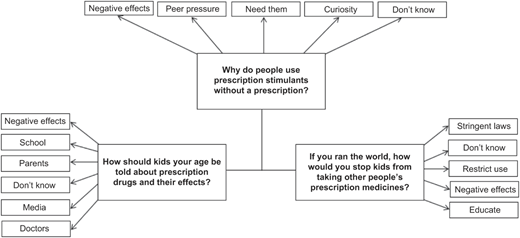
Diagram representing the themes that emerged for each of three qualitative questions
Diagram representing the themes that emerged for each of three qualitative questions
How should kids your age be told about prescription drugs and their effects?
When youth were asked how they should be educated about prescription drugs and their effects, the top 3 themes that emerged included negative effects, school, and parents (Figure 2). Many youths (n = 297; 33 percent) believed children should be told about the negative effects of prescription drug use, saying “they should be told how bad they are for your health” and “that they are dangerous and taking them with recreational goals can lead to death.” It was also believed that users should relate their personal narratives to educate kids about the negative consequences related to use. For example, one youth suggested, “I think by having speakers come and talk about their personal use is very effective.” The second-largest theme to emerge (n = 276; 31 percent) was school and teacher sources as a means of education. For example, “teachers in health class” and “school assemblies” were examples of the common responses. After schools, parents/guardians were the third largest medium of recommended education mentioned (n = 165; 18 percent). The youth believed parents or caretakers should be the ones to educate kids on prescription drugs and their effects. Common responses included “by parents starting from a young age.” The school was a more common theme amongst the older age groups while parents were a more common theme among the younger age group (10–12 year-olds).
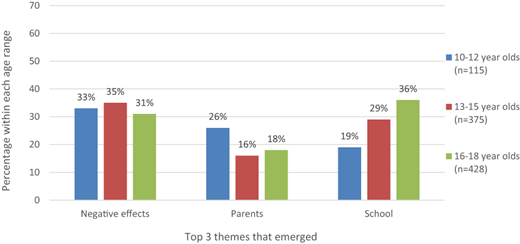
How should kids your age be told about prescription drugs and their effects?
How should kids your age be told about prescription drugs and their effects?
The remaining themes that are not included in Figure 2 included not knowing how to educate kids on prescription drug use (n = 117; 13 percent) with common responses including “I really don’t know” or simply “just don’t use them.” Another theme that emerged was media advertising (n = 101; 11 percent) such as “a television through commercials” because kids watch and listen to television and the radio. The remaining theme was through health professionals (n = 87; 10 percent) such as doctors or prescribers.
If you ran the world, how would you stop kids from taking other people’s prescription medicines?
When youth were asked this question, the three most common themes to emerge included restricting use, enforcing more stringent laws, and not knowing how (Figure 3). The most common theme was to implement more stringent laws. These youth (n = 240; 27 percent) believed creating laws and punishments if laws were broken would help stop the use of other people’s prescription drugs. Some suggested examples include “put them in juvie (detention center or court for juvenile offenders)” and “make a law against it.” Many youths (n = 237; 26 percent) did not know how to stop kids from taking other’s prescription drug and this was the second most common theme. Responses included “I honestly don’t know” and “I’m not sure. That’d be the least of my worries if I ruled the world.” The third-largest theme to emerge was the restriction of prescription drugs (n = 228; 25 percent); youth suggested banning prescription drugs all together: “they wouldn’t exist” and “I would take them away from everyone.” Others also suggested that implementing security measures would help reduce prescription drug use. Some of these responses included “put a lock on the bottle with a combo,” “make sure every pill is tracked,” and “make them go to the store and buy 1 for each day.” When youth were stratified by age, restricting use was the most common theme among 10–12-year olds while implementing stringent laws was most common among 13–15-year olds.
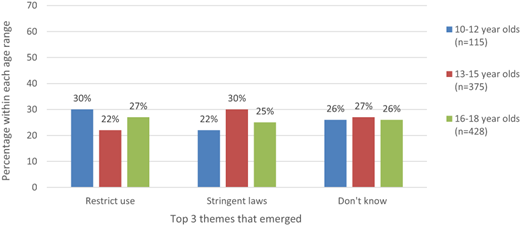
If you ran the world, how would you stop kids from taking other people’s prescription medicines?
If you ran the world, how would you stop kids from taking other people’s prescription medicines?
After restricting use, discussing negative consequences was the most common theme (not included in Figure 3). These youth (n = 151; 17 percent) believed children should be told about the negative consequences related to using prescription drugs that do not belong to them. Responses included stating “how bad the drug is and what it may cause” and stating that they would “show them the long-term mental health effects.” The remaining youth (n = 51) believed education was the way to stop kids from using prescription drugs. Responses included “by educating kids on the hazards of these medicines” or “reduce use by increasing awareness throughout the world.”
Why do people use prescription stimulants without a prescription?
Lastly, when youth were asked this question, the top responses included, “because of the effects” and “peer pressure”. The “effects” response was the most common theme regardless of age (n = 538; 60 percent); the rate of this response increased with age (Figure 4). The youth believed stimulant use without a prescription was due to the good feelings that prescription stimulants can cause and common responses included “to get high” and “feel better” and the effects from use would “make them happy and relieve their pain” or help them “forget their problems.” The second-largest theme to emerge was use by peer pressure. Youth who mentioned this (n = 136; 15 percent) thought people used prescription stimulants without a prescription in order to fit in with others around them. Common responses included “to look good in front of friends” and “peer pressure.” The peer pressure response decreased with age.
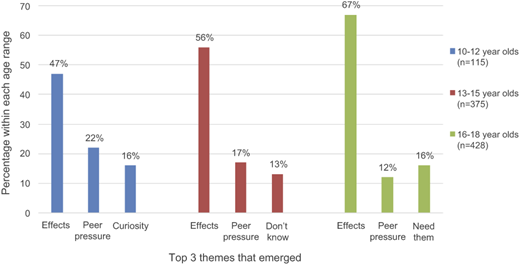
Why do people use prescription stimulants without a prescription?
Why do people use prescription stimulants without a prescription?
The remaining youth (n = 111; 12 percent) believed individuals could not afford prescription stimulants but needed them. Some responded with “they probably can’t afford it but need it,” or “maybe because they don’t have insurance.” Others answered that they did not know why youth used prescription stimulants without prescriptions (n = 90; 10 percent). Finally, some (n = 83; 9 percent) believed that those who used prescription stimulants without a prescription were curious and were experimenting because they had never tried it before. These youth commonly responded with “just being curious” or “because they don’t know what it does.”
Discussion
Among a sample comprising over 11,000 youth, we assessed perceptions of prescription drug use and ways these youth would stop the non-medical use of prescription drugs. The youth believed they should be educated about the negative effects related to prescription drug use, that education efforts should be included in their formal education at school or that they should be informed through their parents. Parental education was a more common theme among younger children 10–12 years, while school education was a more common theme among older children 16–18 years of age. These results suggest that education efforts for prescription drugs may need to be delivered through different sources depending on youth age groups. Parents may have a greater influence on younger children, who expect their parents to educate them on prescription drugs, while formal education in schools may have a greater influence on older children and adolescents.
Additionally, if youth ruled the world, they would stop kids from taking other people’s prescription drugs by implementing more stringent laws. Differences emerged by age groups, where restricting use was the most common theme among those aged 10–12 years of age. Implementing stringent laws was more common among 13–15 year-olds. This suggests that strategies restricting access to other people’s prescription drugs may have a greater influence on younger children, who believe this would be effective. Conversely, older children and adolescents appear to be more motivated by legal consequences and the threat of punishment.
Interestingly, we found that youth, regardless of age, most commonly believed the main motivation for non-medical use of prescription stimulants was for their psychoactive effects. It was the most common belief among 16–18-year olds (67 percent) compared to every other answer they gave, as well as the younger cohorts. This may be potentially related to the increasing pressure to perform academically. Previous studies have found an association between prescription stimulant use and cognitive enhancement among college students [36–38]. In our study, the motivation for peer pressure decreased with age. The youngest youths (10–12 year-olds) believed non-medical use was due to peer pressure more frequently compared to older youths. Other studies have found substance use is often influenced by social networks and factors such as peer pressure [39–42]. These findings suggest that motivations for non-medical use of prescription stimulants may change as adolescents mature.
The sampling technique used in the N-MAPSS resulted in prevalence rates of prescription drug use among youth that were similar to those found by traditional national surveys. In the last few decades, national surveys have examined prescription drug use among youth using quantitative surveys. In addition, some qualitative studies have used a focus group approach to gain a better understanding of attitudes and perceptions on substance use [43, 44]. Uniquely, the N-MAPSS not only surveyed youth about their own use but also used a mixed-methods approach to assess perspectives of youth on how to stop non-medical use of prescription drugs. Though surveys such as these are an integral part of monitoring prescription drug use among youth, supplementing measures with qualitative data can help to understand the opinions and concerns of youth regarding prescription drugs. Results from studies like the N-MAPSS, which include both quantitative and qualitative measures, can be used to better understand the non-medical use of prescription drugs among youth and to find possible interventions to reduce such use [31–33].
We had the opportunity to analyze qualitative questions embedded in a larger quantitative study to get a better understanding of prescription drug use among youth. Results from this study are most relevant in today’s epidemic. Previous nation-wide prevention programs such as the D.A.R.E. program have been shown not to be effective in the long term. In fact, literature has shown that D.A.R.E. was minimally effective [45, 46] and during a five year follow-up period, no significant differences were observed between intervention and comparison schools [47]. More recently, D.A.R.E. has revised its curriculum to include decision-making skills and social competence. Preliminary results from the revised curriculum have shown higher efficacy in preventing substance use [48]. Integrating perspectives from youth, such as the results from this current study, and teaching youth social skills into future prevention programs that target the prevention of drug use among youth may be a more effective prevention strategy. Assumptions by adults about non-medical use among youth can be avoided with this approach and resources can be directed to the most appropriate settings. For instance, integrated education efforts from multiple outlets including the media and doctor visits may be more effective than efforts delivered solely within a school setting. Using parental-based education efforts amongst younger children and then gradually increasing school-based efforts as children get older may also be an effective approach, based on our results.
Some limitations of the data include the cross-sectional nature of the study, meaning that cohort changes over time cannot be examined. Data were also self-reported, which could lead to under-reporting of comments on the questions, to begin with. In addition, age differences were not empirically tested. However, these preliminary analyses examined through a mixed-methods approach have highlighted thematic differences by age among youth that need to be further examined. Gender differences and thematic differences that may emerge between youth who use and don’t use prescription drugs non-medically should also be further examined. It should be noted that the data collected covers a broad time period (2008–2011) and may not reflect current prescription drug practices. However, the qualitative information ascertained from the youth can be translated for interventional purposes regarding the mitigation of non-medical use of prescription medications among their peers and these ideas can then transcend time.
This study had many strengths in addition to using mixed methods to better understand youth and their perspectives on prescription drug use. The questions analyzed were open-ended and responses were clear and unambiguous allowing easy identification of themes. Also, the entertainment venue methodology was successful, with only 10 percent of participants declining to participate, allowing recruitment of a large data set of youth in a short period. Age, sex, race, and composition of urban and rural areas of this sample in the N-MAPSS were also comparable to the 2010 US Census data.
Overall, the themes we observed in this study varied and helped identify some useful guidelines for moving forward. For example, younger children appear to have different views and suggestions compared to those of older adolescents. This suggests that different targeted approaches by age group would be useful to study, considering the themes identified when asking about education, prevention, and motivation. Strategies may be more effective if designed based on the opinions of the youth themselves, rather than the preconceived ideas of adults about the opinions of youth.
Conclusion
Though many national surveys quantify trends and changes in the prevalence of prescription drug use among youth, no study so far has directly asked youth about their perceptions regarding their ideas on prescription drugs and how they would prevent non-medical use. This current analysis uses qualitative methods to examine prescription drug use among youth and obtain their insight on future prevention strategies of non-medical use. These results suggest that further research among this age population should focus on prevention strategies more central to the youth, without making assumptions about drug use behavior.
Funding: Shire Development LLC and Noven Therapeutics and the University of Florida Substance Abuse Training Center in Public Health T32DA035167.

