


Sharjah is the United Arab Emirates' (UAE) third largest city and third highest waste producer (9.9% of ˜26 million in 2012). A total of about ˜$1bn has been invested into programs pursuing zero-landfill waste by 100% recycling. Besides infrastructure, assessing knowledge, attitudes and practices (KAP) are needed for effective waste management. The purpose of this study is to examine recycling KAP in Sharjah.
A cross-sectional study, using pilot-tested questionnaires, was conducted among public venues during March and April 2016. A total of 400 residents (18–55 years) were selected via convenience sampling. SPSS-22 was used for analysis.
Mean age [28 years (±9.4)] with 56.5% females. Knowledge level [51.8% (±18.1)]; students reported the highest (53.7%, p = 0.007, 95% CI [51.4–56.1]). 22.9% knew recycling benefits, 31.2% knew how to correctly prepare items. Attitude level 92.6% (±16.5); 51.1% and 46.8% would recycle more with a financial reward or penalty, respectively. 70.4% reported practicing recycling; 16.0% always recycle. Logistic regression model indicated knowledge (OR = 1.013, 95% CI [1.001–1.025]) and attitude (OR = 1.014, 95% CI [1.001–1.028]) as the only significant predictors of recycling practice.
This is the first study measuring recycling KAP in the UAE. Results could be starting points for improved local waste management and subsequently reduced public health concerns.
Introduction
Environmental problems, especially man-made pollution, have demanded our attention worldwide. The activities of people result in waste, and the way this waste is handled, stored, collected and disposed of can have adverse effects on the environment and global public health [1]. The waste management sector is facing a plethora of challenges on a global scale; as a consequence of moving toward an urban future, the rate of production of municipal solid waste (MSW) is rapidly surpassing the rate of urbanization. It is estimated that currently, about 3 billion residents are producing 1.3 billion tonnes of MSW per year. A further increase is anticipated by 2025 to 4.3 billion urban residents producing about 2.2 billion tonnes of MSW per year [2]. Currently, many countries worldwide are adopting environmentally friendly approaches to resist these challenges and problems related to municipal solid waste. These are mainly focused on integrated waste management: reduction, reuse and recycling of waste materials [3].
Sharjah is the third largest city in the United Arab Emirates (UAE) and is also the third highest waste producer with a total of 9.9% out of the ≈26 million tonnes of waste generated in the UAE in 2012. Bee'ah, an environmental management company based in Sharjah, has invested over USD 1bn in recycling facilities aiming to make Sharjah the first Arab city to achieve zero landfill waste by 100% recycling and conversion [4]. However, despite the benefits of recycling programs, their use has been limited due to a lack of public awareness and low participation in recycling activities. Achieving an integrated MSW management should begin with identifying and assessing the people's knowledge, attitudes and behavior regarding the issue [5].
Methodology
Research design
A cross-sectional design was implemented to assess the prevalence of knowledge, attitudes and practices in the Sharjah community at a single point in time.
Sampling and conducting questionnaire
A convenience sampling methodology targeting the residents of Sharjah's community was employed. A sample size of 400 was calculated based on 5% marginal error (ME) and 50% prevalence (P). A self-administered questionnaire was used and tested by 12 volunteers and ethically approved by the ethics committee at the University of Sharjah.
Questionnaire structure
The questionnaire covered 33 questions and included four sections: demographics, knowledge, attitudes and practices. Demographics were assessed through five main variables: gender, age, nationality, educational level and occupational status. The knowledge section included nine questions on solid waste and recycling. The attitude section consisted of twelve statements with a five-point Likert scale. The practices section had seven questions and a practice score. The Cronbach's alpha (reliability coefficient) was calculated to measure the internal consistency of the data collection tool. Adults over the age of 18 who could speak English or Arabic and were residents of the UAE were randomly approached in public places. Tourists and visitors, those who did not speak Arabic or English and individuals under the age of 18 were excluded from this study.
Data collection
The questionnaire was prepared and written in both English and Arabic, then edited by the supervisor. Answers were given, as per the standardization process, to any inquiry. Data collection took place during March and April of 2016. Individuals meeting the inclusion criteria were approached by the authors in public places and asked to fill the questionnaires on the spot. As soon as they were completed, the questionnaires were then returned to the authors. The authors made sure respondents did not use the Internet or any other external source of information to answer the questions.
Statistical analysis
Statistical Package for the Social Sciences (SPSS)-22 software was utilized for statistical analysis using descriptive statistics to assess variables as appropriate. Quantitative variables were reported as a mean ± standard deviation if normally distributed, and the median was reported if data were not normally distributed. Various inferential statistical tests were applied to study the relationship among variables: chi-square, ANOVA, t-test, Pearson correlation and logistic regression. A p-value of ≤0.05 was considered to be statistically significant.
Ethical approval
Ethical approval for this study was obtained in January 2016 from the Ethics and Research Committee (ERC) in the Medical and Health Sciences Colleges, University of Sharjah (Code: REC-16-02-07-03-RS).
Results
Response rate, sample distribution and internal consistency
A total of 436 out of a total of 450 questionnaires were correctly filled and returned on the spot, yielding a response rate of 96.9%. Demographic variables of respondents are shown in Table 1.
Demographic distribution of the sample
| Demographic variables | Frequency | % |
|---|---|---|
| Gender | ||
| Male | 192 | 44.0 |
| Female | 244 | 56.5 |
| Age (years) | ||
| <25 | 237 | 54.4 |
| 25-40 | 152 | 34.9 |
| >40 | 47 | 10.8 |
| Nationality | ||
| Arab GCC | 48 | 11.0 |
| Arab non-GCC | 300 | 68.8 |
| Non-Arab | 88 | 20.2 |
| Educational level | ||
| Until high school | 206 | 47.2 |
| University and above | 230 | 52.8 |
| Occupational status | ||
| Unemployed | 66 | 15.1 |
| Employed | 161 | 36.9 |
| Student | 209 | 47.9 |
Note(s): n = 436; GCC = Golf Cooperation Council
The Cronbach's alpha (reliability coefficient) value calculated from all KAP items (n = 84) was 0.727, indicating an acceptable level of internal consistency within the questionnaire.
Solid waste and recycling knowledge
Solid waste and recycling knowledge were assessed based on a total of nine questions that dealt with the definition of recycling and its benefits, correct ways of preparing and separating recyclable materials, the fate of solid waste and health problems caused by solid waste accumulation (infections, respiratory conditions, allergies and growth problems). The results of the study revealed that the mean percentage of knowledge among the respondents was 51.8% ± 18.1%. However, 76% of the respondents lacked any knowledge about the benefits of recycling, and only 31.2% knew how to correctly prepare recyclable materials. Moreover, a meager 11.7% of the respondents knew about all the possible results of solid waste. When asked about their sources of knowledge, the respondents mainly quoted the Internet (64.0%), television (55.3%) and places of study (39.4%) as the main sources. In addition, 82.1% noticed the presence of recycling bins. Knowledge of solid waste and recycling was not found to be significantly associated with any demographic variable except occupational status, where students were found to have the highest knowledge percentage (53.7%, p = 0.007, 95% CI [51.4–56.1]).
Environmental and recycling attitude
The attitude percentage was calculated based on the answers given to four out of the 12 statements regarding environmental and recycling attitudes, shown in Figure 1. Respondents showed a mean attitude of 92.6% (±16.5) toward recycling. The chart and the attitude percentage demonstrated that respondents had overwhelmingly positive attitudes toward the environment and recycling. The remaining questions explored variable factors influencing the public's willingness to recycle; 46.8% of the respondents said they would recycle more if a financial penalty was imposed, compared to 51.1% if a financial reward was introduced. It was found that being below 25 years (55.3%) or being a student (55.0%) independently increased the propensity to recycle if a financial reward was introduced. Only 37.6% were self-motivated to recycle without a reminder. Respondents also expressed increased willingness to recycle if there was easier access (85.3%) or enough storage space (68.6%). Lastly, 55.7% of the respondents were more willing to buy a product if it was recyclable.
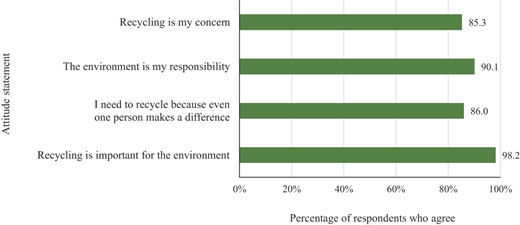
Percentage of respondents who agree with environmental and recycling attitude statements
Percentage of respondents who agree with environmental and recycling attitude statements
Recycling practice
When asked whether they recycled or not, 70.4% (n = 307) of the respondents reported that they recycled. This recycling practice was found to be significantly associated with age; 80.9% of the middle age group reported that they recycled, followed closely by the old age group (78.7%) and then by the young age group (62.0%) (χ2 = 17.62, p-value <0.0005). There was also an association between recycling practice and nationality; more non-Arabs (87.5%) reported that they recycled compared to Arabs generally, both GCC (80.9%) and non-GCC (63.7%) (χ2 = 21.32, p-value <0.0005). Educational level was an additional factor that affected recycling practice; 77.0% of people who had a university degree or higher practiced recycling versus only 63.1% of high school degree holders and below (χ2 = 10.01, p-value = 0.002). Finally, more employed people (80.7%) reported that they recycled in comparison to unemployed (78.8%) and students (59.8%) (χ2 = 21.75, p-value <0.0005). Gender was not found to be associated with recycling practice in our study (p-value = .222).
Of those who practice recycling, 13.7% always recycled, 31.4% frequently recycled, 38.9% sometimes recycled and 16.0% rarely recycled, indicating only a moderate overall frequency of recycling. Recycling frequency showed a similar pattern of variation as the recycling practice with regards to age, nationality, educational level and occupational status. Once more, recycling frequency was not associated with gender (p-value = 0.658).
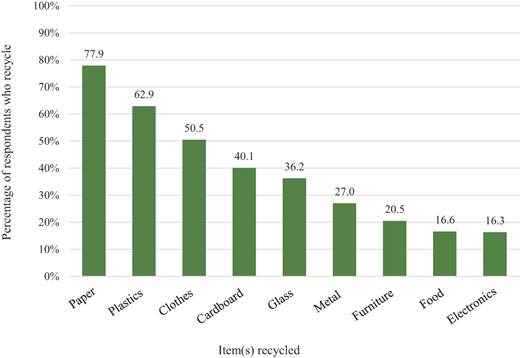
Figure 2 shows the items most recycled by the respondents. Most of this recycling was done either in public places (57.0%), such as malls and parks or at home (52.8%), whereas only 18.6% recycled in their places of study.
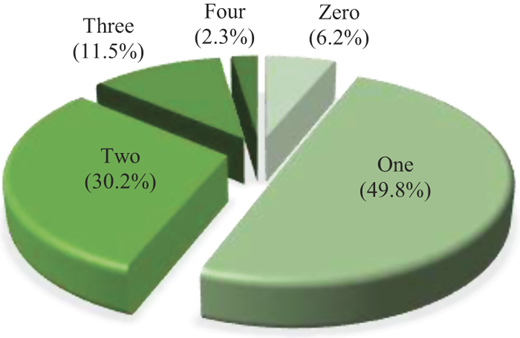
Out of all respondents, 48.7% threw general waste in recyclable bins, indicating that recyclable bins are not commonly used for their intended purpose. A practice score was used to evaluate recycling behavior. This score was calculated based on four statements; the more statements that applied to the respondent, the higher the score, giving a maximum score of four and a minimum of zero. These statements are shown in Table 2, and the score of the respondents is shown in Figure 3. Although the majority reported that they recycled, the figure shows that only 2.3% of respondents had ideal recycling behaviors; most respondents got a score of two and below. This practice score was not found to be significantly associated with any demographic variable, indicating that recycling behavior is generally lacking irrespective of the respondent.
Knowledge and usage of Bee'ah services
The main recycling services offered by Bee'ah which respondents were asked about were Tandeef public recycling, Tandeef residential recycling and You Call… We Haul. Out of the three, Tandeef public recycling was both the most known (88.7%) and used (84.7%), whereas You Call… We Haul was the least known (17.3%) and used (10.4%). Knowledge of each service was strongly associated with usage but to varying degrees, Table 3.
Knowledge and usage of Bee'ah services
| Service | Respondents who know service (%) | Respondents who use service (%) | Respondents who use service they know (%) | p-value |
|---|---|---|---|---|
| Tandeef public recycling | 88.7 | 84.7 | 93.9 | <0.0005 |
| Tandeef residential recycling | 59.2 | 44.0 | 70.7 | <0.0005 |
| You Call… we Haul | 17.3 | 10.4 | 50.0 | <0.0005 |
| None of the above | 6.9 | 6.5 | – | – |
Interrelations among knowledge, attitude and practices
Logistic regression model indicated that knowledge (OR = 1.013, 95% CI [1.001–1.025]) and attitude (OR = 1.014, 95% CI [1.001–1.028]) were the only significant predictors of recycling practice, keeping demographic variables constant.
Discussion
The level of knowledge in the Sharjah community on solid waste and recycling (51.8%) was lower than other similar studies conducted in Malaysia (63.8%) [1] and Thailand (average of 90.6%) [6]; this could be due to a lack of awareness on recycling specifically or on environmental issues generally. The latter also was suggested in a recent study on plastic pollution [7]. Regardless of the extent, the need to increase the level of knowledge among Sharjah residents is evident; based on the results of our study, there should be a strong emphasis on the proper ways to prepare and separate recyclable items as well as on the benefits of recycling. In addition, knowledge on the local recycling services offered by Bee'ah should be increased since our study highlights awareness of only some of these services. All this could be done most effectively through the Internet, television and places of study, the three most common sources of knowledge which participants quoted in the study.
Despite the relative lack of knowledge, recycling attitudes in the Sharjah community are extremely positive (92.6%), reflecting the residents' understanding of shared environmental responsibility as well as their willingness to participate in recycling. The importance of a financial incentive in motivating recycling behavior is apparent in the 51.1% who expressed increased willingness to recycle if a financial reward was introduced, particularly among the younger age group (<25 years) and students. This is expected because behaviorists, such as Gagne and Skinner, already established that reward and reinforcement increased the chances of a particular behavior [8]. Since the young age group and students usually do not have a stable source of income, a financial incentive becomes a particularly appealing option to increase recycling practice. This could be achieved by implementing a card-based reward system, whereby customers who recycle could collect points on their cards and redeem them for financial rewards.
Another factor that needs to be addressed when it comes to translating the high level of motivation into recycling practice is the ease of access to recycling bins; since 85.3% of correspondents would recycle more with easier access, it becomes essential to tackle possible barriers that are hindering recycling, such as a lack of nearby recycling bins or a lack of knowledge on the available recycling services. The former is a factor shown to influence recycling willingness [9], in which participants of the study were more willing to separate waste and recycle if recycling bins were within walking distance. Even if recycling bins were available, it is also important to make people aware of their presence since they may not know that they exist. This barrier was demonstrated in a study carried out in Poland [10], where most non-recyclers were not aware of the locations of recycling bins nearby.
Regarding recycling practice, the level reported by the participants was significantly higher in Sharjah compared to other similar studies, such as Iran (1.7%) [5] and Malaysia (42.2–54.9%) [11]. This could be a reflection of Sharjah's investment into recycling facilities allowing increased participation in recycling. However, the evaluation of recycling frequency, types of materials recycled and recycling efficiency (through the practice score) reveal a suboptimal practice of recycling; there is an inconsistent frequency of practice among those who recycle, and although paper, plastics and cardboard are highly recycled, the rest of the items showed lower levels, particularly furniture (20.5%), food (16.6%) and electronics (16.3%). As such, the results of our study highlight a need to improve the efficiency of recycling practice, so it becomes more frequent and inclusive of more material types. A good starting point could be improving Sharjah residents' knowledge on recycling and the services available (such as “You Call… We Haul”, a service for furniture recycling), as well as increasing the range of services available – if necessary – to cover the other items.
This study has successfully predicted the positive effect which knowledge and attitude have on recycling as per the logistic regression model, a finding consistent with results in other studies [11].
Interestingly, despite students having the highest level of knowledge (53.7%), they were found to practice recycling the least (59.8%, compared to 80.7% in the employed and 78.8% in the unemployed). This explains the low level of recycling in places of study (18.6%), despite being a relatively common source of knowledge (39.4%). These results corroborate a trend that previous studies have shown [11, 12]. Therefore, students should be motivated to apply their knowledge on recycling by encouraging them to recycle more frequently in their places of study, with or without a possible incentive as mentioned earlier. Schools and universities should also make sure recycling bins are readily offered on campus in order to further facilitate this process.
The findings above collectively highlight the need for awareness programs that specifically address public health concerns from accumulating solid waste, benefits of recycling, correct ways to prepare recyclable items and knowledge of available recycling services. In addition, access to recyclable bins should be increased to further reinforce the motivation to recycle. Finally, consistent use of recycling schemes including all kinds of recyclable items should be encouraged to enhance recycling practice and its efficiency. By increasing and improving household recycling, the accumulation of waste in landfill sites may be lowered with a subsequent decrease in environmentally damaging processes, such as incineration and water pollution. The health issues caused by waste accumulation would also be expected to decrease. Therefore, improved waste management at households would contribute positively toward limiting public health and environmental burdens from increased waste.
Limitations
The sampling method used in the study was convenience sampling, which led to a biased sample (54.4% of correspondents <25 years). Further studies are recommended to prove the generalizability of the results to Sharjah's community. In addition, the authors are aware that the individual household members in the general population who took part in this study would not be the main sources of waste in the UAE compared with industrial markets. However, they do produce a considerable amount of daily waste that cannot be ignored.
Conclusions
The analysis of the data collected for this study affirms that, despite the positive attitudes among Sharjah residents toward recycling, the majority showed a lack of both knowledge and satisfactory recycling practice. In order to increase the prevalence and efficacy of recycling, knowledge of recycling and its environmental benefits should be ameliorated by awareness and segregation programs. In addition, more recycling bins should be introduced to provide easier access, particularly in places of study, and innovative methods, such as a card-based reward system, could be created to encourage increased recycling practices.
Conflict of Interest: None
The authors of this study would like to acknowledge Dr. Ali Zibdeh for his contribution toward data collection, as well as Mrs. Amal Hussein for her close supervision and support throughout the project.

