


This paper aims to examine the history of trading stamps in the USA – an early form of customer-directed loyalty programs once described as a “national mania” – to reveal the interplay of consumer psychology, retailer strategy and economic conditions in shaping modern marketing practices. It traces how this foundational loyalty mechanism emerged, rose to national prominence and ultimately declined as consumer priorities shifted.
This study uses archival material from the John W. Hartman Center for Sales, Advertising and Marketing History at Duke University (Durham, North Carolina, USA) to examine the rise and fall of trading stamps in the USA from 1891 to 2008. Through qualitative analysis of historical records, it investigates key behavioral and strategic components that underpinned the program’s longevity and ultimate downfall.
Trading stamps reveal how retailers incentivized repeat purchases, balanced short-term sales boosts with long-term customer loyalty and embedded consumer incentives within broader cultural narratives. They also illustrate the creation of value beyond direct monetary transactions and the emotional connections formed with customers through perceived rewards. Consumer responses to these incentives offer insights into evolving marketing dynamics.
This paper underscores the enduring relevance of trading stamps to understanding loyalty strategies across time, showing how their evolution reflects fundamental principles of customer engagement, incentive design and emotional connection that persist in modern loyalty programs. By revealing historical patterns and consumer behaviors, it offers a valuable lens through which to examine contemporary practices and challenges in loyalty management.
This paper enhances our understanding of several key areas: how consumers respond to incentives, the strategies encouraging repeat purchases, the balance between short-term sales boosts and building long-term relationships with customers, creating value beyond direct monetary transactions, embedding loyalty programs within broader cultural narratives and fostering emotional connections with customers.
Loyalty program (LP) participation in the USA has reached record levels. In 2024, US consumers belonged to nineteen LP memberships on average (though they actively used a little less than half of those), the highest rate in ten years (Statista, 2025a). This surge in participation aligns with strong market growth: the US LP market is projected to grow at a compound annual growth rate of 13.2% between 2025 and 2029 (ResearchAndMarkets, 2025). Globally, the loyalty management industry is expected to surpass US$41.2bn by the end of 2032 (Statista, 2025b), highlighting the increasing strategic importance of LPs. Understanding the history of LPs is, therefore, essential for both researchers and marketing strategists.
In part due to their ubiquity and in part due to their presumed strategic importance, LPs – also known as loyalty reward programs, frequent-flier or frequent-buyer programs, frequency programs and patronage reward programs – have gained considerable academic attention in the context of customer relationship management (O’Malley and Prothero, 2004), customer satisfaction and loyalty (Duffy, 1998; Ho et al., 2009; Noordhoff et al., 2004; Stauss et al., 2005; Thompson and Tuzovic, 2020), LP efficiency, effectiveness and potential outcomes (Baker and Legendre, 2020; Meyer-Waarden et al., 2013) and their negative impact on the psychological and financial well-being of their participants (Pez et al., 2017; Stauss et al., 2005). Researchers have also highlighted how LPs can be used to differentiate one offering from another in a market that is already saturated (Ching and Hayashi, 2010). Loyal customers benefit a firm because they “are believed to be less price sensitive and more profitable, more committed and tolerant of a company’s downsides and resistant to competitive offers. They are also more engaged on social media and generate favourable word of mouth” (Belli et al., 2022, p. 148).
Other researchers have focused on the benefits and costs to consumers. For example, Woloson (2012) pointed to LPs originating in the early 1850s (such as discount tokens and coupons), crediting them with fueling the consumer revolution of the 19th century by “inducing people to buy things they did not necessarily want or need” (p. 790). He argues that premium systems allowed suppliers to unload inventory that they could not otherwise sell on the unsuspecting public. She also notes the prevalence of fraudulent premium schemes in which “If they were lucky, purchasers might receive inferior goods; as often, they received nothing at all in return for their money” (p.792). Over the years the one theme that appears again and again is the appeal to the consumer of getting something for nothing (Phillips, 1960; Rubinow, 1905; Woloson, 2012). In view of the considerable investment required to set up, maintain or terminate LPs, it is important to note that research findings indicate many firms do not reap the strategic benefits they sought from implementing their loyalty plans (Melnyk and Bijolt, 2015; Nastasoiu and Vandenbosch, 2018; Reinartz, 2006).
To Savitt (1989), it is apropos to expand the frame of reference and examine the history of retailing to look at patterns of practices that have come and gone, along with those that have dominated and identify factors which marked a change in consumer or marketer attitude toward LPs over time. This paper traces the evolution of trading stamps (an early form of LPs) in the USA. From 1891 to 2008 to illuminate how early LPs shaped consumer-retailer dynamics and laid the groundwork for contemporary LPs. Drawing on archival material from the John W. Hartman Center, this research focuses on trading stamps directed at individual customers and issued by brands, retailers, or third-party companies such as Sperry & Hutchinson (S&H). It explores the shifting dynamics between consumers and service providers, offering insights into how consumers respond to incentives and the strategies encouraging repeat purchases. By analyzing trading stamps’ rise and eventual decline, this paper explores the balance between short-term sales boosts and building long-term relationships, highlighting their enduring influence on marketing practices. In addition, it offers insights into creating value beyond direct monetary transactions, embedding LPs within broader cultural narratives and fostering emotional connections with customers.
Next, we introduce our methodological process before providing a historical review of the history of trading stamps in the USA between 1891 and 2008. We then outline the debate around, and the challenges brought by, trading stamps. The paper ends with concluding remarks and an appendix.
Methodology
To write this paper, we began by reviewing secondary sources – primarily printed whether academic or mainstream, such as newspapers, magazines, blogs, websites and reports. Those secondary materials provided valuable clues that guided our later selection of primary archival sources (Lipartito, 2013). With the help of a research assistant, we accessed the John W. Hartman Center for Sales, Advertising and Marketing History at Duke University in Durham, North Carolina, the USA, in 2021. This paper draws extensively on archival material (L’eplattenier, 2009; Tennent and Gillett, 2023) from the Diners/Fugazy Travel collection, the Bates Worldwide collection, the Wunderman archive, the J. Walter Thompson Company, the Outdoor Advertising Association of America and the Trinity College Historical Society collection. The archival material includes company memoranda; marketing proposals; pamphlets, flyers and posters; newspaper and magazine clippings; catalogs; and correspondence and flyers from collectors’ clubs.
To organize our results, we used Branchik’s (2010) four-step adaptation of Hollander et al. (2005, p. 39)’s “periodization by turning points” framework to “make the chronological narrative more understandable.” This process covers four steps:
undertaking a historical chronology;
using historical turning points to divide history into phases or periods with the key events as bookends for each period;
analysis; and
finding examples.
Moreover, this process takes into account the need to place the development of marketing practices within the context of the larger economic system, taking care to note the influences of economic depressions and expansion, advances in technology and the influence of specific firms or individuals (Savitt, 1989).
The four historical key events, or turning points, that served as “markers” for the end of one period and beginning of another are: the first time trading stamps were issued, First World War, Second World War and the launching of the United Airlines AAdvantage program. We treat the two world wars as significant inflection points that shaped the history of trading stamp programs in the US economy. This approach is consistent with earlier studies, including Sommer’s (1932) and Gorman’s 1960 thesis, which similarly use war and depression periods to structure historical discussion. Using these marker events, we divided the history of trading stamps in the USA into four historical periods:
Phase 1 (1891–1918): Early attempts to secure customer loyalty, as evidenced through increased purchasing, by individual marketers (retailers and/or manufacturers), from the earliest example we found in 1891 up to the end of First World War, 1918.
Phase 2 (1919–1945): Post First World War up to 1945. During this period, the effects of the Great Depression on LPs can be seen.
Phase 3 (1946–1980): Post Second World War up to 1980, a phase that included the growth of what was known as “database marketing.”
Phase 4 (1981–2008): The contemporary period of LPs, marked by the launch of American Airlines AAdvantage program in 1981, up to 2008 when the last operating trading stamp company in the USA closed.
As with many phenomena of interest to marketing historians, LPs do not always fit easily into only one period. For example, while Parke’s Blue Stamp Trading system was first introduced in 1895 (period 1), their trading stamp programs, in general, continued well into the 1960s and 1970s (period 3). Figure 1 shows the timeline of the major events.
 The timeline is arranged horizontally with arrows between phases. Phase 1 covers 1891 to 1918 and includes 1891 beginning of Wrigley's three-tier premium programme and Schuster's trading stamps, 1895 beginning of Parke's Blue Point Trading Stamps, 1896 S and H launches Green Stamps, and 1914 to 1918, World War One. Phase 2 covers 1919 to 1945 and includes 1922 E McDonald's business-to-business incentive programme and 1939 to 1945 World War Two, when trading stamps hit a low. Phase 3 covers 1946 to 1980 and includes 1950 to 1953 Korean War, 1951 a Denver supermarket using trading stamps, 1956 legal clashes with the United States government, mid 1960s four out of five United States families use stamps, 1958 peak year for trading stamps, 1966 Housewives' Revolt in the United States, 1969 Federal Trade Commission challenges S and H policies, and 1972 S and H wins the appeal against Federal Trade Commission. Phase 4 covers 1981 to 2008 and includes 1981 United Airlines introduces AAdvantage, 1982 S and H Ideabook and the Redeem-A-Dream concept, and 2008 last operating trading stamp company in the United States closes.
A four-phase timeline from 1891 to 2008 outlining major events in the history of trading stamps in the USA
The timeline is arranged horizontally with arrows between phases. Phase 1 covers 1891 to 1918 and includes 1891 beginning of Wrigley's three-tier premium programme and Schuster's trading stamps, 1895 beginning of Parke's Blue Point Trading Stamps, 1896 S and H launches Green Stamps, and 1914 to 1918, World War One. Phase 2 covers 1919 to 1945 and includes 1922 E McDonald's business-to-business incentive programme and 1939 to 1945 World War Two, when trading stamps hit a low. Phase 3 covers 1946 to 1980 and includes 1950 to 1953 Korean War, 1951 a Denver supermarket using trading stamps, 1956 legal clashes with the United States government, mid 1960s four out of five United States families use stamps, 1958 peak year for trading stamps, 1966 Housewives' Revolt in the United States, 1969 Federal Trade Commission challenges S and H policies, and 1972 S and H wins the appeal against Federal Trade Commission. Phase 4 covers 1981 to 2008 and includes 1981 United Airlines introduces AAdvantage, 1982 S and H Ideabook and the Redeem-A-Dream concept, and 2008 last operating trading stamp company in the United States closes.A four-phase timeline from 1891 to 2008 outlining major events in the history of trading stamps in the USA
The rise and fall of trading stamps in the USA
Incentive programs, a form of LPs, can be broadly categorized into three main types: salesmen’s incentives (which reward sales staff for meeting or exceeding sales targets), dealer incentives (which are aimed at retailers or distributors to encourage product promotion or bulk purchasing) and customer incentives (issued by brands, retailers or third-party companies). These programs often include premiums – promotional items such as household products, collectables, toys or souvenirs – that are offered in conjunction with a purchase. A premium may be included with the original purchase or may require the consumer to collect tokens or box tops which they mail to the manufacturer to receive a gift (Grayson et al., 2022). Hansen (1941) made a distinction between two forms of premium usage and the goals they support. The immediate sales type of premium typically offers the consumer one specified item that is meant to prompt immediate purchase and can be typified by giveaways, combination offers (premium product packaged with another good) and trade/stamp cards (the consumer collects stamps or punches on a card). The second type of premium is meant to maintain patronage and can be typified by the coupon-enclosure or trading stamps (stamps can be accumulated and affixed in booklets). The idea behind this form of premium is to reward customers for their patronage and encourage them to continue to patronize a specific supplier or retailer. As Americans strove to recover from the economic effects of the financial crisis of 1873, the prospect of getting something for nothing, in the form of a premium, was appealing to many consumers.
Focusing on customer-directed premiums used as a strategy to sustain consumer loyalty, this paper traces the rise and fall of trading stamps in the USA between 1891 and 2008, organizing the events into four phases: (a) 1891 to First World War; (b) 1919 to Second World War; (c) 1945–1980, and (d) 1981–2008 (as outlined in the Methodology section).
Phase 1: 1891 to First World War (1914–1918)
By the 1850s, Americans were already “avid consumers,” although, as Woloson (2012) argued, they were “still fairly naïve when it came to consumption decisions, such as judging the quality of new goods and the ability to decipher the rhetoric of advertising and marketing,” especially that premiums made them think “they were getting a bonus item for a wise purchasing decision, a reward for buying the right thing” (p. 791)1.
In 1891, Schuster’s Department Store in Milwaukee, Wisconsin, began issuing trading stamps as a new method of sales promotion (Clapp, 1962; Strum, 1962). Trading stamps were small paper coupons, resembling postal stamps, that could be glued into a stamp collection booklet. Although they had a minimal cash value individually, when accumulated into a booklet, the stamps could be exchanged with the trading stamp company (usually a third-party) for premiums, such as toys, personal items, housewares, furniture and appliances (Mastrangelo, 1980). Two of the major start-up costs associated with stamps were advertisement and opening distribution and redemption centers.
At first, only customers who paid for purchases in cash (instead of credit) were rewarded with the stamps. Soon, other retailers copied that practice of giving out trading stamps that could be redeemed at the issuer’s store. For example, the L.H. Parke Company, a Philadelphia and Pittsburgh manufacturer and distributor of food products (e.g. coffee, tea, spices and canned goods) established its trading stamp program in 1895 under the name “Parke’s Blue Point Trading Stamps.” Due to the program’s success, Parke established showrooms in its headquarters buildings in Philadelphia and Pittsburgh, where customers could inspect and obtain premium goods. Sperry & Hutchinson (S&H) launched its S&H Green Stamps program in 1896 (Gorman, 1960) and opened their first Redemption Center in 1897 (Figure 2). Their first customer was a housewife who shopped in a dry goods store in Jackson, Michigan (Hartman Archive, Marketing Vertical File, 1946–1999, Box 50, S&H Catalogue, The New York Times advertisement, October 18, 1964). For the first time, the consumer (usually the housewife) profited from the provision of a “unit of value small enough to give a discount on a small cash purchase.” This put the business largely on a cash basis and “their customers become lasting friends,” hence, building customer loyalty (Hartman Archive, Marketing Vertical File, 1946–1999, Box 50, The Story of S&H Cash-discount Stamps by the S&H Co.).
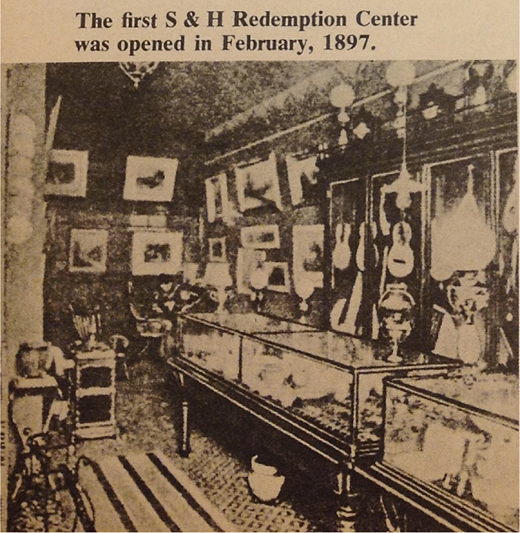
First S&H redemption center in 1897
Source: Hartman center, marketing vertical file, 1946–1999, Box 50 – dynamic maturity 1965
First S&H redemption center in 1897
Source: Hartman center, marketing vertical file, 1946–1999, Box 50 – dynamic maturity 1965
Independent trading stamp companies2, such as S&H, introduced an important innovation – when the same stamps were given by groups of noncompeting businesses, the consumer could concentrate stamp saving by shopping only in those stores, hastening receipt of the premium (Gorman, 1960). By collecting stamps for goods they purchased regularly, consumers were able to reap additional value. Of course, for regular stamp collectors, the program also represented a switching cost if they considered shopping elsewhere (Hurley, 2017).
When the trading stamp cards program started operating in the late 19th century, customers were required to obtain a prerequisite number of punches or stamps through purchases to receive a free item or a purchase discount. The intent was to get customers to be loyal to the merchant by having them continue shopping in the same place to obtain enough stamps to redeem for merchandise. This promotional advertising tool helped retailers to bring in new customers, attract high-volume shoppers and turn secondary customers into primary customers (when they start focusing their shopping on the store giving stamps). Another major objective was to give customers an inducement to pay for merchandise in cash3, rather than to run charge accounts (Hartman Archive, Marketing Vertical File, 1946–1999, Box 50, “Retail trading stamp plans: History”).
By the early 1910s, with the spread of chain gasoline stations, the use of trading stamps grew. At that point in time, retailers found it more profitable to award them to all customers and not just cash-only customers. Gorman (1960) reported that in 1916, S&H claimed to have issued 21.5 billion stamps and to have redeemed 84% of them (Figure 3 features a pair of S&H advertisements from the 1910s). Aside from the success of S&H, in general, the use of all forms of premiums was pared back during First World War (1914–1918) (Hansen, 1941). Gorman (1960) speculated about the causes, suggesting that “defense cutbacks on materials, a seller’s market and an inflationary spiral have never been conducive to effective stamp promotion” (p. 26). First World War created dramatic change in both the supply and demand for certain products or materials, and the shortages of merchandise led to the cessation of premium advertising/LPs in some places (Sommer, 1932).
 The collage shows a woman and a man standing near a shopfront with the words At the Sign of the S and H. One notice describes the plan as the best and most stable premium plan. An advertisement for Seniors Department Store, 216 220 West 125 th Street, offers double S and H Green Trading Stamps on Friday, November 10. A section reads A and P Xmas Dividend S and H Green Trading Stamps. A Christmas coupon offers 20 S and H Green Trading Stamps free. A side heading states that a pair of 1910s advertisements vaunt S and H Trading Stamps as the best and most stable of all premiums.
1910 advertisement by S&H, printed in Audacity, Spring 1994, p. 52
Source: Hartman center, marketing vertical file, 1946–1999, Box 50
The collage shows a woman and a man standing near a shopfront with the words At the Sign of the S and H. One notice describes the plan as the best and most stable premium plan. An advertisement for Seniors Department Store, 216 220 West 125 th Street, offers double S and H Green Trading Stamps on Friday, November 10. A section reads A and P Xmas Dividend S and H Green Trading Stamps. A Christmas coupon offers 20 S and H Green Trading Stamps free. A side heading states that a pair of 1910s advertisements vaunt S and H Trading Stamps as the best and most stable of all premiums.1910 advertisement by S&H, printed in Audacity, Spring 1994, p. 52
Source: Hartman center, marketing vertical file, 1946–1999, Box 50
Phase 2: Post First World War to 1945
In post First World War years, as economies slowly readjusted, premium advertising began to be used again (Sommer, 1932). Knowledge about the use of premium programs had become more widespread among sellers and an increase in use led to a “boom” in the practice (Hansen, 1941, p. 185). Consumers, however, became more “careful if not more skillful buyers during the depression years of the 1930s and more interested in the types of bargains they have been able to secure in the form of premiums” (Hansen, 1941, p. 196). Thus, while trading stamp programs often reached their peak of use during economic downturns and depressions, as a way of “reviving ailing sales” (Wall Street Journal, 1953a, 1953b), during Second World War (1939–1945), the use of trading stamps hit a low. Hansen (1941) cited a study conducted by the National Retail Dry Goods Association in 1934 which revealed that of 191 companies responding, only 14% used trading stamps (p. 189, cf. Boone et al., 1978). One explanation of why stamps “dipped to their lowest ebb in the depression period of the middle 1930s” is that to customers, “price became more essential than service and other ‘fringe’ luxuries” (Beem, 1957). Gorman (1960, p. 26) observed that while S&H and The Eagle Stamp Company were able to weather the storm, many smaller firms either collapsed, scaled back operations or shifted to different types of premiums. These failures were compounded by the economic pressures of the Great Depression (between the Stock Market Crash of 1929 and the outbreak of Second World War in 1939), a period marked by severe material shortages due to defense cutbacks and rising inflation. Yet there were other success stories. In the late 30s, Curt Carlson founded Gold Bond stamp company4 – which by the 1970s, became the third biggest in the business after S&H and Kroger Co.’s Top Value. Known as a “crafty promoter,” the day after signing up a new retailer to take on his stamps, Carlson would send his wife around and, “’n a loud voice, she would tell the proprietor she was there because she had learned that he had Gold Bond stamps” (Hartman Archive, Marketing Vertical File, 1946–1999 Box 50, Forbes, March 15, 1975, p. 38).
Phase 3: 1946–1980
Although the seller’s markets of the early 1940s meant that merchants need not bother with programs like trading stamps (Fox, 1969), after the war, many LPs, including trading stamps, continued in the same form as they had before the war, or expanded to meet the “pent-up demand” that spurred postwar consumer spending. Pridmore and Zwick (2011) pointed to the post Second World War period as the time when marketers began, “assembling” consumers into marketing segments and categories[…] It [market segmentation] expanded significantly […] as numerous organizations collected demographic and psychographic data to discover, “attitudes, opinions, and interest” of consumers” (p. 271). This shift in marketing thought and strategy also marks the start of this period.
Before the 1950s, the general belief was that supermarkets could not successfully adopt trading stamps. Yet in 1951, a Denver supermarket began using trading stamps as a promotional device, inspiring eight out of the ten top chains of food supermarkets at the time to follow suit (Hartman Archive, Marketing Vertical File, 1946–1999, Box 50, “Retail trading stamp plans: History”). Following Second World War (1939–1945) and the Korean War (1950–1953)5 and up until the second half of the 1950s, most supermarket chains and groups of independents adopted trading stamps programs; however, they did so for different reasons rooted in their perspective market positions and challenges. For supermarket chains: (1) the program helped them to differentiate themselves from their nonchain competitors, giving them the upper hand and allowing for “non-price competition” (Barber, 1960); (2) to their consumer, the value of merchandise traded was greater than a cash discount; (3) it helped consumers to save routinely; and (4) it created a synergistic effect when noncompetitive stores distributed a particular trading stamp (Allvine, 1969). By 1953, S&H had 35,000 retail stores using its Green Stamps, operated 300 redemption stores and distributed its premium catalog by mail to 15 million families (Wall Street Journal, 1953a, 1953b) [6].
It is worth noting that in addition to targeting housewives, S&H distributed pamphlets stating that the trading stamp industry helped farmers, boasting that there were 450 S&H Redemption Stores serving farm areas throughout the USA.
Opposite to supermarket chains that adopted trading stamps primarily as a strategic tool for differentiation and nonprice competition, small retailers adopted them reactively, in response to rising operating expenses and competitive pressures. Small retailers in the mid-1950s had difficulty maintaining their competitive positions because of: (1) the increased importance of discount houses and other high-volume, low markup retailers; (2) the continuous expansion of modern suburban shopping centers; (3) the migration of customers to the outlying areas of the city; and (4) the rapidly increasing operating expenses.
As a result of these pressures, especially the rising operating expenses, small retailers adopted trading stamps and promoted them aggressively. Soon, “[c]onsumers realized that they could obtain five or six premiums annually by concentrating their food purchases in stamp stores” (Meloan and McCammon, 1958, p. 173). Although small retailers expected various benefits from sales increases (e.g. improved gross-margin percentage, reduced operating-expense ratio, higher rate of inventory turnover and/or increased profits), there were three other main reasons for stamp adoption. First, they wanted to maintain rather than enhance their competitive positions because consumers “demanded” stamps. Second, these retailers depended on larger stores for customer traffic; once customers of major stamp-giving retailers acquired the saving habit, they wanted to fill their books as rapidly as possible, consequently, small merchants in the vicinity of such stores often adopted stamps to attract the patronage of these premium conscious consumers. Finally, stamps provided small retailers with competitive retaliation and what they considered the best promotional possibility at their disposal to compete effectively against mass distributors (Meloan and McCammon, 1958, pp. 173–175).
In 1953, the Wall Street Journal (1953a) announced, “American housewives are falling hard for stamp collecting” with at least 100,000 merchants offering trading stamps. They attributed retailers’ interest in using trading stamps to increased market competition and the need to offset rising costs, primarily raising wages. In the mid-1950s, stamp savers did not think stamps led to higher prices; therefore, premiums were regarded as an actual plus of the family’s well-being and a way of “painless saving” for wanted luxuries. Psychologically, the economic appeal of stamps and saver books satisfied customers’ feeling of enjoyment and satisfaction (Beem, 1957, pp. 128–129). Such a success, however, brought legal clashes, for in 1956, independent investigations of the industry were led by the Federal Trade Commission, the United States Department of Agriculture and the United States Department of Justice (Regulation of the Trading Stamp Industry, 1957, p. 71).
The trading stamps industry also had an impact on the economy; in 1957, it bought $250m worth of products from America’s manufacturers, providing employment for 90,000 people in different industries, and paid $55m in state and federal taxes (Hartman Archive, Marketing Vertical File, 1946–1999, Box 50, Information message by S&H). In addition, by 1957 it was estimated that trading stamp companies had between 1,400 and 1,600 retail centers where consumers could redeem their stamps (Morell, 2015) and nearly 250,000 retail outlets were issuing trading stamps, with nearly two thirds of US households saving them7. While trading stamps were worth only about quarter of a cent each, by the late 1950s, more than 400 companies were engaged in the printing and selling of US$600m worth of stamps a year. In the grocery field, 90,000 stores gave stamps with every customer purchase, and altogether, there were 170,000 stamp-giving stores scattered across the country. Although trading stamps never replaced money, they gave money “a good run for itself” in cities where trading stamps flourished (like Sacramento, California), for people treated stamps the same as cash; “You can’t leave them around any more than you do $10 bills.” Ministers reported finding blocks of them, and even whole stamp books, in the offering plate on Sunday (Hartman Archive, Marketing Vertical File, 1946–1999, Box 50, JWT Library Flash, no. 44, 3/5/57).
In the late 1950s, S&H printed a series of messages to show the importance of their Green Stamps (Figure 4 is an example). Collecting trading stamps was called the “U.S. Housewife’s favourite hobby” (Hartman Archive, Marketing Vertical File, 1946–1999, Box 50, The Denver Post, Dec. 4, 1960). By the mid-1960s, roughly four out of five US families were collecting stamps, pasting them in books and exchanging the books for an assortment of consumer goods (Hartman Archive, Marketing Vertical File, 1946–1999, Box 50, Forbes, January 1st, 1973).
 The left page features an illustrated woman holding a sign about economy and purchasing quality goods at low prices with stamps as a cash discount. Marginal markings indicate completion of one quarter of the book when filled. The bottom instructs users to fill the page with 30 S and H Green Stamps. The right page shows an illustrated man walking past a shop displaying a sign about issuing S and H Green Stamps. Text promotes increased buying power and saving while spending. The bottom again instructs users to fill the page with 30 S and H Green Stamps.
Pages 10–11 from the S&H green stamps catalog (1957) showing the impact of gender in the language used
Source: Hartman center, marketing vertical file, 1946–1999, Box 50
The left page features an illustrated woman holding a sign about economy and purchasing quality goods at low prices with stamps as a cash discount. Marginal markings indicate completion of one quarter of the book when filled. The bottom instructs users to fill the page with 30 S and H Green Stamps. The right page shows an illustrated man walking past a shop displaying a sign about issuing S and H Green Stamps. Text promotes increased buying power and saving while spending. The bottom again instructs users to fill the page with 30 S and H Green Stamps.Pages 10–11 from the S&H green stamps catalog (1957) showing the impact of gender in the language used
Source: Hartman center, marketing vertical file, 1946–1999, Box 50
Customers could redeem trading stamps for various merchandise or gifts offered by stamp companies and advertised in their “books” or catalogs. In the 1950s, a full book of stamps was valued between US$3.42 and US$5.22, with a median value of US$3.74 (Figure 5). In a 1957 Marketing Research Report on how trading stamps affected food prices, the US Department of Agriculture stated:
 The table presents average dollar value per book of stamps and average rate of return on a 150 dollar expenditure based on manufacturers list prices and average department store and discount house prices in Washington District of Columbia, November 1956. Items listed include portable mixer, automatic toaster A, automatic toaster B, steam dry iron, roaster oven, aluminium 4 and one half quart dutch oven, and dictionary. A column records number of stores giving prices. Dollar value per book of stamps is provided for list prices, department store prices, and discount house prices. Average rate of return in percent is provided for list prices, department store prices, and discount house prices. Summary rows include all items priced, median value, and range in value. A footnote states one stamp is given for each 10 cent purchase and 150 dollars are required to fill a book of 1,500 stamps. A second footnote states manufacturers list prices do not have to be maintained.
Marketing research report no. 169, by the US Department of Agriculture, Page 6 (1957)
Source: Hartman center, marketing vertical file, 1946–1999, Box 50
The table presents average dollar value per book of stamps and average rate of return on a 150 dollar expenditure based on manufacturers list prices and average department store and discount house prices in Washington District of Columbia, November 1956. Items listed include portable mixer, automatic toaster A, automatic toaster B, steam dry iron, roaster oven, aluminium 4 and one half quart dutch oven, and dictionary. A column records number of stores giving prices. Dollar value per book of stamps is provided for list prices, department store prices, and discount house prices. Average rate of return in percent is provided for list prices, department store prices, and discount house prices. Summary rows include all items priced, median value, and range in value. A footnote states one stamp is given for each 10 cent purchase and 150 dollars are required to fill a book of 1,500 stamps. A second footnote states manufacturers list prices do not have to be maintained.Marketing research report no. 169, by the US Department of Agriculture, Page 6 (1957)
Source: Hartman center, marketing vertical file, 1946–1999, Box 50
These [exchanged products in lieu of stamps] are usually articles of popular brands that range in appeal from personal items for each member of the family to household items that all can enjoy [such as mixers, toasters, steam-dry iron, roaster oven, Dutch ovens, and dictionaries]. They include articles that classify as necessities as well as those that are luxuries […] If stamps were available only at a food store, it would take the average urban family who spends about $25 a week for food consumed at home about 5 to 6 weeks to fill a book of 1,500 stamps provided all food items were bought at the same store or a store issuing the same brand of stamps. (Hartman Center, Marketing Vertical File, 1946-1999, Box 50).
In S&H’s Diamond Jubilee book published in 1956 (Hartman Center, Marketing Vertical File, 1946–1999, Box 50, “Distinguished Merchandise” published by S&H, 1956), approximately 2,000 items were listed. The merchandise available for redemption included a wide range of elegant and practical items, such as fine China dinnerware sets, silver-plated flatware, crystal glassware, candelabras, decorative figurines, vases, lamps, small furniture pieces like tables and chairs, storage ottomans, tea sets, coffee makers, serving trays, kitchen appliances, bedding sets, towels, luggage, watches, toys, baby products, outdoor gear and sewing or tool kits. These items reflected the mid-century style and were designed for home and family use (Figures 6 and 7). S&H’s suppliers included major brands such as General Electric, Westinghouse, International Silver, Eastman Kodak, Spalding, West Point-Pepperell and Longines-Wittnauer. Three states – Washington, Wyoming and Wisconsin – required that stamps be redeemable for cash only. Sixteen other states mandated that stamp savers be given the option of redeeming stamps for either merchandise or cash. However, since merchandise offered significantly better value, fewer than 1% of customers chose the cash option. (Hartman Center, Marketing Vertical File, 1946–1999, Box 50, “Answers to Some Frequently Asked Questions About the Sperry and Hutchinson Company and S&H Green Stamps” published by S&H, November 1970). In 1967, stamp companies like S&H and Gift Stars started accepting Dividend Coupons from tobacco brands (Figure 8), allowing smokers to “collect the equivalent of two and-a-half additional books, or 30% more per year” (Hartman Center, Marketing Vertical File, 1946–1999, Box 50, “Tobacco Companies Give New Twist to Stamp Plans,” Incentive, April 1967). To encourage the collection of stamp books, Plaid Stamp – issued by the E. F. McDonald Stamp Co. – offered to ship gifts to customers, postpaid, if their Plaidland redemption store was more than 25 miles from their home. Delivery of made-to-order furniture, color televisions (Figure 9) and major appliances did not include installation or service (Hartman Center, Marketing Vertical File, 1946–1999, Box 50, “E. F. MACDONALD Plaid Stamp GIFT CATALOG, 1970). In addition to the extensive range of products listed in stamp catalogs, trading stamps were sometimes used to fulfill more unique or community-driven needs. For instance, in 1966, a school in Erie, Pennsylvania, collected 5.4 million S&H Green Stamps with the help of the local community to acquire two gorillas. Local stores ran “gorilla specials” and offered extra stamps with the purchase of certain items, and “merchants displayed collection boxes with pictures of two young gorillas and the sign, ‘Help Bring Us to Erie’.” The campaign ended when S&H redeemed the books for US$ 9,000 – enough for the zoo to buy the two gorillas from Trefflich’s Bird and Animal Company, Inc., in New York. One was sent to the Pittsburgh Zoo in Highland Park, while the other – a female named Samantha – was placed at the Glenwood Park Zoo in Erie to serve as a companion for their resident male gorilla, Lonesome George (The New York Times, 1965; Willis, 2013).
 Multiple catalogue pages display household goods and redemption items associated with S and H Green Stamps. The upper section includes cutlery sets, serving spoons, glassware, silverware, trays, bowls, and boxed sets arranged in panels with captions and prices. A woman is seated holding an open case of cutlery beside arranged utensils and decorative items. The middle section presents furniture, including tables, chairs, shelving units, lamps, stools, and storage pieces, each isolated against plain backgrounds with item numbers and descriptions below. The lower section includes tools and hardware such as a hose, shears, hammer, saw, hand plane, and other workshop items displayed against a pegboard. A lawn mower appears in a separate panel. Another page shows a building illustration positioned over a map of the United States of America with accompanying explanatory text. All pages contain printed descriptions and pricing information beneath the images.
Six pages from S&H’s distinguished merchandise catalog (1956)
Source: Hartman center, marketing vertical file, 1946–1999, Box 50
Multiple catalogue pages display household goods and redemption items associated with S and H Green Stamps. The upper section includes cutlery sets, serving spoons, glassware, silverware, trays, bowls, and boxed sets arranged in panels with captions and prices. A woman is seated holding an open case of cutlery beside arranged utensils and decorative items. The middle section presents furniture, including tables, chairs, shelving units, lamps, stools, and storage pieces, each isolated against plain backgrounds with item numbers and descriptions below. The lower section includes tools and hardware such as a hose, shears, hammer, saw, hand plane, and other workshop items displayed against a pegboard. A lawn mower appears in a separate panel. Another page shows a building illustration positioned over a map of the United States of America with accompanying explanatory text. All pages contain printed descriptions and pricing information beneath the images.Six pages from S&H’s distinguished merchandise catalog (1956)
Source: Hartman center, marketing vertical file, 1946–1999, Box 50
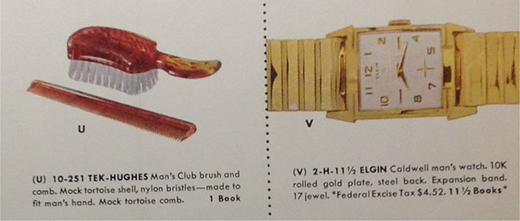
A Man’s club brush and comb redeemable for 1 S&H Book (on the left) and an ELGIN Caldwell man’s watch redeemable for 11½ S&H books (on the right)
Source: Hartman center, marketing vertical file, 1946–1999, Box 50
A Man’s club brush and comb redeemable for 1 S&H Book (on the left) and an ELGIN Caldwell man’s watch redeemable for 11½ S&H books (on the right)
Source: Hartman center, marketing vertical file, 1946–1999, Box 50
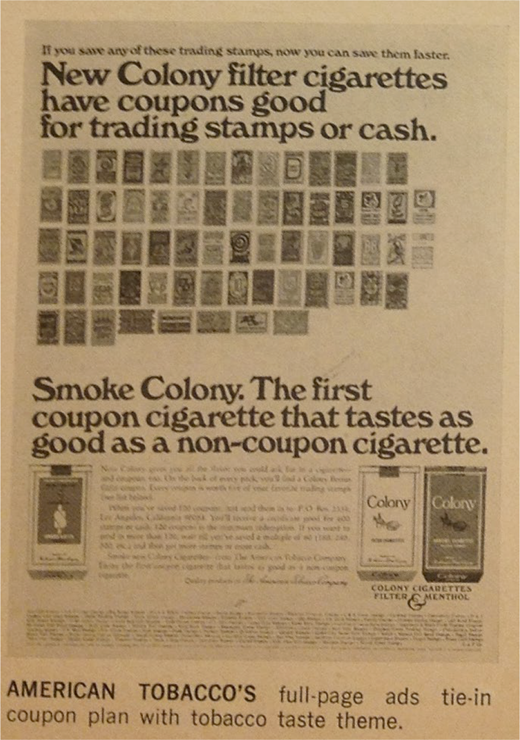
Advertisement tying coupon plans with buying tobacco, Incentive, April 1967
Source: Hartman center, marketing vertical file, 1946–1999, Box 50
Advertisement tying coupon plans with buying tobacco, Incentive, April 1967
Source: Hartman center, marketing vertical file, 1946–1999, Box 50
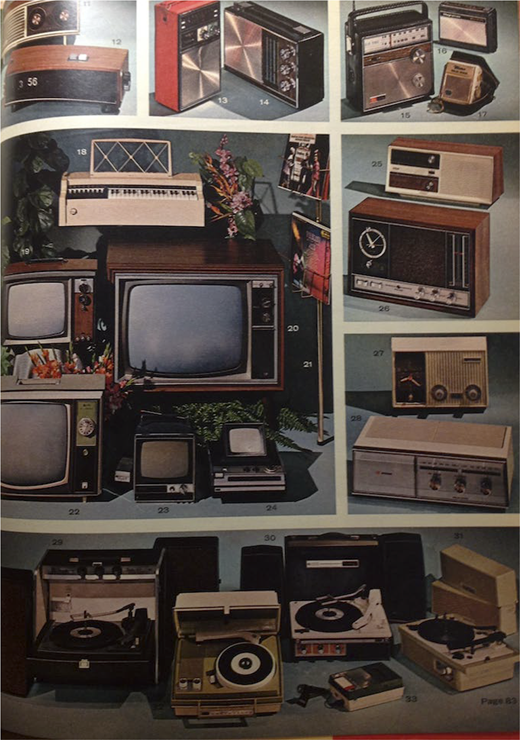
Page 82 in E. F. Macdonald plaid stamp gift catalog, 1970
Note(s): Colored televisions cost between 45 and 190 stamp Books.
Source: Hartman center, marketing vertical file, 1946–1999, Box 50
Page 82 in E. F. Macdonald plaid stamp gift catalog, 1970
Note(s): Colored televisions cost between 45 and 190 stamp Books.
Source: Hartman center, marketing vertical file, 1946–1999, Box 50
As the popularity of trading stamps spread in the USA, problems arose. Several unreliable trading stamp companies sprang up, often operating as “fly-by-night” businesses. These firms, interested in quick profits on insufficient capital, exploited the lag between stamp distribution and redemption. Many expected low redemption rates or even planned to discontinue operations after a short period. Some concealed redemption centers to avoid obligations, while others abruptly closed when consumers began redeeming their books (as evidenced by the 1962 scene in Figure 10 depicting Merchants Green Stamp savers outside a shuttered redemption center), leaving customers with worthless stamps. In other cases, premiums were substituted with inferior goods or items other than those advertised (Gorman, 1960, pp. 23–24). This gave trading stamp programs a bad reputation. Furthermore, S&H found themselves having to deal with counterfeit stamps being redeemed for products, which were later sold off by the perpetrators of the counterfeit scheme (Wall Street Journal, 1953a, 1953b).
 They face a window in the brick wall. A caption at the bottom reads Savers of Merchants Green Stamps stand in vain outside closed redemption center.
Savers of Merchants Green Stamps stand in vain outside a closed redemption center in 1962
Source: Hartman center, marketing vertical file, 1946–1999, Box 50, Business Week – March 10, 1962, p. 60
They face a window in the brick wall. A caption at the bottom reads Savers of Merchants Green Stamps stand in vain outside closed redemption center.Savers of Merchants Green Stamps stand in vain outside a closed redemption center in 1962
Source: Hartman center, marketing vertical file, 1946–1999, Box 50, Business Week – March 10, 1962, p. 60
Despite the apparent success of trading stamps, there was rising criticism that accused stamps of being a “gimmick” which, in the long run, would not solve sales problems but instead cause an increase in costs. For example, the A&P food chain acknowledged that “an increase in their costs was partially attributed to stamps … [and] that for the quarter ending May 26, 1962, there was a larger increase in sales, but the profits were no better than in the same period of 1961 when the company was not offering stamps” (Hartman Archive, Marketing Vertical File, 1946–1999, Box 50).
Several major supermarket chains aligned themselves with specific trading stamp programs during the 1950s and 1960s. For example, Kroger partnered with Top Value Stamps, while King Soopers and Red Owl adopted S&H Green Stamps and Colonial Stores offered Gold Bond Stamps. These affiliations often shaped competitive dynamics, with early adopters like King Soopers gaining a first-mover advantage before trading stamps became widespread. To further differentiate themselves, supermarket chains increasingly relied on extra stamp giveaway programs, such as bonus stamps on weekends or for featured products. Stores preferred stamps because unlike price cutting that is easily imitated, stamp use is typically on a franchised basis, hence, provides “distinctiveness.” This is because even when store competitors use different stamps, customer acceptance varies considerably among stamp brands, and “the store with the best stamp and the best program for promoting its stamp has an edge” (Beem and Isaacson, 1968). However, since 1962 most supermarket chains and independent associations of food stores had adopted trading stamp programs, their effectiveness as a means of differentiation decreased (Boone et al., 1978).
As prices rose sharply after 1965, price-conscious consumers focused less on premiums and more on sticker price (Fox, 1969). Still, “1968 was the peak year for trading stamps, 440 billion were issued – a nearly twentyfold increase over the 25 billion issued in 1952” (Boone et al., 1978, p. 72), indicating that there may have been a lag effect. By the 1970s, a steady decline in trading stamp sales could be observed; “In 1976, trading stamp sales were estimated at approximately $400 million. This compares with $540 million in 1975, $600 million in 1973 and a record $950 million in 1969” (Boone et al., 1978, p. 72).
Gallo and Boehm (1978) estimated that while food stores accounted for between 80% and 90% of trading stamp sales in the mid to late 1970s, only approximately 10% of all retail grocery sales would take place with trading stamps, a marked decline from 1969. Furthermore, there were only 100 companies selling trading stamps to retailers, down from 300 companies in 1965. While 95% of stamps were still being redeemed by consumers, total stamp use had declined. Gallo and Boehm (1978) attributed the decline to “shift[ing] consumer preferences, a change in the competitive structure of the food retailing industry [and] changes in the fundamental economic conditions prevailing” (p. 36). In the 1970s, gasoline service stations stopped offering trading stamps due to the energy crisis (Gallo and Boehm, 1978) and many supermarkets started spending more money to advertise lower prices rather than issue stamps (Beyette, 1993; Jolley, 2005; Mastrangelo, 1980). In addition, and partly because of the industry’s own wild proliferation, sales of stamps steadily declined from US$800m industrywide in 1967 to about US$350m in 1974 (Hartman Archive, Marketing Vertical File, 1946–1999, Box 50, Forbes, July 1, 1977). In the 1960s and 1970s, inflation further undermined the appeal of trading stamps by eroding their real purchasing power. As the cost of living rose, consumers needed substantially more stamps to obtain the same premiums, making the programs less rewarding and more time-consuming. At the same time, alternative incentives such as direct price reductions and cash discounts gained favor, reinforcing a shift away from stamps as a preferred loyalty device.
Looking back, the trading of stamps was an important retail marketing device. And it was extremely popular with young married couples with modest incomes, with housewives being the main food shoppers and stamp savers, although the concept also appealed to men (Smith, 1994). In his 1955 study, Vredenburg outlines the advantages and disadvantages of retailers’ use of trading stamps programs: on the one hand, they increased sales volume (leading to better store operation and financing), improved profit margins and expense ratios, spread sales volume more evenly throughout the week, stabilized business and provided sustained promotional effect. On the other hand, some retailers faced a high cost of stamps leading to small profit margins and the eventual need to raise prices, the need to increase advertising, the slowing down of store operations (especially during rush periods), the reduced flexibility of the merchandising program, the need to safeguard stamps like money, the neutralization of benefits when competitors install stamps and the difficulty to discontinue stamps (pp. 114–149).
Writing near the end of this period, Gallo and Boehm (1978) echoed the work of Hansen (1941) suggesting that food retailers found trading stamps useful both for increasing sales volume and for maintaining customer loyalty. During the 1950s in the USA, about one-half of all food sales and nearly a third of the gasoline sales involved trading stamps, and retailers paid stamp companies about $1bn for the stamps they distributed each year. Trading stamp programs also influenced shopping patterns. For example, rather than shop at one store to receive the best price on eggs, and then another to get the best price on chicken, trading stamps encouraged housewives to concentrate their purchasing on one store – one-stop shopping – where they would receive a “break” on all prices via collecting stamps (Wall Street Journal, 1953a, 1953b).
Although it could be argued that stamps filled consumers’ psychological needs and provided some incentive for consumer loyalty, there was also a question of whether trading stamps led to a rise in prices and how their distributional and allocative effects might have impacted consumers. Author Wilbur Cross declared in Life magazine, on May 3, 1957, that “[h]ousewives give up time, money and convenience to get “something for nothing” while economists try to figure who really is stuck with the $600 million tab” (Hartman Archive, Marketing Vertical File, 1946–1999, Box 50). Sherman (1968) argued that trading stamps “can rob the market of some of its precision in responding to the intensity of consumer desires, and can produce a bias in resource allocation” (p. 30). While Beem (cited in Stone, 1957) reported that in the food retailing industry at least, stamp programs either had no influence, or helped to keep prices down.
By the mid-1960s, supermarkets were spending an average of about US$27,000 annually on trading stamps, representing roughly 2% of their gross sales. In 1966, S&H was the leading stamp company (Figures 11 and 12) with about 75% of the total stamp business of US$1.1bn; they conceded that for stamps to pay their way, retailers must have at least a 12% increase in sales (Waddell, 1968). The cost of trading stamps had to be borne by someone, either the non-stamp-giving retailer, the stamp-giving retailer, the consumer, or any combination of these. In 1966, a “housewives’ revolt” erupted8, bringing hundreds of placard-toting women into the streets chanting against high supermarket prices, singling out stores that offered trading stamps which they believed needlessly added to grocery costs, and boycotting commercial bakeries due to increasing bread prices (Daugherty, 2016). However, by 1968, and according to Ira Kaplan, president of King Korn Stamp Co., a Rexall Drug survey conducted among 40,000 housewives showed 93% of them saved stamps (Hartman Archive, Marketing Vertical File, 1946–1999, Box 50, Incentive, August 1968).
 The map shows numerous symbols distributed across the country. The legend at the lower left identifies three facility types as redemption centers, warehouses, and district offices. Symbols appear throughout the eastern, central, and western regions. A higher concentration of symbols appears in the eastern United States. The map contains only facility markers and the legend identifying the three categories.
The inside cover of an S&H catalog showing their redemption centers, warehouses and district offices (1963)
Source: Hartman center, marketing vertical file, 1946–1999, Box 50
The map shows numerous symbols distributed across the country. The legend at the lower left identifies three facility types as redemption centers, warehouses, and district offices. Symbols appear throughout the eastern, central, and western regions. A higher concentration of symbols appears in the eastern United States. The map contains only facility markers and the legend identifying the three categories.The inside cover of an S&H catalog showing their redemption centers, warehouses and district offices (1963)
Source: Hartman center, marketing vertical file, 1946–1999, Box 50
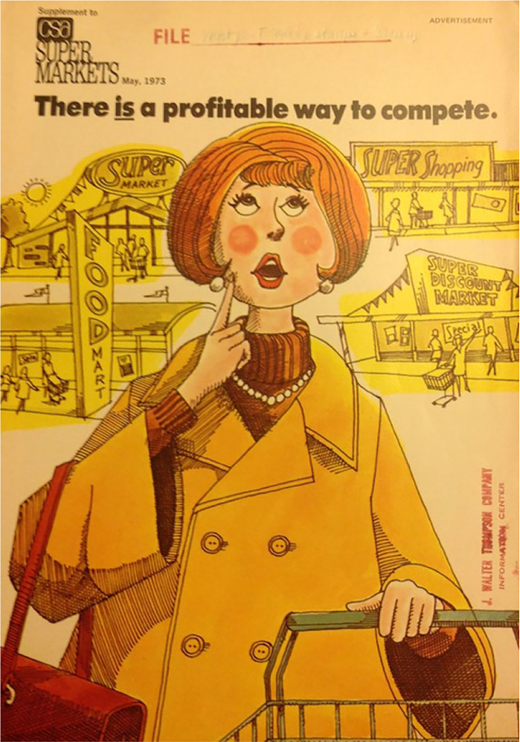
Cover of the CSA SUPERMARKETS booklet, supplied by S&H, May 1973
Source: Hartman center, marketing vertical file, 1946–1999 Box 50
Cover of the CSA SUPERMARKETS booklet, supplied by S&H, May 1973
Source: Hartman center, marketing vertical file, 1946–1999 Box 50
Although trading stamps remained relatively pervasive, at the end of that period, it started falling from favor with corporate marketers because they did not provide specific details about their customers. Bouk (2017) highlighted the influence of global economic crises in the 1970s on management’s thinking about the consumer data that they held, “Customer loyalty programs […] soon looked like so many golden geese because they also produced extensive data doubles that advertisers, market researchers and political groups were willing to pay for” (p. 102). Data that was previously considered a “by-product” of doing business, if considered at all, became an asset that could be sold at a profit.
Phase 4: 1981–2008
By the 1980s, stamp programs were in decline. To encourage their customers to use their catalogs, S&H experimented with different marketing directions. For example, they introduced the “Redeem-A-Dream” concept in their 1982 Ideabook (a name that resonates with inspiration and not just being a source of household gifts), where discounts on a variety of vacation packages, domestic flights on Air Florida and Dollar Rent-A-Car were offered for the first time in their 86-year history. Other S&H innovations included renovating their redemption stores, eliminating their single stamp awarded for each 10-cent purchase, and upgrading their catalog merchandising (Hartman Archive, Marketing Vertical File, 1946–1999, Box 50, Premium Incentive Business, April 1982).
The period from the mid-1980s through the 2010s represents a period of transition from seeing consumers through a broad demographic lens to monitoring them as individuals who give off streams of data, often in real time (Turow et al., 2015). The introduction of the AAdvantage LP by American Airlines in 1981 was shortly followed by United Airlines’ Mileage Plus program, marking a turning point in the history of LPs (Turow, 1997; Vinod, 2011). AAdvantage is usually regarded as the first full-scale LP of the modern era. By the 1990s, card-based retail LPs gained popularity. As Pridmore and Zwick (2011, p. 270) contended, “the customer database has fundamentally changed the speed and degree to which companies are able to collect, sort and process information about consumers.” As the number of LPs grew in the early 1990s, industry commentators noted the importance of linking them with the “segmentation skills of database marketing” (Cuneo, 1995, p. S10). By the year 2000, and supported by technology – for example, computerized point-of-sale systems, database marketing, statistical modeling, broadband connectivity facilitating real-time data exchange, and Customer Relationship Management (CRM) and Enterprise Resource Planning integration – the reward-for-patronage idea behind stamps had evolved into popular loyalty card programs (Withiam, 2000). This helped retailers to not only reward consumers for their loyalty and patronage but to also collect the latter’s more personal and shopping information. Failing to compete against the new LPs, through the 1990s and early 2000s, the majority of the remaining trading stamp companies either ceased operations or converted to an online format (Lonto, 2004; Morell, 2015). And in 2008, the last operating trading stamp company in the USA, the Eagle Stamps, closed. Table A1 in the Appendix summarizes major US trading-stamp companies, detailing founding dates alongside key milestones and program outcomes. After this point, LPs in the USA shifted from plastic card schemes to mobile-app-based initiatives (Son et al., 2020). For example, Walmart introduced its first digital savings program in 2012, while Target launched its free loyalty program, Target Circle, in 2019 – offering personalized deals and mobile integration. Subscription-based models such as Amazon Prime, which debuted in 2005 and expanded significantly in the 2010s, also became dominant. These innovations marked a transition from paper-based stamps to data-driven, omnichannel loyalty ecosystems that remain central to US retail strategy today.
Although loyalty management in the 1980s through the late 20th century primarily focused on operating LPs, after 2000, the emphasis shifted toward the “invisible” benefits these programs provided – namely, the customer insights they generated and their role in targeted marketing. Over time, loyalty management expanded into CRM and, more recently, Customer Experience Management. Today, loyalty-driven organizations prioritize the systematic collection and analysis of individual customer data (Cao, 2021). At the same time, marketing strategies have evolved to deliver an omnichannel experience, integrating multiple touchpoints to create seamless, personalized engagements (Ziliani and Ieva, 2020) that foster long-term relationships with the customers (Liu, 2007).
The controversy about trading stamps
Trading stamps were controversial from the beginning and were opposed by retail trade associations, labor unions, politicians and some merchants. In the early years of trading stamps, some issues arose that we would see repeated in later time periods. The anti-stamp lobby tried to sway public opinion by pointing out that stamps were not a “something for nothing” deal. Retailers who did not adopt trading stamp programs often sought protection from the courts against retailers who did adopt trading stamps as part of their business practices. The early 1900s saw the constitutionality of anti-stamp legislation debated in the courts of 20 states (“Regulation of the Trading Stamp Industry,” 1957, p. 71). However, the US courts generally sided with the stamp industry. This legal debate made its way to the Supreme Court (U.S. Supreme Court, 1916) which said that trading stamps were “an appeal to stupidity” and ruled, on March 6, 1916, that the Fourteenth Amendment does not apply to businesses and that states do have the right to set limits on stamps and other premium programs. Reporting on what he called a “curious and interesting war waged for more than a quarter of a century,” O’Donnell (1920, p. 167) noted that the Supreme Court of Colorado had once again affirmed that legislation prohibiting trading stamps was unconstitutional. He noted that before 1915, no fewer than 18 states had arrived at the same decision; yet the “war” continued. These early legal clashes, which took place during Phase 1, set a precedent for ongoing regulatory debates.
As stamp companies proliferated, the competitive advantage they offered to merchants was neutralized (Rubinow, 1905). As consumers lost interest, so did merchants. In 1932, the US National Chamber of Commerce noted a decline in the use of premium advertising from 1929 into the early 1930s. Part of the decline was thought to be the cost, compared to newspaper advertising (Sommer, 1932). Writing in the Harvard Business Review, Sommer (1932) observed that premium advertising was employed more often by retailers seeking to attract consumers than by manufacturers attempting to sell more to wholesalers or retailers. An interview study of 544 Chicago housewives, conducted during the 1930s, revealed that for 54% of respondents, premium programs held little to no attraction (Lohner, 1937). Thirty-two percent said they had no use for the premium items offered, while 22% said they disliked the entire idea of premiums. Notably, 40% of this second group were classified in the lowest income category. Another interesting finding in Lohner’s (1937) study was that 60% of the women who did not favor premium programs said they thought they would just end up paying for the premiums in the long run through higher prices; another 19% said they thought the premium items they would receive would be of low quality. A series of studies reported in Printers’ Ink Monthly from 1934 to 1940 supported these results.
Arguments for and against the use of premium advertising pretty much settled into familiar themes. Benefits of premium programs identified by advocates included: consumers receiving household goods of “great value,” encouraging the public to save, replacing “wasteful” advertising with advertising for premiums, and “protecting the smaller enterprise against the merciless onslaught of big business” (Sommer, 1932, p. 207). Premium programs were thought to carry a lower risk for retailers than newspaper advertising for which all costs had to be borne in advance, and to lead to more stability for businesses, with consumers seeking to fill the empty spots in their stamp books by purchasing again from merchants offering that brand of stamp (Fox, 1969). Among the advocates could be found the producers of the items used as premiums (glassware, toys and household goods). Those against the use of premium programs included the manufacturers of competing products, retail trade associations and some workers’ associations. Arguments focused on what was said to be the inferior quality of items used as premiums, the large number of coupons that had to be redeemed to constitute a complete “set” of articles, and the moral effects of such programs. As Sommer (1932, p. 207) put it, “since the premium arrangement contributes to the deterioration of business ethics and fosters dishonesty among clerks, servants and children, it is often claimed to be demoralizing.” Another argument against premium plans was the aforenoted slump in sales at the end of the premium period (Hansen, 1941, p. 194).
A study conducted by the Agricultural Marketing Service (AMS) of the US Department of Agriculture concluded that between November 1953 and March 1957, food prices increased by 0.6% more in supermarkets participating in trading stamp programs than in nonparticipating stores. However, the AMS also estimated that the value of the premiums for which the stamps were redeemed was slightly higher than the higher cost of food. The report concluded “it would appear that, on the average in […] 21 cities studied, consumers who save and redeem stamps can more than recoup the relative price difference between stamp and non-stamp stores” (Rothwell, 1959, p. 276). During this same time period, it was estimated that 57% of all stamp programs were associated with retail food stores and that between 90 and 95% of all stamps distributed by retailers were eventually redeemed by consumers (Rothwell, 1959, p. 276). As noted in Phase 3, these findings fueled debates over whether stamps truly benefited consumers or masked retailer cost-shifting.
The 1950s and early 1960s were marked by “rapid and steady growth […] closely paralleling the growth of the supermarket industry” (Boone et al., 1978, p. 71; cf. Gallo and Boehm, 1978). Trading stamps then possessed two characteristics which made them appealing: “they could produce shopper loyalty to one chain, thereby reducing the tendency of shoppers to patronize competitive stores” and “many shoppers considered trading stamp programs [to be] an automatic means of routine saving for practical purchases or occasional indulgences.” Legal scrutiny intensified in the late 1960s. For example, in January 1969, the Michigan Law Review wrote about the challenge brought by the Federal Trade Commission (FTC) against S&H’s two policies: the one-for-ten policy (which required licensed retailers to issue stamps to consumers at the rate of one stamp for every 10 cents worth of merchandise purchased) and preventing the redemption of S&H stamps at any place other than S&H redemption centers. To the FTC, those policies impaired competition, and restrained free and open redemption of trading stamps (Hartman Archive, Marketing Vertical File, 1946–1999, Box 50). In March 1972, S&H would win the appeal against the FTC (Supreme Court, 1972).
By the late seventies, consumer priorities had shifted. A study conducted among Oklahoma shoppers indicated that both stamp collectors and noncollectors ranked trading stamps as the least important out of seven reasons for shopping at their favorite grocery store. Noncollectors ranked price as the primary factor, while collectors ranked clean facilities first and good service second in importance (Boone et al., 1978, p. 73). Both collectors (76%) and noncollectors (93%) said they would prefer a 2% price discount over the existence of a trading stamp program, a result the study’s authors attribute to the inflationary pressures of the 1970s (Boone et al., 1978). The 1970s also saw gasoline service stations stop offering trading stamps due to the energy crisis that occurred. Moreover, many supermarkets started spending more money to advertise lower prices rather than issue stamps (Beyette, 1993; Jolley, 2005; Mastrangelo, 1980).
After the peak years of stamp distribution (1962 - 64), multiple factors pushed shoppers back to the basics of “merchandising of groceries at the lowest possible cost.” Shoppers became more price conscious; the poorly staffed redemption centers were less attractive to shoppers than the then-new convenient suburban shopping centers with wide assortment of merchandise; the licking and pasting of stamps had become more disagreeable to shoppers who saw themselves as part of an affluent and modern society; and the novelty of saving stamps diminished with time (Allvine, 1969, pp. 50–51). These controversies reveal the fragility of the “something for nothing” appeal, as economic pressures and consumer skepticism undermined the viability of trading stamps. They also prefigure modern LP challenges, such as debates over data exploitation and consumer trust, suggesting that the tensions surrounding trading stamps remain relevant to understanding loyalty strategies today.
Concluding remarks
Throughout history, the adoption of LPs has been polarizing. Early critics warned that trading stamps were a short-term stimulant with long-term risks. For example, in 1962, in Incentive magazine, merchandising expert R. Duffy Lewis described the adoption of trading stamps as an “unwelcome habit,” a “curse” and a “dope-like stimulant” that brings a temporary reaction and “builds up a bad reaction and backwash that has to be faced in the future” (Hartman Archive, Marketing Vertical File, 1946–1999, Box 50). Unlike trading stamps accused of increasing retail failures (Hartman Archive, Marketing Vertical File, 1946–1999 Box 50, JWT Library Flash, 1957), the current LPs with their data collection mechanisms have become retailers’ treasure trove. The evolution of today’s digital LPs from trading stamps highlights persistent challenges, such as balancing cost with consumer trust, now amplified by data privacy concerns.
In November 1965, the Progressive Grocer (pp. 154–157) reported that “If most of the supermarkets in your trade area give stamps your customers might be “captive” stamp savers. If this is true, they have “little choice” and “[t]he only way a merchant can overcome these tendencies toward profit erosion is through continuing innovation – finding more effective ways to please ever-changing consumers, staying one step ahead of the relentless pressure of competing customer alternatives” (Hartman Archive, Marketing Vertical File, 1946–1999 Box 50). Interestingly, if we substitute the word “stamps” with “loyalty cards,” both statements would perfectly describe todays’ retailing environment. Table A2 in the Appendix provides a summary of the advantages and disadvantages of trading stamps from the viewpoints of supermarket chains, independent retailers, consumers, stamp companies and economic/regulatory bodies.
Using primary archival material (from the John W. Hartman Center for Sales, Advertising and Marketing History at Duke University in Durham, North Carolina, USA) and secondary material (academic and mainstream), this paper contributes to the business history literature by tracing the rise and fall of trading stamps in the USA from 1891 to 2008. Historical research, such as this, helps to demonstrate how external forces influence managerial decision-making. It offers valuable insights into the evolution of trading stamps and their impact on different stakeholders (customers, retailers, third-party business owners and policymakers). It highlights how consumers respond to incentives, strategies for repeat purchases and the balance between short-term sales and long-term relationships. It also explores how businesses can create value beyond monetary transactions, integrate LPs into cultural narratives and foster emotional connections with customers.
Trading stamps were once described a “national mania,” a phenomenon that generated a high degree of consumer loyalty with US$821m in sales in 1969 (Hartman Archive, Marketing Vertical File, 1946–1999, Box 50, Incentive Marketing, March 1973, p. 49). Yet they declined because market saturation (i.e. An “over-stamped” retail environment) with multiple competing stamp programs diluted their exclusivity and reduced their perceived value, while rising inflation heightened consumer price sensitivity, prompting shoppers to favor immediate price reductions over deferred rewards. Digital technology ushered in a new era of LPs, offering customers greater flexibility and instant rewards through a variety of reward structures, such as points-based systems, digital coupons and cashback initiatives. Nowadays, retailers continue to invest heavily in LPs not only to foster direct customer loyalty but also to capture granular, individual-level transaction data that would otherwise remain inaccessible. This data enables retailers to generate insights that improve marketing decisions, pricing and cross-selling strategies. Kumar and Reinartz (2018) referred to these indirect benefits as “effectiveness profits” – medium- to long-term gains achieved through better learning about customer preferences, which create sustainable competitive advantage and higher profitability over time.
The historical trajectory in this paper suggests avenues for further study, such as exploring the role of gender in stamp collecting, the global diffusion of trading stamp models and parallels with modern LP data ethics. By revealing these patterns, this paper underscores the enduring relevance of trading stamps to understanding loyalty strategies across time, showing how their rise and fall reflect fundamental principles of customer engagement, incentive design and emotional connection that persist in modern LPs, hence, offering a valuable lens through which contemporary practices and challenges in loyalty management can be examined.
Notes
The first premium offer in the USA was possibly the “baker’s dozen,” dating as early as 1793, when a merchant in Sudbury, New Hampshire, gave away copper tokens with purchases that could be later redeemed for goods in his store (Nagle, 1971). The idea of discount tokens caught on and in 1851, the B.A. Babbitt Company developed this idea further, putting certificates in their packages of baking soda and Sweet Home laundry soap that could be later exchanged for color lithographs (Gorman, 1960; Woloson, 2012). In the 1860s, the Great Atlantic and Pacific Tea Company (A&P) became the first major retailer to use premiums to attract consumers to their establishments, giving away chromolithographs, glassware and majolica pottery ware as incentives (Johnson, 1965, p. 2). Other landmark LPs at the time include the launching of the Aunt Jemima rag doll in 1888 (Davis, 2007), and Wrigley’s three-tier premium program to promote their chewing gum in 1891 (Williams and Williams, 2017).
A trading stamp company is legally defined as “a firm engaged in the business of issuing and selling trading stamps to retail merchants and of redeeming such stamps from the customers of such merchants” (The Sperry and Hutchinson Co. complaint in the matter of the Sperry and Hutchinson company, 1968).
According to Belisle (2006), “Cash-only sales allowed big stores to accumulate large amounts of capital, which they used to buy hugely discounted orders from suppliers. Offering low prices and large assortments, they turned over stock faster than other retailers and realized unprecedented profits” (p. 114). Also, encouraging customers to pay in cash instead of credit minimized the retailers’ financial risk. For more about the rise of credit, see Josh Lauer (2017)Creditworthy: A History of Consumer Surveillance and Financial Identity in America.
The Gold Bond Stamp Company was incorporated in 1938. In 1973, its name changed to Carlson Companies, Inc., to better reflect the firm’s expansion into new markets and businesses (Wieffering, 1993).
Both Clapp (1962) and Fox (1969) pointed to the end of the Korean War in 1953 (when there was a rising price level) as a turning point in the popularity of trading stamps.
During the 1960s, S&H promoted its rewards catalogue as being the largest publication in the United States and boasted that it issued three times as many stamps as the US Postal Service (Hatala, 2019).
A stamp company’s profit was derived from the mark-up over cost of the merchandise at wholesale. In addition, any stamps not redeemed were constituted clear profit to the stamp company. In the Internal Revenue Service audits of their books, S&H asserted that their stamps saw at least 55 per cent redemption. Other sources estimated that the redemption rate in some areas was much lower (Shaffer, 1956).
Life magazine reported that the housewives’ revolt started when a “feisty, 52-year-old Denver grandmother, Mrs. Paul West, noticed the price for a jar of olives had gone up four times within a single month and asked a store official for an explanation, she was told to ‘stick to your cooking and let us decide prices’” (Daugherty, 2016).
References
Appendix 1
Major US trading stamp companies: operational timeline and highlights
| Company name | Year established | Highlights and outcome |
|---|---|---|
| Sperry & Hutchinson (S&H) | 1896 | Achieved peak revenue of US$368m in 1969; distributed more stamps than the US Postal Service; issued 35 million catalogs annually; facilitated over US$10bn in merchandise redemptions; sold in 1981; major operations ceased in the late 1980s; Greenpoints digital loyalty program discontinued in 2020 |
| Eagle stamps | 1903 | Introduced by The May Department Stores Company; widely distributed through May Company stores, Pick-N-Pay supermarkets and affiliated retailers; highly popular in the Midwest from the early 1900s through the 1970s; recognized as the third-largest US trading stamp company by the late 1970s; remained profitable until its closure on January 31, 1989 |
| Gold bond stamps | 1938 | In 1978, Carlson Premium Group reported US$250m in revenue, with approximately one-third attributed to Gold Bond Stamps; the program declined during the 1970s as the company diversified its business interests, such as, hospitality (Radisson Hotels), restaurants (TGI Friday’s) and travel services (Ask Mr. Foster); the program was phased out by the early 1980s |
| Blue chip stamps | 1950 | Recorded peak revenues of US$126m in 1970, followed by US$102m in 1971, US$19.4m in 1980 and US$1.5m in 1990; merged into Berkshire Hathaway in 1983; legacy cash redemption of old stamp books continued until 2010 |
| Top value stamps | 1950 | Operations were adversely affected by the 1973 fuel crisis; the program concluded in 1982 |
| Gift house stamps | 1950 | Ceased operations shortly after the termination of its partnership with National Tea Company (a major Midwestern grocery chain) around 1970 |
| King korn stamps | 1953 | Experienced collapse after losing major retail accounts, including supermarket chains Waldbaum’s and Daitch-Shopwell, in 1965 |
| Triple-s stamps | 1955 | Initiated by The Grand Union Company (a supermarket chain) in 1955; gradually phased out by the late 1970s |
| E.F. MacDonald (Plaid) | 1961 | Plaid Stamps rapidly expanded after securing A&P, the largest US grocery chain, as its primary client, driving company sales from US$55m in 1961 to a projected US$115m in 1962. By the late 1960s, the program operated approximately 675 redemption centers, including 175 Plaidland stores. Following A&P’s withdrawal in 1972, which caused a US$20m revenue loss (about half of Plaid’s volume), the program entered steep decline and was gradually wound down during the 1970s |
Summary of the advantages and disadvantages of trading stamps by perspective
| Perspective | Advantages | Disadvantages |
|---|---|---|
| Retailer/supermarket chain | Increased sales volume and improved profit margins; encouraged cash payments over credit; provided sustained promotional effect; spread sales volume more evenly throughout the week; stabilized business; enabled nonprice competition; created synergistic effect when noncompeting stores used same stamps; helped differentiate from nonchain competitors | High cost of stamps leading to reduced profit margins; need to increase advertising; slowed store operations during rush periods; reduced flexibility of merchandising program; difficulty discontinuing stamps; benefits neutralized when competitors also used stamps; legal scrutiny and regulatory challenges; perceived as gimmick increasing costs |
| Retailer/independent small retailer | Retained customer base due to consumer demand for stamps; attracted premium-conscious consumers; provided competitive retaliation; viewed as best promotional tool available; improved gross margin percentage; reduced operating-expense ratio; higher inventory turnover | Dependent on larger stores for customer traffic; adopted stamps reactively due to competitive pressure; faced rising operating expenses; risk of profit erosion; difficulty maintaining competitive position |
| Consumer | Perceived value of receiving “something for nothing;” routine saving for practical purchases or indulgences; psychological enjoyment and satisfaction; viewed as painless saving; received household goods of great value; encouraged one-stop shopping | Time and effort required to collect and redeem stamps; belief that stamps led to higher prices; inferior quality of premium items; required large number of coupons for complete sets; slump in interest after novelty wore off; licking and pasting became disagreeable; sacrificed convenience and money |
| Stamp company | Created extensive redemption networks and catalogs; supported farmers and rural areas; distributed premium catalogs to millions; innovated with vacation packages and catalog upgrades; provided employment and economic stimulus | Faced counterfeit stamp schemes; legal battles with FTC; required high retailer sales to be profitable; decline due to changing consumer preferences and competition from modern loyalty programs |
| Economic/regulatory | Stimulated consumer spending during economic downturns; supported employment and manufacturing; provided tax revenue; created value beyond monetary transactions | Legal challenges and regulatory scrutiny; viewed as gimmick that distorted market precision; bias in resource allocation; criticized for deteriorating business ethics; fostered dishonesty; inflationary pressures reduced appeal; FTC investigations into anti-competitive practices |

