Skip to Main Content
Purpose

This paper examines the creation and utilization of the AMELIA research infrastructure, a data knowledge platform, to increase the level of ecosystem intellectual capital, in its three dimensions, human, structural and relational.

Design/methodology/approach

This research integrates a literature review on ecosystem intellectual capital and data knowledge platform. Through a case study analysis, it investigates the implementation and effects of AMELIA, a sophisticated research infrastructure that holds various databases, to enhance intangible human, structural and relational assets at an ecosystem level.

Findings

AMELIA, as a data knowledge platform, supports and facilitates decision-making processes by data and multidisciplinary collaboration, transforming raw data into information and therefore knowledge. These advanced functionalities benefit local and non-local policy development, encourage social participation and improve operational efficiency for small and medium-sized enterprises and public or private organizations, thus affecting ecosystem intellectual capital.

Originality/value

This paper describes the characteristics of AMELIA as an innovative research infrastructure thanks to the integration of open innovation, knowledge management and a decision support system to effectively address contemporary challenges in ecosystem sustainable development by strategically using digital tools.

Territorial dimensions play a strategic role in a globalized and open economic environment, not only in fostering economic growth and innovation but also in identifying existing gaps in asset distribution, analyzing their causes and exploring possible strategies to address them (Dameri and Ricciardi, 2015). The accessibility and effective use of customized intellectual capital contribute to development by increasing efficiency through factors such as a strong entrepreneurial orientation, a culture of openness and creativity, an opportunity-seeking business mindset and local institutional frameworks focused on “challenge and response” (Cappellin, 2003).

Evolving economies require the development and preservation of knowledge networks, the integration of knowledge theory and business practice and the strengthening of synergies between two distinct spheres, research and business, to generate economic and social outputs, results and impacts (Del Giudice and Maggioni, 2014).

The academic literature is increasingly focusing on how knowledge resources may affect various territorial levels of sustainable development (Erickson and Rothberg, 2014). A growing strand of research on intellectual capital explores its role in fostering more resilient social, economic and environmental ecosystems, understood not as isolated organizations but as interconnected networks of diverse actors and institutions distributed across regions, cities and communities (Chin et al., 2023). In this perspective, knowledge is recognized as essential not only for corporate success but also, more critically, for tackling the significant ecological, socioeconomic and demographic challenges confronting our communities. Consequently, knowledge-based approaches are employed to enhance the sustainability and livability of different social ecosystems (Dameri and Ricciardi, 2015), considering ecosystems as a spatial defined area joint by various actors to push innovation and growth through intangible assets that institute the ecosystem intellectual capital (Moore, 1993; Autio and Thomas, 2022; Bontis, 2004; Grande et al., 2023; Marinelli et al., 2023).

From the early stages of intellectual capital research, it has been widely acknowledged that intangible assets play a critical role in value creation within the contemporary global economy. Pike et al. (2002) observed that “as business society evolves, the critical phase in value creation has progressed up an intellectual staircase.” The dynamic theory of intellectual capital suggests that the roles and impacts of its various components are complex and difficult to predict (Roos et al., 2007).

Therefore, the management of knowledge and territorial capital is considered a key success factor for fostering innovation and regional growth (Del Giudice and Maggioni, 2014). These elements enhance the ability to effectively manage information, enabling both the accurate identification and resolution of problems, and the transformation of information and inventions into innovation and productivity gains through cooperative or market-based interactions. Within this framework, the “learning” region is perceived as the locus in which cognitive processes are essential, integrating existing yet fragmented expertise, market need interpretations and information flows with intellectual artifacts, thereby facilitating experience exchange and collaboration (Lundvall and Johnson, 1994). When multiple actors are involved, knowledge evolution is not merely the result of individual research and development efforts within separate firms; rather, it arises from the combination of complementary capabilities and extensive interactive learning processes that engage numerous customers and suppliers throughout a clearly delineated supply chain (Cappellin, 2003).

Thus, knowledge is an essential production factor that enhances the comparative advantage of ecosystem competitiveness. Integrating data into knowledge management systems, as in a data-knowledge research infrastructure, strengthens the predictive capacity of analytical processes, which are increasingly grounded in data correlation. As a result, companies and the ecosystem as a whole can orient their actions toward development models in which knowledge management becomes essential to support sustainable growth, improve performance and promote inclusive development (Intezari and Gressel, 2017).

The rise of the open innovation paradigm, together with the growing transfer of external information, has made information management systems indispensable for fostering innovation and improving firm performance (Cunningham et al., 2020).

Knowledge management is no longer limited to internal processes; it serves as a critical interface between firms and their external partners and stakeholders. The literature highlights both the importance and the complexity of managing knowledge inflows and outflows, given the dynamic and often unpredictable nature of these processes (North, 2018). Without structured knowledge management systems grounded in digital technologies, organizations risk losing key opportunities for innovation. The notion of open innovation delineates a knowledge flow between internal and external organizational environments, aimed at creating new insights by integrating external and internal knowledge to explore novel avenues and advanced technologies (Chesbrough, 2019).

In this context, AMELIA Data Knowledge Platform serves as an enabling tool for implementing open innovation, knowledge management and decision support models within the GRINS research project, that is Growing Resilient, INclusive and Sustainable, with the goal of enhancing intellectual capital at ecosystem level.

Amid the widespread proliferation of advanced technologies during the digital transformation era, knowledge generation and dissemination processes increasingly transcend organizational boundaries and evolve within inter-organizational frameworks (Bereznoy et al., 2021). Several studies have explored the positive impacts of implementing open innovation practices on knowledge management systems. Sawhney and Nambisan (2007) identified three core benefits: improved ability to detect new idea; mitigation of the risks associated with their commercialization; acceleration of market realization. These systems enhance the fluidity of innovation processes; however, to realize their full potential, organizations must reevaluate how they explore and exploit knowledge flows, as well as how they can leverage the adoption of digital platforms, infrastructures and artifacts (Scuotto et al., 2021). In recent years, the examination of innovation through the lens of inter-organizational networking has emerged as a priority in research, particularly considering contemporary trends associated with digitalization (Lakhani et al., 2013).

National and European funding programs increasingly promote cooperation between local and regional businesses and projects led by entrepreneurial universities, under more purpose-oriented initiatives. These collaborative efforts provide a framework for the development of ecosystem intellectual capital. Such initiatives can have a direct impact on firms and indirectly generate knowledge spillovers (Kudyba and D Cruz, 2023). For the purposes of this article, we define “impact” broadly, considering the persistence in time and scope of the short-term outcomes, and it may be quantified in terms of intellectual capital generation (Trequattrini et al., 2018).

This paper aims to examine the main characteristics of the AMELIA Data Knowledge Platform and its implementation, within the GRINS project, which aims to enhance ecosystem intellectual capital in its three dimensions, human, structural and relational and so facilitate data-driven decision-making process.

Therefore, it aims to answer to the following research question: how can a Data Knowledge Platform strategically enhance Ecosystem Intellectual Capital by (1) enriching human capital through increased data literacy and knowledge sharing, (2) strengthening structural capital by integrating advanced digital infrastructures and decision support systems and (3) fostering relational capital via open innovation networks and stakeholder engagement, thereby promoting socio-economic resilience, inclusivity and sustainable development?

This paper is structured as follows: the second section presents a literature review concerning Ecosystem Intellectual Capital as intangible assets in a local area that drive innovation, collaboration and economic growth. Moreover, Section 2 discusses literature on data knowledge flow in a knowledge-based view and the role of data-knowledge platforms as research infrastructure; the Section 3 introduces the case study by outlining the theoretical framework on which the design of the AMELIA platform is based; the Section 4 explores the platform’s implication for ecosystem intellectual capital. Finally, Section 5 concludes research implications and future development prospects.

Creating strategies for managing intellectual capital at the territorial level has become a hot subject due to its increasing significance of it as a driver of economic progress (Secundo et al., 2018; Song et al., 2021). Taking into consideration ecosystems (Moore, 1993), in their spatial perspective, as a geographically defined area where various actors, like businesses, research institutions and government entities, interact and collaborate to foster innovation and growth, we can define Ecosystem Intellectual Capital as intangible assets present in a local area that drive innovation, collaboration and economic growth (Autio and Thomas, 2022; Bontis, 2004; Grande et al., 2023; Marinelli et al., 2023).

Like intellectual capital within a company, territorial intellectual capital includes human capital, so the knowledge, skills and experience of the people living in the ecosystem. Moreover, it includes structural capital that refers to infrastructures and systems that support innovation and knowledge sharing. Finally, relational capital, the relationships and collaborations between individuals, organizations and institutions within the Ecosystem (Cuozzo et al., 2017; Ramezan, 2011; Alvino et al., 2021; Quintero-Quintero et al., 2021).

Human capital encompasses the knowledge, expertise, intuition and individual capacities required to achieve ecosystem growth (Lin, 2018). It also includes the cultural values and philosophical principles embedded within an ecosystem (Chijioke and Amadi, 2019; Okumura and Deguchi, 2021). Broadly, human capital reflects the total capabilities of people in an ecosystem, including education, health, knowledge, experience, motivation, intuition, entrepreneurship and specialized skills. Additionally, indicators such as a highly skilled labor force, the presence of scientists and engineers, female workforce participation and health metrics (e.g. life expectancy, number of physicians) serve as important measures of human capital.

Relational capital refers to the collaboration and exchange of knowledge in an ecosystem. It is the value derived from the relationships between different actors, such as firms, institutions and individuals. Relational capital is defined as the degree of mutual trust, close interaction and reciprocal exchange of knowledge among actors (Yoo et al., 2010). As an intangible asset, it contributes to value creation through the development of trust and recognition (Catanzaro et al., 2019). It goes beyond individual capabilities and focuses on the strength of connections among actors.

Structural capital at the territorial level refers to the organizational and systemic knowledge, processes and assets that a territory possesses. It’s the foundation upon which the human and relational capital can build and flourish. This capital includes things like local governance structures, infrastructure, information systems and intellectual property (Tzu-Yorn and Sandui, 2017).

Although intellectual capital literature covers at least 2 decades, the spatial view on this phenomenon remains in its infancy (Kuzkin et al., 2019). Above all, several scholars have focused on the theoretical issue (Kohl et al., 2015; Lerro and Schiuma, 2009; Trequattrini et al., 2018) and others have tried to define key performance indicators (KPIs) (Bontis, 2004; Schiuma et al., 2008; Romano et al., 2025) but few studies have been devoted to analyzing factors and actors acting as a lever to increase the intellectual capital of an ecosystem. Therefore, this paper tries to start a research discussion around the role of data knowledge platform in sustaining the level of ecosystem intellectual capital.

Science is progressively engaging with extensive datasets that are heterogeneous, distributed and necessitate specialized infrastructure for data collection, storage, processing and visualization (OECD, 2020; Demchenko et al., 2013). The digitalization of science, akin to that of industry, is propelled by the rapid advancement of digital technology and cloud-based infrastructure services. Specifically, digital technologies facilitate the platform and ecosystem paradigm for future scientific endeavors (Gawer and Cusumano, 2014). This creates new opportunities for cross-sector integration and resource consolidation, necessitating an infrastructure that can collect, store, distribute, process, exchange and preserve research data to facilitate the sharing of common knowledge, thereby rendering it an asset and a catalyst for the digital economy and society (Adner, 2017).

The platform economy (Parker et al., 2017; Langley and Leyshon, 2017; Rietveld et al., 2019; Cennamo and Santalo, 2013; Facin et al., 2016) and digital ecosystems (Jacobides et al., 2018; Nicotra, 2019) are two pivotal trends influencing the current evolution of the contemporary economy, driven by digitalization.

A platform is defined as a product, service or technology that innovators use as a basis for innovation and the development of supplementary products, services or technologies (Gawer and Cusumano, 2014; Kim, 2016). The significant impact of platforms on the success of tech giants such as Google, Apple, Intel and Microsoft is increasingly emerging, as they enable the generation of value between consumers and service providers in global markets with a collaborative approach. However, such a model is not limited exclusively to B2C digital services, although it represents a departure from conventional organizational structures (Parker et al., 2017), in which companies replace internal operational governance with the coordination of external sources of value. The focus of the paper is related to the architecture of the platform and the understanding of the functionality of its essential components, as well as the network effects that increase the value of the platform itself (De Reuver et al., 2018).

Platforms integrate and facilitate networks among partners, constituting interdependent organizations that mutually benefit from the effects derived from the sharing of resources and information, collaboration and rivalry between these entities (Bogers et al., 2019). Relying solely on a single platform is not enough to understand the different trajectories that influence the degree of innovation within a network (Cusumano et al., 2020). The platform depends, in fact, on network effects; the higher the engagement, the more valuable the platform will be for all users.

The research reveals the concept of a platform, comprising the digital structure, its participants and the offers created on it (Eloranta and Turunen, 2016). A multitude of actors engage inside a platform ecosystem, exchanging talents and synthesizing knowledge, rendering the platform phenomenon a challenge in both socio-economic and knowledge management domains, as well as a technical one (De Reuver et al., 2018; Gawer and Cusumano, 2014).

A platform supports a system that can be represented as multiple interacting subsystems, characterized by an underlying framework that influences its behavior, functionality and development over time. The platform works as the basis for components, ensuring consistency and organization. The interaction of subsystems is determined by the architecture – defined by the components, their externally observable characteristics and their interrelationships – of the ecosystem in which the platform operates (Parker et al., 2017).

The interactions between individuals, machines and organizational contexts within a platform are complex. Platform interactions are inherently dynamic and develop through iterative modeling of technical infrastructure and social constructs. The technical components of a platform encompass all the elements that make up the technical core of an organization, including the functional scope, hardware and software components, design methodologies, architecture and infrastructure, along with the interactions between these elements. Operations carried out within an ecosystem of platforms constitute the fundamental purpose of an organization and its adaptation to the environment, in accordance with the objectives and needs of the different stakeholders (Lyytinen and Newman, 2008).

Participants in a platform are the owners, external innovators and end users. Platforms bring together different participants to generate value within the system through dynamic interactions. Actors use networking capabilities to promote both their individual interests and the broader functionality of the platform (Nieuwenhuis et al., 2018), thus simultaneously promoting interconnectedness and innovation (Huang et al., 2013). The framework outlines geographic distribution systems, degrees of centralization, decision-making protocols, authority and workflow, emphasizing the normative and behavioral aspects of models, the exercise of authority and functioning within a defined ecosystem (Lyytinen and Newman, 2008).

A data knowledge platform is a research infrastructure, as defined at the European level (OECD, 2019, 2020; EU Com, 2024). The European Research Area is an important area of European policy development and funding to support European science and ensure its competitiveness, while facilitating European cooperation and integration. Research infrastructures are one of the pillars of the European Research Area, designed to connect research, higher education and innovation. A research infrastructure, in this Area, is a virtual facility or platform that provides the scientific community with resources and services to conduct high-level research in their respective fields (EU Com, 2024). Research infrastructures can be local or distributed or an e-infrastructure and can be part of a national or international network of facilities or networks of interconnected scientific instruments (Constantinides et al., 2018; Helfat and Raubitschek, 2018).

The European Union gives great importance to virtual research infrastructures as key elements to support its scientific and technological competitiveness (OECD, 2019, 2020). This is about the digitalization of research as part of the broader plan to digitalize society and the economy (OECD, 2020). Virtual infrastructures play a central role in this process, making the use of research resources more accessible and sustainable (De Reuver et al., 2018). The full transition to digital science means that researchers can perform simulations, modeling and data analysis through virtual infrastructures that reduce the need for expensive physical experiments (EU Com, 2024).

An important tool for defining the development and evolution of European research infrastructures is the ESFRI (European Strategy Forum on Research Infrastructures) Roadmap. It defines important priorities that include consolidating the European research infrastructure landscape, opening up, interconnecting and integrating Research Infrastructure to develop the full potential of data generated and increasing the innovation potential of the European research area in its cooperation with industry. Research infrastructures are a powerful resource for industry and a prerequisite for collaboration between industry and academia. Among them, the new ESFRI Roadmap refers to a DIGIT area “Data, Computing And Digital Research Infrastructure” (ESFRI, 2024).

Digital research infrastructures, such as Data Knowledge Platforms, are strategic for scientific and technological research in Europe and worldwide (Cusumano et al., 2020). These platforms enable the collection, management, analysis and sharing of large amounts of data, facilitating interdisciplinary and international collaboration and enhancing innovation capacity (EU Com, 2024; Yang and Han, 2021). High-tech companies, startups and industrial research centers, for example, exploit these platforms to develop new products and services (Vargo et al., 2020; Scuotto et al., 2019, 2021).

With the advent of the digital era, the volume of data generated by scientific research has grown exponentially (EU Com, 2024). Most research projects depend on the analysis of huge amounts of data. Data management platforms become essential to collect data from different sources and technologies; organize data in standardized formats, facilitating interoperability; analyze large datasets through advanced tools such as statistical analysis, machine learning and predictive modeling; and share results with the scientific community and society accelerating the diffusion of knowledge.

Data Knowledge Platforms are designed to facilitate data sharing between researchers and institutions, regardless of their geographical location in an open science approach that encourages transparent sharing of research results and data, making them accessible not only to the academic community but also to citizens and businesses (Ferrari et al., 2018; Broekhuizen et al., 2019). Digital infrastructures ensure that research data are freely available, accelerating scientific discovery and innovation, that it is verifiable and reproducible (Yang and Han, 2021).

The ability to quickly access high-level digital resources is essential to accelerate the progress of science and innovation in all sectors (Yang and Han, 2021). Virtual infrastructures provide access to powerful computing resources, such as high-performance computing allowing for the processing of huge datasets in short timeframes.

A centralized data platform also allows researchers from different disciplines to access and analyze the same data, promoting convergence between sectors such as economics, biology, physics, engineering and social sciences.

Building digital infrastructures allows for resource optimization. Traditionally, data were often stored disjointedly in local or national repositories, with high costs for their preservation, access and use. Data Knowledge Platforms allow to reduce the duplication of research efforts, preventing researchers collecting or producing data already available; optimize the use of technological resources, with cloud infrastructures or distributed computing networks that make access to data cheaper and scalable; and facilitate the sharing of resources such as supercomputers and high-speed networks, essential for the analysis of large data (Blasco-Arcas et al., 2020).

Data-driven knowledge platforms are at the basis of the development of new technologies such as machine learning and artificial intelligence (AI). Large amounts of data, both structured and unstructured, are crucial to train AI algorithms that can be applied to multiple areas of research (Romano et al., 2020; Romano and Nicotra, 2020). For example, by analyzing huge patient datasets, AI can help identify new treatments or prevent diseases. AI can also be useful in industrial research to optimize production, improve energy efficiency and develop new materials.

Another crucial aspect of digital research infrastructures is the management of security and ethical issues related to data (Wareham et al., 2014; Zhong and Sun, 2020). With the growing amount of sensitive information, it is essential that platforms take rigorous measures to protect the privacy of the subjects from whom the data are collected, in compliance with European regulations such as the GDPR (General Data Protection Regulation); ensure data security, preventing unauthorized access or cyber-attacks; and ensure the ethical use of information, especially in the fields of health, AI and genomics, where ethical implications can be complex (Wareham et al., 2014; Zhong and Sun, 2020).

The use of virtual infrastructures also reduces the environmental impact of research, as it allows limited travel to access physical laboratories and promotes the use of shared more energy-efficient computational resources.

An integrated digital ecosystem enhances research capacities, strengthens interdisciplinary cooperation and improves access to data and resources across Europe, contributing to a more open, efficient and sustainable science.

The present work adopts a theoretically informed, exploratory single-case study design (Yin, 2009; Eisenhardt, 1989). This approach is particularly suited to examining complex, context-embedded phenomena for which theoretical development is still limited, such as digital infrastructures for Ecosystem Intellectual Capital. In line with the interpretive tradition in Intellectual Capital research (Secundo et al., 2016), the AMELIA case is used not for statistical generalization but as a revelatory and generative example (Siggelkow, 2007), enabling deeper theorization around the role of platforms in enabling knowledge-based ecosystem development.

The case is thus not merely illustrative but serves as a theoretical lens to investigate the infrastructural and governance conditions under which IC can drive territorial transformation (Orlando et al., 2020).

It relies on document analysis as its primary source of evidence. The empirical material consists of official and publicly available documents related to the GRINS project and the AMELIA platform, including (1) PNRR–MUR project documentation and deliverables, (2) reports and descriptions published by Fondazione GRINS, (3) cascade-call documentation describing pilot activities and prototypes and (4) technical descriptions of AMELIA’s architecture and services produced by project partners. These sources provide systematic information on design, governance, data integration and expected applications of the platform.

Data were collected between 2022 and 2025 and analyzed through a process of triangulation, comparing information across official reports, project websites and technical materials to ensure consistency and validity. The analysis was theoretically guided by the ecosystem, platform and Intellectual Capital stream of literature, which were used not merely descriptively but to frame and interpret how AMELIA operationalizes the creation and diffusion of intellectual capital at ecosystem level.

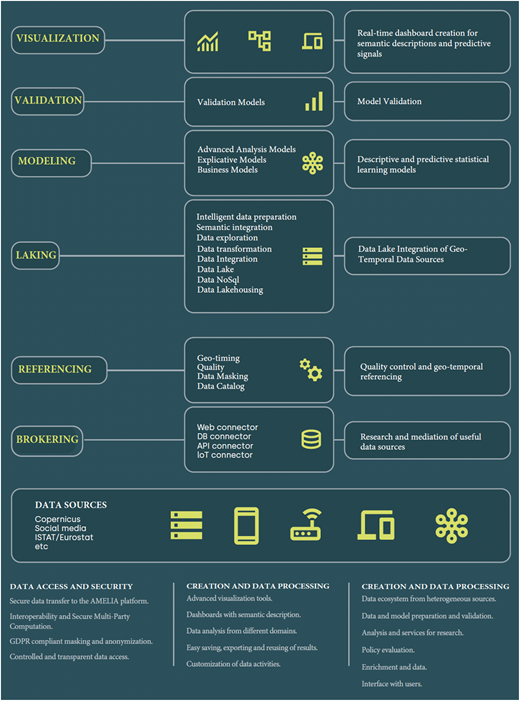
AMELIA is a sophisticated, cloud-based software-as-a-service platform (Figure 1) designed to collect, harmonize and disseminate data from a broad range of sources (Bereznoy et al., 2021; van Biljon et al., 2017), thereby supporting Italy’s transition to a knowledge-driven economy (Fondazione GRINS, 2025). It is developed inside the GRINS Project, a pioneering endeavor within Italy’s National Recovery and Resilience Plan - PNRR (Fondazione GRINS, 2025). The platform embodies the fundamental principles of a knowledge ecosystem, centralizing diverse data types (including structured, semi-structured and unstructured information) within a unified repository (Haasz and Baracskai, 2022; Wareham et al., 2014). The AMELIA system has been developed in accordance with a data mesh architectural framework, which represents a contemporary approach to data management, with the goal of unifying data from diverse sources into a coherent and reliable knowledge base (Bereznoy et al., 2021).

In a context where traditional decision-making processes are frequently hampered by fragmented, obsolete or difficult to-access data, AMELIA integrates datasets in a consistent, high-quality format for stakeholders thus bridging that gap through a dynamic and integrated data-knowledge platform that allows: making evidence-based (data driven) decisions in real time; ensuring transparency and accountability in governance choices; actively involving citizens, businesses and researchers; ensuring privacy and security in data processing, collaborating seamlessly between sectors and stakeholders (Fondazione GRINS, 2025).

The platform’s utility as a collaborative research tool is enhanced by AMELIA’s Data Dictionary – a carefully organized collection of data sets classified in different categories – which support cross-referencing, thematic indexing and advanced search features that facilitate knowledge discovery. The creation of thematic clusters allows the identification of predictions for a wide range of applications, generating customized reports. These reports are modeled on the complex and differentiated needs of various stakeholders, including small- and medium-sized enterprises (SMEs), local administrations and academic researchers. Consequently, users can locate and utilize specific information with greater ease and it is particularly beneficial for those engaged in the creation of strategic plans and programs, as policymakers, researchers and business professionals who require accurate and timely data (Fondazione GRINS, 2025; Yoo et al., 2010; Fisher et al., 2003).

AMELIA is designed to facilitate the seamless incorporation of data from diverse domains and integration with other systems, thanks to its optimized interoperability. This peculiarity provides crucial support for interdisciplinary research, thus fostering multi-stakeholder collaboration; AMELIA evolves and grows, continuously collecting and processing data, ensuring the scalability and its analytical capabilities in response to changing and emerging research challenges and needs (Fondazione GRINS, 2025).

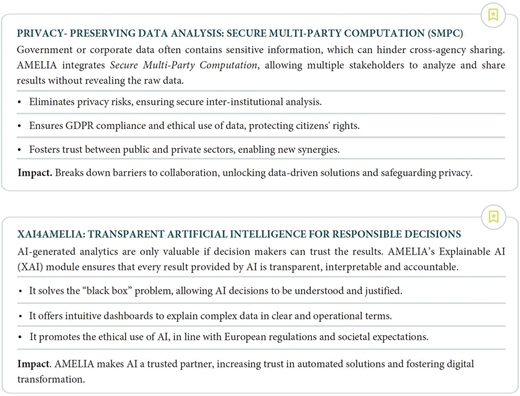
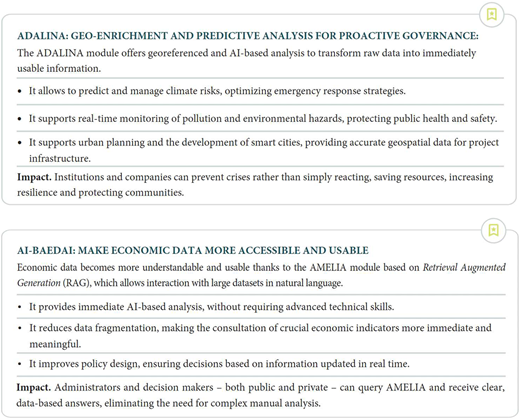
The platform also ensures compliance with the highest standards of data security and protection, promoting user trust and long-term sustainability. It uses machine learning, predictive analysis and Explainable Artificial Intelligence techniques to generate immediate insights. It is designed for full GDPR compliance, through data encryption tools, Secure Multi-Party Computation and synthetic data to avoid risks of personal data violation. It processes and integrates satellite images, Copernicus, Sentinel and LiDAR data to enrich information with geospatial components. Moreover, AMELIA incorporates an advanced multimedia rendering layer that facilitates enhanced accessibility for users with diverse requirements and varying degrees of technical expertise. The user interface of AMELIA is designed to enable users to visualize data in a range of formats, including interactive charts, maps and dashboards. This latter specificity also enables users without high technical skills to interpret and utilize information from complex data sets (Fondazione GRINS, 2025; Wareham et al., 2014). It is of great consequence that this functionality is promoted, as it facilitates meaningful stakeholder engagement, thereby fostering an evidence-based approach to decision-making since through the standardization and integration of heterogeneous data sources, the platform transforms fragmented information into coherent and actionable insights (Bereznoy et al., 2021; Haasz and Baracskai, 2022). Specifically, AMELIA is based on a series of innovative services, each designed to solve critical issues in public management and in the activities of businesses and researchers, revolutionizing the use of data to make informed decisions, such as simulations, predictive analysis and scenario planning for stakeholders to reduce the impact of environmental and economic shocks (Figure 2).

By assisting decision-makers in risk assessment and in monitoring progress toward policy targets, AMELIA operationalizes data for policy impact. Its ability to synthesize qualitative and quantitative dimensions within a unified interface facilitates evidence-based governance and economically viable planning.

Since a distinctive aspect of the GRINS project is its commitment to social inclusion, particularly in relation to groups traditionally excluded from data-driven policy processes, through the deployment of AMELIA, specifically as a tool of structural intellectual capital, the project facilitates more equitable access to strategic information among diverse user communities, including young people not in education, employment or training, underrepresented populations and local actors with limited technical capacity. By enabling these stakeholders to access and interpret relevant data, AMELIA helps reduce informational asymmetries that often exacerbate existing ecosystem and social inequalities. In doing so, the platform also supports the creation of a more inclusive and distributed knowledge ecosystem operating in its dimension of relational capital. AMELIA’s role extends beyond aggregation: it acts as a strategic enabler for data integration, participatory analysis and inclusive visualization practices that empower local stakeholders.

The platform plays an indispensable role in fostering resilience and inclusiveness, facilitating the development of quantitative, data-driven approaches in a field, namely the socio-economic field, which has heretofore been primarily governed by qualitative sources (Haasz and Baracskai, 2022).

As a flexible and continuously evolving research infrastructure, AMELIA addresses structural barriers to inclusion that continue to limit Italy’s economic potential. At the same time, it lays the foundation for long-term, territorial balanced development that is consistent with both national objectives and broader European sustainability agendas.

As an exploratory single-case study, the implications discussed in this section primarily reflect ex-ante-defined rather than fully realized impacts, given the early deployment stage of the AMELIA platform. This allows us to delineate the boundaries of validity and the generative and exploratory nature of the contribution. In this context, the following discussion illustrates how AMELIA potentially enhances the three dimensions of Ecosystem Intellectual Capital – human, structural and relational – based on the integration, management and dissemination of knowledge within the ecosystem.

By linking the platform’s functionalities to these three dimensions, we can see how AMELIA acts not merely as a repository of data but as a catalyst for enhancing human capabilities, facilitating collaborative networks and consolidating structural assets, thereby operationalizing the theoretical principles of intellectual capital within a territorial context (Trequattrini et al., 2018).

According to Marinelli et al.’s (2023) approach, AMELIA coordinates human, structural and relational capital at both the micro and meso levels by aligning the skills and goals of individual actors with the goals of the whole ecosystem for sustainable development. Its role of “localized orchestration” is what makes it different from other research data infrastructures (EU Com, 2024).

By improving data literacy, information sharing and cooperative learning among local players, AMELIA helps to strengthen ecosystem human capital. In line with the literature emphasizing human capital as a dynamic combination of knowledge, skills and competences essential for organizational and ecosystem success (Cuozzo et al., 2017; Alvino et al., 2021), AMELIA operationalizes this by providing users with advanced analytical and visualization tools that transform complex datasets into actionable knowledge. This enables stakeholders to interpret trends, identify opportunities and make decisions grounded in evidence, demonstrating the platform’s role as an enabler of knowledge acquisition, cognitive skill development and continuous learning within the ecosystem.

By means of its strong and advanced cloud-based architecture and unified data repositories, AMELIA greatly enhances even structural capital. It offers a cohesive, interoperable digital ecosystem that incorporates advanced analytics, predictive decision-support tools and comprehensive data integration protocols. This integration guarantees the smooth aggregation, harmonization and application of various data sources, thereby facilitating more informed, proactive policy-making and resource optimization (Benevene and Cortini, 2010; Alvino et al., 2021). Moreover, AMELIA’s sophisticated search capabilities and data dictionary provide excellent, consistent data management, enhancing organizational efficiency and decision support capacity inside ecosystems. This addresses the importance of dynamic infrastructures able to effectively manage and distribute information, hence supporting sustainable ecosystem development (Quintero-Quintero et al., 2021; Romano et al., 2014). By ensuring continuity, interoperability and scalability, AMELIA consolidates the structural assets of the ecosystem, providing the technological and organizational backbone required for long-term knowledge accumulation and governance (Orlando et al., 2020; Wareham et al., 2014).

Then, serving as a catalyst for open innovation and inter-institutional collaboration, AMELIA clearly promotes relational capital by applying participatory governance techniques and supporting multi-stakeholder cooperation by means of interactive tools that enable open dialog and continuous feedback systems. The platform’s infrastructure links trust-based networks of SMEs, universities, public institutions and civil society groups, hence promoting collaborative problem-solving. Through data-driven insights and shared ecosystem intelligence, this cooperative ecosystem supports collective socio-economic value creation, improves collaborations and enables the constant interchange of knowledge and information (Chin et al., 2023; Romano et al., 2014; Ramezan, 2011).

This three-dimensional conception aligns with the concept of AMELIA as enabling factor for knowledge spillovers, collective learning, competition and collaboration by turning data into useful information (Temouri et al., 2025).

To generate and measure a broad Intellectual Capital (IC) impact, we can base our approach on two tools developed by Romano et al. (2025): the IC-based Research Impact Tool (ICRIT) and the IC-based Research Impact Report (ICRIR).

ICRIT is a method of showing how the research initiative co-creates value for all the stakeholders, seizing possibilities to be exploited and helping to quickly spot non-productive tasks to be cut. Adopting the ICRIT allows to plan, monitor and report outputs, outcomes and impacts, hence producing more important results (Romano et al., 2025). This tool is a reduced version of the research logic that can be seen as a common language across the research team. A depiction like this helps to manage the complexity of a research endeavor and to highlight and grasp the pertinent components in a particular field and their interactions (Cunningham et al., 2018, 2020; Del Giudice and Maggioni, 2014). Thus, regarding the business model, an ICRIT helps to capture, illustrate and convey the rationale of a project. Mapped and comprehended under such a framework, a project lays the groundwork to strengthen its proactive abilities to react to outside influences (Del Giudice et al., 2017). Furthermore, it coordinates research with commercial value, allowing to foster and support innovation.

ICRIR, on the other hand, assesses the largest impact of the project in the form of new incremental wealth generated in the region. Incremental wealth can take different forms depending on the type of impact and can affect different types of beneficiaries (Romano et al., 2025). Reporting impact means to monitor several KPIs concerning the different fields in which the project can generate outcomes and, consequently, impact. The following categories related to the Structural Intellectual Capital dimension will be monitored within the AMELIA infrastructure (Kohl et al., 2015). The first level of analysis concerns the “direct economic impact”, referring to the immediate monetary flows associated with wages paid, taxes collected and profits reinvested into the system – representing the tangible financial contribution stemming from structural assets (Kohl et al., 2015; Lerro and Schiuma, 2009). The second level is the “indirect economic impact”, which arises from the production chain composed of suppliers of goods and services functionally related to the sector. This impact is assessed by examining the liquidity reintroduced into the system through initial investments, operational expenditures and collaborations with strategic partners. A further dimension is the “induced economic impact”, resulting from the spending and consumption patterns of stakeholders involved in both the direct and indirect chains. This impact is measured by the cascading effects of investments, operational spending and the consumption behavior of employees and collaborators (Romano et al., 2025). In addition, AMELIA allows for the assessment of “environmental impact”, encompassing benefits aligned with key environmental objectives such as CO2 emission reduction, climate change mitigation and adaptation, sustainable resource management and the transition toward a circular economy. Beyond the Structural IC dimension, AMELIA also enables the monitoring of “social impact” across all three pillars of intellectual capital (human, structural and relational). These impacts stem from the creation and diffusion of knowledge through patents, spin-offs, scientific publications and educational outputs, as well as from broader processes of knowledge spillover (Romano et al., 2025).

In the domain of human capital, relevant indicators include levels of educational attainment, the capacity for knowledge diffusion across supply chains and scientific networks and the scientific attractiveness of the region (Romano et al., 2025; Kohl et al., 2015). Regarding structural capital, attention is directed to the emergence of new business ventures linked to the infrastructure, the market value of patents and publications and the provision of high-value services to the local ecosystem. For relational capital, key drivers include the strength of collaborative networks, the quality of interactions between academic and industrial actors, the attraction of foreign direct investment, the enhancement of ecosystem reputation and the generation of non-market value, such as symbolic or reputational gains (Schiuma et al., 2008; Romano et al., 2025).

Each of these categories is associated with specific KPIs, whose aggregation provides a comprehensive estimate of the impact generated by the infrastructure. The classification of impacts across the three dimensions of intellectual capital facilitates a nuanced understanding of how AMELIA contributes to ecosystem development dynamics (Kohl et al., 2015).

From this perspective, AMELIA is not merely a repository of resources or a locus of activity, but rather a catalyst for the enhancement of local intellectual capital. It nurtures human capital, understood as the collective knowledge and competencies embedded in the region; it strengthens relational capital through high-quality interactions that foster innovation and cohesion; and it enriches structural capital, which encompasses the cultural, institutional and infrastructural assets rooted in the ecosystem context (Trequattrini et al., 2018). The research infrastructure’s capacity to simultaneously foster all three components of intellectual capital makes it a key driver of local economic growth and a strategic asset in enhancing ecosystem competitiveness on a global scale.

A Data Knowledge Platform, as a research infrastructure, represents a valuable opportunity that cannot be underestimated in sustaining Ecosystem Intellectual Capital. It is an essential facilitator for the integration of different knowledge management systems in a data platform, increasing the level of intangible human, structural and relational assets in a spatial Ecosystem.

Ecosystem Intellectual Capital has been conceptualized as the value of the knowledge assets that fuel value creation processes of the referred region, since knowledge itself represents the foundation of all Intellectual Capital components (Schiuma et al., 2008). All the knowledge managed by the research infrastructure is leveraged to generate different kinds of long-term impact that contribute to enhancing sustainable ecosystem competitiveness (Kohl et al., 2015; Lerro and Schiuma, 2009).

The data knowledge platform AMELIA demonstrates how digital platforms can be the decisive tool to Ecosystem Intellectual Capital by exploiting all the different datasets available through innovative and sophisticated analysis algorithms that transform raw data into knowledge resources. In this way, all the stakeholders involved, such as governments, SMEs, public and private organizations and the ecosystem as a whole, will be able to significantly improve the stock of Intellectual Capital.

From an entrepreneurial perspective, AMELIA’s unique expertise, such as in climate stress testing, ESG scoring and market trend analysis thanks to the data entered and processed, significantly helps managers identify growth opportunities, improve business continuity and reduce environmental risks. As a result, companies can leverage the re-elaboration of this data in terms of advancing the intellectual capital at their disposal to sharpen their strategic direction, improve sustainability performance and establish competitive advantages in increasingly dynamic markets. Secondly, AMELIA supports academia and research institutions by enabling the integration and analysis of different data sets, thus bridging the gap between theoretical research and practical application and acting as a strategic infrastructure supporting the connection between structural and relational intellectual capital with all potential stakeholders concerned. Indeed, the machine learning and AI used by the platform help academic managers to maximize the reach and visibility of their research results, while strengthening collaboration with industry players.

From a managerial and policymaker point of view, this paper offers significant insights into how data, processed by a knowledge-based research infrastructure, could facilitate the accumulation of intellectual capital both for companies, academia and research institutions and the ecosystem as a whole. Particularly, data combination and knowledge provided by AMELIA returns scenario planning to help allocate resources based on evidence and, consequentially, disadvantaged communities can more effectively benefit from focused policy interventions based on specific data, according to the idea that proximity-based knowledge platforms improve collective competitiveness.

From a theoretical point of view, it offers a theoretical understanding of mechanisms and tools enhancing the stock of intellectual capital in an ecosystem and its long-term impact.

The views and opinions expressed are solely those of the authors and do not necessarily reflect those of the European Union, nor can the European Union be held responsible for them.
Adner
,
R.
(
2017
), “
Ecosystem as structure: an actionable construct for strategy
”,
Journal of Management
, Vol. 
43
No. 
1
, pp. 
39
-
58
, doi: .
Alvino
,
F.
,
Di Vaio
,
A.
,
Hassan
,
R.
and
Palladino
,
R.
(
2021
), “
Intellectual capital and sustainable development: a systematic literature review
”,
Journal of Intellectual Capital
, Vol. 
22
No. 
1
, pp. 
76
-
94
, doi: .
Autio
,
E.
and
Thomas
,
L.D.W.
(
2022
), “
Researching ecosystems in innovation contexts
”,
Innovation and Management Review
, Vol. 
19
No. 
1
, pp. 
12
-
25
, doi: .
Benevene
,
P.
and
Cortini
,
M.
(
2010
), “
Interaction between structural capital and human capital in Italian NPOs: leadership, organizational culture and human resource management
”,
Journal of Intellectual Capital
, Vol. 
11
No. 
2
, pp. 
123
-
139
, doi: .
Bereznoy
,
A.
,
Meissner
,
D.
and
Scuotto
,
V.
(
2021
), “
The intertwining of knowledge sharing and creation in the digital platform based ecosystem. A conceptual study on the lens of the open innovation approach
”,
Journal of Knowledge Management
, Vol. 
25
No. 
8
, pp. 
2022
-
2042
, doi: .
Blasco-Arcas
,
L.
,
Alexander
,
M.
,
Sörhammar
,
D.
,
Jonas
,
J.M.
,
Raithel
,
S.
and
Chen
,
T.
(
2020
), “
Organizing actor Engagement: a platform perspective
”,
Journal of Business Research
, Vol. 
118
, pp. 
74
-
85
, doi: .
Bogers
,
M.
,
Chesbrough
,
H.
,
Heaton
,
S.
and
Teece
,
D.J.
(
2019
), “
Strategic management of open innovation: a dynamic capabilities perspective
”,
California Management Review
, Vol. 
62
No. 
1
, pp. 
77
-
94
, doi: .
Bontis
,
N.
(
2004
), “
National intellectual capital index: a United Nations initiative for the Arab region
”,
Journal of Intellectual Capital
, Vol. 
5
No. 
1
, pp. 
13
-
39
, doi: .
Broekhuizen
,
T.
,
Emrich
,
O.
,
Gijsenberg
,
M.
,
Broekhuis
,
M.
,
Donkers
,
B.
and
Sloot
,
L.
(
2019
), “
Digital platform openness: drivers, dimensions and outcomes
”,
Journal of Business Research
, Vol. 
122
, pp. 
902
-
914
, doi: .
Cappellin
,
R.
(
2003
), “
Ecosystem knowledge management: towards a metrics of the cognitive dimension of agglomeration economies
”,
International Journal of Technology Management
, Vol. 
26
Nos
2-4
, pp. 
303
-
325
, doi: .
Catanzaro
,
A.
,
Messeghem
,
K.
and
Sammut
,
S.
(
2019
), “
Effectiveness of export support programs: impact on the relational capital and international performance of early internationalizing small businesses
”,
Journal of Small Business Management
, Vol. 
57
 
No. sup2
, pp. 
436
-
461
, doi: .
Cennamo
,
C.
and
Santalo
,
J.
(
2013
), “
Platform competition: strategic trade-offs in platform markets
”,
Strategic Management Journal
, Vol. 
34
No. 
11
, pp. 
1331
-
1350
, doi: .
Chesbrough
,
H.W.
(
2019
),
Open Innovation Results: Going beyond the Hype and Getting Down to Business
,
Oxford University Press
,
Oxford
.
Chijioke
,
A.K.
and
Amadi
,
A.I.
(
2019
), “
Human capital investment as a catalyst for sustainable economic development in Nigeria
”,
International Journal of Management Science and Business Administration
, Vol. 
5
No. 
5
, pp. 
13
-
22
, doi: .
Chin
,
T.
,
Del Giudice
,
M.
,
Di Vaio
,
A.
,
Fiano
,
F.
,
Garcia-Perez
,
A.
,
Paoloni
,
N.
and
Magni
,
D.
(
2023
), “
Guest editorial: unveiling the roles of intellectual capital in entrepreneurial ecosystems: evidence from moderate innovative countries
”,
Journal of Intellectual Capital
, Vol. 
24
No. 
1
, pp. 
1
-
9
, doi: .
Constantinides
,
P.
,
Henfridsson
,
O.
and
Parker
,
G.G.
(
2018
), “
Platforms and infrastructures in the digital age
”,
Information Systems Research
, Vol. 
29
No. 
2
, pp. 
381
-
400
, doi: .
Cunningham
,
J.A.
,
Menter
,
M.
and
O’Kane
,
C.
(
2018
), “
Value creation in the quadruple helix: a micro level conceptual model of principal investigators as value creators
”,
R&D Management
, Vol. 
48
No. 
1
, pp. 
136
-
147
, doi: .
Cunningham
,
J.
,
Del Giudice
,
M.
,
Nicotra
,
M.
,
O’Kane
,
C.
and
Romano
,
M.
(
2020
), “Principal investigators and knowledge management: a micro foundational conceptual framework”, in
Audritch
,
D.
,
Lehmann
,
E.
and
Link
,
A.
(Eds),
Handbook of Technology Transfer
,
Edward Elgar Publisher
,
Cheltenham
.
Cuozzo
,
B.
,
Dumay
,
J.
,
Palmaccio
,
M.
and
Lombardi
,
R.
(
2017
), “
Intellectual capital disclosure: a structured literature review
”,
Journal of Intellectual Capital
, Vol. 
18
No. 
1
, pp. 
9
-
28
, doi: .
Cusumano
,
M.A.
,
Yoffie
,
D.B.
and
Gawer
,
A.
(
2020
), “
The future of platforms
”,
MIT Sloan Management Review
, Vol. 
61
No. 
3
, pp. 
46
-
54
.
Dameri
,
R.P.
and
Ricciardi
,
F.
(
2015
), “
Smart city intellectual capital: an emerging view of ecosystem systems innovation management
”,
Journal of Intellectual Capital
, Vol. 
16
No. 
4
, pp. 
860
-
887
, doi: .
De Reuver
,
M.
,
Sørensen
,
C.
and
Basole
,
R.C.
(
2018
), “
The digital platform: a research agenda
”,
Journal of Information Technology
, Vol. 
33
No. 
2
, pp. 
124
-
135
, doi: .
Del Giudice
,
M.
and
Maggioni
,
V.
(
2014
), “
Managerial practices and operative directions of knowledge management within inter-firm networks: a global view
”,
Journal of Knowledge Management
, Vol. 
18
No. 
5
, pp. 
841
-
846
, doi: .
Del Giudice
,
M.
,
Nicotra
,
M.
,
Romano
,
M.
and
Schillaci
,
C.E.
(
2017
), “
Entrepreneurial performance of principal investigators and country culture: relations and influences
”,
The Journal of Technology Transfer
, Vol. 
42
No. 
2
, pp. 
320
-
337
, doi: .
Demchenko
,
Y.
,
Grosso
,
P.
,
De Laat
,
C.
and
Membrey
,
P.
(
2013
), “
Addressing big data issues in scientific data infrastructure
”,
Proceeding 2013 International Conference on Collaboration Technologies and Systems (CTS 2013)
,
San Diego, CA
,
[PubMed]
.
Eisenhardt
,
K.M.
(
1989
), “
Building theories from case study research
”,
Academy of Management Review
, Vol. 
14
No. 
4
, pp. 
532
-
550
, doi: .
Eloranta
,
V.
and
Turunen
,
T.
(
2016
), “
Platforms in service-driven manufacturing: leveraging complexity by connecting, sharing, and integrating
”,
Industrial Marketing Management
, Vol. 
55
, pp. 
178
-
186
, doi: .
Erickson
,
S.
and
Rothberg
,
H.
(
2014
), “
Big data and knowledge management: establishing a conceptual foundation
”,
Electronic Journal of Knowledge Management
, Vol. 
12
No. 
2
, pp. 
108
-
116
.
ESFRI
(
2024
),
Landscape Analysis 2024 for the ESFRI Roadmap
,
ESFRI Roadmap 2024
,
Milan
.
European Commission
(
2024a
),
The European Data Market Study 2024-2026
,
Lisbon Council Research
.
European Commission
(
2024b
),
European Research Area and Research Infrastructures: Policy Priorities
.
Facin
,
A.L.F.
,
De Vasconcelos Gomes
,
L.A.
,
De Mesquita Spinola
,
M.
and
Salerno
,
M.S.
(
2016
), “
The evolution of the platform concept: a systematic review
”,
IEEE Transactions on Engineering Management
, Vol. 
63
No. 
4
, pp. 
475
-
488
, doi: .
Ferrari
,
T.
,
Scardaci
,
D.
and
Andreozzi
,
S.
(
2018
), “The open science commons for the European research area”, in
Mathieru
,
P.P.
and
Aubrecht
,
C.
(Eds),
Earth Observation Open Science and Innovation. ISSI Scientific Report Series Book Series
,
Springer
,
Cham
, Vol. 
15
, pp. 
43
-
67
, doi: .
Fisher
,
C.W.
,
Chengalur-Smith
,
I.
and
Ballou
,
D.P.
(
2003
), “
The impact of experience and time on the use of data quality information in decision making
”,
Information Systems Research
, Vol. 
14
No. 
2
, pp. 
170
-
188
, doi: .
Fondazione GRINS
(
2025
),
Soluzioni data-driven e research-based per la sostenibilità e la resilienza di sistemi e territory: Il contributo del partenariato GRINS e della piattaforma dati AMELIA. Handbook di progetto
,
Fondazione GRINS
,
Bologna
.
Gawer
,
A.
and
Cusumano
,
M.A.
(
2014
), “
Industry platforms and ecosystem innovation
”,
Journal of Product Innovation Management
, Vol. 
31
No. 
3
, pp. 
417
-
433
, doi: .
Grande
,
S.
,
Bertello
,
A.
,
De Bernardi
,
P.
and
Ricciardi
,
F.
(
2023
), “
Enablers of explorative and exploitative intellectual capital in entrepreneurial ecosystems
”,
Journal of Intellectual Capital
, Vol. 
24
No. 
1
, pp. 
35
-
69
, doi: .
Haasz
,
G.
and
Baracskai
,
Z.
(
2022
), “
Collaborative knowledge platform: when the learning route provides data for the knowledge-based system
”,
Knowledge Management Research and Practice
, Vol. 
20
No. 
6
, pp. 
925
-
934
, doi: .
Helfat
,
C.E.
and
Raubitschek
,
R.S.
(
2018
), “
Dynamic and integrative capabilities for profiting from innovation in digital platform-based ecosystems
”,
Research Policy
, Vol. 
47
No. 
8
, pp. 
1391
-
1399
, doi: .
Huang
,
P.
,
Ceccagnoli
,
M.
,
Forman
,
C.
and
Wu
,
D.J.
(
2013
), “
Appropriability mechanisms and the platform partnership decision: evidence from enterprise software
”,
Management Science
, Vol. 
59
No. 
1
, pp. 
102
-
121
, doi: .
Intezari
,
A.
and
Gressel
,
S.
(
2017
), “
Information and reformation in KM systems: big data and strategic decision-making
”,
Journal of Knowledge Management
, Vol. 
21
No. 
1
, pp. 
71
-
91
, doi: .
Jacobides
,
M.G.
,
Cennamo
,
C.
and
Gawer
,
A.
(
2018
), “
Towards a theory of ecosystems
”,
Strategic Management Journal
, Vol. 
39
No. 
8
, pp. 
2255
-
2276
, doi: .
Kim
,
J.
(
2016
), “
The platform business model and business ecosystem: quality management and revenue structures
”,
European Planning Studies
, Vol. 
24
No. 
12
, pp. 
2113
-
2132
, doi: .
Kohl
,
H.
,
Wuscher
,
S.
,
Orth
,
R.
and
Steinhofel
,
E.
(
2015
), “
Intellectual capital statements as a driver for regional development
”,
European Conference on Intangibles and Intellectual Capital
, p.
189
.
Kudyba
,
S.
and
D Cruz
,
A.
(
2023
), “
Understanding project success involving analytic-based decision support in the digital era: a focus on IC and agile project management
”,
Journal of Intellectual Capital
, Vol. 
24
No. 
6
, pp. 
1429
-
1446
, doi: .
Kuzkin
,
Y.
,
Cherkashyna
,
T.
,
Nebaba
,
N.
and
Kuchmacz
,
B.
(
2019
), “
Economic growth of the country and NIC
”,
Problems and Perspectives in Management
, Vol. 
17
No. 
1
, pp. 
348
-
359
.
Lakhani
,
K.R.
,
Lifshitz-Assaf
,
H.
and
Tushman
,
M.L.
(
2013
), “Open innovation and organizational boundaries: task decomposition, knowledge distribution and the locus of innovation”,
Handbook of Economic Organization
,
Edward Elgar Publishing
,
Cheltenham
, pp.
355
-
382
.
Langley
,
P.
and
Leyshon
,
A.
(
2017
), “
Platform capitalism: the intermediation and capitalisation of digital economic circulation
”,
Finance and society
, Vol. 
3
No. 
1
, pp. 
11
-
31
, doi: .
Lerro
,
A.
and
Schiuma
,
G.
(
2009
), “
Knowledge-based dynamics of regional development: the case of Basilicata region
”,
Journal of Knowledge Management
, Vol. 
13
No. 
5
, pp. 
287
-
300
, doi: .
Lin
,
C.Y.
(
2018
), “
Intellectual capital of South Africa: a comparison with Poland and Romania
”,
Journal of Intellectual Capital
, Vol. 
19
No. 
3
, pp. 
498
-
518
, doi: .
Lundvall
,
B.Ä.
and
Johnson
,
B.
(
1994
), “
The learning economy
”,
Journal of Industry Studies
, Vol. 
1
No. 
2
, pp. 
23
-
42
, doi: .
Lyytinen
,
K.
and
Newman
,
M.
(
2008
), “
Explaining information systems change: a punctuated socio-technical change model
”,
European Journal of Information Systems
, Vol. 
17
No. 
6
, pp. 
589
-
613
, doi: .
Marinelli
,
L.
,
Bartoloni
,
S.
,
Pascucci
,
F.
,
Gregori
,
G.L.
and
Farina Briamonte
,
M.
(
2023
), “
Genesis of an innovation-based entrepreneurial ecosystem: exploring the role of intellectual capital
”,
Journal of Intellectual Capital
, Vol. 
24
No. 
1
, pp. 
10
-
34
, doi: .
Moore
,
J.F.
(
1993
), “
Predators and prey: a new ecology of competition
”,
Harvard Business Review
, Vol. 
71
No. 
3
, pp. 
75
-
86
.
Nicotra
,
M.
(
2019
),
Shifting Paradigms in Entrepreneurial Ecosystems: A Data-Driven Perspective
,
UTET
,
Milano
, ISBN:
[PubMed]
.
Nieuwenhuis
,
L.J.
,
Ehrenhard
,
M.L.
and
Prause
,
L.
(
2018
), “
The shift to cloud computing: the impact of disruptive technology on the enterprise software business ecosystem
”,
Technological Forecasting and Social Change
, Vol. 
129
, pp. 
308
-
313
, doi: .
North
,
K.
(
2018
),
Knowledge Management: Value Creation through Organizational Learning
,
Springer
,
Cham
.
OECD
(
2019
),
Measuring the Digital Transformation: A Roadmap for the Future
,
OECD Publishing
,
Paris
.
OECD
(
2020
),
The Digitalisation of Science, Technology and Innovation: Key Developments and Policies
,
OECD Publishing
,
Paris
.
Okumura
,
R.
and
Deguchi
,
H.
(
2021
), “
Indicating human capital including non-economic value
”,
Evolutionary and Institutional Economics Review
, Vol. 
18
No. 
1
, pp. 
45
-
62
, doi: .
Orlando
,
B.
,
Mazzucchelli
,
A.
,
Usai
,
A.
,
Nicotra
,
M.
and
Paoletti
,
F.
(
2020
), “
Are digital technologies killing future innovation? The curvilinear relationship between digital technologies and firm’s intellectual property
”,
Journal of Intellectual Capital
, Vol. 
22
No. 
3
, pp. 
587
-
609
, doi: .
Parker
,
G.
,
Van Alstyne
,
M.
and
Jiang
,
X.
(
2017
), “
Platform ecosystems: how developers invert the firm
”,
MIS Quarterly: Management Information Systems
, Vol. 
41
No. 
1
, pp. 
255
-
266
, doi: .
Pike
,
S.
,
Rylander
,
A.
and
Roos
,
G.
(
2002
), “Intellectual capital management and disclosure”, in
Choo
,
C.W.
and
Bontis
,
N.
(Eds),
The Strategic Management of Intellectual Capital and Organizational Knowledge
,
Oxford University Press
,
New York, NY
, pp.
657
-
671
.
Quintero-Quintero
,
W.
,
Blanco-Ariza
,
A.
and
Garzón-Castrillón
,
M.
(
2021
), “
Intellectual capital: a review and bibliometric analysis
”,
Publications
, Vol. 
9
No. 
46
, doi: .
Ramezan
,
M.
(
2011
), “
Intellectual capital and organizational organic structure in knowledge society: how are these concepts related?
”,
International Journal of Information Management
, Vol. 
31
No. 
1
, pp. 
88
-
95
, doi: .
Rietveld
,
J.
,
Schilling
,
M.A.
and
Bellavitis
,
C.
(
2019
), “
Platform strategy: managing ecosystem value through selective promotion of complements
”,
Organization Science
, Vol. 
30
No. 
6
, pp. 
1232
-
1251
, doi: .
Romano
,
M.
and
Nicotra
,
M.
(
2020
), “Technologies 4.0 towards digital transformation”, in
Bresciani
,
S.
,
Ferraris
,
A.
,
Romano
,
M.
and
Santoro
,
G.
(Eds),
Digital Transformation Management for Agile Organizations
,
Emerald Organizations
, ISBN
[PubMed]
.
Romano
,
M.
,
Catalfo
,
P.
and
Nicotra
,
M.
(
2014
), “
Science parks and intellectual capital: an integrated model for intangibles’ representation, evaluation and control
”,
Journal of Intellectual Capital
, Vol. 
15
No. 
4
, pp. 
537
-
553
, doi: .
Romano
,
M.
,
Nicotra
,
M.
and
Munnia
,
A.
(
2020
), “Data management”, in
Bresciani
,
S.
,
Ferraris
,
A.
,
Romano
,
M.
and
Santoro
,
G.
(Eds),
Digital Transformation Management for Agile Organizations
,
Emerald Organizations
, ISBN
[PubMed]
.
Romano
,
M.
,
Cunningham
,
J.A.
,
Cuttone
,
G.
,
Munnia
,
A.
and
Nicotra
,
M.
(
2025
), “
Intellectual capital-based research impact management: a strategic approach to increase regional intellectual capital
”,
Journal of Intellectual Capital
, Vol. 
26
No. 
7
, pp. 
24
-
42
, doi: .
Roos
,
G.
,
Pike
,
S.
and
Fernstrom
,
L.
(
2007
),
Managing Intellectual Capital in Practice
,
Routledge
,
Oxford
.
Sawhney
,
M.
and
Nambisan
,
S.
(
2007
),
The Global Brain: Your Roadmap for Innovating Faster and Smarter in a Networked World
,
Pearson Prentice Hall
,
New Jersey
.
Schiuma
,
G.
,
Lerro
,
A.
and
Carlucci
,
D.
(
2008
), “
The knoware tree and the regional intellectual capital index: an assessment within Italy
”,
Journal of Intellectual Capital
, Vol. 
9
No. 
2
, pp. 
283
-
300
, doi: .
Scuotto
,
V.
,
Arrigo
,
E.
,
Candelo
,
E.
and
Nicotra
,
M.
(
2019
), “
Ambidextrous innovation orientation effected by the digital transformation. A quantitative research on fashion SMEs
”,
Business Process Management Journal
, Vol. 
26
No. 
5
, pp. 
1121
-
1140
,
[PubMed]
, doi: .
Scuotto
,
V.
,
Nicotra
,
M.
,
Del Giudice
,
M.
,
Krueger
,
N.
and
Gregori
,
G.L.
(
2021
), “
A microfoundational perspective on SMEs’ growth in the digital transformation era
”,
Journal of Business Research
, Vol. 
129
, pp. 
382
-
392
, doi: .
Secundo
,
G.
,
Dumay
,
J.
,
Schiuma
,
G.
and
Passiante
,
G.
(
2016
), “
Managing intellectual capital through a collective intelligence approach: an integrated framework for universities
”,
Journal of Intellectual Capital
, Vol. 
17
No. 
2
, pp. 
298
-
319
, doi: .
Secundo
,
G.
,
Massaro
,
M.
,
Dumay
,
J.
and
Bagnoli
,
C.
(
2018
), “
Intellectual capital management in the fourth stage of IC research: a critical case study in university settings
”,
Journal of Intellectual Capital
, Vol. 
19
No. 
1
, pp. 
157
-
177
, doi: .
Siggelkow
,
N.
(
2007
), “
Persuasion with case studies
”,
Academy of Management Journal
, Vol. 
50
No. 
1
, pp. 
20
-
24
, doi: .
Song
,
Y.
,
Wei
,
Y.
,
Zhu
,
J.
,
Liu
,
J.
and
Zhang
,
M.
(
2021
), “
Environmental regulation and economic growth: a new perspective based on technical level and healthy human capital
”,
Journal of Cleaner Production
, Vol. 
318
, 128520, doi: .
Temouri
,
Y.
,
Luong
,
H.-P.
,
Pereira
,
V.
and
Rammal
,
H.
(
2025
), “
The role of cluster ecosystems and intellectual capital in achieving high growth entrepreneurship: evidence from Germany
”,
Journal of Intellectual Capital
, Vol. 
26
No. 
1
, pp. 
1
-
24
, doi: .
Trequattrini
,
R.
,
Lombardi
,
R.
,
Lardo
,
A.
and
Cuozzo
,
B.
(
2018
), “
The impact of entrepreneurial universities on regional growth: a local intellectual capital perspective
”,
Journal of the Knowledge Economy
, Vol. 
9
No. 
1
, pp. 
199
-
211
, doi: .
Tzu-Yorn
,
K.
and
Sandui
,
M.-E.
(
2017
), “
Process capital of Mongolia: year 2005-2014
”,
Journal of Economics and Political Economy
, Vol. 
4
No. 
3
, pp. 
302
-
305
.
van Biljon
,
J.
,
Marais
,
M.
and
Platz
,
M.
(
2017
), “
Digital platforms for research collaboration: using design science in developing a South African open knowledge repository
”,
Information Technology for Development
, Vol. 
23
No. 
3
, pp. 
463
-
485
, doi: .
Vargo
,
S.L.
,
Akaka
,
M.A.
and
Wieland
,
H.
(
2020
), “
Rethinking the process of diffusion in innovation: a service-ecosystems and institutional perspective
”,
Journal of Business Research
, Vol. 
116
, pp. 
526
-
534
, doi: .
Wareham
,
J.
,
Fox
,
P.B.
and
Giner
,
J.L.C.
(
2014
), “
Technology ecosystem governance
”,
Organization Science
, Vol. 
25
No. 
4
, pp. 
1195
-
1215
, doi: .
Yang
,
M.
and
Han
,
C.
(
2021
), “
Stimulating innovation: managing peer interaction for idea generation on digital innovation platforms
”,
Journal of Business Research
, Vol. 
125
, pp. 
456
-
465
, doi: .
Yin
,
R.K.
(
2009
),
Case Study Research: Design and Methods
, (4rd ed.) ,
Sage Publications
,
Thousand Oaks, CA
.
Yoo
,
Y.
,
Henfridsson
,
O.
and
Lyytinen
,
K.
(
2010
), “
Research commentary– the new organizing logic of digital innovation: an agenda for information systems research
”,
Information Systems Research
, Vol. 
21
No. 
4
, pp. 
724
-
735
, doi: .
Zhong
,
Q.
and
Sun
,
Y.
(
2020
), “
The more the better? Relational governance in platforms and the role of appropriability mechanisms
”,
Journal of Business Research
, Vol. 
108
, pp. 
62
-
73
, doi: .
Published by Emerald Publishing Limited. This article is published under the Creative Commons Attribution (CC BY 4.0) license. Anyone may reproduce, distribute, translate and create derivative works of this article (for both commercial and non-commercial purposes), subject to full attribution to the original publication and authors. The full terms of this license may be seen at Link to the terms of the CC BY 4.0 licence.

Data & Figures

Figure 1
A layered diagram showing data-related components grouped into labeled sections.The diagram presents multiple labeled sections arranged vertically, each connected by horizontal lines to corresponding textboxes on the right. At the top, the section labeled “VISUALIZATION” connects to a central box containing three icon graphics of charts and dashboards. This box connects to a right-side textbox labeled “Real-time dashboard creation for semantic descriptions and predictive signals”. Below it, the section labeled “VALIDATION” connects to a textbox labeled “Validation Models” with a bar chart icon, which connects to a right-side textbox labeled “Model Validation”. Below this, the section labeled “MODELING” connects to a textbox containing “Advanced Analysis Models”, “Explicative Models”, “Business Models”, and a flower-like icon. This connects to a right-side textbox labeled “Descriptive and predictive statistical learning models”. Below this, the section labeled “LAKING” connects to a larger textbox containing “Intelligent data preparation”, “Semantic integration”, “Data exploration”, “Data transformation”, “Data Integration”, “Data Lake”, “Data N o S q l”, “Data Lakehousing”, and a stacked bar icon. This connects to a right-side textbox labeled “Data Lake Integration of Geo-Temporal Data Sources”. Below this, the section labeled “REFERENCING” connects to a textbox containing “Geo-timing”, “Quality”, “Data Masking”, “Data Catalog”, and a gear icon. This connects to a right-side textbox labeled “Quality control and geo-temporal referencing”. Below this, the section labeled “BROKERING” connects to a textbox containing “Web connector”, “D B connector”, “A P I connector”, “I o T connector”, and a database icon. This connects to a right-side textbox labeled “Research and mediation of useful data sources”. At the bottom, a wide box labeled “DATA SOURCES” contains “Copernicus”, “Social media”, “I STAT/Eurostat”, and “etc”, along with icons representing different data types and devices. Below the main diagram, three horizontal sections provide additional information. The left section labeled “DATA ACCESS AND SECURITY” contains: “Secure data transfer to the AMELIA platform”, “Interoperability and Secure Multi-Party Computation”, “G D P R compliant masking and anonymization”, and “Controlled and transparent data access”. The middle section labeled “CREATION AND DATA PROCESSING” contains: “Advanced visualization tools”, “Dashboards with semantic description”, “Data analysis from different domains”, “Easy saving, exporting and reusing of results”, and “Customization of data activities”. The right section labeled “CREATION AND DATA PROCESSING” contains: “Data ecosystem from heterogeneous sources”, “Data and model preparation and validation”, “Analysis and services for research”, “Policy evaluation”, “Enrichment and data”, and “Interface with users”. The diagram shows grouped components and their corresponding descriptions without indicating a specific directional flow.

AMELIA structure (Fondazione GRINS, 2025)

Figure 1
A layered diagram showing data-related components grouped into labeled sections.The diagram presents multiple labeled sections arranged vertically, each connected by horizontal lines to corresponding textboxes on the right. At the top, the section labeled “VISUALIZATION” connects to a central box containing three icon graphics of charts and dashboards. This box connects to a right-side textbox labeled “Real-time dashboard creation for semantic descriptions and predictive signals”. Below it, the section labeled “VALIDATION” connects to a textbox labeled “Validation Models” with a bar chart icon, which connects to a right-side textbox labeled “Model Validation”. Below this, the section labeled “MODELING” connects to a textbox containing “Advanced Analysis Models”, “Explicative Models”, “Business Models”, and a flower-like icon. This connects to a right-side textbox labeled “Descriptive and predictive statistical learning models”. Below this, the section labeled “LAKING” connects to a larger textbox containing “Intelligent data preparation”, “Semantic integration”, “Data exploration”, “Data transformation”, “Data Integration”, “Data Lake”, “Data N o S q l”, “Data Lakehousing”, and a stacked bar icon. This connects to a right-side textbox labeled “Data Lake Integration of Geo-Temporal Data Sources”. Below this, the section labeled “REFERENCING” connects to a textbox containing “Geo-timing”, “Quality”, “Data Masking”, “Data Catalog”, and a gear icon. This connects to a right-side textbox labeled “Quality control and geo-temporal referencing”. Below this, the section labeled “BROKERING” connects to a textbox containing “Web connector”, “D B connector”, “A P I connector”, “I o T connector”, and a database icon. This connects to a right-side textbox labeled “Research and mediation of useful data sources”. At the bottom, a wide box labeled “DATA SOURCES” contains “Copernicus”, “Social media”, “I STAT/Eurostat”, and “etc”, along with icons representing different data types and devices. Below the main diagram, three horizontal sections provide additional information. The left section labeled “DATA ACCESS AND SECURITY” contains: “Secure data transfer to the AMELIA platform”, “Interoperability and Secure Multi-Party Computation”, “G D P R compliant masking and anonymization”, and “Controlled and transparent data access”. The middle section labeled “CREATION AND DATA PROCESSING” contains: “Advanced visualization tools”, “Dashboards with semantic description”, “Data analysis from different domains”, “Easy saving, exporting and reusing of results”, and “Customization of data activities”. The right section labeled “CREATION AND DATA PROCESSING” contains: “Data ecosystem from heterogeneous sources”, “Data and model preparation and validation”, “Analysis and services for research”, “Policy evaluation”, “Enrichment and data”, and “Interface with users”. The diagram shows grouped components and their corresponding descriptions without indicating a specific directional flow.

AMELIA structure (Fondazione GRINS, 2025)

Close modal
Figure 2
A set of four text panels describing AMELIA modules and their functions.The set of four rectangular text panels is arranged vertically, each with a bold heading, descriptive paragraph, bullet points, and an “Impact” statement. The content is consistent across the image and the four pages of the accompanying document. At the top, the first panel is titled “ADALINA: GEO-ENRICHMENT AND PREDICTIVE ANALYSIS FOR PROACTIVE GOVERNANCE:” and below it, a paragraph reads “The ADALINA module offers georeferenced and A I-based analysis to transform raw data into immediately usable information”. Three bullet points follow: “It allows to predict and manage climate risks, optimizing emergency response strategies”. “It supports real-time monitoring of pollution and environmental hazards, protecting public health and safety”. “It supports urban planning and the development of smart cities, providing accurate geospatial data for project infrastructure”. A final line reads “Impact. Institutions and companies can prevent crises rather than simply reacting, saving resources, increasing resilience and protecting communities”. The second panel is titled “A I- B A E D A I: MAKE ECONOMIC DATA MORE ACCESSIBLE AND USABLE”. The paragraph states, “Economic data becomes more understandable and usable thanks to the AMELIA module based on Retrieval Augmented Generation (RAG), which allows interaction with large datasets in natural language”. Three bullet points follow: “It provides immediate A I-based analysis, without requiring advanced technical skills”. “It reduces data fragmentation, making the consultation of crucial economic indicators more immediate and meaningful”. “It improves policy design, ensuring decisions based on information updated in real time”. The panel ends with “Impact. Administrators and decision makers – both public and private – can query AMELIA and receive clear, data-based answers, eliminating the need for complex manual analysis”. The third panel is titled “PRIVACY-PRESERVING DATA ANALYSIS: SECURE MULTI-PARTY COMPUTATION (S M P C)”. The paragraph reads “Government or corporate data often contains sensitive information, which can hinder cross-agency sharing. AMELIA integrates Secure Multi-Party Computation, allowing multiple stakeholders to analyze and share results without revealing the raw data”. Three bullet points follow: “Eliminates privacy risks, ensuring secure inter-institutional analysis”. “Ensures G D P R compliance and ethical use of data, protecting citizens’ rights”. “Fosters trust between public and private sectors, enabling new synergies”. The panel ends with “Impact. Breaks down barriers to collaboration, unlocking data-driven solutions and safeguarding privacy”. The fourth panel is titled “X A I 4 AMELIA: TRANSPARENT ARTIFICIAL INTELLIGENCE FOR RESPONSIBLE DECISIONS”. The paragraph reads “A I-generated analytics are only valuable if decision makers can trust the results. AMELIA’s Explainable A I (X A I) module ensures that every result provided by A I is transparent, interpretable and accountable”. Three bullet points follow: “It solves the “black box” problem, allowing A I decisions to be understood and justified”. “It offers intuitive dashboards to explain complex data in clear and operational terms”. “It promotes the ethical use of A I, in line with European regulations and societal expectations”. The panel ends with “Impact. AMELIA makes A I a trusted partner, increasing trust in automated solutions and fostering digital transformation”.A set of four text panels describing AMELIA modules and their functions.

Key services that redefine data management models (Fondazione GRINS, 2025)

Figure 2
A set of four text panels describing AMELIA modules and their functions.The set of four rectangular text panels is arranged vertically, each with a bold heading, descriptive paragraph, bullet points, and an “Impact” statement. The content is consistent across the image and the four pages of the accompanying document. At the top, the first panel is titled “ADALINA: GEO-ENRICHMENT AND PREDICTIVE ANALYSIS FOR PROACTIVE GOVERNANCE:” and below it, a paragraph reads “The ADALINA module offers georeferenced and A I-based analysis to transform raw data into immediately usable information”. Three bullet points follow: “It allows to predict and manage climate risks, optimizing emergency response strategies”. “It supports real-time monitoring of pollution and environmental hazards, protecting public health and safety”. “It supports urban planning and the development of smart cities, providing accurate geospatial data for project infrastructure”. A final line reads “Impact. Institutions and companies can prevent crises rather than simply reacting, saving resources, increasing resilience and protecting communities”. The second panel is titled “A I- B A E D A I: MAKE ECONOMIC DATA MORE ACCESSIBLE AND USABLE”. The paragraph states, “Economic data becomes more understandable and usable thanks to the AMELIA module based on Retrieval Augmented Generation (RAG), which allows interaction with large datasets in natural language”. Three bullet points follow: “It provides immediate A I-based analysis, without requiring advanced technical skills”. “It reduces data fragmentation, making the consultation of crucial economic indicators more immediate and meaningful”. “It improves policy design, ensuring decisions based on information updated in real time”. The panel ends with “Impact. Administrators and decision makers – both public and private – can query AMELIA and receive clear, data-based answers, eliminating the need for complex manual analysis”. The third panel is titled “PRIVACY-PRESERVING DATA ANALYSIS: SECURE MULTI-PARTY COMPUTATION (S M P C)”. The paragraph reads “Government or corporate data often contains sensitive information, which can hinder cross-agency sharing. AMELIA integrates Secure Multi-Party Computation, allowing multiple stakeholders to analyze and share results without revealing the raw data”. Three bullet points follow: “Eliminates privacy risks, ensuring secure inter-institutional analysis”. “Ensures G D P R compliance and ethical use of data, protecting citizens’ rights”. “Fosters trust between public and private sectors, enabling new synergies”. The panel ends with “Impact. Breaks down barriers to collaboration, unlocking data-driven solutions and safeguarding privacy”. The fourth panel is titled “X A I 4 AMELIA: TRANSPARENT ARTIFICIAL INTELLIGENCE FOR RESPONSIBLE DECISIONS”. The paragraph reads “A I-generated analytics are only valuable if decision makers can trust the results. AMELIA’s Explainable A I (X A I) module ensures that every result provided by A I is transparent, interpretable and accountable”. Three bullet points follow: “It solves the “black box” problem, allowing A I decisions to be understood and justified”. “It offers intuitive dashboards to explain complex data in clear and operational terms”. “It promotes the ethical use of A I, in line with European regulations and societal expectations”. The panel ends with “Impact. AMELIA makes A I a trusted partner, increasing trust in automated solutions and fostering digital transformation”.A set of four text panels describing AMELIA modules and their functions.

Key services that redefine data management models (Fondazione GRINS, 2025)

Close modal

Supplements

References

Adner
,
R.
(
2017
), “
Ecosystem as structure: an actionable construct for strategy
”,
Journal of Management
, Vol. 
43
No. 
1
, pp. 
39
-
58
, doi: .
Alvino
,
F.
,
Di Vaio
,
A.
,
Hassan
,
R.
and
Palladino
,
R.
(
2021
), “
Intellectual capital and sustainable development: a systematic literature review
”,
Journal of Intellectual Capital
, Vol. 
22
No. 
1
, pp. 
76
-
94
, doi: .
Autio
,
E.
and
Thomas
,
L.D.W.
(
2022
), “
Researching ecosystems in innovation contexts
”,
Innovation and Management Review
, Vol. 
19
No. 
1
, pp. 
12
-
25
, doi: .
Benevene
,
P.
and
Cortini
,
M.
(
2010
), “
Interaction between structural capital and human capital in Italian NPOs: leadership, organizational culture and human resource management
”,
Journal of Intellectual Capital
, Vol. 
11
No. 
2
, pp. 
123
-
139
, doi: .
Bereznoy
,
A.
,
Meissner
,
D.
and
Scuotto
,
V.
(
2021
), “
The intertwining of knowledge sharing and creation in the digital platform based ecosystem. A conceptual study on the lens of the open innovation approach
”,
Journal of Knowledge Management
, Vol. 
25
No. 
8
, pp. 
2022
-
2042
, doi: .
Blasco-Arcas
,
L.
,
Alexander
,
M.
,
Sörhammar
,
D.
,
Jonas
,
J.M.
,
Raithel
,
S.
and
Chen
,
T.
(
2020
), “
Organizing actor Engagement: a platform perspective
”,
Journal of Business Research
, Vol. 
118
, pp. 
74
-
85
, doi: .
Bogers
,
M.
,
Chesbrough
,
H.
,
Heaton
,
S.
and
Teece
,
D.J.
(
2019
), “
Strategic management of open innovation: a dynamic capabilities perspective
”,
California Management Review
, Vol. 
62
No. 
1
, pp. 
77
-
94
, doi: .
Bontis
,
N.
(
2004
), “
National intellectual capital index: a United Nations initiative for the Arab region
”,
Journal of Intellectual Capital
, Vol. 
5
No. 
1
, pp. 
13
-
39
, doi: .
Broekhuizen
,
T.
,
Emrich
,
O.
,
Gijsenberg
,
M.
,
Broekhuis
,
M.
,
Donkers
,
B.
and
Sloot
,
L.
(
2019
), “
Digital platform openness: drivers, dimensions and outcomes
”,
Journal of Business Research
, Vol. 
122
, pp. 
902
-
914
, doi: .
Cappellin
,
R.
(
2003
), “
Ecosystem knowledge management: towards a metrics of the cognitive dimension of agglomeration economies
”,
International Journal of Technology Management
, Vol. 
26
Nos
2-4
, pp. 
303
-
325
, doi: .
Catanzaro
,
A.
,
Messeghem
,
K.
and
Sammut
,
S.
(
2019
), “
Effectiveness of export support programs: impact on the relational capital and international performance of early internationalizing small businesses
”,
Journal of Small Business Management
, Vol. 
57
 
No. sup2
, pp. 
436
-
461
, doi: .
Cennamo
,
C.
and
Santalo
,
J.
(
2013
), “
Platform competition: strategic trade-offs in platform markets
”,
Strategic Management Journal
, Vol. 
34
No. 
11
, pp. 
1331
-
1350
, doi: .
Chesbrough
,
H.W.
(
2019
),
Open Innovation Results: Going beyond the Hype and Getting Down to Business
,
Oxford University Press
,
Oxford
.
Chijioke
,
A.K.
and
Amadi
,
A.I.
(
2019
), “
Human capital investment as a catalyst for sustainable economic development in Nigeria
”,
International Journal of Management Science and Business Administration
, Vol. 
5
No. 
5
, pp. 
13
-
22
, doi: .
Chin
,
T.
,
Del Giudice
,
M.
,
Di Vaio
,
A.
,
Fiano
,
F.
,
Garcia-Perez
,
A.
,
Paoloni
,
N.
and
Magni
,
D.
(
2023
), “
Guest editorial: unveiling the roles of intellectual capital in entrepreneurial ecosystems: evidence from moderate innovative countries
”,
Journal of Intellectual Capital
, Vol. 
24
No. 
1
, pp. 
1
-
9
, doi: .
Constantinides
,
P.
,
Henfridsson
,
O.
and
Parker
,
G.G.
(
2018
), “
Platforms and infrastructures in the digital age
”,
Information Systems Research
, Vol. 
29
No. 
2
, pp. 
381
-
400
, doi: .
Cunningham
,
J.A.
,
Menter
,
M.
and
O’Kane
,
C.
(
2018
), “
Value creation in the quadruple helix: a micro level conceptual model of principal investigators as value creators
”,
R&D Management
, Vol. 
48
No. 
1
, pp. 
136
-
147
, doi: .
Cunningham
,
J.
,
Del Giudice
,
M.
,
Nicotra
,
M.
,
O’Kane
,
C.
and
Romano
,
M.
(
2020
), “Principal investigators and knowledge management: a micro foundational conceptual framework”, in
Audritch
,
D.
,
Lehmann
,
E.
and
Link
,
A.
(Eds),
Handbook of Technology Transfer
,
Edward Elgar Publisher
,
Cheltenham
.
Cuozzo
,
B.
,
Dumay
,
J.
,
Palmaccio
,
M.
and
Lombardi
,
R.
(
2017
), “
Intellectual capital disclosure: a structured literature review
”,
Journal of Intellectual Capital
, Vol. 
18
No. 
1
, pp. 
9
-
28
, doi: .
Cusumano
,
M.A.
,
Yoffie
,
D.B.
and
Gawer
,
A.
(
2020
), “
The future of platforms
”,
MIT Sloan Management Review
, Vol. 
61
No. 
3
, pp. 
46
-
54
.
Dameri
,
R.P.
and
Ricciardi
,
F.
(
2015
), “
Smart city intellectual capital: an emerging view of ecosystem systems innovation management
”,
Journal of Intellectual Capital
, Vol. 
16
No. 
4
, pp. 
860
-
887
, doi: .
De Reuver
,
M.
,
Sørensen
,
C.
and
Basole
,
R.C.
(
2018
), “
The digital platform: a research agenda
”,
Journal of Information Technology
, Vol. 
33
No. 
2
, pp. 
124
-
135
, doi: .
Del Giudice
,
M.
and
Maggioni
,
V.
(
2014
), “
Managerial practices and operative directions of knowledge management within inter-firm networks: a global view
”,
Journal of Knowledge Management
, Vol. 
18
No. 
5
, pp. 
841
-
846
, doi: .
Del Giudice
,
M.
,
Nicotra
,
M.
,
Romano
,
M.
and
Schillaci
,
C.E.
(
2017
), “
Entrepreneurial performance of principal investigators and country culture: relations and influences
”,
The Journal of Technology Transfer
, Vol. 
42
No. 
2
, pp. 
320
-
337
, doi: .
Demchenko
,
Y.
,
Grosso
,
P.
,
De Laat
,
C.
and
Membrey
,
P.
(
2013
), “
Addressing big data issues in scientific data infrastructure
”,
Proceeding 2013 International Conference on Collaboration Technologies and Systems (CTS 2013)
,
San Diego, CA
,
[PubMed]
.
Eisenhardt
,
K.M.
(
1989
), “
Building theories from case study research
”,
Academy of Management Review
, Vol. 
14
No. 
4
, pp. 
532
-
550
, doi: .
Eloranta
,
V.
and
Turunen
,
T.
(
2016
), “
Platforms in service-driven manufacturing: leveraging complexity by connecting, sharing, and integrating
”,
Industrial Marketing Management
, Vol. 
55
, pp. 
178
-
186
, doi: .
Erickson
,
S.
and
Rothberg
,
H.
(
2014
), “
Big data and knowledge management: establishing a conceptual foundation
”,
Electronic Journal of Knowledge Management
, Vol. 
12
No. 
2
, pp. 
108
-
116
.
ESFRI
(
2024
),
Landscape Analysis 2024 for the ESFRI Roadmap
,
ESFRI Roadmap 2024
,
Milan
.
European Commission
(
2024a
),
The European Data Market Study 2024-2026
,
Lisbon Council Research
.
European Commission
(
2024b
),
European Research Area and Research Infrastructures: Policy Priorities
.
Facin
,
A.L.F.
,
De Vasconcelos Gomes
,
L.A.
,
De Mesquita Spinola
,
M.
and
Salerno
,
M.S.
(
2016
), “
The evolution of the platform concept: a systematic review
”,
IEEE Transactions on Engineering Management
, Vol. 
63
No. 
4
, pp. 
475
-
488
, doi: .
Ferrari
,
T.
,
Scardaci
,
D.
and
Andreozzi
,
S.
(
2018
), “The open science commons for the European research area”, in
Mathieru
,
P.P.
and
Aubrecht
,
C.
(Eds),
Earth Observation Open Science and Innovation. ISSI Scientific Report Series Book Series
,
Springer
,
Cham
, Vol. 
15
, pp. 
43
-
67
, doi: .
Fisher
,
C.W.
,
Chengalur-Smith
,
I.
and
Ballou
,
D.P.
(
2003
), “
The impact of experience and time on the use of data quality information in decision making
”,
Information Systems Research
, Vol. 
14
No. 
2
, pp. 
170
-
188
, doi: .
Fondazione GRINS
(
2025
),
Soluzioni data-driven e research-based per la sostenibilità e la resilienza di sistemi e territory: Il contributo del partenariato GRINS e della piattaforma dati AMELIA. Handbook di progetto
,
Fondazione GRINS
,
Bologna
.
Gawer
,
A.
and
Cusumano
,
M.A.
(
2014
), “
Industry platforms and ecosystem innovation
”,
Journal of Product Innovation Management
, Vol. 
31
No. 
3
, pp. 
417
-
433
, doi: .
Grande
,
S.
,
Bertello
,
A.
,
De Bernardi
,
P.
and
Ricciardi
,
F.
(
2023
), “
Enablers of explorative and exploitative intellectual capital in entrepreneurial ecosystems
”,
Journal of Intellectual Capital
, Vol. 
24
No. 
1
, pp. 
35
-
69
, doi: .
Haasz
,
G.
and
Baracskai
,
Z.
(
2022
), “
Collaborative knowledge platform: when the learning route provides data for the knowledge-based system
”,
Knowledge Management Research and Practice
, Vol. 
20
No. 
6
, pp. 
925
-
934
, doi: .
Helfat
,
C.E.
and
Raubitschek
,
R.S.
(
2018
), “
Dynamic and integrative capabilities for profiting from innovation in digital platform-based ecosystems
”,
Research Policy
, Vol. 
47
No. 
8
, pp. 
1391
-
1399
, doi: .
Huang
,
P.
,
Ceccagnoli
,
M.
,
Forman
,
C.
and
Wu
,
D.J.
(
2013
), “
Appropriability mechanisms and the platform partnership decision: evidence from enterprise software
”,
Management Science
, Vol. 
59
No. 
1
, pp. 
102
-
121
, doi: .
Intezari
,
A.
and
Gressel
,
S.
(
2017
), “
Information and reformation in KM systems: big data and strategic decision-making
”,
Journal of Knowledge Management
, Vol. 
21
No. 
1
, pp. 
71
-
91
, doi: .
Jacobides
,
M.G.
,
Cennamo
,
C.
and
Gawer
,
A.
(
2018
), “
Towards a theory of ecosystems
”,
Strategic Management Journal
, Vol. 
39
No. 
8
, pp. 
2255
-
2276
, doi: .
Kim
,
J.
(
2016
), “
The platform business model and business ecosystem: quality management and revenue structures
”,
European Planning Studies
, Vol. 
24
No. 
12
, pp. 
2113
-
2132
, doi: .
Kohl
,
H.
,
Wuscher
,
S.
,
Orth
,
R.
and
Steinhofel
,
E.
(
2015
), “
Intellectual capital statements as a driver for regional development
”,
European Conference on Intangibles and Intellectual Capital
, p.
189
.
Kudyba
,
S.
and
D Cruz
,
A.
(
2023
), “
Understanding project success involving analytic-based decision support in the digital era: a focus on IC and agile project management
”,
Journal of Intellectual Capital
, Vol. 
24
No. 
6
, pp. 
1429
-
1446
, doi: .
Kuzkin
,
Y.
,
Cherkashyna
,
T.
,
Nebaba
,
N.
and
Kuchmacz
,
B.
(
2019
), “
Economic growth of the country and NIC
”,
Problems and Perspectives in Management
, Vol. 
17
No. 
1
, pp. 
348
-
359
.
Lakhani
,
K.R.
,
Lifshitz-Assaf
,
H.
and
Tushman
,
M.L.
(
2013
), “Open innovation and organizational boundaries: task decomposition, knowledge distribution and the locus of innovation”,
Handbook of Economic Organization
,
Edward Elgar Publishing
,
Cheltenham
, pp.
355
-
382
.
Langley
,
P.
and
Leyshon
,
A.
(
2017
), “
Platform capitalism: the intermediation and capitalisation of digital economic circulation
”,
Finance and society
, Vol. 
3
No. 
1
, pp. 
11
-
31
, doi: .
Lerro
,
A.
and
Schiuma
,
G.
(
2009
), “
Knowledge-based dynamics of regional development: the case of Basilicata region
”,
Journal of Knowledge Management
, Vol. 
13
No. 
5
, pp. 
287
-
300
, doi: .
Lin
,
C.Y.
(
2018
), “
Intellectual capital of South Africa: a comparison with Poland and Romania
”,
Journal of Intellectual Capital
, Vol. 
19
No. 
3
, pp. 
498
-
518
, doi: .
Lundvall
,
B.Ä.
and
Johnson
,
B.
(
1994
), “
The learning economy
”,
Journal of Industry Studies
, Vol. 
1
No. 
2
, pp. 
23
-
42
, doi: .
Lyytinen
,
K.
and
Newman
,
M.
(
2008
), “
Explaining information systems change: a punctuated socio-technical change model
”,
European Journal of Information Systems
, Vol. 
17
No. 
6
, pp. 
589
-
613
, doi: .
Marinelli
,
L.
,
Bartoloni
,
S.
,
Pascucci
,
F.
,
Gregori
,
G.L.
and
Farina Briamonte
,
M.
(
2023
), “
Genesis of an innovation-based entrepreneurial ecosystem: exploring the role of intellectual capital
”,
Journal of Intellectual Capital
, Vol. 
24
No. 
1
, pp. 
10
-
34
, doi: .
Moore
,
J.F.
(
1993
), “
Predators and prey: a new ecology of competition
”,
Harvard Business Review
, Vol. 
71
No. 
3
, pp. 
75
-
86
.
Nicotra
,
M.
(
2019
),
Shifting Paradigms in Entrepreneurial Ecosystems: A Data-Driven Perspective
,
UTET
,
Milano
, ISBN:
[PubMed]
.
Nieuwenhuis
,
L.J.
,
Ehrenhard
,
M.L.
and
Prause
,
L.
(
2018
), “
The shift to cloud computing: the impact of disruptive technology on the enterprise software business ecosystem
”,
Technological Forecasting and Social Change
, Vol. 
129
, pp. 
308
-
313
, doi: .
North
,
K.
(
2018
),
Knowledge Management: Value Creation through Organizational Learning
,
Springer
,
Cham
.
OECD
(
2019
),
Measuring the Digital Transformation: A Roadmap for the Future
,
OECD Publishing
,
Paris
.
OECD
(
2020
),
The Digitalisation of Science, Technology and Innovation: Key Developments and Policies
,
OECD Publishing
,
Paris
.
Okumura
,
R.
and
Deguchi
,
H.
(
2021
), “
Indicating human capital including non-economic value
”,
Evolutionary and Institutional Economics Review
, Vol. 
18
No. 
1
, pp. 
45
-
62
, doi: .
Orlando
,
B.
,
Mazzucchelli
,
A.
,
Usai
,
A.
,
Nicotra
,
M.
and
Paoletti
,
F.
(
2020
), “
Are digital technologies killing future innovation? The curvilinear relationship between digital technologies and firm’s intellectual property
”,
Journal of Intellectual Capital
, Vol. 
22
No. 
3
, pp. 
587
-
609
, doi: .
Parker
,
G.
,
Van Alstyne
,
M.
and
Jiang
,
X.
(
2017
), “
Platform ecosystems: how developers invert the firm
”,
MIS Quarterly: Management Information Systems
, Vol. 
41
No. 
1
, pp. 
255
-
266
, doi: .
Pike
,
S.
,
Rylander
,
A.
and
Roos
,
G.
(
2002
), “Intellectual capital management and disclosure”, in
Choo
,
C.W.
and
Bontis
,
N.
(Eds),
The Strategic Management of Intellectual Capital and Organizational Knowledge
,
Oxford University Press
,
New York, NY
, pp.
657
-
671
.
Quintero-Quintero
,
W.
,
Blanco-Ariza
,
A.
and
Garzón-Castrillón
,
M.
(
2021
), “
Intellectual capital: a review and bibliometric analysis
”,
Publications
, Vol. 
9
No. 
46
, doi: .
Ramezan
,
M.
(
2011
), “
Intellectual capital and organizational organic structure in knowledge society: how are these concepts related?
”,
International Journal of Information Management
, Vol. 
31
No. 
1
, pp. 
88
-
95
, doi: .
Rietveld
,
J.
,
Schilling
,
M.A.
and
Bellavitis
,
C.
(
2019
), “
Platform strategy: managing ecosystem value through selective promotion of complements
”,
Organization Science
, Vol. 
30
No. 
6
, pp. 
1232
-
1251
, doi: .
Romano
,
M.
and
Nicotra
,
M.
(
2020
), “Technologies 4.0 towards digital transformation”, in
Bresciani
,
S.
,
Ferraris
,
A.
,
Romano
,
M.
and
Santoro
,
G.
(Eds),
Digital Transformation Management for Agile Organizations
,
Emerald Organizations
, ISBN
[PubMed]
.
Romano
,
M.
,
Catalfo
,
P.
and
Nicotra
,
M.
(
2014
), “
Science parks and intellectual capital: an integrated model for intangibles’ representation, evaluation and control
”,
Journal of Intellectual Capital
, Vol. 
15
No. 
4
, pp. 
537
-
553
, doi: .
Romano
,
M.
,
Nicotra
,
M.
and
Munnia
,
A.
(
2020
), “Data management”, in
Bresciani
,
S.
,
Ferraris
,
A.
,
Romano
,
M.
and
Santoro
,
G.
(Eds),
Digital Transformation Management for Agile Organizations
,
Emerald Organizations
, ISBN
[PubMed]
.
Romano
,
M.
,
Cunningham
,
J.A.
,
Cuttone
,
G.
,
Munnia
,
A.
and
Nicotra
,
M.
(
2025
), “
Intellectual capital-based research impact management: a strategic approach to increase regional intellectual capital
”,
Journal of Intellectual Capital
, Vol. 
26
No. 
7
, pp. 
24
-
42
, doi: .
Roos
,
G.
,
Pike
,
S.
and
Fernstrom
,
L.
(
2007
),
Managing Intellectual Capital in Practice
,
Routledge
,
Oxford
.
Sawhney
,
M.
and
Nambisan
,
S.
(
2007
),
The Global Brain: Your Roadmap for Innovating Faster and Smarter in a Networked World
,
Pearson Prentice Hall
,
New Jersey
.
Schiuma
,
G.
,
Lerro
,
A.
and
Carlucci
,
D.
(
2008
), “
The knoware tree and the regional intellectual capital index: an assessment within Italy
”,
Journal of Intellectual Capital
, Vol. 
9
No. 
2
, pp. 
283
-
300
, doi: .
Scuotto
,
V.
,
Arrigo
,
E.
,
Candelo
,
E.
and
Nicotra
,
M.
(
2019
), “
Ambidextrous innovation orientation effected by the digital transformation. A quantitative research on fashion SMEs
”,
Business Process Management Journal
, Vol. 
26
No. 
5
, pp. 
1121
-
1140
,
[PubMed]
, doi: .
Scuotto
,
V.
,
Nicotra
,
M.
,
Del Giudice
,
M.
,
Krueger
,
N.
and
Gregori
,
G.L.
(
2021
), “
A microfoundational perspective on SMEs’ growth in the digital transformation era
”,
Journal of Business Research
, Vol. 
129
, pp. 
382
-
392
, doi: .
Secundo
,
G.
,
Dumay
,
J.
,
Schiuma
,
G.
and
Passiante
,
G.
(
2016
), “
Managing intellectual capital through a collective intelligence approach: an integrated framework for universities
”,
Journal of Intellectual Capital
, Vol. 
17
No. 
2
, pp. 
298
-
319
, doi: .
Secundo
,
G.
,
Massaro
,
M.
,
Dumay
,
J.
and
Bagnoli
,
C.
(
2018
), “
Intellectual capital management in the fourth stage of IC research: a critical case study in university settings
”,
Journal of Intellectual Capital
, Vol. 
19
No. 
1
, pp. 
157
-
177
, doi: .
Siggelkow
,
N.
(
2007
), “
Persuasion with case studies
”,
Academy of Management Journal
, Vol. 
50
No. 
1
, pp. 
20
-
24
, doi: .
Song
,
Y.
,
Wei
,
Y.
,
Zhu
,
J.
,
Liu
,
J.
and
Zhang
,
M.
(
2021
), “
Environmental regulation and economic growth: a new perspective based on technical level and healthy human capital
”,
Journal of Cleaner Production
, Vol. 
318
, 128520, doi: .
Temouri
,
Y.
,
Luong
,
H.-P.
,
Pereira
,
V.
and
Rammal
,
H.
(
2025
), “
The role of cluster ecosystems and intellectual capital in achieving high growth entrepreneurship: evidence from Germany
”,
Journal of Intellectual Capital
, Vol. 
26
No. 
1
, pp. 
1
-
24
, doi: .
Trequattrini
,
R.
,
Lombardi
,
R.
,
Lardo
,
A.
and
Cuozzo
,
B.
(
2018
), “
The impact of entrepreneurial universities on regional growth: a local intellectual capital perspective
”,
Journal of the Knowledge Economy
, Vol. 
9
No. 
1
, pp. 
199
-
211
, doi: .
Tzu-Yorn
,
K.
and
Sandui
,
M.-E.
(
2017
), “
Process capital of Mongolia: year 2005-2014
”,
Journal of Economics and Political Economy
, Vol. 
4
No. 
3
, pp. 
302
-
305
.
van Biljon
,
J.
,
Marais
,
M.
and
Platz
,
M.
(
2017
), “
Digital platforms for research collaboration: using design science in developing a South African open knowledge repository
”,
Information Technology for Development
, Vol. 
23
No. 
3
, pp. 
463
-
485
, doi: .
Vargo
,
S.L.
,
Akaka
,
M.A.
and
Wieland
,
H.
(
2020
), “
Rethinking the process of diffusion in innovation: a service-ecosystems and institutional perspective
”,
Journal of Business Research
, Vol. 
116
, pp. 
526
-
534
, doi: .
Wareham
,
J.
,
Fox
,
P.B.
and
Giner
,
J.L.C.
(
2014
), “
Technology ecosystem governance
”,
Organization Science
, Vol. 
25
No. 
4
, pp. 
1195
-
1215
, doi: .
Yang
,
M.
and
Han
,
C.
(
2021
), “
Stimulating innovation: managing peer interaction for idea generation on digital innovation platforms
”,
Journal of Business Research
, Vol. 
125
, pp. 
456
-
465
, doi: .
Yin
,
R.K.
(
2009
),
Case Study Research: Design and Methods
, (4rd ed.) ,
Sage Publications
,
Thousand Oaks, CA
.
Yoo
,
Y.
,
Henfridsson
,
O.
and
Lyytinen
,
K.
(
2010
), “
Research commentary– the new organizing logic of digital innovation: an agenda for information systems research
”,
Information Systems Research
, Vol. 
21
No. 
4
, pp. 
724
-
735
, doi: .
Zhong
,
Q.
and
Sun
,
Y.
(
2020
), “
The more the better? Relational governance in platforms and the role of appropriability mechanisms
”,
Journal of Business Research
, Vol. 
108
, pp. 
62
-
73
, doi: .

Languages

or Create an Account

Close Modal
Close Modal