


Purpose
This paper investigates the literary corpus on the role of intellectual capital (IC) for the sustainable and innovative development of organisations. It provides a quantitative overview of the academic literature that constitutes this field. The paper discusses whether IC, through the implementation of knowledge management (KM) processes, can influence the entrepreneurial orientation (EO) towards the creation of sustainable business models (SBMs), which are outlined in the Sustainable Development Goals (SDGs) 2030 agenda and adopted by all United Nations member states in 2015.
Design/methodology/approach
Based on a database containing 45 publications in the English language with a publication date from 1990 to 2019 (October), a bibliometric analysis was conducted. Data on publications, journals, authors and citations were collected, re-checked and examined by applying bibliometric measures.
Findings
The bibliographic analysis identified that the research published on IC in the perspective of sustainability focusses mainly on the measurement of results, in terms of increased business performance. The results show that the IC is linked to the concept of long-term value. Therefore, the development potential of the IC is linked to the 2030 agenda for sustainable development (SD). These results also provide a framework for the literature on IC and SDGs by highlighting the connection with the EO to develop SBMs.
Originality/value
This paper contributes to the literature on IC as a driver for SD. In more detail, it provides a systematic review of the literature on these topics under the umbrella of the SDG perspective.
1. Introduction
Within the modern knowledge economy (Guthrie et al., 1999; Oliveira et al., 2010), intellectual capital (IC) marks the transition to innovative, competitive and sustainable development (SD) (Carrillo et al., 2009). “People” are the engine of this growth, because the knowledge they possess is the most important resource for the company. IC can be defined as the set of skills and experiences of the employees of an organisation, which together with the information archives expresses with a certain degree of reliability the potential for corporate profit in the long term (Joshi et al., 2013). Therefore, IC is considered an intangible activity that includes people, the art of making and learning (human capital), organisational and technological culture (structural capital) and relations with the external environment (relational capital) (Oliveira et al., 2010) in the value creation process (Lerro et al., 2014), which guides companies towards competitiveness (Mavridis, 2004; Xu and Wang, 2018). The IC embodies that sphere of “intangible” resources not quantified in the budget documents (de Villiers and Sharma, 2017; Bhasin et al., 2011; Bhasin, 2011; Meritum, 2002) but decisive for the creation of long-term value (Zhou and Fink, 2003), which is necessary for sustainability (Jardon et al., 2019; Xu and Wang, 2018), in support of economic development and people's well-being and in line with the Sustainable Development Goals (SDGs) established by the 2030 agenda of the United Nations. It is no coincidence that organisations are developing systems for the quantification and reporting of their IC, considered as a resource capable of improving corporate competitiveness and increasing stakeholder confidence (Caputo et al., 2016).
IC is predominantly studied as a measurable resource for value creation (Lerro et al., 2014; Liebowitz et al., 2000); however, from a dynamic point of view, the role of IC in the implementation of organisational processes for the creation of value based on the knowledge of the organisation (KM) was analysed to determine the interactions between KM and IC in order to create and maximise the advantages of IC (Lerro et al., 2014; Zhou and Fink, 2003). Furthermore, through the involvement of human resources in the corporate disclosure processes, companies can align themselves with market expectations, disseminating information that can shorten information asymmetry (Caputo et al., 2016).
In particular, the use of new technologies (NTs) plays a fundamental role for the dissemination of knowledge (Carrillo et al., 2010), as it allows to maximise the use of available information (Del Giudice et al., 2019a,b) and to encourage the exchange of information beyond the boundaries of individual organisations and sectors (Natalicchio et al., 2019). The ambidextrous companies, through financial and strategic operations also aimed at implementing NT within their own business model (Rossi et al., 2017), are increasingly committed to structuring KM paths, in order to exploit the existing skills, creating profitable combinations for future market needs (Rossi et al., 2019a,b). Furthermore, the mobilisation of knowledge in all sectors of social, economic and environmental life has become a key tool to contribute to the creation of a more sustainable future (Carrillo et al., 2010), which guides the human race towards the development of systems of production of goods and services while respecting the natural and social balance of the global ecosystem (Malone and Yohe, 2002).
In this scenario, scholars and professionals seek strategic solutions that put humans at the centre, combining entrepreneurial spirit and socio-environmental commitment through the integration of “biophysical, economic and social sustainability components” (Carrillo et al., 2009), based on knowledge and ethical values, which help to strengthen the capacity of organisations to create competitive advantages (Jardon et al., 2019; Malone and Yohe, 2002). However, this cannot be done by neglecting the role of the NTs, which are integrated with people's know-how, make information easily accessible and limit the learning times of organisations, thereby improving profitability (Natalicchio et al., 2019; Carrillo et al., 2010; Sharkie, 2003).
Thus, the aim of this paper is to analyse how the characteristics of the IC can foster the development of entrepreneurship based on sustainable and intelligent development in line with SDGs and sustainable performance. In particular, the evolution of the literature on IC was investigated, including the role of digitisation and the use of NTs towards the creation of sustainable business models (SBMs). More in detail, this paper states that knowledge management (KM) and the implementation of IC can contribute to improving competitiveness and trust of stakeholders, favouring innovation and sustainable growth. The following research questions are addressed: (1) How does the IC contribute to long-term value creation? (2) How can IC steer entrepreneurship into a commitment to intelligent and SD based on an integrated approach?
To answer these questions, this paper examines the results achieved in this academic field by using a bibliometric analysis of 45 articles. The rest of this document is structured as follows. Section 2 describes the method for conducting the reflection and the software used for data analysis. Section 3 provides a picture of the IC in the SDGs perspective. Section 4 describes the results of the review. Finally, Section 5 presents the conclusions, revealing practical and theoretical insights obtained.
2. Methodology
The paper's methodology is based on a qualitative method focussed on the content of articles related to IC, SD and NTs. The sample articles were collected through a detailed search on the ISI Web of Science (WoS) search engine, according to the common research procedures (Fink, 2010). Articles were also obtained through a manual search process on Google Scholar (GS) based on the examination of citations in high-level journals (Rashman et al., 2009). These journals have been chosen because they notoriously publish theoretical or empirical studies on topics related to IC, technological development and socio-environmental change, such as the Journal of Knowledge Management; Technological Forecasting and Social Change; Sustainability; Critical Perspectives on Accounting (Okoli et al., 2010).
The research process was divided into two parts: the first step was to extract and study the relevant articles, and the second step was to conduct a bibliometric analysis of the selected articles. In the first step, the extracted articles were studied, based on the following criteria: (1) search of databases, (2) qualitative analysis, (3) manual search for other consistent contributions and (4) composition of the data set. Figure 1 presents a holistic approach for data collection; these steps were followed to ensure a sound methodology.
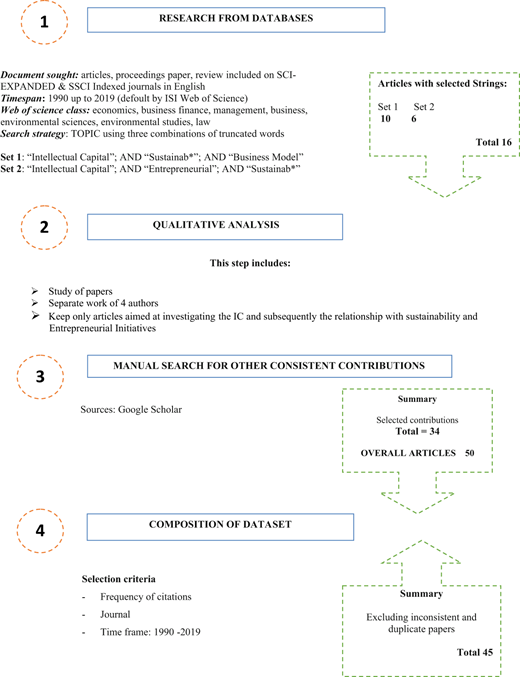
In the first step, the two main databases – WoS and GS – were utilised to study academic publications in the literature to highlight and systematise the main research directions of scholars. In this step, time constraints were not imposed on the research process to be able to acquire all the contributions on the topic from 1990 to 2019 (October), as imposed by the WoS database default years (see Table A1). In order to identify the appropriate articles, the research was conducted using truncated combinations of two groups of search strings:
Group 1: including all articles on IC, sustainability and business model (BM);
Group 2: collecting all contributions to IC initiatives, SD and entrepreneurship (E).
Data collection and classification
| Sr. No | Year | Author's | Journal | Article type | Subtopic | Aims and findings | Methodology |
|---|---|---|---|---|---|---|---|
| 1999 | Patrick H. and Sullivan | Journal of Knowledge Management | Article | IC; Profit; Firms; Knowledge | This study is focussed on the role of IC and knowledge to generate profit for businesses | Qualitative Study: Conceptual Paper | |
| Guthrie J | OECD International Symposium: Measuring and Reporting IC | Article | IC; Intangibles; Sustainability; NFR | This study examines the systems of measurement of intellectual capital | Qualitative Study: Theoretical Paper | ||
| 2000 | Verna Allee | Journal of Intellectual Capital | Article | IC; SBM; Intangibles; Sustainability | This research is based on the role of intangibles, which of IC, to conciliate business and sustainable needs | Qualitative Study: Conceptual Paper | |
| Jay Liebowitz Ching Y. Suen | Journal of Intellectual Capital | Article | IC; Knowledge management; Measure | This paper identifies IC measurement and knowledge management systems | Qualitative Study: Theoretical Paper | ||
| 2001 | Guthrie J | Journal of Intellectual Capital | Article | IC; Intangibles; Sustainability; NFR | This study investigates the role of IC for long-term value creation and non-financial reporting | Qualitative Study: Conceptual Paper | |
| Roos, G., Bainbridge, A. and Jacobsen, K | Strategy and Leadership | Article | IC; Organisational; Measurement | This document explores the concept of IC in the organisational and strategic business process | Qualitative Study: Theoretical Paper | ||
| 2002 | Malone, T. F. and Yohe, G. W | Journal of Knowledge Management | Article | IC; SBM; Intangibles; Sustainability | This paper investigates knowledge management tools for sustainable development | Qualitative Study: Theoretical Paper | |
| 2003 | Garry L. Adams and Bruce T. Lamont | Journal of Knowledge Management | Article | Knowledge management; IC; Sustainable development | This paper is focussed on the role of knowledge management in the development of organisations | Qualitative Study: Theoretical Paper | |
| Zhou, A. Z. and Fink, D | Journal of intellectual capital | Article | Knowledge management; IC; Value | This paper analyses the integration between IC and knowledge management systems to optimise profits | Qualitative Study: Theoretical Paper | ||
| Sharkie R | Journal of Knowledge Management | Article | Knowledge management; IC; Sustainable development | This paper analyses the use of ICs and KM processes to achieve sustainable competitive advantage | Qualitative Study: Conceptual Paper | ||
| 2004 | Tomi Hussi | Journal of Knowledge Management | Article | Knowledge management; IC; Intangibles; Business | This paper is focussed on the role and definitions of KM. | Qualitative Study: Theoretical Paper | |
| Mavridis D. G | Journal of Intellectual capital | Article | Knowledge management; IC; Banks; Business performance | This paper is focussed on the role of IC in banks' performance | Quantitative study | ||
| Martín de Castro, G., López Sáez, P. and Emilio Navas López, J | Journal of Intellectual Capital | Article | IC; KM; Strategy | This paper focusses on the role of relational capital in environmental strategy | Qualitative Study: Theoretical Paper | ||
| 2005 | Hayton J.C. | R&D Management | Article | IC; Innovation; Management; Knowledge | This paper explores the competitive advantage derived from ICs and new technologies | Qualitative Study: Content Analysis | |
| 2007 | Hahn, T., Figge, F. and Barkemeyer, R | International Journal of Environmental Technology and Management | Article | Sustainable development; Long-term value; CSR | This paper examines the use of sustainable resources for creating sustainable value among European manufacturing companies | Quantitative study: Empirical Study | |
| 2008 | Curado C | Journal of Knowledge Management | Article | Knowledge management; IC; Banks | This paper is focussed on the role of IC and KM in banks' performance | Qualitative Study: Content Analysis | |
| 2009 | Carrillo, F. J., Mohamed, M., Stankosky, M. and Mohamed, M | Journal of Knowledge Management | Article | Knowledge management; IC; Sustainable development | This paper is focussed on the role of IC and KM in the perspective of sustainable development | Qualitative Study: Theoretical Paper | |
| 2010 | Carrillo, F. J., Metaxiotis, K., Yigitcanlar, T., Mohamed, M., Murray, A. and Mohamed, M | Journal of Knowledge Management | Article | Knowledge management; IC; Sustainable development, ICT | This paper is focussed on the role of ICT in KM and sustainable development | Quantitative study | |
| Oliveira, L., Lima Rodrigues, L. and Craig, R | Journal of Intellectual Capital | Article | IC; Sustainable development; NFI | This paper analysed the role of IC in non-financial disclosure | Qualitative study: Theoretical Paper | ||
| Lubin, D. A. and Esty, D. C | Harvard business review | Article | Sustainable development; Organisations | This paper focusses on the need to adopt a sustainable commitment by companies | Qualitative study: Theoretical Paper | ||
| 2011 | López-Gamero, M. D., Zaragoza-Sáez, P., Claver-Cortés, E. and Molina-Azorín, J. F | Business Strategy and the Environment | Article | IC; Sustainable development; Stakeholders; Intangibles | This paper is focussed on the intangibles for sustainable development | Qualitative study: Theoretical Paper | |
| 2013 | Serenko, A. and Bontis, N | Journal of Knowledge Management | Article | IC; KM; Knowledge sharing | This paper contains the major studies on IC and KM. | Qualitative study: Research paper | |
| de Leaniz, P. M. G. and del Bosque, I. R | Intangible Capital | Article | IC; Sustainable development; Reputation | This paper is focussed on the role of IC in the perspective of companies' reputation | Qualitative study: Theoretical Paper | ||
| 2014 | Lerro, A., Linzalone, R., Schiuma, G., Kianto, A., Ritala, P., Spender, J. C. and Vanhala, M | Journal of Intellectual capital | Article | Knowledge management; IC; Sustainable development, Value | This paper is focussed on the role of the IC to create long-term value | Qualitative Study: Conceptual Paper | |
| 2017 | Liu, C. H | Tourism Management | Article | IC; Value; Performance | This paper examines the effect of IC on the organisational capacity of companies and the effects on performance | Quantitative Study | |
| Evans, S., Vladimirova, D., Holgado, M., Van Fossen, K., Yang, M., Silva, E. A. and Barlow, C. Y | Business Strategy and the Environment | Article | IC; SBM; Value | This paper is focussed on SBM and the role of the IC to create long-term value | Qualitative Study: Conceptual Paper | ||
| Caldera, H. T. S., Desha, C. and Dawes, L | Journal of Cleaner Production | Article | IC; KM; Sustainable business model | This paper analysed the role of KM in sustainable development and SBM. | Qualitative Study: Literature review | ||
| Barth, H., Ulvenblad, P. O. and Ulvenblad, P | Sustainability | Article | SBM; Innovation; Entrepreneurship; Sustainability | This paper explores the SBMs and proposes a conceptual framework for sustainability that can guide entrepreneurship | Qualitative Study: Literature review | ||
| De Villiers, C. and Sharma, U | Critical Perspectives on Accounting | Article | IC; KM; NFI; Integrated Reporting | This paper analysed the use of integrated reporting to disclose IC. | Qualitative study: Theoretical Paper | ||
| 2018 | Torres, A., Ferraz, S. and Santos-Rodrigues, H | Journal of Intellectual Capital | Article | KM; IC; Performance; Sustainable growth | This paper examines the impact of KM on the development of SBM. | Quantitative Study: Empirical research | |
| Xu, J. and Wang, B | Sustainability | Article | IC; Performance; Sustainable Development | This paper analysed the role of IC to create sustainable development | Quantitative Study: Empirical research | ||
| Bresciani, S., Ferraris, A. and Del Giudice, M | Technological Forecasting and Social Change | Article | ICT; IOT; KM | This paper investigates the use of intelligent systems to increase business competitiveness and the advantages of ambidextrous organisations | Quantitative Study: Empirical research | ||
| 2019 | Del Giudice, M., Garcia-Perez, A., Scuotto, V. and Orlando, B | Technological Forecasting and Social Change | Article | Knowledge; Technology; International growth | This paper explores the role of digital, social and transformation technologies for the development of SME competitiveness | Qualitative Study: Content Analysis | |
| Del Giudice, M., Scuotto, V., Garcia-Perez, A. and Petruzzelli, A. M | Technological Forecasting and Social Change | Article | Entrepreneurship; Innovations; Technology | This paper explores the technological innovation of companies by exploiting knowledge for the use of technological innovations | Quantitative Study: Empirical research | ||
| Cillo, V., Petruzzelli, A. M., Ardito, L. and Del Giudice, M | Corporate Social Responsibility and Environmental Management | Article | IC; Innovations; Sustainable development | This study proposes a review of the concept of sustainable development and sustainable innovation | Qualitative Study: Literature review | ||
| Natalicchio, A., Ardito, L., Messeni Petruzzelli, A. and Del Giudice, M | R&D Management | Article | KM; Innovations; Universities; IC | This paper investigates the use of intelligent KM systems in universities | Qualitative Study: Theoretical Paper | ||
| Ardito, L., Ferraris, A., Petruzzelli, A. M., Bresciani, S. and Del Giudice, M | Technological Forecasting and Social Change | Article | KM; Universities; Innovations; ICT | This paper investigates the use of knowledge management systems and ICT in universities | Quantitative Study: Empirical research | ||
| Coluccia, D., Dabić, M., Del Giudice, M., Fontana, S. and Solimene, S | Journal of Business Research | Article | Innovations; KM; Stakeholder | This paper analyses a system for measuring company innovation activities and related disclosure practices | Quantitative Study: Empirical research | ||
| de Paula Arruda Filho, N | The International Journal of Management Education | Article | Agenda 2030; SDG; Sustainability | This paper examines the role of Agenda 2030 for responsible management and development | Qualitative Study: Theoretical Paper | ||
| Singh, S. K., Chen, J., Del Giudice, M. and El-Kassar, A. N | Technological Forecasting and Social Change | Article | Sustainability; Environmental; Knowledge; Competitiveness | This paper analyses the environmental and social protection practices of organisations for increasing competitiveness | Quantitative Study: Empirical research | ||
| Santoro, G., Thrassou, A., Bresciani, S. and Del Giudice, M | IEEE Transactions on Engineering Management | Article | Ambidextrous organisations; Entrepreneurship; KM | This paper analyses how KM can affect the ambiguity of companies | Quantitative Study: Empirical research | ||
| Vătămănescu, E. M., Gorgos, E. A., Ghigiu, A. M. and Pătruț, M | Sustainability | Article | IC; Sustainable; Internationalisation | This document explores the concept of IC in the sustainable business internationalisation process | Quantitative Study: Empirical research | ||
| Khan, S. Z., Yang, Q. and Waheed, A | Corporate Social Responsibility and Environmental Management | Article | IC; Intangibles; Sustainable development | This paper investigates the role of investment in intangible resources to improve sustainable competitiveness | Quantitative Study: Empirical research | ||
| Hassan, H., Ying, Q., Ahmad, H. and Ilyas, S | Sustainability | Article | Entrepreneurial orientation; IC; Intangibles; Development | This paper examines the role of internal resources as ICs for the development of organisations and entrepreneurial orientation | Quantitative Study: Empirical research | ||
| Frondizi, R., Colasanti, N., Fantauzzi, C. and Fiorani, G | Qualitative Research in Intangibles, Intellectual Capital and Integrated Reporting Practices | Extended Abstract | IC; Universities; KM; Sustainability | This paper examines the role of universities in the creation and dissemination of knowledge, from a sustainability perspective through IC. | Qualitative Study: Conceptual Paper |
Source(s): Author's processing
The extraction of articles took place through these two combinations to include as many articles related to the topic studied and to verify the interrelation between the articles included in the different research groups. In this way, we were able to extend the research to all the studies on IC in the perspective of SD, without neglecting the effects on business models and the effects on business initiatives. In fact, IC and SD appear as constant references in search strings, as they constitute the substratum of our scientific research, from which the relationship analyses with BM and E have been developed.
The second step is to identify the relevant articles; we have examined the content of each document by reading the abstracts of the article to ensure consistency with the research objective. Therefore, the abstract of each article was read and highlighted the relationship with the problems investigated in this research. In the third phase, we hypothesised that WoS might not include all the relevant articles for the analysis; we integrated the manual search on GS using the same parameters. In the fourth and final phase, all the authors of this article are worked separately to examine each article and highlight the critical aspects that are useful for this research. After eliminating irrelevant articles and duplicates, all the authors compared their results and then developed the sections dedicated to the review of the literature. The final list of works was composed of 45 articles. The bibliometric analysis of these selected articles is explained in section 4.1.
3. Contextual framework on IC in the SDGs perspective
IC is the basis for growth and competitiveness (Lerro et al., 2014; Zhou and Fink, 2003; Guthrie, 2001), as it contributes to improving people's well-being and the economic performance of businesses (Jardon et al., 2019; Liu, 2017; Mavridis, 2004; Alee, 2000; Sullivan, 1999). In fact, according to some scholars, companies are more likely to obtain competitive advantages by investing in intangible assets, thus increasing the chances of survival on the market (de Leaniz et al., 2013). This is because, according to the traditional distribution of IC in human, structural and relational capital (Marr and Roos, 2005; Roos et al., 2001; Brennan and Connell, 2000), relational capital contributes to creating reputation value for the company, considered as an open system that dialogues with the external environment and interested parties (Martín de Castro et al., 2004).
This aspect has become even more important in the face of the growing awareness of the need to adopt an integrated approach to tackle the complex economic, social, environmental and institutional challenges to achieve the transition towards an SD model [1], increasingly in demand also by stakeholders (de Villiers and Sharma, 2017). Indeed, the interest of stakeholders has shifted towards non-financial reporting models, which are able to describe the intellectual, social and environmental capital movement of companies, better known as sustainability reporting (Dumay, 2016).
According to scholars, the capacity with which companies will be able to meet the challenge of sustainability will determine their profits and market survival (de Villiers and Sharma, 2017; Lubin and Esty, 2010; Hahn et al., 2007). Four years after the adoption of the 2030 United Nations agenda, with its 17 SDGs, awareness has developed from governments and civil society to foster a change in the socio-economic paradigm, making concrete steps to help put the world on a path of SD (Caldera et al., 2017; de Paula Arruda Filho, 2017). In this context, large companies have taken on new commitments to change their business model and contribute to the achievement of SDGs (Barth et al., 2017; Evans et al., 2017). According to Figge and Hahn (2005), to contribute to SD, companies need to exploit every form of capital more efficiently; above all, the management of IC is the most delicate aspect (De Leaniz et al., 2013).
While the issues related to environmental sustainability have been analysed extensively by scholars and professionals, due to numerous natural catastrophes (López-Gamero et al., 2011), aspects of economic and social sustainability have been emerging in recent years (De Leaniz et al., 2013), also thanks to corporate social responsibility (CSR) (de Villiers and Sharma, 2017). Professionals by now understand that they must equip themselves with a system of skills and knowledge to face global challenges and adopt a sustainable approach (Hassan et al., 2019). This is because companies invest in intangible resources (Khan et al., 2019) and the culture of their organisations (Jardon et al., 2019) to achieve sustainable competitive advantages. These aspects reveal the importance of IC as a long-term creator (Singh et al., 2019) of “productivity, organisational competitiveness, and sustainability” (Vătămănescu et al., 2019). To facilitate the transmission of knowledge, companies need the help of NTs able to favour the dissemination of information that helps maintain a link among profit, environment and society, favouring alignment between knowledge and opportunities development (Cillo et al., 2019; Carrillo et al., 2010).
4. Results
The next section is dedicated to the qualitative analysis of selected papers, highlighting the following aspects: 1) bibliometric features, 2) content and 3) classification by secondary topic.
4.1 Bibliometric aspects of the selected articles
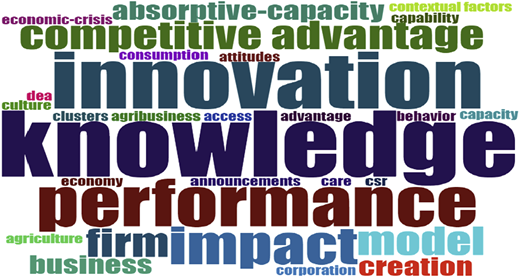
The selected articles were analysed on Bibliometrics. Figure 2 presents the “WordCloud” of the abstracts and highlights the 50 most common words in the abstracts of the articles available in the databases. The dimensions of the words in the image depend exclusively on the presence of words in the selected articles. As the figure shows, the keywords of our study are innovation and knowledge, located in the centre of the map. Indeed, these words recur in our data set as a constant throughout the research period (ex multis Cillo et al., 2019; Coluccia et al., 2019; Frondizi et al., 2019; Hassan et al., 2019; Jardon et al., 2019; Khan et al., 2019; Caldera et al., 2017; Liu, 2017; Lerro et al., 2014; De Leaniz et al., 2013; Curado, 2008; Martín de Castro et al., 2004; Adams et al., 2003; Guthrie, 2001). Then, the words performance, impact, competitive advance, model and business were recurrent in most of the articles examined and are introduced in Table A1 in the Appendix.
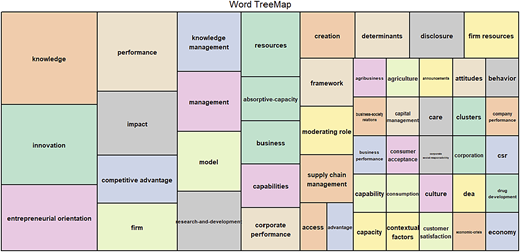
Based on the bibliometric analysis, the conceptual map was reconstructed related to the correlation between the keywords present in the database (Aria and Cuccurullo, 2017). Figure 3 shows that words are distributed in boxes and divided by colour. Concept maps are diagrams that represent the interrelationships between concepts. They are an effective tool to understand conceptual changes and to see how ideas are connected and correlated, making the study more immediate and efficient (Liu, 2004). It can be seen that the correspondence by colour measures the index of recurrence of words in terms of frequency, thus expressing the more or less significant plot of the database topic in the concept map. In the correspondence by colour, it is interesting to note ex multis that the words “entrepreneurial orientation, management, capabilities, consumer acceptance, culture” have a connection. In addition to the words “innovation, resources, absorptive capacity, business, clusters, drug development” or “competitive advantage, knowledge management, business performance, economy, CSR”. This co-occurrence index shows how close the link is among knowledge, innovation and business models because corporate culture can influence entrepreneurial orientation (EO) and improve corporate competitiveness, also in light of the sustainable challenge.
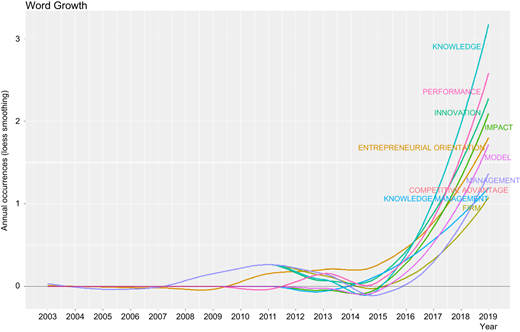
Considering the research period (1990–2019), the topic of the survey registered growth starting from 2015, as shown by the dynamic analysis of the most recurrent words in the data set (Figure 4). This figure is interesting regarding the objectives of our research because in the year 2015, the United Nations adopted the 2030 agenda and its objectives. Consequently, such an increase in studies on EO, knowledge, management and innovation technology (IT) would seem to highlight the element of a close correlation among IC, IT and SDGs. The peak of interest by scholars is recorded in 2019.
This interest has been registered more among scholars in China, the United States and Romania (Figure 5), followed by Italy, Spain and Portugal. Figure 5 describes both the production index by country of each author (green colour) and the collaboration index with the authors of that country (orange colour). This means that in China, there is not only a greater production of research articles for our topic but also most of the collaborations between authors from different countries. The same case is found for the United States. This could be explained because the United States and China represent the major economic powers in the world and are directly involved in the adoption of programmes that can reconcile economic growth and socio-environmental well-being.
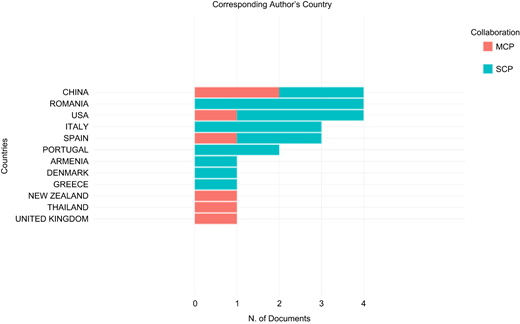
It is interesting to note that most of the studies conducted on our topic are registered in countries that are not part of the European Union. However, the presence of Italy, Spain, Portugal, Denmark and Greece testifies to an economic and cultural commitment also on the part of the European community on the issues of developing IC for sustainable growth.
4.2 Content of the selected articles
Following the various stages in which this study was carried out, the following results were obtained from the bibliometric analysis performed on 45 studies. Regarding the content of the articles, Table A1 in the Appendix shows a framework of analysis based on the following categorisation: (1) year, (2) author, (3) journal, (4) article type, (5) subtopic, (6) aims and findings and (7) methodology.
The classification of the articles carried out with Table A1, through the schematisation of the subtitle and the brief description of the purpose of each article, revealed that most of the scholars analysed, in general, the implications that KM can have on the competitiveness of companies, also through the use of NTs (Ardito et al., 2019; Cillo et al., 2019; Coluccia et al., 2019; Santoro et al., 2019; Bresciani et al., 2018; Natalicchio et al., 2017; Xu and Wang, 2018; Lerro et al., 2014; Curado, 2008; Hussi, 2004; Mavridis, 2004; Zhou and Fink, 2003; Guthrie, 2001; Alee, 2000; Liebowitz et al., 2000; Sullivan, 1999). Some have instead studied in particular the implications that the IC has on the prerogatives of SD and the creation of SBMs, whereas sustainability has become a major issue in commercial operations (Hassan et al., 2019; de Villiers and Sharma, 2017; Xu and Wang, 2018; Barth et al., 2017; Caldera et al., 2017; Evans et al., 2017; Liu, 2017; de Leaniz et al., 2013; López-Gamero et al., 2011; Oliveira et al., 2010; Carrillo et al., 2009; Adams et al., 2003; Sharkie, 2003; Malone and Yohe, 2002). Indeed, IC has a fundamental influence on the development prerogatives of companies and is a long-term source of value (de Villiers and Sharma, 2017).
The concept of value is linked to the business model (Evans et al., 2017) because it expresses the condition of balance among corporate profit, respect for civil society and environmental protection, necessary for inclusive development and SD. This explains why some scholars have overcome the purely quantitative approach to investigate IC to analyse rather the competitive advantage deriving from KM processes (Lerro et al., 2014; Guthrie, 2001; Sullivan, 1999). The set of activities of learning, acquisition and dissemination of information constitutes the KM and directly involves human capital, thus contributing to the creation of value for the company (Sullivan, 1999). According to Guthrie (2001), IC brings a tangible advantage to organisations, stimulating innovation (Bhasin, 2011), which together with the company's material resources can contribute to decision-making and development processes, with a significant impact on performance (Zhou and Fink, 2003). In fact, IC represents a sustainable resource with “infinite” capabilities for organisations (Mavridis, 2004), which must be implemented to expand into the knowledge economy. Companies can improve their knowledge to make the most of the resources they have, thereby contributing to more SD (López-Gamero et al., 2011). According to Ying et al. (2019), intangible resources are less expensive, so they can be the best tool to facilitate sustainable performance, especially for companies with precious and scarce resources (Xu and Wang, 2018).
The transversal dimension of SD understood as a “development” that meets the needs of the present without compromising the ability of future generations to satisfy their needs (WCED, 1987) brings together economic, environmental and social aspects. This development is pursued in the modern knowledge economy through the implementation of networks that facilitate the global exchange of information and relationships towards sustainability, as well as through the use of information and communication technologies (ICTs) (Sharkie, 2003; Carrillo et al., 2009). Modern technological supports can facilitate the space–time sharing of knowledge, thus creating a greater return to companies in terms of expansion of know-how.
Organisations that use high-technology tools to make the most of their IC stimulate EO (Hayton, 2005), with significant effects on business models, through the involvement of sustainability values in the development of economic, environmental and social dimensions (Carrillo et al., 2010; Oliveira et al., 2010; Carayannis et al., 2005). ICTs can strengthen the partnership among institutions, civil society and economic organisations, developing a shared vision focussed on the values of humans, nature, peace and justice in line with what was codified by SDG≠17 by the United Nations 2030 agenda and improving CSR.
De Leaniz (2013) showed that proactive commitment to sustainability goals also generates a reputational advantage. In this way, organisations improve their competitiveness. Furthermore, the disclosure of such information, including intangible assets, corporate governance and risk management strategies, can improve the information asymmetry between the company and interested parties (Bhasin et al., 2013; Ousama et al., 2012). Especially, stakeholders can know the status of business performance and get an idea of the direction taken for the future. According to Khan et al. (2018), there is a positive relationship between the IC and CSR, as companies that adopt and report on good CSR practices also strengthen IC, improving corporate ethics, culture and know-how. All this is reflected in the improvement of the corporate image and the increase in trust by stakeholders.
According to (de Villiers and Sharma, 2017), the implementation of the IC disclosure also improves the decision-making processes of the company through the involvement of a “network of values” that pushes towards new SBMs. Some scholars (Hassan et al., 2019) have empirically observed the role that the IC, ICTs and EO can play in the sustainability practices of companies, demonstrating that these internal factors positively stimulate organisational activities, for example, in terms of safety, health of the workers and environmental protection. Moreover, according to Vătămănescu et al. (2019), IC helps to increase the sustainable competitiveness of companies and generates a process of internationalisation, which favours the exchange of knowledge with the foreign market.
The ability of organisations to exploit their knowledge for exploratory purposes through product innovation and connection with foreign markets is known as “ambidextrous organization” (Rossi et al., 2017, 2019a,b; Santoro et al., 2019). These companies are pushing for open solutions, aimed at integrating their business with external solutions and technologies. This ability is essential to reach higher levels of competitiveness and stimulate entrepreneurship to create innovative systems that can fully exploit intangible resources to achieve sustainable performance.
5. Discussion
Starting from the analysis of the results of our research, the importance attributed to intangible resources raises the need to investigate not only the economic but also the cultural and social implications of the IC as a business engine for the creation of long-term value and a beacon for entrepreneurship towards the direction of intelligent and SD. Most studies have investigated the impact that external factors, such as institutional pressures or other external forms of government intervention, have on some business management processes (Hassan et al., 2019). However, they neglected to examine the role of internal resources such as IC, ICTs and EO, which, combined with elements of innovation, can improve processes, convey information and stimulate relationships, with positive effects on environmental and social performance (de Villiers and Sharma, 2017). This happens through the creation of an integrated climate among all the subjects that participate in the corporate life, through processes of innovation (Liu, 2017).
This is because more and more organisations recognise the potential of IC and are experimenting with KM systems that favour relational and strategic exchange, achieving better results in terms of competitiveness, image, trust and productivity (Khan et al., 2018). This approach is also reflected in the CSR because of IC efficiency increases in the presence of responsible investments (Barrena-Martinez et al., 2019). The business activity causes a series of socio-environmental impacts that can no longer be neglected by companies (Hassan et al., 2019) because the global economic debate is concentrated on finding strategic solutions to achieve sustainable economic development in the long term. The 2030 agenda of the United Nations has established an ambitious shared prosperity programme, which accompanies the effort of a multitude of actors towards the achievement of the SDGs, which include the three dimensions of SD: the economic, social and environmental dimensions. In this context, IC plays a key role as a driving force in developing knowledge and skills towards a forward-looking and proactive approach to creating long-term value for the company. According to Xu and Wang (2018), the efficient use of ICTs affects the financial performance of companies that achieve higher sustainable growth. This effort must lead to the adoption of SBM (Evans et al., 2017), which combines entrepreneurial spirit, adaptability and innovation in a holistic IC vision to exploit KM processes and create an integrated, sustainability-oriented culture (Cillo et al., 2019).
6. Conclusions and implications for future
The results of this study show that the literature has studied only some aspects involved in SD through the IC. It has certainly been recognised as a strategic resource for improving performance and organisational processes. However, less attention has been paid to the use of the IC in relation to the goals set by the 2030 agenda and the established guidelines for companies.
In the modern economy of knowledge and technological development, the efficient use of ICs can lead to important innovation choices, since a company's ability to innovate depends precisely on the IC at its disposal. Innovation is defined as “the implementation of new ideas that create value” (Linder et al., 2003, pp. 43–49). Kalkan et al. (2014, p. 706) has demonstrated the existence of a cause–effect relationship between IC, innovation and organisational strategy, according to which “human capital affects the capital of innovation and the capital of process”; as well as “innovation capital affects process capital, which in turn influences client capital”. If IC expresses the set of immaterial resources of the company, KM refers to all the processes of management and implementation of these resources, which through the creation and sharing of good practices improve performance and favour SD (Torres et al., 2018). Therefore, scholars have emphasised the importance of monitoring and measuring intangible resources, such as IC, as a driving force for competitiveness, market confidence, innovation and sustainability.
In this sense, the IC is configured as a transversal resource, able to also model the cultural change of organisations and civil society and foster a solid commitment to sustainable change. In the current climate of social and economic change, the present study reveals interesting managerial and scientific implications, turning the spotlight on the active role of organisations in the context of global challenges. Sustainability has become an obstacle to existence and survival; in this sense, companies act as drivers of resources that can potentially create sustainable value, even if intangible. This implies the need to open up to investment solutions able to implement the KM processes, as well as the use of innovative and technological systems able to favour the sharing of knowledge and optimise the IC potential. Equally, governments and institutions play a key role in the process of sustainable growth, acting as catalysts for global priorities, also through forms of transnational collaboration capable of guiding entrepreneurship towards more mature investment choices. To support these initiatives, scientific research should continue to investigate the relationship between IC and SD, widening the boundaries of knowledge on the subject and suggesting practical implications as well as theoretical, aimed at supporting the intentions of the 2030 agenda focussed on sustainability, what value shared and essential for the future.
We would like to thanks to the Editors and Reviewers for their precious suggestions that allowed us to improve our study.Funding: This research has been funded by “Business Administration Research Team”, Department of Law, University of Naples “Parthenope”.
Note
The Global Risks Report, 2019.

