“Integrated care” (IC) is an approach to health and social care delivery that aims to prevent problems arising from fragmented care systems. The collective content of the IC literature, whilst valuable, has become extensive and wide-ranging to such a degree that knowing what is most important in IC is a challenge. This study aims to address this issue.
A scoping review was conducted using Arksey and O'Malley's framework to determine IC priority areas.
Twenty-one papers relevant to the research question were identified. These included studies from many geographical regions, encompassing several study designs and a range of populations and sample sizes. The findings identified four priority areas that should be considered when designing and implementing IC models: (1) communication, (2) coordination, collaboration and cooperation (CCC), (3) responsibility and accountability and (4) a population approach. Multiple elements were identified within these priorities, all of which are important to ensuring successful and sustained integration of care. These included education, efficiency, patient centredness, safety, trust and time.
The study's findings bring clarity and definition to what has become an increasingly extensive and wide-ranging body of work on the topic of IC. Future research should evaluate the implementation of these priorities in care settings.
Background
“Integrated care” (IC) is an approach to health and social care delivery that aims to prevent problems arising from fragmented care systems. IC has many definitions that are typically context dependent, but at the core of which is an approach to overcome issues that adversely impact the quality of care, service users' care experiences and care outcomes (Valentijn et al., 2013; Goodwin, 2016).
IC services should be delivered at all care levels and sites according to service users' needs and throughout their lives (World Health Organisation, 2020). Ensuring optimal continuum of care is paramount (Busetto et al., 2018) and transitions between different steps in care pathways should be as seamless as possible, particularly with regards to the management of service users with complex care needs requiring multidisciplinary input (Burke et al., 2018). Care should also be accessible to service users: it should be provided free at the point of delivery and delivered in a timely manner (Burke et al., 2018). IC also aims to empower people to take charge of their own health and wellbeing rather than being passive recipients of services (World Health Organisation, 2020). From a systems perspective, IC seeks to ensure optimal efficiency with regards to financial expenditure and the use of staff and technical resources (Ramagem et al., 2011).
Fragmentation on the other hand hinders the achievement of such ambitions (Ramagem et al., 2011). To illustrate, IC is especially needed throughout the world at present to address fragmentation in care systems that are poorly resourced and/or are under increasing pressure due to the COVID-19 pandemic and complex comorbidities resulting from ageing populations (Health Service Executive, 2018; Ramagen et al., 2011; Sanchez-Rodriguez et al., 2020). To that end, IC has become an increasingly pressing policy issue internationally in both developed and developing countries and care systems.
Thus, it is not surprising that the aims of IC are as many, as wide-ranging, and as well documented as they are. However, the collective content of IC literature, whilst valuable, has become extensive and variable to such a degree that knowing what is most important in IC is a challenge. To that end, with an aim to informing research, policy and practice, this study will address this issue by identifying and examining the key priorities for IC.
Methods
This study used a scoping review methodology guided by Arksey and O'Malley's (2005) framework and later recommendations by Levac et al. (2010). This approach involved a six-stage sequential process whereby (1) a research question was identified; (2) relevant studies were found; (3) studies were selected; (4) data were charted; (5) results were collated, summarised and reported, and (6) experts on the study topic were consulted. Whereas systematic reviews use highly rigorous study selection methods and are largely concerned with providing answers to well defined research questions, scoping reviews allow for greater flexibility and are particularly useful for the exploration of novel or poorly understood topics such as the one being investigated in this study (Munn et al., 2018).
Identifying the research question
The study's research question (What are the priorities for the future development of IC?) was informed by the directives of national (i.e. Irish) and international healthcare policy, limitations in existing literature concerning acknowledgement of what is most important in IC and the outcomes of regular meetings between project group members (i.e. research and healthcare professionals with IC expertise).
Identifying relevant studies
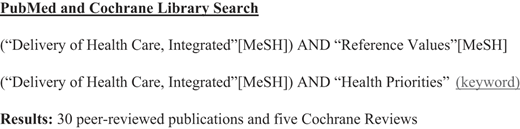
Two electronic databases (PubMed and the Cochrane Library) were searched using a combination of carefully selected keywords and MeSH terms (see Figure 1). Searches were run for the years 2010–2020 to ensure that study findings accurately portray current IC priorities. Relevant studies were also identified through hand searching of PubMed and the Cochrane Library using relevant keywords and MeSH terms.
Study selection
Studies were included if they were deemed to identify priorities for IC. Examples of the published and grey literature were included.
Meanwhile, studies were excluded according to the following criteria:
They did not examine IC.
They examined IC priorities with regards to only a single health condition.
They were written in languages other than English.
Their full text was not available.
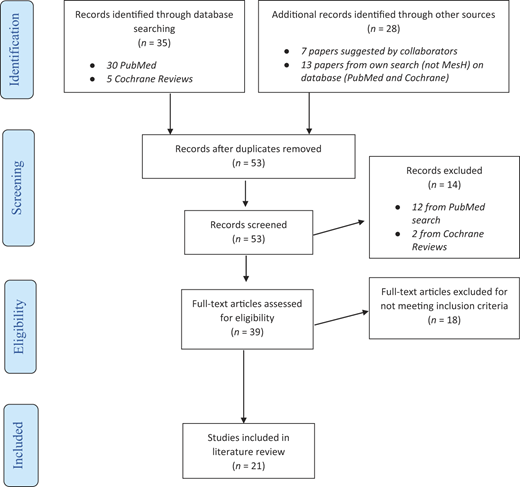
The inclusion and exclusion of studies was determined by two independent persons reviewing full-text articles (see Figure 2 – PRISMA flow chart).
Charting the data
Once all exclusion criteria were applied the remaining studies were charted. Studies were charted according to various relevant headings including author, year, study design and study population (see Table 1).
Collating, summarising and reporting the results
Data was collated and analysed using EndnoteX9 reference management software and a thematic analysis approach (Clarke et al., 2015). Prominent themes were judged to be those that represent a priority or priorities for IC. Results are presented in running text (see “Results” section) and table format (see “Table 1”).
Consultation
Project collaborators included professionals with considerable IC expertise at policy, scientific and clinical levels. Collaborators contributed to the study's article selection and inclusion/exclusion processes (they suggested articles that were not identified in electronic searches), and they also assisted with the interpretation of study findings and manuscript drafting.
Results
Initial searching of the “PubMed” and “Cochrane Library” databases yielded 35 records. Twenty-eight papers were also identified by way of basic search methods and consultation with experts in the subject area. After excluding articles not considered relevant to the research question, 21 of 63 papers were selected for the purpose of this scoping review. The search, identification and selection process are summarised in detail in the accompanying PRISMA diagram (see Figure 2).
Studies frequently used a combination of research methodologies including review, case study, observational, interview, questionnaire and expert consultation methods. Seven studies used review methods (i.e. systematic review and narrative review), and case study methods were also common, with eight studies using modifications of these methods to examine various kinds of IC interventions. The reviewed studies also included two conference abstracts, a policy paper and a PhD thesis summary. A range of international literature was analysed. Many of the included studies focused on IC initiatives within specific countries, continents and other geographical regions. These included North and South America (countries not specified), the USA specifically, numerous European countries (e.g. the Netherlands, Germany, Belgium, the United Kingdom, Norway and Spain), New Zealand, Eastern Mediterranean Region countries (countries not specified) and several lower to middle-income countries in Africa (Togo, Zambia, South Africa, Tanzania and Zimbabwe) and Asia (India and Nepal). Other studies examined IC more generally and were first authored in countries throughout the world (see Table 1). This scoping review's studies also included a range of sample sizes and ages. While the specific study populations varied between papers, most studies covered chronic health conditions such as diabetes, HIV and care of the elderly.
Priorities in integrated care
Four priorities were identified in the literature using a thematic analysis method (Clarke et al., 2015). These priorities were (1) communication, (2) coordination, collaboration and cooperation (CCC), (3) responsibility and accountability and (4) the adoption of a population approach. The themes consisted of multiple overlapping sub-themes, all of which are required to ensure successful and sustained integration of care. These sub-themes included efficiency, patient centredness, safety, trust and time.
Communication
Good communication was outlined as a priority for IC by almost all the included papers. Effective communication was shown to be important for all stakeholders, but particularly with regards to interactions between care professionals, as well as interactions between care professionals and service users (Grimsmo, 2010; Røsstad et al., 2013). The findings suggest that effective communication enhances the efficiency of system level functioning and various service user outcomes, as well as service users' overall experience of using care services (Borgermans and Devroey, 2017). Commonly cited communication barriers included systemic factors (e.g. fragmented structure of care pathways and fragmented relationships within care pathways) and technological issues (e.g. inadequate, or inaccessible IT communication resources) (Ivbijaro et al., 2015; McGonigle and McGeoch, 2017). Facilitators of communication meanwhile were shown to include conscious efforts to build strong and trusting relationships between stakeholders, the encouragement of service user involvement with regards to designing care models and self-care, greater staff involvement with service users' communities, and highly available and efficient IT resources dedicated to service user consultation, safe service user transfer and general care team activities (McGeoch et al., 2019; Nicholson et al., 2013; Røsstad et al., 2013; Timmons and Ham, 2013).
Results (Coordination, collaboration, and cooperation (CCC))
The findings also show that IC is facilitated by effective CCC between relevant stakeholders (Dudley and Garner, 2011; Ferrer and Goodwin, 2014; Ramagem et al., 2011; Zonneveld et al., 2018). Cooperation between care professions in particular was outlined as a major facilitator to the success of interventions (Busetto et al., 2018). Shared planning, clinical priorities, protocols, commissioning and joint funding were also identified as key CCC related initiatives enabling the success of IC models (Busetto et al., 2018; Ivbijaro et al., 2015; Nicholson et al., 2013, Rahman, 2015; Vázquez et al., 2012). The reviewed studies also indicate that there should be agreement across the board on target areas for intervention design and the role of multidisciplinary teams within IC networks and pathways (Nicholson et al., 2013). The importance of CCC is particularly well demonstrated by studies documenting the “Canterbury Model” (Gullery and Hamilton, 2015; McGonigle and McGeoch, 2017), a clinical trial in Norway (Røsstad et al., 2013) and Vázquez et al. (2012). These studies show that enhanced CCC yields numerous benefits for IC stakeholders, including most notably, a greater comprehension of and adherence to care strategies and pathways.
Responsibility and accountability
Responsibility and accountability were also commonly cited as IC priorities. The findings indicate that greater responsibility and accountability among care staff at all levels are central to the establishment of effective IC models (Goodwin, 2016). The findings also suggest that it is vital that care governance lead by example in this respect, as responsibility and accountability on their part tends to permeate staff performance, resource management and workplace culture in general (Busetto et al., 2018; Ivbijaro et al., 2015; Vázquez et al., 2012). Leaders who champion change, as well as advocate and promote integrated services appear to be key to successful models (Ivbijaro et al., 2015; Vázquez et al., 2012). Furthermore, it has been argued that the strongest form of IC is the “fully-integrated” model where teams working in an organisation operate under a single set of governance and accountability rules, as well as common budgets and incentives (Goodwin, 2016). Assigning responsibilities followed by the establishment of a monitoring system also appears to be a key step to success of IC models (Rahman, 2015). The terms “responsibility” and “accountability” were explicitly mentioned by some papers (e.g. Zonneveld et al., 2018; Ferrer and Goodwin, 2014; Borgermans and Devroey, 2017), while synonymous terms such as “leadership”, “management” and “ownership” were also commonly used.
Population approach
“Patient-centredness” was outlined to be a core principle or value of care integration by several papers (e.g. Borgermans and Devroey, 2017; Busetto, 2016; Busetto et al., 2018). However, these studies indicated that it is key for an integration model to not only be patient centred, but also population focused (e.g. Reynolds and Sutherland, 2013; Valentijn et al., 2013). The findings suggest that IC models should be developed with country-specific population level care needs and health challenges in mind (Reynolds and Sutherland, 2013), that IC models should not be disease specific but rather applicable to any age or patient group (Nicholson et al., 2013), and that care models should account for the multifaceted needs of populations by employing less singular and more integrative, holistic and multidisciplinary forms of care needs (Nicholson et al., 2013). “Whole-system” population approaches were frequently cited as being effective and sustainable, or at least potentially so (Gullery and Hamilton, 2015). The whole-system approach emphasises not only what is “best for people”, but also what is “best for system”, and its success depends on how well professionals at all levels of care systems work together and take sufficient levels of responsibility and accountability. The whole-system approach was particularly well evidenced by studies documenting the “Canterbury Model” of IC (Gullery and Hamilton, 2015; McGeoch et al., 2019).
Discussion
Key findings
Many things should be considered when designing and implementing IC policy and models. Integration processes are difficult, complex and long term, and they require extensive change and commitment by key stakeholders and professionals. However, despite such complexity, this review identified four priority areas for IC, these being: (1) communication, (2) CCC, (3) responsibility and accountability and (4) a population approach. These priority areas point to the importance of several matters, but most notably they highlight relationships between key stakeholders, personal and collective obligations among care professionals for the management of care and the promotion of health and wellbeing for all individuals in society.
How the findings relate to other literature
This study's findings parsimoniously indicate that these four priorities are more important to IC than has been suggested in the past. Previous studies have placed notably less emphasis on their significance. To illustrate, Ferrer and Goodwin (2014) include variations of this study's priorities among a total of 16 principles for guiding and Valentijn et al. (2013) outline similar priorities among 12 key elements for IC in primary care. This study's findings may also have greater generalisability because they deliver this parsimonious viewpoint with respect to IC in general, rather than specific IC domains such as healthcare, social care, or mental healthcare alone, as has often previously been the case (see Ramagem et al., 2011; Valentijn et al., 2013; Vázquez et al., 2012). Further, it is worth noting that like the existing IC literature, this study's included articles spanned a wide range of geographical regions. Also, like existing literature on the topic, this study's findings demonstrated that IC initiatives vary considerably between countries due to the influence of contextual factors such as care systems' resource capacities and population care needs (e.g. Dudley and Garner, 2011; Ramagem et al., 2011). However, the findings differ to those of such studies because they do not focus as intently on such differences. Rather, with the intent of providing insights and recommendations that have universal applicability, the findings emphasise key IC priorities that these countries share.
Implications for research and practice
This review's findings indicate that IC research and practice should take the identified priorities into greater consideration than has previously been the case. Research and practice activities should focus on how initiatives relating to these priorities may impact key systemic and service user level outcomes identified by this review's studies including care services' resource capacities and service user care outcomes and care experiences (Busetto et al., 2018; Borgermans and Devroey, 2017). Previously reported examples of communication initiatives that may enhance integration include improved eRefferal (Bouamrane and Mair, 2014) and electronic discharge (Murphy et al., 2017) systems. Likewise, Close et al. (2019) demonstrated improved care coordination with their ‘Somerset Practice Quality Scheme', and the country of New Zealand showed considerable gains with regards to responsibility and accountability among care providers as a result of alliances between District Health Boards and Primary Health Organisations (Gauld, 2014). The implementation and evaluation of similar initiatives globally may yield benefits. Research investigating care facilitators and barriers (see Busetto et al., 2018) concerning the four priorities identified in this study is also recommended to enhance IC delivery in care settings. Lastly, it is also advised that research examines the influence of priority relevant initiatives and factors from multiple perspectives across a variety of care settings (e.g. primary and secondary care, social care settings, mental health services) using more standardised and thus replicable study designs and tools.
Methodological considerations
This study benefitted from the adoption of several methodological techniques, frameworks and tools. Firstly, the scoping review method provided an excellent platform to map the literature and identify gaps in what is admittedly a broad and often poorly defined topic. This scoping review benefitted from the guidance outlined by Arksey and O'Malley's scoping review framework. The framework allowed for the flexibility of a scoping review approach whilst maintaining widely accepted degrees of scientific rigour. This review also benefitted from the use of established scientific databases (PubMed and the Cochrane Library), as well as the adoption of established MeSH terms. These search tools provided a greater degree of validity to this study's method and findings. Lastly, studies were selected for inclusion by two independent reviewers, thereby reducing the possibility of this study's findings being influenced by bias.
Still, this study's method also had its limitations. While scoping reviews are rigorous in the sense that they have clear methodological guidelines facilitating replication, their study selection process is not as rigorous as it is for systematic reviews, and so it is possible that this study did not include some relevant papers. In addition, while this study used established search databases, it did only use two of them. It is possible that more studies would have been included in this review had more databases been searched. The number of studies included in this review may also have been too few because we did not include studies published in languages other than English. Finally, as is common with scoping reviews, this study did not assess the quality of included articles.
Conclusions
Four key priority areas for IC were identified and examined, these being: (1) communication, (2) CCC, (3) responsibility and accountability and (4) a population approach. The findings bring clarity and definition to what has become an increasingly extensive and wide-ranging body of work on the topic of IC. It is recommended that priority related initiatives are implemented and evaluated by researchers and practitioners. Doing so will be challenging albeit rewarding as such activities may yield considerable benefits for understanding of IC, and how it can be applied to enhance care provision, experiences and outcomes.
The study was funded by the Ireland East Hospital Group and internal funding from the UCD College of Health and Agricultural Sciences and School of Medicine.
Ethics approval and consent to participate: Not applicable.
Conflict of interests: The authors declare that they have no conflicting interests.