The world is in crisis – again. Climate change, inequality, conflict and technology are sources of deep pain and anxiety. And around the world, too many politicians seem intent on deepening economic, environmental and social fault lines rather than healing them.
We have been here before. The first half of the twentieth century was one of the most destructive and disorientating in history. Two world wars, economic crises, famines, pandemics, colonialism and violent revolutions defined the times. The chaos led a group of foresighted leaders to a novel conclusion: lasting peace and prosperity would only be achieved through a commitment to the well-being of every individual.
The Universal Declaration of Human Rights [1] reset people's expectations of government and government's duty to every person. It was based on the idea that everyone deserved a dignified life, enabled by civil, social, economic and political rights.
Article 26 of the Declaration was on education. Its language was simple, but entirely revolutionary for its time. “Everyone has the right to education…(elementary) education shall be free…higher education shall be equally accessible to all on the basis of merit…education shall be directed to the full development of the human personality…it shall promote understanding, tolerance and friendship….”
The authors of the Declaration had the awesome ability to imagine a better world and a pathway to achieving it. One of the keys, they knew, was to unleash the capabilities of an entire generation by investing in their education and well-being.
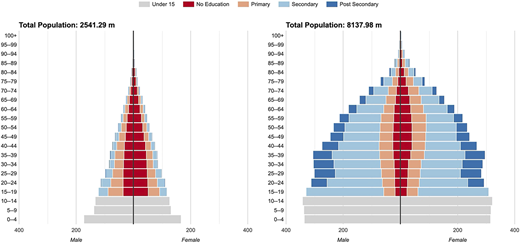
The massive expansion of education that followed in the second half of the twentieth century created a generation of people more capable than any other in human history (see Figure 1). They reduced poverty, launched a green revolution, strengthened institutions, improved human health and longevity and expanded the vibrant social and cultural spaces we enjoy today.
The challenges of the twenty-first century are prompting us to build on “great expansion” – to improve schools and school systems by incorporating new insights into how young people learn and how they can adapt to a changing world. Here are nine conclusions I gathered from speaking with a group of prominent educators [3]:
Teachers and school leaders will determine whether we realize our aspirations. Whether coming from the study of neuroscience, early childhood development, educational psychology, economics or science education, research emphasizes how important teachers and school leaders are to improving learning. Their vision, relationships, creativity and initiative will enable us to reshape the system. There is a need for more evidence on teacher effectiveness, and the need for teachers themselves to have better access to research and training in how to use it. Leadership itself needs to be reconfigured to ensure that it is inclusive and builds capacity across educational systems.
Educators will benefit from a new, science-based focus on early childhood development and early learning environments. Infancy and early years of education are an intense period of development. Neuroscience is showing us how the infant brain develops, providing insights into how children learn and suggesting good educational practices. “The early brain is born to learn, ready to learn, and when certain conditions are met, kids can soar,” says Patricia Kuhl, co-director of the University of Washington Institute for Learning and Brain Science. Children benefit immensely from learning environments that are joyful, social and encourage curiosity, inquisitiveness and agency. Research is also helping with early identification of certain neurodiverse learners and suggesting effective remediation.
Schooling and curricula will be reimagined. For too long, children's learning has been harmed by a misbegotten belief in innate intelligence and fixed talent – and very narrow measures of talent at that. Educational testing is too often used to distribute educational opportunities, based on a flawed assumption that the tests measure capability for future achievement. Schools of the future should measure what matters – not just academic achievements but socio-emotional skills, problem-solving, teamwork, mindsets and citizenship.
Personalized and student-driven learning is taking off. It's important to place students at the center of education – students need to develop agency and expertise as part of the process of learning, while educators need to foster social interaction that is the foundation of motivation and curiosity.
The possibilities for digital learning are growing quickly. Online learning can make education much more widely available and enhance learning. Capabilities are improving by leaps and bounds, bringing new digital tools that can help support good teachers and school systems to be more effective. Technology provides the opportunity for children and teens to share their cultural learning practices with peers across countries and widen their perspectives about the world of learners.
Blended learning may become the norm – based on an understanding of what works well face-to-face, and new opportunities with online learning open for engagement across boundaries, be they institutional, social, economic or geographic. Students will earn credentials from a variety of sources. Learning will be more self-paced, social, active and technologically-enabled.
To make this a reality, schools will need to begin now to balance investments in bricks and mortar with investments in bits and bytes. And we need equitable access to the internet and digital commons.
Capacity to innovate and learn from experimentation is fundamental part of individual and societal development. School systems – and education as a discipline – would be well served by a stronger reliance on human centered design and scientific experimentation. Exploiting interdisciplinarity – bridging between fields like economics, neuroscience and education – can lead to better science and better solutions. A more scientific approach, using measurement and analysis, would allow educators and to iterate improvements in teaching.
Better research and evidence can help. Whole systems can benefit from rigorous, evidence-based scientific experimentation and more rigorous evidence synthesis, but everyone must take a role in it. Teachers should collect evidence and use it to tailor their lessons; students should learn to experiment and practice making decisions. Organizations succeed when they use “discovery” to explore challenges and define solutions.
Commitment to equity drives innovation. Improvements should reach people who need it most. Specifically, there should be greater access to learning for those marginalized in current systems by poverty, gender, geography, ethnicity and disability. Education strengthens the voice of these groups. When the drive for equity is met by strong, human-centered approaches to finding new solutions, great change can happen.
Non-state actors have an important role to play. One delegate to the 1990 Jomtien conference on Education for All quipped: “education is too important to leave only in the hands of government.” Many governments may need to give up some powers to let new ideas and reform flourish. Non-state actors are critical to delivering services and sustaining innovation – whether they're community partners, advocacy groups, or new kinds of service providers.
Translating innovations to systems change is a major challenge. We need to cultivate a generation of leaders committed to improving education, and encourage them to work as teachers, administrators or advocates for education in whatever careers they pursue. Innovative and committed leaders need to fill key posts in government, bringing new ways of framing challenges and solutions into the mainstream. From another perspective, technology experts are opening up a very wide space to reimagine how we organize schools and systems. And researchers are spurring shifts in policy by giving better quality evidence about what works, where and why.
The twenty-first century has brought a further, notable challenge to education. Shifting demographic patterns have put the majority of the world's young people in the most resource-constrained countries, where school systems are stretched to capacity. Given the existential crises at hand, their education is high stakes for everyone. And therein lies the opportunity: international cooperation to support more growth and development of those education systems, unleashing the human ingenuity that is our best hope to build a better world for all.
Notes
United Nations General Assembly, Universal Declaration of Human Rights, G.A. Res. 217 (III) A, U.N. Doc. A/RES/217(III) (Dec. 10, 1948).
Wittgenstein Centre for Demography and Global Human Capital (2018). Wittgenstein Centre Data Explorer Version 2.0. Available at: Link to the website
Anant Agarwal, Founder and CEO, edX; Kamal Ahmad, Founder, Asian University for Women; Vicky Colbert, Founder and Director, Fundacion Escuela Nueva; Carol Dweck, Lewis and Virginia Eaton Professor of Psychology, Stanford University; Usha Goswami, Professor of Cognitive Developmental Neuroscience, University of Cambridge; Eric A. Hanushek, Paul and Jean Hanna Senior Fellow, Hoover Institute of Stanford University; Larry Hedges, Chairman of the Department of Statistics, Northwestern University; Thomas Kane, Walter H. Gale Professor of Education, Harvard Graduate School of Educatio; Salman Khan, Founder and CEO, Khan Academy; Wendy Kopp, CEO and co-Founder, Teach for All; Patricia Kuhl, Co-Director, University of Washington Institute for Learning & Brain Sciences; Lucy Lake, Chief Executive Officer, CAMFED; Erum Mariam, Executive Director, BRAC Institute of Educational Development; Angeline Murimirwa, Executive Director – Africa, CAMFED; Muhammad Musa, Executive Director, BRAC International; Carl Wieman, Professor of Physics & Graduate School of Education at Stanford University; Zhu Yong-xin, Founder, New Education Experiment.