This study examines the topic of “schools in China” on the YouTube video platform, identifies the influential videos, groups, and resource dissemination patterns, while revealing the Top 10 most influential YouTube videos and the content that the audience follows.
This study collected a YouTube video network dataset by searching for the keyword “schools in China” using NodeXL. Social network analysis methods were employed to analyze the dataset, thereby examining information exchange patterns and key content among numerous users discussing this topic.
The study reveals that YouTube is an effective medium for conveying relevant topics. The results indicate that a diverse user base and high engagement levels have yielded a substantial dataset of YouTube videos on “schools in China.” Additionally, key influential videos and group-focused content on the topic of “schools in China” primarily revolve around China's educational model, daily school life, and modern educational technology. This study effectively interprets public discourse within YouTube's video network, offering valuable insights for both the public and government to understand and examine China's education system.
This study expands upon social network analysis methodologies by introducing an under-explored dimension: the use of NodeXL tools to support social network analysis (SNA). It conducts an in-depth examination of both the content and network structure of discussions surrounding “schools in China” on the YouTube social media platform. The research clearly reveals the complex dynamics associated with this topic within the educational field.
1. Introduction
With the advancement of information society and network technology (Razaque, Rizvi, Almiani, & Al Rahayfeh, 2022), social media continues to evolve, and social networks have become an integral part of people's daily lives and work in modern society. Information spreads rapidly and exerts immense influence on social networks. In contrast, YouTube (known as Tubing in China) is an ever-evolving and dynamic social media platform (Shoufan & Mohamed, 2022). YouTube's diverse user base and high engagement levels generate vast amounts of social network data. This provides a foundation for studying different topics and user behaviors within the contemporary social media landscape. Mining YouTube video network data can help people better understand how information spreads through social networks and effectively gauge public discourse on specific topics.
Education has always been one of the most crucial aspects of a nation's development (Samsudin, Halim, Syukri, Tiew, & Putri, 2025). In recent years, the advancement of digital technology has spurred continuous exploration and reform in the educational sectors of various countries. China's education system has drawn significant global attention. In particular, Chinese schools have made considerable progress in areas such as teaching facilities and the effectiveness of educational reforms. On YouTube social media, the topic of “schools in China” has become widely discussed among the public. However, research on this topic within social media platforms remains limited.
Social network analysis (SNA) has become a crucial tool for analyzing the complex social networks within social media platforms (Cakmak, Agarwal, & Oni, 2024), particularly for understanding interaction dynamics. Despite significant progress in social network research, this field still faces numerous challenges. The spread of topics on YouTube video networks is often influenced by multiple factors, such as timeliness, public freedom of speech, cross-platform dissemination, and algorithmic recommendations within social media, which present challenges for social network research.
It is worth noting that the NodeXL tool supports social network analysis methods, which can be used to analyze and measure complex network data and content on social media platforms (Capa Bataglin et al., 2021). The NodeXL tool supports social network analysis methods and is employed to analyze complex network data on social media. Therefore, this study aims to delve into discussions and information flows concerning “schools in China” on the YouTube social media platform. This study employs social network analysis to transform the intersection of these videos into a network and analyzes the structural characteristics of this video network to identify key influential videos and dominant discussion themes. Accordingly, this research seeks to address the following pivotal questions:
What types of social structures and subgroups exist within the YouTube video network about “schools in China”?
What are the key videos related to “schools in China”?
What is the most influential video content related to the topic of “schools in China”?
2. Literature review
2.1 Social network analysis and NodeXL
Social network analysis (SNA) can be divided into two categories: personal and overall networks (Rawlings et al., 2023). Each social actor is regarded as a “point” and the relationship between each actor is represented by the “line” formed by each point. SNA can be used to map and study the relationships and flows between individual networks and the overall network (Alzboon et al., 2021), thereby visualizing invisible networks. More importantly, through the visualization results shown in the chart, researchers can draw meaningful conclusions and provide insights for further research. At present, researchers have gradually applied social network analysis to practice to study and solve problems related to education, including not only network relationships in real classroom learning environments, but also topics that are generally concerned and discussed in network structures.
As a new type of social network analysis application, NodeXL integrates Microsoft Excel basic analysis module, the network general index module and visualization function module, and has been continuously applied and practiced in various fields. It enables researchers to perform community clustering, influencer detection, content analysis, sentiment analysis, time series analysis, etc. through content analysis and data visualization after calculating the centrality, degree and clustering of the network. SNA helps reveal the different network shapes of social media users and may also reveal other characteristics of the network (Chadwick, Fenton, Dron, & Ahmed, 2021), including:
How users are connected to each other (referred to as vertices).
The connections between users (referred to as edges).
Identify the most influential or most connected users in the network.
2.2 YouTube social media
With the rapid development of social networks, research on information diffusion on social networks has gradually become a focus of public attention (Razaque et al., 2022). Information diffusion on social networks refers to the process by which information spreads within a social network (Li, Wang, Gao, & Zhang, 2017). The development of information technology has promoted the progress of social media. Social media is becoming more and more popular (Duncan, Yarwood-Ross, & Haigh, 2013). YouTube is the second most popular social media platform in the world (Osman, Mohamed, Elhassan, & Shoufan, 2022). YouTube is the most used social platforms for video sharing and information dissemination (Drozd, Couvillon, & Suarez, 2018). YouTube users come from all over the world, providing a useful channel for the exchange and dissemination of information. The works created by YouTube users on the social platform can interact with others, such as likes, comments, and reposts. YouTube videos cover a wide range, including personal daily self-expression, medicine, education, business, etc. YouTube users can search and subscribe to topics of interest.
YouTube is an educational platform with valuable resources. It can be used as an auxiliary tool for educational purposes and to disseminate education-related information (Jones & Cuthrell, 2011). Users can find a large amount of educational content according to their needs, including not only theoretical knowledge and practical knowledge, but also interesting topics related to education or school. While previous research has analyzed platforms like YouTube in various contexts, there are still gaps in understanding how each platform, from algorithmic visibility to user engagement models, influences the formation, development, and ultimate sustainability of a topic (Osman, Kim, Park, & Park, 2025). Bridging these gaps is crucial for understanding information flows within the YouTube video network. This study addresses this research gap by exploring the topic of “schools in China” within the YouTube video network.
2.3 Schools in China
Whether in mainland China or other developing countries, school education is a public service. At present, China has placed education in a strategic position of priority development (Lin, Xu, & Wang, 2024). China has made important achievements in school education reform. In June 2025, the Ministry of Education of the People's Republic of China issued the “Statistical Communiqué on the Development of National Education in 2024”. As of 2024, there are 470,000 schools of all levels and types in China, the number of students enrolled in various levels and types of academic education reached 286.465 million, and the proportion of facilities and equipment of all levels and types of schools that meet the standards is more than 90% (Ministry of Education of the People's Republic of China, 2025). China has built the world's largest and highest-quality education system. Schools in China are constantly improving in practice. Schools at all levels and types actively explore teaching reforms, which play a vital role in promoting educational equity, sharing high-quality educational resources, and cultivating innovative talents. At the same time, it has a positive impact on Asian education.
China has made significant progress in exploring and reforming school education. What mission and role should Chinese schools assume in the 21st century? This question warrants careful consideration when studying Chinese schools (Gu, Ma, & Teng, 2017). Previous research suggests that the use of social media tools can expand the scope of data collection and improve convenience (Osman et al., 2025). Social media discussions on various topics related to Chinese schools have attracted the attention of education communities worldwide. However, the discussion of “schools in China” on social media has been understudied.
This study focuses on public discussion and understanding of “schools in China” on social media, particularly YouTube. By exploring the complex information flows and interactions within YouTube video networks, this research further understands the dynamics of Chinese schools in a rapidly changing society. By visualizing information flows within video networks, we identify patterns in the dissemination of influential videos, groups, and resources, and reveal the content of public opinion. These patterns and relationships, which may be difficult to capture through traditional research methods, represent a positive exploration of using social media network analysis to gain a deeper understanding of the dynamics of the school environment.
3. Methods
NodeXL is used to retrieve data that is widely used in social media research on YouTube. This study utilized the YouTube Video Network Importer feature in NodeXL to collect data by searching for the keyword “schools in China”. The YouTube video network dataset was extracted on 01 February 2025, with no specific date range defined during data collection. The number of videos, comments, and replies searched was limited to 100. This data was retrieved using the NodeXL default query parameters. The generated dataset containing 100 video networks is automatically saved in the “Vertex” and “Edge” worksheets of NodeXL.
To address potential biases in extracting the YouTube Video Network Dataset, this study applied basic filtering techniques, such as removing videos in non-English languages, irrelevant content, and duplicate comments. Furthermore, these channels were cross-checked by examining profiles, comments, and activity outside the YouTube Video Network Dataset. This ensured that this study's analysis focused on meaningful video network data.
This study aims to analyze a YouTube video network dataset related to “schools in China” using social network analysis methods. Social network analysis visually represents symmetric and asymmetric relationships among discrete objects through graphical representations (Brandes & Wagner, 2004). Among various SNA metrics, this study employs degree centrality, betweenness centrality, closeness centrality, and eigenvector centrality (Osman et al., 2025). Centrality typically signifies strong visibility and influence, serving as a measure of node activity and communication accessibility (Zhang & Luo, 2017). Consequently, this study employs social network analysis to identify complex relationships among social networking service users.
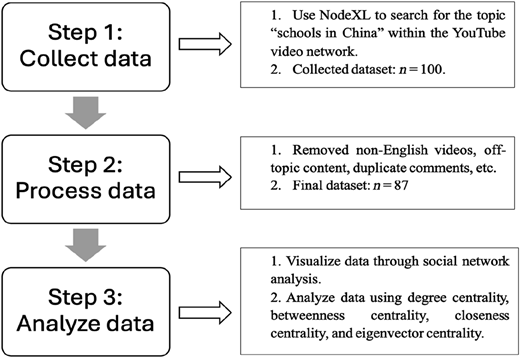
The research framework of this study is shown in Figure 1, which mainly includes three steps: (1) Data collection. This study searches for data related to the topic “schools in China” in the YouTube video network. (2) Data processing. The 100 collected data are screened and preprocessed, and finally a 87-video data set related to the topic “schools in China” is obtained. (3) Data analysis. Using social network analysis methods, the complex relationship between YouTube video network users and video content is identified, and the position of users in the entire network and the relationship structure between these users are revealed. In addition, this study also focuses on the most influential videos in the YouTube video network and then uses content analysis to gain a deeper understanding of the type and content of information disseminated through the YouTube video network.
4. Results
4.1 Overall analysis of YouTube network structure
Looking at the overall data, Table 1 describes the values of the YouTube video network graph metric, which is used to identify how the social media platform shapes the network structure of “schools in China.” The average geodesic distance determines the density of the network (Osman et al., 2025). The average geodesic distance is 2.996061, indicating that two random nodes can be connected by approximately three links. In theory, close connections facilitate the rapid dissemination of information.
Table 1 shows the interactions between all videos about schools in China in the YouTube video network. The groups are weighted according to their size based on the interaction and engagement patterns of the schools in China videos. The YouTube video networks in different groups focus on different aspects. There is close communication and dialogue between and within the videos of the groups. The largest group in the YouTube video network has been labeled as Group 1 to help with identification. Based on the unique feature of Group 1 in the dataset results, which has only vertices and no edges, this group can be described as an “isolated” group because no other users are mentioned in the videos posted by the users. The remaining groups can be called community groups because the YouTube video networks in these different groups focus on different aspects and there are interactions between them.
Table 2 details the clustering of the “schools in China” topic within the YouTube video network into 10 groups. Each point represents a video, and the “lines” formed by groups of points indicate relationships between videos. The lines between them represent edges, signifying comments from the same user. Videos are grouped based on the frequency with which they mutually mention the topic within videos or video comments. Across the entire network, YouTube video networks are clustered into social network graph clusters. Ten clusters were identified for the “schools in China” theme. The largest cluster, G1, contains 53 video segments, followed by G2 (8), G3 (8), and G4 (7). These clusters provide educational content, critical perspectives, and discussions on various aspects of “schools in China,” attracting a diverse audience with differing viewpoints on the topic.
4.2 Top 10 most impactful key videos
The most influential YouTube videos typically rank highest across all centrality measures, with rankings determined by sorting users based on their degree centrality scores (Gomez-Vasquez, Forstmane, Da Silva, & Romero-Hall, 2024). Table 3 shows influential videos about “schools in China” ranked by betweenness centrality scores. Among videos uploaded to YouTube on this topic, the top 10 accounts include not only ordinary citizens but also those of journals and newspapers These accounts share their perspectives and opinions through videos and have amassed large followings. Notably, China Observer ranked first, and the second-ranked account belongs to the South China Morning Post, an English-language newspaper based in Hong Kong owned by Alibaba. Each centrality YouTube video and channel holds varying levels of influence or position within the network.
Table 4 lists the titles and sources of the ten most influential videos on the YouTube video network related to the topic of “schools in China” during this period. The top ten videos have very high view counts. As can be seen from the video titles, key themes emerge around the theme of “schools in China,” encompassing school activities, students, classrooms, and teaching methods, covering a wide range of topics. These videos contain both factual and controversial content, highlighting the diverse perspectives of public discussion on the topic.
4.3 Content analysis of the topic “school in China” from YouTube videos
From the overall results of the YouTube video network analysis of “schools in China”, the content of the videos shows topics related to different themes. Through the analysis of the content of the top 10 videos, they are mainly focused on three aspects: China's education model, the daily life of Chinese students and modern educational technology. Videos related to these three topics have attracted the attention of a large number of users on the YouTube platform.
The educational model in Chinese schools is the topic of greatest interest to users. The top 1 video talks about China's college entrance examination. This phenomenon is merely an issue of educational management in a few schools, more fundamentally, it stems from differences in perception caused by variations in China's education model and cultural context. The top 2 video shows the extraordinary basketball skills displayed by children in a kindergarten. This display of teamwork and basketball skills has attracted widespread attention on social media. The video implies that these skills are the result of hard training and practice, and the video also reflects the importance that some Chinese schools attach to education. This is consistent with the views of the videos in top 3 and top 9. China attaches great importance to education, and both families and society attach great importance to academic success. Under China's strict education system and high academic standards, Chinese students study hard, enabling them to achieve excellent results in their studies.
The second type of video focuses on the daily life of Chinese students. The video “A day in a Chinese high school” uploaded by Jessica Duhon on the YouTube video network deeply shows the typical daily schedule of Chinese high school students, including morning exercises, classes and study courses, and also introduces the various extracurricular activities that students participate in, such as sports and art. From another perspective, it reveals that students' class time in a day is usually long, usually starting very early in the morning and ending very late in the evening. Due to the strict academic environment of the school, students often face huge exam pressure. However, the top 7 videos show that Chinese kindergarten schools have rich activities and students learn to take care of themselves in school (such as cooking). In fact, the daily activities of Chinese students in school reflect the emphasis placed by Chinese education on the all-round development of students in moral, intellectual, physical, aesthetic, and labor education. This approach aligns with China's national conditions and the developmental needs of students, while also responding to China's educational policies.
Finally, modern educational technology in Chinese schools is also a topic that users are most concerned about, including the infrastructure construction of current and future classrooms and the teaching methods of schools. From the top 5 video, it is found that many schools in China are equipped with smart classrooms, which include interactive whiteboards, artificial intelligence learning tools, online education platforms and other modern educational technologies designed to enhance the learning experience. This aims to make learning more efficient. The Top 10 video showed how some Chinese schools have effectively integrated technology (e.g. programming, robotics, and artificial intelligence) into their curricula. Monitoring devices like AI cameras installed in classrooms track students' attention and engagement levels during lessons, providing real-time feedback to enhance academic performance. However, this has also raised concerns about privacy for both teachers and students.
5. Discussion
In the past decade, YouTube has established its dominance as the main video social network (Lijo, Castro, & Quevedo, 2024). The dissemination of YouTube video networks serves as an effective channel for information access. However, the sheer volume of videos on the YouTube platform poses challenges to comprehensively understanding the online dissemination of content related to specific topics. This study utilized the NodeXL tool precisely because it offers specialized social network and content analysis capabilities compared to other tools. This study effectively extracted content related to the “schools in China” topic from YouTube's video social network using the NodeXL. With specialized social network and content analysis capabilities, NodeXL serves as an effective tool for capturing and simplifying social media data analysis.
The topic of “schools in China” has received widespread attention on the YouTube platform. Within the YouTube video network, a dissemination network structure has emerged centered around the core group of G1 to G10, with key videos occupying pivotal positions. Users participating in the dissemination of these video networks span diverse fields, including citizens, periodicals, and newspapers. This phenomenon arises as YouTube's user base becomes increasingly globalized, leading to a diversification of actors within the information network. The results of this study are consistent with previous studies that social network analysis methods can provide researchers with rich analytical insights by analyzing the network structure generated by the data of specific social platforms (Alqahtani, 2024). Moreover, China's educational development has drawn global attention in recent years and demonstrated its educational influence on the international stage.
The topics discussed by YouTube users on the platform contain both factual elements and points of contention. This is due to freedom of speech on social media. The results of this study show that many schools in China are equipped with smart classrooms to enhance students' learning experience. And integrating technology into the curriculum has received widespread attention from society. This is consistent with the view of Zeng, Liu, Wu, and Yue (2023) that smart classrooms are the main teaching space in Chinese schools, and the construction of future schools should also be intelligent. This series shows the progress of China's educational technology. In this era of rapid information technology advancement, this provides valuable insights for other countries in building smart classrooms.
YouTube videos also shed light on another aspect: some members of the public believe that certain Chinese high school students face heavy schoolwork burdens and immense exam pressure, with limited time for daily study. This tense environment may have an impact on students' physical and mental health and overall happiness. This underscores from another perspective that China's education system should prioritize the holistic development of students throughout its evolution. Students are individuals in the process of development (Song, 2022), and education must focus on their needs.
Furthermore, while the values conveyed in YouTube videos are shared globally, their expression may elicit differing perspectives across societies due to cultural variations and differences in educational systems. It is worth noting that the public views reflected on YouTube's video network may not be entirely uniform. Social media platforms may remove videos they deem likely to incite hate speech or restrict comment privileges (Rothenberger & Hase, 2024). Of course, these differences are permissible. Therefore, when examining public opinion and educational perspectives on social media, researchers should adopt an objective stance grounded in the educational contexts of different countries.
In conclusion, this study used NodeXL to apply SNA, analyzing the network structure of the “schools in China” topic within YouTube's video network. It identified influential videos, groups, and resource dissemination patterns, while also discussing public opinion surrounding this topic. The findings provide valuable insights for educational development. This study also acknowledges its limitations in applying NodeXL tool to YouTube video networks. The distinct infrastructure of different social media platforms influences sample selection and measurement outcomes. Variations in content generation across platforms may yield differing results when employing alternative analytical tools. Future research could consider utilizing Python for morphological reduction of datasets or employing VOSviewer for graphical visualization.
6. Conclusion
Overall, the YouTube video network is an effective way to access information. The real-time data provided by YouTube's social media platform offers researchers a rich information source. This study adopts an innovative approach: leveraging NodeXL to perform network analysis on YouTube videos. Applying social network analysis methods enhances understanding of social network structures and information exchange (Gasa et al., 2024), while clearly revealing the positional structures and relational attributes of communication entities within information networks. This study recommends that future research incorporate a comprehensive analysis of video comments and interactions, which will help provide deeper insights into the network structures formed by the public on social media.
The topic “schools in China” within YouTube's video network provides insights into the dynamics of Chinese education. Findings from this study indicate that YouTube video content primarily focuses on modern educational technology in China, the daily lives of Chinese students, and China's educational models. These results offer direction for China to foster a conducive learning environment and ensure improvements within its school system. Simultaneously, these findings promote other countries' intuitive understanding of Chinese education. Furthermore, by leveraging social media network structures, this study successfully illustrates the complex dynamics of education, offering a reference for future research employing this methodology to explore other topics.
This paper forms part of a special section “Examining the Dynamics of the School Environments in Africa and Asia Using Social Media Network Analysis”, guest edited by Drs Mohd Ali Samsudin, Chia Chun Tiew and Wee Ling Tan.