Cybersecurity in healthcare has become an urgent matter in recent years due to various malicious attacks on hospitals and other parts of the healthcare infrastructure. The purpose of this paper is to provide an outline of how core values of the health systems, such as the principles of biomedical ethics, are in a supportive or conflicting relation to cybersecurity.
This paper claims that it is possible to map the desiderata relevant to cybersecurity onto the four principles of medical ethics, i.e. beneficence, non-maleficence, autonomy and justice, and explore value conflicts in that way.
With respect to the question of how these principles should be balanced, there are reasons to think that the priority of autonomy relative to beneficence and non-maleficence in contemporary medical ethics could be extended to value conflicts in health-related cybersecurity.
However, the tension between autonomy and justice, which relates to the desideratum of usability of information and communication technology systems, cannot be ignored even if one assumes that respect for autonomy should take priority over other moral concerns.
In terms of value conflicts, most discussions in healthcare deal with the conflict of balancing efficiency and privacy given the sensible nature of health information. In this paper, the authors provide a broader and more detailed outline.
1. Introduction
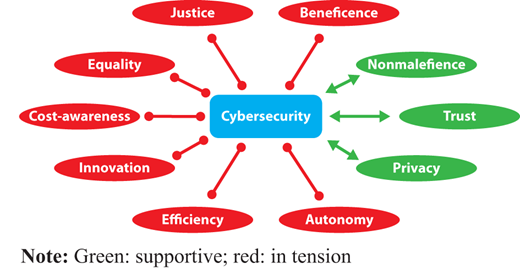
Recent global attacks such as the WannaCry ransomware attack in May 2017 had considerable effects on the information and communication technology (ICT) infrastructure of many healthcare providers, indicating that cybersecurity in healthcare is rather underdeveloped compared to other domains such as the financial sector (ENISA, 2016). What is the reason for this given that everybody agrees that health is an important value to human beings and that health information is among the most sensitive information? We suggest that one reason for this problem are the many values relevant for healthcare that are often in a conflicting tension with the aim of cybersecurity, as shown in Figure 1. Although one may claim that cybersecurity prevents damage from malicious attackers (i.e. supports non-maleficence), enables the protection of privacy and in this way usually enables trust, both moral (such as equality or care) and instrumental values (such as cost-effectiveness or efficiency) can have a conflicting relation to cybersecurity. For example, cybersecurity measures are costly and often effortful.
As an illustration, take the example of autonomy. When ICT is used in healthcare, it shall be aimed at ensuring that patients themselves determine which information is revealed to whom. Generally, password protection and encryption are common measures that are maintained. However, in emergencies, when patients are no longer able to make this decision, there is a risk that important medical information will not be accessible. Moreover, it might be very helpful to widely share medically relevant patient information among healthcare professionals to improve the quality and efficiency of treatment. Cybersecurity can thus be both supportive for privacy (understood as an aspect of autonomy) and hinder data sharing as a means for improving healthcare; therefore, it can be an obstacle to beneficence.
To analyze this problem, our contribution aims to answer two questions.
Which values are relevant for the ethics of cybersecurity in health?
What is the relation between the values at stake in cybersecurity and the four principles of medical ethics?
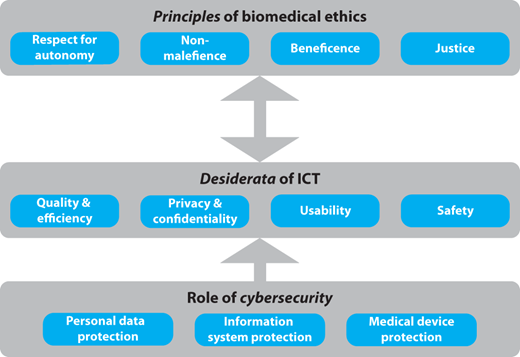
The analysis we offer relies on a conceptualization involving three classes of concepts:
the principles of medical ethics;
desiderata of ICT in health; and
the instrumental role of cybersecurity in facilitating or hindering the achievement of each of these three desiderata.
We begin our analysis with the role of cybersecurity in healthcare by distinguishing between three types of threats based on the target of the attack: threats against information, information systems and medical devices. In a fundamental sense, however, all attacks can be described as threats to the confidentiality, integrity and availability of information (Anderson, 1972; Voydock and Kent, 1983), including disrupting a system such that information cannot be processed. These threats relate to four main functions of ICT systems: improving the quality and efficiency of services, protecting confidentiality, enhancing usability and protecting patients’ safety. Finally, the tensions of these four desiderata to the principles of biomedical ethics are explained (Figure 2). While this involves a huge simplification of the debate, it allows us to explain in a relatively simple manner the role of cybersecurity. Our contribution is based on a review of 75 papers that were identified as being relevant for ethics in cybersecurity regarding health (Yaghmaei et al., 2017).
2. Desiderata of information and communication technology and the instrumental value of cybersecurity
Cybersecurity is not an end in itself but a precondition or means of other more general functions of ICT in health. Hence, it might be possible to explain the value conflicts in cybersecurity by relating them to the most important desiderata of virtually all ICT systems. We can distinguish between them as follows:
quality and efficiency of services;
privacy;
usability; and
safety.
2.1 First desideratum: efficiency and quality of services
If one agrees that health is an important value to human beings, then a healthcare system that can provide effective and efficient help in case of medical problems is most valuable. As reported by Nancy Lorenzi (2005, p. 2), currently:
[a]lmost every major economy in the world experiences the effects of the high cost of health care, and many, if not most, national and regional governments are in some stage of healthcare reform.
In fact, it can be said that in many countries, the reform of the healthcare system has developed into a permanent state. The development and implementation of ICT to support the provision of healthcare services is often a major part of these reforms. One of the main purposes of ICT systems in healthcare is the administration of information about patients and treatments to increase the efficiency of the healthcare system and, at the same time, to reduce its costs.
Quality, which is distinct from efficiency, refers to improvements in healthcare of qualitative and not quantitative nature. It refers, for example, to radically new services, as opposed to deliver more of the same kind of services, with the same resources. For instance, the collection and sharing of as much health-related data as possible could be used to identify new information about diseases and possible treatments and would thus enable innovations in healthcare (Olvingson et al., 2002; Vayena et al., 2016). Genomic research is especially seen as a promising approach to bring about progress in public health (Caulfield et al., 2008); it could even be argued that participating in biobanks is an act of solidarity (Hens et al., 2011; Hoedemaekers et al., 2007).
2.2 Second desideratum: privacy
McClanahan (2007, p. 69) stresses that:
[t]he increased use of electronic medical records has created a substantial tension between two desirable values: the increased quality and utility of patient medical records and the protection of the privacy of the information they contain.
Privacy is an important desideratum of services in the medical domain. Privacy includes both individual privacy, the ability to control information about the self (Westin, 1967; Fried, 1970), and group privacy (Bloustein, 2003), which protects “the desire and need of people to come together, to exchange information, share feelings, make plans and act in concert to attain their objectives” (Bloustein, 2003, p. 124), particularly the exchange of information between patients and their physicians and other caregivers.
Protecting “confidentiality”, i.e. preventing unauthorized information gain, is one of the main goals of cybersecurity (Anderson, 1972; Voydock and Kent, 1983). Confidentiality in the cybersecurity sense can be understood as a means to protect the privacy of both individuals and groups.
2.3 Third desideratum: usability
ICT is designed to afford usability: “[T]he degree of effectiveness, efficiency, and satisfaction with which users of a system can realize their intended task” (Roman et al., 2017, p. 70). Depending on the function of the ICT item in question, users can be patients, health workers and professionals, administrators or a combination of these. Persons in all three of these categories have different degrees of ICT competences, depending on personal attitudes and socio-demographic variables (e.g. education and age) or individual capabilities, and their limitations, e.g. handicapped persons. Hence, ICT that has a high degree of usability for most people in a given demographics may have a poor degree of usability in a different demographics (Kaplan and Litewka, 2008). Usability is not entirely independent of quality and efficiency. Low usability can compromise quality and efficiency directly, e.g. when it leads to human errors or a slowing down of the processes. While it may be difficult to consider quality independently of usability, one can imagine usability as a filter that limits access to more intrinsic qualities of a service in different degrees for different kinds of users. Users who are more willing to invest time in learning how to use a service may have access to a quality that is inaccessible to other users.
2.4 Fourth desideratum: safety
For the sake of this study, safety can be defined as the reduction of health-threatening risk and risks to persons’ health. Security in cybersecurity typically refers to the protection conferred to an entity against deliberate attacks, i.e. human causes involving malicious goals. It is clear that the security of data, information systems and devices is necessary to protect the health of the patients that depend on them. Thus, security (as in cybersecurity) can be considered a means to safety as defined here. Safety can be distinguished from quality, in that, for example, an ICT system (e.g. an implanted drug delivery system) can both enable therapies of higher quality and expose the individual to new risks, e.g. in the event of a cyberattack. Usability is not entirely independent of safety. Low usability can compromise safety, quality and efficiency directly, e.g. when it leads to human errors.
It may be objected that confidentiality, usability and safety are all aspects of the quality of services. While this is certainly true, it is also possible to distinguish a narrower concept of quality that concerns the primary function of a service and is, at least conceptually, relatively independent from the other three desiderata. There could be improvements in the quality of care or its cost-effectiveness achieved by ICT systems that are difficult to use, place privacy at risk and generate threats to patients’ safety in specific circumstances (e.g. the subject is a valuable target for economic or political reasons). Hence, it is meaningful to treat the four goals of ICT systems in questions as four distinct desiderata.
In Section 3, we therefore analyze the literature on cybersecurity in relation to the four desiderata identified above.
3. Cybersecurity as a means to information and communication technology desiderata
3.1 Quality and efficiency
First, cybersecurity is a means to protect personal information that is the prerequisite of the functioning of ICT systems designed to enhance the quality and efficiency of healthcare services. The majority of papers that we reviewed in detail are dealing with utilizing health-related electronic information or, more precisely, storing, exchanging and using patients’ (big) data. As already mentioned above, the use of ICT in healthcare should support the achievement of both economic and medical objectives. Utilizing health-related electronic information efficiently requires electronic information databases such as electronic healthcare records (EHR), which are increasingly implemented in health facilities. The major advantage of these records, besides cost efficiency, is the fast and uncomplicated exchange of health-related data between organizations (van der Linden et al., 2009; McGraw et al., 2009) and members of different health-related professions like general practitioners, hospital doctors, nurses or paramedics. The employment of electronic information is diverse: it plays, for example, an important role in the emergency department (Ayatollahi et al., 2009) or in connection with maternal and child health registries (Myhre et al., 2016). Furthermore, electronic health information has a seemingly big impact on counseling and psychological therapy (Barros-Bailey and Saunders, 2010; van Allen and Roberts, 2011; Kotsopoulou et al., 2015). Until now, electronic patient records have mainly been used to store “traditional” patient data such as patient’s identity and demographic characteristics, recent and distant medical history, current medications, allergies and sensitivities, chronic conditions, contact information or legal preferences. Genomic data cover whole genome sequencing (Presidential Commission for the Study of Bioethical Issues, 2012), large-scale genetic data sets (Wjst, 2010) and human biobanks (Cambon-Thomsen et al., 2007). Other data such as geographic information (Olvingson et al., 2002) and geospatial data (Lane and Schur, 2010) might also be used in the health domain, e.g. in public health and epidemiology. Biomedical and biometric data provided by individuals and patients themselves and collected with apps and smart devices (Vayena et al., 2016) also raise concerns with regard to protecting personal information. The quality element, the potential for improvement of patients’ life (Devillier, 2016; Kaplan and Litewka, 2008), is often mentioned.
Some of the studies mention the security of technologies for telemedicine (Kaplan and Litewka, 2008) and in support of an independent life at home, as in the so-called ambient assisted living (AAL) systems (Ikonen and Kaasinen, 2008; Rothenpieler et al., 2011; Spitalewsky et al., 2013). Demographic change and its impact on the age structure of society, the availability of labor and the increase in healthcare costs will contribute to the future availability and deployment of AAL systems. Other studies focus on mobile applications such as personal health apps (e.g. Project HealthDeSign, Olmsted et al., 2015) and apps for self-tracking one’s own body functions and behavior (e.g. sexual and reproductive activities, Lupton, 2015), often referred to with the phrase “quantified self.”
3.2 Privacy
While the primary motivation to use ICT in healthcare comes from the possibility of enhancing its quality and efficiency, the deployment of ICT in healthcare raises some ethical concern. Many of the studies that we reviewed particularly address security and privacy problems regarding EHR (i.e. Barrows and Clayton, 1996; Dong et al., 2012; Ozair et al., 2015; Rahim et al., 2013; Stahl et al., 2014). Different approaches of how to deal with security and privacy could be identified, such as solutions based on technology (for biometric authentication, e.g. Rodrigues and Santos, 2013, and for secure systems, e.g. Xiao et al., 2008) and ethical guidelines (i.e. Buckovich et al., 1999; The Academy of Medical Sciences, 2017). Security issues, among other factors, could lead to another crucial issue that was mentioned in 28 studies: the loss of control. The first type of issue is related to concerns regarding access control, which comprises everything from an unclear data access authorization (Dong et al., 2012; Stahl et al., 2014) over lacking some control (Ikonen and Kaasinen, 2008; Motti and Caine, 2015; Olmsted et al., 2015; Olvingson et al., 2002) to a complete loss of control with regard to personal information (Barrows and Clayton, 1996; Caulfield et al., 2008). The consequence could be unauthorized access by others (Buckovich et al., 1999; Greenbaum et al., 2011; Myhre et al., 2016), e.g. in a professional medical context (Ayatollahi et al., 2009; Caldicott and Manning, 2013; McGraw et al., 2009; van Allen and Roberts, 2011; Wallace, 2015; Wang et al., 2013; Xiao et al., 2008). The other type is the loss of control over one’s own data (Barrows and Clayton, 1996; Caulfield et al., 2008; Mascalzoni et al., 2015). This is noticeable regarding a lack of possibilities to manage one’s own data (Bourret and Pestana, 2015; Thilakanathan et al., 2016), a lack of control over the concrete use of data (Greenbaum et al., 2011; Ienca and Haselager, 2016; Rodrigues and Santos, 2013; Vayena et al., 2016) and, in the worst case, the risk of losing ownership of one’s own data (Kluge, 2011). This loss can be a risk to the empowerment of patients (Bourret and Pestana, 2015).
The less security and control one has over one’s own data, the more urgent the ethical issue of misuse of data becomes, as discussed on different levels in 41 studies. In particular, data theft (i.e. Buckovich et al., 1999; Myhre et al., 2016; Ozair et al., 2015; Thilakanathan et al., 2016) and thus identity theft (Rodrigues and Santos, 2013; Rothenpieler et al., 2011) are crucial issues. However, the most important risks of misuse of data are the disclosure of information (mentioned by 32 papers, i.e. McGraw et al., 2009; Wjst, 2010) and a possible identification via the data (mentioned by 14 studies, among others Lane and Schur, 2010; The Academy of Medical Sciences, 2017), which may increase the risk of surveillance (Mulligan and Schneider, 2011; Ozair et al., 2015; Rothenpieler et al., 2011). The stated issues seem to have at least some effect on confidentiality (21 studies outline confidentiality and trust issues). On the one hand, stakeholders show a lack of trust with regard to technologies (Rahim et al., 2013; Saigí-Rubió et al., 2016) and security systems (Olvingson et al., 2002; Tieu et al., 2015). On the other hand, trust in professionals and medical staff is also an issue (Ayatollahi et al., 2009; Williams, 2008), and confidentiality seems to be crucial (Caldicott and Manning, 2013; Wallace, 2015), especially in counseling settings (Barros-Bailey and Saunders, 2010; Kotsopoulou et al., 2015; van Allen and Roberts, 2011). It is generally possible to (re-)identify people (e.g. their health status, relationship link, dispositions) based on genetic information (i.e. Lowrance, 2006; Vayena et al., 2016; Wright et al., 2013) and to commercialize this knowledge (Cambon-Thomsen et al., 2007; Lupton, 2015).
3.3 Safety
Six sources discuss the risk of hacking and other forms of attacks (Motti and Caine, 2015; Mulligan and Schneider, 2011; Tieu et al., 2015), which could directly affect the physical and psychological safety of individuals (Camara et al., 2015; Ienca and Haselager, 2016; Altawy and Youssef, 2016). In addition to trade-offs between quality/efficiency vs privacy/confidentiality, the design of implantable medical devices illustrates better than other health-related ICT contexts the trade-offs of both former desiderata against safety (Table I). The incorporation of more extended communication and networking functions, known as telemetry, leads to improvements in quality and cost-effectiveness, e.g. patients can move freely in their homes, while healthcare providers can constantly monitor them (Camara et al., 2015; Altawy and Youssef, 2016).
However, this is a “vulnerable communication channel,” which “makes it easier to attack the device” and “could potentially allow an adversary to monitor and modify the implant without necessarily being close to the victim” (Camara et al., 2015, pp. 272-273). This also compromises quality of services with implications on safety, e.g. “if the information sent by the implant to the programmer is altered, the doctor might make a wrong decision” (Camara et al., 2015, p. 273).
3.4 Usability
The analysis of the literature, particularly on electronic health records, telemedicine and AAL technologies, highlights difficulties regarding usability (Roman et al., 2017; Kaplan and Litewka, 2008; Spitalewsky et al., 2013; Young et al., 2014) and the importance of acceptance of ICT systems by their users (Saigí-Rubió et al., 2016; Tieu et al., 2015). One example of a usability issue is the aforementioned trade-off between the usability of an implant outside a medical environment and its vulnerability to cybersecurity attacks. Another one, again in the context of implantable devices, is the fact that authentication may be problematic in emergency situations (Camara et al., 2015; Altawy and Youssef, 2016).
Because usability can differ for different demographics, there is a tight connection between this desideratum and one of the outstanding ethical issues concerning ICT in health, emerging from our review: the fact that vulnerable groups and those with special needs must be taken into particular consideration. Because of the “digital divide,” people who have little or no experience with the application of ICT can face disadvantages regarding health-related services (Chang et al., 2004). This also applies to people with limited health literacy (e.g. in case of use of online portals, Tieu et al., 2015). The literature shows that the elderly form a group with special needs and interests, which could present a barrier for the adoption of health-related technologies (Devillier, 2016; Young et al., 2014). People with dementia, Alzheimer’s or other cognitive handicaps present a special case (i.e. Batchelor et al., 2012).
3.5 Instrumental role of cybersecurity
Cybersecurity measures are a means to ensure the reliability of ICT, which is a key requisite for the quality, efficiency and safety and privacy of health services. In 26 studies addressing technical security issues in health contexts, difficulties concerning reliability of systems (Ikonen and Kaasinen, 2008; Spitalewsky et al., 2013) and reliability of data (i.e. Ozair et al., 2015) have been mentioned. Threats to data integrity are unauthorized modification (Barrows and Clayton, 1996; Stahl et al., 2014; Wang et al., 2013), manipulation (Kaplan and Litewka, 2008; Kluge, 2011) or sabotage of data (Williams, 2008). Cybersecurity involves trade-offs regarding quality of ICT, as shown by the literature on implantable medical devices (Table I): encryption and authentication, e.g., slow down device response and indicate higher energy consumption. The latter has implications on battery and thus device life, which, in turn, has implications on cost-effectiveness and safety because surgery is required to replace such devices.
Cybersecurity’s relation to usability is also multifaceted. On the one hand, cybersecurity can be a hindrance to usability. This holds mainly for two reasons: for humans, adhering to policies that are necessary to keep data, systems and devices secure, which normally takes resources such as time and mental efforts (Tieu et al., 2015, related to dementia and remembering passwords see Batchelor et al., 2012). Second, cybersecurity technologies tend to reduce the immediacy with which the data, system or device can be used for its primary function as shown by the example of authentication for implantable medical devices (Camara et al., 2015; Altawy and Youssef, 2016).
On the other hand, poor usability can be an indirect cybersecurity threat. For example (outside cybersecurity), aggressive warning messages in AAL lead users to deactivate security messages (Rothenpieler et al., 2011). Similarly, in the cybersecurity context, when security is a hindrance to usability, it may backfire, e.g. users may look for workarounds such as writing complex passwords on a post-it to easily access them.
Summing up, it seems that the four desiderata explored here, namely, quality and efficiency of services, privacy, usability of health-related ICT systems and safety, are related as in a pentalemma, where you cannot simultaneously advance all of them through cybersecurity. For example, cybersecurity protects systems that produce, connect and make large amounts of personal data accessible while ensuring their integrity and completeness. This, however, makes privacy harder to protect. If cybersecurity also includes tools for protecting privacy, they must reduce the information in the data or its accessibility. If one wants to have both high-quality services and privacy protection, data should be accessible for some and inaccessible for others, i.e. one needs authorization systems but these also reduce usability.
4. Cybersecurity and principles of biomedical ethics
4.1 Four principles of biomedical ethics
The “Principles of Biomedical Ethics,” first published in 1977 by Tom L. Beauchamp and James F. Childress, is a classic text in biomedical ethics (Beauchamp and Childress, 2013). The core features of this principlism are to identify four moral principles (autonomy, non-maleficence, beneficence and justice) pertinent to a particular moral situation and to use specification, balancing and (deductive) application to create a bridge between the moral situation and the relevant principles.
Principlism is not undisputed in bioethics (Clouser and Gert, 1990; Hine, 2011). Nevertheless, principlism remains highly influential among bioethicists and practitioners (Reijers et al., 2017). Hence, we would like to use principlism as a starting point of our ethical analysis concerning cybersecurity in health.
The four principles of biomedical ethics are respect for autonomy, non-maleficence, beneficence and justice. Beauchamp and Childress’ definitions can be summarized as follows:
Respect for autonomy involves the right for an individual (patient) to make his or her own choice, particularly for medical decisions. It involves the right to be informed about therapeutic and diagnostic options in an appropriate way.
Non-maleficence can be derived from the classic quote “above all, do no harm,” as stated in the Hippocratic Oath. It involves the duty to make pertinent risk-benefit assessments and to minimize risks to patients (and others) because of medical action (or omission).
Beneficence requires acting with the best interest of the other in mind. It reflects the basic moral motivation of medical acting, namely, to improve the health status and quality of life of your patient.
Justice emphasizes fairness and equality among individuals. It requires going beyond the mere interaction between individual patients and medical professionals and taking a holistic point of view, particularly with respect to distributive justice of scarce goods.
4.2 Relations between information and communication technology desiderata and the four principles
Quality and efficiency are mostly related to beneficence. A more cost-effective system can potentially help more people. Quality improvements can help people who could not have been helped in the past. Moreover, even if quality innovations may initially not be cost-effective, often they become more affordable with time and tend to augment the number of persons helped and treated in the long term.
Safety is mostly related to non-maleficence. Once ICT services promoting quality and efficiency are in place, the failure to guarantee their reliability can lead to harming individuals. Higher information processing or communication capabilities can do more harm than more primitive systems with less capabilities, even if the former are potentially able to confer greater benefits (or the same benefit to more people) than the latter.
Privacy is mostly related to autonomy and non-maleficence. Some cybersecurity measures are meant to guarantee the privacy of information and communication within healthcare. Non-maleficence is at stake because violations of privacy can cause reputational harm, discrimination and all those other risks to which a blackmailed subject may expose him or herself and those who depend on the subject’s decisions.
Moreover, privacy is a precondition of autonomy. The connection between privacy and autonomy is more organic. It has been argued that privacy is essential for autonomy in the sense of individuality (Bloustein, 2003, p. 42):
The man who is compelled to live every minute of his life among others and whose every need, thought, desire, fancy or gratification is subject to public scrutiny […] merges with the mass. His opinions, being public, tend never to be different; his aspirations, being known, tend always to be conventionally accepted ones; his feelings, being openly exhibited, tend to lose their quality of unique personal warmth and to become the feelings of every man. Such a being, although sentient, is fungible; he is not an individual.
Usability is mostly related to justice, but it is also related to non-maleficence and autonomy. There is a complex relation between usability, justice and each of the other principles. A system may enhance the autonomy of some users, those who are able to navigate a more complex system and express their preferences through it, but it may at the same time reduce the autonomy of health-illiterate or ICT-challenged ones. Moreover, poor usability may compromise safety, for example, information in a medical implant may be harder to retrieve in emergency situations. It may unequally affect the security of different populations in different circumstances. A design choice that enhances the autonomy or safety of some of its users while reducing that of others may be considered unjust because it distributes benefits unequally, especially if those negatively affected belong to vulnerable populations, which are already in a situation of disadvantage.
5. Conflicts of moral principles in cybersecurity
Having explained the relation between ICT desiderata and the four principles of medical ethics, it is now possible to map trade-offs between the goals of cybersecurity into conflicts between the four principles of medical ethics.
5.1 Prioritizing beneficence and autonomy at the expense of justice
Suppose that cybersecurity protections in healthcare are designed to optimize the quality and efficiency of services and the privacy of information and confidentiality of communication, while sacrificing usability and safety. As shown above, a system maximizing the amount of data produced and analyzed could be responsive to the individual privacy preferences of patients, thus enhancing their autonomy and allocating resources efficiently, which may benefit more people (beneficence). But a system capable of achieving this will tend to be quite complex and, as such, compromises usability for certain demographics, in contrast or even contradiction to the justice principle.
5.2 Prioritizing beneficence and (informational self-determination) autonomy at the expense of non-maleficence
Consider again a highly networked, data-intensive information system in healthcare, which is designed to benefit people with better and more cost-effective services, while respecting their autonomy. If the system involves complex, granular, stratified authorization systems, requiring complex passwords, it may invite workarounds which undermine cybersecurity defenses. This generates exposure to passive and active attackers, who may interfere with a device or gain access to confidential information, which is in conflict with the principle of non-maleficence. In relation to implantable medical devices, a system with extended networking capabilities and privacy protections may reduce usability in critical situations (authorization issues) and safety (e.g. battery life issues), which is also in tension with the principle of non-maleficence.
5.3 Prioritizing beneficence, justice and non-maleficence at the expense of autonomy and non-maleficence
Suppose that the quality and efficiency of services are optimized, together with usability and sacrificing privacy, e.g. a system that makes extensive use of electronic health records and extensive surveillance of patients through data generated by medical devices with good protection of data integrity and accessibility but poor protection for confidentiality and privacy. Such a design may comply with some aspects of the principle of beneficence (data-intensive services) and some aspects of non-maleficence (increased patient surveillance), but sacrifice autonomy (patient surveillance and privacy violations) and other aspects of non-maleficence (harmful privacy violations). Incidentally, such a design may be compatible with justice only because it “levels down” privacy and autonomy.
5.4 Prioritizing non-maleficence and (privacy-related) autonomy at the expense of beneficence and autonomy
Consider a system of medical health records optimized to promote privacy and safety. The most extreme form of this would be a system minimizing data collection, data sharing, communication and networking. Such a system may be able to avoid privacy breaches and impersonation and denial of service attacks, thus avoiding device malfunctions. It would be responsive to the principle of non-maleficence and also of autonomy, i.e. it protects privacy, which is crucial for autonomy.
Such a design, however, could not be used for providing data intensive services, which may involve a sacrifice in quality and/or cost-effectiveness. This is contrary to the principle of beneficence. In the context of implantable medical devices, maximizing privacy and safety leads to sacrificing certain aspects of usability (e.g. no wireless monitoring) with implications on autonomy.
5.5 Prioritizing for justice at the expense of autonomy and non-maleficence
A design choice may promote quality and efficiency while equalizing safety and privacy for different demographics. Consider an electronic health record with a relatively simple authentication system and just one privacy setting for all. Complex authentication systems would be avoided too. It may be more suitable for patients from certain demographics (e.g. elderly or illiterate), who may actually gain autonomy because of a system that offers few personalization options and is thus simple to use. Less sophisticated ICT users would also be less tempted to find workarounds to security systems, so the system may achieve a more even level of security. The design may achieve a more equal distribution of benefits because it would be easier for otherwise disadvantaged users to take advantage of it. Such a simple system would be maximally compatible with justice, but it would be incompatible with services that guarantee informational self-determination. It would also conflict with non-maleficence because it would feature weak authentication, which could put the privacy of the most vulnerable individuals at risk.
6. Conclusion: How should one set priorities between conflicting principles?
The preceding analysis shows that trade-offs involved in design choices for cybersecurity systems map into conflicts between the four principles of medical ethics. We use the concept of a “conflict” to describe the fact that different principles (beneficence, non-maleficence, autonomy and justice) point in different directions. We use the concept of a “trade-off” to describe the extent to which a design choice can satisfy each principle. The above analysis deals with the most extreme cases for the purpose of illustration. For example, the design choice described in Section 5.1 tries to maximally satisfy the beneficence and autonomy principles, which leads to sacrificing justice. Conversely, the design choice described in Section 5.5 tries to maximally satisfy justice with a cost in terms of the degree to which principles of autonomy and non-maleficence are satisfied. As the design choices discussed in Sections 5.3 and 5.4 show, the trade-off can also be between different ways of satisfying the same principle. For example, the design in Section 5.3 fulfills the principle of non-maleficence by enhancing patient surveillance but makes the patient vulnerable to another kind of harm because of reduced privacy. The design in Section 5.4 fulfills the autonomy principle with respect to privacy (which is an enabler of autonomy) but not with respect to usability (which is an enabler too). Of course, real-world choices do not have to be so extreme because designers will try to partially accommodate all principles without fully sacrificing any of them. However, the trade-offs seem unavoidable.
Principlism does not provide priority rules for balancing the four principles when they conflict. This is left to the individual wisdom of ethical decision-makers (e.g. physicians, administrators) as no formula is given to make decisions. However, the departure from the tradition of medical beneficence and the “discovery” of patient autonomy is possibly the most significant evolution in medical ethics since at least the second half of 20th century (Faden and Beauchamp, 1986, pp. 75-100). In this tradition, the emphasis is on being respected as an autonomous individual, rather than on the (arguably more demanding) conditions of being autonomous, involving actual independence and authenticity in the subjects involved (Faden and Beauchamp, 1986, pp. 7-8). It may be possible to ask whether this idea of a priority of the principle of respect for autonomy, conceived in this way, is normatively appropriate and whether it de facto represents a dominant view among experts of this domain not only concerning the role of the patient vis-a-vis a physician but also of the user of ICT in health vis-a-vis cybersecurity.
With reference to cybersecurity of personal data and information systems, respect for autonomy may initially appear enhanced by a system that tries to optimize for quality/efficiency and privacy/confidentiality while sacrificing usability and safety; however, this is objectionable. Except in a formal sense, such design distributes the preconditions for autonomy in a somewhat unequal way. This system will only enhance the autonomy of some people, namely, those with the competences and abilities required to be able to use and take advantage of such systems and protect themselves well against cybersecurity risks.
A system sacrificing privacy tends to be incompatible with autonomy because it enables privacy violations with negative impact on autonomy across a wide-range of social contexts.
Finally, a system sacrificing quality and usability would also be problematic for autonomy, e.g. consider implantable devices. A design that minimizes networking and communication capabilities may afford better protection of privacy (against eavesdroppers) and safety (against life- or health-threatening manipulations or malfunctions). However, it will have to sacrifice usability in a way that it reduces autonomy, e.g. in relation to the possibility for a patient to leave medical environments and have a more autonomous life outside.
We believe that additional research, both empirical and normative, is required to determine if respect for autonomy should be given more importance than other principles and whether this is in fact a tendency in the field. Even if respect for autonomy is given more importance, it may be questioned whether the principle of respect for autonomy enjoys the same importance in “common morality” as it appears to have among practitioners of ethics or policy-makers in the field. It is yet another question whether this moral view is correct, irrespective of its popularity. Finally, the analysis here suggests that it is important to investigate aspects of autonomy that are not associated with privacy protection, but with the usability of ICT in healthcare.