This study aims to analyze the evolution of climate migration narratives in Italian print media from 2014 to 2024, examining how crisis-driven framings perpetuate the “Panicocene” – an era characterized by the fusion of climate and migration discourses into narratives of emergency.
Through a systematic qualitative analysis of 106 articles from the Carta di Roma Association’s press review, this research reveals how Italian media oscillate between humanitarian victimization and securitized othering of climate-displaced.
This research reveals how Italian media oscillate between humanitarian victimization and securitized othering of climate-displaced. This discourse reinforces structural inequalities by collapsing long-term socio-environmental challenges into sensationalized emergencies, legitimizing exclusionary policies while erasing the agency of affected communities. The study critiques the dominance of crisis rhetoric for fostering “climate migration amnesia,” which obscures historical patterns of environmental adaptation and excludes voices from climate-vulnerable regions.
By situating Italy as a “narrative laboratory,” the analysis demonstrates how media logic transforms global climate mobilities into localized threats, advancing the concept of invasion from the so-called Global South.
Introduction
Climate migration represents one of the most significant socio-political challenges of the contemporary era, yet scholarly understanding of how this phenomenon is communicated to and understood by the public has been growing in the past years. This article examines the evolution of climate migration narratives in Italian print media over the past decade, analyzing how discursive frameworks have shaped public perception, policy responses and the lived experiences of climate-displaced populations. As climate change intensifies globally, media representations play a crucial role in constructing collective imaginaries around human mobility induced by environmental degradation, extreme weather events and long-term climate destabilization (Boas et al., 2019; McLeman, 2018).
The crisis frame has dominated both climate change and migration discourse in media and policy, often depicting these complex, long-term phenomena as sudden emergencies requiring immediate intervention (Boas et al., 2024; Baldwin, 2022). Media coverage of climate change frequently employs apocalyptic and catastrophic narratives, framing environmental transformations as abrupt threats rather than ongoing, systemic processes (DeAngelo and Curry, 2025; Schäfer, 2015; Warner and Boas, 2017). Similarly, migration is persistently constructed as a crisis, with migrants portrayed as either passive victims or security threats, reinforcing perceptions of unpredictability and danger (Musarò and Parmiggiani, 2022; Cantat et al., 2023). This dual crisis framing not only obscures the structural and historical dimensions of both climate change and migration but also amplifies public anxiety and fosters divisive “us versus them” imaginaries, particularly in western media contexts (Giacomelli, and Cappi, 2025).
By collapsing long-term, intersectional challenges into the language of emergency, these narratives contribute to the “Panicocene,” an era marked by heightened societal panic where climate and migration crises are fused into a singular narrative of perpetual threat. In this context, emergencies are treated as unexpected and short-lived, while the realities of climate change, migration and their nexus are enduring, interconnected and deeply political. The Panicocene does not seek to replace established epochal concepts like the Anthropocene or Capitalocene; rather, it foregrounds the powerful role of media and political narratives in shaping collective imaginaries and responses to these intertwined phenomena (Giacomelli, 2023; Giacomelli and Cappi, 2025).
This crisis-driven, panic-inducing framing has significant consequences: it distorts public perceptions, fuels misinformation and fake news and legitimizes exclusionary or securitized policy responses that further marginalize climate-affected and mobile populations. Moreover, it risks perpetuating colonial logics by privileging short-term, project-based interventions over the decolonial, structural transformations required to address the root causes of both climate change and migration (Boas et al., 2024). Recognizing the centrality of narrative and framing is thus essential for understanding how imaginaries of climate and migration can either reinforce injustice and othering or open pathways toward more inclusive, just and future-oriented societies (Baldwin, 2022; Bettini, 2013; Durand-Delacre, 2022).
This research contributes to the growing body of literature at the intersection of media studies, migration studies and climate communication by examining the Italian context as a particularly revelatory case study. The study analyzed a ten-year period from 2014 to 2024, concentrating on the portrayal of the interplay between migration and climate change within Italian print media. The data set [1] was compiled from the press review maintained by the Carta di Roma Association. Articles were selected through a systematic keyword search strategy targeting the intersection of “migration” and “climate change.” This process yielded a total of 106 pertinent articles published throughout the specified timeframe.
Climate migration: a difficult media encounter
Climate or environmental migration is defined as:
[…] the movement of a person or groups of persons who, predominantly for reasons of sudden or progressive change in the environment due to climate change, are obliged to leave their habitual place of residence, or choose to do so, either temporarily or permanently, within a State or across an international border (IOM, 2020, p. 5).
This working definition, while lacking specific legal value, provides an analytical framework for understanding population movements triggered by climate-related environmental changes.
The academic and policy discourse on climate-driven human movement has undergone a significant conceptual shift from the notion of “climate migration” to the broader and more nuanced framework of “climate (im)mobilities” (Boas et al., 2019, 2022; Boas, 2025; Bettini and Gioli, 2016; Farbotko et al., 2022). The term “climate migration” has often been associated with large-scale, cross-border movements triggered by environmental change, reinforcing state-centric and crisis-driven narratives that prioritize border security and migration management (Miller et al., 2021). However, empirical evidence suggests that the impacts of climate change on human movement are far more complex, encompassing not only migration but also various forms of mobility and immobility, such as voluntary relocation, internal displacement and situations where individuals are unable or unwilling to move despite environmental risks (Baldwin and Bettini, 2017). The climate (im)mobilities paradigm recognizes that mobility is shaped by a multitude of intersecting factors, including social, economic, political and historical contexts, and that immobility – whether due to lack of resources, social ties or policy constraints – is equally significant in understanding responses to climate change (Boas et al., 2022). This approach challenges the assumption that climate change inevitably leads to mass migration, instead highlighting the diversity of experiences and the agency of affected populations, while also drawing attention to the “mobility regimes” and power relations that enable or constrain movement (Sheller, 2018; Boas et al., 2022).
The emerging field of climate mobilities research extends beyond simplistic push–pull migration models to consider the complex interplay of factors that shape human movement in response to climate change. This approach recognizes that human mobility refers to both voluntary movement and involuntary displacement, as well as government-led resettlement and relocation initiatives (Boas, 2025). Critically, the concept of mobilities must be understood alongside immobilities: the constraints, barriers and factors that prevent movement despite environmental pressures (Cundill et al., 2021).
Recent scholarship has sought to politically re-signify the terminology of climate migration, diversifying the theoretical frames and assumptions that typically dominate discourse on this issue (Farbotko et al., 2022, 2023). This conceptual widening reflects recognition that climate-induced movement exists within complex social, political and economic structures that shape who moves, who stays and under what conditions. Contemporary understanding of climate mobilities thus requires attention to the structural inequalities and power dynamics that determine vulnerability and adaptive capacity (Sultana, 2024; Sheller, 2023). By moving beyond a migration-centric lens, the climate (im)mobilities framework allows for a more holistic, decolonial and justice-oriented analysis of how climate change interacts with human mobility and stasis.
Climate (im)mobilities and representations
Climate (im)mobilities exist in public consciousness, largely through its mediated representations. Unlike many social phenomena directly observable in everyday life, climate (im)mobilities are primarily understood through the frames, narratives and images presented in media discourse (Boykoff, 2011; Ransan-Cooper et al., 2015). Media representations of climate migration perform a dual function: they both reflect and shape societal understandings of the issue (Raimi et al., 2024; Methmann and Oels, 2015). As one study on Italian media coverage of climate change notes, global warming and its consequences are often inaccessible to direct human experience and are instead largely constituted in the public mind from media narrations (Beltrame et al., 2017). Media thus possess significant power to cultivate collective imaginaries around climate change, (im)mobilites and their nexus, influencing public perceptions and policy responses (Rice and Atkin, 2013).
On one side, we have climate change. Media representation of climate change plays a crucial role in shaping public understanding, policy responses and societal engagement with this global issue. Unlike academic research, which offers in-depth and evidence-based analysis, media coverage often serves as the primary conduit through which the public encounters climate science and its implications (Moser, 2010). The framing of climate change in media varies widely, influenced by national contexts, political priorities and journalistic norms, leading to significant disparities in how the issue is presented to different audiences (Boykoff, 2011; Schäfer, 2015). Framing theory has been central in analyzing these portrayals, with studies showing that media often prioritize certain aspects – such as crisis, controversy or economic impact – while downplaying others like long-term adaptation or social justice (Schäfer et al., 2016; Entman, 1993). These selective frames can amplify public anxiety, reinforce political divides or, conversely, foster greater awareness and action depending on the narrative emphasis. Furthermore, media coverage is not only shaped by scientific findings but also by economic, cultural and political factors, which can result in significant miscommunication or misinformation. As a result, the alignment – or lack thereof – between academic research and media narratives has profound implications for public debate, policy development and the collective capacity to address climate change effectively.
On the other side, in the context of migration, media practices play a decisive role in processes of othering (Hall, 1992; Andreucci and Zografos, 2022; Jensen, 2011) and bordering (Van Houtum and Van Naerssen, 2002), influencing not only everyday experiences but also the broader social imaginaries that underpin them. Media logic often sensationalizes migration, using frames that structure how audiences interpret migrants’ behaviors, intentions and perceived impacts on host societies (Chouliaraki, 2013). These mediated representations are far from neutral; they can reinforce dominant stereotypes and anxieties or, conversely, challenge prevailing narratives and promote more nuanced understandings (Seiter, 2006; Hall, 1992). This dynamic is particularly evident in coverage of asylum seekers and irregular migration, where the tendency to frame arrivals as crises or emergencies amplifies public fears and legitimizes exceptional political measures. While migration has been a constant in human history, its prominence in political and media discourse has grown markedly in recent decades, shaping government policy and public debates over border control and national identity (Jensen, 2011; Van Houtum and Van Naerssen, 2002). As with climate change, discussions about migration are often clouded by misinformation, knowledge gaps and bias, particularly in Europe and other wealthy countries where media and political actors frequently emphasize irregular migration, security and crime Musarò & Parmiggiani, 2017; Schäfer et al., 2016). Such selective framing leads the public to overestimate the scale of migration, perpetuating cycles of fear and anxiety (Giacomelli et al., 2021).
Several challenges hinder effective media coverage of climate migration. One significant issue is the complexity of attributing migration solely to climate change. Migration decisions are influenced by a web of factors, including economic, social and political drivers, making it difficult to isolate the impact of environmental degradation. This complexity often results in oversimplified narratives that fail to capture the nuances of human mobility in a world of changing climate. The second challenge is the over-mediatization of cross-border climate migration. Raimi et al. (2024), in their analysis of the effects of communicating the rise of climate migration on public perceptions in the USA, show how exposure to future episodes of mass cross-border climate migration led to greater cross-border migration “risk perception” and did not increase people’s support for climate change policies. However, exposure to stories about internal climate migration in the USA did make people more supportive of these policies. In other words, informing about future episodes of mass cross-border climate migration will not make people back better climate policies. It will probably just make people more fearful and apprehensive of migration in general. Scholars such as Hiraide (2022) and De Haas (2020) have highlighted the complexities of defining and categorizing so-called “climate refugees,” pointing to a persistent legal vacuum and limited, but alarmist, media attention. Despite growing scientific consensus on the links between climate change and human displacement (Rosignoli, 2022), the coverage remains fragmented and often guided by political or sensationalist frames. Thus, representations of climate migration typically oscillate between humanitarian and security frames (Giacomelli, 2023; Sakellari, 2021; Ransan-Cooper et al., 2015). Humanitarian frames emphasize the vulnerability of affected populations, focusing on climate change as a driver of forced displacement and highlighting the moral obligation to assist those affected (Baldwin and Bettini, 2017). Security frames, by contrast, position climate migration primarily as a threat to receiving societies, emphasizing potential competition for resources, social instability and challenges to national sovereignty (Boas et al., 2019; Warner and Boas, 2017). These contrasting representations invoke different emotional responses and policy implications, alternately calling for compassion and protection, or vigilance and restriction.
Sakellari’s, (2021) research offers a nuanced analysis of how media representations shape public perceptions of climate-induced mobility, emphasizing the dual role of journalism in both reflecting and constructing societal understandings of climate migration. Through studies of UK news media and NGOs coverage, Sakellari (2021, 2024) demonstrates that media narratives frequently oscillate between humanitarian and securitized frames – depicting climate migrants alternately as vulnerable victims in need of protection or as potential threats to national security. This duality, as Sakellari argues, not only influences public sentiment but also legitimizes policy responses that can be either inclusive or exclusionary. Importantly, Sakellari highlights the tendency of mainstream media to oversimplify the complex drivers of climate mobility, often attributing migration solely to environmental factors while neglecting the interplay of socio-economic and political contexts. By foregrounding the “mediatization” of climate mobility, Sakellari calls for a shift toward more critical and intersectional media practices that recognize the agency of climate-affected populations and the structural inequalities underlying their mobility choices.
The consequences of these representational practices extend beyond academic discourse. How media frame climate migration influences public understanding, which in turn shapes political responses and policy development. The construction of climate migration narratives in print media thus represents a critical site of knowledge production with material consequences for the governance of human mobility in the context of climate change (Durand-Delacre, 2022). Dominant narratives often present climate migration as inevitable and overwhelming, with migrants depicted as passive victims or security threats rather than as agents with diverse motivations, capacities and experiences (Ransan-Cooper et al., 2015; Giacomelli and Cappi, 2025). Such representations risk naturalizing climate change impacts while obscuring the political and economic structures that produce vulnerability and constrain adaptive options.
Media and othering processes
Media representations of migration frequently participate in processes of othering – discursive practices that construct and maintain boundaries between an imagined “us” and “them” (Said, 1979; Wodak, 2015). In the Italian context, research has documented how migration coverage often reinforces existing social hierarchies and cultural anxieties (Ambrosini, 2020; Musarò and Parmiggiani, 2022). A 2024 report on Italian media coverage found that newspapers and television news reports have reduced their attention to migration issues by 42% over the past year, yet when migration is covered, politics tends to take up a great deal of space, and coverage was usually negative (Associazione Carta di Roma, 2024).
This politically oriented framing contributes to the construction of migration primarily as a matter of national security and sovereignty rather than as a complex social phenomenon with humanitarian dimensions (Ambrosini, 2020). The report found that coverage frequently centered on the “regulatory framework of debate,” with key terms like “Albania” (referring to Italy’s agreements with Albania for the transfer of migrants) dominating the discourse (Associazione Carta di Roma, 2024). Such framing narrows the scope of public understanding, limiting the complexity of migration processes and the agency of migrants themselves. The othering process operates through several discursive mechanisms in media representations: the homogenization of diverse migrant populations, emphasis on cultural difference, amplification of threat narratives and dehumanization through statistical representation (Wodak, 2015; Giuliani, 2021).
The research noted that 2024 had been a year in which people are disappearing” from coverage while politics remained “front and center,” suggesting a troubling erasure of migrant subjectivity from public discourse (Associazione Carta di Roma, 2024).
In climate migration coverage specifically, these tendencies may be compounded by apocalyptic framings that position climate migrants as harbingers of environmental catastrophe (Bettini, 2013). The construction of climate migrants as others serves multiple social and political functions. It reinforces national identity through contrast with foreign others, legitimizes restrictive border policies by emphasizing threat and displaces responsibility for climate change impacts onto affected populations rather than acknowledging historical emissions from industrialized nations (Baldwin, 2022). These othering practices are not unique to climate migration but build upon established discursive patterns in migration coverage more broadly.
Italy as a case study: context and significance
Italy represents a particularly revealing case study for examining climate migration narratives for several reasons. First, Italy’s geographic position at the Mediterranean frontier of Europe has placed it at the center of European migration debates, particularly since the 2015 refugee crisis. As a primary destination for mixed migration flows from North Africa and the Middle East, Italy has experienced firsthand the political, social and logistical challenges of managing migration in a context of rising nationalism and resource constraints.
Second, Italy faces significant climate vulnerabilities itself, with coastal regions threatened by sea level rise, increasing frequency of extreme weather events and agricultural impacts of changing precipitation patterns [2]. This dual position – as both a receiving context for migration and a site of climate vulnerability – creates a complex backdrop for media narratives about climate-induced mobility.
Third, research indicates that “Italians seem being not particularly concerned about climate change mitigation” according to Eurobarometer surveys [3]. This apparent disconnect between Italy’s climate vulnerability and public concern suggests interesting questions about the role of media representations in shaping risk perception and policy priorities. The analysis of how Italian media frame climate migration can illuminate broader patterns in climate change communication and public engagement.
Fourth, Italy’s media landscape offers a rich context for analysis. While there has been an overall reduction in migration coverage (with a 34% drop in headlines over the past year), significant differences exist between outlets. The Catholic-linked daily Avvenire, for instance, consistently produces the most migration coverage, with 254 articles on the front page and 870 in total during the study period (Associazione Carta di Roma, 2024). These variations reflect differing editorial priorities and political orientations that shape how (climate) migration is represented.
Finally, examining Italian media coverage addresses a significant research gap. While substantial scholarship exists on media representations of migration in Northern European contexts, the Mediterranean perspective remains comparatively understudied, particularly regarding climate-specific migration. Hence, understanding how Italian media frame climate migration has both theoretical and practical significance (McLeman, 2018).
The study of climate migration narratives in Italian print media over the past decade (2014–2024), thus, offers a window into broader dynamics of climate communication, migration politics and media representation. By analyzing how these narratives have evolved, this research contributes to our understanding of how climate mobilities are socially constructed, politically managed and culturally understood within Mediterranean Europe. Such analysis carries implications not only for media studies but also for policy development, public education and the ethical treatment of climate-displaced populations.
Methods
The analysis examined the decade spanning 2014–2024, focusing on media treatment of the relationship between migration and climate change in Italian print media. The corpus was derived from the Press Review of the Carta di Roma Association. The selection was conducted using keyword-based search strategies focusing on the nexus between “migration” and “climate change.” In total, 106 relevant articles were identified across the time period considered. This relatively small number, given the vastness and urgency of the climate-induced migration phenomenon, highlights the limited attention this topic receives in Italian media. The modest quantity of articles strengthens the hypothesis that the specific “migration-climate” theme is marginalized within the broader journalistic coverage dedicated to migration.
The newspapers that most significantly contributed to the production of related headlines were major nationally distributed dailies. Specifically, Avvenire led with 18 articles, followed by La Stampa with 17 and Corriere della Sera with 13. Other significant contributions came from La Repubblica (seven articles), La Verità (six), Il Fatto Quotidiano (five), La Gazzetta del Mezzogiorno (four), Libero Quotidiano (four), Il Giornale (four) and Il Sole 24 Ore (three).
From a methodological standpoint, textual analysis was conducted using the Iramuteq software, a tool for statistical analysis of textual data. In particular, multiple correspondence analysis was applied, enabling the identification of the most frequently used lemmas and the principal semantic nuclei characterizing media discourse on the topic. This approach made semantic mapping possible, useful for understanding recurrent associations and dominant narrative patterns in the analyzed headlines. The textual data was processed using the Iramuteq software for correspondence and semantic analysis. Word frequencies, annual trends and clustering methods (e.g. chi2 index and dendrogram mapping) were used to identify dominant narratives and semantic classes.
Analysis
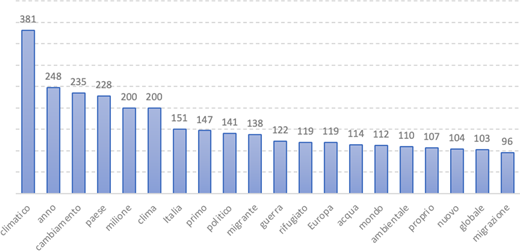
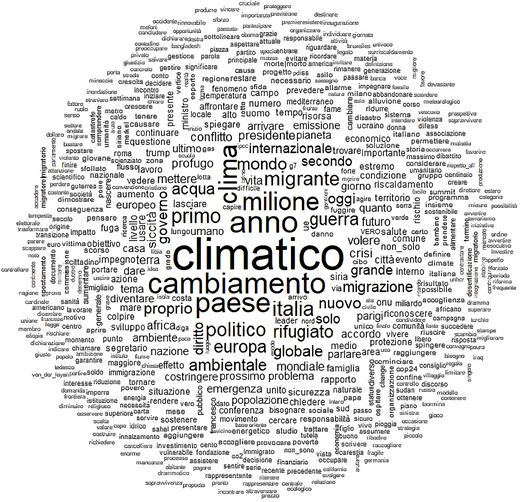
Analysis of the top 20 lemmas in the corpus (Figure 1), supported by word cloud visualization (Figure 2), reveals the primary conceptual nuclei that have characterized Italian media discourse on climate-related migration from 2014 to 2024. Beyond terms directly related to the research focus, such as “clima” (climate) and “migrante” (migrant), lemmas suggesting significant narrative frames emerge. Among these, “paese” (country), “millione” (million), “Italia” (Italy) and “politico” (political) stand out, indicating a framing of the phenomenon within the general dynamics of migrant arrivals and national political management. Simultaneously, terms like “guerra” (war) and “acqua” (water) reference the causes and consequences of climate migration (Figure 1).
Temporal analysis of characteristic lemmas for each year, conducted through the chi-square index, identifies the evolution of media narratives throughout the decade. In the 2014–2016 triennium, the most representative terms include “ambientale” (environmental), “acqua” (water), “siccità” (drought) and “contadini” (farmers), outlining a framework in which climate migrations are closely associated with environmental crises. In parallel, language used to describe migrants highlights legal status and forced nature of migration, with lemmas such as “profugo” (refugee) and “forzato” (forced).
In 2017–2018, the focus shifts to political leaders and global actions addressing the climate crisis. Terms like “Trump,” “Merkel,” “Guterres” and “Cop24” dominate media lexicon, reflecting a narrative centered on international summits and attempts at multilateral agreements. An illustrative example is seen in the 2017 headline “Trump Merkel G7 cancelliera Taormina” (Trump Merkel G7 Chancellor Taormina), highlighting this focus on international political gatherings.
In subsequent years, attention shifts toward humanitarian issues and symbolic cases. A significant example is Ioane Teitota, the first climate asylum seeker recognized by the United Nations, representing a crucial precedent in the debate on rights related to climate migration. This story was captured in headlines from 2021.
In 2021, characteristic lemmas like “piazza” (square) and “Greta” recall youth climate mobilizations, which received extensive coverage in national and international news. Finally, in the last triennium (2022–2024), an interweaving of global humanitarian crises, wars and famines emerges, with terms such as “ucraino” (Ukrainian), “fame” (hunger), “carestia” (famine) and “grano” (grain) representing the connections between conflicts, food insecurity and forced migration.
Thus, the Italian media’s coverage of climate migration reflects broader global trends, with a concentration on the consequences of climate change, such as environmental disasters and food insecurity. While international summits and policy discussions receive attention, there is often a lack of in-depth analysis of the root causes and potential solutions. Moreover, the intersection of climate change with geopolitical conflicts and humanitarian crises, particularly in regions like the Sahel and Syria, requires more nuanced reporting to avoid generalizations and stereotypes. The most frequent words – such as “clima,” “acqua,” “siccità” and “profugo” – reflect a preoccupation with environmental catastrophes and the human toll of climate disruption.
The textual analysis identified three main conceptual spheres, or semantic classes, representing the dominant themes in public discourse on climate migrants in the press. These clusters, consisting of groups of high relative frequency lemmas, outline the prevalent narratives associated with the phenomenon:
summit coverage;
policy discourse; and
consequences focus.
While the news articles examined in this study often blend multiple interpretative frames – sometimes intertwining crisis, humanitarian and security narratives within the same piece – for analytical clarity, we have identified and focused on three principal lines of analysis. This approach allows us to systematically explore the dominant tendencies in Italian print media coverage of climate migration, while recognizing that in practice, these frames are frequently mixed and mutually reinforcing. By disentangling these threads, we aim to highlight how summit coverage, policy discourse and their consequences are shaped by recurring patterns of representation, even as individual articles may reflect a more complex or hybrid framing.
Summit coverage (and quantification abstractions)
This class contains about a quarter of the corpus lemmas (26%) and centers on international climate summits. The vocabulary used includes references to world and Italian leaders (Trump, Merkel, Pope Francis, Gentiloni, Macron, Meloni, Greta Thunberg, Obama, Salvini, Schlein) and official meetings (conference, summit, meeting, G20, G7). The most influential years in this semantic class are 2017 and 2019. Publications that most contribute to this lexicon include Italia Oggi, Libero Quotidiano, Il Giornale, Il Fatto Quotidiano and La Gazzetta del Mezzogiorno.
Headlines reflecting this cluster include “ARRIVANO MILIONI DI MIGRANTI LI SPINGE IL CLIMA” (MILLIONS OF MIGRANTS ARE COMING, PUSHED BY CLIMATE) from Gente in 2019, focusing on the dramatic predictions often discussed at international forums. Thus, Italian media’s summit coverage relies excessively on quantitative abstractions – “50 million climate migrants by 2050” (IOM, 2020) – that obscure individual experiences and systemic injustices. Another example comes from Avvenire (July 31, 2016), discussing Ethiopia: “A year of drought has brought 10 million Ethiopians to their knees […] After the floods in March, 237,000 people left their homes” (“Un anno di siccità ha messo in ginocchio 10 milioni di etiopi… Dopo gli allagamenti di marzo, 237mila persone hanno lasciato le abitazioni”). This statistical spectacle serves what Pattison (2022) calls the “numbers game” of migration governance, where alarmist figures justify securitized responses while masking the political choices driving displacement.
Three problematic effects emerge from this quantitative framing:
Desensitization: Repeated exposure to large numbers reduces public empathy through “psychic numbing” (Slovic, 2007), making abstract statistics easier to dismiss than personal stories (Durand-Delacre et al., 2021).
Temporal displacement: Projections like “2050 scenarios” deflect attention from present-day displacements in favor of speculative futures, delaying concrete action.
Causal obfuscation: Aggregate numbers erase the specific historical and geographical contexts of climate migration, including Europe’s extractive legacies in the Global South (Chakrabarty, 2012) and current European internal displacement due to climate change.
The Italian media’s reproduction of UNHCR statistics without contextualizing Europe’s responsibility for climate impacts exemplifies a neoliberal governance logic that values quantifiable lives over qualitative justice.
Media also highlight the symbolic and political dimensions of international conferences. Corriere della Sera (May 10, 2017) quotes Barack Obama at the Milan Seed & Chips summit: “Climate change threatens global food security, with the risk of conflict and migration” (“Il cambiamento climatico minaccia la sicurezza alimentare mondiale, col rischio di conflitti e migrazioni”). However, such coverage is often more focused on political theater than substantive policy outcomes, revealing a gap between media spectacle and practical action.
Policy discourse (and absence of embodied narratives)
This semantic class (29%) focuses on policies addressing the effects of climate change and climate migration. The most recurring terms reflect themes related to the climate crisis, with references to renewable energy, climate agreements, sustainable development and gas emissions, but also concepts related to the protection of climate migrants, international protection and environmental refugee status. The most significant years for this semantic class are 2019, 2020 and 2023. Publications contributing most to this lexicon are Primo Piano Molise, La Verità, Il Messaggero, Italia Oggi, L’Espresso and Il Giornale.
A representative headline in this category is “Welby: i Paesi ricchi responsabili di emergenza climatica” (Welby: Rich Countries Responsible for Climate Emergency) from Avvenire in 2022, which addresses responsibility and policy implications.
Coverage often emphasizes the absence of legal frameworks to protect environmental migrants. For example, Avvenire (February 21, 2014) presents Carlotta Venturi’s appeal: “Those who emigrate due to climate issues are not recognized by either the Geneva Convention or the 1967 New York Protocol” (“Chi emigra a causa di problemi climatici […] non è riconosciuto né dalla Convenzione di Ginevra né dal Protocollo di New York del 1967”).
Policy discourse coverage in Italian media demonstrates a striking absence of embodied narratives from climate-affected communities. Analysis of 106 articles revealed that less than 8% included direct quotes from displaced individuals, compared to 63% featuring statements from EU officials, security experts and politicians. This disparity reflects what Couldry (2010) identifies as “narrative injustice” – the systemic exclusion of marginalized voices from public storytelling about crises affecting their lives.
The silencing operates through three mechanisms:
Elite sourcing bias: Journalists disproportionately cite government and UN representatives, privileging institutional perspectives over grassroots accounts (Splendore, 2020).
Epistemic marginalization: Traditional knowledge systems and Indigenous climate adaptation strategies are absent from 92% of analyzed articles, despite their relevance to mobility justice (Yumagulova et al., 2023).
Linguistic othering: When migrant voices appear, they are often filtered through interpreters or NGO spokespeople, distorting narrative agency (Musarò and Parmiggiani, 2022).
This erasure has material consequences. The exclusion of migrant narratives from climate discourse enables policies that treat displaced populations as “governance objects” rather than rights-bearing subjects. The Italian media’s focus on EU funding for Libyan coast guards, rather than migrant experiences of detention, exemplifies how dehumanized representations legitimize violent border regimes.
Consequences framing (and justice deficit)
This class, the most extensive (45% of lemmas), concerns the direct consequences of climate change on the environment and migration. The dominant terms deal with predictions about environmental refugees (e.g. “250 million by 2050”), problems related to water, drought, floods, rising temperatures, as well as wars and conflicts. Geographic areas cited are diverse and include places like Syria, Sahel, Africa, Sudan, Asia, Bangladesh and Iraq. This sphere addresses themes related to human rights and food emergencies. The most impactful years in this semantic class are 2015, 2016, 2021, 2022 and 2024. Publications contributing most to this lexicon are Avvenire, Le Scienze, Il Manifesto, L’Unità, Il Corriere delle Alpi, Il Mattino, Famiglia Cristiana, La Sicilia, Il Piccolo, Il Giornale di Brescia and La Provincia Pavese.
Headlines exemplifying this focus include “Eco-profughi, il dramma dei popoli in fuga dal meteo” (eco-refugees, the drama of people fleeing from weather) from Avvenire in 2014 and “Sono in arrivo gli «ecoprofughi» in fuga dai cambiamenti climatici” (The “eco-refugees” fleeing from climate change are coming) from La Verità in 2017.
Media coverage of consequence framing, together with climate summits and policy debates focuses, systematically excludes climate justice and mobility justice frameworks when discussing the consequences of human displacement. Rather than interrogating the structural inequalities that render specific populations vulnerable to climate impacts (Ajl, 2021), Italian print media predominantly frames climate migration through technocratic lenses, emphasizing “crisis management” and “adaptation solutions” (Boas et al., 2024) and “blaming nature” (Giacomelli and Cappi, 2025). This depoliticized approach mirrors a “distributive justice trap,” where discussions of climate impacts focus narrowly on resource allocation rather than addressing the colonial histories and capitalist systems that produce differential vulnerabilities (Sultana, 2022).
The European Union’s climate migration policies exemplify this justice deficit. As analyzed in the Italian media corpus, EU discourse emphasizes border security and “orderly migration” while remaining “gender and environmental justice-blind”. This aligns with bettini et al. (2017) critique of “climate refugee” narratives that prioritize state security over reparative justice. The consistent omission of historical responsibility frameworks – particularly Europe’s disproportionate contribution to cumulative emissions – reproduces what Sultana (2022) term “climate apartheid,” where high-emission regions externalize adaptation costs onto vulnerable populations.
Mobility justice perspectives (Sheller, 2018) are particularly absent in summit coverage. Media reports on COP declarations and EU migration pacts rarely mention the asymmetrical mobility regimes that grant climate-vulnerable populations limited movement rights compared to high-emission nations’ citizens. This silence perpetuates the “passport privilege” system critiqued by Torpey (2018), wherein birthplace determines one’s capacity to escape climate impacts. The Italian media’s focus on Mediterranean “border crises” further naturalizes these inequalities by framing mobility restrictions as inevitable rather than politically constructed.
Conclusions
This study’s examination of climate migration narratives in Italian print media from 2014 to 2024 reveals significant insights into how media discourse shapes public understanding of one of the contemporary era’s most complex socio-political challenges. The analysis demonstrates that Italian media coverage has largely perpetuated the Panicocene (Giacomelli, 2023; Giacomelli and Cappi, 2025), the “crisis-panic nexus,” wherein climate migration is consistently framed through emergency rhetoric that obscures the structural and historical dimensions of both climate change and human mobility (Boas et al., 2024). This finding contributes to our understanding of how the Panicocene manifests in national media contexts, where the collapse of long-term, intersectional challenges into emergency language creates a perpetual state of societal anxiety that ultimately serves to legitimize exclusionary policy responses.
The research reveals how Italian media discourse oscillates between what we identify as “humanitarian victimization” and “securitized othering” frames when representing climate-displaced populations. This oscillation represents a novel form of discursive violence that simultaneously infantilizes climate migrants as passive victims while constructing them as potential security threats, thereby denying their agency and political subjectivity (Bettini, 2013; Farbotko et al., 2022). This dual representation strategy allows media narratives to maintain apparent moral legitimacy through humanitarian concern while reinforcing exclusionary boundaries through security discourse – a phenomenon we term “compassionate securitization.”
Perhaps most significantly, this study demonstrates how Italian media’s failure to adopt the climate (im)mobilities framework (Boas et al., 2019; Bettini et al., 2017) represents a form of epistemological colonialism that privileges western-centric understandings of human movement over the lived experiences and agency of climate-affected populations. The persistent use of deterministic migration narratives reflects “mobility imperialism” – the imposition of simplified push–pull models that erase the complex social, economic and political factors that shape climate-related human movement. This finding extends beyond media studies to contribute to decolonial theory by revealing how representational practices can reinforce colonial logics in contemporary climate governance.
The analysis suggests that Italian media’s representational practices contribute to what we term “climate migration amnesia” – the systematic forgetting of historical patterns of environmental displacement and adaptation that characterizes Mediterranean societies. This amnesia serves to naturalize contemporary climate migration as an unprecedented crisis rather than recognizing it as part of longer historical patterns of human–environment interaction. Such forgetting has profound implications for policy development, as it prevents the incorporation of traditional knowledge systems and adaptive strategies that could inform more effective and culturally appropriate responses to climate-induced mobility.
Findings indicate that the dominance of crisis framing in Italian media reflects broader structural inequalities in global knowledge production about climate migration. The absence of voices from climate-affected communities in media narratives represents what we identify as “representational apartheid” – a systematic exclusion of those most directly impacted by climate change from discussions about their own mobility experiences (McLeman, 2018; Durand-Delacre, 2022). This exclusion not only perpetuates epistemic injustice but also undermines the development of effective climate adaptation and mobility governance strategies.
The study’s temporal analysis reveals that Italian media coverage has become increasingly securitized over the decade examined, particularly following major Mediterranean migration events. This trend toward securitization represents a concerning shift away from humanitarian frames toward what we conceptualize as “climate fortress Europe” – a discursive strategy that positions climate migration as an external threat requiring enhanced border controls rather than a shared global challenge requiring cooperative responses. This finding has significant implications for European climate policy and suggests the need for alternative narrative strategies that emphasize climate justice and international solidarity.
This research contributes to climate communication scholarship by demonstrating how national media contexts can serve as “narrative laboratories” where global climate migration discourses are localized and transformed according to specific political and cultural logics. The Italian case reveals how Mediterranean geopolitical positioning influences media framings, with proximity to Africa and the Middle East shaping representations of climate migration as both immediate threat and distant problem. This geographical imaginary has profound implications for how Italian audiences understand their relationship to global climate change and their responsibilities toward climate-displaced populations.
The study suggests several critical areas for future research. First, comparative analysis of climate migration representation across different European media contexts could reveal how geopolitical positioning and colonial histories shape national narrative strategies. Second, ethnographic research with Italian journalists and editors could illuminate the professional and institutional factors that influence climate migration coverage. Third, audience reception studies could examine how Italian publics interpret and respond to different framings of climate migration, potentially revealing opportunities for more effective communication strategies.
Finally, this research calls for the development of what we term “regenerative climate narratives” that move beyond crisis framing to emphasize adaptation, resilience and the potential for climate migration to contribute to social and ecological transformation. Such narratives would require fundamental shifts in journalistic practice, editorial priorities and the broader political economy of media production. The development of these alternative narratives represents not merely an academic exercise but an urgent political project essential for fostering the kind of collective imaginaries necessary to address the intertwined challenges of climate change and human mobility in the 21st century (Baldwin, 2022; Boas et al., 2024; Boas, 2025).
The structural silences in Italian climate migration discourse reflect broader failures in global climate governance. By neglecting justice frameworks, erasing individual voices and fetishizing quantitative abstraction, media and policymakers reproduce the colonial logics underlying both climate change and forced displacement. Addressing these gaps requires more than incremental reforms – it demands a paradigmatic shift toward reparative epistemologies that center the expertise and agency of climate-affected communities. As the Mediterranean becomes a frontline of climate mobility, Italy’s media and institutions have an ethical imperative to lead this discursive transformation.
Notes
All available in the following dataset: AUTHOR, E. (2025). PANICOCENE_DATASET_ MediaNarrativesOnCCIM_20250604 [Data set]. Zenodo. https://doi.org/10.5281/zenodo.15591027.