


There continues to be important discussion on how ChatGPT can be effectively integrated into the student learning environment in higher education. However, less is known about how social influences faced by students and the anthropomorphic features of ChatGPT affect technology adoption and student well-being. This study aims to develop and test a model that integrates the seminal technology acceptance model with subjective norm and anthropomorphism.
Data from a sample size of 128 higher education students in Singapore was collected using a self-administered survey and analyzed using partial least squares structural equation modeling, which is a useful method for estimating relationships between model variables.
Results indicate that subjective norm and anthropomorphism can influence the technology acceptance of ChatGPT, with anthropomorphism playing a significant role in driving the perceived usefulness and the perceived ease of using ChatGPT. The resulting intention to use ChatGPT can affect the subjective well-being of higher education students.
This study introduces a design typology that offers managerial implications on the key roles of subjective norm and anthropomorphism in the context of ChatGPT in higher education. In addition to authors’ Policy-Empowerment-Novelty (PEN) framework, their empirical results show how the meaningful design of both the social environment and artificial intelligence applications in higher education can encourage ChatGPT usage and improve the well-being of students.
1. Introduction
In November 2022, ChatGPT, an artificial intelligence (AI) chatbot capable of reinforcement learning to create complex conversations, was launched by OpenAI (OpenAI, 2022). Since then, public interest in AI has grown (VisionSuper, 2023), with ChatGPT gaining approximately 200 million weekly active users in 2024 (The Verge, 2024), mostly between 18 and 34 years of age (Turner, 2024) and comprising students and researchers (Neumann et al., 2023).
ChatGPT has gained significant attention among educators, students and policymakers for its ability to disrupt the education sector (Dwivedi et al., 2023) and the ways it can respond and learn in a human-like manner (Rahman et al., 2023; Saif et al., 2024). In higher education, the use of chatbots such as ChatGPT can result in an enhancement of learning, teaching (Adiguzel et al., 2023; Dwivedi et al., 2023) and student experience (Rasul et al., 2023). Students have also recognized that such AI tools can significantly influence their fields of study and future careers and express a desire to incorporate AI into the classroom and industry (Bisdas et al., 2021; Lee et al., 2022). Positive student experience with ChatGPT includes improvements in anxiety levels (Rudolph et al., 2024) and enriching the overall learning experience (Rasul et al., 2023).
For such benefits to occur, the effective adoption of ChatGPT is key. In the mature research stream of technology acceptance, multiple models have been developed to explain this phenomenon (Venkatesh et al., 2003), with seminal models such as the technology acceptance model (TAM) (Malik et al., 2021) or the Unified Theory of Acceptance and Use of Technology (UTAUT) (Raffaghelli et al., 2022) being applied to new paradigms such as student use of ChatGPT. For instance, Sobaih et al. (2024) found partial support for the UTAUT2 model in the context of student acceptance of ChatGPT in Saudi Arabia. Dahri et al. (2024) applied TAM to examine academics’ adoption of ChatGPT and found that perceptions of ChatGPT’s usefulness in supporting learning and its ease of use were key factors influencing their acceptance. Maheshwari (2024) combined the Theory of Planned Behavior (TPB) model with TAM to explore how students use ChatGPT. Overall, these studies underscore how behavioral intention can influence the use of AI in academia.
Despite increasing attention to the use of AI in education, research on how both subjective norm and anthropomorphism can affect ChatGPT adoption and higher education student well-being is understudied. The combination of subjective norms and anthropomorphism is salient to the student’s acceptance of using ChatGPT, with the former associated with the design of the social environment, while the latter is the design of the AI application itself. When peers, lecturers and the institution widely encourage the use of ChatGPT, students may feel motivated or even obligated to adopt ChatGPT because of the perceived social pressure. On anthropomorphism, studies such as Xiao and Kumar (2019) and Sheehan et al. (2020) identified the human-like characteristics of AI as being key that would prompt user acceptance and adoption. Such fragmented research findings represent a critical gap in the literature as higher education students experience both stimuli when considering ChatGPT usage. In addition, it remains unclear how both subjective norm and anthropomorphism can affect technology acceptance and the key usage intention outcome of student well-being (Brewer et al., 2019; Rehman et al., 2024).
Hence, our study aims to answer the following research questions:
How do subjective norms and anthropomorphism affect ChatGPT adoption in the context of higher education students?
How can the social environment and ChatGPT design be optimized in higher education to enhance students’ well-being?
In this study, the seminal TAM by Davis et al. (1989) was used as the underpinning theory to determine the technology acceptance of ChatGPT. TAM was inspired by the theory of reasoned action (TRA) and originally conceived to predict the acceptance of computer-based information systems among organizational users, with the key predictors being the perceived usefulness and the perceived ease of use of the systems (Davis, 1985). Despite its conceptualization four decades ago, TAM remains relevant in the age of generative AI, including ChatGPT, and continues to be a widely used model for technology acceptance (Mogaji et al., 2024). Studies on the use of AI have also conceptualized customer acceptance using TAM (Wirtz et al., 2018) with emerging empirical research analyzing the applicability of TAM in specific AI service environments (Wong and Wong, 2024).
Our study supports the recommendations by Mogaji et al. (2024) by embedding the TAM model in the specific industry of higher education. Using our extended TAM model, our results show that both subjective norm and anthropomorphism can affect the technology acceptance of ChatGPT, which in turn can influence subjective well-being. In addition to our contribution to the literature on technology adoption, our study contributes to the transformative services literature by focusing on the role of ChatGPT service in improving the well-being of its users (Field et al., 2021) and improving our understanding of the link between ChatGPT and well-being (Cambra-Fierro et al., 2024; Rehman et al., 2024). Our design typology also translates to a new framework for optimizing ChatGPT implementation for the higher education industry.
This paper is sectioned as follows. Section 2 describes the significance of subjective norms and anthropomorphism and the different ways these are actualized in the higher education industry. Literature review is conducted and hypotheses are developed in Section 3. The methodology used in this study is presented in Section 4. Results are presented and analysis is given in Section 5. In Section 6, the discussion of this study is presented, and the limitations and future directions are discussed in Section 7.
2. Social environment and artificial intelligence design in higher education
Subjective norm is the extent to which students believe that the people around them, including friends, teachers and the university, support their use of ChatGPT (Ajzen, 1991; Venkatesh et al., 2003). Various studies indicate that subjective norms significantly impact users’ behavioral intentions to adopt technology in various contexts, such as mobile learning (Nikolopoulou et al., 2020), e-learning platforms (Sabraz Nawaz and Rusith, 2019), learning management systems (Ain et al., 2016) and facial recognition using AI (Wu et al., 2024). In the context of ChatGPT, it is reasonable to suggest that when students observe their peers using ChatGPT and recognize its benefits, they are more likely to adopt it for learning purposes. Indeed, research by Foroughi et al. (2024) and Menon and Shilpa (2023) found that students were more inclined to use ChatGPT if they perceived people they respected in their social circles recognized its use. Also, subjective norm has been shown to impact technology acceptance for collectivistic (non-Western) cultures (Schepers and Wetzels, 2007). This would be a particularly relevant consideration for higher education institutions with significant international student enrolments that are experimenting with AI. Overall, subjective norm has been identified as a key factor in empirical studies examining technology acceptance.
While the subjective norm is more salient to the design of the social environment surrounding the student, anthropomorphism – attributing human-like qualities to non-human entities (Waytz et al., 2010) – is a notable platform design feature of chatbots to simulate human-like service interactions (Noor et al., 2022b). According to anthropomorphism theory, attributing human characteristics to technology can positively influence its adoption and use (Duffy, 2003). Research has explored anthropomorphism as a key factor in chatbot experimentation (Zhao et al., 2024) and adoption (Balakrishnan et al., 2022; Sheehan et al., 2020), showing its positive impact on human–AI interaction experiences (Li and Sung, 2021). Further, the human-like empathy associated with anthropomorphism can play a vital role in fostering supportive learning environments (Pelau et al., 2021), making students feel understood and encouraged, which enhances their interactions with ChatGPT.
Several typologies have been proposed in the literature to provide greater granularity and clarity of our understanding of AI applications and their various characteristics and use contexts (Noor et al., 2022a; Perkins et al., 2024). For our study, Figure 1 provides examples of four different contexts in which the use of ChatGPT can vary in higher education depending on the levels of subjective norm and anthropomorphism.
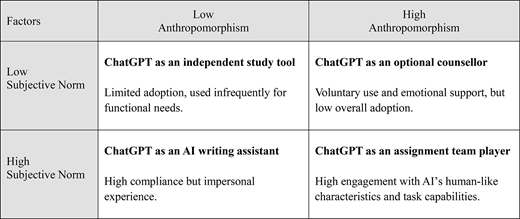
Typology of subjective norm and anthropomorphism of ChatGPT in higher education
Source: Authors’ own work
Typology of subjective norm and anthropomorphism of ChatGPT in higher education
Source: Authors’ own work
Low subjective norm and low anthropomorphism: This is a situation where there is an independent use of ChatGPT for study support. In this context, ChatGPT is available to the student, but the university neither encourages students to use it nor offers much guidance on how best to do so. ChatGPT is positioned as a “study materials creating tool” and students consider the software as just one of the many stand-alone resources. Interactions are functional and primed for utilitarian needs. Without external use pressure or a deeper emotional connection, students will seek ChatGPT infrequently or for particular tasks. Accordingly, usage and engagement are often undetected.
Low subjective norm and high anthropomorphism: There is optional AI support in course counseling in which ChatGPT is described as an optional “empathetic advisor” for course exploration. Here, ChatGPT offers thoughtful and personalized advice to students. Students find it user-friendly and view it as a source of emotional support. Without social or institutional pressure, this encourages self-directed engagement, which may resonate well with those comfortable using the technology. While this scenario may create positive experiences for users who choose to use it, overall adoption remains low due to a lack of institutional encouragement and peer pressure.
High subjective norm and low anthropomorphism: The use of ChatGPT for AI writing assistance for assignments is made explicit. This is where the university requires students to use ChatGPT for drafting or editing academic papers but designates it as a “language processing tool” rather than a human-like entity. The main reason students use ChatGPT is because of the expectations set by the institution as well as the overall environment where other students can be seen using ChatGPT. However, ChatGPT is treated as an impersonal, task-oriented tool without personality or human-like interaction. Although there are high levels of compliance because of the institutional pressure, the engagement may feel more transactional and less personalized.
High subjective norm and high anthropomorphism: One scenario is in the writing of a group assignment, where the university encourages students to use ChatGPT as an “interactive peer” for brainstorming ideas. In this environment, lecturers and peers can be seen to use ChatGPT frequently. Accordingly, students may feel social pressure to use ChatGPT. ChatGPT is perceived as a “team player” that contributes ideas, refines content and plays an active role in classroom activities and assessments. Students are further encouraged to engage with it because of the perceived social expectations to do so and the AI’s human-like characteristics.
Our typology’s dimensions are supported by Polyportis and Pahos (2025) study on adoption factors, which highlights how institutional policy and design novelty influence the impact of anthropomorphism on adoption, especially across different cultural contexts. The four-quadrant typology helps higher education institutions assess their ChatGPT adoption by evaluating two key factors: institutional and social encouragement (subjective norm) and the degree of human-like interaction (anthropomorphism). Institutions with low adoption can strengthen policies and faculty modeling, while those with high adoption but low engagement should enhance AI design for a more human-like experience. Those already advanced should innovate further by integrating ChatGPT as a collaborative learning partner. This dynamic framework can help institutions to strategically shift their approach through targeted initiatives like training and AI development partnerships to maximize student benefits and effectiveness.
The following section proceeds to integrate these two factors with TAM and introduces our hypotheses for this study.
3. Literature review and hypotheses development
3.1 Perceived usefulness and perceived ease of use
In TAM, perceived usefulness is the extent to which users perceive that the technological application would benefit them in performing their task, while perceived ease of use is the degree of effortlessness users perceive in using the application (Davis et al., 1989). Both factors impact technology acceptance.
Perceived ease of use acts as an antecedent to perceived usefulness (Davis et al., 1989). Multiple studies continue to support the relevance of perceived ease of use in driving perceived usefulness in different service contexts (Legris et al., 2003; Noor, 2024). In studies related to TAM and AI applications, while Cambra-Fierro et al. (2024) and Wong and Wong (2024) did not analyze this relationship, Belanche et al. (2019) found this relationship to remain significant. We therefore hypothesize the following:
Perceived ease of use positively influences the perceived usefulness of ChatGPT.
3.2 Intention to use
In the original TAM by Davis et al. (1989), the intention to use the technological application was initially hypothesized to be affected by the attitude toward the application, as inspired by the TRA. In this original configuration, perceived usefulness and perceived ease of use impacted the attitude toward the application.
Venkatesh and Davis (2000) further varied TAM by linking the variables of perceived usefulness and perceived ease of use directly with the intention to use the technological application. A majority of TAM studies have also adopted these direct theoretical associations (Schepers and Wetzels, 2007). Therefore, we hypothesize as follows:
Perceived usefulness positively influences ChatGPT usage intention.
Perceived ease of use positively influences ChatGPT usage intention.
3.3 Subjective norm
In the performance of a task, subjective norm is the perceived social pressure that people experience which can affect their behavioral intention (Ajzen, 1991). First introduced to the TRA and subsequently in the theory of planned behavior (Ajzen, 1985, 1991), this construct was added to the extended TAM2 (Venkatesh and Davis, 2000). This highlighted how the social context can indeed influence the individual’s decision to use the technological application (Schepers and Wetzels, 2007).
A meta-analysis investigating the relationship between subjective norm and the variables in TAM in the literature found that the effect of subjective norm was more significant on perceived usefulness than perceived ease of use (Schepers and Wetzels, 2007). For students, the theoretical mechanism of internalization in the context of technology acceptance may come into effect (Venkatesh and Davis, 2000), to which signals from their peers and the institution nudge them to believe the usefulness of ChatGPT. It is also reasonable to posit that students who consistently hear news of the extraordinary capabilities of ChatGPT from their peers and media may be more likely to view ChatGPT more positively in terms of its usefulness. This is supported by the Stimulus–Organism–Response (S-O-R) theory (Mehrabian and Russell, 1974), to which social influence may act as a stimulus that triggers functional perceptions of the usefulness of ChatGPT. Based on these arguments, we hypothesize that:
Level of subjective norm in using ChatGPT positively influences the perceived usefulness of ChatGPT.
3.4 Anthropomorphism
Anthropomorphism refers to the humanlike characteristics of AI applications and is a key attribute in the performance of such AI applications in service (Noor et al., 2022b; Troshani et al., 2020). For services performed by generative AI such as ChatGPT, this means that users can also be taken care of functionally as well as emotionally by ChatGPT throughout the user journey (Huang and Rust, 2024).
Early research on AI acceptance by Wirtz et al. (2018) suggested that the level of humanlike characteristics of the AI application can affect the consumer acceptance of the AI. The authors based this on the proposition that the level of anthropomorphism of AI applications can affect the social-emotional elements that consumers experience and their resulting acceptance of AI. In their conceptualization, anthropomorphism was an emotional element affecting customer acceptance and was in contrast with other more functional drivers such as perceived ease of use and perceived usefulness (Wirtz et al., 2018). Specific to TAM constructs, more recently, empirical research by So et al. (2024) using the framework of attributes–perceptions–responses has shown that anthropomorphism as the attribute can affect the functional perceptions of usefulness and ease of use of AI applications. Their study focused on the functional benefits of anthropomorphism. In addition, their framework is in line with the S-O-R theory (Mehrabian and Russell, 1974), in which our context suggests that anthropomorphism may act as a stimulus that can influence the organism cognitively in terms of functional perceptions. Similar to service robots (So et al., 2024), and notwithstanding the emotional benefits of anthropomorphism such as triggering parasocial relationships (Noor et al., 2022a), in our context we argue that humanlike ChatGPT attributes can evoke functional perceptions of the AI application being more helpful and also being easier to interact with. Thus, our hypotheses are as follows:
ChatGPT’s anthropomorphism affects the perceived usefulness of ChatGPT positively.
ChatGPT’s anthropomorphism affects the perceived ease of use of ChatGPT positively.
3.5 Subjective well-being
Subjective well-being measures how people evaluate their lives and can be done cognitively and affectively (Diener et al., 1999). The well-being of students in higher education is an important research stream with studies looking at the role of social and organizational environments in increasing the resilience of students (Brewer et al., 2019). The introduction and significance of ChatGPT in the educational environment represents another potential intervention factor in improving student well-being that warrants further research.
In this regard, research in higher education has begun looking at the effects of ChatGPT usage on the well-being of students (Rehman et al., 2024). On the direct relationship between adoption and well-being, Cambra-Fierro et al. (2024) found that the faculty’s ChatGPT adoption can improve the faculty’s well-being. They theorized the connection between productivity, workload and happiness in the context of faculty ChatGPT usage. It is reasonable to posit that the same effects can be experienced by students. Further applying the S-O-R theory (Mehrabian and Russell, 1974), we suggest that subjective well-being can manifest as a response to the organism in terms of its level of acceptance of ChatGPT. Therefore, we hypothesize that:
Intention to use ChatGPT positively influences the subjective well-being of the student.
Figure 2 shows the theoretical model summarizing the above path relationships.
 The diagram represents an extended Technology Acceptance Model (T A M) framework. It shows how subjective norm and anthropomorphism influence user perceptions and outcomes. Perceived ease of use directly affects perceived usefulness (H 1), while both perceived usefulness and ease of use influence intention to use (H 2 and H 3). Subjective norm also enhances perceived usefulness (H 4). Anthropomorphism contributes to perceived usefulness (H 5) and perceived ease of use (H 6), reflecting the role of human like system characteristics. Finally, intention to use technology positively influences subjective well-being (H 7).
Theoretical model
Source: Authors’ own work
The diagram represents an extended Technology Acceptance Model (T A M) framework. It shows how subjective norm and anthropomorphism influence user perceptions and outcomes. Perceived ease of use directly affects perceived usefulness (H 1), while both perceived usefulness and ease of use influence intention to use (H 2 and H 3). Subjective norm also enhances perceived usefulness (H 4). Anthropomorphism contributes to perceived usefulness (H 5) and perceived ease of use (H 6), reflecting the role of human like system characteristics. Finally, intention to use technology positively influences subjective well-being (H 7).Theoretical model
Source: Authors’ own work
4. Methodology
Ethics approval for this project was granted by Curtin University Human Research Ethics Committee (HREC2024-0076). This study adopted scales from the extant literature. The scales for subjective norm (3-item) and intention to use (3-item) were adapted from the study by Jo (2023) on the use of ChatGPT. Anthropomorphism was measured using the 6-item scale developed by Noor et al. (2022b). Perceived usefulness (4-item) and perceived ease of use (4-item) were adapted from the original TAM study by Davis et al. (1989). Finally, subjective well-being was measured using the 3-item scale used by Noor et al. (2022a) on the use of AI virtual assistants.
A self-administered online survey was distributed by the coauthors to higher education students across two universities located in Singapore over four months. Nonrandom purposive sampling was used, with students selected based on their experience of having used ChatGPT in school or any other context. Section 1 consisted of profiling questions, including a screening question to ensure that participants met the criteria of having used ChatGPT. Section 2 of the survey required respondents to rate the randomized measure items using a seven-point Likert scale anchored from 1 = strongly disagree to 7 = strongly agree. The questionnaire also included an instructional manipulation check (Oppenheimer et al., 2009) asking respondents to select “Others” for a question at the beginning of the survey to improve the overall quality of the responses received.
We provide the sample breakdown by gender, age, education level, country of residence, ChatGPT usage frequency and access method. The final sample consisted of 128 responses, with 49 male (38.3%) and 79 female (61.7%). This sample size met the recommended partial least squares structural equation modeling (PLS-SEM) requirements of ten times the largest number of predictors pointing to an endogenous variable in our model (Hair et al., 2011). Most of the respondents were below the age of 35, with 106 (82.8%) aged 18–24 while 18 (14.0%) were aged 25–34. Regarding their highest education level, the majority had a bachelor’s degree (56 or 43.8%) while 46 respondents (35.9%) had a high school diploma or equivalent. All 128 respondents were from Asia, with the majority residing in China (65 or 50.7%), while 42 of the respondents (32.8%) were from Singapore. For their ChatGPT usage behaviors, 50 respondents (39.1%) used ChatGPT 2–3 times a month, while 37 of them (28.9%) used ChatGPT weekly. The majority of the respondents accessed ChatGPT via the website using their PC (102 or 79.7%) while the rest accessed ChatGPT using mobile apps (12 or 9.4%) or websites via their mobile phones (10 or 7.8%). Table 1 summarizes the profile of respondents in this study.
Profile of study respondents
| Category | Frequency | % |
|---|---|---|
| Gender | ||
| Male | 49 | 38.3 |
| Female | 79 | 61.7 |
| Total | 128 | 100.0 |
| Age | ||
| 18–24 | 106 | 82.8 |
| 25–34 | 18 | 14.0 |
| 35–44 | 2 | 1.6 |
| 45–54 | 2 | 1.6 |
| Total | 128 | 100.0 |
| Highest education | ||
| Less than a high school diploma | 2 | 1.6 |
| High school diploma or equivalent | 46 | 35.9 |
| Bachelor’s degree | 56 | 43.8 |
| Postgraduate | 21 | 16.4 |
| Others | 3 | 2.3 |
| Total | 128 | 100.0 |
| Country of residence | ||
| Afghanistan | 1 | 0.8 |
| China | 65 | 50.7 |
| India | 4 | 3.1 |
| Indonesia | 9 | 7.0 |
| Japan | 1 | 0.8 |
| Laos | 1 | 0.8 |
| Malaysia | 1 | 0.8 |
| Myanmar | 1 | 0.8 |
| Singapore | 42 | 32.8 |
| Thailand | 1 | 0.8 |
| Vietnam | 2 | 1.6 |
| Total | 128 | 100.0 |
| ChatGPT usage frequency | ||
| Daily | 10 | 7.8 |
| Weekly | 37 | 28.9 |
| 2–3 times a month | 50 | 39.1 |
| Once a month | 14 | 10.9 |
| Every 2–3 months | 17 | 13.3 |
| Total | 128 | 100.0 |
| ChatGPT access method | ||
| Mobile app | 12 | 9.4 |
| Website using a mobile phone | 10 | 7.8 |
| Website using PC | 102 | 79.7 |
| Others | 4 | 3.1 |
| Total | 128 | 100.0 |
5. Results and analysis
5.1 Model evaluation
We used the PLS-SEM using SmartPLS 4 to assess our study model. PLS-SEM has been used in empirical studies related to ChatGPT adoption (Jo, 2023) and higher education students (Strzelecki, 2023). The method is also appropriate for our study which pertains to the exploration and prediction of new theoretical relationships with a small sample size (Hair et al., 2019).
The Standardized Root Mean Square Residual (SRMR) value was 0.07 and below 0.08 (Benitez et al., 2020), indicating model fit. Cronbach’s alpha and composite reliability values were above 0.70, indicating internal consistency (Hair et al., 2011). All average variance extracted (AVE) values exceeded the cutoff of 0.50 (Hair et al., 2019), indicating convergent validity. For indicator reliability, while most of our factor loadings were above the favorable threshold of 0.70 (Hair et al., 2011), all our items still scored above the acceptable range of 0.50 and were thus retained (Bagozzi and Yi, 1988). Further, the lower value item indicators were kept as the overall construct validity and reliability criteria had been met (Benitez et al., 2020). Table 2 summarizes the reliability and convergent validity results.
Construct reliability and validity results
| Construct and measure items | Loading | Cronbach’s alpha | Composite reliability | AVE |
|---|---|---|---|---|
| Subjective norm | ||||
| SNO1 | 0.883 | 0.776 | 0.870 | 0.692 |
| SNO2 | 0.880 | |||
| SNO3 | 0.722 | |||
| Anthropomorphism | ||||
| ANT1 | 0.781 | 0.828 | 0.875 | 0.541 |
| ANT2 | 0.685 | |||
| ANT3 | 0.630 | |||
| ANT4 | 0.823 | |||
| ANT5 | 0.690 | |||
| ANT6 | 0.787 | |||
| Perceived usefulness | ||||
| PUSE1 | 0.904 | 0.900 | 0.930 | 0.769 |
| PUSE2 | 0.841 | |||
| PUSE3 | 0.902 | |||
| PUSE4 | 0.860 | |||
| Perceived ease of use | ||||
| PEASE1 | 0.843 | 0.795 | 0.867 | 0.622 |
| PEASE2 | 0.786 | |||
| PEASE3 | 0.690 | |||
| PEASE4 | 0.826 | |||
| Intention to use | ||||
| ITU1 | 0.918 | 0.910 | 0.943 | 0.847 |
| ITU2 | 0.933 | |||
| ITU3 | 0.910 | |||
| Subjective well-being | ||||
| SWB1 | 0.935 | 0.895 | 0.934 | 0.826 |
| SWB2 | 0.880 | |||
| SWB3 | 0.911 | |||
For discriminant validity, as seen in Table 3, the Heterotrait–Monotrait (HTMT) values were below 0.85 (Hair et al., 2019). In addition, results from a full collinearity test in which the variation inflation factor values met the limit of 3.3, as well as Harman’s single factor test, where the results of the first factor were 39.60% and less than 50%, both suggest that no common method bias was present in our model (Lim, 2024).
Discriminant validity results
| Factor | ANT | ITU | PEASE | PUSE | SNO | SWB |
|---|---|---|---|---|---|---|
| ANT | ||||||
| ITU | 0.561 | |||||
| PEASE | 0.731 | 0.826 | ||||
| PUSE | 0.707 | 0.721 | 0.863 | |||
| SNO | 0.536 | 0.785 | 0.809 | 0.749 | ||
| SWB | 0.392 | 0.265 | 0.298 | 0.323 | 0.227 |
Finally, based on the guidelines of Hult et al. (2018) and Sarstedt et al. (2019), we conducted a test for endogeneity using the recommended instrument-free Gaussian copula approach. Results from Table 4 indicate that almost none of the possible models were significant (p > 0.05). However, when considering both one and two endogenous variables, results indicate possible endogeneity issues between perceived ease of use and behavioral intention. As this study did not contain any additional data on suitable control or instrumental variables to further investigate the endogeneity issue, we report our Gaussian copula findings as recommended by Hult et al. (2018). Similar to Mishra et al. (2024) who detected endogeneity in their TAM model, a further endogeneity assessment is also more suitable for future explanatory research and not the current study which has more causal-predictive goals (Hair et al., 2019).
Assessment of endogeneity test using the Gaussian copula
| Factor | Coefficient | p-values |
|---|---|---|
| One copula | ||
| GC (subjective norm → perceived usefulness) → perceived usefulness | 0.085 | 0.612 |
| GC (anthropomorphism → perceived usefulness) → perceived usefulness | −0.36 | 0.119 |
| GC (anthropomorphism → perceived ease of use) → perceived ease of use | −0.381 | 0.496 |
| GC (perceived ease of use → perceived usefulness) → perceived usefulness | 0.008 | 0.962 |
| GC (perceived ease of use → behavioral intention to use) → behavioral intention to use | −0.297 | 0.001 |
| GC (perceived usefulness → behavioral intention to use) → behavioral intention to use | −0.045 | 0.579 |
| GC (behavioral intention to use → subjective well-being) → subjective well-being | −0.079 | 0.32 |
| Two copulas | ||
| GC (anthropomorphism → perceived usefulness) → perceived usefulness | −0.357 | 0.135 |
| GC (subjective norm → perceived usefulness) → perceived usefulness | 0.074 | 0.673 |
| GC (anthropomorphism → perceived usefulness) → perceived usefulness | −0.553 | 0.06 |
| GC (perceived ease of use → perceived usefulness) → perceived usefulness | −0.226 | 0.29 |
| GC (perceived ease of use → behavioral intention to use) → behavioral intention to use | −0.343 | 0.001 |
| GC (perceived usefulness → behavioral intention to use) → behavioral intention to use | 0.089 | 0.368 |
5.2 Hypotheses testing
We performed the hypotheses testing using a two-tailed 95% significance level test with bootstrapping on 5,000 subsamples. As shown in Table 5, there was a significant and positive relationship between perceived ease of use and perceived usefulness (β = 0.418, p < 0.001), thus supporting H1. Results also showed that perceived usefulness had a significant and positive impact on intention to use (β = 0.311, p < 0.01), supporting H2. Perceived ease of use significantly led to intention to use (β = 0.482, p < 0.001), supporting H3. For our external predictors, subjective norm significantly influenced perceived usefulness (β = 0.263, p < 0.01), accepting H4. Further, anthropomorphism positively influenced perceived usefulness (β = 0.250, p < 0.01) and perceived ease of use (β = 0.604, p < 0.001), thus supporting H5 and H6. Perceived usefulness was impacted more by subjective norm than anthropomorphism. Also, anthropomorphism had a significant influence on perceived ease. Finally, intention to use positively influences subjective well-being (β = 0.250, p < 0.01), supporting H7.
Results of hypotheses tests
| Hypothesis | β values | p values | SD | 2.5% | 97.5% | Result |
|---|---|---|---|---|---|---|
| H1: Perceived ease of use → perceived usefulness | 0.418 | 0.000 | 0.095 | 0.219 | 0.591 | Supported |
| H2: Perceived usefulness → intention to use | 0.311 | 0.006 | 0.112 | 0.088 | 0.530 | Supported |
| H3: Perceived ease of use → intention to use | 0.482 | 0.000 | 0.101 | 0.278 | 0.676 | Supported |
| H4: Subjective norm → perceived usefulness | 0.263 | 0.001 | 0.077 | 0.126 | 0.431 | Supported |
| H5: Anthropomorphism → perceived usefulness | 0.250 | 0.005 | 0.089 | 0.071 | 0.417 | Supported |
| H6: Anthropomorphism → perceived ease of use | 0.604 | 0.000 | 0.058 | 0.485 | 0.716 | Supported |
| H7: Intention to use → subjective well-being | 0.250 | 0.006 | 0.091 | 0.095 | 0.432 | Supported |
Figure 3 is the path diagram showing the results of the estimated relationships from the SmartPLS software.
 The diagram illustrates a structural model connecting subjective norm and anthropomorphism to perceived usefulness, perceived ease of use, behavioural intention to use, and subjective well being. Subjective norm, measured by S N O 1, S N O 2, and S N O 3, strongly predicts perceived usefulness with factor loadings above 0.72. Anthropomorphism, measured by six indicators A N T 1 through A N T 6, influences both perceived usefulness and perceived ease of use, with loadings ranging between 0.63 and 0.82. Perceived usefulness, supported by P U 1 through P U 4, is linked to behavioural intention to use with a loading of 0.311. Perceived ease of use, measured by P E O U 1 through P E O U 4, affects both perceived usefulness (0.418) and behavioural intention (0.482). Behavioural intention, indicated by B I T 1 through B I T 3, significantly contributes to subjective well being, measured by S W B 1 through S W B 3, with a path coefficient of 0.250.
SmartPLS output figure
Source: Authors’ own work
The diagram illustrates a structural model connecting subjective norm and anthropomorphism to perceived usefulness, perceived ease of use, behavioural intention to use, and subjective well being. Subjective norm, measured by S N O 1, S N O 2, and S N O 3, strongly predicts perceived usefulness with factor loadings above 0.72. Anthropomorphism, measured by six indicators A N T 1 through A N T 6, influences both perceived usefulness and perceived ease of use, with loadings ranging between 0.63 and 0.82. Perceived usefulness, supported by P U 1 through P U 4, is linked to behavioural intention to use with a loading of 0.311. Perceived ease of use, measured by P E O U 1 through P E O U 4, affects both perceived usefulness (0.418) and behavioural intention (0.482). Behavioural intention, indicated by B I T 1 through B I T 3, significantly contributes to subjective well being, measured by S W B 1 through S W B 3, with a path coefficient of 0.250.SmartPLS output figure
Source: Authors’ own work
6. Discussion
Our research contributes to the literature by uniquely integrating subjective norm and anthropomorphism into the TAM framework, illuminating how both social pressures and AI–human design features jointly affect technology adoption in the context of ChatGPT and higher education. The stronger impact of subjective norms on perceived usefulness suggests institutional endorsement is critical for utilitarian adoption, while anthropomorphism’s link to ease of use highlights its role in reducing interaction barriers. This dual pathway emphasizes the importance of institutional support for initial adoption and thoughtful AI design for sustained engagement.
Our findings, which show that anthropomorphism positively affects perceived ease of use, align with emerging concerns by El-Akhras et al. (2025) about the potential cognitive risks of over-relying on ChatGPT, especially within educational environments. This highlights the importance of institutional safeguards that maintain a balance between student engagement and the preservation of critical thinking. Moreover, while existing work tends to center on behavioral intention alone, our study extends the adoption discourse by examining the impact on students’ subjective well-being, thus bridging the gap between technology acceptance and holistic student outcomes. The positive effect on well-being implies ChatGPT’s potential as a transformative tool, provided its integration balances functional efficiency with opportunities for meaningful human connection. Further theoretical and managerial implications for various stakeholders will next be elaborated.
6.1 Theoretical implications
In the context of higher education, while numerous papers have studied the impact of subjective norm and anthropomorphism (Cambra-Fierro et al., 2024; Foroughi et al., 2024), these studies have analyzed the factors separately. Our paper contributes to the literature by integrating subjective norm and anthropomorphism in the use of ChatGPT. We provide a novel typology of subjective norm and anthropomorphism of ChatGPT in higher education in Figure 1. Our empirical results further show how subjective norm and anthropomorphism both interact with the key functional constructions of perceived usefulness and perceived ease of use in TAM.
Accordingly, our second contribution is the adoption of TAM into the higher education setting. Specifically, our paper further illuminated the connection between the role of ChatGPT service through the intention to use the AI via TAM and the improvement of higher education students’ well-being (Cambra-Fierro et al., 2024; Field et al., 2021; Rehman et al., 2024). This is in contrast to previous studies in higher education that did not investigate TAM outcomes beyond usage intention (Malik et al., 2021; Dahri et al., 2024).
6.2 Managerial implications
The findings from this study offer several implications for effective industry implementation of ChatGPT that can be structured into a series of key strategic steps comprising policy, empowerment and novelty (PEN).
The first step is policy. Based on Figure 1, the implementation of ChatGPT can be adapted according to the levels of subjective norm and anthropomorphism that higher education institutions and faculty want to display and embed into their policies and practices. ChatGPT can play the role of an (1) independent study tool or (2) AI writing assistant or (3) counselor or (4) assignment team player to the students. The implementation process can be done incrementally from Stages 1–4 to promote a smooth transition of ChatGPT usage in higher education. The crafting of such a policy should be done in consultation with various stakeholders in the institution, be communicated clearly as a strategic directive with accountability across the institution and its departments and be trialed in selected subjects before being implemented across all subjects.
The second step involves empowerment. The policies adopted by higher education institutions should clearly outline the proper techniques students can use to include ChatGPT in their learning process. Like using EndNote or ProQuest database to streamline research work, dedicated training can be provided to students on the recommended usage of ChatGPT, following higher education standards. Institutions can provide resources such as training classes, help desks, private consultations, online tutorials and user guides to assist students in creating a supportive social environment to motivate the effective use of ChatGPT. Such training may be institutionalized in the form of service and engagement hours for academic staff and credit points for students as part of their curriculum.
The third step involves novelty in terms of product, people and processes. With the product, ChatGPT developers can consider designing the user interface to offer new and more effective user experiences for students and faculty. This can include relevant humanlike features that may mimic a classroom setting for students to experience. The evolving function of ChatGPT would also mean the emergence of new roles for stakeholders in higher education, which would continue to require careful change management. As for processes, a rapid and agile collaboration between ChatGPT developers and higher education institutions is necessary to ensure up-to-date innovation while still maintaining the perceived ease of use and usefulness of the AI platform toward students. To generate more novel ideas, for instance, students can be encouraged to provide their feedback and suggestions with rewards ranging from letters of appreciation to internship stints with AI developers.
The introduction of a novel typology and PEN framework further operationalizes the insights, offering a practical roadmap for institutional contributions that was lacking in earlier research. For students, structured training can enhance the tool’s utility while preventing overreliance. Educators play a key role by normalizing ChatGPT as a supplementary aid, such as an idea generator for brainstorming, while integrating it into the curriculum and teaching critical evaluation of AI outputs. However, promoting anthropomorphic AI can raise ethical concerns by encouraging emotional attachment or blind trust in AI-generated content. Institutions should support its use with digital literacy initiatives that highlight ChatGPT’s limitations and the importance of human judgment. Institutions should establish clear policy frameworks that encourage responsible use, ensuring AI complements rather than replaces critical thinking. To achieve this, we encourage that AI literacy be viewed as a process with fundamental critical thinking skills taught in the beginning, before introducing the use of AI. For instance, core writing skills should be achieved before students’ progress to learning how to communicate better with ChatGPT.
In the post-pandemic era, the connection between ChatGPT use and improved well-being remains important, especially as students continue to navigate the lasting effects of remote and self-directed learning. For those who experienced isolation during the pandemic, anthropomorphic AI can act as a supportive tool that provides academic support while also offering a sense of companionship, similar to a virtual study partner. As digital fatigue and mental health concerns persist, institutions should design AI use in ways that not only enhance learning efficiency but also encourage real human interaction, combining ChatGPT with peer discussion forums to foster community and connection.
7. Limitations and future research
This paper contains certain limitations that can pave the way for future research directions. First is the sample’s geographic and demographic limitations. The current research sample is mainly sourced from two private universities in Singapore and consists largely of younger international students from China. Letjani et al. (2025) show that adoption drivers can differ significantly in non-Asian contexts, pointing to a limitation of our study, which focused solely on Asian students. The use of purposive sampling from the two universities in Singapore may also limit generalizability. Therefore, future research can examine the applicability of our theoretical model in the context of other locations, public university settings and diverse international student populations with more diverse age groups to test the generalizability of the hypotheses. Moderation tests with multi-group analysis based on gender or country can also illuminate potential differences in our findings between different segments.
To improve the robustness of our causal interpretations, a more precise determination of the sample size using a power analysis can be used to ensure the statistical power of future studies (Lim, 2024). In addition, although our study contributes to the literature by testing for endogeneity in PLS-SEM studies using the relatively new Gaussian copula approach, as proposed by Hult et al. (2018), we acknowledge our study limitation in being unable to further progress in the investigation of the presence of endogeneity because of the lack of suitable control or instrumental variables in our study. With more data, future studies can include such control and instrumental variables to identify omitted variables that may be contributing to potential endogeneity issues.
In addition, researchers can examine the use and impact of ChatGPT on other educational levels beyond higher education. Many primary and secondary schools are introducing laptops into the classroom. It would be timely to also study the impact of ChatGPT on these younger learners. This paper also uses ChatGPT as a technological sample of generative AI. Future research could also study the effects of other AI services, such as Gemini and Grammarly, on students’ well-being and perceptions.
Our research adopts a student-centered lens to understand how both subjective norm and anthropomorphism shape ChatGPT adoption and influence student well-being by employing the TAM framework. Future studies could explore a comparative or integrated model that examines both student and educator perspectives, potentially combining TAM, DIT and UTAUT frameworks to provide a more comprehensive understanding of ChatGPT adoption across different stakeholders. Al-Kfairy (2024) and Al-Kfairy et al. (2024) identify privacy and security as key concerns in the educational use of ChatGPT. Future research could incorporate these aspects, as they are not addressed in our current model.
Finally, to validate the four-quadrant ChatGPT typology, future studies could use a mixed-methods approach. Quantitative surveys can measure policies, usage and perceptions to place institutions within the framework, while qualitative interviews can check how well reported practices match those placements. Longitudinal studies could track changes over time after specific interventions such as new policies or redesigns. Comparing different types of institutions may reveal what factors affect their quadrant. Experiments could test how subjective norms and anthropomorphism influence user behavior. Together, these methods would make the model more reliable and useful.

