


This paper aims to present a cooperative adaptive cruise control, called stable smart driving model (SSDM), for connected and autonomous vehicles (CAVs) in mixed traffic streams with human-driven vehicles.
Considering the linear stability, SSDM is able to provide smooth deceleration and acceleration in the vehicle platoons with or without cut-in. Besides, the calibrated Virginia tech microscopic energy and emission model is applied in this study to investigate the impact of CAVs on the fuel consumption of the vehicle platoon and traffic flows. Under the cut-in condition, the SSDM outperforms ecological SDM and SDM in terms of stability considering different desired time headways. Moreover, single-lane vehicle dynamics are simulated for human-driven vehicles and CAVs.
The result shows that CAVs can reduce platoon-level fuel consumption. SSDM can save the platoon-level fuel consumption up to 15%, outperforming other existing control strategies. Considering the single-lane highway with merging, the higher market penetration of SSDM-equipped CAVs leads to less fuel consumption.
The proposed rule-based control method considered linear stability to generate smoother deceleration and acceleration curves. The research results can help to develop environmental-friendly control strategies and lay the foundation for the new methods.
1. Introduction
In recent years, autonomous driving technologies started to be implemented to provide transport services. Since 2019, Level 3 autonomous vehicles have been tested in the Oslo area to provide public transport services. Until December 2020, more than 29,000 passengers have been served and over 33,000 kilometers have been operated by autonomous buses [1]. Moreover, the number of vehicles equipped with adaptive cruise control (ACC) in the transport system is expected to increase. Accordingly, autonomous driving-related topics attracted the attention of researchers all over the world. As one of the core parts of the autonomous vehicle, a proper control strategy will significantly improve the performance of autonomous vehicles and/or transport systems in terms of traffic efficiency, safety and fuel consumption (Kamal et al., 2011; Kesting et al., 2008; Li et al., 2015a; Luo et al., 2015; Mahdinia et al., 2020; Yuan et al., 2009).
Existing control strategies for autonomous vehicles can be divided into three major categories: optimization, machine learning and physical models. Desjardins and Chaib-Draa (2011) proposed a reinforcement-learning-based longitudinal following strategy that applied function approximation techniques and gradient-descent learning algorithms to modify the following policy. Based on a machine-learning method to detect special maneuvers and predict trajectory, Kazemi et al. (2018) develop a stochastic model predictive controller to guarantee safety. Li and Görges (2020) developed an ecological ACC by using reinforcement learning with a novel actor-gear-critic architecture. Recently, Lin et al. (2021) compared the ACC methods based on deep learning and model predictive control. They pointed out that the deep learning method can train a policy very close to the optimal. However, the deep learning method has difficulties to deal with the case that fall outside the training dataset. Recently, Kuutti et al. (2021) conducted a comprehensive review on deep learning-based control strategies. They indicated the drawbacks of these strategies in computation, architecture selection, adaptability, generalization, etc. Moreover, the explainability of the deep learning-based method is also a challenge (Fazi, 2020). Another widely applied approach to develop autonomous vehicle control strategies is the optimization method. Sakhdari and Azad (2018) proposed an adaptive tube-based nonlinear model predictive control method to control autonomous vehicles and reduce the energy cost of plug-in hybrid electric vehicles. Considering the predicted traffic state, the ecological driving system proposed by Huang et al. (2018) could optimize the travel speed profile to reduce fuel consumption. Considering the fallback procedure, Xue et al. (2019) proposed an adaptive model predictive control strategy to avoid potential collisions. To improve ride comfort and safety, He et al. (2020) proposed a stair-like predictive cruise control that can significantly reduce the computational cost. Li and Görges (2020) proposed an optimal control strategy by using reinforcement learning with a novel actor-gear-critic architecture to reduce fuel consumption while ensuring the safe inter-vehicle distance. Wang et al. (2020) proposed the idea of dynamically optimizing the information flow topologies for cooperative ACC and enhance its performance in terms of string stability. Tajeddin et al. (2020) proposed a control strategy to provide optimal speed and lane-to-drive in real-time. The optimization objective includes safety, energy efficiency and desired speed tracking. Based on the hardware-in-loop experiments, the result shows that the proposed method can reduce up to 27% of energy consumption compared to human drivers. Moreover, Nunen et al. (2019) designed a model predictive control strategy to guarantee string stability. Zhu et al. (2020) proposed a linear matrix inequalities-based method to synthesize string-stable control strategy with low computational cost. The results from numerical experiments validated the performance of these proposed methods.
Moreover, numerous ACCs are developed based on physical models. To simulate human-driven vehicles, several car-following models are introduced in the past decades (Anesiadou et al., 2021; Bando et al., 1995; Gipps, 1981; Jiang et al., 2001; Lenz et al., 1999; Newell, 1961; Tampere, 2004). Based on existing car-following models, Davis (2004) and Kesting et al. (2010) developed several ACC strategies to investigate the impact of autonomous vehicles on traffic stability and capacity. Recently, Yang et al. (2020) developed a novel hierarchical ecological cooperative adaptive cruise control based on combined feedforward-feedback control. The results showed that the proposed model can maintain a stable platoon and reduce fuel consumption. Huang et al. (2020) proposed a CACC strategy considering the time-varying lags function. The linear stability has been investigated based on Lyapunov function theory. Moreover, the proposed CACC can significantly reduce fuel consumption compared to human-driven vehicles.
In recent years, researchers started to adopt field tests and explore the performance of autonomous control strategies. Gunter et al. (2019, 2020) conducted a set of car-following experiments to collect field data from ACC-equipped vehicles. They evaluated calibrated models and pointed out that the models are string unstable. Similarly, Makridis et al. (2020) conduct a field experiment with five ACC-equipped vehicles to explore the properties of ACC systems and their performances under real-world situations. The results showed that the ACC system used in the experiment leads to instability of the car-platoon even for slight perturbations. Recently, Shang and Stern (2021) investigated the traffic impact of commercially available ACC vehicles, which is based on intelligent driver model. The result shows that commercially available ACC vehicles may reduce highway bottleneck capacity up to 35% because of string unstable. Meanwhile, they also indicated that the string stability and time headway are major impact factors, leading to bottleneck capacity reduction caused by the commercially available ACC vehicles.
In summary, several ACC/CACC systems have been developed to control connected and autonomous vehicle (CAVs). Most of the ecological control strategies are formulated as optimization problems, such as particle swarm optimization and model predictive control. Because optimization-based approaches are complicated and computation-intensive, rule-based control strategies have monopolized the production vehicle market because of their low computational demand, natural adaptability to online applications and reliability (Enang and Bannister, 2017; Lu et al., 2019a, 2019b). However, to the best of the authors’ knowledge, none of the existing control strategies considered fuel efficiency or linear stability at the same time. To bridge the existing gap, a rule-based autonomous vehicle control strategy is proposed.
The rest of the paper is organized as follows. Section 2 presents the rule-based control strategy that considers fuel efficiency and linear stability. Section 3 evaluates the performance of the proposed control method by simulating different traffic situations. The conclusion is presented in Section 4.
2. Methodology
Recently, a rule-based ACC, named smart driver model (SDM), is proposed to address the instability of IDM under homogenous traffic conditions (Lu and Aakre, 2018). The acceleration profile of the following vehicle equipped with SDM is determined by the following equation:
where,
= acceleration of the following vehicle that is equipped with SDM (m/s2);s0 is the standstill distance between stopped vehicles (m);amax is the maximum acceleration (m/s2);
Δx = spacing between the leading and the following vehicle (m);
T = desired time headway (s);
v0 = desired speed (m/s);
vn = speed of the following vehicle (m/s); andvn − 1
= speed of the leading vehicle (m/s).
Considering the synchronized flow and congestion condition, where the driving behavior of the following vehicle is impacted by the leading vehicle, the impact of speed control terms in equation (1), , can be ignored. Therefore, equation (1) can be simplified as follows:
Based on the SDM (Lu and Aakre, 2018) and ecological SDM (EcoSDM) (Lu et al., 2019a, 2019b), a rule-based Ecological CACC, named stable SDM (SSDM), is proposed considering the platoon-level string stability. With regard to connected vehicles and autonomous vehicles, we assume that connected vehicles are capable of communicating with other connected vehicles through vehicle-to-vehicle communication (Davis, 2017). Moreover, the onboard sensors measure vehicle speed, space headway and relative speed with respect to the preceding vehicle on regular time intervals (Wang et al., 2018).
By introducing the stabilization parameter into SDM [equation (2)], the acceleration profile of the following vehicle equipped with the proposed SSDM is determined by the following equation:
where,
= acceleration of the following vehicle that is equipped with SSDM (m/s2); and
β = stabilization parameter.
According to the existing string stability analysis studies (Chen et al., 2013; Pei et al., 2016; Wilson and Ward, 2011), the general form of time-continuous car-following models is formulated as follows:
where,
f = a general nonlinear function;
= acceleration of the following vehicle in the platoon;sn is the space headway, sn = s0 + vn × T;τ is the delay; and
Δvn = relative velocity between the leading and following vehicles, Δvn = vn − 1 − vn.
In this study, a platoon mixed with SSDM-equipped vehicles and human-driven vehicles is considered. To achieve the platoon-level string stability, the parameter (β) of SSDM is determined, based on the string stability condition proposed by Talebpour and Mahmassani (2016) and Sun et al. (2018), as follows:
Where, , and are partial derivatives of human-driven model, which represent the human-driven vehicles in the platoon; , and are partial derivatives of SSDM model, which represent the autonomous vehicles in the platoon; and φ denotes the penetration rate of autonomous vehicles in the platoon, .
By substituting equations (6)–(9) into the stability condition [equation (4)], we have the following:
Because , we have:
As a result, the stability condition is derived as follows:
By solving the stability condition [equation (12)], we have the following:
Therefore, the stabilization parameter in this study is as follows:
Because the following vehicle is targeting at the speed of the leading vehicle, the speed of the leading vehicle is set as the equilibrium speed. The stabilization parameter is calculated as follows:
The environmental benefit may vary with the location in the string of mixed traffic (Ioannou and Stefanovic, 2005). According to the study conducted by Ioannou and Stefanovic (2005), the CAV located in the front of the platoon must be able to attenuate most of the disturbance from the human-driven vehicle in front of it to achieve better stabilization and ecological effects. Therefore, we weighted the stabilization parameter based on the position of CAVs in the platoon. The SSDM is formulated as follows:
Especially, when the delays are ignored, equation (16) is simplified as follows:
Same as in the study conducted by Talebpour and Mahmassani (2016), the IDM (Kesting et al., 2010) is used in this paper to simulate the human-driven connected vehicles. The IDM is formulated as follows:
where,
= acceleration of the following vehicle based on the IDM (m/s2);s* is the desired headway space (m); and
b = desired deceleration (m/s2).
According to the study conducted by Li et al. (2015b), the partial derivatives of IDM at equilibrium can be calculated as follows:
By substituting equations (21)–(23) into the stability condition [equation (13)], we have the following:
3. Numerical simulations
Numerical simulation has been widely used to compare techniques in transportation research to evaluate performance (Zheng, 2021). In this section, numerical experiments are conducted to evaluate the performance of SSDM-equipped vehicles by comparing them with existing control strategies. The parameters of ACC or car-following models are based on the parameters used by existing studies (Chen et al., 2009; Kesting et al., 2010; Lu and Aakre, 2018), where the maximum acceleration is 1.4 m/s2; the desired time headway is 1.6 s; and the standstill distance is 1.5 m. Based on the work conducted by Li et al. (2015b), an open-boundary single-lane highway with 30 m/s speed limit is simulated considering different scenarios. The speed and distance between the leading and following vehicles are measured by the sensor at each time step.
3.1 Vehicle platoon with cut-in
First of all, the performance of SSDM is compared with SDM and EcoSDM by simulating the cut-in scenario, which has been widely applied in existing studies (Davis, 2007; Lu and Aakre, 2018; Milanés and Shladover, 2016). As shown in Figure 1, the oscillations from the cut-in vehicle are reduced by the 4th to the 14th vehicles equipped with control models when the desired time headway is 1.5 s. When the desired time headway is 1 s, the SDM is amplifying the oscillation while EcoSDM and SSDM are stable. Moreover, the SSDM outperforms EcoSDM and SIDM in terms of stability considering different desired time headways. The reason is that SSDM considered platoon-level stability.
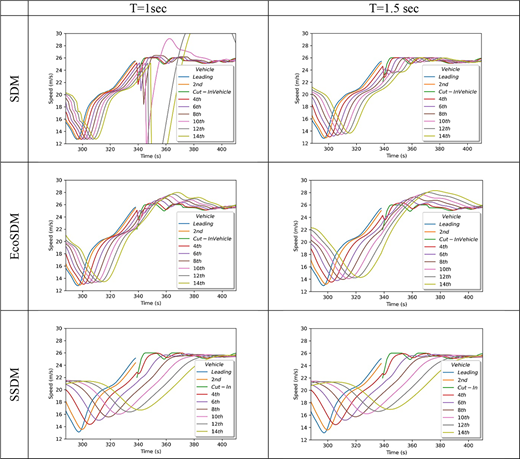
Acceleration profiles of vehicles equipped with SDM, EcoSDM and SSDM under cut-in situation considering different desired time headways
Acceleration profiles of vehicles equipped with SDM, EcoSDM and SSDM under cut-in situation considering different desired time headways
3.2 Vehicle platoon without cut-in
Driving cycles, which represent different driving scenarios, have been widely applied in simulations to evaluate the performance of control strategies (Li and Görges, 2020; Lu et al., 2019a, 2019b; Lin et al., 2021). In this study, a vehicle platoon with 100 vehicles is simulated on a single-lane road where the leading vehicle follows the driving cycle of federal test procedure (FTP) [2]. In this section, the CAVs are equipped with different control strategies, i.e. SDM, EcoSDM and SSDM. Therefore, the stability and safety performance of SSDM has been explored by comparing with SDM and EcoSDM.
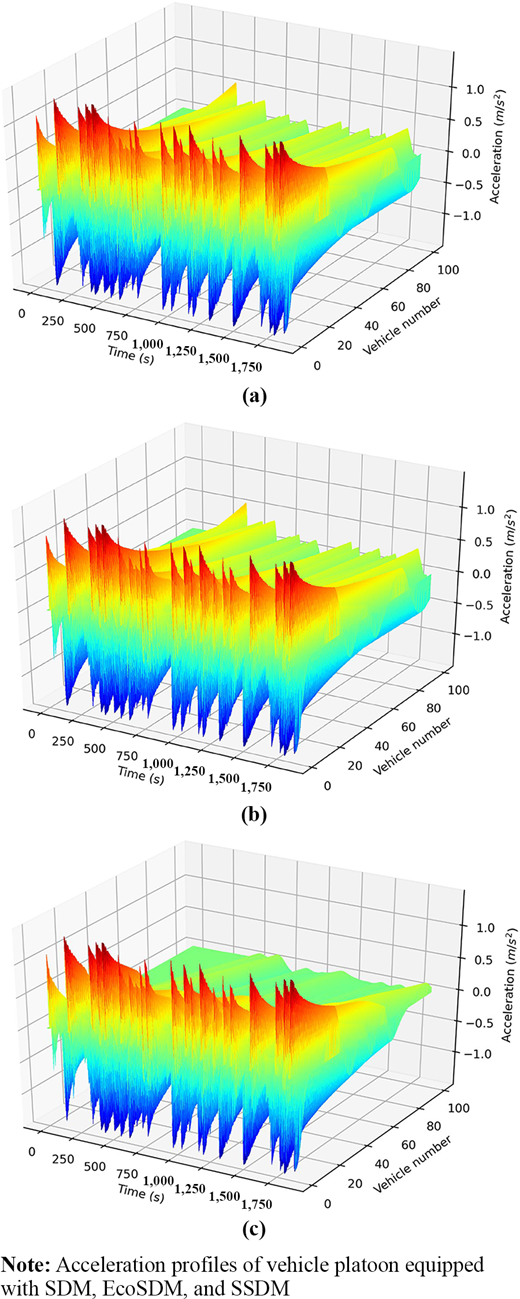
As shown in Figure 2, SSDM is able to stabilize the string faster than SDM and EcoSDM. Moreover, SSDM provides smoother deceleration and acceleration than SDM and EcoSDM. Therefore, it requires fewer CAVs in the platoon to maintain a stable string if CAVs are equipped with SSDM.
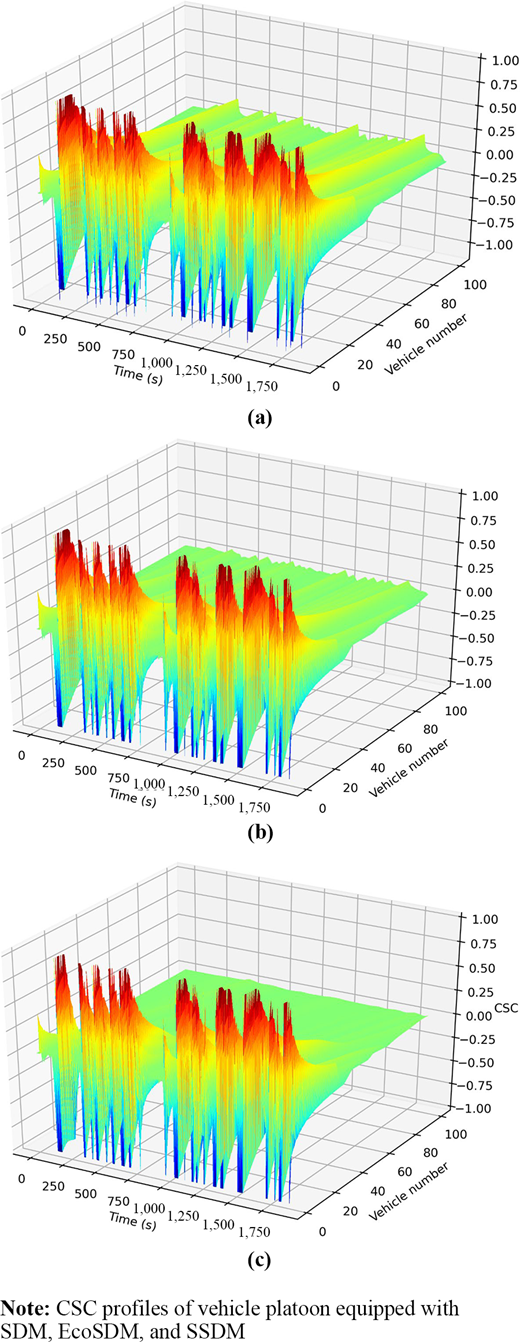
To investigate the safety performance of SSDM, the collision sensitivity coefficient (CSC) by Jiao et al. (2021) is used in this study. The CSC is calculated as follows:
If CSC is less than 0, the probability of a collision between vehicles increases. Alternatively, if CSC is larger or equal to 0, the probability of a collision between vehicles is small.
As shown in Figure 3, SSDM leads to a safer platoon than SDM and EcoSDM. Together with the aforementioned result, the control strategies with better stabilization ability will lead to the better platoon-level safety performance.
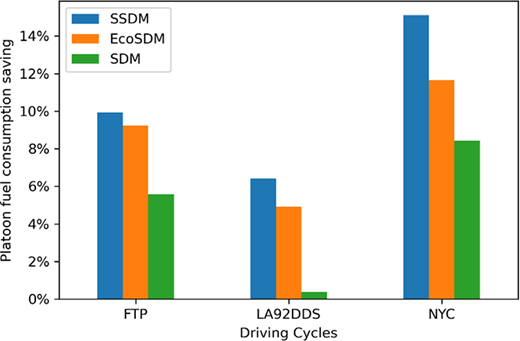
Moreover, a platoon with 20 vehicles is simulated to evaluate the fuel consumption of different control strategies. In this study, IDM is used to model human-driven vehicles and used as the baseline. The Virginia tech microscopic energy and emission (VT-Micro) model (Ahn et al., 2002; Rakha and Ahn, 2004), which is calibrated by Lu et al. (2018), is used to calculate the fuel consumption of vehicles. Three driving cycles, which are FTP, NY City cycle (NYCC) and LA92 dynamometer driving schedule (LA92DDS) [3], are considered in this study. The performance of different control strategies is shown in Table 1. Considering FTP, NYCC and LA92DDS, three control strategies have similar average speed and average acceleration, which means that the travel times of vehicles equipped with these control strategies are similar. Overall, SSDM has the smoothest speed profile with the smallest acceleration variance. Figure 4 shows the fuel consumption enhancement of SDM, EcoSDM and SSDM considering different driving cycles. The result shows that SSDM outperforms EcoSDM and SDM in terms of fuel consumption considering FTP, NYCC and LA92DDS. Moreover, SSDM can reduce the platoon-level fuel consumption by up to 15%.
Performance of different control strategies
| Driving cycle | Characteristic | Statistics | SDM | EcoSDM | SSDM |
|---|---|---|---|---|---|
| FTP | Speed (m/s) | Average | 9.39 | 9.38 | 9.37 |
| Standard deviation | 7.05 | 6.85 | 6.8 | ||
| Acceleration (m/s2) | Average | 0.007 | 0.007 | 0.007 | |
| Standard deviation | 0.501 | 0.458 | 0.446 | ||
| NYCC | Speed (m/s) | Average | 3.2 | 3.2 | 3.2 |
| Standard deviation | 3.27 | 3.13 | 3.04 | ||
| Acceleration (m/s2) | Average | 0.001 | 0.001 | 0.001 | |
| Standard deviation | 0.398 | 0.361 | 0.331 | ||
| LA992DDS | Speed (m/s) | Average | 10.98 | 10.98 | 10.98 |
| Standard deviation | 8.74 | 8.51 | 8.46 | ||
| Acceleration (m/s2) | Average | 0.002 | 0.002 | 0.002 | |
| Standard deviation | 0.57 | 0.519 | 0.499 |
3.3 Merging
In this section, a hypothetical single-lane highway with a single-lane on-ramp (Figure 5) is applied to evaluate the performance of the proposed control strategy. The merging maneuver proposed by Davis (2007) is used in this study. Because the proposed control strategy is able to consider string stability, a congested traffic status is considered in this study. Therefore, the main lane and ramp flow are set to 2000 veh/h and 600 veh/h, respectively. As shown in Figure 6, the higher market penetration of SSDM-equipped CAVs leads to less fuel consumption.

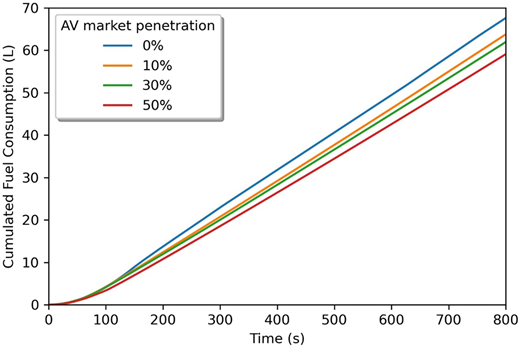
Cumulative fuel consumption on the simulated freeway segment considering different market penetration of SSDM-equipped CAVs
Cumulative fuel consumption on the simulated freeway segment considering different market penetration of SSDM-equipped CAVs
4. Conclusions
In this paper, we present a cooperative ACC, called SSDM, for CAVs in mixed traffic streams with human-driven vehicles. Considering the linear stability, SSDM is able to provide smooth deceleration and acceleration in the vehicle platoons with or without cut-in. Moreover, the calibrated VT-Micro is applied in this study to investigate the impact of CAVs on the fuel consumption of vehicle platoon and traffic flows.
Under the cut-in condition, all control strategies can reduce the oscillations caused by the cut-in vehicle when the desired time headway is 1.5 s. When the desired time headway is 1 s, the SDM is amplifying the oscillation while EcoSDM and SSDM are stable. Moreover, the SSDM outperforms EcoSDM and SDM in terms of stability considering different desired time headways.
Moreover, single-lane vehicle dynamics are simulated for human-driven vehicles and CAVs. The result shows that CAVs can reduce platoon-level fuel consumption. SSDM can save platoon-level fuel consumption up to 15% compared to human-driven vehicle platoons. SSDM outperforms the SDM and EcoSDM in terms of fuel consumption. Considering the single-lane highway with merging, the higher market penetration of SSDM-equipped CAVs leads to less fuel consumption.
The present paper has the following limitations. First, only one of the existing lateral maneuvers is considered in this study. Different combinations of longitudinal and lateral maneuvers should be applied to identify the best control strategy of CAVs. Moreover, field experiments will be conducted to evaluate the performance. Second, because human driving behavior may change because of the presence of autonomous driving technologies (Anesiadou et al., 2021; Pan et al., 2021; Shi et al., 2021; Zhao et al., 2020), the human driver behavior model, which is considered in the proposed strategy, needs to be updated according to the field data from mixed traffic in the future. Third, the performance of control strategies is evaluated based on freeway traffic conditions. In the future, network-level performance may be further evaluated. Moreover, the performance of the control methods based on machine learning, optimization and rules should be compared and discussed in future works.
The research is part of the project China-Norway Partnership in Smart Sustainable Metropolitan Transport (COMet) (UTF-2020/10115), funded by the Norwegian Agency for International Cooperation and Quality Enhancement in Higher Education (Diku). Any opinions, findings, and conclusions expressed in this material are those of the authors and do not necessarily reflect the views of these organizations.
Notes
https://www.epa.gov/vehicle-and-fuel-emissions-testing/dynamometer-drive-schedules
https://www.epa.gov/vehicle-and-fuel-emissions-testing/dynamometer-drive-schedules

