Due to various constraints, there are limitations in the use of digital technology to enhance corporate innovation capabilities.
This paper examines the relationship between digital transformation (DT) and corporate innovation by taking A-share listed companies in Shanghai and Shenzhen from 2009 to 2020 as samples, and uses path analysis method to test the mechanism of the relationship between them, and further examines its moderating effect on the relationship between DT and corporate innovation from the perspective of absorptive capacity.
The results show that: (1) DT has an “too much of a good thing” effect on corporate innovation, and there is a significant inverted U-shaped relationship between them; (2) The reduction of financing constraints and the enhancement of operating risks caused by DT determine the inverted U-shaped relationship between the DT and corporate innovation; (3) Technology absorptive capacity significantly moderates the inverted U-shape relationship between DT and corporate innovation. When the technology absorptive capacity is low, the inhibitory effect of excessive digitalization on corporate innovation will be more obvious.
The originality of this article is as follows: It reveals the non-linear relationship between DT and corporate innovation from the perspective of “excess being as bad as deficiency”, identifies the dual mediating mechanism of financing constraints and operational risks through path analysis, and introduces technology absorptive capacity as a key moderating variable, thereby deepening the understanding of the boundary conditions for the realization of the value of DT, thus providing new exploration and new solutions for the DT practice of Chinese enterprises.
1. Introduction
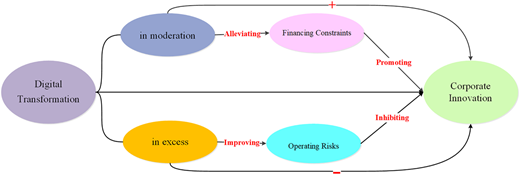
In the survival of the fittest market environment, most enterprises’ survival and development are obvious a clear life cycle, which may eventually be eliminated with the decline of the industry. If an enterprise wants to maintain its competitiveness in the market, it needs to constantly innovate according to changes in the external environment, and gradually form long-term competitive advantages by creating a set of short-term competitive advantages to ensure its survival and sustainable development. In other words, innovation is the source for enterprises to maintain competitive advantages and an important driving force for sustainable development (Hamel, 1994; Bone and Saxon, 2000). Digital transformation (DT), which has been widely concerned in recent years, provides new technical support for the improvement of corporate innovation level, and brings greater value growth space for enterprises. Existing studies have preliminarily discussed the relationship between DT and corporate innovation, believing that DT shorens the spatiotemporal distance between knowledge flow and innovation information transmission (Wu et al., 2021), enabling enterprises to realize information analysis, direction grasp and process optimization of internal and external activities at a smaller cost, and thus achieve more output effects (Shen and Yuan, 2020). That means, DT can promote the process of corporate innovation and development (He et al., 2023; Ma et al., 2023). However, in business practice, some enterprises are faced with the dilemma that DT has little effect (Hajli et al., 2015; Gebauer et al., 2020). Ford and Procter & Gamble, for example, have both paid a high price for their excessive digital investments. In 2020, Accenture released the “Win-win Cooperation” report based on a survey of 1,550 manufacturing and industrial executives around the world. Nearly 70% of executives at Chinese companies surveyed said digital investments have not had any effect on revenue growth. Therefore, some scholars put forward the “Information Technology Productivity Paradox”. They believe that there is a boundary for the degree of enterprise DT (Zhan, 2019; Kohtamäki et al., 2019), and when this boundary is exceeded, the effect of “too much of a good thing” will be produced, so that the effect of DT shows an inverted U-shaped trend. It should be noted that when digital investment exceeds the threshold, it is referred to as excessive DT. This usually manifests as excessive technological overloading, neglect of the core business value, lack of continuous iterative capabilities, and disregard for organizational culture adaptation, etc (Liu et al., 2025; Yang et al., 2025). The paradox theory provides important theoretical support for conflict management within and between organizations (Smith and Lewis, 2011). How to systematically identify and dynamically manage the contradictions and conflicts during the transformation process from the perspective of paradox theory, and construct an organizational response mechanism with strong adaptability and high agility, has become an important topic in both theoretical research and practical exploration. DT is a dynamic evolutionary process that is nonlinear, gradual and involves both disruption and innovation. For instance, the availability of digital technologies enhances the flexibility and innovation of organizations, but at the same time, it also weakens the stability and standardization of processes (Liu et al., 2023). As a systematic change issue characterized by complexity and dynamics, DT is embedded with multiple conflicts and its paradoxical features are becoming increasingly prominent. Based on this, we believe that there is also such a nonlinear relationship between DT and the corporate innovation level. On the one hand, DT improves the information transparency of enterprises, helps alleviate the financing constraints of enterprises, and thus improves the corporate innovation level. On the other hand, excessive digital investment will occupy a large amount of capital, and may also increase the operating risk of the enterprise, so that the management will reduce innovation activities in order to avoid risks.
Taking A-share listed companies from 2009 to 2020 as a sample, this paper deeply explores the impact of DT on enterprise innovation. The results show that there is indeed an inverted U-shaped relationship between DT and enterprise innovation. Further mechanism test found that DT alleviated the financing constraints of enterprises, thus promoting innovation, but at the same time, DT also caused an increase in operating risks, thus inhibiting corporate innovation. The technology absorption capacity (AC) of enterprises significantly moderates the above inverted U-shaped relationship. When the technology AC of enterprises is lower, the inhibition effect of excessive digitalization on the innovation level will be more obvious. The research of this paper reveals the deep relationship between DT and enterprise innovation and its internal mechanism.
The contribution of this paper is mainly reflected in the following aspects: First, the research of this paper discusses the impact of the application of new technology on corporate innovation, and enriches the research results in the field of corporate innovation. Previous literature mainly studied the influencing factors of corporate innovation from the perspectives of risk, externality and financing constraints, and proposed the means to promote innovation from the perspectives of government subsidies and intellectual property protection (Guo, 2018; Sampat and Williams, 2019). In recent years, the application of new technologies represented by digitalization has provided more possibilities for enterprise innovation. The results of this paper analyze the influence of DT on the level of innovation from both direct and indirect paths, and supplement the research on the influence factors of innovation from the perspective of new technology application.
Secondly, the research of this paper provides evidence of the inverted U-shaped effect of DT from the perspective of innovation, deepening our understanding of DT. Our research shows that DT has a “too much of a good thing” effect on the level of enterprise innovation, indicating that DT is not “more is better”. This paper further attempts to open the “black box” of the action path of DT on enterprise innovation level from the two dimensions of “advantages and disadvantages” of DT. The research in this paper shows that although DT can alleviate financing constraints and promote enterprise innovation, it will also increase operating risks and inhibit enterprise innovation. This conclusion has reference significance for discussing how to give full play to the positive effect of DT on innovation and reduce its negative effect.
Finally, this paper verifies the moderating effect of technology AC on DT and enterprise innovation level, and reveals the importance of enterprise technology AC to improve the effect of DT. The research conclusions of this paper help to deepen the market’s understanding of the implementation effect of DT, provide direction and guidance for enterprises on how to improve their competitive advantages, and also provide certain guidance for their DT decisions.
The structure of the rest of this paper is as follows: the second part is theoretical analysis and research hypothesis, summarizing and reviewing the views of existing literature, combining the relevant theories and putting forward the research hypothesis of this paper; The third part is the research design, which mainly introduces the sample and data sources, the measurement of variables and the construction of the empirical model; The fourth part is the analysis of empirical results, mainly discussing the impact of DT on enterprise innovation level and its mode of action, and further analyzing the adjustment effect of absorptive capacity. The fifth part is the research conclusion and enlightenment.
2. Theoretical analysis and research hypothesis
Compared with the traditional economic model, the digital economy breaks through the boundary constraints of traditional elements and fundamentally changes the organizational operation mode and value creation mode (Matarazzo et al., 2021; Jafari-Sadeghi et al., 2021; Bertani et al., 2021). For enterprises, DT is to embed digital technology into traditional production and business models, reorganize and optimize resources with the help of disruptive innovative technologies, and innovate the market expansion mode of enterprises, which will directly bring a positive impact on enterprise innovation activities (Han et al., 2019; Manesh et al., 2021). In addition, as a kind of long-cycle activity with typical input-sinking, irreversible process and uncertain output, accompanied by high information asymmetry and investment risk, innovation activity faces high adjustment cost and financing cost (Tang et al., 2020). Therefore, finding efficient and low-cost financial support is the key factor to ensure the continuous development of innovation activities, that is to say, stable and abundant financial support can provide a guarantee for the quality and efficiency of enterprise technological innovation. The digital construction of an enterprise is a reflection of its own strength. Advanced digital technologies enhance the communication efficiency among enterprises and multiple stakeholders such as external enterprises and banks (Wu et al., 2021; Flynn et al., 2010), reduce information friction among all participants (Tan et al., 2016; Gu et al., 2017), help enterprises attract more high-quality external resources, and alleviate the financing constraints faced by enterprises (Sheng and Xu, 2022). Meanwhile, China is vigorously promoting and supporting enterprises in their DT, which provides sufficient financial support for innovative activities such as technological transformation and product upgrading (Li et al., 2022).
However, in the philosophical thought systems of both China and the West, there exists the “principle of moderation”. Simply believing that a certain factor or practice can produce the effect of “the more, the better” may overly simplify the relationships among variables. It is worth noting that, first of all, continuous investment in digitalization does not guarantee a steady stream of financial support. However, the process of DT for enterprises requires a significant investment of the resources of human, material and financial, and incurs higher operating costs. Therefore, with the increase of investment in DT, the negative effects it generates will continue to amplify, including continuous capital occupation, the intensification of the digital divide and the increase in the difficulty of collaboration, etc (Han et al., 2014). When the cost-effect generated by DT is higher than the compensation effect, it will cause an imbalance in the allocation of limited resources of enterprises and have a certain dilution effect on the innovation activities of enterprises (Xu and Tian, 2017). Secondly, from the perspective of internal processes, the DT of enterprises needs to go through the investment stage, the internalization stage and finally reach the output stage. Therefore, the positive impact it has on enterprises has a certain lag. Excessive digitalization will expose enterprises to greater operating risks, which are the key reference indicator that the managers inevitably assess when they make R&D decisions for the enterprise. The reason is that the innovative behavior of enterprises is characterized by long cycles and high risks. When the performance fluctuates greatly, enterprises face high operating risks. Continuously increasing R&D investment will only deplete the existing core resources of the enterprise. At this point, even if innovation investment is crucial to the future success of an enterprise, managers may still cut certain innovation expenditures for the purpose of maintaining stable performance, in order to alleviate the employment risks brought about by performance fluctuations. Thus, operating risk is an important factor influencing managers’ innovation willingness and enterprises’ innovation behavior (Nambisan, 2017; Galindo et al., 2019). Excessive digital investment will increase the operating risks of enterprises. To avoid risks, the management of enterprises will reduce the formation of resource-consuming activities such as innovation (Deleveraging, 2022), resulting in a low level of innovation.
Overall, advanced digital facilities provide technical guarantees and financing support for innovation activities. But excessive digitalization requires a large amount of cost, which will cause a large amount of capital occupation and lead to an imbalance in the distribution of existing resources of enterprises. There is a diminishing marginal utility between DT and the corporate innovation levels. Under the influence of this law, as enterprises’ digital investment continues to increase, their resource base and capabilities cannot meet the requirements of excessive digitalization and the process of improving the corporate innovation levels slows down until the innovation level does not rise but falls instead.
Based on the above analysis, this paper puts forward the following hypothesis:
There is an inverted U-shaped curve relationship between digital transformation and the corporate innovation level, that is, moderate digital transformation will enhance the corporate innovation level. However, when the digital transformation of enterprises exceeds a certain level, it will have an inhibitory effect on the corporate innovation levels.
Financing constraints and operating risks play a mediation role in the u-shaped relationship between digital transformation and corporate innovation.
Moderate digital transformation can alleviate corporate financing constraints, thus promote the improvement of corporate innovation.
Excessive digital transformation will increase the operating risks faced by enterprises and thereby inhibit the improvement of their innovation levels.
Based on the above theoretical analysis and research hypotheses, the theoretical model of this paper is constructed, as shown in Figure 1.
3. Research design
Sample Selection and Data Sources
This paper takes A-share listed companies in Shanghai and Shenzhen that have carried out DT from 2009 to 2020 as research samples and conducts the following screening on the initial selected samples: (1) Exclude samples that have not carried out DT; (2) Exclude samples under special treatment or particular transfer; (3) Exclude samples in the financial industry; (4) Exclude samples with missing variable data. Ultimately, a sample dataset containing 9,192 valid observations was formed. The data used in this paper are sourced from the China Stock Market & Accounting Research Database, Wind database, China Research Data Service Platform and RESSET Financial Database. Meanwhile, all continuous variables were subjected to 1% winsorizing at both ends to eliminate the influence of outliers on the regression results.
- (2)
Variable Definition and Measurement
- •
Dependent Variable
Corporate Innovation (Innovation). Referring to the research of Li and Ran (2021), corporate innovation is measured from the dimension of substantive innovation. The specific measurement method is as shown in Formula (1).
Choosing the ratio of the number of patent applications to the total number of patent applications in the same industry rather than the number of patent grants as the proxy variable for the corporate innovation level, mainly because it can promptly and cyclically reflect the enterprise’s R&D decisions and innovation enthusiasm, avoiding endogeneity issues caused by the lag in patent authorization; at the same time, the number of patent applications more comprehensively covers various innovation attempts of the enterprise, and can better reflect the extensive impact of DT on the innovation ecosystem.
- •
Independent Variable
DT. From a theoretical perspective, data has been widely accepted as an important economic “new energy” in the new stage of development. Corporate DT is not merely the digitization of data and materials, but rather the use of cutting-edge digital technologies and hardware systems to drive the digitalization of the means and processes of production, thereby achieving the crucial goal of enhancing quality and efficiency. Among them, the technologies centered on artificial intelligence, blockchain, cloud computing, big data provide corresponding underlying technical support for the corporate DT (Qi and Xiao, 2020). Apart from the core underlying technical framework, specific digital applications are manifestations at the aspect of technical practice. Therefore, this paper refers to the research of Wu et al. (2021), statistically analyzes the frequency of related terms in the five dimensions of artificial intelligence technology, blockchain technology, cloud computing technology, big data technology and data technology application in the annual report and takes napierian logarithm of them to measure the degree of corporate DT.
The specific algorithm is shown in Formula (2).
- •
The mediation variable – Financing Constraints (WW). Referring to the research of Whited and Wu (2006), this paper adopts the WW index to measure the corporate financing constraint level. The calculation model is shown in Formula (3).
In Formula (3), CF represents the ratio of cash flow from operating activities to total assets. CASHDIV is a dummy variable, which takes 1 when cash dividends are paid and 0 otherwise. LTD is the ratio of long-term liabilities to total assets; LNASSET is the napierian logarithm of total assets. SG and SG_Ind represent the growth rate of operating income of the company and its industry respectively. The larger the value of WW is, the higher the level of financing constraints that the enterprise is facing.
- –
Operating risk (Risk). Digital investment in the current period may cause significant fluctuations in current performance. Therefore, this paper uses variable coefficient of operating income in the four-quarters to measure the operating risks faced by enterprises. The calculation process is shown in Formula (4).
- •
Control Variables
This paper refers to the studies of Zhao and Wang (2021) and Yu et al. (2022) and selects the control variables for this paper. The definitions and measurement methods of the main variables are shown in Table 1.
- (3)
Model Setting and Empirical Strategies
To examine the relationship between DT and corporate innovation level, as well as the mechanism of their interaction, this paper establishes the three-step regression model as follows:
Path A:
Path B:
Path C:
4. Empirical results
Multiple Regression Analysis • Baseline Test
Table 2 presents the test results of the relationship between corporate DT and corporate innovation (Inno). In the baseline regression, the squared term of corporate digital transformation (DT_Squ) is negatively correlated with corporate innovation level(Inno) at the 10% significance level, which indicates that there might be an inverted U-shaped relationship between DT and corporate innovation(Inno)initially.
Furthermore, when the true relationship of the dataset only contains a certain monotone interval of the inverted U-shaped function, the square term of digital transformation (DT_Squ) will also show a significant negative correlation with the corporate innovation level (Inno). That is to say, there is a pseudo-inverted U-shaped relationship in the model estimation results. To eliminate the pseudo-inverted U-shaped relationship, a U Test was conducted in this paper and the results are shown in Table 3. The value range of DT is [0.693, 6.252], with the extreme point being 3.455, which falls within the value range. Moreover, the significance level of the inverted U-shaped relationship test is 5%. Therefore, the inverted U-shaped relationship between DT and corporate innovation has passed, indicating that moderate DT will enhance corporate innovation level. However, when the degree of digitalization exceeds a certain level, it will instead have a certain inhibitory effect on the corporate innovation level. The U Test results further support the research hypothesis H1 of this paper.
- •
Mechanism Test
According to 2. Theoretical Analysis and Research hypothesis, the inverted U-shaped relationship between DT and corporate innovation is the result of the combined effect of financing mechanisms and risk-avoidance mechanisms. That is, on the one hand, DT alleviates financing constraints and generates factors conducive to the improvement of corporate innovation levels. On the other hand, investment in digital technologies has also increased the uncertainty of business operations and given rise to factors that suppress corporate innovation. To verify the mediating role of the two between the DT and the corporate innovation, this paper, based on models (6) and (7), uses the stepwise regression method to examine the mechanism by which DT affects the corporate innovation level.
- –
The results of the financing mechanism test
Firstly, this paper starts with the action chain of “digital transformation – financing constraints – innovation level” to examine the positive impact of DT on corporate innovation. The test results are shown in Table 4.
Based on the data results in columns (1) and (2) of Table 4, it can be known that DT will alleviate the financing constraints faced by enterprises and the lower level of financing constraints will provide financial support for the continuous corporate innovation activities, thereby enhancing their innovation level. The data results of the two columns indicate that the impact of DT on corporate innovation may be transmitted through the financing mechanism, that is, financing constraints play a mediating role in the relationship between DT and the corporate innovation level. The research hypothesis H2a of this paper has been initially tested.
To further investigate whether DT has a differentiated impact on financing constraints as it continues to deepen, this paper divides the samples into the excessive DT sample group and the moderate DT sample group based on the mean value of DT. The regression results are shown in Table 5.
Columns (1) and (2) of Table 5 respectively present the regression results of the moderate DT sample group and the excessive DT sample group. Based on the regression results of the two columns, it can be seen that in the sample group of moderate DT, the significance of the regression coefficient between DT and financing constraints is higher than that in the sample group of excessive DT. This result indicates that enterprises are more likely to obtain financing support in the early stage of DT. As the transformation continues to deepen, its alleviating effect on financing constraints will become increasingly limited.
- –
The results of the operating risk mechanism test
Then, this paper starts from the action chain of “digital transformation – operating risk – corporate innovation level” to examine the negative impact of DT on the corporate innovation level. The examination results are shown in Table 6.
Based on the data results in columns (1) and (2) of Table 6, it can be seen that DT will intensify the corporate operating risk. Driven by the motivation of risk avoidance, management will, to some extent, reduce research and development expenditures, resulting in a decline in the corporate innovation levels instead of an increase. The data results of the two columns indicate that the impact of DT on the corporate innovation levels may be transmitted through the risk-avoidance path, that is, operating risks play a mediating role in the relationship between DT and the corporate innovation level. The research hypothesis H2b of this paper has been initially tested.
Similarly, to further investigate whether the DT has a differentiated impact on corporate operating risk as it continues to deepen, this paper divides the samples into the excessive DT sample group and the moderate DT sample group based on the mean value of DT. The regression results are shown in Table 7.
Columns (1) and (2) of Table 7, respectively, present the regression results of the moderate DT sample group and the excessive DT sample group. Based on the regression results of the two columns, it can be seen that in the sample group of excessive DT, the regression coefficient of DT and operating risk is positively correlated at a significance level of 1%, while in the sample group of moderate DT, there is no significant positive correlation between the two. This result indicates that in the early stage of DT, digital investment by enterprises will not cause significant fluctuations in performance. However, excessive DT not only consumes the existing funds of enterprises but also widens the gap between enterprises and their upstream and downstream partners, causing significant fluctuations in operating performance in the short term and increasing the corporate operational risks. That is to say, as the transformation deepens continuously, its impact on performance fluctuations will become increasingly obvious.
Based on the regression results from Tables 4–7, it can be known that the inverted U-shaped relationship between DT and the corporate innovation levels is the result of the combined effect of the alleviation of financing constraints and the improvement of operating risks. As the corporate digitalization investment increases, the relief of financing constraints becomes increasingly limited, while the increase in operating risks becomes more and more obvious. These interactions lead to a slowdown in the process of enhancing the corporate innovation level as the degree of DT increases, until the innovation level declines instead of rising.
- (2)
Robustness Test • U-shaped Relationship Robustness Test – Change the measurement method of the independent variables. The previous section adopted the text analysis method to measure the degree of the corporate DT, using the terms frequency related to DT in the annual reports of listed companies to assess the actual application of digital technologies in enterprises. However, this measurement method may have certain biases. It might represent the planning for future DT rather than the current application situation. Therefore, this paper follows the approach of Liu and Tian (2019) and uses the level of digital investment to measure the current degree of corporate DT. Specifically, the degree of digital transformation (DT_Sub) is represented by the sum of hardware capital and software capital divided by total assets:
After changing the measurement method of the independent variables, the regression process in the previous text was repeated based on the empirical model (5), and the robustness test results are shown in Table 8, which are completely consistent with the previous test, further verifying the research hypothesis 1 of this paper.
- –
Instrumental variable estimation
To address the endogeneity issue, this paper draws on the research of Xiao et al. (2021) and selects the degree of DT in the same industry as an instrumental variable. The reason for choosing this instrumental variable is that, on the one hand, the information and experience obtained by an enterprise will affect its own behavior and decision-making. It is observed that after other enterprises in the same industry undergo DT, the enterprise will also actively promote its own digitalization process and the instrumental variables and explanatory variables meet the correlation requirements. On the other hand, the overall DT level of the same industry cannot directly affect the innovation level of individual enterprises, meeting the requirement of exclusivity. Table 9 presents the second-stage estimation results with the addition of instrumental variables.
It can be known from the test results in Table 9 that, first of all, the p-value of the K-Prk LM statistic is 0.0000, rejecting the null hypothesis of “insufficient identification of instrumental variables”. The statistic of K-Prk Wald F is 176.500 and the statistic of C-D Wald F is 199.572, both far exceeding the minimum critical values. Therefore, the average level of DT in the industry can serve as an effective instrumental variable to address the endogeneity issue in this study. The empirical results from the addition of instrumental variables show that DT and its quadratic term are both significant at the 10% level, and the regression results are completely consistent with those in Table 3. It proves that after eliminating the possible endogeneity problem between the dependent variable and the independent variable, the research conclusion of this paper remains reliable.
- –
The independent variable lags behind by one period
In the empirical research of this paper, there may be an endogeneity problem caused by reverse causality, that is, enterprises with a high level of innovation are more inclined to carry out DT, and the improvement of the innovation level may be the cause rather than the result of the corporate DT. Considering that the impact of enterprise DT may have a time lag, this paper regressed the model by lagging the independent variables by one period, and the results are shown in Table 10.
It can be found that the coefficient estimate of the square term of DT is still significantly negative at the 1% confidence level. After the independent variable is lagged by one period, the research conclusion of this paper remains reliable.
- •
Robustness test of the mechanism of action – The robustness test of the financing constraint mechanism
Change the measurement method of financing constraint levels. Referring to the research of Gu et al. (2020), the FC index (FC) is used to measure the corporate financing constraint level. The first step is to calculate the average values of the following three indicators after centralization on an annual basis, namely, the corporate scale (taking the natural logarithm of total assets), the cash dividend payout ratio, and the number of years since listing. The second step is to sort the values calculated in the first step and divide them into three equal parts by size. Take the trartile as the dividing point of the financing constraint level and set a dummy variable (FC_Dummy). If the company is within the range below the 33rd percentile, it will be placed in the financing constraint group, with the value of FC_Dummy being 1. Placed in the financing constraint group, with the value of FC_Dummy being 1. In the third step, logit regression is performed based on model (9) to fit the p-value of each company for each year, and this is used to measure the financing constraint level faced by the companies (FC), with the value range being [0, 1]. The larger the value is, the higher the corporate financing constraint level will be.
In the above formula, SIZE represents the natural logarithm of the corporate total assets; LEV is the ratio of total liabilities to total assets; DIVPOS is the cash dividends distributed in the current year; BM is the corporate book-to-market ratio; CR is the ratio of current assets to current liabilities; EBIT is the corporate earnings before interest and taxes, and ASSET is the corporate total assets.
After replacing WW with FC to measure the financing constraint level, regression was re-performed on models (6) and (7), and the robustness test results are shown in Table 11.
- •
Test of the robustness of the operating risk mechanism
In the previous section, the variability coefficient of the corporate quarterly operating income was used to measure the level of its operating risk. However, for different industries, apart from the internal environment that affects the fluctuation of income, the external market environment that the industry faces may also influence the fluctuation of enterprise performance. Therefore, in order to eliminate the differences among industries and make the regression results more robust, this paper uses the coefficient of variation of operating income adjusted by the industry mean to measure the corporate operating risks (Risk_Sub). After changing the measurement method of the operating risk, robustness tests were conducted based on Models (6) and (7), and the regression results are shown in Table 12.
- (4)
Further Analysis – The Moderating Effect of Technology Absorptive Capacity
To what extent and at what speed an enterprise can transform new knowledge into innovative performance largely depends on its technology absorptive capacity (Levinthal and Levinthal, 1990). If an enterprise has a strong capacity to absorb technology, it can accelerate the application and transformation of new external knowledge within the enterprise, thereby making the technical level and development efficiency of new products higher. As a new resource input, the contribution of DT to corporate value creation is influenced by its technological AC. Enterprises with a high AC for new knowledge and new technologies tend to master relevant digital technologies more easily, accelerate the promotion and integration of digital technologies within the enterprise, and enable DT to generate the maximum positive effect. Therefore, based on the previous benchmark test, this paper further explores whether the technology absorptive capacity of enterprises has a moderating effect on the relationship between DT and the corporate innovation level. Specifically, referring to the research of Tsai (2001) and Jia et al. (2018), the ratio of research and development expenses to operating income is used to measure the corporate AC. The corporate technological AC, the intersection term of DT and technology absorptive capacity (DT_AC), as well as the quadratic term of DT and the intersection term of technological AC (DT_Squ_AC) are incorporated into the regression model (5) to construct a regression model of the moderating relationship, as follows:
Regression operations were performed on the model (10), and the results are shown in Table 13.
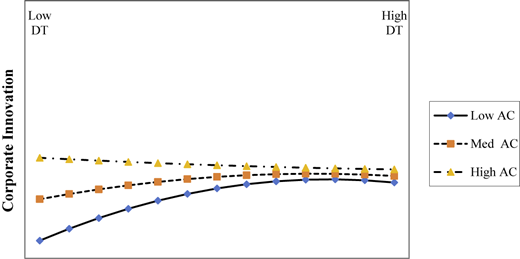
In order to more clearly illustrate how the technology absorptive capacity moderates the relationship between enterprise DT and corporate innovation level, this paper has drawn a two-dimensional moderation curve diagram, as shown in Figure 2.
As can be seen from Figure 2, when an enterprise’s technology absorptive capacity is at a medium or low level, the relationship between the DT and the corporate innovation level presents an inverted U-shaped curve. Furthermore, this paper finds that when an enterprise’s technology absorptive capacity is at a relatively low level, the inverted U-shaped curve between DT and corporate innovation level is relatively steep. However, when the enterprise has a higher technological AC, no significant inverted U-shaped relationship is observed between DT and innovation level. This conclusion indicates that as DT progresses, compared to enterprises with lower technological absorption capabilities, those with higher technological absorption capabilities are better able to slow down the decline in innovation levels. Enterprises with already strong absorption capabilities may be able to enhance their innovation levels by absorbing new knowledge and technologies. However, in the early stages of DT, due to issues such as capital occupation, the corporate innovation levels were actually reduced. However, when enterprises are at the same level of DT, those with higher technological absorption capabilities have a higher level of innovation. In general, a higher level of technological absorption ability can accelerate the promotion and integration of digital technologies within the enterprise, making the negative marginal effects caused by excessive DT on the enterprise less obvious.
5. Research conclusions and implications
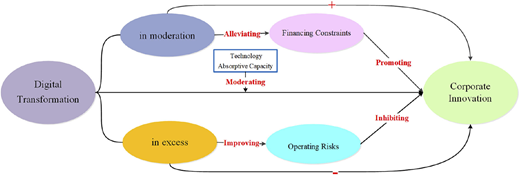
Based on the realistic background of China’s DT strategy, this paper takes the listing of A-shares on the Shanghai and Shenzhen stock exchanges from 2009 to 2020, covering enterprises in normal operating conditions other than the financial industry, to examine the impact and mechanism of the degree of DT on the corporate innovation levels. The model has included all influencing factors as control variables as much as possible, thus making it extensible. The research in this paper shows that: (1) There is a significant inverted U-shaped relationship between the degree of DT and the corporate innovation levels. Moderate DT can enhance the corporate innovation levels. However, when the degree of DT exceeds the critical value, excessive DT will inhibit the improvement of the corporate innovation levels instead. (2) The inverted U-shaped relationship between DT and the corporate innovation levels is the result of the combined effect of the alleviation of financing constraints and the enhancement of operating risks. That is, when DT reaches a certain extent, the effect of the alleviated financing constraints on enhancing the innovation level is less than the inhibitory effect of the increased operating risks on the innovation level, thus causing the overall level of innovation to decline instead of rise. (3) Technology absorptive capacity can moderate the inverted U-shaped relationship between DT and corporate innovation level. When an enterprise has a high technological AC, the inhibitory effect of excessive digitalization on innovation will be weakened. The summarized conclusions of the whole results are shown as Figure 3.
The methodology of this paper can be applied to other emerging economies with similar DT trajectories. However, as the digital environment and strategies change, the methods chosen in this paper may also have limitations and the research conclusions may also change accordingly. Therefore, in future research, we will continuously optimize the model based on real scenarios. Overall, there is an “over-kill” effect between the degree of DT of Chinese enterprises and their innovation level. Once the threshold is crossed, the direction of the effect will undergo a sudden change, presenting a “U-shaped” curve. This conclusion is particularly applicable to emerging economies like China. In these markets, many enterprises are still in the stage of exploring and adapting to digitalization. Their organizational structures, management capabilities and technology assimilation systems are not yet fully mature, making them more vulnerable to the uncertainties brought about by “excessive digitalization”. While mature economies such as the EU and the United States have a higher level of digitalization, due to the fact that enterprises generally possess stronger digital capabilities, more complete institutional environments and more mature innovation systems, they have a stronger ability to cope with the complexity and risks brought about by DT. Therefore, the threshold for the benefits of DT may be higher, and the “over-kill” inflection point may also be delayed accordingly.
The conclusions of this paper remind enterprises to be aware of the “digital paradox” phenomenon when undergoing DT. Given the high costs of digital construction, application and maintenance, enterprises should formulate scientific DT strategies and allocate digital technology resources rationally based on their own organizational conditions and resource foundations to avoid the negative impacts on the corporate continuous development, and further enhance the positive effect of digitalization levels on enterprise value creation.