


The layer section of laser additive manufacturing (AM) can be rasterized. Subsequently, the rasterized layer section can be converted into sparse matrix. However, large storage space is occupied due to the high manufacturing resolution. In order to reduce the storage space, the purpose of this research is to propose a lossless compression method to compress the sparse matrix.
A lossless compression method for additive manufacturing is proposed. According to manifold and irregularity feature of the object of laser AM, a lossless compression method called continuous rows compressed storage (CRCS) based on continuous rows is innovatively proposed. In particular, the better direction strategy of compression method is selected based on the side-projected area per layer.
Take human teeth as an example, compared with compressed sparse row (CSR), the CRCS has advantage up to 98.88% in storage space. Compared with block compressed sparse row (BCSR), the CRCS has advantage up to 60.04% in storage space.
The proposed CRCS could be employed to compress the sparse matrixes of rasterized layer sections of laser AM. Compared with common lossless compression method of sparse matrix, the compression ratio of CRCS is greater. CRCS is propitious to reduce the storage space usage, thereby improving transmission efficiency.
1. Introduction
Additive manufacturing (AM), also known as 3D printing, is a special type of manufacturing method. Compared to traditional method, AM can be used to produce complex parts with low cost.
AM includes digital light processing (DLP), selective laser sintering (SLS), selective laser melting (SLM) and so on. DLP can be used to fabricate complex models for 4D printing (Kuang et al., 2019). SLS can be used to fabricate polyporous bio-based composites structures (Colucci et al., 2024). The 316L stainless steel specimens produced by SLM have high mechanical properties and tribological performance (Bartolomeu et al., 2017).
The model of AM is sliced into layers. And the layer section can be converted into sparse matrix. Sparse matrix can be compressed to reduce storage space and improve transmission efficiency. Compressed sparse row (CSR) can be used to solve the semi-infinite domain dynamics problems (Zhou et al., 2023). Block compressed sparse row (BCSR) can be used in the linear-scaling calculations (Borštnik et al., 2014).
The compression algorithm is important for AM. Based on the previous papers (Xu et al., 2020, 2021), a lossless compression algorithm which is called continuous rows compressed storage (CRCS) to reduce the storage space usage is proposed.
2. Generation of rasterized layer section
In additive manufacturing, the 3D manifold model can be represented by decomposition representation (D-rep), constructive solid geometry (CSG) and boundary representation (B-Rep). Figure 1(a) is the 3D model of human upper molar tooth, as it has four tooth roots to enhance chewing ability. The size of the 3D model is 8.6423 × 9.2872 × 12.8918 mm3. The volume of the 3D model is 432.6509 mm3. Figure 1(b) demonstrates the support of the 3D manifold. The volume of the support is 57.9527 mm3.

(a) The 3D model of the human upper molar tooth; (b) the external support of the 3D manifold
(a) The 3D model of the human upper molar tooth; (b) the external support of the 3D manifold
The 3D model is sliced into layer sections. The location of layer sections can be represented by the normalized height in printing coordinate system. The normalized height of the layer section is defined as:
where is the height of layer section and is the total height of the 3D model.
The voxelization algorithm converts 3D model to the voxel representation. Similarly, the layer section can be converted to rasterized data which is appropriate for laser AM. Figure 2 displays the layer section of human tooth with support and the rasterized data converted from the layer section. The blue area represents tooth. The orange area represents support. Figure 2(a) displays the layer section with hn = 20%. Figure 2(b) displays the layer section with hn = 50%. Figure 2(c) displays the rasterized data converted from the layer section with hn = 20% of lower resolution. Figure 2(d) displays the rasterized data converted from the layer section with hn = 50% of lower resolution.

The layer section and the rasterized data converted from the layer section where (a) (c) are with hn = 20% and (b) (d) are with hn = 50%
The layer section and the rasterized data converted from the layer section where (a) (c) are with hn = 20% and (b) (d) are with hn = 50%
The resolution can be defined as the amount of points each millimeter. The resolution of Figure 2(c)(d) is 8/mm. At this point, the accuracy is increased with the improvement of resolution, which means the volume error is reduced. Therefore, the resolution is important for laser AM. The resolution can be 20/mm for some laser AM printer. With the improvement of resolution, the storage space of the rasterized data grow greatly. Moreover, the size of human teeth is relatively small. The size of printed object can be large, which means large storage space is occupied by the rasterized data and information transmission efficiency is low. Therefore, lossless compression algorithm with higher compression rate can improve the efficiency of laser AM and maintain the manufacturing accuracy.
The rasterized data is sparse matrix. The matrix sparsity of layer section is the percentage of zero values in the sparse matrix.
where is the amount of null data in sparse matrix. m is the line number. n is the column number.
BCRS compress sparse matrix based on regular blocks of elements. The nonzero elements of rasterized data have continuity and irregularity because the object of laser AM is usually manifold and irregular. Therefore, compression algorithm based on continuous rows of nonzero elements is appropriate for the rasterized data of layer section.
3. Continuous rows compressed storage algorithm (CRCS)
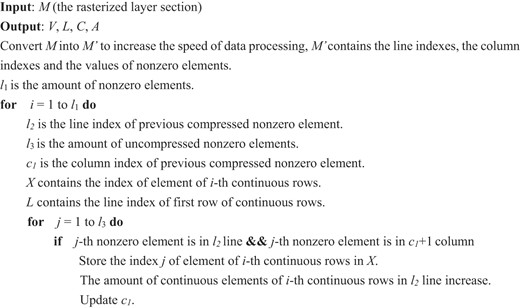
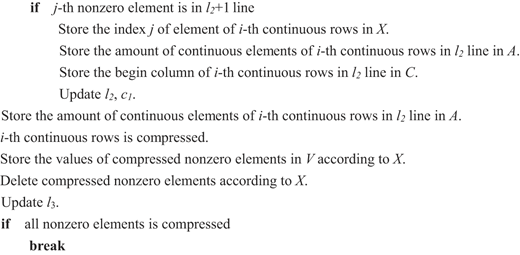
In CRCS, the rasterized layer section M is divided into continuous rows of nonzero elements. The continuous rows are compressed into four arrays. The array V contains the values of nonzero elements. The array L contains the first line index of continuous rows. The array C contains the begin column of continuous rows in each line. The array A contains the amount of continuous elements of continuous rows in each line.
The pseudocode of CRCS is as follows.
4. Numerical example using CRCS
4.1 Optimized direction of rasterized layer section
In CRCS, continuous rows are compressed based on row. The direction of rasterized continuous rows layer section can be rotated ninety degrees, which means the continuous rows is changed. Based on the principle of CRCS, the storage space is reduced with less rows. The number of rows is negatively associated with the orthogonal side-projected area. Therefore, calculation of side-projected area is conducive to reduce the storage space further. The side-projected area of the human tooth with support is revealed in Figure 3. The projected area of V is area of projection on the vertical projective plane (XOZ). The projected area of W is area of projection on the width projective plane (YOZ).

Orthotropic side-projected area of the human tooth with external support per layer when amount of layers is 149
Orthotropic side-projected area of the human tooth with external support per layer when amount of layers is 149
When the projected area of V is larger, the number of rows of original continuous rows is smaller. When the projected area of W is larger, the number of rows of rotated continuous rows is smaller. Figure 4 indicates storage space based on the optimized direction and the other direction. The storage space based on the optimized direction is smaller in most cases. And the sum of storage space based on the optimized direction is 954,944 bytes. The sum of storage space based on the other direction is 971,765 bytes. The storage space decreases by 1.7315%.

4.2 Comparison with the traditional compression algorithm
In order to verify the effectiveness of CRCS, the rasterized layer sections of human tooth with support is compressed by CRS, BCRS and CRCS.
The detailed comparison about storage space of different algorithms is listed in Table 1. As indicated in table, CRCS can reduce storage space requirements by 98.88% compared with CRS. Meanwhile, CRCS can reduce storage space requirements by 60.04% compared with BCRS.
5. Conclusions
The layer sections of AM can be converted into sparse matrix. In order to reduce the massive storage space, a lossless compression method called continuous rows compressed storage (CRCS) for additive manufacturing is proposed. The proposed CRCS has advantage up to 98.88% in terms of storage space, over traditional CRS method. Compared with BCRS, the CRCS has advantage up to 60.04% in storage space. In conclusion, CRCS could be employed so as to compress the sparse matrixes of rasterized layer sections of laser AM, meaning the CRCS method can reduce the storage space and improve transmission efficiency.
This work was supported by the National Key Research and Development Project of China (Grant No. 2022YFB3303303).

