This study aims to explore the effects of dimensions related to job satisfaction on knowledge sharing behaviors among Chinese chronic disease management teams across professions and organizations.
This study used a multistage stratified random sampling method to survey 511 rural chronic disease managers across eastern, central and western China. Univariate analysis was used to identify the factors influencing knowledge sharing behavior. Hierarchical linear regression analysis and structural equation modeling were applied to determine the effects of various dimensions of job satisfaction on different knowledge sharing behaviors.
Business consideration demonstrated a significantly positive impact on written contributions, organizational communication and personal interaction behaviors (β = 0.126, p < 0.05; β = 0.130, p < 0.01; β = 0.175, p < 0.001, respectively). The nature of work also demonstrated a significantly positive impact on written contributions, organizational communication and personal interaction behaviors (β = 0.111, p < 0.05; β = 0.178, p < 0.001; β = 0.160, p < 0.001, respectively). Colleague relationship demonstrated a significant positive impact on personal interaction behavior (β = 0.144, p < 0.01). Written contribution behavior was influenced by gender; organizational communication behavior was influenced by factors such as region, gender, work years, employment method and practicing qualification; and personal interaction behavior was influenced by practicing qualification.
This study investigates the relationship between job satisfaction and knowledge sharing behavior among rural chronic disease managers in China, incorporating perspectives from cross-organizational and cross-professional teams. This study helps break away from the current focus on single organizations, offering valuable insights for networked organizations to improve health-care service quality and performance.
1. Introduction
Knowledge sharing behavior is a set of behaviors that aid the exchange of acquired knowledge (Wing and Lai Sheung, 2008), in which knowledge is transferred or transmitted from one individual, group or organization to another (Jae-Nam, 2001). Through knowledge sharing, individuals and organizations can avoid reinventing the wheel and learn from each other’s successes and failures, thereby improving their performance and productivity.
In 1996, the Organization for Economic Cooperation and Development proposed the “Knowledge-based Economy.” A knowledge-based economy marks the beginning of an era based directly on the production, distribution and use of knowledge and information. Knowledge has since become an important resource for organizations to maintain competitive advantage (Drucker, 2001). The key to organizational development lies in maximizing knowledge ownership and quality. Knowledge management is indispensable, encompassing specific activities such as creating, storing, transferring and applying knowledge (Alavi and Leidner, 2001). As the core of organizational knowledge management (Frank and Michel, 2007; Gee and Young-Gul, 2002; Ghulam Murtaza and Khalid, 2018; Mobashar et al., 2014; Peter, 1997a), knowledge sharing aims to expand the value of knowledge and produce effects through knowledge exchange (Amjad et al., 2018; Den Hooff Bart and Ridder Jan, 2004; Eduardo Kunzel et al., 2018; William et al., 2018), thereby constructing organizational advantages for a company (Hoppock, 1935; Karl‐Erik, 2001; Magaly et al., 2019; Shiuann-Shuoh et al., 2012).
Sharing knowledge is a complex and challenging process that cannot occur on its own, and various factors influence knowledge sharing behavior. Several studies have confirmed that job satisfaction affects knowledge sharing behavior. The effect of job satisfaction on knowledge sharing behavior is multifaceted and can be categorized into the following key aspects.
An increase in job satisfaction contributes to greater knowledge sharing behavior, and a significant positive relationship exists between the two. Pei‐Lee and Hongyi (2012) found that employees who were more satisfied with their jobs were more likely to engage in knowledge sharing behavior. Usmanova et al. (2021) demonstrated that job satisfaction has a significantly positive effect on knowledge sharing behavior. The results revealed that employees’ job satisfaction levels were directly and positively related to their knowledge sharing behavior.
In addition, the relationship between job satisfaction and knowledge sharing behavior may be moderated by other factors such as organizational culture, leadership style and the nature of the work itself. For instance, Shiuann-Shuoh et al. (2012) found that the relationship between job satisfaction and knowledge sharing behavior is enhanced by the creation of a favorable organizational climate, which, in turn, boosts employees’ attitudes and intentions to engage in knowledge sharing behaviors, leading to benefits for the organization as a whole. The higher the level of diversity, integrity and importance of skills required for work, the greater the influence that knowledge workers feel on the organization, resulting in more knowledge sharing behaviors (Li et al., 2021; Men et al., 2019). Furthermore, job satisfaction may influence knowledge sharing behavior through mediating factors. Trust, leadership style and intrinsic motivation mediate the relationship between job satisfaction and knowledge sharing behavior (Jain, 2016). Job satisfaction has a significant positive effect on organizational commitment, and employees with high levels of organizational commitment are more willing to actively share their knowledge to improve the overall knowledge of the organization (Ćulibrk et al., 2018). It can also positively affect knowledge sharing behavior of the employees through organizational affective commitment (Mobashar et al., 2011). The relationship between job satisfaction and knowledge sharing may vary across cultural contexts. According to Abubakr and Ameen Abdulla (2014), cultural differences play a role in the effectiveness of knowledge sharing behavior among employees. Cultural differences among nations can influence the implementation of knowledge management systems. For instance, individualism, collectivism and Confucian dynamism are two factors that positively influence the knowledge sharing behavior of Chinese employees (Sven and Zheng, 2005).
The existing literature suggests that job satisfaction can have a significant impact on knowledge sharing behavior. However, this relationship is intricate and multifaceted and involves various dimensions of job satisfaction and diverse types of knowledge sharing behaviors. Moreover, this relationship can be influenced by a plethora of organizational and individual factors. Therefore, organizations must consider these factors when devising interventions to foster knowledge sharing in the workplace. Nevertheless, prior research has primarily focused on the direct link between job satisfaction and knowledge sharing behavior without explicating which specific factors within job satisfaction affect knowledge sharing behavior. There are gaps in our understanding of the mechanisms underlying these effects that warrant further research.
Notably, the studies mentioned in this context have mainly investigated the correlation between job satisfaction and knowledge sharing behavior within the same organization at both the individual and group levels. However, limited research has explored knowledge sharing behaviors across organizations or among members of different organizations. Many scholars have only examined the factors that impact knowledge sharing behavior among employees of a single organization or company (Mobashar et al., 2011; Abubakr and Ameen Abdulla, 2014).
To address the increasing complexity of innovation demands in knowledge-intensive industries, the traditional model of organizational autonomy is gradually being replaced by networked structures that emphasize interdependence and collaboration. As observed by Powell et al. (1996), innovation often does not originate from a single organization but rather emerges through inter-organizational collaboration networks. Within these networks, various entities such as companies, universities and research institutions interact and share knowledge and resources. These networks operate as dynamic systems composed of interconnected and complementary nodes that facilitate the flow of knowledge and create essential conditions for breakthrough innovation. At present, most organizational paradigms tend to be networked. Unfortunately, there have been limited in-depth investigations into whether satisfaction within network organizations affects knowledge sharing behavior.
In 2015, the World Health Organization (WHO) proposed the basic framework of integrated health services, aiming to promote horizontal or vertical integration of health service institutions to realize the rational allocation and effective use of medical and health resources so that patients could receive a continuum of preventive and curative services according to their needs over time, coordinated across different levels of the health-care system (WHO, 2015). Interprofessional collaborative teams involving general practitioners and specialists, along with cooperation between family physicians and other health-care professionals, have been extensively implemented in health-care systems worldwide, yielding significant outcomes (Slama-Chaudhry et al., 2008; Gibbons et al., 2012; Lahariya et al., 2020; Bhutta et al., 2018). Such collaborations transcend organizational boundaries and have become essential in driving chronic disease management and coordinating health-care services. It demonstrates the significant potential of interprofessional and interorganizational cooperation in improving the accessibility and efficiency of health-care services, providing valuable references and guidance for other countries (Martinussen, 2013). In the context of integrating health service institutions, cross-institutional knowledge sharing plays a crucial role in addressing performance-related issues in the health-care sector. Integrating the diverse knowledge of health-care professionals into a shared mental model is a prerequisite for effective teamwork and performance (Körner et al., 2016). However, research on the relationship between job satisfaction and knowledge sharing behavior has been largely predominantly confined to the context of single organizations (Mobashar et al., 2014; Abubakr and Ameen Abdulla, 2014; Sven and Zheng, 2005). This study transcends the limitations of current research by concentrating on hypertension chronic disease management teams in rural primary health-care institutions at the township and village levels in China. Chronic disease management in China involves a cross-organizational and cross-professional collaborative team (Zheng et al., 2023). This study aimed to explore the mechanisms by which dimensions of job satisfaction among personnel in Chinese chronic disease management teams affect different types of knowledge sharing behaviors. The findings offer significant insights for health-care network organizations aiming to enhance knowledge sharing behavior in cross-organizational and cross-professional collaborative teams.
2. Literature review
2.1 Job satisfaction
Over the years, various definitions of job satisfaction have been proposed to emphasize their importance in the workplace. An American psychologist, Hoppock (1935), described job satisfaction as a sense of contentment that employees experience, encompassing both psychological and physiological aspects related to their work and its associated factors. Management scholar Locke defined job satisfaction as a “function of the perceived relationship between an individual’s expectations of the job and what the job actually provides” (Locke, 1969). Furthermore, job satisfaction is often understood as the extent to which employees feel either positively or negatively about their work (Locke, 1976; Howard and Russell, 1996; Paul, 1997; Randall et al., 1990).
Job satisfaction is one of the most extensively researched variables in the field of management, as it is a key factor influencing various organizational outcomes (Jen-Te, 2010). These outcomes include employee performance (Donald and Larry, 1970; Hsieh, 2016; Petty et al., 1984; Wright and Cropanzano, 2000), emotional commitment to the organization (Barooj and Abdul, 2020; Bolon, 1997) and employee turnover (Birgit and Marcel, 2006; Emma, 2004; Larry and John, 1986; Paula, 2006). Employees with higher job satisfaction are generally more likely to approach their job responsibilities proactively, align with the company’s values, foster a strong sense of organizational identification, and are consequently more inclined to stay with the organization in the long term, meaningfully contributing to its success.
Methods for measuring job satisfaction have become increasingly multidimensional and comprehensive. Among the most commonly used scales in academic research are the “Job Satisfaction Questionnaire” developed by Spector (1985) and the “Minnesota Satisfaction Questionnaire” created by David et al. (1967). These tools are extensively used in diverse populations. In the health-care industry, job satisfaction is shaped by multilevel governance factors (unit, organization and regional government) and organizational climate. In this context, researchers have concentrated on the principal determinants of job satisfaction among health-care professionals, including compensation, nature of work, relationships with leadership, colleague relationship, work environment, organizational culture, training and professional development opportunities, promotion opportunities and work–life balance (Cantarelli et al., 2023; Huixuan et al., 2018; Quyen et al., 2020; Ruthann et al., 2022).
2.2 Knowledge sharing behavior
Knowledge sharing is at the core of knowledge management (Hendriks, 1999), which is an effective strategy for maximizing knowledge value (Lin, 2007b). Knowledge is among organizations’ most critical resources (Mostafa et al., 2008; Robert, 1991). Collecting, analyzing and exchanging knowledge within and across organizations are key factors in determining success in the health-care industry (Tamanna and Sanjeev, 2019).
Recently, health-care systems have increasingly emphasized interorganizational and interprofessional collaboration to provide more comprehensive services (Poursheikhali and Dehnavieh, 2020; Körner et al., 2016). For example, China has established a three-tiered county-level health-care service system, whereas Spain has divided health-care services into two complex levels. However, due to the fragmented nature of health care (Pecukonis et al., 2008; Reeves et al., 2011), organizational members often prefer to work within their own professional domains rather than collaborate with colleagues from other functions (WHO, 2010). This fragmentation diminishes the health-care system’s capacity for knowledge management, leading to the formation of knowledge silos that negatively impact team performance (Kosklin et al., 2023), service quality (Zhou and Nunes, 2016; Ayatollahi and Zeraatkar, 2020) and patient satisfaction (Alolayyan et al., 2020).
Knowledge sharing among organizational members is a critical driver in addressing these challenges. Therefore, effective human resource management is necessary to facilitate knowledge sharing (Caputo et al., 2019b; Eoin and Marian, 2011). When organizational members can share knowledge across functions, departments, and even interorganizational boundaries and improve knowledge sharing processes, it mitigates knowledge silos and promotes cross-departmental collaboration (Caputo et al., 2023). This enhances an organization’s ability to learn, adapt to external changes and embrace innovation (Wang and Noe, 2010). In addition, it fosters an environment that encourages the free flow of ideas, enabling organizational members to contribute to sustainable development, gain competitive advantages and improve overall performance (Caputo et al., 2019a; Cillo et al., 2022).
The academic community has not reached a unified or clear consensus on the definition of knowledge sharing. It has been conceptualized from different perspectives, including Ikujiro and Hirotaka (1995) knowledge transformation view, Peter (1997b) knowledge learning perspective, Fons (1998) knowledge transfer view and Thomas and Laurence (1998) knowledge transaction approach. Synthesizing these perspectives, this study defined knowledge sharing behavior as the process by which health-care professionals exchange and discuss knowledge through various channels within and across organizational boundaries. This process may also involve recreating and refining existing knowledge to expand and innovate. The primary goal was to transform valuable knowledge, skills and expertise into actionable outcomes through an efficient knowledge exchange. This enhances the practical value of knowledge, fosters innovation and improves organizational performance and service quality.
3. Theoretical hypotheses
Knowledge sharing behavior can be viewed as a meaningful way for employees to reciprocate their organizations in exchange for their job satisfaction (Bolon, 1997). Consequently, higher job satisfaction can serve as a strong incentive for individuals to engage in knowledge sharing. Building on this foundational principle, we hypothesized a significant positive correlation between job satisfaction and knowledge sharing behavior. Based on a review of the relevant literature (Section 2), this study adopted the scale developed by Yi (2009) which is particularly suitable for health-care professionals because of the specialized nature of their work and the unique context within which they operate. Furthermore, considering the specific cultural and organizational context in China, we selected three dimensions for analysis: written contributions, organizational communication and personal interaction. In summary, this study proposes the following hypotheses:
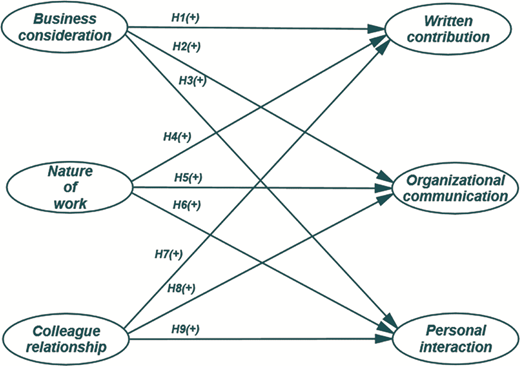
The theoretical model used in this study is illustrated in Figure 1.
Competitive compensation packages and financial incentives can influence organizational members’ work attitudes and behaviors (Chopra et al., 2022; Yousf and Khurshid, 2024), fostering a positive cycle of knowledge sharing (Cabrera et al., 2006; Siemsen et al., 2008). Obrenovic et al. (2020) demonstrated that generous compensation and financial rewards significantly impact knowledge sharing behavior. Furthermore, several scholars argued that a lack of appropriate financial incentives (Abubakr and Ameen Abdulla, 2014) and inadequate remuneration (Müller et al., 2014) hinder effective knowledge sharing. Compensation and reward systems are essential tools for fostering knowledge sharing within organizations. A well-designed compensation and reward system can effectively motivate employees to engage actively in knowledge sharing activities, thereby enhancing workplace performance (Nguyen and Malik, 2020). Based on these perspectives, this study proposes the following hypotheses:
Business consideration satisfaction positively impacts written contribution behavior.
Business consideration satisfaction positively impacts organizational communication behavior.
Business consideration satisfaction positively impacts personal interaction behavior.
The nature of work plays a crucial role in influencing knowledge sharing behavior. Sun et al. (2022) found that employees’ satisfaction with the intrinsic nature of their work positively affected the likelihood of effective knowledge sharing. Dwivedula (2020) suggested that task characteristics, such as task variety, significance and autonomy, along with feedback mechanisms (including feedback from the task itself and colleagues) and opportunities for learning and growth (such as acquiring new skills and receiving career development support), collectively enhance employees’ sense of job meaningfulness. This, in turn, fosters positive attitudes and significantly boosts intrinsic motivation. Foss et al. (2009) argued that employees place great importance on job characteristics such as autonomy, task identity and feedback, which influence knowledge sharing through motivational mechanisms. In organizations where jobs are characterized by a greater degree of skill diversity, completeness and importance, knowledge workers perceive a stronger impact on the organization. They recognize the value and significance of their work, cultivating a sense of responsibility and mission. This leads to increased knowledge sharing behavior. Building on these perspectives, this study posits the following hypotheses:
Nature of work satisfaction has a positive influence on written contribution behavior.
Nature of work satisfaction has a positive influence on organizational communication behavior.
Nature of work satisfaction has a positive influence on personal interaction behavior.
Colleague relationships are among the most critical interpersonal connections established by employees. During the process of knowledge sharing, employees are more likely to share essential information and knowledge with colleagues they have close relationships with, while withholding such information from those with whom their relationships are more distant (Maris and Robert, 1997; Xiao-Ping and Siqing, 2008). These relationships not only determine whether knowledge sharing behavior occurs but also influence the extent of knowledge sharing, as shaped by the closeness or distance of these connections (Jiang and Hu, 2016). Weak relationships with colleagues can diminish employees’ enthusiasm and proactiveness at work, whereas strong relationships foster trust among employees, affecting their willingness to share knowledge. Mobashar et al. (2014) and other researchers have emphasized that cultivating positive workplace relationships, enhancing communication, building trust and improving mutual understanding contribute to a more conducive environment for knowledge sharing. Building on these perspectives, this study posits the following hypotheses:
Colleague relationship satisfaction positively influences written contribution behavior.
Colleague relationship satisfaction positively influences organizational communication behavior.
Colleague relationship satisfaction positively influences personal interaction behavior.
4. Methodology
4.1 Measurement
Previous research has indicated that demographic factors such as age, gender, education, marital status, job position, work experience and revenue, can influence knowledge sharing behavior (Fischer and Döring, 2022; Ojha, 2005; Oye et al., 2011; Yang et al., 2021; Liana et al., 2016). In this study, we used gender, region, work years, employment method and practicing qualification as control variables to analyze the relationship between job satisfaction and knowledge sharing behavior among team members with different demographic characteristics.
The following are the measurements of the variables used in this study:
4.1.1 Job satisfaction.
We used Spector (1985)JSS to evaluate job satisfaction among rural chronic disease managers. The job satisfaction survey (JSS) comprises 36 items that assess nine dimensions, including pay (four items), promotion (4 items), supervision (4 items), benefits (4 items), contingent rewards (4 items), operating procedures (4 items), nature of work (4 items), coworkers (4 items) and communication (4 items). The nature of work, pay, supervision and coworkers dimensions in the JSS scale are well suited for measuring job satisfaction in China (Yang et al., 2010). Therefore, for this study, we selected 11 items from the JSS, specifically from the dimensions of pay, benefits, nature of work, supervision and coworkers. We extracted three factors with eigenvalues greater than 1 from the 11 selected items. Two items with factor loadings below 0.40 were excluded, resulting in 9 items that were renamed as three dimensions: business consideration (3 items), nature of work (3 items), and colleague relationships (3 items). This meets the requirements of structural equation modeling (SEM), where each latent variable must have at least three observed variables to meet the model’s identification requirements. The items were rated on a five-point Likert scale ranging from 1 (strongly disagree) to 5 (strongly agree).
4.1.2 Knowledge sharing behavior.
The “Knowledge Sharing Behavior Scale” (KSBS) used in this study was adapted from the American KSBS (Yi, 2009) to suit the research objectives. The modified KSBS consists of 30 items evaluating three dimensions: Written contributions (5 items), organizational communication (18 items) and personal interaction (7 items). An exploratory factor analysis was conducted to extract and examine the factors and verify the structural validity of the KSBS for chronic disease management personnel. Items with factor loadings less than 0.40 were eliminated, resulting in 12 remaining items, including written contributions (4 items), organizational communication (4 items) and personal interaction (4 items). Further information is provided in Table 2. A five-point Likert scale ranging from 1 (never) to 5 (always) was used, with higher scores denoting more frequent knowledge sharing behaviors.
4.2 Data collection
A multistage stratified random cluster sampling method was used. Based on geography, we first obtained a representative sample of provinces from eastern, central and western China, specifically Zhejiang, Henan and Shaanxi. Two sample counties were randomly selected from each sampled province for a total of six counties. The townships in each sampled county were categorized into three groups (economically developed, moderately developed and less developed) or two groups (economically developed and less developed). One township was selected from each category as the sample township. Seventeen townships were selected randomly. The medical workers of the chronic disease management teams in these 17 townships were selected as the study participants. The study participants included clinicians, nurses, paramedic personnel, public health personnel, village doctors and other personnel, with clinicians comprising the largest proportion.
Based on this, a questionnaire was administered to the health-care professionals involved in chronic disease management. A total of 580 questionnaires were distributed, and 560 were returned, resulting in a return rate of 96.55%. Of these, 511 questionnaires were deemed valid and were used for data analysis. This study was approved by the ethics committee of Hangzhou Normal University. The local health administration department provided a roster of the chronic disease management personnel in the selected towns, which was subsequently verified. The survey was conducted using questionnaires between February 2017 and May 2018, with guaranteed anonymity and confidentiality of the responses. Completed questionnaires were promptly collected from the chronic disease management personnel.
5. Data analysis and results
5.1 Statistical analysis
The data were first fed into EpiData software (version 3.1) to establish a comprehensive database, followed by duplicate entry and verification. Subsequently, the Statistical Package for the Social Sciences software (version 22.0) was used for descriptive statistical analysis, along with the calculation of Cronbach’s alpha coefficient and composite reliability (CR) to evaluate the reliability and validity of the questionnaire. To control for multicollinearity, a hierarchical linear regression analysis was conducted to examine the effects of business consideration, nature of work and colleague relationships on written contributions, organizational communication and personal interaction. Finally, an SEM was constructed using the AMOS software (version 24.0) to validate the proposed hypotheses regarding the influence of job satisfaction on knowledge sharing behavior of health-care workers.
5.2 Sample characteristics
Table 1 presents the key demographic and professional characteristics of the study participants. A total of 511 individuals participated in the survey, with 33.7% from the eastern region, 40.1% from the central region and the remaining from the western region. Most respondents were males (59.1%), with an average age of 43 years. Most participants were married (89.2%) and had an educational level of high school or below (56.2%) at the time of the survey. Regarding professional experience, most (80.6%) had less than 30 years of work experience. The analysis of salary distribution indicated that the participants’ average monthly salary was relatively modest, with nearly half (48.9%) earning less than 2,500 yuan.
5.3 Preliminary analyses
A Cronbach’s alpha coefficient threshold of 0.7 was established to ensure the reliability of each variable. The coefficients for the six questionnaire dimensions were as follows: business consideration (0.878), nature of work (0.914), colleague relationships (0.867), written contributions (0.880), organizational communication (0.881) and personal interaction (0.903). All values exceeded the 0.7 benchmark, indicating strong internal consistency across the dimensions. To further evaluate internal consistency, CR was calculated for each variable following the guidelines of Nunnally and Bernstein (1994). The CR results for all constructs surpassed the threshold of 0.7, confirming the high level of reliability of the questionnaire (Table 2). Convergent validity was assessed using standardized factor loadings and average variance extracted (AVE). All individual item factor loadings in the model were statistically significant (p < 0.001). The AVE values were all above the recommended minimum of 0.5, signifying strong convergence within the constructs. Although values in the range of 0.36–0.5 are considered acceptable in certain cases, our findings demonstrated AVE values exceeding 0.5.
Table 3 presents the results of the Pearson correlation analysis, which was conducted to examine the relationship between job satisfaction and knowledge sharing behavior. The analysis revealed significant positive correlations between written contributions, organizational communication, personal interaction, business consideration, nature of work and colleague relationships. The observed correlations provide a solid foundation for further analysis using the SEM and regression models.
5.4 Hierarchical linear regression
This study aims to develop regression equation models using written contributions, organizational communication and personal interaction behaviors as dependent variables. Hierarchical linear regression analysis was conducted in four stages. In the first layer, the demographic characteristics that demonstrated statistically significant differences in the one-way analysis of variance were included as control variables. In the second layer, business consideration satisfaction was added to the demographic characteristics. The third layer expands the model further by including the nature of work satisfaction along with the previously added variables. Finally, in the fourth layer, colleague relationship satisfaction was included along with demographic characteristics and the △R2 values were analyzed to infer the impact of these variables on written contributions, organizational communication and personal interaction behaviors.
First, a hierarchical linear regression analysis was conducted with written contributions as the dependent variable (Table 4). The results showed that the variance inflation factors (VIF) for all independent variables were below 5, indicating no significant multicollinearity. When demographic characteristics, business consideration and nature of work were included in the equation, the △R2 was statistically significant (p < 0.001). By comparing the changes in △R2 values, it was observed that demographic characteristics had a greater impact on the written contribution behavior of chronic disease management personnel, explaining 4.9% of the variance. The written contribution behavior of chronic disease management personnel increased with higher scores in business consideration satisfaction and nature of work satisfaction (β = 0.126, p < 0.05; β = 0.111, p < 0.05).
Second, a hierarchical linear regression analysis was conducted with organizational communication behavior as the dependent variable (Table 4). The results showed that the VIF for all independent variables were below 5, indicating no significant multicollinearity. When demographic characteristics were included in the equation, the △R2 was statistically significant (p < 0.001). By comparing the changes in △R2 values, it was observed that demographic characteristics had a greater impact on the organizational communication behavior of chronic disease management personnel, explaining 6.7% of the variance. The organizational communication behavior of chronic disease management personnel increased with higher scores in business consideration satisfaction and nature of work satisfaction (β = 0.130, p < 0.01; β = 0.178, p < 0.001).
Finally, a hierarchical linear regression analysis was conducted with personal interaction behavior as the dependent variable (Table 4). The results showed that the VIF for all independent variables were below 5, indicating no significant multicollinearity. When demographic characteristics were included in the equation, the △R2 was statistically significant (p < 0.001). By comparing the changes in △R2 values, it was observed that business consideration satisfaction had a greater impact on the personal interaction behavior of chronic disease management personnel, explaining 8.0% of the variance. The personal interaction behavior of chronic disease management personnel increased with higher scores in business consideration satisfaction, nature of work satisfaction and colleague relationship satisfaction (β = 0.175, p < 0.001; β = 0.160, p < 0.001; β = 0.144, p < 0.01).
5.5 Structural equation modeling
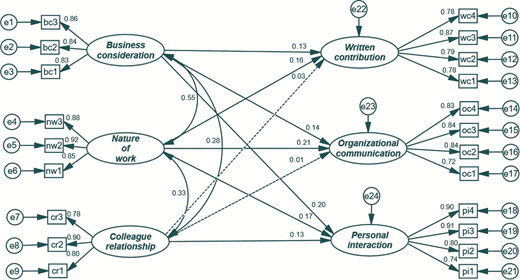
Figure 2 depicts the SEM constructed in this study, which demonstrates a strong fit with the data, as indicated by the fit indices: χ2/df = 2.039, GFI = 0.936, AGFI = 0.916, IFI = 0.973, CFI = 0.972, TLI = 0.967 and RMSEA = 0.045 (Table 5). As demonstrated in Table 6, the SEM results revealed that satisfaction with business considerations has a positive effect on written contributions (0.062), organizational communication (0.057) and personal interaction (0.062). Similarly, nature of work satisfaction positively influenced written contributions (0.070), organizational communication (0.064) and personal interaction (0.069). Furthermore, colleague relationship satisfaction positively impacts personal interaction (0.056) but does not exhibit a significant effect on written contributions or organizational communication.
6. Discussion
Existing research indicates that job satisfaction significantly impacts knowledge sharing behavior. However, due to health-care teams’ interorganizational and interprofessional collaboration, the relationships and mechanisms between the two are complex and multidimensional. Therefore, this study examined the impact of the following three critical factors on the knowledge sharing behaviors of rural chronic disease management personnel: business consideration satisfaction, nature of work satisfaction and colleague relationship satisfaction. This offers valuable insights for future research on the factors influencing knowledge sharing behavior among individuals across institutions, organizations and professions.
Univariate analysis revealed significant differences in the knowledge sharing behavior scores of rural chronic disease management personnel based on region, gender, work years, employment method and practicing qualifications. Male workers scored higher than female workers in written contributions and organizational communication behaviors, consistent with the findings of (Heisig and Kannan, 2020). Personnel in the western regions exhibited a higher frequency of organizational communication behavior than those in the eastern and central regions. Workers with 31–40 years of experience demonstrated the highest levels of organizational communication behavior, while those with less than 11 years of experience scored the lowest, contrasting with (Sarti, 2018) research. A possible explanation is that personnel with 31–40 years of experience are more experienced, have stable family and career circumstances, and possess stronger task-handling abilities, facilitating knowledge sharing.
Formally used personnel exhibited higher levels of organizational communication behavior than contract workers and others, aligning with Sarti (2014) findings. Formal employees exhibit greater job stability and stronger team recognition, motivating them to share knowledge actively. Conversely, contract workers and other personnel demonstrated reduced knowledge sharing behavior owing to job instability and a weaker sense of belonging. Practicing physicians scored higher than assistant physicians, registered nurses, and other personnel in organizational communication and personal interaction behaviors. This may be because physicians are often the team’s core members, bear greater responsibilities, and possess stronger knowledge bases and professional skills, rendering them the primary contributors to knowledge sharing.
The empirical findings indicate that business consideration satisfaction among chronic disease management personnel positively correlates with their written contributions, organizational communication and personal interaction behaviors (H1–H3). This finding aligns with previous studies (Obrenovic et al., 2020; Cabrera et al., 2006; Bock et al., 2005). Based on empirical results and prior theoretical and empirical contributions, reasonable business consideration has a significant motivating effect (Güngör, 2011; Kroll and Porumbescu, 2017) and serves as an external stimulus to encourage individuals to engage in knowledge sharing behavior (Kim and Ko, 2014). Organizational members are more inclined to engage in a behavior when its perceived benefits and rewards outweigh its costs and hazards (Chen et al., 2017). Material rewards in business consideration act as a form of compensation for knowledge sharing, providing individuals with tangible benefits, thereby enhancing job satisfaction and motivation, which promotes knowledge sharing behaviors (Cabrera et al., 2006). Furthermore, such rewards help employees recognize the organization’s appreciation and encouragement of these behaviors, motivating them to participate actively in knowledge sharing activities.
Interpersonal trust, including trust among colleagues, is crucial for facilitating knowledge exchange. Yin et al. (2015) argued that external factors, including monetary and material incentives, can enhance interpersonal trust by influencing emotions. When individuals experience high levels of satisfaction with business consideration, they are likely to feel safer and more secure in their work environment, which fosters trust and facilitates knowledge sharing through personal communication and interactions.
The empirical study also revealed that job satisfaction related to the nature of the work itself is positively correlated with written contributions, organizational communication and personal interaction behaviors (H4–H6). This result is consistent with previous theoretical and empirical contributions to knowledge management (Thomas and Laurence, 1998). As Fuller et al. (2006) emphasized, when individuals perceive their work as meaningful and experience high levels of job satisfaction, they are more inclined to invest greater energy in their tasks and to participate more actively and frequently in knowledge sharing behavior. Similarly, individuals with profound emotional attachment and normative commitment to their profession are more inclined to knowledge sharing (Rahman et al., 2015). When individuals perceive that knowledge sharing is valued in their work environment and will be used, they are more inclined to participate in knowledge sharing behavior (Lin, 2007b; Lin, 2007a).In addition, individuals with higher job satisfaction tend to reflect personal fulfillment and a sense of identification with their organization, encouraging more altruistic behaviors (Adam, 2008), thereby promoting knowledge sharing.
Job feedback is also critical for enhancing individuals’ understanding of their work and improving job satisfaction. It assists individuals in comprehending how others perceive them, thereby supporting their personal development within the organization (Peifer et al., 2020). This process dismantles obstacles among individuals, groups and departments in conventional organizations, encouraging deeper interaction and communication and ultimately creating a more favorable knowledge sharing environment.
Our empirical findings indicate that colleague relationship satisfaction among chronic disease management personnel positively correlates with their personal interaction behaviors (H9). This outcome aligns with the research of Matošková et al. (2020) and Ding et al. (2018), revealing that improved colleague relationships are frequently associated with elevated levels of knowledge sharing. Numerous researchers have indicated that trust is a fundamental condition for knowledge sharing (Wang et al., 2011; Rahman et al., 2015). Therefore, positive colleague relationships enhance communication and trust (Mobashar et al., 2014). A favorable communication environment within the organization encourages individuals to share their knowledge, fostering and facilitating cross-team and cross-departmental knowledge sharing behavior.
Nevertheless, our H7 and H8, lacked empirical evidence. Satisfaction with colleague relationships nonsignificantly influenced written contributions or organizational communication behavior (H7 and H8). Despite strong emotional connections among team members, factors including a lack of trust (Levin and Cross, 2004), insufficient awareness of the significance of knowledge sharing (Ventura and Nassif, 2016), underestimation of knowledge sharing (Cabrera and Cabrera, 2005), conflict of interests (De Lange and Mulder, 2022) and the absence of effective communication channels or tools (Alavi and Leidner, 2001) may result in inefficient knowledge flow. In practice, confucianism and collectivism influence Chinese preference for face-to-face communication (Wu and Sun, 2024). The emotional bonds within the team have yet to be transformed into the motivation for sharing in public and in writing. This motivation is more reliant on performance-oriented indicators and management tools of the organization.
7. Contribution and limitations
7.1 Theoretical contribution
This study examined the correlation between job satisfaction and knowledge sharing behavior among personnel in China’s rural chronic disease management teams. Empirical investigations improve theoretical research on the factors influencing knowledge sharing. Previous studies have focused on individual-level or single-organization contexts, examining the direct relationship between job satisfaction and knowledge sharing behavior (Mobashar et al., 2011; Abubakr and Ameen Abdulla, 2014). Conversely, this study adopted the perspective of interorganizational and interprofessional teams and analyzed the specific context of rural chronic disease management teams. It investigates how different dimensions of job satisfaction (satisfaction with business consideration, the nature of work and colleague relationships) differentially affect knowledge sharing behaviors (written contributions, organizational communication and personal interaction). This research revealed the complex mechanisms by which job satisfaction influences knowledge sharing behavior and provides systematic theoretical and empirical support for knowledge management in interorganizational collaboration contexts.
The findings demonstrate the specific relationships between different dimensions of job satisfaction and various types of knowledge sharing behaviors. For instance, business consideration satisfaction and the nature of work satisfaction positively impact written contributions and organizational communication behaviors, whereas colleague relationship satisfaction has a particularly strong effect on personal interaction behavior. This indicates that the influence of job satisfaction is not uniform but exhibits differentiated characteristics depending on the type of knowledge sharing behaviors.
Subsequent investigations indicate that the motivational effect of business consideration satisfaction significantly enhances written contributions and organizational communication. This may be because reasonable business consideration increases staff members’ sense of responsibility and engagement, encouraging them to share knowledge. The positive impact of nature of work satisfaction on organizational communication may also be related to team members’ task identification within their professional domains, which facilitates the team to achieve common goals. Colleague relationship satisfaction primarily promotes personal interaction behavior by enhancing emotional support and trust. This suggests that positive colleague relationship can reduce psychological barriers to knowledge sharing and increase individuals’ willingness to exchange knowledge, playing a crucial role in team collaboration.
These findings indicate that job satisfaction does not influence knowledge sharing behavior through a single dimension but promotes various types of knowledge sharing behaviors through distinct pathways. The multidimensional analysis in this study extends the relatively broad understanding of the relationship between job satisfaction and knowledge sharing behavior in previous research, providing new perspectives on the driving mechanisms of knowledge sharing behavior.
The study further reveals significant differences in the strength of the influence of demographic characteristics (region, gender, work years, employment method and practicing qualifications) on knowledge sharing behavior. In underdeveloped areas, business consideration satisfaction has a particularly significant impact on written contributions, likely because lower levels of economic development make material incentives more effective in these areas. In teams with higher levels of education, the nature of work satisfaction has a stronger effect on organizational communication, possibly because team members place greater value on professional fulfillment (Khan and Mehmood, 2024). In addition, the influence of satisfaction with colleague relationships on personal interaction behavior is more prominent among female staff, which may be linked to women emphasizing interpersonal support and emotional connections at work (Boles et al., 2007).
In the context of the rapid development of knowledge-intensive industries, interorganizational collaboration has become a significant driver of innovation (Powell et al., 1996), and cross-organizational cooperation has received increasing attention. This study, which focuses on rural chronic disease management, a field involving interorganizational and interprofessional collaboration, examined the impact of job satisfaction on knowledge sharing behavior, highlighting the unique characteristics of knowledge management in interorganizational contexts.
The findings demonstrate that business consideration satisfaction and the nature of work improve formal knowledge sharing behavior, including written contributions and organizational communication, providing clearer knowledge support for the goals of interorganizational collaboration. Conversely, satisfaction with colleagues’ relationships promotes tacit knowledge transfer between teams. These findings emphasize the need to consider the internal organizational factors influencing knowledge sharing and job satisfaction among interorganizational team members in driving knowledge flow.
Furthermore, this study highlights the unique challenges of interorganizational collaboration. For instance, due to the uneven distribution of resources and support systems among organizations in rural areas, the influence of job satisfaction on knowledge sharing behavior may be relatively fragile. This underscores the importance of optimizing working conditions and enhancing team collaboration experiences to promote the flow and integration of knowledge in interorganizational knowledge management.
7.2 Managerial and policy implications
From a practical application perspective, this study provides several managerial insights for chronic disease management teams.
First, based on the study’s findings, organizations should encourage formal employees and practicing physicians to take the lead in knowledge sharing while providing more career development support for contract employees, assistant physicians and nurses. For example, offering opportunities for external training, improving compensation and increasing participation in decision-making can enhance emotional commitment, a sense of security and a sense of belonging to the profession.
Second, we confirmed that business consideration satisfaction among chronic disease management personnel positively correlated with their written contributions, organizational communication and personal interaction behaviors. In chronic disease management teams, knowledge sharing requires significant investments of time and resources. To attract and retain skilled knowledge workers, it is essential to establish fair, reasonable and market-competitive compensation systems, which are critical for organizations’ long-term development and stability (Reddy and Govender, 2014). A sound compensation management system needs to be established to ensure the rationality of the compensation level, the fairness of distribution and the scientific nature of the growth rate. Providing material rewards is key to encouraging and sustaining knowledge sharing behavior (Chaudhry and Golay, 2019). For example, offering bonuses to members with outstanding written contributions or organizational communication can boost participation and engagement. In addition to material rewards, psychological incentives should not be ignored. Public recognition, career development support and team acknowledgment fulfill the higher-level psychological needs of team members.
Third, we identified the critical role of job satisfaction related to the nature of work in promoting knowledge sharing behavior. Incorporating knowledge sharing behavior as key indicators in performance evaluations and linking evaluation results to compensation can help chronic disease management personnel better recognize the value of their work, thereby significantly enhancing their knowledge sharing behaviors (Abubakr and Ameen Abdulla, 2014; Wai Ling et al., 2009). To improve the effectiveness of knowledge sharing behavior, organizations can design evaluation criteria across three dimensions: written contributions, organizational communication and personal interaction. Written contributions can focus on the quantity and quality of knowledge documentation, including the practicality and innovativeness of technical guidelines, case analyses and experience summaries. Organizational communication can assess members’ frequency and effectiveness in participating in internal or external knowledge exchange activities, including contributions to workshops and training sessions. Personal interaction can measure the extent and impact of members’ participation in small-scale knowledge sharing, including collaborating to solve problems or sharing experiences.
Finally, our research indicates that satisfaction with colleague relationships positively correlates with personal interaction behavior among chronic disease management personnel. However, satisfaction with colleague relationships nonsignificantly influenced written contributions or organizational communication behavior, which means emotional bonds within teams have not changed the communication preferences of the Chinese people. On the one side, organizations should strengthen traditional communication methods, including regular cross-institutional sharing activities can improve the flow of knowledge within and across organizations. On the other side, leveraging recreational activities and team-building exercises, can give rural chronic disease management personnel more communication opportunities. Establishing a supportive team communication environment and cultivating trust can significantly improve team members’ job satisfaction, promote knowledge sharing behavior and enhance overall workplace performance (Abu Dalal et al., 2022).
In practice, although chronic disease management team members may be willing to share knowledge, they frequently encounter the challenge of lacking suitable platforms. By leveraging modern information technology, organizations can develop knowledge databases and sharing platforms with features, including discussion forums, knowledge repositories and real-time collaboration tools. These platforms offer practical and accessible solutions for online knowledge sharing, effectively overcoming the geographic and communication barriers between teams and organizations. Such platforms can significantly facilitate the flow, creation and integration of knowledge (Lane et al., 2024).
7.3 Limitations and further research
This study has three major limitations that future research could address. First, it used a cross-sectional design, which may not fully consider the factors influencing knowledge sharing behavior. Future studies should adopt a longitudinal design to better explore causal relationships and establish the temporal precedence of the variables. Second, the study was based on a sample of medical personnel involved in chronic disease management in primary health-care institutions in rural China. Future research could expand this scope to include other professional groups and broader geographic regions. Finally, the relationship between job satisfaction and knowledge sharing behavior is inherently complex and may involve mediating factors and interactions that warrant further exploration. Despite these limitations, this study offers valuable theoretical and empirical evidence on the link between job satisfaction and knowledge sharing behavior among cross-professional and cross-organizational personnel, providing practical insights for managers and policymakers.
8. Conclusion
Our study found that both business consideration and the nature of work satisfaction positively influenced written contributions and organizational communication behaviors. Moreover, business consideration, the nature of work and colleague relationship satisfaction positively impacted personal interaction behavior. These findings highlight the importance of enhancing job satisfaction and fostering knowledge sharing behavior within rural chronic disease management teams. To support these efforts, it is recommended that primary health-care institutions establish a fair performance assessment and compensation system to ensure that job compensation is aligned with job performance. Furthermore, creating an open knowledge sharing environment, strengthening organizational communication and personal interactions and ensuring smooth information flow are essential. Leveraging modern information technology to develop a knowledge sharing platform can facilitate the rapid transmission and application of knowledge, ultimately improving the overall effectiveness of the team.
Acknowledgements
The authors would like to thank the Editor-in-Chief and anonymousreferees for providing helpful comments andsuggestions, which led to improving the article.
Authors contribution
Fang, Yuanyuan and Yu, Luxia contributed equally to this work and should be considered co-first authors.