This conceptual paper aims to examine Entrepreneurial Education (EE) in Higher Education Institutions (HEIs) through a Knowledge Management (KM) lens. It explains how enabling technology affordances, when aligned with the characteristics of entrepreneurial knowledge, shape Knowledge Transfer (KT) and Knowledge Retention (KR) under conditions of cognitive bias. It clarifies how KM processes support durable entrepreneurial capability development.
The study adopts a theory-driven conceptual methodology. Drawing on KM process theory and conceptual theory-building guidance, the paper develops a mechanism-based framework through six stages: problematisation, theoretical anchoring, construct selection, mechanism mapping, model integration and proposition development. The framework positions KT and KR as the analytical core, enabling technologies as differentiated KM affordances, and cognitive bias as an embedded condition that can distort knowledge interpretation, transfer, retention and reuse.
The framework proposes that enabling technologies can strengthen KT and KR when their affordances align with the knowledge’s tacitness, codifiability and contextual dependence, and are supported by interaction, reflection, curation and governance routines. Immersive/simulation, AI/analytics and collaborative/process technologies support KT/KR mechanisms. Cognitive bias can weaken or distort knowledge transfer, retention and reuse, whereas bias-aware routines and cohort-to-cohort feedback can improve knowledge fidelity, programme memory and entrepreneurial capability development.
The paper advances a KM-centred reframing of EE by positioning KT and KR as the focal mechanisms linking enabling technologies to durable entrepreneurial capability development. It differentiates technologies by their KM affordances and integrates cognitive bias, boundary conditions and programme-level feedback within a single conceptual architecture, offering testable propositions and design principles for technology-enabled EE.
1. Introduction
Knowledge Management (KM) has long been recognised as a critical driver of organisational learning, innovation and performance in knowledge-intensive contexts (Alavi and Leidner, 1999; Dalkir, 2011). Its core processes include knowledge creation, transfer, retention and application (Alavi and Leidner, 2001; Argote et al., 2003). Knowledge Transfer (KT) and Knowledge Retention (KR) are especially important because they make knowledge available beyond its source and over time, yet both are difficult when knowledge is tacit, experiential and behaviourally embedded (Levy, 2011; Levallet and Chan, 2019; Argote and Miron-Spektor, 2011). Higher Education Institutions (HEIs) are knowledge-intensive organisations centred on producing, transmitting and preserving knowledge, but their KM practices, particularly in teaching and learning, remain uneven and under-theorised (Kidwell et al., 2000; Rowley, 2000; Cranfield and Taylor, 2008; Secundo et al., 2019). This issue is salient in Entrepreneurial Education (EE), which seeks innovation, employability and adaptive capacity (OECD, 2019; European Commission, 2023), yet shows mixed short- and long-term outcomes (Nabi et al., 2017). The central question is therefore how entrepreneurial learning is transferred, retained and converted into durable entrepreneurial capabilities. EE requires both explicit knowledge – models, frameworks and tools – and tacit knowledge – judgement, heuristics and opportunity recognition – to be transferred and retained (Kolb, 1984; Mitchelmore and Rowley, 2010; Lans et al., 2014). However, project-based learning, mentoring and stakeholder interaction often generate experiential knowledge without systematic capture, consolidation or reuse, leaving learning episodic and cohort-specific (Neck and Greene, 2011). From a KM perspective, this constitutes knowledge loss comparable to that caused by organisational turnover or discontinuity (Enakrire and Smuts, 2022).
Digitalisation further reshapes KT and KR. Collaborative platforms, learning management systems, analytics, artificial intelligence and immersive environments are widely adopted to improve scale and personalisation (Secundo et al., 2021), but their effects depend on alignment with specific knowledge processes and educational objectives (Sulisworo, 2012; Iqbal, 2021). Entrepreneurial learning also occurs under uncertainty and bounded rationality, making it vulnerable to overconfidence, planning fallacy and illusion of control (Simon et al., 2000; Thomas and Wulf, 2019). Although explored within the realm of behavioural entrepreneurship (Abatecola et al., 2021), the influence of these biases on KT and KR remains insufficiently examined. From a KM standpoint, they are endogenous distortions of knowledge interpretation, transfer, retention and reuse (Daghfous et al., 2013; Levallet and Chan, 2019). In light of this, this paper adopts a KM perspective to reframe EE as a theoretically informative context for examining KT and KR under conditions of uncertainty, behavioural complexity and technological mediation. Building on KM theory (Alavi and Leidner, 2001; Argote et al., 2003) and KM research in educational and entrepreneurial settings (Bolton and Thompson, 2004; Sulisworo, 2012; Secundo et al., 2019; Solomon et al., 2019), it connects KT and KR as core processes, enabling technologies as KM enablers, and cognitive bias as an embedded moderating condition. Accordingly, the paper addresses the following research questions (RQs):
What factors facilitate or hinder the effectiveness of Knowledge Transfer and Knowledge Retention in Entrepreneurial Education as a knowledge-intensive learning environment?
How do enabling technologies shape, support, and mitigate cognitive biases in Knowledge Transfer and Knowledge Retention processes in Higher Education Institution contexts?
How can we conceptualise the mechanisms through which enabling technologies foster Knowledge Transfer and Knowledge Retention processes within Higher Education Institutions?
The absence of a structured understanding of how enabling technologies influence KT and KR represents a significant gap in EE research and practice. Digital, AI-based and immersive tools are often selected for their availability or novelty rather than their knowledge-process fit; the proposed model addresses this gap by systematically linking them to KT and KR mechanisms and provides a principled basis for technology-enabled EE design and evaluation.
2. Theoretical framework
2.1 Knowledge transfer and knowledge retention as core knowledge management processes
KM research argues that adaptability depends not only on creating knowledge but also on moving it to where it is needed and preserving it for future use. KT and KR are therefore interdependent processes through which knowledge becomes actionable and durable, especially under uncertainty and turbulence (Bolisani and Bratianu, 2017).
KT pertains to the transfer of knowledge among individuals, groups and organisational units, enabling replication, coordination and learning beyond single actors. It is constrained by limited attention, weak incentives and communication channels, and source–recipient misalignment (Riege, 2007), especially when knowledge is difficult to articulate or codify. Tacit KT depends on trust because exchanged knowledge is incomplete, ambiguous and hard to verify (Holste and Fields, 2010). KT is therefore a socially embedded process of interpreting, negotiating and applying knowledge in local contexts, not merely information circulation or repository access. In parallel, codification is not a universal solution: documented knowledge may still require situated expertise for correct interpretation and use (Hall, 2006). Effective KT relies on combination of mechanisms rather than a single channel and depends on recipients’ absorptive capacity and motivation (Nguyen, 2017). KR and knowledge loss are equally critical because valuable knowledge can dissipate through turnover or project discontinuity (Daghfous et al., 2013). KR therefore extends beyond document storage to preserving knowledge in retrievable, meaningful and usable forms through intentional strategies that reduce vulnerability to attrition (Levallet and Chan, 2019). KT and KR are tightly coupled: transfer without retention produces short-lived learning and retention requires human and system-based mechanisms that keep knowledge accessible (Levy, 2011). Their effectiveness depends on knowledge characteristics, contextual conditions and organisational arrangements that support translation, stabilisation and reactivation over time.
2.2 Knowledge management in higher education institutions context for entrepreneurial education
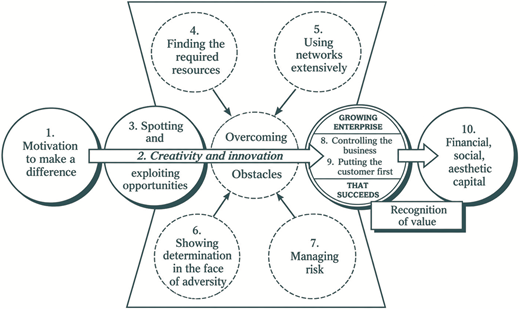
EE in HEIs seeks actionable competencies such as opportunity orientation, creativity, resilience and calibrated risk-taking rather than fixed personality traits (Bolton and Thompson, 2004; Obschonka and Stuetzer, 2017). This competence-based view shifts attention to how educational practices create, share, apply and stabilise knowledge. The KM challenge is therefore how HEIs support KT and KR so that practice-oriented learning persists and can be revisited beyond a course (Alavi and Leidner, 2001; Argote et al., 2003). Figure 1 presents the Bolton and Thompson (2004) competence-based entrepreneurial profile that anchors the mechanisms discussed below.
From a KM perspective, HEIs are knowledge-intensive organisations whose teaching, research and engagement depend on creating, mobilising and preserving knowledge (Kidwell et al., 2000; Iqbal, 2021). Because educational knowledge is often tacit, socially constructed and enacted through situated interaction and reflection, KM cannot be treated as a linear creation–storage–application pipeline (Alavi and Leidner, 2001; Hall, 2006). A process view instead foregrounds KT and KR as the mechanisms through which knowledge moves across actors and contexts and remains durable beyond initial learning (Levy, 2011; Levallet and Chan, 2019). In HEIs, KT is multidirectional among faculty, students, staff and external stakeholders and is shaped by governance and incentives as well as pedagogy (Elezi and Bamber, 2022). When promotion, performance or workload systems do not reward transfer-oriented behaviour, KT remains fragile despite sharing platforms (Gonzalez-Sanchez et al., 2022). Leadership, culture, incentives and relational conditions are therefore necessary complements to content and tools (Iqbal, 2021; Riege, 2007). HEIs are vulnerable to knowledge loss because cohorts and project roles rotate (Enakrire and Smuts, 2022). KR is therefore an organisational capability involving deliberate selection and context-sensitive interpretation, not mere capture (Levy, 2011; Levallet and Chan, 2019). Experiential insights that are not externalised into shared artefacts may be lost even when materials are stored, as experiences of remote-teaching adaptation illustrate (Srivastava et al., 2024). This challenge becomes acute in EE because opportunity recognition, negotiation and similar knowledge are experiential, contextual and tacit (Mitchelmore and Rowley, 2010; Lans et al., 2014); codification can omit the cues needed for use (Hall, 2006). KT consequently requires trust, psychological safety and interaction-rich practices (Kolb, 1984; Holste and Fields, 2010; Nguyen, 2017), while KR requires deliberate capture, curation and reintegration into later programme iterations (Levy, 2011; Levallet and Chan, 2019).
2.3 Enabling technologies as knowledge management enablers
Enabling technologies (ETs) are not neutral tools but socio-technical infrastructures that shape knowledge creation, transfer, retention and reuse (Bolisani and Bratianu, 2017; Massa et al., 2023). Their effects are conditional: AI, learning analytics, immersive environments and collaborative platforms alter what can be codified, searched, recombined and recontextualised, while introducing governance and adoption challenges (Ribeiro et al., 2021; Iqbal, 2021; Iaia et al., 2024). For KT, they expand reach, speed and visibility, but effective transfer still requires trust, motivation and shared interpretation (Holste and Fields, 2010). Codification supports dissemination and reuse but can omit tacit or contextual elements (Hall, 2006; Daghfous et al., 2013), so technology-enabled KT is strongest when combined with mentoring, feedback and communities of practice. For KR, technologies can support organisational memory, but stored knowledge must remain retrievable, interpretable and current (Levy, 2011; Levallet and Chan, 2019; Iqbal, 2021). AI and analytics can scale curation and retrieval while raising questions about which knowledge is prioritised (Massa et al., 2023; Iaia et al., 2024; Leoni et al., 2024; Del Giudice et al., 2023).
A KM-grounded account therefore distinguishes technologies by affordances – what actors can do with them and what they constrain (Leonardi, 2011; Kirchner and Razmerita, 2025). Immersive and simulation-based environments, including VR/AR/MR, serious games and metaverse applications, enable experiential externalisation and rehearsal of tacit knowledge such as opportunity recognition, negotiation and decision-making under pressure (Loia et al., 2025; Hall, 2006), but entail cost, design complexity and limited scalability. AI and analytics enable codification, retrieval and personalisation, exerting strong influence on KR through curation and recombination, while algorithmic selection shapes knowledge visibility (Leoni et al., 2024; Kumar, 2025; Iaia et al., 2024). Collaborative and process platforms, including LMSs, repositories and social tools, expand interaction and stabilise organisational memory but cannot guarantee interpretive depth (Razmerita et al., 2016; Levy, 2011).
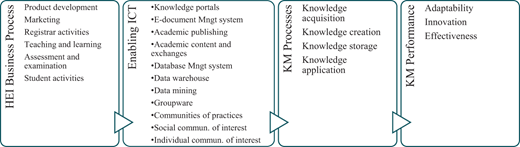
The relevance of this technological integration to KM is underscored by Sulisworo’s (2012) framework, which illustrates how ICT integration in HEIs can strengthen KM processes and support outcomes such as adaptability, innovation and performance (Figure 2).
Technology-enabled KM also creates endogenous risks. Algorithmic curation may encourage automation bias and over-trust; codification and AI summarisation may strip tacit context; technological substitution may weaken reflection and skill development; and platform proliferation may generate overload, fragmentation and silos (Hall, 2006; Daghfous et al., 2013; Razmerita et al., 2016; Kumar and Chakrabarti, 2012; Sun and Xu, 2025; Serenko, 2025). Governance, reflection and use routines determine whether technologies amplify or attenuate these risks and their effects on KT and KR (Massa et al., 2023; Iaia et al., 2024).
2.4 Cognitive bias as a moderating condition of knowledge management processes
KM processes unfold under conditions of bounded rationality. Individuals and groups cannot process all available information, and therefore rely on selective attention, simplifying rules and prior interpretive frames. In learning contexts, these mechanisms can produce cognitive biases that influence how knowledge is searched, evaluated, transferred, encoded, retrieved and reused (Simon et al., 2000). This is particularly important for KM because the presence of knowledge in lectures, repositories, mentoring interactions or feedback systems does not ensure that such knowledge becomes usable. Available knowledge may remain cognitively invisible if actors fail to notice it, discount it, misinterpret it or overvalue more salient but less diagnostic information (McKenzie et al., 2011). In KT, confirmation bias, anchoring, overconfidence and social-cognitive filtering may affect which sources are trusted, which feedback is accepted, and how transferred knowledge is interpreted. Learners may privilege evidence that confirms initial assumptions, remain tied to early customer signals or valuation anchors, or resist disconfirming feedback from peers, mentors and external stakeholders. In such cases, the problem is not necessarily that knowledge has failed to circulate, but that its interpretation and internalisation have been selectively distorted (Kumar and Chakrabarti, 2012; Abatecola et al., 2021).
In KR, bias shapes what is stabilised as memory. Planning fallacy, self-enhancement and overconfidence may encourage learners and educators to document simplified success narratives while neglecting failure, uncertainty or causal ambiguity. As a result, what is retained in programme artefacts, cases, repositories or reflective outputs may not faithfully represent the learning process. Over time, these individual-level distortions may become embedded in institutional memory, producing cumulative knowledge loss or biased KR despite the formal existence of retention mechanisms (Daghfous et al., 2013; Levallet and Chan, 2019; Serenko, 2025).
These dynamics are especially relevant in EE, where entrepreneurial learning takes place under uncertainty and often depends on incomplete evidence, iterative experimentation and confidence calibration (Thomas and Wulf, 2019; Simon et al., 2000). Cognitive biases may stimulate entrepreneurial action, but they can also undermine learning when outcomes are interpreted as validation rather than as evidence requiring reflection. For this reason, bias is not treated in this paper as an external psychological variable, but as a KM-relevant condition that affects the fidelity of KT and the quality of KR. AI-mediated tools, analytics systems, digital platforms and repositories can expand access to knowledge, accelerate feedback and increase retrievability, but they can also reshape cognitive authority and influence which knowledge is trusted, documented or reused. Algorithmic outputs may be overtrusted, digital visibility may amplify self-presentation effects, and searchable traces may reinforce selective retrieval. Accordingly, technologies may reduce or amplify bias depending on the reflective and governance routines surrounding their use (Sun and Xu, 2025; Serenko, 2025).
3. Methodology
3.1 Research approach and conceptual methodology
This study is positioned as a theory-driven conceptual paper that develops a mechanism-based framework to explain how enabling technologies shape KT and KR in EE within HEIs. The paper does not report empirical data, test hypotheses or claim empirical validation. Instead, it develops a conceptual architecture that clarifies how entrepreneurial knowledge is transferred, retained, distorted and reactivated under conditions of technological mediation and cognitive bias. This approach is consistent with conceptual article development, where the objective is to clarify constructs, specify relationships, and develop theoretical explanations through structured integration of prior knowledge (Jaakkola, 2020). The methodological objective is therefore not to measure the effectiveness of specific educational technologies, but to construct a KM-centred framework that explains the mechanisms through which technologies affect KT and KR. EE is treated as a theoretically informative context in which KT and KR are particularly fragile because entrepreneurial knowledge is often tacit, experiential, uncertainty-laden, and difficult to preserve across cohorts. In this sense, EE provides a relevant setting for examining how knowledge can be transferred, stabilised, retrieved and reused over time (Hall, 2006; Levy, 2011; Levallet and Chan, 2019). Based on Jaakkola’s (2020) guidance for conceptual article development and Sandberg and Alvesson (2021) typology of theoretical contribution, the paper is positioned primarily as an ordering theory with comprehending elements, rather than as a fully explanatory or predictive theory. As an ordering contribution, the framework organises constructs that have often been treated separately: entrepreneurial learning objectives, KT, KR, enabling technologies, cognitive bias and programme-level feedback. As a comprehending contribution, it deepens understanding of how these elements interact in the specific context of EE in HEIs. The propositions developed later in the paper are therefore offered as theoretically grounded conjectures for future empirical examination, not as empirically confirmed causal claims.
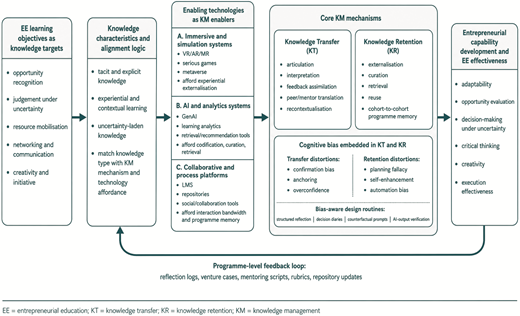
The conceptual model presented in Figure 3 reflects this methodological positioning. Rather than presenting a linear sequence of educational inputs and outcomes, the figure depicts a mechanism-based KM architecture. It begins with entrepreneurial learning objectives as knowledge targets, proceeds through knowledge-type diagnosis and technology–KM affordance alignment, places KT and KR mechanisms at the centre of the framework, embeds cognitive bias within these mechanisms, and includes a programme-level feedback loop through which cohort learning may be converted into institutional memory.
3.2 Conceptual development logic and scope conditions
Building on guidance for conceptual article development and theory construction (Jaakkola, 2020; Sandberg and Alvesson, 2021), the framework was developed through a six-stage operational derivation process: problematisation, theoretical anchoring, construct selection, mechanism mapping, model integration and proposition development. This process was used to make explicit how the model was constructed and to avoid presenting Figure 3 as a narrative synthesis of related literatures.
Firstly, the problematisation stage identified the central KM puzzle addressed by the paper: although EE aims to develop entrepreneurial capabilities, existing research provides limited explanation of how entrepreneurial knowledge becomes transferable, retainable, reusable and cumulatively available across cohorts in HEIs. This gap is particularly important because EE often generates experiential and tacit knowledge that may remain episodic, individualised and weakly institutionalised unless KT and KR mechanisms are deliberately designed (Levy, 2011; Levallet and Chan, 2019).
Secondly, the theoretical anchoring stage positioned KT and KR as the core KM processes around which the framework is organised. KT was selected because EE depends on the movement, interpretation and adaptation of entrepreneurial knowledge among instructors, mentors, peers, external stakeholders and learners. KR was selected because EE programmes face recurring risks of knowledge loss caused by rotating cohorts, discontinuous projects, changing mentors and weak programme memory (Levy, 2011; Levallet and Chan, 2019; Enakrire and Smuts, 2022).
Thirdly, the construct-selection stage applied three criteria: KM centrality, mechanism explicability and boundary-condition value. Each construct had to be directly connected to KT and/or KR, explain how knowledge is transferred, interpreted, retained, retrieved, reused or distorted, and help clarify why KT and KR may succeed, fail or generate unintended consequences under different technological, organisational, pedagogical or cognitive conditions (Hall, 2006; Levallet and Chan, 2019; Kumar and Chakrabarti, 2012).
Fourthly, the mechanism-mapping stage translated the selected constructs into process mechanisms. Entrepreneurial learning objectives were reframed as knowledge targets because they specify the types of knowledge that must be transferred and retained. The entrepreneurial behaviour model presented in Figure 1 informed the identification of capability domains commonly targeted in EE, such as opportunity-oriented behaviour, resource mobilisation and risk management, which were then interpreted as knowledge domains requiring KT and KR (Bolton and Thompson, 2004). Similarly, the ICT–KM model for HEIs presented in Figure 2 informed the process logic through which ICT infrastructures shape KM processes and performance outcomes (Sulisworo, 2012). These models were not mechanically combined; rather, they were used as analytical lenses to guide construct coverage and alignment across levels of analysis.
Fifthly, the model-integration stage assembled these mechanisms into the recursive architecture presented in Figure 3. The model connects entrepreneurial knowledge targets, knowledge-type diagnosis, technology–KM affordance alignment, KT/KR mechanisms, cognitive bias, entrepreneurial capability development, and programme-level feedback. Cognitive bias is embedded within the KT/KR mechanism layer because biases shape what knowledge is attended to, accepted, interpreted, encoded, documented, retrieved and reused. The inclusion of cognitive bias follows the logic that bounded awareness can make available knowledge cognitively invisible, weakening KT and KR even when formal tools or repositories are present (Kumar and Chakrabarti, 2012).
Sixthly, the proposition-development stage translated the framework into testable theoretical conjectures. The propositions specify expected relationships among knowledge targets, technology affordances, KT/KR mechanisms, cognitive bias, boundary conditions and capability development. Their purpose is not to report empirical findings, but to articulate theoretically grounded conjectures for future empirical examination, consistent with conceptual theory-building approaches (Jaakkola, 2020; Sandberg and Alvesson, 2021).
The framework applies mainly to programme- and course-level EE in HEIs where learning is experiential, project-based, reflective and technologically mediated. It is less applicable where entrepreneurship is taught mainly through decontextualised lectures, interaction is minimal, technology only delivers content, or institutional memory mechanisms are absent. Relevant scope conditions include curriculum flexibility, governance and resources; learners’ prior knowledge, motivation and bias awareness; technology usability and support for codification, retrieval and reuse; and pedagogical conditions such as feedback quality, mentoring and reflection intensity. These conditions indicate when the mechanisms in Figure 3 are likely to operate, weaken or generate unintended consequences.
3.3 Construct selection and integration protocol
Constructs were included according to three criteria. KM centrality required a direct contribution to explaining KT and/or KR: entrepreneurial learning objectives as knowledge targets requiring transfer and retention (Bolton and Thompson, 2004), enabling technologies as KM affordances rather than generic tools, and cognitive bias as a condition shaping attention, interpretation and retrieval. Mechanism explicability required each construct to explain how knowledge moves, stabilises or becomes distorted: KT through articulation, feedback assimilation and recontextualisation; KR through externalisation, curation, retrieval and cohort-to-cohort memory (Levy, 2011; Levallet and Chan, 2019). Boundary-condition value required each construct to help explain variation in outcomes: knowledge characteristics, because tacit and codifiable knowledge require different configurations; technological affordances, because immersive, AI/analytics and collaborative platforms reshape KT/KR differently; and cognitive bias, because available knowledge may still be misinterpreted, overtrusted or poorly reused (Hall, 2006; Holste and Fields, 2010; Kumar and Chakrabarti, 2012).
The framework is built around KT and KR rather than adjacent KM constructs such as absorptive capacity, organisational memory, communities of practice, knowledge governance or dynamic learning routines. These are not excluded but repositioned as nested mechanisms or boundary conditions: absorptive capacity as a recipient-side condition (Nguyen, 2017), organisational memory as an infrastructural expression of retention (Levy, 2011; Levallet and Chan, 2019), communities of practice as relational channels for tacit transfer (Holste and Fields, 2010), knowledge governance as a condition affecting curation and reuse, and dynamic learning routines as feedback mechanisms. This preserves parsimony while keeping KT and KR as the focal constructs that directly capture the movement and durability of entrepreneurial knowledge in HEIs.
4. Conceptual framework
4.1 Specification and architecture
Building on Section 3, this section specifies how enabling technologies, KT and KR mechanisms, cognitive bias and programme feedback shape the transfer, retention, distortion, correction and reuse of entrepreneurial knowledge. The framework distinguishes KM effectiveness, defined as the transfer and preservation of knowledge across actors and cohorts, from individual learning effectiveness. A programme may improve entrepreneurial intention or self-efficacy yet remain weak as a KM system if knowledge is individualised, difficult to retrieve or not stabilised in programme memory (Nabi et al., 2017; Levallet and Chan, 2019). KT and KR therefore produce durable, retrievable and reusable knowledge assets that support, but are not identical to, educational outcomes. The framework also distinguishes EE as the institutional provision of programmes that develop entrepreneurial competencies, entrepreneurial learning as individual experiential acquisition and refinement, and entrepreneurial capability development as durable competencies such as adaptability, opportunity evaluation, critical thinking, creativity and decision-making under uncertainty (Bolton and Thompson, 2004; Mitchelmore and Rowley, 2010). Capability development is thus mediated by KT and KR rather than resulting directly from technology use.
The framework presented in Figure 3 is organised around five interdependent components. Firstly, EE learning objectives are reframed as knowledge targets. Secondly, entrepreneurial knowledge is characterised by tacitness, codifiability, experiential embeddedness, contextual dependence and uncertainty. Thirdly, enabling technologies are conceptualised as differentiated KM affordances rather than as generic educational tools. Fourthly, KT and KR operate as the core mechanisms through which entrepreneurial knowledge is articulated, interpreted, externalised, curated, retrieved, reused and carried across cohorts. Fifthly, cognitive bias is embedded within these mechanisms because it can distort what knowledge is noticed, trusted, documented, retrieved and reused. The framework also includes a programme-level feedback loop through which learning artefacts, reflection outputs, venture cases, mentoring scripts, rubrics and repository updates can be reintegrated into future programme design.
This architecture is deliberately recursive rather than linear. Technologies do not automatically translate into improved learning outcomes. Their contribution depends on alignment with the type of knowledge involved and with the KT/KR mechanisms required. Similarly, KT does not necessarily lead to KR unless transferred knowledge is externalised, curated, made retrievable and reused. Cognitive bias further complicates this process because learners and educators may selectively attend to, interpret or preserve knowledge in ways that weaken the fidelity of KT and KR. The model therefore explains technology-enabled EE as a socio-technical KM system in which knowledge characteristics, technological affordances, cognitive conditions and programme-level routines interact to shape whether entrepreneurial knowledge becomes durable and reusable.
4.1.1 Teaching and learning objectives in entrepreneurial education as knowledge targets.
The first component identifies the entrepreneurial capabilities that EE seeks to develop as the targets of KT and KR within programmes and cohorts (Bolton and Thompson, 2004). These objectives are treated as knowledge objects that must be transferred (e.g. from instructors, mentors, peers and external stakeholders to learners and across teams) and retained (e.g. carried forward and reapplied across projects and time) to generate entrepreneurial capabilities that remain retrievable, reusable, and adaptable across projects, cohorts and contexts (Argote et al., 2003; Levy, 2011). In this framing, entrepreneurial competencies are not treated as outputs in isolation, but as the downstream manifestation of learning-intensive KT/KR processes operating under uncertainty.
4.1.2 Knowledge characteristics and alignment logic.
The second component concerns the diagnosis of the knowledge to be transferred and retained. Entrepreneurial knowledge varies in its degree of tacitness, codifiability, experiential embeddedness, contextual dependence and uncertainty. These characteristics are theoretically important because they determine which KT and KR mechanisms are likely to be effective. Tacit and experiential knowledge, such as opportunity recognition, negotiation judgement or decision-making under uncertainty, requires interaction-rich mechanisms, including mentoring, peer critique, simulation, feedback assimilation and recontextualisation. More explicit or codifiable knowledge can be more effectively supported through documentation, repositories, templates, analytics and retrieval systems. The alignment logic therefore constitutes the bridge between entrepreneurial learning objectives and enabling technologies: technologies are not selected because they are available or innovative, but because their affordances fit the knowledge type and the KM mechanism required (Alavi and Leidner, 2001; Hall, 2006; Holste and Fields, 2010).
4.1.3 Enabling technologies for entrepreneurial education as knowledge management enablers.
Enabling technologies are conceptualised not as generic educational tools – including MOOCs and online platforms (Pizarro Millian et al., 2016), immersive environments (Loia et al., 2025) and AI-enabled systems (Kumar, 2025) – but as differentiated KM affordances organised around the architectural classes established in Section 2.3. Immersive and simulation-based systems primarily support experiential externalisation and tacit KT. AI and analytics systems primarily support codification, curation, search and personalisation, while introducing governance and capability requirements that condition adoption (Leoni et al., 2024; Kumar, 2025). Collaborative and process-oriented platforms primarily support interaction bandwidth, feedback circulation and programme memory (Razmerita et al., 2016). This distinction clarifies why technology has no uniform effect on KT and KR: each architecture strengthens some mechanisms while creating specific constraints, such as algorithmic dependence or weak interpretive depth (Massa et al., 2023; Iaia et al., 2024).
4.1.4 Enabling technologies’ impact on knowledge transfer and knowledge retention performance.
The fourth component explains how enabling technologies affect KT/KR performance by strengthening or weakening specific KM mechanisms. Technologies can enhance KT by supporting knowledge articulation and sharing, increasing the visibility of relevant knowledge, and enabling iterative feedback loops across actors. They can strengthen KR by operating as organisational memory systems: repositories, archives, searchable traces and curated artefact collections persist beyond the immediate learning episode. Digitalisation also enables more dynamic KR, shifting retention from static storage to continuous updating and recombination of reusable knowledge assets. The framework views these performance effects as conditional because codification increases availability of explicit knowledge but may omit tacit and contextual meaning, making KT dependent on interpretive work and interaction-rich settings. Similarly, investing in repositories does not guarantee retention if knowledge is not retrievable, interpretable and reintegrated into practice, which links KR directly to reuse conditions and governance (Levallet and Chan, 2019; Daghfous et al., 2013). This is particularly salient in EE, where simulations and adaptive platforms may support experiential learning and reflection, but can also produce superficial transfer if learners misinterpret signals or overgeneralise from limited feedback (Cowdean et al., 2019).
4.1.5 Cognitive bias within knowledge transfer/knowledge retention mechanisms, capability development and the feedback loop.
The fifth component links KT/KR mechanisms to entrepreneurial capability development and to the programme-level feedback loop. Entrepreneurial capability development is understood as the durable downstream outcome of improved KT and KR, reflected in competencies such as adaptability, critical thinking, opportunity evaluation, creativity, execution effectiveness and decision-making under uncertainty (Bolton and Thompson, 2004; Simon et al., 2000). These outcomes are not assumed to result directly from technology use; rather, they depend on whether entrepreneurial knowledge is transferred with sufficient fidelity, retained in usable form, and reactivated across tasks, projects and cohorts. Within this architecture, cognitive bias is embedded in the KT/KR layer rather than treated as an external moderator. Its role is to explain why formally available knowledge may still be poorly transferred, weakly retained or selectively reused when bounded awareness makes relevant knowledge cognitively invisible (Kumar and Chakrabarti, 2012). In KT, confirmation bias, anchoring and overconfidence affect how learners evaluate sources, interpret feedback, and incorporate disconfirming evidence. In KR, planning fallacy, self-enhancement and automation bias influence what is documented, retrieved and institutionalised as programme memory, with implications for knowledge loss and distorted retention (Daghfous et al., 2013; Levallet and Chan, 2019; Serenko, 2025). Thus, bias operates where knowledge is interpreted, encoded, externalised and reused. A repository, simulation, AI tool or feedback platform may increase access to knowledge, but it does not ensure accurate interpretation or future-oriented retention. For example, AI-generated feedback may accelerate KT while encouraging over-reliance on algorithmic authority if learners do not verify or contextualise outputs (Sun and Xu, 2025), while reflective artefacts may preserve self-enhancing success narratives if failure, uncertainty and causal ambiguity are not explicitly documented (Serenko, 2025).
The feedback loop in Figure 3 has two functions. Firstly, it converts learning outputs, such as reflection logs, venture cases, mentoring notes, assessment rubrics and project artefacts, into programme-level memory for subsequent cohorts. Secondly, it enables bias correction through structured reflection, decision diaries, counterfactual prompts, feedback traceability, triangulated evaluation and AI-output verification. These routines are KM correction mechanisms because they help preserve the fidelity of transferred and retained knowledge. The model therefore explains capability development as a recursive process in which entrepreneurial knowledge is transferred, retained, checked for distortion, and reintegrated into future learning cycles.
4.2 Relationship logic and boundary conditions
Building upon the construct definitions outlined in Sections 4.1.1–4.1.5, this section delineates the theoretical logic linking the components depicted in Figure 3 and elucidates the boundary conditions under which the proposed effects are anticipated to be amplified or diminished. The framework employs a socio-technical KM perspective, positing that enabling technologies influence KT and KR by reconfiguring mechanisms such as codification, search, interaction, feedback and organisational memory, rather than directly impacting performance in isolation.
4.2.1 From entrepreneurial education learning objectives to enabling technologies.
The first relationship posits that EE learning objectives should be treated as knowledge targets whose properties determine the appropriate KT and KR configuration. Capabilities such as opportunity recognition, judgement under uncertainty, resource mobilisation, networking and creativity involve different combinations of tacit, explicit, experiential, contextual and uncertainty-laden knowledge (Bolton and Thompson, 2004; Hall, 2006). In KM terms, the diagnostic step is necessary because the same educational objective may require different transfer and retention mechanisms depending on whether the focal knowledge is primarily codifiable, experiential or context-dependent. Boundary conditions include weak construct clarity, overgeneralised competency labels, and programme designs that specify educational outcomes without identifying the knowledge characteristics through which those outcomes are expected to emerge.
4.2.2 From knowledge-characteristic diagnosis to enabling-technology alignment.
The second relationship proposes that knowledge characteristics determine the appropriate configuration of enabling technologies. When learning targets are highly tacit and practice-based, technology choices should prioritise interaction-rich and experiential modalities, such as simulations, immersive environments, mentoring platforms or collaborative tools, that preserve contextual cues needed for effective transfer (Loia et al., 2025; Hall, 2006; Kolb, 1984). Conversely, when learning targets are more codifiable, technologies that enhance documentation, standardisation, curation and retrieval, such as e-document management systems, repositories, templates, analytics and AI-assisted search, become more suitable for supporting retention and reuse across cohorts (Enakrire and Smuts, 2022; Hall, 2006; Levy, 2011). This alignment relationship is theoretically consistent with the KM claim that knowledge processes perform best when tools and practices are suited to the specific type of knowledge managed (Alavi and Leidner, 2001). Boundary conditions include the weakening of alignment when programmes prioritise technology availability or novelty over KM compatibility, leading to superficial transfer, such as content delivery without meaningful engagement, and poor retention, such as storage without reuse. Alignment also relies on institutional governance capacity, which can be limited in HEIs due to fragmented platform ownership and diverse pedagogical practices (Iqbal, 2021).
4.2.3 From enabling technologies to knowledge transfer/ knowledge retention process performance.
The third relationship proposes that enabling technologies influence KT/KR performance through four fundamental KM mechanisms:
codification and externalisation;
searchability and retrieval;
interaction bandwidth and feedback; and
organisational memory stabilisation.
Process-oriented technologies can augment KT by facilitating the externalisation of experiential insights into structured artefacts such as templates, cases and reflective logs, thereby enhancing the shareability of knowledge beyond direct interaction (Hall, 2006). Digital infrastructures improve KR by increasing the discoverability and re-accessibility of knowledge assets over time, which mitigates knowledge loss associated with cohort turnover and discontinuous teaching arrangements (Levy, 2011; Daghfous et al., 2013). Collaborative platforms and social technologies strengthen KT by broadening peer-to-peer exchange and reducing coordination costs, thereby amplifying the frequency and diversity of knowledge interactions (Razmerita et al., 2016). Immersive and simulation-based systems can enhance both KT and KR by enriching experiential content and facilitating repeated application, thus supporting deeper encoding and the development of more transferable mental models (Kolb, 1984; Loia et al., 2025).
Boundary conditions for these effects are contingent upon complementary organisational factors such as incentives, trust and norms for knowledge sharing, since technology alone can provide visibility without ensuring the willingness to share or the interpretive effort necessary for effective transfer (Razmerita et al., 2016). Moreover, configurations that rely heavily on codification may underperform in domains where knowledge is highly tacit and context-specific, as excessive codification can obscure situational cues crucial for correct application (Daghfous et al., 2013). Finally, successful technology adoption necessitates capabilities and governance structures to prevent fragmentation across multiple platforms and the proliferation of knowledge silos (Levallet and Chan, 2019; Iqbal, 2021).
4.2.4 From knowledge transfer/knowledge retention performance improvements to entrepreneurial education effectiveness and soft-skill development.
The fourth relationship argues that improved KT/KR performance contributes to EE effectiveness by enabling learners to repeatedly access, reinterpret and apply entrepreneurial knowledge in uncertain contexts, thereby strengthening transversal competencies. In KM terms, high-quality KT increases the probability that learners acquire not only declarative content but also procedural and conditional knowledge, while strong KR increases the likelihood that such knowledge remains retrievable and reusable across time, projects and contexts (Argote et al., 2003; Levy, 2011). This capability pathway is consistent with the view that knowledge processes underpin organisational learning and adaptive performance, which, translated into EE, becomes improved learner adaptability, innovation capability and decision quality under uncertainty (Cowdean et al., 2019). Boundary conditions are important. This pathway weakens when KT/KR are measured only as exposure or completion rather than as reuse and performance, creating a risk of illusory learning. It also weakens when programme design does not provide sufficient opportunities for iterative application and feedback, which are required to convert transferred knowledge into stable competence (Argote et al., 2003).
4.2.5 Feedback loop: from developed capabilities back to programme knowledge and learning design.
The feedback loop depicted in Figure 3 illustrates how enhanced learner capabilities can influence programme-level knowledge through reflection artefacts, peer sharing, interactions with mentors and cross-cohort transfer. This process reinforces the programme’s memory and facilitates ongoing refinement of learning objectives and teaching practices (Levy, 2011; Levallet and Chan, 2019). In KM terms, this loop operationalises the transformation of individual learning into organisational knowledge assets that can be stabilised, curated and reutilised (Rani, 2025). Such a mechanism is particularly pertinent within HEIs, where continuity of programmes is frequently impeded by staff turnover and episodic external engagement, thus necessitating deliberate retention strategies to prevent knowledge attrition (Enakrire and Smuts, 2022). Boundary conditions affect the efficacy of this loop. Its influence diminishes when reflection and project insights are kept private or unstructured, thereby limiting their integration into programme memory. The loop’s effectiveness is also reduced when institutional governance fails to allocate responsibility for the curation and preservation of repositories and learning assets over time (Levallet and Chan, 2019; Iqbal, 2021).
4.2.6 Cognitive bias as an embedded moderator across the framework.
Within the framework, cognitive bias moderates the relationship between technology-enabled KT/KR mechanisms and their outcomes, as each stage of the model involves attention, interpretation, judgement, documentation and reuse under bounded rationality (Simon et al., 2000). Bias can weaken KT and KR even when formal mechanisms for knowledge sharing, storage and retrieval are present, as available knowledge may remain unused, misused or selectively interpreted when bounded awareness limits what actors notice and integrate (Kumar and Chakrabarti, 2012). Bias affects the framework at three main points. Firstly, it can distort the diagnosis of knowledge targets and technology alignment: learners and educators may overestimate the codifiability of entrepreneurial judgement, anchor on early assumptions, or privilege familiar technologies over mechanisms better suited to tacit and experiential knowledge. Secondly, bias can shape how technology-enabled knowledge is searched, trusted, interpreted and reused. AI and analytics systems may increase searchability and feedback speed, but also encourage automation bias or over-trust in fluent outputs, while collaborative platforms may amplify social signalling, selective self-presentation, or status-based credibility judgements (Razmerita et al., 2016; Serenko, 2025). Thirdly, bias moderates the conversion of KT into KR. Transferred knowledge becomes retained knowledge only when it is encoded, externalised, curated and reactivated; this process is weakened when learners document what confirms their assumptions, omit failed experiments, or transform uncertain experiences into simplified success stories. In such cases, programme memory may accumulate distorted knowledge, creating knowledge-loss risks despite the existence of formal retention mechanisms (Daghfous et al., 2013; Levallet and Chan, 2019).
Structured reflection, decision diaries, counterfactual prompts, feedback traceability, triangulated evaluation and AI-output verification help reduce selective attention, overconfidence and uncritical reliance on algorithmic or socially salient knowledge. The moderating logic is therefore two-sided: cognitive bias weakens the relationship between technology-enabled KT/KR and capability development, whereas bias-aware routines strengthen it by improving the fidelity of KT and the reliability of KR.
5. Discussion and implications
5.1 Theoretical implications
This study enhances the theoretical comprehension of EE and KM by presenting a conceptual framework that delineates how EE within HEIs functions as a knowledge-intensive learning environment. In this context, KT and KR serve as the principal KM mechanisms linking entrepreneurial learning objectives with educational outcomes (Riege, 2007; Levallet and Chan, 2019). This theorisation addresses the three research questions by clarifying the conditions that facilitate or hinder KT and KR in EE (RQ1), specifying how enabling technologies shape these processes in HEIs (RQ2), and integrating both into an overarching conceptualisation that links technology, KM processes and educational value (RQ3).
In response to RQ1, the framework implies that what enables or constrains KT and KR in EE is not reducible to “having technology” but depends on how knowledge characteristics, pedagogical design and organisational arrangements interact in HEIs. EE frequently involves tacit, experiential and context-dependent knowledge, where meaning is constructed through interpretation, feedback and iterative application rather than through simple transmission of codified content (Hall, 2006). Under these conditions, KT is facilitated when programmes create repeated opportunities for interaction, critique, mentoring and timely feedback, and learners are guided to articulate and share the reasoning behind decisions. KR, in turn, is facilitated when experiential learning is deliberately stabilised into retrievable artefacts and routines, allowing insights to persist beyond a single cohort; it is hindered when programmes lack curation responsibilities, repository governance or continuity mechanisms, making knowledge vulnerable to decay through staff and mentor turnover (Riege, 2007; Levallet and Chan, 2019). This logic reinforces the view that EE effectiveness depends as much on the design of KT and KR conditions as on the selection of pedagogical activities. In relation to RQ2, the model advances a more precise account of how enabling technologies shape KT and KR in HEIs by treating technologies as KM enablers with distinct affordances, rather than as neutral delivery channels (Massa et al., 2023).
In response to RQ3, the model’s core theoretical implication is an integrated conceptualisation of how enabling technologies support KT and KR processes in HEIs, linking them to educational value through intermediate KM performance improvements. The framework conceptualises entrepreneurial learning objectives, grounded in a competency-based view of entrepreneurship (Bolton and Thompson, 2004), as knowledge targets requiring diagnosis, technology-affordance alignment, KT/KR mechanisms, and programme-level feedback; KT and KR matter to the extent that they build adaptability, innovation and effectiveness. This mediation logic bridges KM process research and EE outcome research without collapsing into broad claims that technology improves learning in general (Riege, 2007; Levallet and Chan, 2019). The framework also implies boundary conditions and tensions that matter for future KM-EE research: codification can strengthen KR but underrepresent tacit judgement; immersive and AI-enabled systems can scale experimentation but introduce governance and adoption constraints; and digital expansion can coexist with inequities of access (Massa et al., 2023; Iaia et al., 2024; Leoni et al., 2024; Iqbal, 2021). Because cognitive bias is embedded within Figure 3 as a distortion and correction mechanism, the framework also highlights how learners may misinterpret feedback or become overconfident, weakening the conversion of KT into KR unless reflective routines are designed into learning cycles (Hall, 2006; Kumar and Chakrabarti, 2012).
The theoretical implications above are consolidated in the following propositions, which articulate testable relationships among the model’s core construct, entrepreneurial learning objectives, enabling ICT bundles, KT and KR performances, and downstream improvements culminating in EE effectiveness and soft-skill development.
5.1.1 P1 (capability–mechanism alignment).
The positive effect of KT mechanisms on entrepreneurial capability development is strongest when the targeted capability is matched to the knowledge type it requires: tacit and uncertainty-laden capabilities require interaction-rich mechanisms such as mentoring, simulation, peer critique and situated feedback, whereas codifiable capabilities benefit more from structured artefacts, repositories and retrieval routines. Under mechanism-capability misfit, KT performance declines because knowledge may be made available without becoming interpretable or actionable.
5.1.2 P2 (differentiated technology-affordance effect).
Enabling technologies enhance KT effectiveness primarily through interaction amplification, i.e. increasing feedback speed, collaboration density, and opportunities for iterative experimentation, rather than through expanded access to codified content alone; technology use that primarily increases content access without strengthening interaction yields limited KT gains. When technologies are adopted for novelty or access alone, their effects are likely to be weak or negative because they increase visibility without ensuring interpretation, reuse or retention.
5.1.3 P3 (codification-retention paradox).
KR improves when experiential learning outputs are systematically externalised into retrievable, standardised artefacts (e.g. reflective logs, annotated venture cases, reusable templates) and are curated through explicit governance routines (ownership, updating, quality control), creating cohort-to-cohort programme memory that reduces knowledge loss associated with staff and mentor turnover. Thus, codification has an inverted effect on KR: it improves retention up to the point where standardisation begins to reduce interpretive richness and, later, reusability.
5.1.4 P4 (bias moderation).
Cognitive biases attenuate the conversion of KT into KR by distorting what learners attend to, accept, document and retrieve. Confirmation bias, anchoring and overconfidence reduce feedback assimilation during KT, while planning fallacy, self-enhancement and automation bias skew what becomes retained as programme memory. Bias-aware routines, such as structured reflection, decision diaries, counterfactual prompts, triangulated feedback and AI-output verification, weaken these negative effects; technology without such routines may amplify rather than mitigate bias.
5.1.5 P5 (reuse-based capability development).
Higher KT and KR performances are associated with stronger development of transversal entrepreneurial competencies (e.g. adaptability, creativity, execution effectiveness) when learners repeatedly reapply and recombine knowledge across varied contexts. When programmes provide access to knowledge but few opportunities for reapplication, the KT/KR-capability relationship weakens and learning remains short-term, episodic or intention-based rather than becoming durable entrepreneurial competence.
5.1.6 P6 (cohort feedback loop).
EE programmes that routinise cohort-to-cohort capture, synthesis and reuse of learning outputs strengthen programme-level KR over time and improve instructional design through feedback-driven adaptation (e.g. refinement of tasks, mentoring scripts, assessment rubrics), generating cumulative improvements in KT and KR across cohorts. In the absence of ownership, quality control and updating responsibilities, repositories and cohort artefacts may generate knowledge overload, obsolete memory or fragmented silos, thereby weakening rather than strengthening cumulative programme learning.
5.2 Practical implications
For HEIs and educators, the framework provides a practical design logic for aligning entrepreneurial learning objectives with KM mechanisms and enabling technologies. The starting point is to clarify the targeted entrepreneurial capability and the type of knowledge it requires (Bolton and Thompson, 2004). In line with P1, tacit and judgement-based capabilities, such as opportunity recognition, require interaction-rich mechanisms including mentoring, coaching, peer critique and situated feedback. More codified capabilities, such as financial modelling, can instead be supported through structured resources, templates and guided practice (Riege, 2007; Levallet and Chan, 2019). Technologies should therefore be selected according to whether they strengthen the required KT mechanism, for example by accelerating feedback, widening participation or supporting collaboration, rather than because they merely increase access to content. Opportunity recognition, for instance, benefits more from mentored deal screening and peer critique than from static repositories, whereas financial modelling may be effectively supported through templated exemplars and guided practice (Gonzalez-Sanchez et al., 2022; Nguyen, 2017).
In line with P2, technology choices should be evaluated in terms of their specific KM contribution. Collaborative and process-oriented platforms, such as LMS discussion spaces or shared venture boards, primarily support interaction bandwidth and programme memory; AI and analytics systems support codification, curation, retrieval and formative feedback; and immersive or simulation-based environments support experiential externalisation when combined with structured debriefing and reflection (Massa et al., 2023; Loia et al., 2025). AI-enabled tools may assist tutoring and the curation of learning outputs, but their value depends on governance, role clarity and educator capability-building to ensure responsible and pedagogically coherent use (Iaia et al., 2024; Leoni et al., 2024).
A distinctive practical implication, derived from P3 and P6, is that HEIs should engineer programme memory as a deliberate knowledge architecture rather than leave it to individual recall. This requires three layers: capturing experiential outputs in standardised but context-rich artefacts, such as reflective logs, annotated venture cases, mentoring scripts and assessment rubrics; curating these assets through clear ownership, updating and quality control; and reusing them in subsequent cohorts. Such governed repositories help convert one cohort’s learning into institutional memory and reduce knowledge loss associated with staff turnover, mentor discontinuity and episodic engagement (Levy, 2011; Daghfous et al., 2013; Levallet and Chan, 2019). However, the codification-retention paradox specified in P3 suggests that structured artefacts should preserve interpretive context, since overly simplified templates may discard the tacit cues needed for future reuse (Hall, 2006).
Consistent with P4, bias-aware routines should be embedded into technology-mediated EE. Decision diaries, structured reflection prompts, counterfactual reasoning, feedback traceability, triangulated evaluation and AI-output verification can reduce mislearning, overconfidence, and uncritical reliance on algorithmic or socially salient knowledge (Kumar and Chakrabarti, 2012; Serenko, 2025; Sun and Xu, 2025). This is particularly important when AI mediates feedback, because learners should be required to verify and contextualise AI-generated suggestions before these outputs shape decisions or become part of programme memory.
Finally, consistent with P5 and P6, the framework is most useful in multi-cohort programmes involving tacit, experiential and uncertainty-laden knowledge, especially where learners can repeatedly reapply knowledge across varied tasks and where institutions have sufficient governance capacity to curate and reuse learning outputs. Its utility is more limited where technology access is uneven, privacy constraints restrict analytics, interaction and feedback are weak, or automation substitutes for experiential practice. It also adds less to one-off interventions or wholly codifiable content, where the cohort feedback loop has little to preserve or improve (Iqbal, 2021; Bolisani and Bratianu, 2017).
6. Conclusion
6.1 Limitations
As a conceptual contribution, the proposed framework requires systematic empirical validation across different EE formats, disciplines and institutional contexts. While the preceding section advanced a set of propositions (P1–P6) linking technology–mechanism configurations to KT, KR and bias awareness, the framework does not yet provide empirical evidence regarding the strength, direction or boundary conditions of these relationships. A further limitation follows from the paper’s conceptual positioning: the framework is intended primarily as an ordering and comprehending contribution rather than as a fully explanatory or predictive theory. In addition, the model is intentionally integrative and may therefore oversimplify how contextual factors, such as cohort composition, instructor capabilities, institutional support, assessment regimes and technology maturity, interact with knowledge mechanisms and shape outcomes. Finally, because several focal constructs can be operationalised in multiple ways, measurement choices may influence observed effects and comparability across studies.
6.2 Future research agenda
Future research should test, refine and qualify the propositions. Building on P1, studies should move beyond assessing EE interventions in general to ask “what works for which capability”: quasi-experimental designs varying the targeted capability and the transfer mechanism used can estimate misalignment penalties and identify conditions for effective alignment. Building on P2, research should treat technology affordances as distinct rather than as a single variable – immersive systems for experiential externalisation, AI/analytics for codification and retrieval, collaborative platforms for interaction and memory – combining learning analytics, digital trace data and rubric-based measures to distinguish content access from interaction, retrieval, reuse and retention.
Third, P3 and P6 highlight a programme-level focus in KM research on retention through programme memory and cohort feedback loops. Future research should clarify when experiential outputs evolve into durable, retrievable organisational knowledge rather than transient student artefacts. Comparative multi-cohort studies can investigate whether standardised but context-rich artefacts, such as reflective logs, annotated venture cases, mentoring scripts, assessment rubrics, reusable templates and repository updates, reduce retention losses associated with staff turnover, mentor discontinuity and cohort rotation. Longitudinal evaluations should also assess whether routine cohort-to-cohort capture, synthesis, curation and reuse produce cumulative improvements in KT and KR, or whether such gains decline over time due to governance drift, repository overload, obsolete knowledge or fragmented digital infrastructures.
Fourth, P4 calls for a bias-aware research agenda that examines cognitive bias as embedded within KT and KR rather than as an external psychological variable. Studies should examine how confirmation bias, anchoring, overconfidence, planning fallacy, self-enhancement and automation bias distort what learners attend to, accept, document, retrieve and reuse. Research could manipulate structured reflection, decision diaries, counterfactual prompts, feedback traceability, triangulated evaluation and AI-output verification to determine whether these routines improve the fidelity of KT and the reliability of KR.
Finally, P5 advocates for longitudinal research that links KT and retention to capability development through repeated application and recombination in different contexts. The framework suggests that the relationship between KT/KR and capability becomes stronger with repeated reapplication across diverse tasks and uncertain conditions, and weaker when reapplication opportunities are lacking. Therefore, multi-wave studies extending beyond course completion are necessary to determine whether skills are maintained, lost or transformed, and to identify lasting capability development versus short-term performance gains. Table 1 outlines the research directions and potential research questions specific to the proposition.
Lucia Pizzichini is based at the Media, Management and Transformation Centre, Jönköping International Business School, Jönköping University, Jönköping, Sweden, and Department of Management and Economics, Pegaso Telematic University, Napoli, Italy.
Massimo Pescarollo is based at the Department of Economics and Statistics “Cognetti de Martiis”, HighESt Lab, University of Turin, Turin, Italy.
Paola Pisano is based at the Department of Economics and Statistics “Cognetti de Martiis”, HighESt Lab, University of Turin, Turin, Italy.
Miroslav Svitek is based at the Czech Institute of Informatics, Robotics and Cybernetics, Czech Technical University in Prague, Prague, Czech Republic, and Faculty of Natural Sciences, Matej Bel University, Banska Bystrica, Slovakia.