This study aims to examine digital knowledge strategy through deliberate and emergent planning approaches to build dynamic capabilities (DCs) for innovation and achieve sustainable performance (SUP) gains amid environmental dynamism (ED) in developing and developed economies, particularly under regulatory obligations imposed by mandatory compliance regimes.
This study adopts a quantitative research design, gathering data from Brazilian and English firms in the variety sector. A total of 302 responses were obtained and analyzed using structural equation modeling.
This study reveals that digital knowledge strategy influences sustainable through DCs in sensing, seizing and transforming into prosperous and emerging economies. The post hoc analysis, using generalized additive models, shows that firms with high levels of digital knowledge strategy to achieve higher DCs and SUP under ED in both countries. However, under these conditions, digital knowledge strategy, innovation-related DCs and SUP appear more developed in the UK than in Brazil.
This study contributes to practitioners’ understanding of how digital knowledge strategy can help firms achieve better performance outcomes across diverse contexts, reinforcing the importance of investing in digital tools to enable effective strategizing.
As the first empirical evidence, to the best of the authors’ knowledge, validating the proposed research model, this study suggests that digital knowledge strategy plays an essential role in enhancing SUP through DCs in innovation under ED in prosperous and emerging economies, while also opening pathways for future knowledge management research on the operationalization of digital technologies in knowledge strategy.
1. Introduction
Global sustainability policies are increasingly shifting sustainable performance (SUP) from voluntary environmental initiatives to regulatory and market requirements. Examples include Brazil’s sustainability regulations (Securities and Exchange Commission, 2023) and European Union initiatives promoting integrated sustainability reporting (European Parliament and Council of the European Union, 2014). As sustainability-related markets expand and regulatory pressures intensify, firms increasingly need strategic and innovation capabilities that enable them to respond to environmental challenges while identifying new opportunities for sustainable value creation (Osei et al., 2024; Peçanha and Ferreira, 2025).
From a strategic management perspective, we recognize the theoretical relevance of the Resource-Based View (RBV), which posits that a firm’s resource base underpins its ordinary capabilities in supporting enterprise strategy and that resources characterized as valuable, rare, inimitable and non-substitutable form the basis of sustained performance differentials (Barney, 1991; Grant, 1991). However, ordinary capabilities alone may be insufficient when firms face technological change, shifting market conditions and sustainability challenges (Chotia et al., 2026). Recent studies show that strategic knowledge associate with dynamic capabilities (DCs) play an important role in helping enterprises improve innovation success (Li et al., 2025a) and reduce innovation failure in complex markets (Chatterjee et al., 2023), while also supporting SUP (Annunziata et al., 2018).
The Dynamic Capabilities Theory (DCT; Teece et al., 1997) defines DCs as a firm’s capacity to integrate, build and reconfigure internal and external competencies in response to changing environments. At the same time, Knowledge-Based Theory (KBT) emphasizes knowledge as a critical organizational resource whose management becomes particularly challenging in digital environments characterized by rapid change, real-time decision-making and intensified competition (Li et al., 2025a; Wang et al., 2026). Yoshikuni et al. (2025a) show that knowledge strategy embedded in digital technologies enable firms to pursue deliberate and emergent patterns of action, building organizational capabilities that support exploration and exploitation innovation, such as ambidexterity.
Knowledge strategy helps firms align their current knowledge resources with the knowledge required to formulate, implement and adapt organizational strategy (Bolisani and Bratianu, 2017; Li et al., 2024). However, increasing attention has been devoted to the relationships among information technology, digital technologies, knowledge management processes and DCs (Cepeda and Vera, 2007; Cepeda-Carrion et al., 2017; Kamasak et al., 2017; Chan et al., 2019; Yan et al., 2019; Hughes and Hodgkinson, 2021; Qi et al., 2024; Zheng, 2024; Yu et al., 2025). Considerably less is known about how a knowledge strategy enabled by digital technologies can foster innovation-oriented DCs and subsequently enhance SUP under challenging environmental conditions.
This issue is particularly relevant because digital technologies increasingly support the integration of deliberate and emergent strategic processes. Prior research on business and technology alignment demonstrates the importance of aligning technologies with both strategy content and strategy processes (Henderson and Venkatraman, 1999; Chan and Reich, 2007; Kohli and Grover, 2008; Chen et al., 2010; Gerow et al., 2014; Coltman et al., 2015). More recent studies further show that digital technologies facilitate the dissemination and integration of strategic knowledge across organizational levels, allowing firms to combine top-down strategic direction with locally generated insights and thereby strengthen strategizing activities (Henfridsson and Lind, 2014; Marabelli and Galliers, 2017; Chanias et al., 2019; Vial, 2019; Yoshikuni et al., 2025a).
Despite advances in understanding how digital technologies shape knowledge strategy (Yoshikuni et al., 2025a), debates persist over their practical utility and effectiveness (Morton et al., 2022; Amrollahi et al., 2025), particularly when examined through a lens that distinguishes between deliberate and emergent planning modes for achieving SUP (Bowman and Parks, 2024) under challenges of external environment (Lawton and Vassolo, 2022). Yet, research still provides limited insight into how digital technologies enable strategic planning and enterprise capabilities that translate into performance outcomes across different economic contexts (Lawton and Vassolo, 2022). Deliberate strategy processes often falter when top management fails to structure planning practices or deploy tools that effectively communicate goals, leaving middle and lower managers misaligned and disengaged (Mintzberg and Water, 1985; Bolisani and Bratianu, 2017; Wolf and Floyd, 2017).
Similarly, firms fail when they do not adapt emergent strategies to market demands in complex environments when employees’ knowledge is not integrated into wider strategic discussions (Mintzberg and Water, 1985; Jarzabkowski and Kaplan, 2015; Heyden et al., 2017). This misalignment breaks the strategic learning feedback loop, undermining an organization’s ability to refine, adapt and evolve its strategies over time. Consequently, finding an effective balance between deliberate and emergent planning remains a central challenge. At the same time, there is a pressing need to examine how digital technologies can reinforce this balance by building DCs – organizational routines for sensing, seizing and transforming – and by strategically aligning knowledge activities (Li et al., 2025a) across varying economic and institutional conditions (Guo et al., 2025). Regarding corporate SUP, De Angelis et al. (2023) call for future research to examine when and how strategic orientation can build DCs for sensing, seizing and transforming to create business model innovation amid environmental challenges.
Although digital knowledge strategy (DKS), innovation-oriented DCs, SUP and environmental dynamism (ED) have individually received attention in previous studies (Jansen et al., 2009; Mikalef et al., 2020; Kristoffersen et al., 2021; Yoshikuni et al., 2025a). These constructs have largely been examined separately. Consequently, empirical understanding remains limited of the process through which DKS, operationalized through deliberate and emergent planning approaches, develops sensing, seizing and transforming capabilities and how these capabilities subsequently contribute to SUP under varying levels of ED. Moreover, digital organizational failure occurs because of strategic misalignment, because firms fail to formulate and execute plans that adequately respond to external environmental challenges (Sithipolvanichgul et al., 2025).
This limitation is also relevant in practice. Industry evidence suggests that a substantial proportion of digital technology initiatives do not generate the expected business, innovation or sustainability outcomes (Mouton and Images, 2018; Bughin et al., 2019; Forth et al., 2020; Hattield et al., 2024; Touborg, 2024). Correspondingly, the knowledge-based literature calls for deeper investigation into how organizations can develop and mobilize knowledge through digital technologies to integrate top-down and bottom-up strategy processes and strengthen sustainability outcomes across different organizational and market conditions (Massa et al., 2023). Yoshikuni et al. (2026) similarly call for greater understanding of how digital technologies support strategizing activities by integrating emergent and prescriptive planning approaches in dynamic and complex markets.
Collectively, these arguments reveal three interrelated research gaps. First, limited research has examined how digitally enabled knowledge strategies foster innovation-oriented DCs by integrating deliberate and emergent strategizing. Second, the mechanism through which these capabilities translate DKS into SUP under ED remains insufficiently understood. Third, empirical evidence remains limited on whether these relationships differ across developed and developing economic contexts. Addressing these gaps, this study proposes that stronger DKS enhances innovation-oriented DCs, which in turn contribute to SUP under changing environmental conditions.
Within this framework, DCs represent the organization’s ability to sense opportunities and threats, seize them through appropriate resource deployment and transform organizational processes and resources to sustain competitiveness (Teece, 2007, 2014; Teece et al., 2016). ED reflects the rate, magnitude and unpredictability of changes in competitive conditions, customer preferences and technological developments (Jansen et al., 2009; Wilhelm et al., 2015). SUP, in turn, encompasses both environmental performance (EP) (Hua et al., 2025; Sharma et al., 2025; Shoaib et al., 2025) and corporate reputation performance (CRP) (Khan et al., 2020; Kristoffersen et al., 2021; Yoshikuni et al., 2025b), capturing the extent to which organizations reduce environmental impacts while strengthening long-term relationships and perceptions among stakeholders. Accordingly, the first research question is:
How does digital knowledge strategy enable dynamic capabilities that translate into sustainable performance under environmental dynamism?
This study further considers whether these relationships vary across geographic and institutional contexts by comparing Brazil and the UK, representing developing and developed economies, respectively. This comparative perspective responds to calls for greater contextualization of strategic processes across different institutional and economic environments (Lawton and Vassolo, 2022). Furthermore, Li et al. (2025a) call for comparative research across diverse knowledge management contexts to examine how enterprises fully align knowledge resources and build DCs to sense, seize and transform to achieve sustainable competitiveness. Yoshikuni et al. (2025b) highlight the need for further research on DKS by examining how external conditions shape its effects, including compliance regimes, sustainability-related demands, environmental uncertainty and volatility and contrasts between emerging and advanced economies, together with firm-specific attributes such as organizational size, firm age, strategic posture and industry domain.
Moreover, Peçanha and Ferreira (2025) outline a research agenda that encourages studies on how cultural differences shape sustainability strategies, sustainable innovation capabilities, DCs for addressing sustainability challenges and sustainability performance, particularly as these elements are strengthened by digital technologies. In 2024, Brazil’s economy, classified as mixed and developing, recorded a gross domestic product of US$4.17tn, with key contributions from agriculture, mining, manufacturing and the services sector. By contrast, the UK exhibited a high-income, service-oriented and globally integrated developed economy, achieving a gross domestic product (GDP) of US$3.64tn (CIA, 2025). Consequently, we ask a second research question:
How do the relationships among digital knowledge strategy, innovation-oriented dynamic capabilities and sustainable performance under environmental dynamism differ across geographic contexts?
To address these research questions, this study proposes and empirically validates a theoretically grounded model that integrates DKS, DCs, SUP and ED, using evidence from organizations in Brazil and the UK. The proposed relationships are examined through partial least squares structural equation modeling (PLS-SEM), complemented by post hoc analyses using generalized additive models (GAMs), allowing investigation of both the hypothesized relationships and potentially non-linear patterns associated with ED.
Theoretically, this study addresses important gaps in the literature on digitally enabled knowledge strategy, DCs, sustainability performance and ED. First, it clarifies how DKS contributes to capability development by explaining how digitally enabled strategic knowledge is converted into sensing, seizing and transforming capabilities, thereby connecting knowledge-based and DC perspectives. Second, it advances understanding of how DKS contributes to sustainability outcomes by examining DCs as the mechanism through which digitally enabled strategic knowledge is translated into SUP. Third, it extends predominantly linear accounts by considering the contingent and potentially non-linear influence of ED on these relationships. Finally, by examining organizations across multiple industries in Brazil and the UK, this study responds to calls for greater contextualization. It provides comparative evidence from both emerging and developed economic settings.
From a managerial perspective, this study guides how firms can use digital technologies to strengthen strategic decision-making and capability development. The findings show how DKS can help C-level, senior and middle managers integrate dispersed strategic information, recognize emerging opportunities and threats, coordinate resources and translate strategic priorities into organizational action. By combining deliberate top-down direction with emergent bottom-up knowledge, firms can strengthen their sensing, seizing and transforming capabilities and respond more effectively to changing business and sustainability requirements. These implications are particularly relevant for organizations operating across different institutional and economic contexts, where the effectiveness of digitally enabled knowledge and sustainability practices may depend on local market maturity and ED.
2. Theory and hypotheses development
This study drew on KBT in conjunction with the firm’s RBV and dynamic capability theory (DCT), which view strategic knowledge as a resource enabled by digital technologies, allowing firms to develop, deploy and transfer knowledge to support strategy making (Yoshikuni et al., 2025b) and build DCs (Li et al., 2025a) to achieve corporate SUP under environmental challenges (Osei et al., 2024). Hence, this research uses the framework of digital knowledge strategy (DKS) associated with the firm’s DCs in innovation to leverage SUP in environmental contexts.
Digital technologies encompass systems of data processing, computational power, communication and interconnectedness, triggering profound changes in how organizations across various sectors support and design their strategies impact advantage competitive (Henfridsson and Lind, 2014; Marabelli and Galliers, 2017; Chanias et al., 2019; Vial, 2019; Morton et al., 2022; Yoshikuni et al., 2025b). The following sections examine knowledge strategy through the deliberate and emergent perspectives, emphasizing the role of digital technologies in shaping what is termed DKS. This study proposes that DKS enhance DCs in three key clusters of innovation capabilities (sensing, seizing and transforming), and ultimately, these enhanced organizational capabilities serve as a foundation for achieving SUP under ED.
2.1 Digital knowledge strategy
DKS can be classified as core to contemporary strategic planning framework, grounding in the knowledge management and strategy-as-practice concept (Yoshikuni et al., 2025b). As stated, DKS enables organizations to appreciate value from digital technologies to realize prescriptive and emergent planning (Bolisani and Bratianu, 2017; Yoshikuni et al., 2022). Current research integrates digital tools and strategizing practices to enable prescriptive and emergent planning to organizations build capabilities and leverage performance (Kohli and Grover, 2008; Henfridsson and Lind, 2014; Whittington, 2014; Marabelli and Galliers, 2017; Morton et al., 2022). Digital applications are integrated into the organization’s routines, shaping the form of their vision, developing strategies, executing plans, collaborating and managing their business processes to achieve outcomes performance (Kohli and Grover, 2008; Chan et al., 2019; Moeini et al., 2019).
Strategic alignment of digital tools with knowledge requirements is crucial to ensuring effective strategy execution (Chan et al., 2019; Li et al., 2024; Yoshikuni et al., 2025b; Yu et al., 2025). A deliberate planning mode reflects the firm’s strategic posture and its view of knowledge as a critical asset, with formal direction and support originating from senior leadership to align with the enterprise strategy work (Mintzberg and Water, 1985; Wolf and Floyd, 2017; Hamann et al., 2023). Digital tools strengthen strategic planning by improving firms’ access to reliable, comprehensive internal control information, particularly within board interlock networks (Fang et al., 2026). DKS supports an integrated, actionable approach (Kersten et al., 2022) that lets firms leverage knowledge strategically to achieve organizational goals and performance targets (Bolisani and Bratianu, 2017; Yoshikuni et al., 2022; Shaik et al., 2024). Then, DKS improves firms’ coordination and communication by building cognitive and social capital. It strengthens employees’ shared understanding and their commitment to a common vision and strategic direction (Restuputri et al., 2024; Yoshikuni et al., 2025a). Moreover, digital tools can support a deliberate strategizing practice through descriptive, predictive and prescriptive analysis. Hence, digital applications enable organizations to identify and uncover patterns in information related to past and present events, revealing issues about the past and providing insights into the present (what has happened and what is happening) and guiding decisions on the future, what the organization should do (what could happen) to enable DCs in innovation (Yoshikuni et al., 2022; Yoshikuni et al., 2025b).
The emergent strategy perspective emphasizes a firm’s ability to adjust its strategic actions in response to changing conditions and emerging opportunities over time (Mintzberg and Water, 1985; Bolisani and Bratianu, 2017; Yoshikuni et al., 2025b). Shared and well-communicated goals are critical for enabling collaboration because they motivate employees to share resources and insights, strengthen mutual understanding (Ali and Varoğlu, 2022; Kersten et al., 2022) and help colleagues interpret strategic priorities through collective interactions with stakeholders (Kersten et al., 2022; Li et al., 2024). Enterprises should attend to weak signals arising from lower organizational levels, drawing on cognitive elements such as intuition and emotion alongside analytical, rational assessment (Wolf and Floyd, 2017; Hughes and Hodgkinson, 2021). Moreover, emergent strategizing using digital technologies allow organizations to support strategic intent and to capture emergent everyday events and practices at the ground level of organizations, performed by individuals and groups, oriented by strategic direction and policies (Henfridsson and Lind, 2014; Baptista et al., 2021). Chanias et al. (2019) and Wiener et al. (2025) highlight that digital technologies shape strategy-making through a continuous and evolving process, where planning and execution happen side by side, without a fixed destination or endpoint to achieve.
Morton et al. (2022) document a growing alignment between IS scholarship and strategy-as-practice research, reflecting a common interest in the human-centered dynamics through which technology and strategizing unfold inside organizations, particularly in digital-driven strategizing. For example, digital tools such as big data, analytics, business intelligence (BI), machine learning and artificial intelligence help organizations leverage large amounts of data to better understand their environment (Huynh et al., 2023; Yoshikuni et al., 2025a; Yoshikuni et al., 2026). Through decision-support systems, AI-enabled knowledge creation dynamically realigns organizational actions with corporate strategy (Li et al., 2025b). Hence, AI supports predictive models and algorithmic pricing techniques and reduced costs of experimentation in innovation, enhance strategic planning by helping firms forecast market shifts, assess their competitive position and proactively reconfigure resources (Xing et al., 2026). Digital connectivity enhances transparency, trust and customer collaboration, while also fostering new modes of value creation through firms’ open strategizing capability-based decision-making, lean management practices and employees’ skills (Amrollahi et al., 2025). The innovative adoption of diverse digital technologies embedded in strategic planning enables data sharing, enhances visibility (Morton et al., 2020) and supports dynamic interactions with multiple stakeholders, driving a strategic renewal of the value proposition by integrating firm strategic resources and capabilities with mutual learning (Mantere and Whittington, 2021).
Therefore, in this study, DKS framework refers to the use of digital tools to support strategizing through a balance between prescriptive and emergent planning (Yoshikuni et al., 2025b). It combines a clearly articulated corporate vision that defines strategic goals and objectives with formal knowledge-transfer practices, social networks and interpersonal interactions that foster dialogue, facilitate informal knowledge sharing and support the achievement of those goals.
2.2 Effects of digital knowledge strategy on dynamic capabilities
DCT explains how some firms build more successful organizational capabilities than other organizations to gain corporate performance under environmental challenges (Helfat and Winter, 2011; Helfat and Raubitschek, 2018; Teece, 2018; Bechtel et al., 2023; Girod et al., 2023). These investigations contend that DCs, based on the extension theory of RBV, enables enterprises to adapt and realign their internal and external resources, effectively managing uncertain environments by deploying dynamic organizational capabilities. Previous studies demonstrate that digital technologies enable specific forms of DCs, such as agility capabilities (Tallon et al., 2019; Mikalef et al., 2020), supply chain capacity (Wamba et al., 2020; Dubey et al., 2023), radical and incremental innovation capabilities (Mikalef and Krogstie, 2020) or ambidexterity (Yoshikuni et al., 2025b), which can touch upon the capacities of sensing, seizing and transforming (Steininger et al., 2022; Li et al., 2025a).
Growing the studies investigate how strategic knowledge management (Li et al., 2025a) support DCs and builds firms innovation to sense capability to identify, develop, co-develop and shape opportunities and threats that are possible to attend to customer needs and business requirements (Teece et al., 2016); to seize capability to capture opportunities by mobilizing required organizational resources to attend requirements of market (Wamba et al., 2020; Bechtel et al., 2023; Yoshikuni et al., 2025b); and to enhance, combine, protect and, if necessary, reconfigure organizational assets (intangible and tangible) to maintain competitiveness (Wamba et al., 2020; Girod et al., 2023).
DKS, in terms of sensing capacity, supports organizations in monitoring the internal and external environment and facilitates planning and decision-making through digital technologies, such as BI (Peters et al., 2016) and big data analytics (Pappas et al., 2018; Yoshikuni et al., 2025b; Zhang et al., 2025). Digital tools, such as the Internet of Things (IoT), machine learning, artificial intelligence and social platforms, play a crucial role in enhancing a firm’s sensing capabilities by leveraging the vast amounts of data they generate (Kulichyova et al., 2025). The data, enabled by digital technologies, supports companies in strategy-making and knowledge-driven innovations (Yoshikuni et al., 2022), identifying emerging business opportunities and anticipating potential threats, ultimately helping them stay ahead of competitive pressure and new market entrants through sensing capacities (Ghosh et al., 2022). For instance, AI-enabled predictive models and algorithmic pricing techniques, and reduced costs of experimentation in innovation, enhance strategic planning by helping firms forecast market shifts, assess their competitive position and proactively reconfigure resources (Xing et al., 2026). DKS regards transforming capacities as helping organizations build the ability to recombine assets to enable ordinary and DCs to maintain sustainable competitiveness (Steininger et al., 2022; Yoshikuni et al., 2022). DKS helps organizations to build IT infrastructures that support process innovation (incremental, radical or disruptive) by enabling reconfiguration in how operational capabilities are used through digital resources that create value for the company (Vial, 2019; Warner and Wäger, 2019; Kulichyova et al., 2025). Moreover, DKS can support enterprise to build capacity to develop business model transformation through the digital transformation culture (Ghosh et al., 2022).
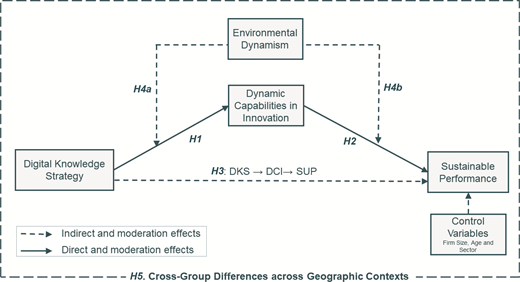
Therefore, existing research has examined how knowledge management, digital technologies and strategizing contribute to capability development, but these streams remain fragmented. This study proposes that DKS connects them through digital technologies, integrating top-down strategic direction with bottom-up knowledge and mobilizing it for strategic adaptation. Through this process, DKS strengthens firms’ ability to sense opportunities, seize them and transform their organizational resources and routines. Thus, it is proposed that DKS (by integrating rational and emergent strategizing practices) influence the development of DCs (sense, seize and transform) in the context of innovation and following the hypothesis:
Digital knowledge strategy influences dynamic capabilities.
2.3 Effects of digital knowledge strategy and dynamic capabilities on sustainable performance
Current studies show that SUP can be assessed through performance measures of economic (Rathore and Gupta, 2025), competitiveness (Kristoffersen et al., 2021), social impact (Dubey et al., 2019; Huo et al., 2019; Aziz et al., 2024), corporate reputation (Amui et al., 2017; Khan et al., 2020; Yoshikuni et al., 2025a) and environmental outcomes (Hua et al., 2025; Sharma et al., 2025; Shoaib et al., 2025). Because of the impracticality of measuring all dimensions of SUP, this study focuses specifically on environmental and corporate reputation metrics. EP refers to how organizations minimize their environmental impact to conserve natural resources and reduce pollution through their products and services (Hua et al., 2025; Sharma et al., 2025; Shoaib et al., 2025). CRP represents the enduring public perception of an organization, as well as the quality of its long-term relationships with customers, business partners, investors and employees (Khan et al., 2020; Kristoffersen et al., 2021; Yoshikuni et al., 2025b).
In the 21st century, the sustainability debate has become central to discussions regarding how organizations’ strategy can establish operational capacity to achieve world-class SUP (Amui et al., 2017; Osei et al., 2024). This new paradigm of strategic management for sustainability means that organizations develop capabilities in innovation to sense and seize opportunities to transform routines in a dynamic to achieve corporate SUP in complex market (Khan et al., 2020). Steininger et al. (2022) and Li et al. (2025a) argue that business strategy is supported with digital technologies (technological, organizational and managerial resources) to build DCs (sensing, seizing and transforming) to leverage organizational performance, such as competitive, financial, sustainability and firm value under the external environment challenges. Moreover, digital-driven strategizing, firm’s capabilities must still be combined with adequate knowledge business strategy to generate a sustainable competitive advantage (Amui et al., 2017).
Therefore, the literature suggests that DKS provides the knowledge-based strategic foundation through which firms align digital resources with sustainability priorities, while DCs convert this strategic alignment into sensing, seizing and transforming actions that enhance environmental and CRP. Drawing on the preceding discussion, the following hypotheses are proposed:
Dynamic capabilities influence sustainable performance.
Dynamic capabilities mediate the relationship between digital knowledge strategy and sustainable performance.
2.4 Effects of environmental dynamism
Strategic management literature argues that DCs contribute to enhancing operating-routine performance to leverage outcomes performance under environmental challenges (Winter, 2003; Teece et al., 2016). In contingency theory, environmental challenges are typically categorized into aggregate external factors (Donaldson, 2014; Wolf and Floyd, 2017). ED is defined as the rate and unpredictability of change within a firm’s industry environment. This construct encompasses the speed at which products and services become obsolete, technological advancements occur and the degree to which competitors’ actions and fluctuations in product and service demand are difficult to anticipate (Jansen et al., 2009; Wilhelm et al., 2015). The impact of DCs is shaped by the level of ED (Helfat and Raubitschek, 2018), as organizations must continually adapt, renew and reorganize their operational routines to respond to the challenges posed by external conditions (Teece et al., 1997; Teece et al., 2016).
Contemporary research on strategy planning suggests organizations should design their strategies to help them build organizational capabilities that adapt to conditions influenced by internal and external factors to achieve performance (Wolf and Floyd, 2017; Amrollahi et al., 2025). In uncertain environments of dynamism, digital applications enable firms to maintain an effective interplay between planned strategy and rapid in-the-moment adjustment (Fan et al., 2026), strengthening resilience and adaptability so the organization stays reliably responsive despite structural constraints, mental lock-in and deeply embedded routines (Yoshikuni et al., 2025b).
This is because rapid shifts in products/services, markets, consumer requirements and technological advancements often pressure organizations to build capacity within their processes to respond to these challenges (Wilhelm et al., 2015; Teece et al., 2016). Previous research on IS strategies indicates that organizations adopting digital technologies are better equipped to respond to ED and enhance their operational capabilities (Li and Chan, 2019; Baptista et al., 2021; Morton et al., 2022; Steininger et al., 2022; Yoshikuni et al., 2025b) and SUP.
Therefore, the literature suggests that Ed. not only creates external pressure but also shapes how much DKS translates into DCs and SUP, as faster, more unpredictable changes in the industry environment increase firms’ need to integrate deliberate strategic direction with rapid, knowledge-based adaptation. This empirical study proposes the hypotheses that ED moderates in the relationship of the proposed model:
The relationship between digital knowledge strategy and dynamic capabilities is influenced by the level of environmental dynamism.
The relationship between dynamic capabilities and sustainable performance is influenced by the level of environmental dynamism.
2.5 Geographical contexts
The contingency factors, including geographic location, competitive pressures and industry context, as influential determinants of proximate and distal organizational outcomes (Wolf and Floyd, 2017). Research on RBV, KBT and DCT related to information technology and digital capabilities has shown that variables such as the competitive market conditions and regional context play a crucial role in determining how organizations balance immediate results with long-term performance (Melville et al., 2004; Kohli and Grover, 2008; Steininger et al., 2022).
Brazil and the UK differ markedly, as mentioned in the CIA World Factbook report (CIA, 2025). The main distinctions between the two countries lie in their geography, economy, demographics and government structures. Geography dimension, Brazil is approximately 35 times larger than the UK, characterized by a tropical climate, diverse terrain and abundant natural resources. In contrast, the UK has a temperate climate, predominantly lowland terrain and moderate reserves of fossil fuels. Brazil has a larger and more demographically diverse population characterized by substantial urbanization and pronounced regional disparities, whereas the UK features a smaller, aging population, robust public services and a multicultural demographic profile. Brazil has a mixed, developing economy with a 2024 GDP of US$4.17tn, driven by agriculture, mining, manufacturing and services. In contrast, the UK has a high-income, developed country, service-based economy with strong global integration and a 2024 GDP of US$3.64tn. Finally, Brazil operates under a federal presidential system, with a directly elected president and state-level autonomy. In contrast, the UK operates under a unitary parliamentary monarchy, where the prime minister leads the government and the monarchy plays a largely symbolic role. As a result, local contexts and cultural norms shape distinct strategic assumptions and visions tied to where the firm operates, with digital technologies serving as key enablers (Steininger et al., 2022; Yoshikuni et al., 2025b).
Moreover, enterprises in developing and developed countries are implementing laws and regulations to encourage the adoption of green initiatives and to lead amid the significant economic impacts of climate change (Li et al., 2024). For instance, in 2023, Brazilian sustainability regulations were introduced by the Securities and Exchange Commission (CVM) through Resolution Number 193, which requires publicly held companies, investment funds and securitization companies to disclose sustainability-related financial information in line with international standards issued by the ISSB for fiscal years starting in 2025 (Securities and Exchange Commission, 2023). Since 2014, the European Union has promoted best practices in sustainability reporting and corporate disclosure through Directive 2014 / 95/EU, which requires sustainability disclosures (European Parliament and Council of the European Union, 2014).
Therefore, contingency factors such as geography, the economy and government influence corporate sustainability performance, including the use of natural resources, the economy’s capacity to invest in technology and government roles in adopting green initiatives. Thus, comparison enables the study to investigate whether differences in institutional maturity, digital readiness, strategic-planning practices, sustainability pressures and ED shape the strength of the relationships among DKS, DCs and SUP under dynamic market. This contextualized perspective extends to KBT and DCT by examining whether the processes through which firms mobilize strategic knowledge and reconfigure organizational resources operate similarly across developing and developed economies. Accordingly, this empirical study proposes the following hypothesis:
Geographic context influences the proposed model relationships, resulting in significant cross-group differences in their effects on sustainable performance.
The literature review has outlined key concepts associated with DKS, DCs and SUP under ED. Figure 1 shows the research model.
3. Methodology
3.1 Research design
This research used a quantitative, cross-country, confirmatory methodology to examine links among DKS, DCs, SUP, ED and firm characteristics, across different economic contexts. The research focuses on enterprises in Brazil and the UK, respectively, developing and developed economies with regulatory frameworks well-suited to evaluating strategic build-innovation DCs to enhance corporate SUP.
3.2 Data collection
This research was conducted across the agribusiness, commerce, finance, manufacturing, services and public service sectors, including organizations of various sizes in Brazil and the UK. Brazilian and English industries are highly relevant to their national economies and contribute significantly to global economic activity (CIA, 2025). In Brazil and the UK, respondents were required to be senior executives actively involved in strategic decision-making and green or sustainability-related activities.
Before data collection, this study followed the cross-cultural research guidelines proposed by Hult et al. (2008) to establish construct equivalence across Brazil and the UK. First, functional equivalence was ensured by confirming that the constructs and organizational practices examined performed comparable roles in both national contexts. Second, conceptual equivalence was established by verifying that the constructs represented the same theoretical domains and meanings in both countries. Third, category equivalence was addressed by applying the same definitions, classification criteria and measurement structure to respondents and organizations in both samples.
Hence, the same theoretical and operational eligibility criteria were also applied in both contexts. Respondents were required to be senior executives actively involved in strategic decision-making and environmental or sustainability-related activities. Equivalent screening procedures were then used to verify their organizational roles, industry backgrounds and strategic responsibilities. Hence, to further enhance data quality and construct validity, all respondents received identical survey instruments and standardized instructions, including explicit guidance to consult knowledgeable executives within their organizations when answering items outside their direct areas of expertise. This procedure reduced the risk of informant bias and ensured that responses reflected organizational-level practices rather than individual perceptions.
In Brazil, organizations were identified through the Technology and Analytics in Management, Accounting and Finance research group directory and recruited via multiple complementary channels, including personal networks, professional associations, email distribution lists, Web-based discussion communities and business directories. Such multi-channel executive recruitment strategies are well established in IS and management research for targeting hard-to-reach senior decision-makers (Mikalef and Gupta, 2021; Yoshikuni et al., 2025b). In the UK, the same eligibility criteria were operationalized through a market research service provider that maintains a rigorously profiled global pool of corporate decision-makers. Market research service screening procedures ensured that only executives matching the same role, industry and strategic responsibility criteria used in Brazil were invited to participate. In line with previous studies that adopted the online survey tool developed and operated by industry research (Akter et al., 2016; Wamba et al., 2017, 2020; Kristoffersen et al., 2021). We obtained 302 usable questionnaires, surpassing the minimum sample threshold recommended for PLS-SEM analysis (Hair et al., 2022). The sample size count must be at minimum tenfold the total structural pathways leading to a given reflective construct (Hair et al., 2022), establishing a threshold of at least 50 cases.
The measurement-model assessment provided further support for cross-country comparability. As reported in Table 3, the reflective measurement model was evaluated for indicator reliability, internal consistency, construct reliability, convergent validity and discriminant validity, confirming that the constructs were measured reliably across the two subsamples (Hair et al., 2022). Collectively, these procedures strengthened the functional equivalence of the target populations and the comparability of the Brazilian and UK subsamples. The survey was conducted from August 2025 to December 2025 in both countries.
3.3 Scale
The research has adopted established measurement scales for DKS, DCs, SUP and ED, using a Likert scale ranging from 1 (strong disagreement) to 7 (strong agreement). For DKS is classified as a Type II second-order construct (reflective first-order, formative second order; Becker et al., 2022), by a seminal study from (Mintzberg and Water, 1985; Henfridsson and Lind, 2014; Bolisani and Bratianu, 2017), operationalized through Yoshikuni et al. (2025a), comprising in two constructs: rational (RS) and emergent strategy (ES) planning. Both constructs are defined as first-order reflective constructs with four items. The respondents answered how their firm’s effectiveness in leveraging digital technologies facilitates knowledge strategy. For example, RS planning includes “A thorough analysis of the organization’s strategy planning before implementation.” ES planning contains statements like “Our organization often adopts unexpected strategies in response to new opportunities and challenges.”
DCs is classified as a Type II second-order construct (reflective first-order, formative second-order), which was adopted by a seminal study from Venkatraman (1989) and complemented it by Teece et al. (2016) and Mikalef and Krogstie (2020). DCs comprise three first-order reflective constructs: sensing (DCS), seizing (DCZ) and transforming (DCT) with three items for each construct. DCS included items such as “We frequently scan the environment to identify new business opportunities.” DCZ includes “When opportunities or threats are sensed, our organization has effective routines for drafting various potential solutions.” DCT includes “Our organization can successfully create new or substantially changed ways of achieving our targets and objectives.”
SUP was conceptualized as a second-order formative construct comprising two first-order reflective constructs: EP and CRP adopted from Kristoffersen et al. (2021). EP, with three items, contained statements like “We reduced energy consumption.” CRP, with four items, includes “We improved corporate image among customers.” ED is first-order reflexive constructs adopted was adopted by Jansen et al. (2009) and Yoshikuni et al. (2025a). ED, with five items, includes “Environmental changes in our local market are intense.”
Control variables were evaluated using firm competitive strategy (CS) by Miles et al. (1978): The four CS is characterized by:
the prospector, representing firms that pioneer the introduction of new products and services;
the analyzer, which follows market leaders in launching innovations;
the defender, focused on protecting established market positions; and
the reactor, characterized by the absence of a consistent strategy, responding only after losing market share.
Company size is classified by number of employees as small (up to 49), medium (50–499) and large (over 500). Organization age is categorized in years: young firms have operated for less than 10 years, established firms for 10 to less than 20 years and mature firms for 20 years or more, reflecting progressively greater organizational experience, stability and capability development; and the industry sector comprises the following: agribusiness (agriculture, livestock, fisheries and related areas), commerce (wholesale, retail, international trade and related areas), finance (banks, financial institutions, insurance companies and related areas), industry, service (textiles, metallurgy, energy, chemicals, paper and related areas) and government services, following Hernandes et al. (2026). All control variables were operationalized using dummy coding. Following Malhotra’s recommendations (Malhotra, 2010), a preliminary assessment was conducted with 34 organizations. Minor refinements were made to the questionnaire to improve the clarity of instructions, item wording and instrument labeling.
3.4 Statistical technique
The suggested research framework was analyzed using PLS-SEM to several advantages:
its robustness against deviations from multivariate normality (Table 1, Shapiro–Wilk test, p-value < 0.001);
its capacity to handle complex structural models;
its suitability for smaller sample sizes;
its ability to incorporate reflective and formative constructs;
its capability to assess indirect and total effects;
its effectiveness in comparing path coefficients through multi-group analysis; and
its role in enhancing model precision by examining relationships among multi-item constructs, thereby reducing potential measurement errors (Hair et al., 2022).
3.5 Common method bias
To strengthen the reliability and validity of the research findings, common method bias was addressed during this study’s design phase. Measures were implemented to enhance response accuracy, including the careful selection of participants capable of providing well-informed answers, the development of precise and unambiguous item statements, the application of counterbalancing techniques to mitigate order effects and the assurance of respondent anonymity (Sekaran, 2016).
A measured latent marker variable (MLMV) was used to assess the minimal correlations between the MLMV construct and SUP, which comprises four formative indicators as defined by Yoshikuni et al. (2025b). The explained variance (R2) was compared with and without the MLMV measure. The change in explained variance of SUP was less than 2%, indicating there was no common method bias concern in the analysis. Additionally, a non-response bias assessment was conducted by analyzing respondents’ roles across all constructs using an Independent Samples T-Test, which revealed no systematic differences (Table 1).
3.6 Endogeneity test
The endogeneity test was conducted by analyzing Gaussian copula model parameters, using as a reference the latent variable coefficients estimated by PLS-SEM, indicated in the guidance on identifying and addressing endogeneity provided by Hult et al. (2018). It is crucial to verify that variables suspected of exhibiting endogeneity do not follow a normal distribution to fulfill the Gaussian copula model’s assumptions (Becker et al., 2022). The Shapiro–Wilk procedure indicated that each variable deviated from a normal distribution (Table 1) (Sarstedt and Mooi, 2014). Full outputs appear in Appendix and show that the evaluated Gaussian copulas (ES, RS, DCS, DCZ, DCT and ED) were not significant (all p > 0.05).
Specifically, when considering SUP’s six predictor constructs as potentially endogenous, the estimated Gaussian coefficients were −0.176 for CES (p-value = 0.486), 0.314 for CRS (p-value = 0.085), −0.013 for CDCS (p-value = 0.935), −0.124 for CDCZ (p-value = 0.521), −0.171 for COTC (p-value = 0.490) and 0.188 for CET (p-value = 0.558). Furthermore, additional analyses considering all other combinations of Gaussian copulas within the model confirmed the absence of significant copula effects ( Appendix). The structural model results indicate that endogeneity is not present in this study, supporting the robustness and validity of the findings (Sarstedt et al., 2020).
4. Results and analysis
4.1 Demography and organizational characteristics
The demographic characteristics of the sample are presented in Table 2. In Brazil, 93% of respondents were C-level executives and 7% were senior executive manager. In the UK, the percentages were 90% and 10%. Competitive strategies also differed: Brazilian firms had a higher proportion of defenders (38%), while English firms favored prospectors (41%) and analyzers (35%). Most firms were mature, accounting for 74% in Brazil and 75% in the UK. The industries sector representation in Brazil was led by manufacturing (36%) and services (38%), whereas the UK firms were predominantly in services (59%). Large firms comprised 80% of the Brazilian sample, whereas the UK sample was more evenly split between large (49%) and medium-sized (45%) companies.
4.2 Measurement model
Table 3 presents the assessment of the reflective measurement model, including construct reliability, indicator reliability, convergent validity and discriminant validity. Internal consistency and construct reliability were examined using composite reliability (CR) and Cronbach’s alpha (CA). Table 3 shows that every construct exceeds the recommended 0.70 cutoffs for both CR and CA, indicating high reliability of the reflective latent measures. Convergent validity was evaluated with average variance extracted, and all constructs report average variance extracted values above 0.50 in Table 3, providing evidence of adequate convergent validity Hair et al. (2022).
The Fornell–Larcker criterion and the Heterotrait-Monotrait ratio, together with the cross-loading approach, were used to evaluate the constructs’ discriminant validity. All retained indicators exhibit loadings greater than 0.70, confirming adequate reliability. The Heterotrait-Monotrait ratios for all reflective constructs fell below the 0.81 threshold, providing evidence of adequate discriminant validity (Henseler et al., 2015) (Table 4). To evaluate model fit, multiple fit indices were used, including the standardized root mean square residual and normed fit index, following recommendations by Hair et al. (2022). The standardized root mean square residual value was 0.06, remaining below the 0.080 threshold, while the normed fit index value was 0.769, which, although below the ideal 0.95 benchmark, indicated an acceptable model fit.
The DKS, DCs and SUP constructs, structured as a second-order reflective-formative model, were analyzed for multicollinearity and the statistical significance of its indicator weights. The variance inflation factor was used to evaluate multicollinearity, yielding a value of 2.09 for all measures (Table 5), below the acceptable limit of 5 (Hair et al., 2022).
4.3 Structural model
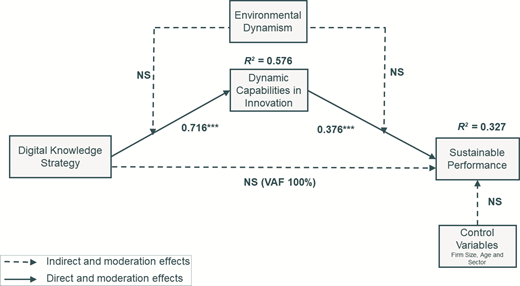
Figure 2 displays the PLS-based structural model, which was evaluated using R2 values, path coefficients (β) and predictor effect sizes (f2). The model explained 57.6% of the variance in DCs (R2 = 0.576) and 32.7% in SUP (R2 = 0.327). The path coefficient analysis of DKS revealed a statistically significant direct effect on DCs [(DKS→DCs: f2 = 1.092, β = 0.716, t = 20.330 and p-value < 0.001), thereby supporting hypothesis H1. Firms’ DCs demonstrated a significant impact on SUP (DCs→SUP: f2 = 0.090, β = 0.376, t = 4.424 and p-value < 0.001), supporting hypothesis H2. The effect mediation of DCs in the relationship between DKS and SUP demonstrates full mediation (Variance account for = 100%), because direct effect was not statistically significant (DKS→SUP: f2 = 0.008, β = 0.112, t = 1.299 and p-value > 0.05), supporting hypothesis H3. Additionality, the results of ED moderation was not significantly in the relationship between DKS and DCs (f2 = 0.004, β = −0.035, t = 0.886 and p-value > 0.05) and DCs and SUP (f2 = 0.000, β = −0.013, t = 0.258 and p-value > 0.05), indicating no support hypotheses H4a and H4b.
The effect size (f2) analysis demonstrated that all direct effects surpassed the established thresholds of 0.09 and 1.09, indicating moderate to substantial effect sizes. The control variables (competitive strategy, industry sector, organizational size and firm age) were also examined and showed no significant effects (all p > 0.05).
The measurement invariance of composite models was conducted before a multi-group partial least square, and partial invariance was established, indicating that the path coefficient estimates can be meaningfully compared across groups. The PLS-MGA was conducted to assess differences in the structural relationships between the Brazilian and UK subsamples. The multi-group analysis revealed a statistically significant difference in the DKS→DCs path coefficient between the Brazilian and UK subsamples (p < 0.05). No statistically significant difference was found in the DCs→SUP path coefficient (p > 0.05). Statistically significant differences were also observed in the R2 values for DCs and SUP between the two subsamples (p < 0.05; Table 6).
Differences in the mean scores of the first-order constructs were examined across the Brazilian and UK subsamples (Table 7). An independent-samples t-test was initially considered; however, the Shapiro–Wilk test indicated that the normality assumption was violated (p < 0.05). Therefore, the non-parametric Mann–Whitney U test was used. Statistically significant differences emerged between the mean scores of the Brazilian and UK subsamples for ES, RS, DCZ, DCT, EP and ED (p < 0.05), with the UK subsample showing higher scores. There were no statistically significant differences observed in the mean scores of DCS and CRP (p > 0.05). Together, the PLS-MGA and Mann–Whitney U test identified cross-country differences in selected path coefficients and construct scores, providing partially support for H5.
4.4 Post hoc analysis
The result presents a deepened understanding of the relationships among DKS, DCs, SUP and ED. Figure 2 shows a summary of the statistical analysis of the proposed model. However, the results also raise intriguing questions. Specifically, it was hypothesized that higher levels of ED would positively moderate the relationships between DKS on DCs and DCs on SUP. The analysis conducted using the proposed PLS-SEM model indicated that the variable ED did not have a significant linear moderating effect on the relationships between DKS and DCs or between DCs and SUP. The strategic management, DC and IT-business value literatures in the field suggest that such an effect should be present in the relationships of the proposed model research (Melville et al., 2004; Teece et al., 2016; Wolf and Floyd, 2017).
In the PLS-SEM model, the variable ED did not show a significant moderation effect of DKS on DCs, and DCs on SUP. It turned into a GAM. This can be advantageous because PLS-SEM is a linear approach that models the conditional mean of the dependent variable. Hence, the post hoc analysis aims to assess whether this absence of statistically significant moderation effects in the PLS-SEM model may be related to functional form restrictions rather than to the absence of conditional relationships per se. PLS-SEM evaluates linear moderation effects based on product terms and estimates average conditional effects. However, the DC literature suggests that the influence of Ed. may operate in a nonlinear or threshold-based manner.
Accordingly, the post hoc analysis examines whether potential nonlinear conditional patterns may have been insufficiently approximated by linear interaction terms. This reasoning follows established precedent in the literature. Wamba et al. (2020) document theoretically expected moderation effects that were not supported in PLS-SEM and subsequently conduct post hoc nonlinear analyses to explain these unexpected results. Moreover, recent methodological research emphasizes that GAMs are particularly suitable as diagnostic tools when theoretically expected effects are not detected under linear specifications, as they allow researchers to assess whether null findings stem from genuine absence of relationships or from functional form misspecification (Failenschmid et al., 2025).
The GAM is a semi-parametric approach that extends traditional regression by allowing nonlinear relationships and smooth interactions among variables without imposing rigid functional forms (Wood et al., 2015). Instead of one coefficient per predictor, a GAM fits smoothing functions (penalized splines) for each variable and, when needed, bivariate surfaces (e.g. tensor products) to capture nonlinear moderation (Zhang et al., 2022).
The model equations will take the form given in equations (1) and (2):
where are univariate smoothers (e.g. penalized splines), are bivariate surfaces (tensor products) that capture nonlinear moderation and are the controls variables. To this end, it used python software. The semi-parametric GAMs make it clear that the relationship between DKS, ED and DCs is neither linear nor uniform across the covariate space. In the full sample, modeling DCs with s(DKS) + s(ED) + te(DKS, ED) yields a pseudo-R2 around 0.58 (GCV = 0.44) and reveals a smooth nonlinear interaction, that is, the marginal effect of DKS on DCs varies with ED, but not monotonically. As ED moves from low to moderate levels, the DKS→DCs slope tends to increase. At the extremes of ED (very low or very high), that marginal gain flattens, indicating a “dome-shaped” (inverted-U) pattern typical of complementarities subject to practical limits of coordination, absorption and reconfiguration. This is precisely the kind of geometry a single linear interaction term (DKS × ED) cannot capture, explaining why PLS and even linear or quantile regressions sometimes failed to find a stable moderator.
When stratified by country, the ED becomes sharper. In the developed-country context (ID = 2, UK), model fit is high (pseudo-R2 = 0.745 and GCV = 0.30) and the interaction surface is more pronounced, where DKS contributes strongly to DCs when ED lies in the “optimal corridor.” In Brazil (ID = 1), the same logic holds but with smoother curvature and more noise (pseudo-R2 = 0.453 and GCV = 0.73), that is, the gain exists, yet is more sensitive to execution frictions, process gaps and contextual constraints. Substantively, more robust institutional environments appear to let investments in DKS translate into DCs more efficiently, while preserving the same constraint of “too much dynamism” at the extremes. In the next link of the chain, from DCs to SUP, the picture is similar but less intense. DCs has a positive, curvilinear effect on SUP and ED gains acts as a nonlinear moderator, with evidence of a “sweet spot” of dynamism that enhances the conversion of DCs into outcomes. This channel is weaker than DKS→DCs, consistent with SUP’s greater multi-causality. On average, the slope maps show that the marginal benefit of increasing DCs is larger when ED is not at its extremes.
Therefore, taken together, the GAMs confirm the central thesis that ED influence the relationships, more strongly in DKS→DCs and more clearly in the UK, but does so nonlinearly. There is a band of ED that amplifies synergy and extremes that dampen it. This geometry reconciles the mixed PLS findings and invites theorizing complementarities in terms of thresholds and context, not a single average slope.
5. Discussion
This study analyzes recent research on the antecedents of SUP and DCs in innovation to clarify how deliberate and emergent knowledge strategy through digital tools interact to address ED in both developing and developed economies. Drawing from the literature on knowledge management, digital technologies and sustainability, this study formulates two research questions and proposes a theoretical model. This study subsequently tests the proposed hypotheses. The results indicate that DKS serves as a predictor of firms’ DCs which in turn contribute to SUP in conditions of ED. This is consistent with earlier studies indicating that DKS equips firms with up-to-date, fit-for-purpose digital tools that support both formal planning and adaptive, emergent strategizing (Yoshikuni et al., 2025b). In essence, firms that effectively integrate digital technologies into knowledge strategizing can reconcile the competing demands of exploration and exploitation planning for action to leverage SUP through the mediating role of DCs in innovation, a major challenge for organizations in advanced and emerging economies. These findings address the first research question (RQ1) by demonstrating that DKS exerts significant direct effects on DCs and indirect impact on SUP. However, ED did not significantly influence the relationship between DKS and DCs or between DCs and SUP.
The second research question (RQ2) indicates that geographic region significantly influences the relationships within the proposed model. The English companies exhibit a greater presence of DKS, DCs, SUP and ED compared to Brazilian firms. This perspective aligns with prior conceptual studies on digital technologies (Melville et al., 2004; Kohli and Grover, 2008; Henfridsson and Lind, 2014; Marabelli and Galliers, 2017; Steininger et al., 2022), knowledge strategy (Bolisani and Bratianu, 2017; Wolf and Floyd, 2017), DCs (Teece et al., 2016; Li et al., 2025a) and sustainable literature (Danso et al., 2019; Osei et al., 2024), which suggest that economic and cultural contexts shape the maturity of digital tool adoption, the diffusion of knowledge strategy practices, the development of organizational capabilities and the attainment of corporate SUP outcomes under market challenges.
Overall, this study advances understanding of the relationship between DKS and SUP and elucidates how DCs mediate this relationship under ED conditions across both developing and developed economies. These results provide several theoretical and managerial implications.
5.1 Theoretical contribution
This research advances theory by clarifying the interrelationships among DKS, DCs, SUP and ED and by providing empirical evidence across multiple industries from Brazil and the UK. In doing so, it addresses the research gaps identified by Massa et al. (2023) and Yoshikuni et al. (2026). First, the results emphasize the central role of DKS in promoting DCs development. Successful, deliberate and emergent planning actions enabled by digital technologies rely on rapid, precise and clear and traceable information exchange to support practitioners’ strategic decision-making. DKS functions as a strategic resource encompassing tangible, human and intangible assets that enhance organizational DCs in innovation, as explained by the RBV, KBT and DCT, extending beyond ordinary operational capabilities. Accordingly, this study advances knowledge management theory by positioning DKS as not merely a digitalized knowledge-management practice but also a strategic capability that closes the gap between a firm’s current knowledge base and the knowledge required for effective strategy formulation, implementation and adaptation. In this way, the study provides a more process-oriented explanation of how digitally enabled knowledge is mobilized and converted into organizational capabilities through a rational and prescriptive planning approach (Chan et al., 2019; Li et al., 2024; Yoshikuni et al., 2025a).
Second, this study broadens insight of the DKS–DCs relationship by showing that DKS prompts organizations to develop DCs that underpin innovation in challenging contexts, thereby extending the theoretical foundation of the knowledge management and DC literature (Li et al., 2025a). Enterprises with stronger DKS are better able to sense by identifying, developing, co-developing and shaping opportunities and threats in ways that address customer needs and business requirements (Teece et al., 2016), seize opportunities by mobilizing the organizational resources required to meet market demands (Wamba et al., 2020; Bechtel et al., 2023; Yoshikuni et al., 2025b) and transform by enhancing, combining, protecting and, when needed, reconfiguring tangible and intangible assets to sustain competitiveness (Girod et al., 2023; Li et al., 2025a).
Accordingly, this study advances digital technology, KBT and DCT studies by explaining the capability-building mechanism through which digitally mobilized strategic knowledge is translated into sensing, seizing and transforming activities. Rather than treating knowledge management and DCs as separate organizational processes, the findings position DKS as the connecting mechanism that translates strategic knowledge into adaptive, innovation-oriented organizational action.
Third, this research advances theory by explaining how DKS contributes to sustainability outcomes through the intervening mechanism of DCs. SUP is advanced when DCs enable enterprises to strengthen EP and CRP across prosperous and emerging contexts. Hence, DCs demonstrate as a full mediator in the relationship between DKS and SUP, that is, DKS does not directly impact SUP; thus, strategy actions are applicable to build organizational capabilities within the cluster of sensing, seizing and transforming routines to leverage SUP. This evidence advances current understanding of resource-based framework (RBV, KBT and DCT), which argues that enterprise strategy depends on resources (tangibles, human and intangibles) that enable the capability to leverage gains in performance outcomes (Grant, 1991).
The post hoc analysis, conducted as a supplementary assessment of H4a and H4b, further examined how environmental dynamism influences the relationships proposed in the mode. The finding supports a view of contingent, non-monotonic complementarity, where ED is not a constant amplifier; it works best within moderate ranges. Very low dynamism constrains variety, exploration and learning, whereas very high ED raises reconfiguration costs, creates overload and can misalign value-capture routines. Cross-country differences reinforce that institutional context shapes both the slope and the curvature of the relationship; in more developed settings, the translation of DKS into DCs is more efficient, yet also more sensitive to excess change, contributing to knowledge that non-linear statistics methods are necessary to complementary understand the results of PLS-SEM (Wamba et al., 2020; Pappas and Woodside, 2021; Yoshikuni et al., 2025b).
Finally, by drawing evidence from multiple sectors in Brazil and the UK, this study grounds its framework in advanced and emerging economic contexts marked by volatile competitive conditions, differing levels of regulatory institutionalization and evolving sustainability expectations. Cross-group differences associated with regional context are demonstrated in the proposed model through differences in construct means, path coefficients and variance explained for DCs and SUP under ED conditions. Companies in the UK exhibit a strong DKS and DCs, enabling them to achieve a higher degree of SUP compared to Brazilian firms. These results confirm that UK companies have higher readiness by prospector competitive strategy tend to be younger, concentrated in services and larger, in terms of DKS and operational capacities in sensing opportunities in the external environment, enabling them to capture these opportunities by creating new products and services and transforming their operational routines to meet the sustainability market and customers’ requirements. This finding aligns with Brazil’s current sustainability regulations, as outlined by the Securities and Exchange Commission (CVM) in Resolution 193 (2023). Starting in 2025, this rule requires publicly traded companies to disclose climate risk and Environmental, Social and Governance data alongside their financial statements, which are already integrated into strategy content. In the order hand, since 2014, developed economies within the European Union have adopted best practices in Integrated Reporting, including International Financial Reporting Standards S1 and S2. Corporate law reforms, such as Directive Number 2014/95/EU, mandate sustainability disclosures. These initiatives encompass comprehensive measures, such as Law 9/2017 on public sector contracts, which incorporates sustainability criteria into procurement processes, as well as targeted actions addressing specific elements of factors. Therefore, Brazilian enterprises, characterized by a defender competitive strategy, greater maturity, service concentration and large size, as early adopters of sustainability practices, encounter distinct challenges in achieving SUP under ED. In contrast, the UK enterprises in developed economies demonstrate greater maturity in implementing sustainability practices. They not only fulfill sustainability-related legal requirements but also associate SUP with meeting competitive market demands, thereby enhancing environmental and corporate reputation.
Accordingly, this framework provides fresh empirical support and offers a platform for future research on how organizations can integrate digital technologies with knowledge practices, strategizing processes and DCs to deliver SUP in turbulent environments across advanced and emerging settings.
5.2 Management implications
In addition to its theoretical implications, this study offers several actionable recommendations for practitioners. The findings indicate that digital technologies serve as strategic resources for integrating deliberate and emergent strategy approaches, as well as for developing DCs, which are crucial for achieving sustainable outcomes in developed and developing countries. The findings indicate that firms should direct digital investments (such as big data, analytics, BI, machine learning and artificial intelligence) toward tools that enable C-level, senior and middle managers to integrate strategic information, identify emerging opportunities and threats, coordinate resource allocation and translate strategic priorities into timely organizational action.
Furthermore, the findings encourage industry leaders to use DKS to strengthen firms’ sensing, seizing and transforming capabilities. In practice, managers should deploy digital tools to monitor market and technological changes, identify emerging opportunities and threats, coordinate the allocation of strategic resources and reconfigure organizational routines in response to evolving business and sustainability requirements. Hence, by effectively coordinating strategic knowledge planning, firms can shift from reactive responses to proactive strategic action, enabling them to accelerate the development and introduction of innovative products and services and capitalize on emerging market opportunities. Achieving long-term sustainable competitiveness, therefore, requires the purposeful integration of top-down direction and emergent bottom-up insights through digital tools.
Finally, Brazilian managers should consider adopting digital tools as effective alternatives for enhancing knowledge strategy and achieving comparable levels of readiness in DCs, thereby leveraging SUP as those observed in developed industries. Recent trade regulations between Brazil and the USA (Lankes, 2025) have compelled Brazilian enterprises to seek alternative international markets. In Brazil, digital transformation is advancing unevenly because of persistent shortages of qualified digital professionals (insufficient supply of workers with advanced technological and analytical skills), disparities in digital education and infrastructure (unequal access to training, connectivity and modern technological resources) and fragmented institutional support (limited coordination among government, educational institutions and industry), which restrict firms (particularly smaller enterprises) from developing the capabilities required to adopt, integrate and generate value from digital technologies (OECD, 2020; Brasscom, 2024).
The findings suggest that Brazilian companies need to enhance their digital capabilities to achieve superior sustainability and competitiveness in developed markets through DKS. Conversely, the UK enterprises that want to sell products/services in the Brazilian market must assess the local market’s maturity in terms of sustainability under higher ED. These enterprises should adapt their products and services, calibrating them to deliver value in emerging economies, where competitive pricing is essential.
5.3 Limitations and future studies
Empirical research has specific constraints that present opportunities for further exploration. First, the data collection relied on a single source who was instructed to recruit additional respondents for the questionnaires. Future research should use multi-source data collection by combining responses from senior executives, middle managers and operational employees with objective organizational indicators and archival data. This approach would reduce reliance on single-informant perceptions and provide a more comprehensive assessment of constructs across organizational levels. Second, the results are relevant to the specific study context, which enhances the generalizability and applicability of related research across different countries and contextual settings. Third, the RBV posits that organizational strategy and IT-business value are facilitated by resources that develop capabilities and support sustainable competitive performance (Grant, 1991; Barney, 2001; Melville et al., 2004). Future research should examine DKS capability orchestrated by tangible, human and intangible resources as second-order construct. Fourth, the structural equation modeling method proved efficient in generating predictive results for the proposed model (Hair et al., 2022). However, subsequent studies could use qualitative comparative analysis to identify equifinality and achieve improved outcome performance in diverse contextual environments, as mentioned by Pappas and Woodside (2021). Data collection followed cross-cultural guidelines proposed by Hult et al. (2008), encompassing functional, conceptual and category equivalence, as well as standardized eligibility criteria, screening procedures, recruitment-source documentation and harmonized survey instruments across both countries. Partial measurement invariance was established, supporting construct comparability between the two samples (Hair et al., 2022). Nevertheless, differences in recruitment sources may have introduced selection effects that measurement invariance tests did not fully address. Future research can use common quota targets or calibration weighting to minimize sample differences from distinct recruitment sources and mitigate potential selection effects.
6. Conclusion
The empirical findings of this study validate the pivotal role of DKS, in fostering operational capabilities and enhancing SUP within rich and emerging economies. Therefore, this study confirms that DKS directly drive SUP mediated by DCs in sensing, seizing and transforming routines to create innovation in both economies. Additionally, it demonstrates that higher degrees of DKS, DCs and SUP are associated with higher degrees of ED. Furthermore, the results highlight that the UK companies have strong readiness of DKS, DCs, SUP under ED than Brazilian enterprises.
The proposed model was successfully implemented using structural equation modeling, indicating that the method is suitable and stable for testing the study framework. In support of this, the data set comprises 302 firms (152 from Brazil and 150 from the UK), covering multiple sectors and differing in size and organizational maturity. Furthermore, the GAM methodology proved useful as a diagnostic when linear models yielded null effects, thereby helping distinguish between no relationship and functional-form misspecification. Building on sustainability, strategic management and digital technologies literature, this study addresses critical research lacunas mentioned in previous studies.
Doing so contributes to academic discourse and managerial practice, offering valuable insights into how enterprises in advanced and emerging economies, through digital tools balance deliberative and emergent strategic planning to build DCs to gain SUP under ED.
Adilson Carlos Yoshikuni is based at the Department of Controllership, Finance and Management Technologies, Mackenzie Presbyterian University, Sao Paulo, Brazil.
Edimilson Costa Lucas is based at the Department of Controllership, Finance and Management Technologies, Mackenzie Presbyterian University, Sao Paulo, Brazil.
Rajeev Dwivedi is based at the Department of Information Systems and Business Analytics, Eastern Washington University, Spokane, Washington, USA.
Roberto Rodrigues is based at the Department of Controllership, Finance and Management Technologies, Mackenzie Presbyterian University, Sao Paulo, Brazil.
Josh Morton is based at the Department of Management and Organisations, University of Leeds, Leeds, UK.
References
Appendix
Endogeneity tests based on the Gaussian Copula Methodology